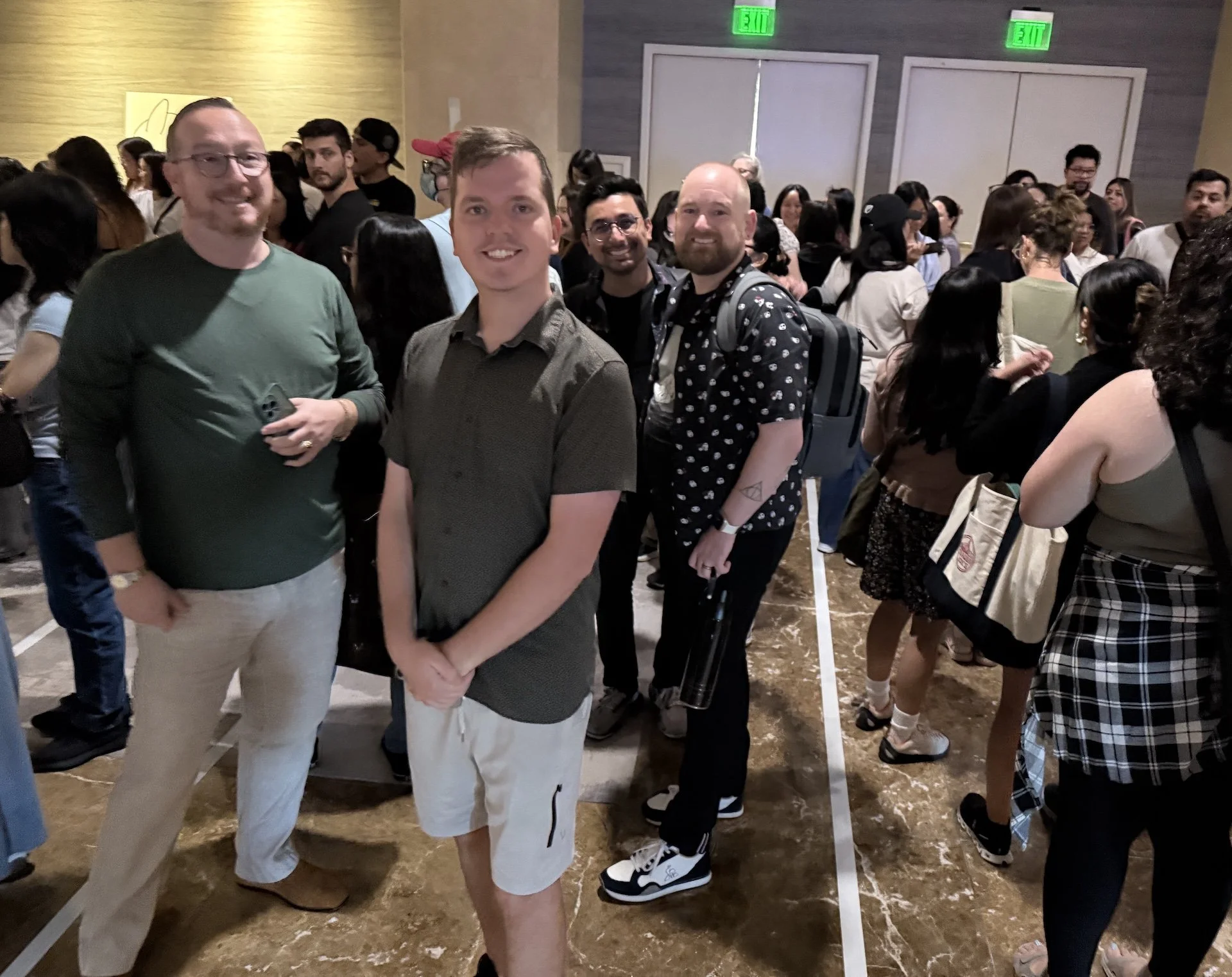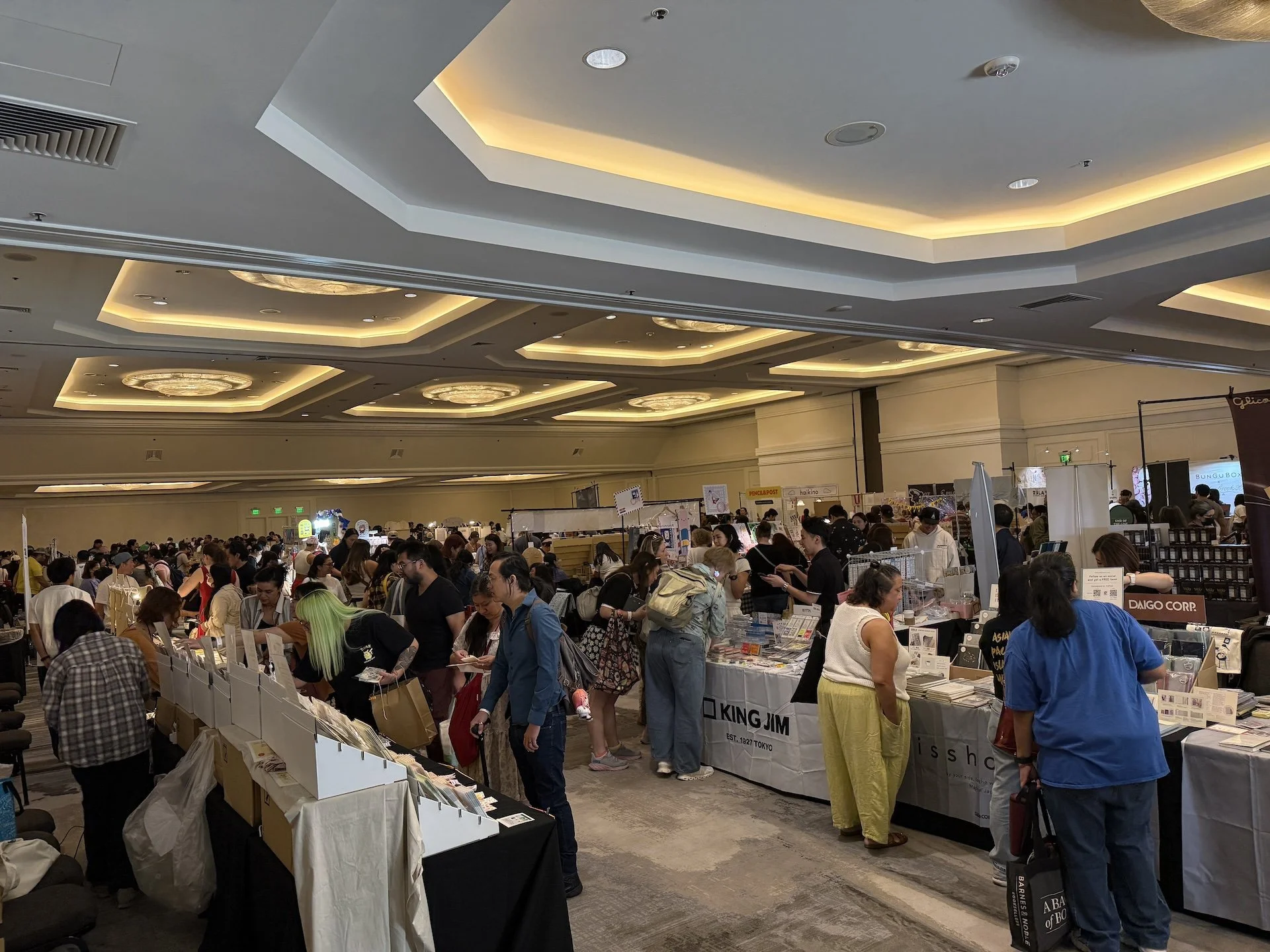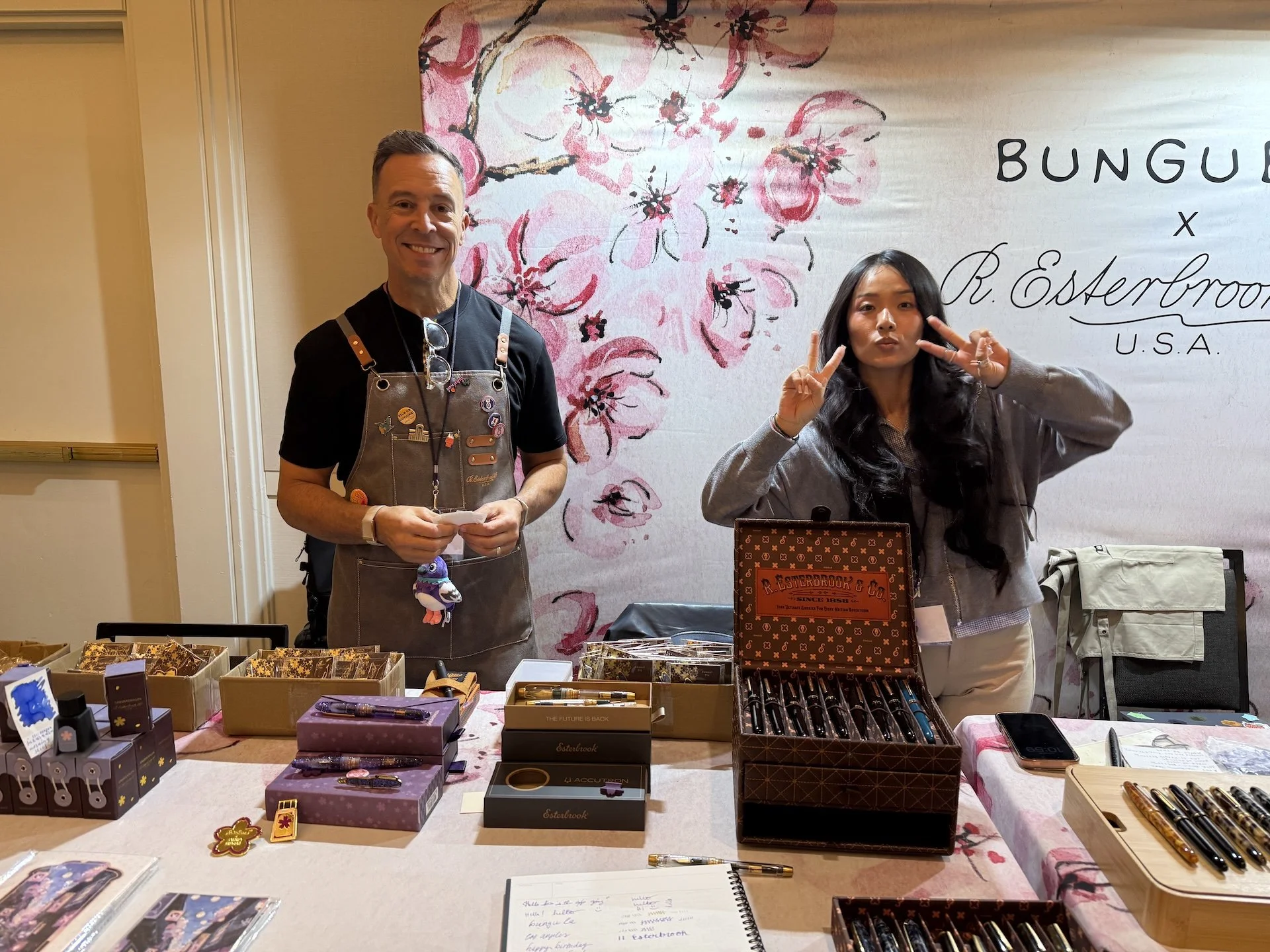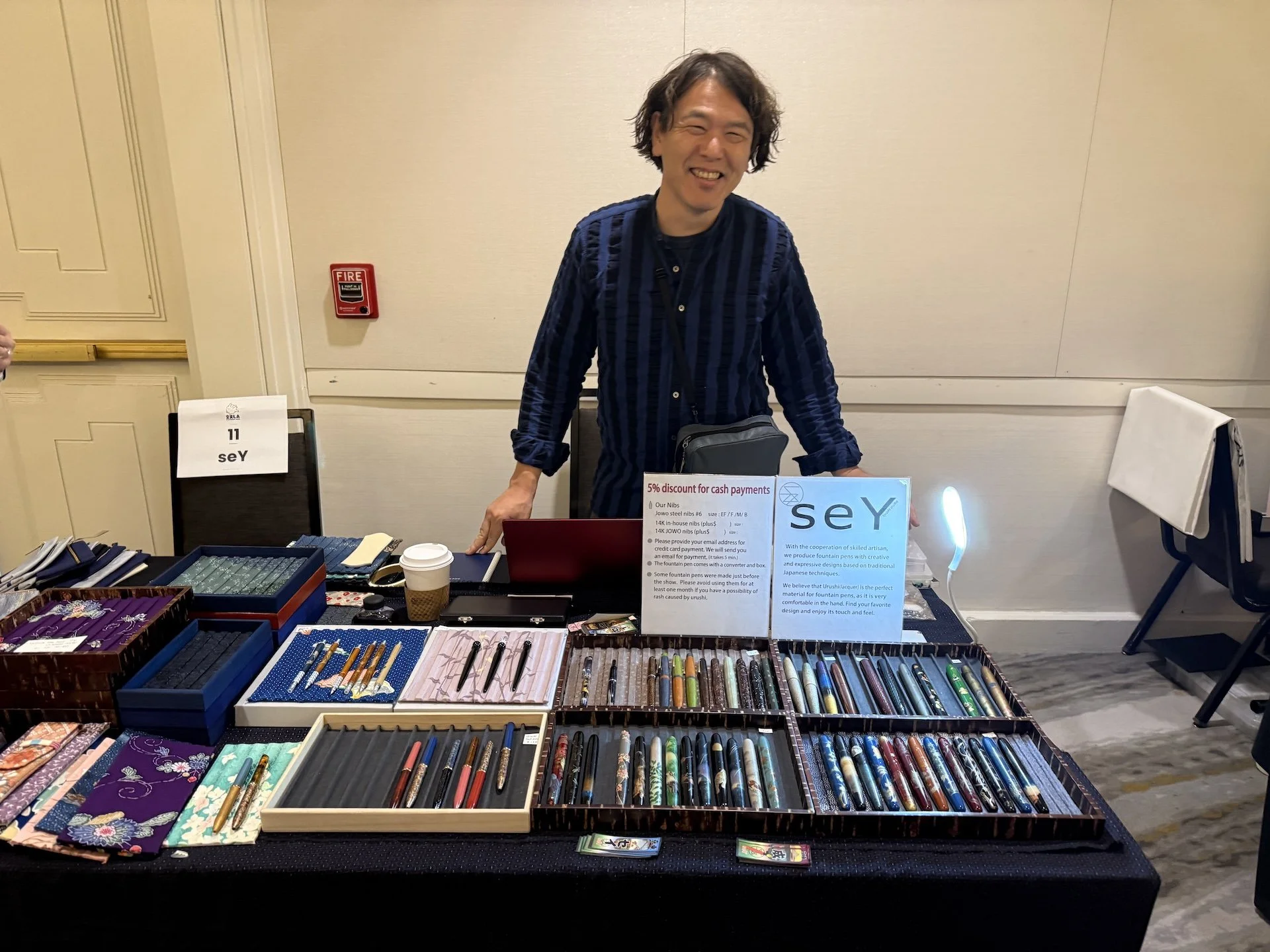

Yours truly and an awesome group of students who took my handwriting improvement class at the SF Stationery Fest.
- Show Tickets - Depending on how many days you can attend, you may want a single day ticket or a weekend pass, or in some cases VIP passes, which allows for early entry and swag bag. Most shows require a show ticket to take classes/seminars.
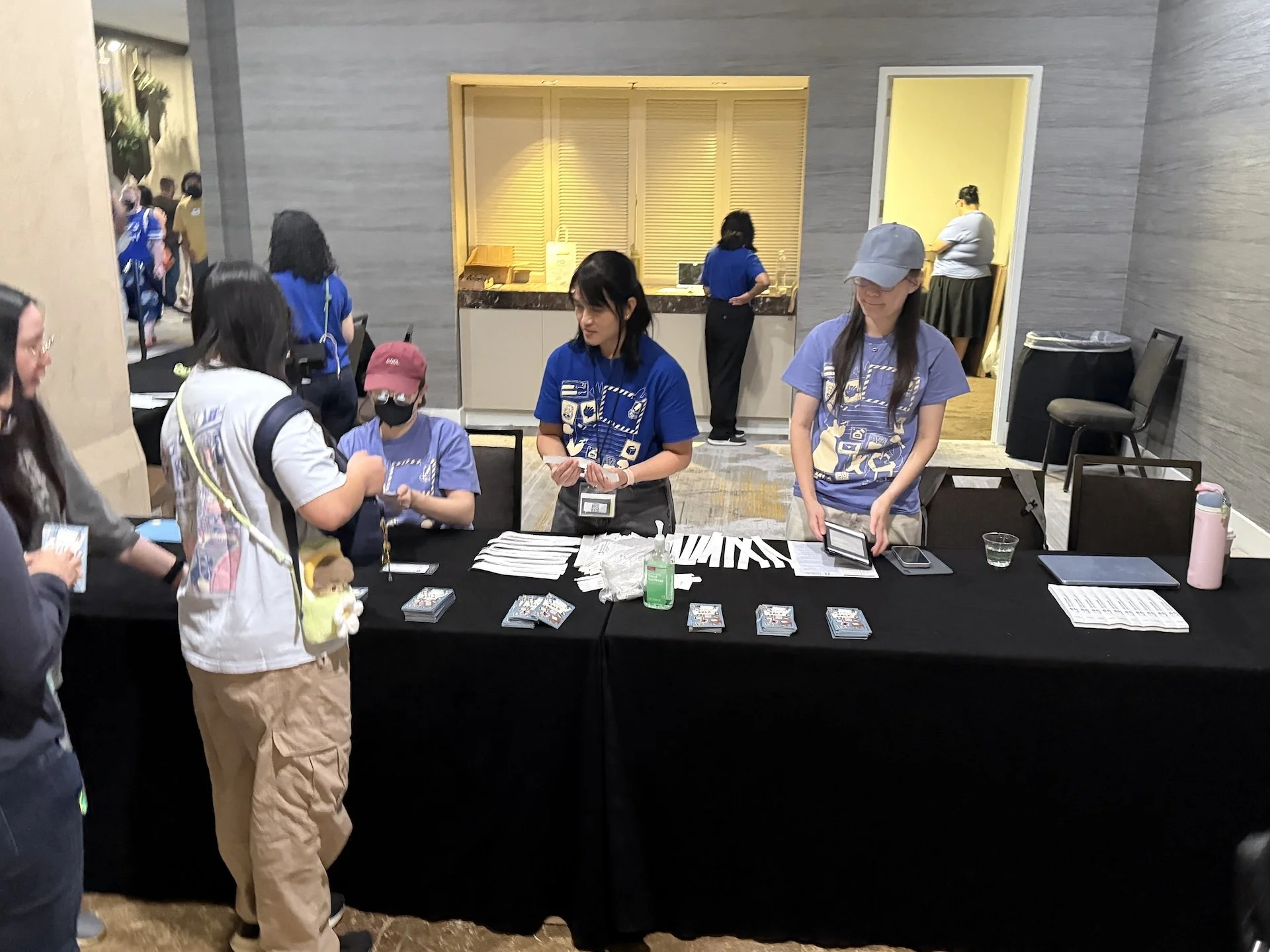
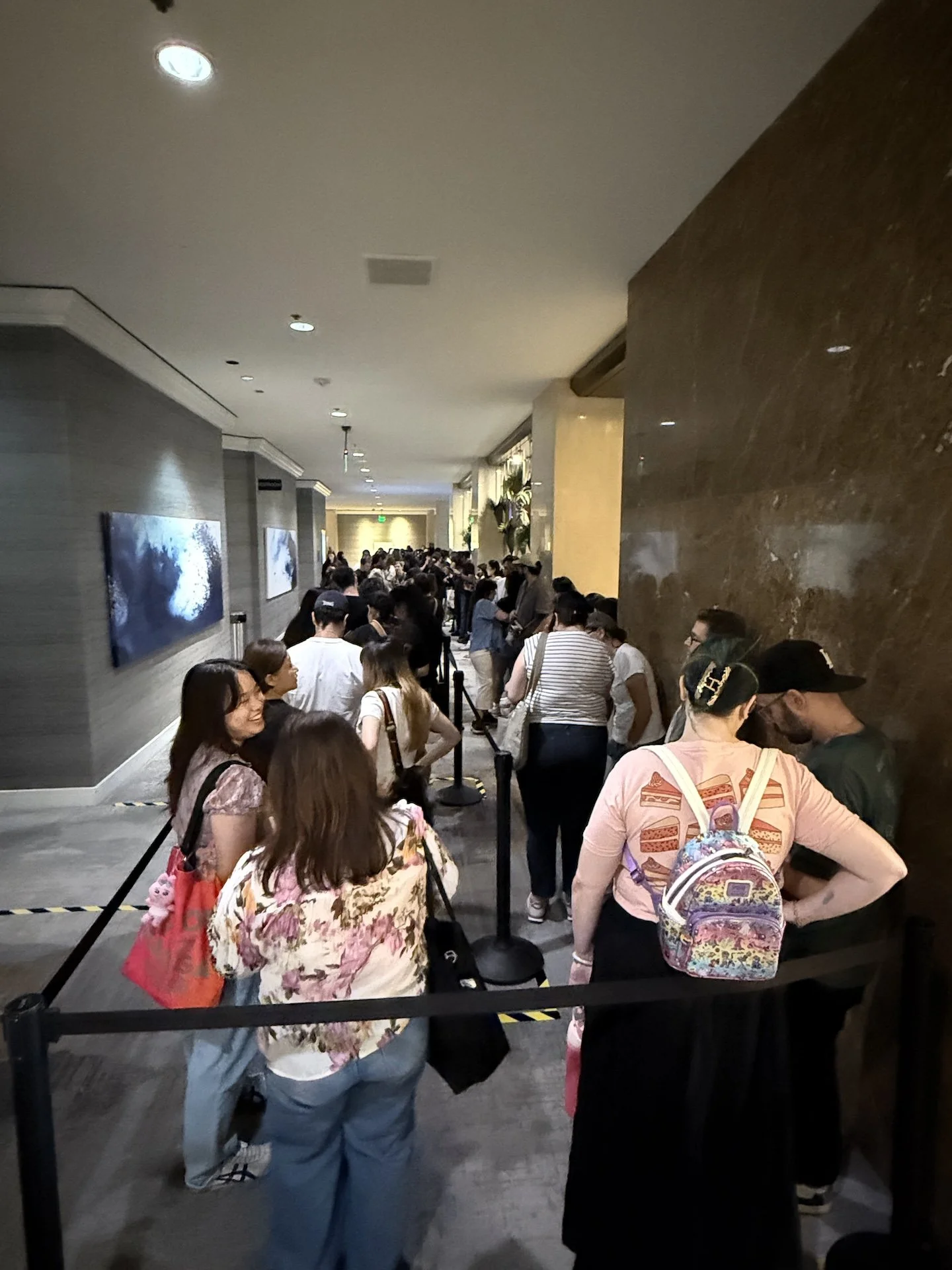
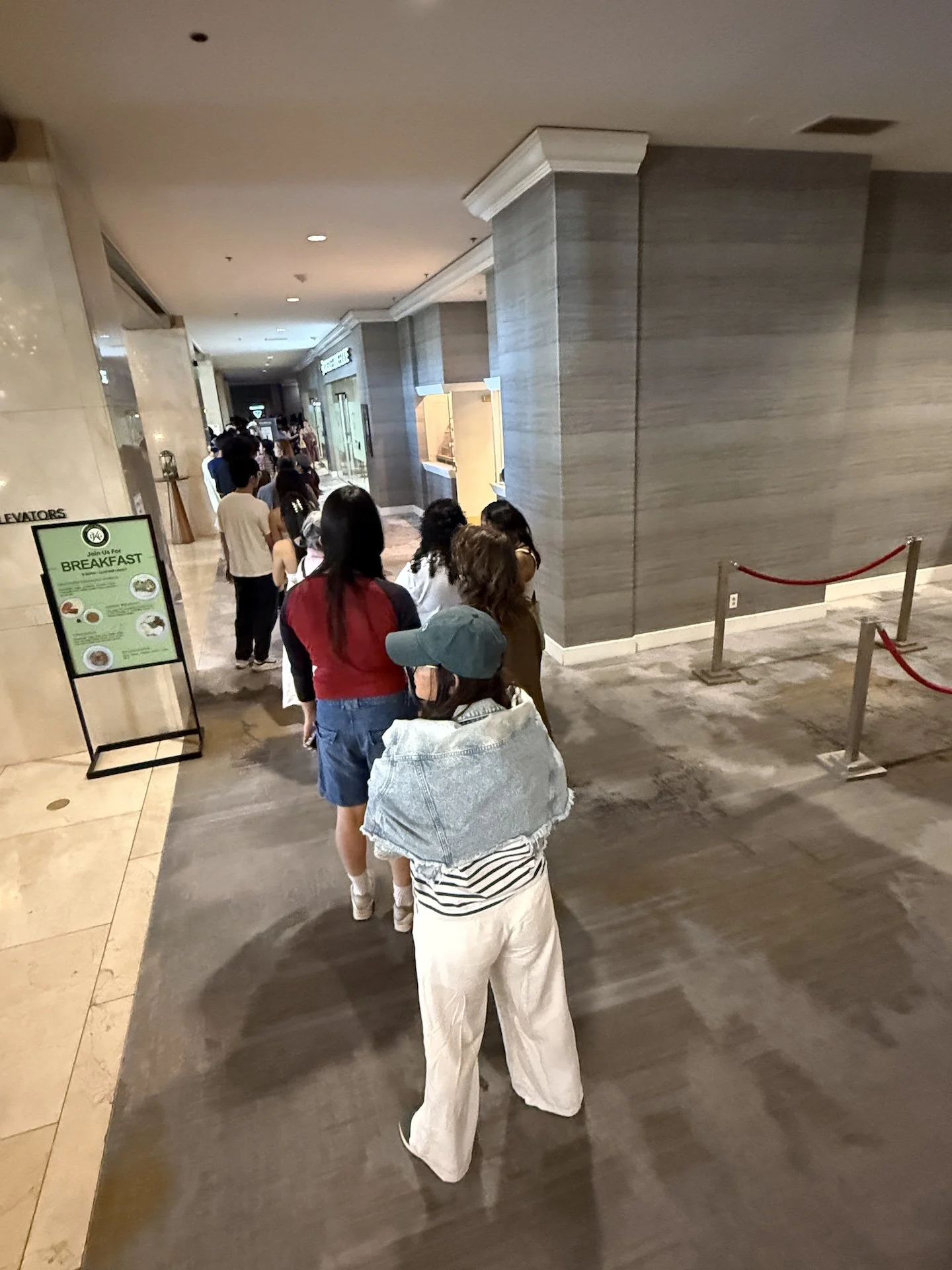
Some shows have both online and in-person ticket sales, while others are in-person only. Find out whether you need to buy tickets by a certain cutoff as there may be price increases based on date, as well as online vs at-the-door ticket prices. In addition, there may also be a limited number of weekend passes, VIP passes, or timed-entry (more common with stationery shows than pen shows). Based on how the show handles ticket sales, you may choose to buy tickets asap because they will sell out (more common with stationery fests). If I’m going as an attendee, I buy my tickets online so it’s faster when I get to the registration desk to pick up my badge. If you’re unsure of your attendance, you can often wait until you get to the show but keep in mind that there might be a (long) line for the registration desk. Most shows also do not offer refunds, and some, but not all, allow tickets to be transferable. Again, do your research, or ask the show organizers if you have any questions.
Ticket types - Every show defines them a little differently but in general, the types are as follows:
- Day Pass/Ticket - Allows you entry for the day for the general admission show hours. Almost all shows allow unlimited re-entry, but there are some time-entry shows that don’t let you get back in if you leave.
- Weekend/All Access Pass - This allows you entry for the entirety of the show weekend and often includes early hour(s) for show entry. Some shows include other perks like a Thursday pizza party (ChiPS), or a cook out (Atlanta).
- VIP Pass - The shows that do this includes a weekend pass as well as a goody bag with special show schwag.
- Trader Pass - While usually not a pass that you can buy separately, some shows will include a “Trader Pass” for Thursday if you buy a weekend or VIP pass. This usually allows folks to set up at a table to sell their items before the show officially starts. This is great for enthusiasts who aren’t vendors, but want to sell their pens/inks/whatever, but don’t have a local club to sell at, or don’t want to deal with online sales, or just want a little extra spending money for the show.
Make a list - I often have several lists for every show, here are a few:
- My to-buy list - these are the “I must buy these at the show because I need them in my life”
- Which vendors might have the stuff I’m looking for
- Stuff I’m researching, like things I want to see/touch/hold in person before deciding to add it to a future shopping list (this is especially useful for inks and papers)
- Purchases or pictures for friends who have asked me to get something for them
- List of pens to be tuned or ground - I keep a running list of pens that I want to get tuned or ground by a nib grinder.
Have a budget - Or at least some semblance of a budget. It is VERY easy to get caught up in the buying frenzy and spend more than intended. Or you start looking at limited edition Montblancs or Nakayas, and next thing you know, that $300 pen doesn’t seem so expensive any more. Having the shopping list can definitely help keep you in check.
Get cash ahead of time - For most vendors, cash is still king. While many vendors (including vintage vendors), will accept credit cards or PayPal, some may also give a small discount for cash. It will also help you stick to your budget. Don’t assume that you’ll just get more cash at the hotel ATM if you run out because that is often emptied out pretty quickly at a pen show, and they don’t always get refilled over the weekend. And double check with your bank about temporarily upping your ATM withdrawal limit, as well as letting your credit card company know ahead of time that you’ll be making some/a lot of purchases this weekend (though you may still get the occasional fraud alerts).
- Mix of small and large bills - If you’re getting cash, be sure to get a mix of small and large bills because vendors can run out of change if folks only have $20s or $100s. It also makes transactions go faster, which is especially helpful at busier shows.
- More small bills, especially for stationery shows/vendors - As more and more shows have stationery and pen-adjacent vendors whose products are priced around $2-5 per item, it’s helpful to pay them in cash instead of credit card, to avoid fees. Vendors not only have to pay a percentage fee, but also a transaction fee (like 3% + $0.10/transaction). Those fees really eat into sales, which is more noticeable when you’re making low dollar purchases. I heard this from quite a few vendors at several shows this year. Some of them told me they were considering a minimum amount for credit card transactions.
Have non-cash options available - While cash is -almost- always king, the increase in international vendors means that they might not want cash because it is an additional cost to have it converted to their currency. Vendors that don’t accept cash will usually accept credit cards, but some will also take PayPal. Some vendors also take Venmo or Zelle, but that is less common than credit cards or PayPal.
- If using PayPal with an international vendor, consider paying by credit card and changing the currency from USD to their local currency as PayPal does not have as good exchange rate as your credit card company. Of course, make sure your credit card does not have any fees for international transactions.
- Physical credit card - Most places that accept CC also accept Apple/Google Pay, but sometimes they need a physical card. It’s handy to have one as a backup just in case. Also handy to have multiple CCs just in case one gets declined or isn’t getting read by the card reader.
Dress for comfort - If you’re only going for a day, your clothing and shoe choice might not make as big of a difference but you’ll be a happier shopper if you chose comfort over fashion.
- Comfy Shoes - Some shows have thick padded carpet, and some do not. Some have concrete floors and others hardwood. Some shows take up so much square footage that I’ve gotten my daily steps just from walking to/from the vendor table to the restroom! If you’re spending multiple days at the show, consider a second pair of shoes to give your feet a break.
- Layers - It can be freezing outside and boiling inside (Philly, I’m looking at you), or boiling outside and freezing inside (STL was a good example this year), or it can be both boiling and freezing AT THE SAME SHOW! Heating and ventilation varies greatly from show to show and if you’re under a vent, you might be freezing, but move a few feet down the aisle and you’ll be super warm. I tend to wear a short sleeve shirt and have a light cardigan or wrap available if the AC kicks up. Rarely will you ever need anything thicker than a light sweater or jacket once you’re indoors; thankfully the super cold winter shows tend to have coat racks so folks don’t have to lug around their parkas.
Bring snacks and water - Every hotel has different food options which vary greatly in terms of convenience, speed, quality, cuisine, price, etc. Even if you have figured out your lunch/dinner plans, having some snacks and a bottle of water will make it easier for you to get through the day and hopefully not make any hangry purchasing decisions. Granola bars, trail mix, chips/crackers/cookies all make good snack options. Many shows have water stations so I usually refill my water bottle.
- Pro tip: Pack a small self-care kit including Advil/Tylenol, vitamins (to counteract the cooties and late nights, etc.), hand sanitizer (no cooties, pls), Miralax and Pepto Bismol if your digestive system isn’t used to travel-food.
At the Show - General Tips
Carry a small bag (not backpack) - The aisles aren’t always wide and it’s very easy to block the aisles, knock people (and things) over as well as getting bumped by people trying to get by. If you have to carry a big bag, put it on the ground in front of you when you’re standing at a table - I will stick my leg through one of the backpack or purse straps if I put my bag down so (1) the bag doesn’t get taken and (2) I don’t forget and walk away without it. If you’re staying at the hotel, take the opportunity to drop stuff off at your room throughout the day.
Don’t put things on the table, especially on top of products - This sounds obvious but you’d be surprised how often people will plop down notebooks or bags on top of trays or binders of pens. You can definitely scratch or damage pens, as well as potentially knock things over. This is also important for beverages - please be careful where you put your drink and make sure there are no paper items in the area. It would be especially bad to spill onto someone’s swatch binder or paper products, or to spill a sugary/milky coffee over brand new pens. Please ask if there’s a place you can set stuff down while you’re looking at their offerings.
Always ask before grabbing something off the table - While the answer is almost always “yes!”, asking first lets the vendor know that you’re interested in something and they can help you with questions or finding the perfect item. They can also tell you how to uncap the pen, what makes it special, or what restorations are needed, etc.
Do the twist - When in doubt, always use a twisting motion to uncap a pen. If that doesn’t work, then ask the vendor if it is a twist cap before pulling the cap. Pens can easily be ruined by a forceful pull of a cap that wasn’t meant to be pulled. For the most part, you can’t damage a snap/slip cap pen by twisting it (at worse, you unscrew the section) but you absolutely can destroy a twist pen by pulling the cap off.
- Gently uncap snap/slip caps - Easier to show in pictures than describe with words, but pulling apart caps too forcefully can result in (1) possibly damaging/misaligning your nib, (2) drawing out ink through the nib, and (3) potentially flinging ink, or worse, flinging the pen.