Posts filed under Meet Your Maker

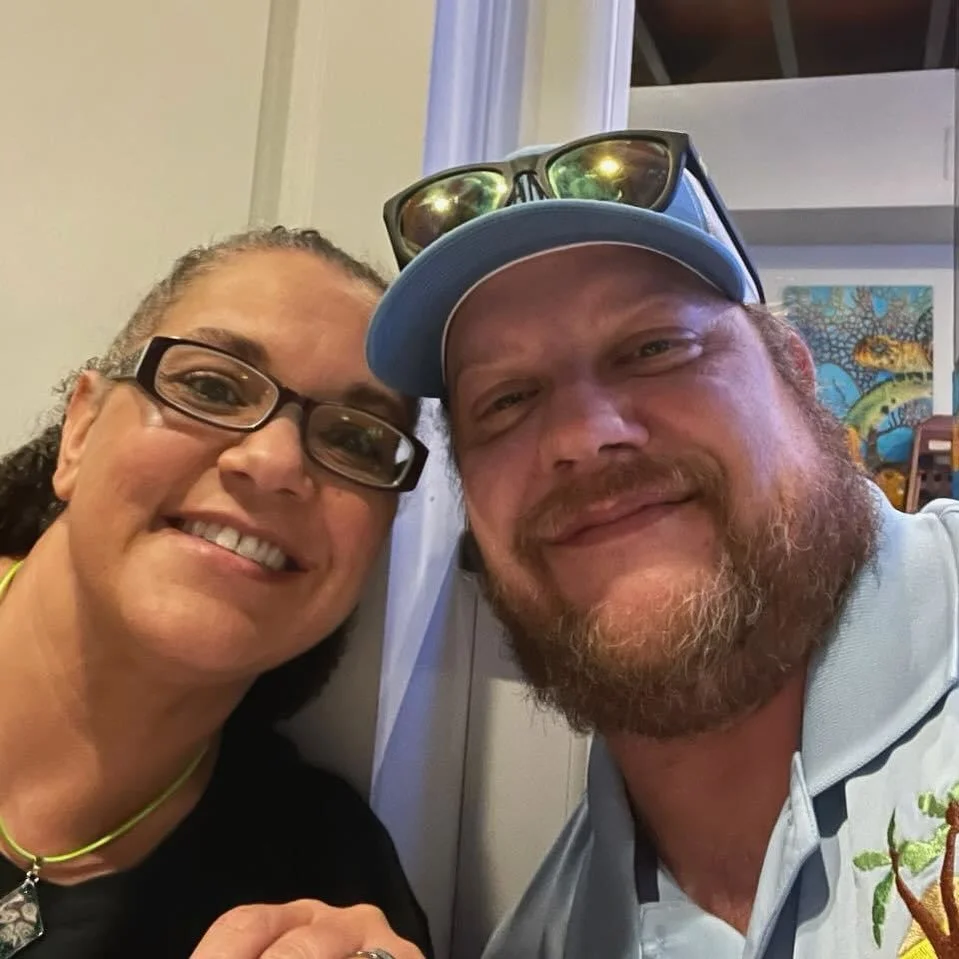
Meet Your Maker: Braxton Frankenbery, Divine Pens Plus

Meet Your Maker: Braxton Frankenbery, Divine Pens Plus

(Caroline Foty's first fountain pen was a 1970s Sheaffer No Nonsense that still writes perfectly. Since she discovered pens by independent makers, she wants "one of each, please" and wants to meet all the makers. Maybe you do, too. She lives in Baltimore with pens, cats, and all kinds of fiber arts supplies.)

Some makers start small, getting drawn into the wood crafts with kit pens or small boxes. Braxton Frankenbery came from the other direction. A longtime process analyst for a large telecom company, he had a high-end furniture business on the side. Then one weekend in 2002 he went to a woodworking show near his home in Ohio, and a store rep was giving a demo on making a pen on a wood lathe.
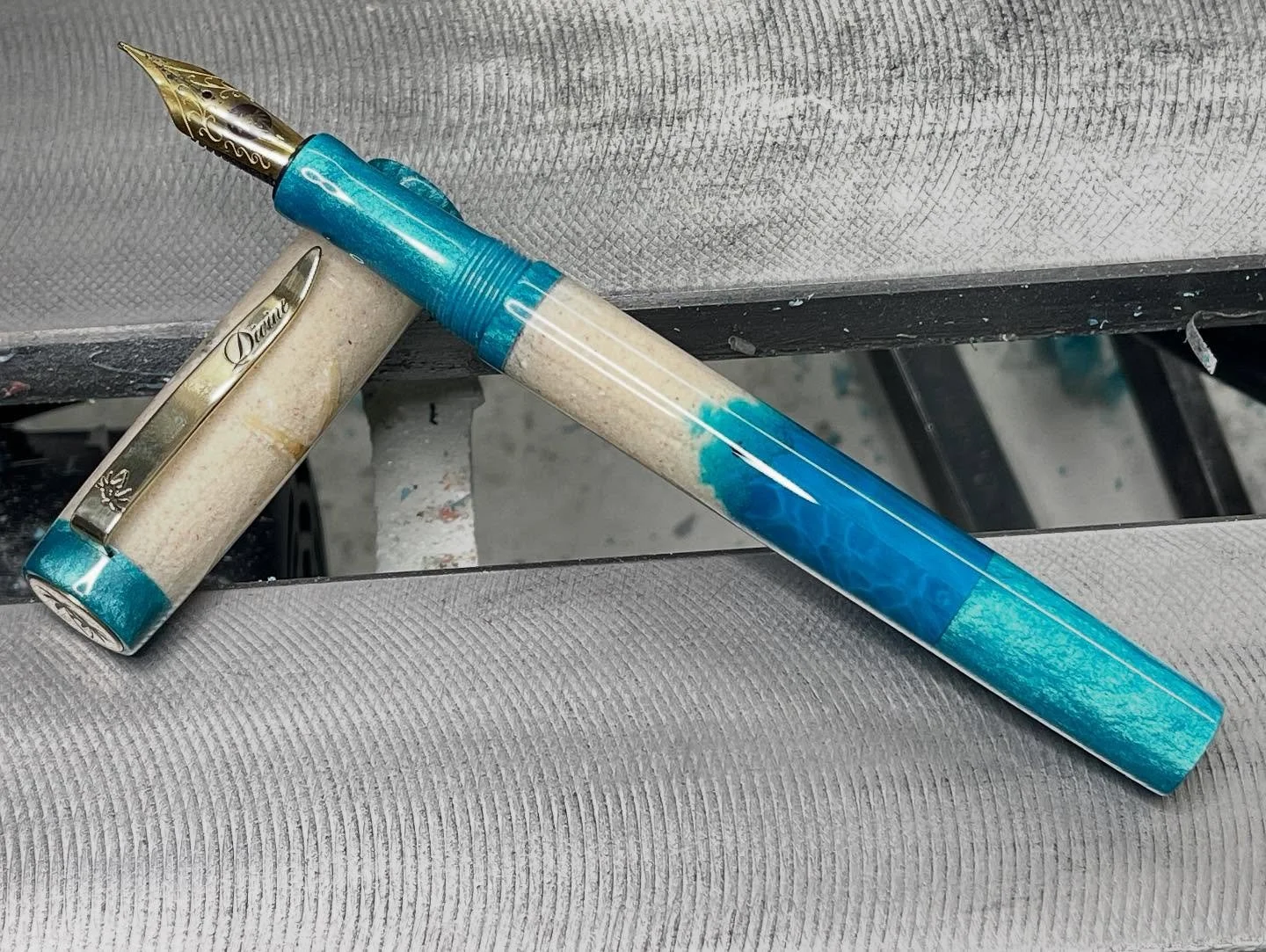
Divine Pens Plus Beach Pen

“This got my interest instantly. I stopped at the store on the way home and bought a wood lathe.” Having previous experience with metal lathes and CNC machines, it seemed like familiar territory. He’s made pens ever since.

When his employer moved to a fully telework model, it became possible to relocate to just about anywhere, and the Frankenberys chose the Florida Keys. Divine Island Designs was born. As pens gradually took over the business, the name changed to keep up.
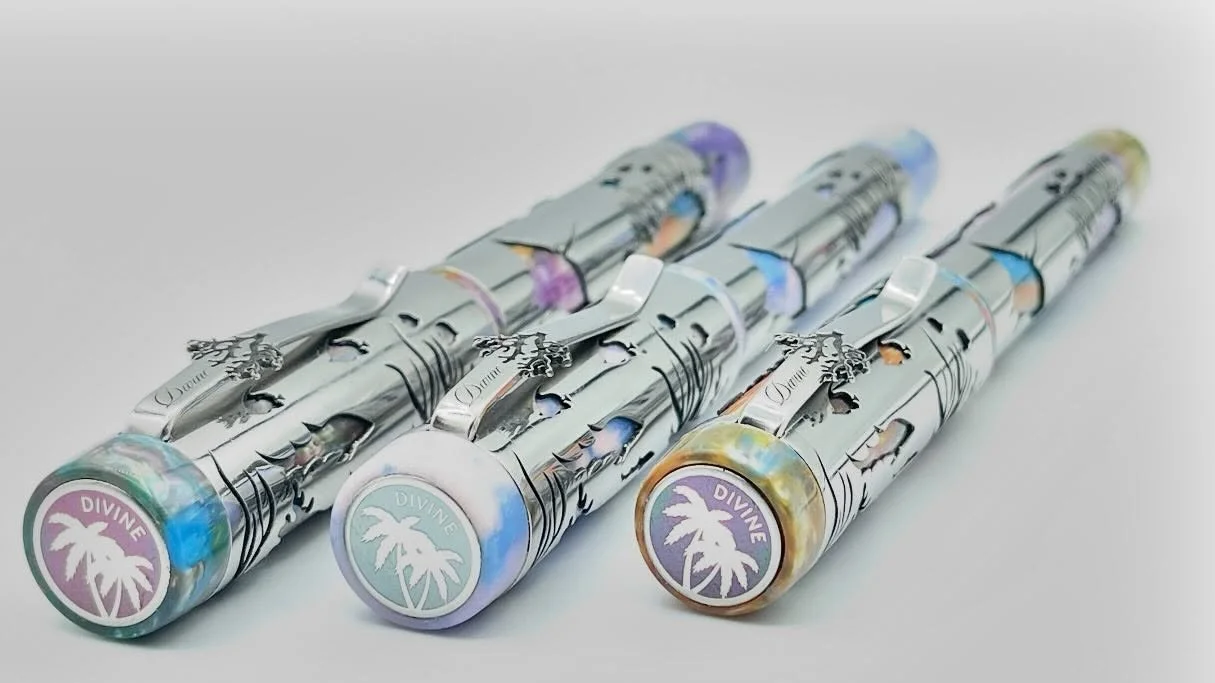
Divine Pens Plus Metal Sleeve

Frankenbery concentrated on the most interesting and high-end kit pens he could find, pushing the limits of the genre by working with proprietary materials made in-house. His wife Erica quit working to become caregiver to her aging mother, and needed a creative hobby for balance. At the time, their son was casting some blanks for pens, and Erica began dabbling with resin, making jewelry. The family had a storefront in the Keys. “It opened right before COVID…” but after two years it was unsustainable and they closed it.

Kit pens proved unsustainable too, from a creative standpoint. Just before COVID, Frankenbery became acquainted with some of the custom pen makers, especially Rich Paul and Jim Hinze, through attending pen turners’ gatherings. At the same time he was getting bored of making kit pens. “It was time to do my own stuff. I love going into the shop and creating whatever I want, not limited by anything like the parts of a kit.”
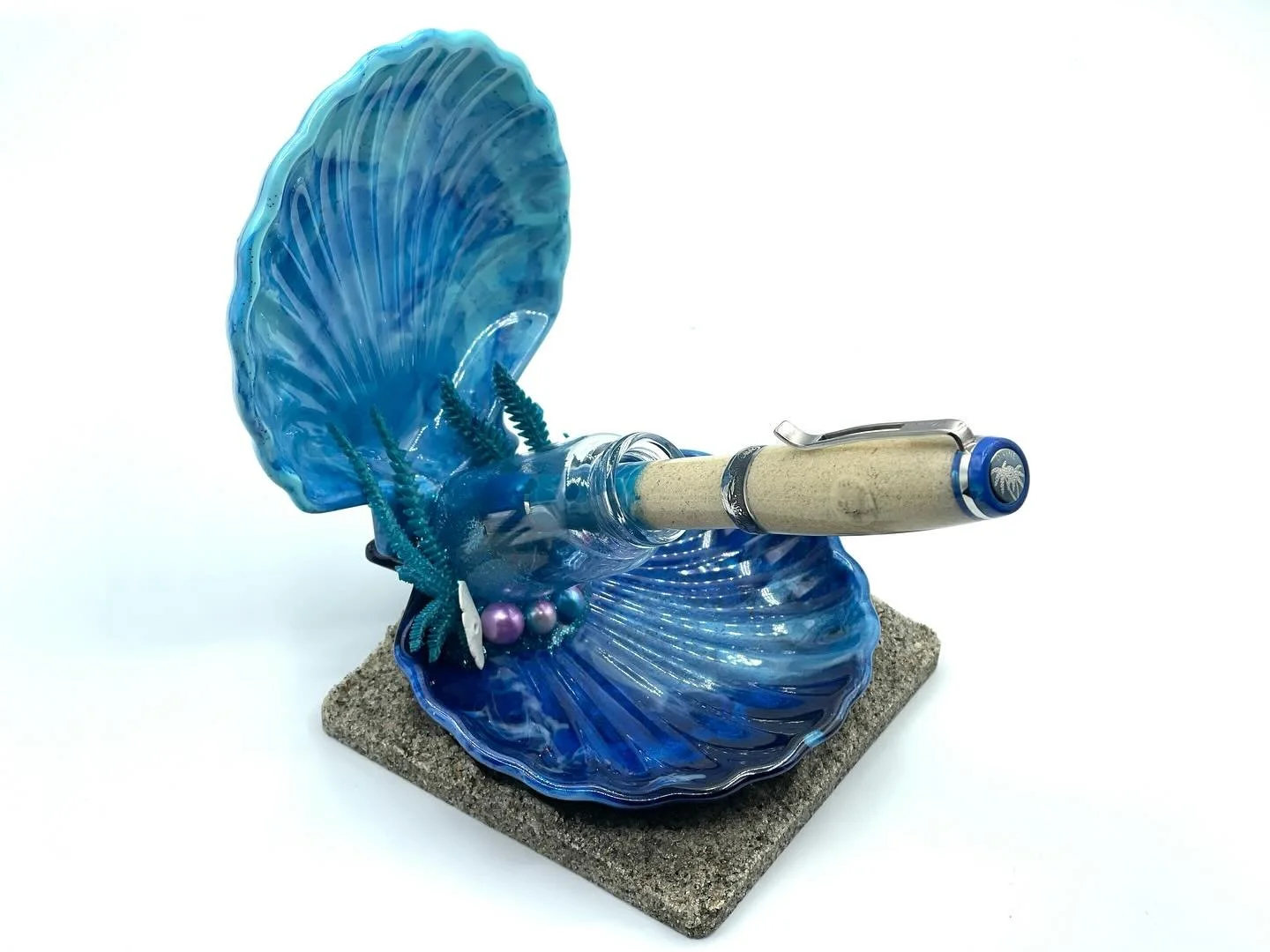
Divine Pens Plus Shell Holder

In Florida, surrounded by beach landscapes, seaside imagery quickly became an important part of Divine Pens’ portfolio. “The Seashore series includes real sand, and little starfish and sand dollars.” Erica designed a pen stand to match the pens, including the blue resin and some of the sand.
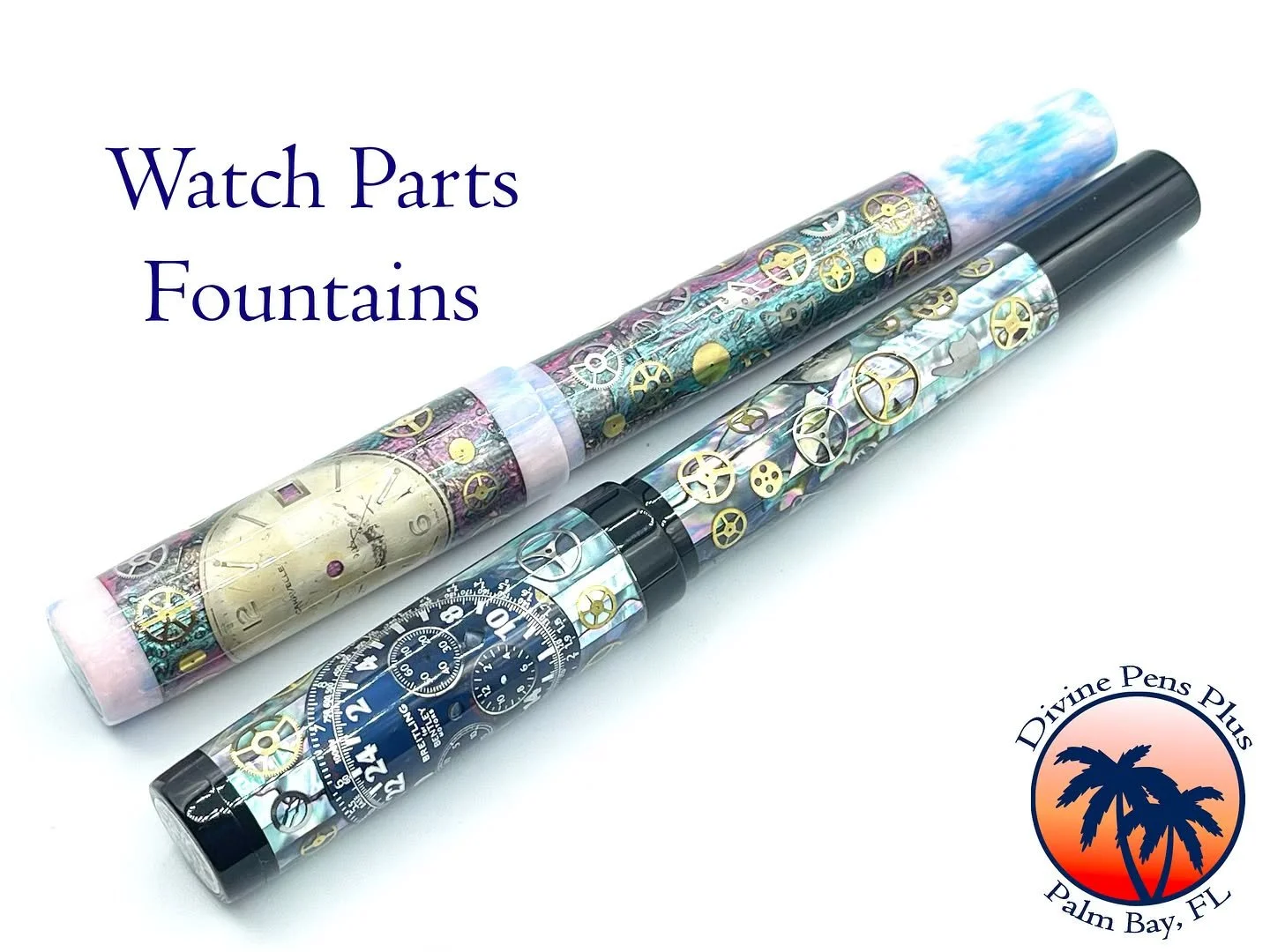
Divine Pens Plus Watch Parts

Some of the most eye-catching pens in the Divine Pens portfolio are the “watch part” pens, made with actual watch parts cast within clear resin. “Those blanks first became popular for kit pens. You can cast anything around a brass tube.” The blanks alone are nearly $200, even before a maker begins to turn the resin down; the look is a bit steampunk depending upon the type of watch that’s involved.
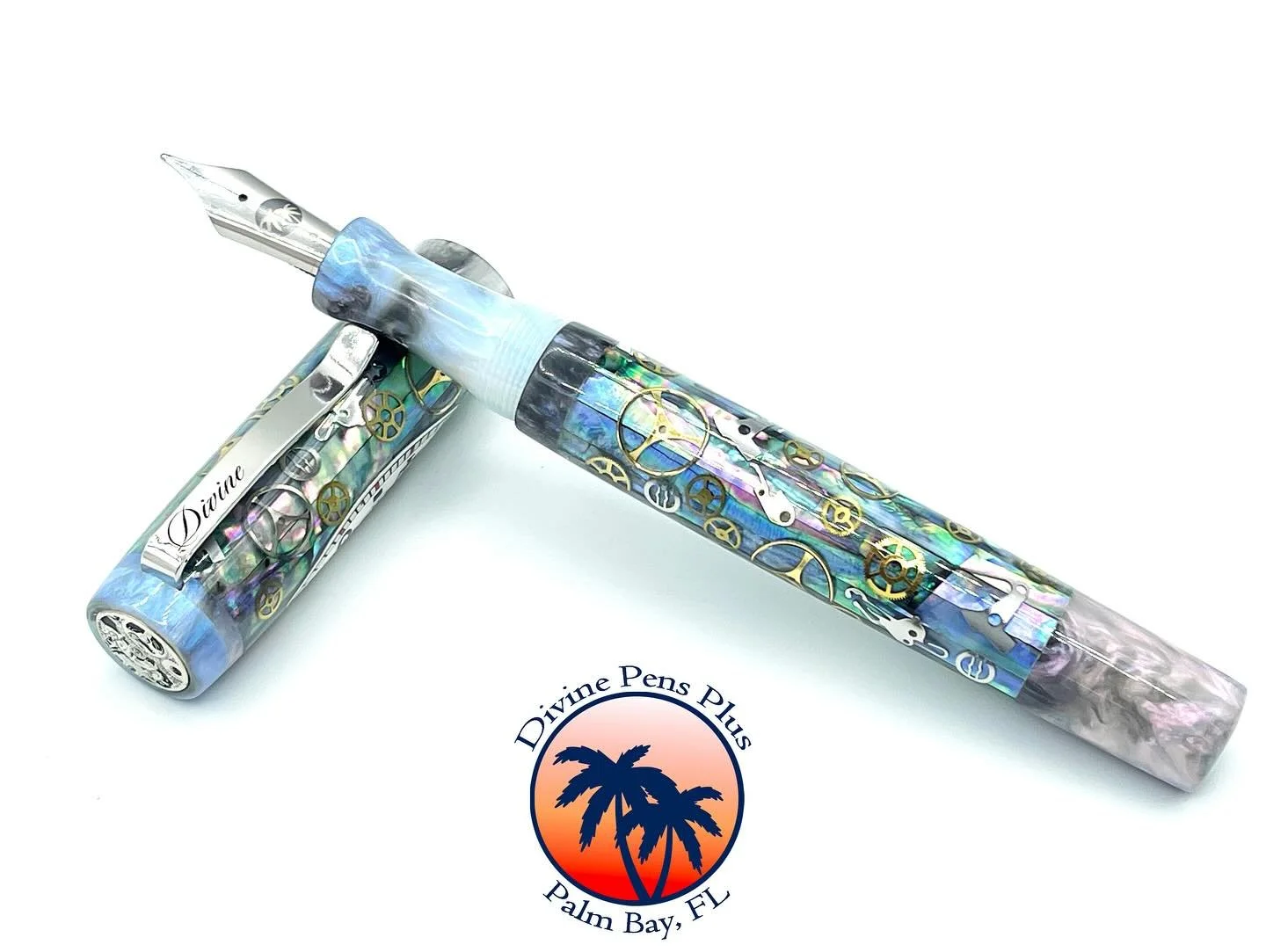
Divine Pens Plus Watch Pearl

Both Frankenberys have had health problems recently that prompted them to return to Ohio, but that is not slowing down their business. In addition to pens and accessories, Divine Pens has their own line of blank casting supplies – base colors and colored glitters. Frankenbery has a fiber laser, and makes his own clips, as well as finial coins for a number of makers. He no longer sells his blanks, but he continues to make them for his own pens. “I’m really picky about material. I try to make my pens different from everybody else’s, and being able to do my own resins helps with that.”
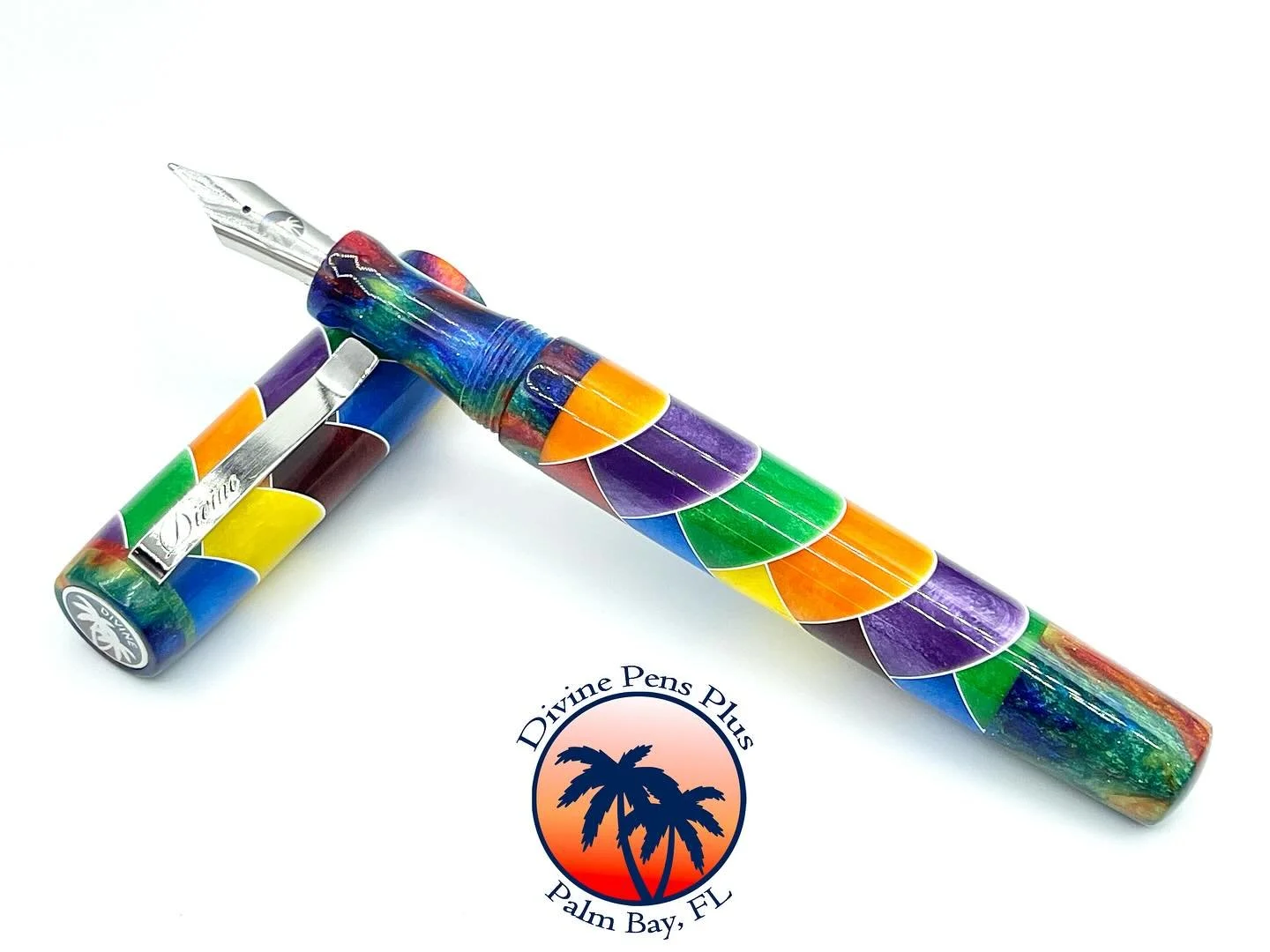
Divine Pens Plus Rainbow

Despite making his own materials, Frankenbery is a fan of the work of some other blank makers, notably McKenzie Penworks’ Diamondcast colors. He particularly likes McKenzie’s Oil Slick rainbow colorway. “I’m the father of a transgender child so we’re all about the rainbows.” One of his favorite pens is an Esterbrook Estie made from blue Diamondcast material for the Miami pen show in 2019. “Kenro approached me, but I couldn’t do what they wanted, like making such long rods, so I sent them to Tim McKenzie.” His own first custom pen was made from his Autism Awareness blank by Jim Hinze after they sat beside one another at the Raleigh show that same year. “I never used fountain pens until I started making them, and now I use them all the time. And the thing I love about pen shows is being able to hang out with those guys!”

Like many makers, Frankenbery can think of a pen of his own that got away. “I’m a Corvette guy. We got some fordite from the Corvette plant in Bowling Green, KY, and my son made some fordite blanks. I made a pen from it for myself. I had it on the table at a show, and a guy made me an offer I couldn’t refuse. I still regret selling it!”
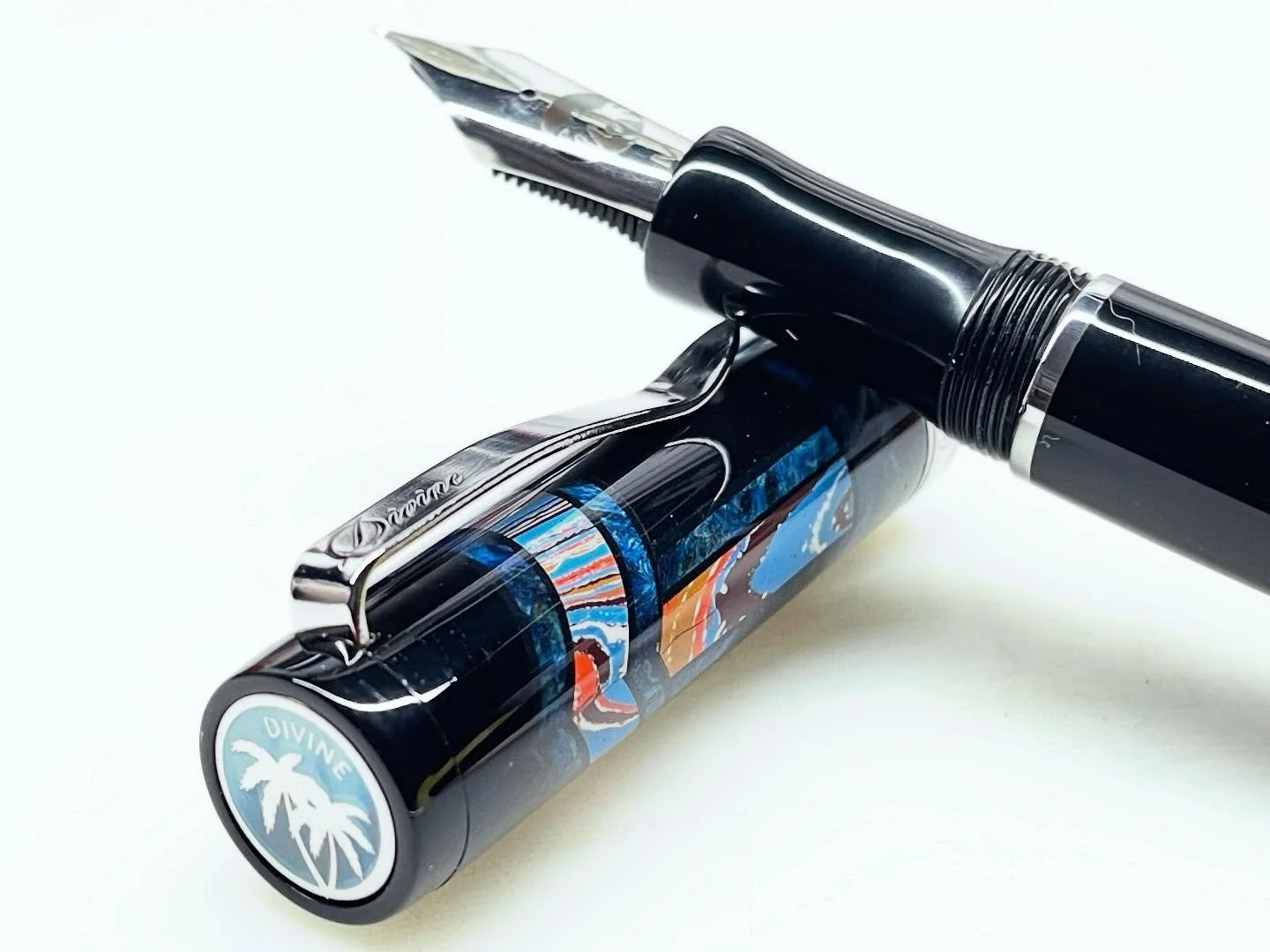
Divine Pens Plus #8 Nib

That regret is not because he’s lacking other pens. “I have about a hundred pens. A lot of them are kit pens from swaps with friends at pen turners’ gatherings. A lot of them I’ll never use, but it’s a cool collection.” His oldest son went with him to a pen turners’ gathering and got interested so he also has a number of his son’s first pens. “I also have some of my first ones that aren’t worth selling.”

Inspiration and ideas are not lacking. “I have lots of ideas, if I can get to them!” He may see a photo of a pen and like the colors, and try to create his own blank from his pigments. He has some interesting wood in his queue, which will require sleeving and sealing processes and which is intended for this year’s DC show. “I may find something unique for a pen and once I find that I’m really interested. A pen is all about the material, the story.”
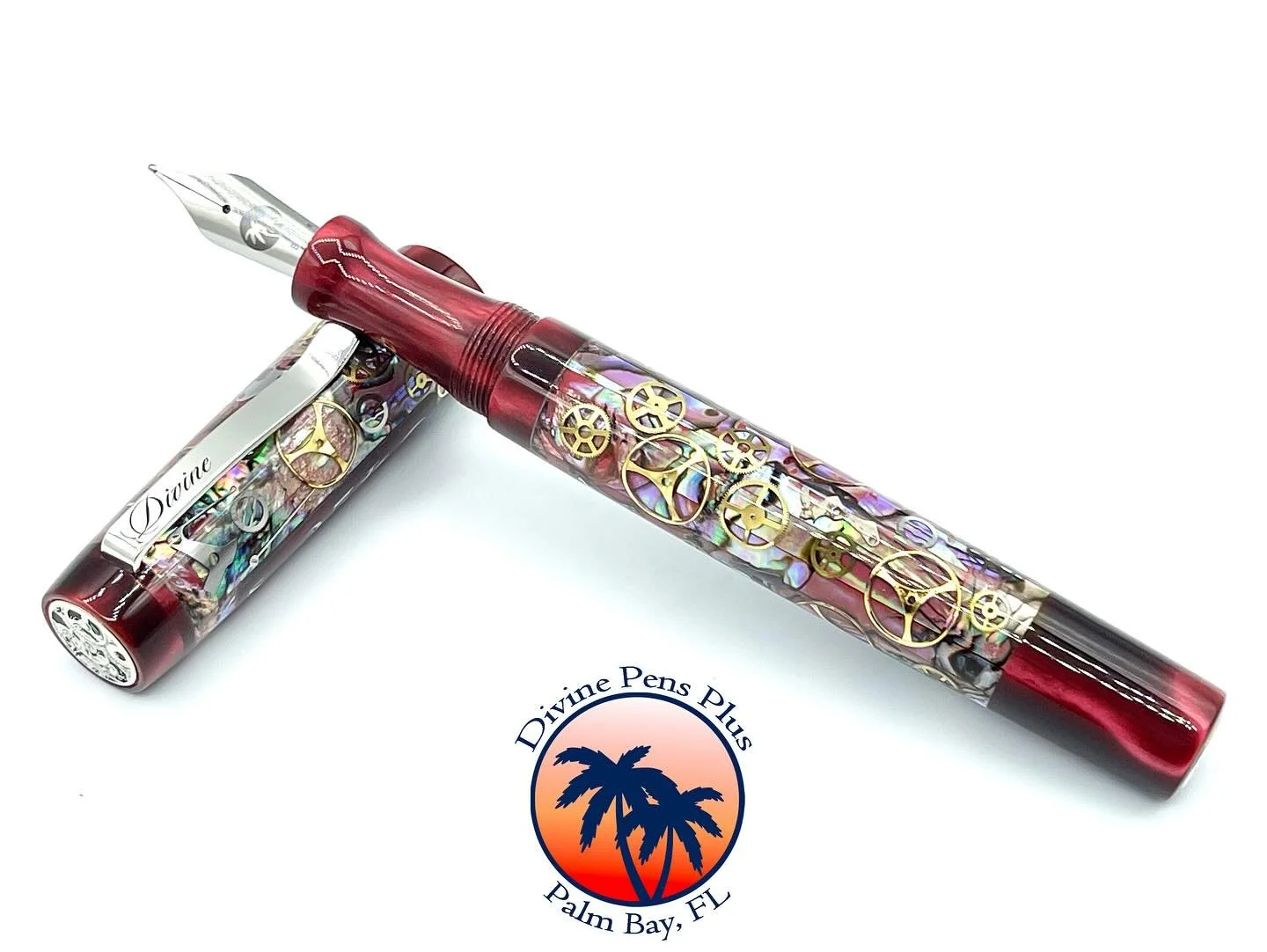
Divine Pens Plus Watch Parts

An unlikely story to inspire a pen is that famous one about a shark. “I’m a huge Jaws fan. This is the fiftieth anniversary of Jaws so I’m working on a Jaws pen, I’m mulling it over in the back of my head. I’ve made kit pens with shark teeth and vertebrae and I still have some blanks. Could I get some wood from the boat used in the movie??”

If the pen happens, you’ll probably see it online. Frankenbery says, “I’m not a big social media guy. Generally if I have time, I’m making pens. But you really need to market yourself.” He does want to begin doing some videos on TikTok and Instagram to show things off. Technology isn’t going to rule, though. “I know CNC but I like making my pens by hand. My day job is busy. This is my break time.”

Braxton Frankenbery’s work can be seen on his Instagram @divinepensplus, his website Divine Pens Plus, on his Etsy shop, and at shows in DC, Baltimore, Atlanta, Orlando, Raleigh, Miami, and Ohio.


Enjoy reading The Pen Addict? Then consider becoming a member to receive additional weekly content, giveaways, and discounts in The Pen Addict shop. Plus, you support me and the site directly, for which I am very grateful.

Membership starts at just $5/month, with a discounted annual option available. To find out more about membership click here and join us!
Posted on July 28, 2025 and filed under Meet Your Maker, Divine Pens Plus.

Meet Your Maker: John Greco, GW Pens

John Greco was so enthralled with the wood and metal shop classes he took as a middle schooler that he intended to become a shop teacher himself. He’d always been mechanically inclined, took shop and mechanical drawing in high school, and was encouraged by a teacher who recognized his aptitude to attend Trenton State College as a tech ed major. He enjoyed learning to work with all kinds of materials. Then his advisor said it was time to discuss his student teaching. “It was a reality check!” Confronted with the idea of managing a room full of sixteen and seventeen year olds around a bunch of power saws, he changed his major to political science.

While working in retail management, Greco maintained woodworking as a hobby. However, a back injury requiring surgery meant no more spending all day on his feet, so he turned to his hobby to start a new career. He had a two year old child, and at this time the recalls of Chinese wooden toys because of lead paint were in full swing, so he began making non-toxic wood toys. “My kids were my focus group.” However, in 2008 new consumer product safety laws imposed new lead testing requirements for wood toys that were prohibitively costly to perform for a small maker. Toy making came to an end.

GW Pens

“I had a friend who was a weaver, who sent me samples of the tools she used and asked if I could make them out of exotic wood. At one point there were two shops that carried my weaving tools, like stick shuttles. But I was not a fiber artist, so I couldn’t enjoy the product. I tried some clocks and hourglasses. Then a friend said, ‘You like pens, why don’t you make those?’ I had no idea you could do that!” He made his first kit pen in 2010 and was instantly smitten. “I had to learn that when you’re working with such a thin wall, you need a light touch.” He quickly began making kitless pens, learning how to cut threads and manage the materials.

GW Pens Acrylic

“My shop was half the garage. Then it was the whole garage. Then packing and shipping spread into the house, and my wife said maybe it was time for me to have my own space.” He moved into an industrial space in 2015, where he was able to get more machinery and also have a showroom for visitors who came to commission pens. “When I asked them if they wanted a tour of the back room shop, they were excited about it.” So when the landlord wanted to take back the space for another purpose, he had the idea of a location with sales in the front and a shop in the back.

GW Pens Sunburst

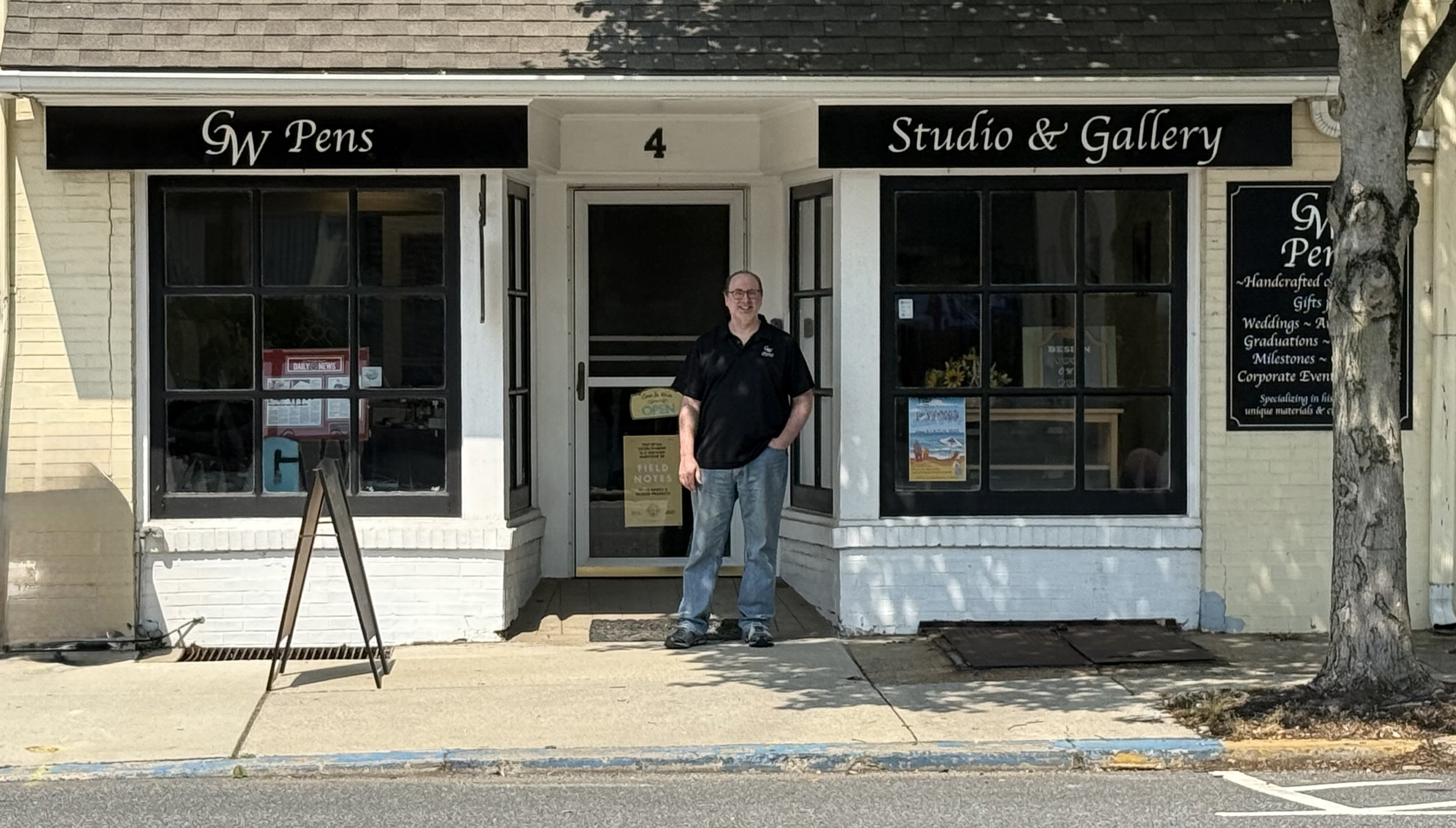
“It took awhile to find one the right size. Finally I saw a little shop in Woodstown, New Jersey, in a building built in the 1860s, with two bay windows. The real estate agent said, ‘Why don’t you put the shop on one side and the retail on the other so people can see it through the window?’” He now has a CNC machine, two wood lathes, and a metal lathe in his shop with a view of the street, and an actual retail store. The name GW Pens evolved from Greco Woodcrafting, which he quickly had to change because people kept asking him, “So, you make furniture?”

It was all pens all the time for Greco, until his son came home from scout camp having discovered Dungeons and Dragons and wanting to play. At that point he wanted to gift him a matching pen and dice set, but couldn’t find any. He’d tried casting once, and given it up – “Jonathon Brooks can do whatever I need” – but he really wanted to cast dice and play with colors. Because there are residential apartments above his store, he had to be careful of noise, so he first tried casting with epoxy, but then he found quiet air compressors at California Air Tools, which could be run below the apartments and allowed him to use pressure pots and cast in alumilite.

GW Pens Rollstop

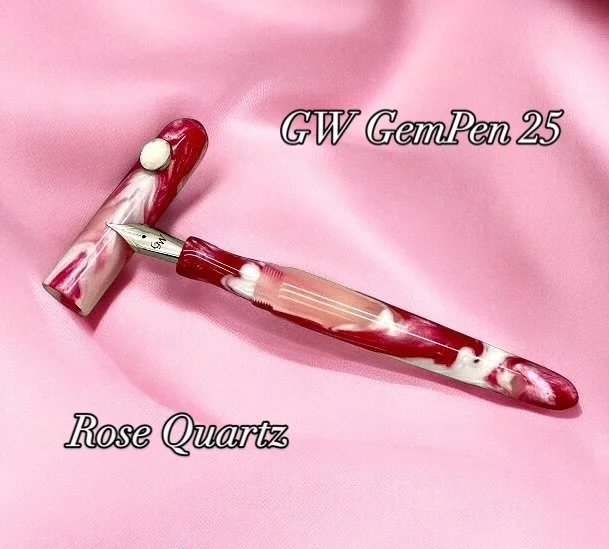
Greco is conscious of the issue of price with his work. “What can I do to make pens as nice as possible without breaking the price point?” The resin pens are made on his CNC machine, and about nine years ago he started making a model with a gemstone rollstop set in silver. “At first I had a silver center band on the pens as well, but that made them too expensive.” Similarly, hand making clips is not in his plans. “If you have a storefront, the overhead is too high to spend the time making clips.”

GW Pens Stokoe House

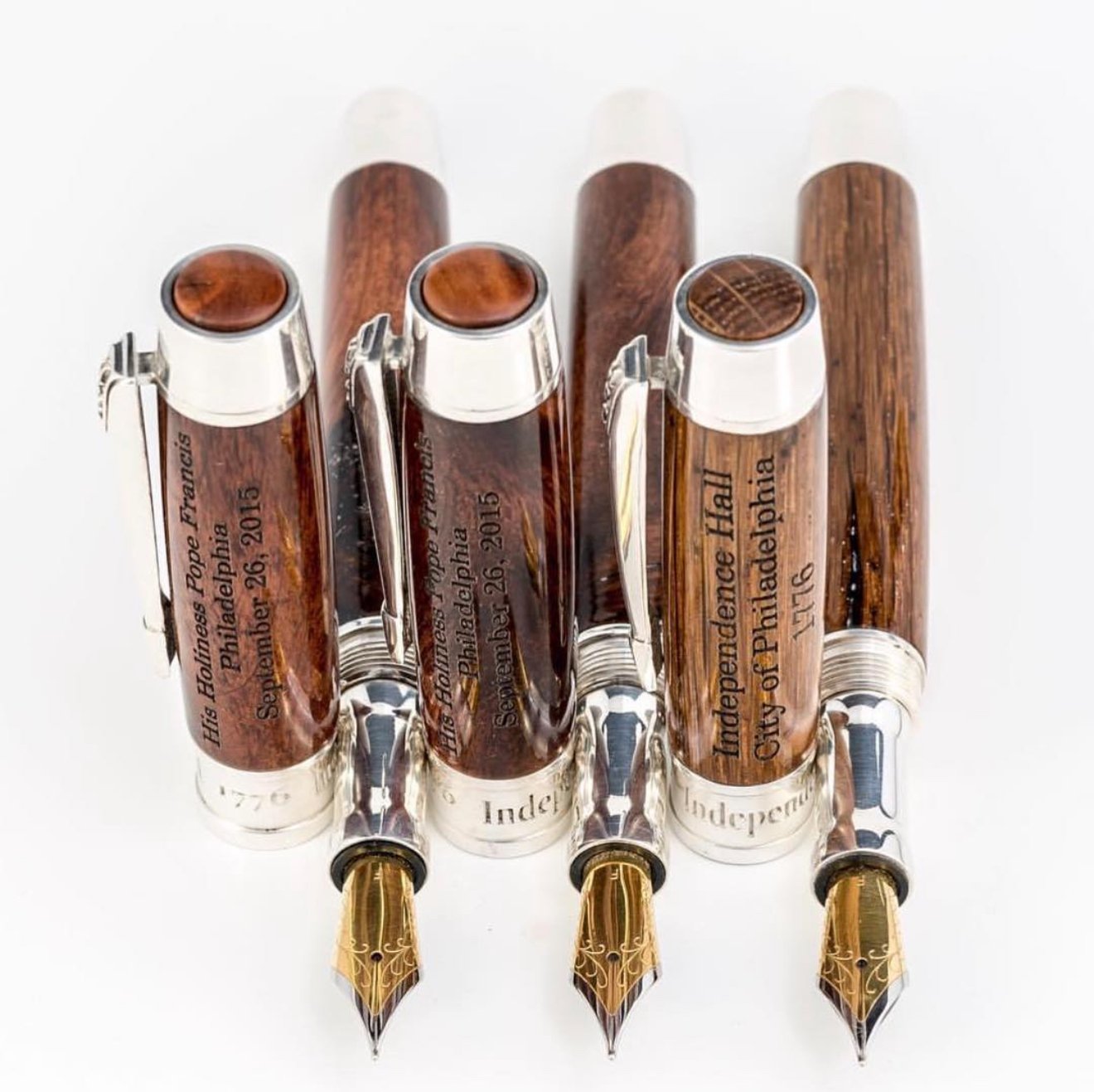
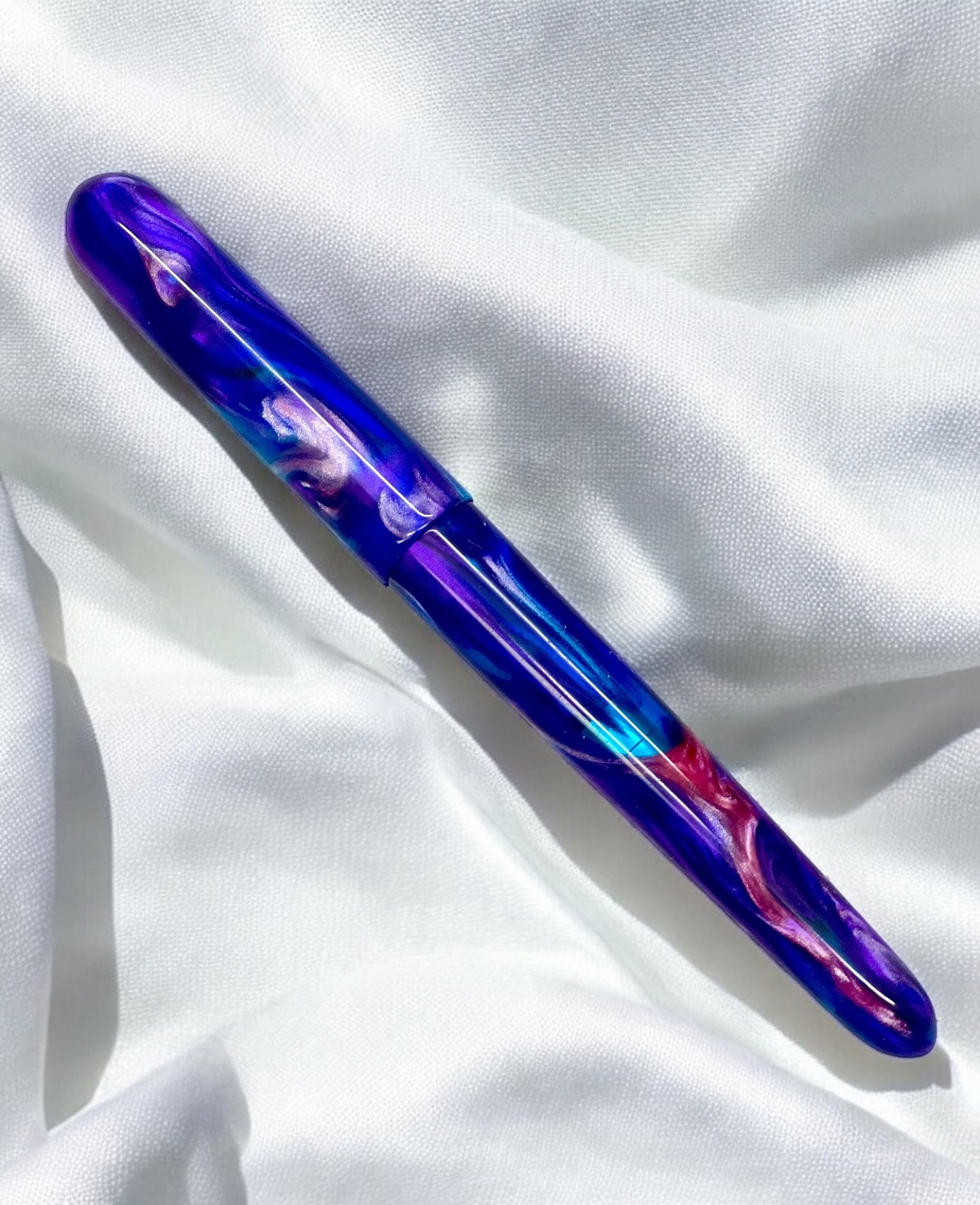
The pens he makes from wood are all hand turned on one of his wood lathes, and his wood is often sourced from interesting places. His one of a kind Stokoe House pen is made from wood from an early seventeenth century house in the north of England where the ground floor was devoted to herding in the cattle when there were border raids. “The Romans mined silver in the area as well, so I added both leather and silver to the wood. I can really tell a story in wooden pens.” Living near a Fender custom guitar facility means he can get wood offcuts from guitar necks, and occasionally make a pen for a guitar buyer from the same wood as the neck of their custom instrument, with a resin in sunburst colors and brass fittings. The city of Philadelphia commissioned a set of three pens from him, made from wood taken from Independence Hall during a renovation; one of the pens was later given to Pope Francis when he visited the city. “There is a difference between an art piece like those pens, and the ones I make enough of to cover my overhead.”

GW Pens Philadelphia

So, does making such art pieces mean he has some wonderfully elaborate favorite pen? “My favorite pen could change every day!” His Montblanc rollerball and pencil set was “my gateway into things that didn’t come from a blister pack.” He also enjoys LAMY AL Stars in fun colors. He recently received some of Jonathon Brooks’ new PM5 material – “I’m keeping a PM5 for myself” – as well as a clip shaped like a cutlass that Tim Cullen of Hooligan Georgia sent him to see if he could use it.

Since wood prompts so many more storytelling opportunities, is wood his favorite? Not really. “Wood has a natural beauty which is even better if it has a story. Resin has fun swirls of color. I get the best of both.”

GW Pens Rose Quartz

Materials are one source of inspiration, but ideas that come from all over the place have him in the store even on days he’s closed, just trying them out. An episode of Mythbusters, about how cannonballs were often made from limestone because metal was so expensive and could just be fired right back, led him to try making pens from alabaster and marble. “The cleanup of the stone dust was insane despite my dust collection system!” Nowadays if someone asks about a pen made from stone, he refers them to Darailpenz.

GW Pens Peace

At first, Greco wasn’t aware pen shows were a thing, until he met Alan Shaw who invited him to the Philadelphia pen show. “Right away I thought, These are my people! There is a sense of community, even among the makers, which just doesn’t exist at craft shows.” He is not hating penmaking despite having done it fulltime for so long. “I like getting to work with my hands, and making something I enjoy and that others enjoy and can use. People can use them and share them, not just look at them.” And he honors those early days in middle school shop class by having local shop classes and scout troops visit his store to see what you can make with the skills they are in the process of learning.

John Greco’s work can be seen on his Instagram @gwpens and his website GW Pens, at his storefront at 4 South Main St in Woodstown, New Jersey, and at pen shows in Philadelphia, Baltimore, Raleigh-Durham, DC, and New York City.


Enjoy reading The Pen Addict? Then consider becoming a member to receive additional weekly content, giveaways, and discounts in The Pen Addict shop. Plus, you support me and the site directly, for which I am very grateful.

Membership starts at just $5/month, with a discounted annual option available. To find out more about membership click here and join us!
Posted on June 23, 2025 and filed under Meet Your Maker.

Meet Your Maker: Dave Dollar, Dave Dollar Custom Pens

Meet Your Maker: Dave Dollar, Dave Dollar Custom Pens

(Caroline Foty's first fountain pen was a 1970s Sheaffer No Nonsense that still writes perfectly. Since she discovered pens by independent makers, she wants "one of each, please" and wants to meet all the makers. Maybe you do, too. She lives in Baltimore with pens, cats, and all kinds of fiber arts supplies.)

Dave Dollar didn’t think he needed a lathe, but he couldn’t resist a good deal.

“I made jewelry boxes, and furniture – why would I need a lathe?”

Then, a friend was clearing out his uncle’s house, and there was a garage full of tools. “There were over a hundred pen kits, two hundred blanks, a mini lathe, and all the tooling. It was probably a $4000 value and he sold it to me for $500.” He tried making a pen, and was instantly hooked. The motor on the mini lathe burned out fairly quickly and he replaced it with a better one. “The hook was set when I realized I could finish a piece of functional art in a day.”

After making component pens for two years, Dollar found out that Jim Hinze was teaching a workshop in how to make a three part custom pen at the Southern California Penturners Gathering, and it was on his birthday. So he went. The following week, COVID lockdowns began. By the end of the year he was specializing in three part pens.

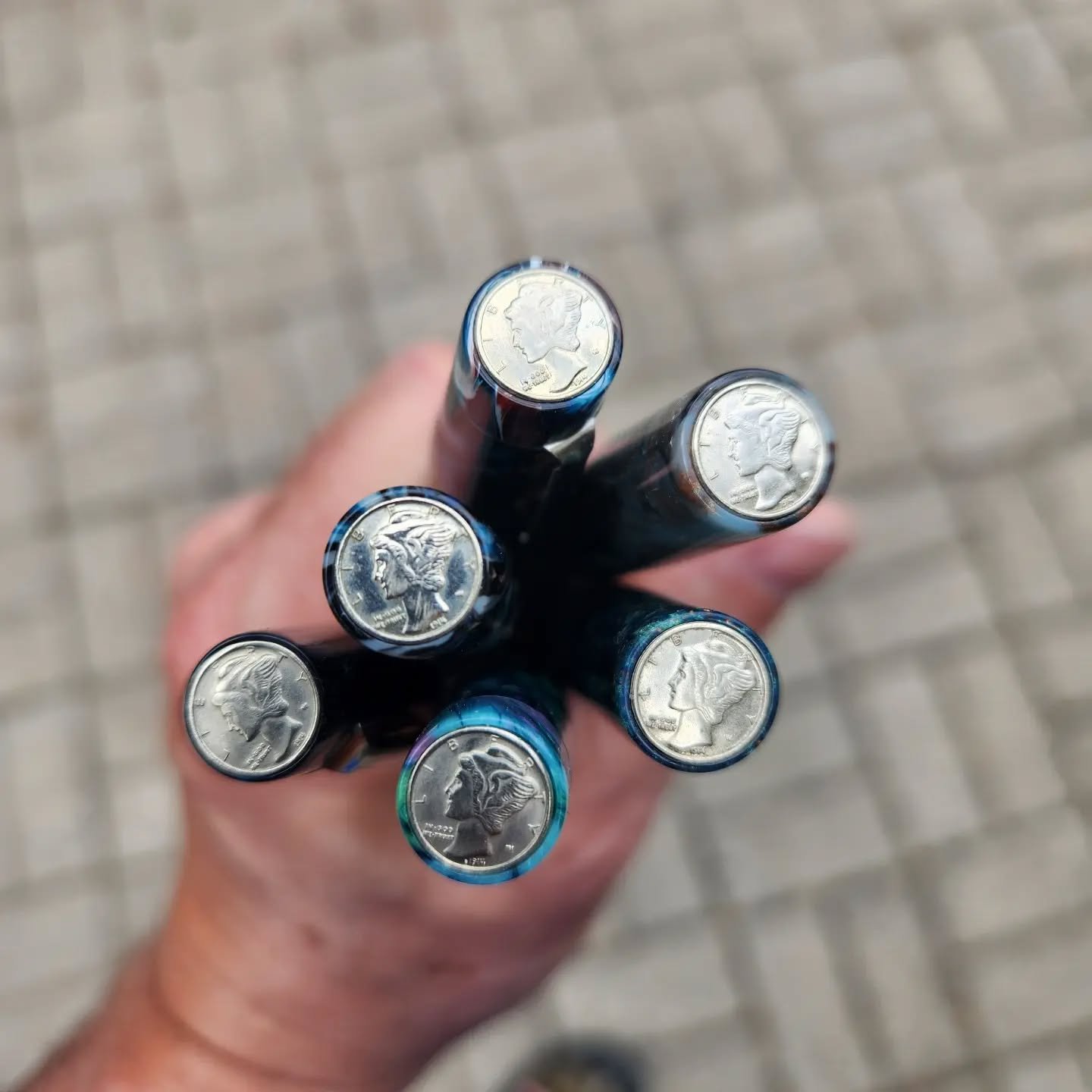
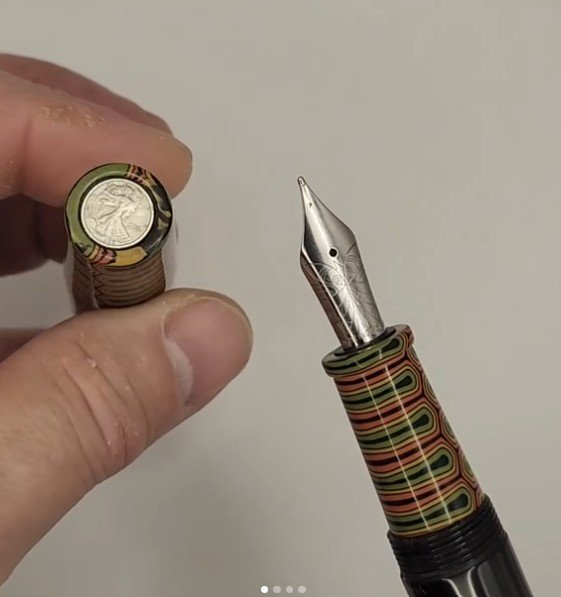
He also discovered the As The Pen Turns podcast, and he listened to it during the year when there were no pen shows, thinking about what he could do at shows and thinking about his focus. Because of his name, he began searching for coins to use as cap finials, and found great sources of the novelty coins that he still uses.

When 2022 rolled around and there were pen shows again, he splurged on a weekend attendee pass at the Baltimore pen show, and spent time with some of the people he most admires today – Jonathon Brooks, Ryan Krusac, and of course Jim Hinze. “I didn’t know then about vintage pens – I saw them and liked the small sizes of them. At that point I was just making the Liberty, my largest pen, and some of the mid-size Ikes.” Seeing these pens inspired him to make his Mercury model, a slimmer pen.

Dave Dollar

In October of that year, Dollar attended the Dallas show as a first time vendor, debuting his Mercury model there. “I sold ten pens! That was great!” The Mercury is now his best-selling model. It is convertible, so it can be both a fountain pen and a rollerball that uses the “Schmidt Cartridge-Rollerball System” with a fountain pen ink converter. While some rollerball tips built to work that way have been something of a flop, this one seems to have pleased everyone who has tried it.

Dave Dollar Fude

His most recent innovation was suggested by his wife Judith, who is an Urban Sketcher. She is fond of the Sailor Fude De Mannen nib and asked for a pen made out of nicer material that she could use with that nib. His Freedom model is a turned cap and body that takes the Fude De Mannen section from a Sailor pen – you can bring your own section, or get one from him. Judith Dollar has begun bringing her postcards and stickers to shows, and offering workshops tailored to urban sketchers and journalists; her most popular one, which is already open for registration at this year’s DC show, is “Make a Pocket Sketch Journal.”

Dave Dollar Benjis

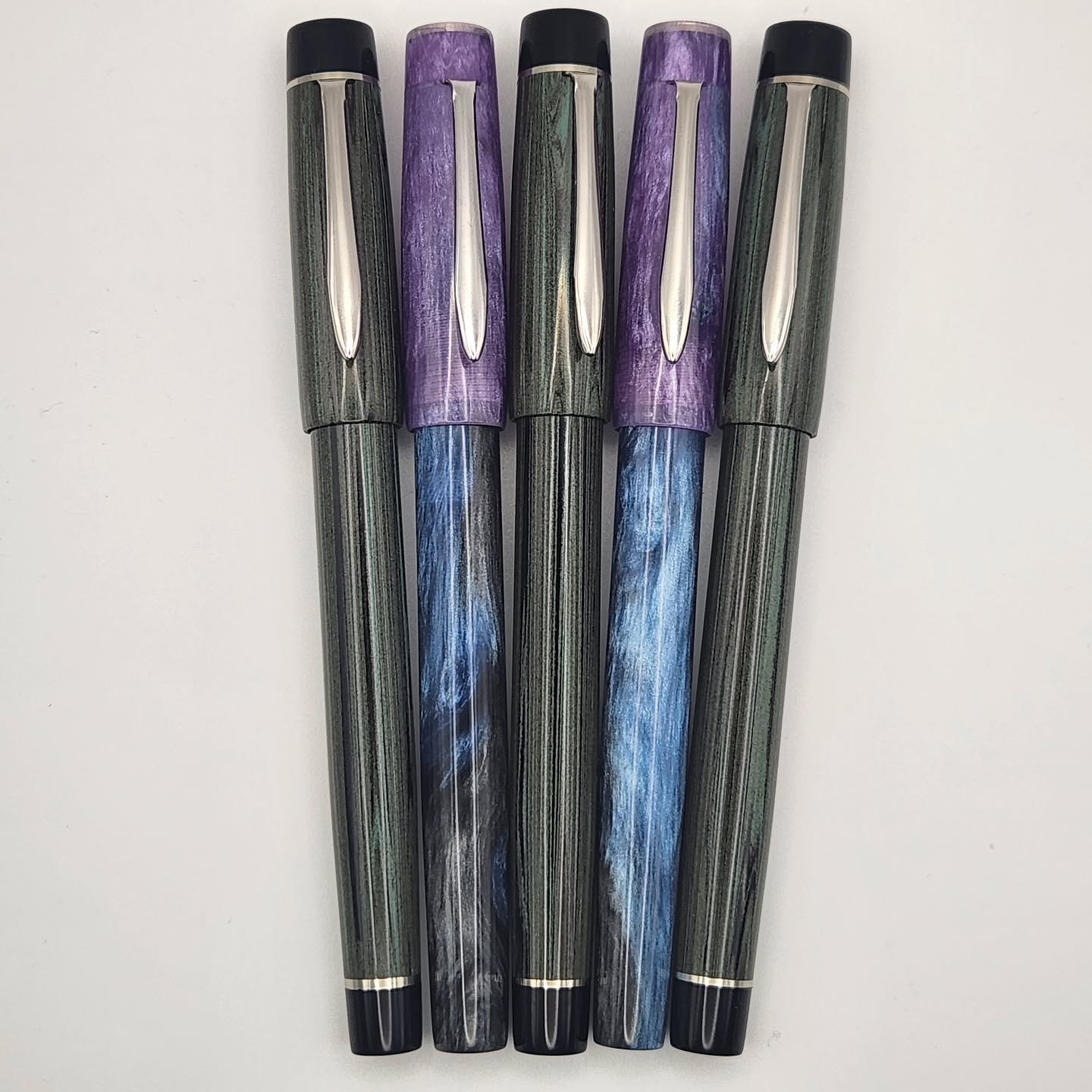
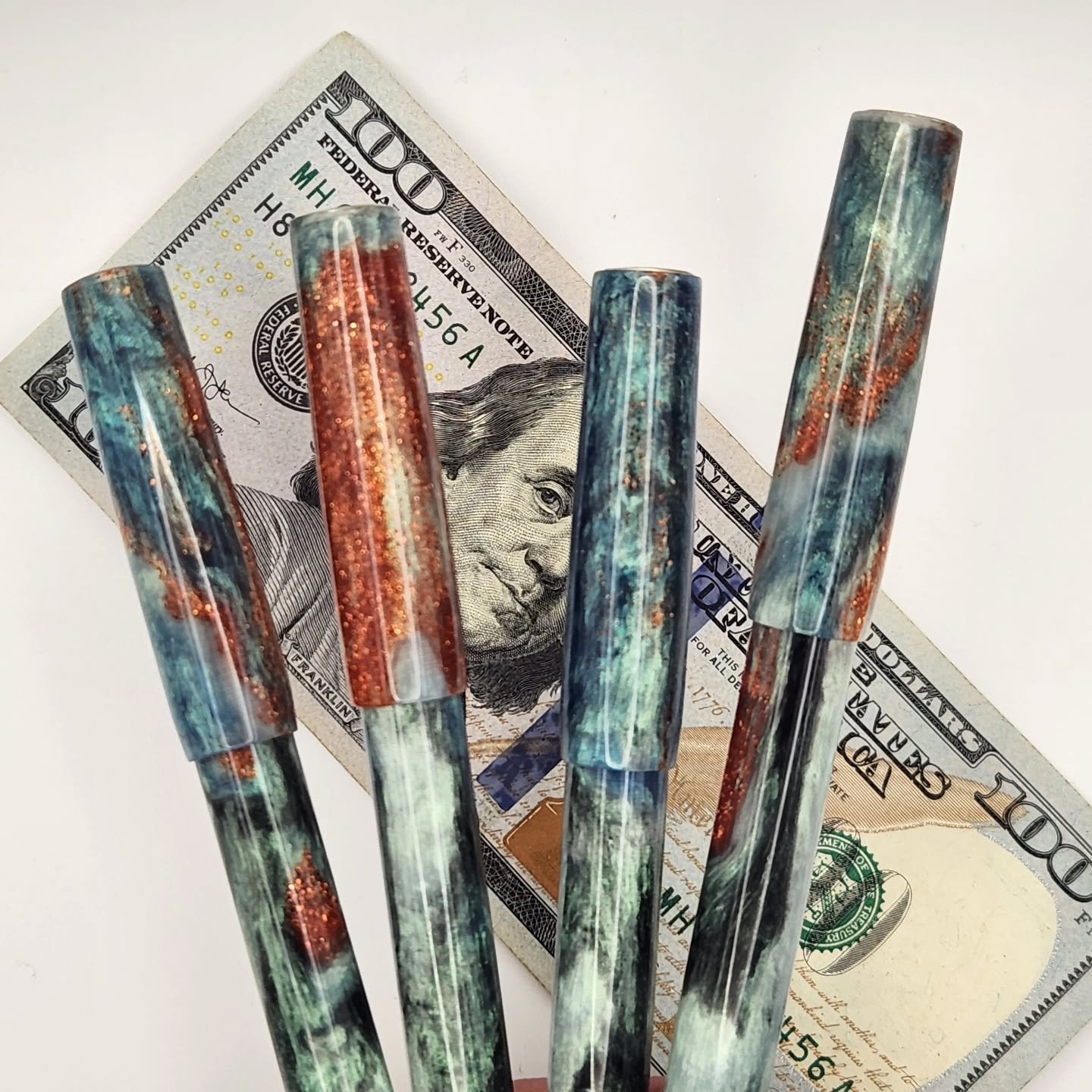
Dollar is endlessly inspired by the possibilities of available pen materials, but that doesn’t mean he wants to make his own. “I’m not tempted. I get materials from thirty-two different sources. I have a proprietary material from Joe Fonseca of Just Joe Pens for my ‘All about the Benjis’ pens. I love micarta and ebonite. When I sell a pen, I put in a card with the name of the material and the maker.” He is looking at doing more pens that mix and pair materials, and has had a request from a customer for color bands. One direction he doesn’t plan to go: “I’m not a wood pen guy. There are already several fantastic wood pen artists!”

Dave Dollar Mercury

Like most makers, Dollar doesn’t have many pens he’s made. “The ones I keep are the ones with imperfections, that I can’t sell.” His favorite pen is a Montblanc Starwalker with a fine nib that he bought in France, but he also loves his Leonardo Momento Magico that he bought at Casa Stilografica in Florence, and his Hello Tello Venice with a Nemosine nib.

“The nib is very important to me, and I’m trying to be more cognizant of it.” He’s fine-tuned his model lineup to offer nib variety: Bock #8 nibs tuned by Kirk Speer and engraved with the Dave Dollar logo, for his larger Liberty model; #5 nibs in his Mercury, which allows him to offer Jowo, Schmidt, and Bock titanium nibs; #6 nibs in his Ike model, which lets him use the Nemosine nibs he has a stock of; and the Fude De Mannen in the Freedom model. He is working on some additions to the Mercury’s capabilities – a customer has requested a pen that will take a vintage Esterbrook nib.

Dave Dollar Fountain Pens

Full-time pen making has allowed Dollar to keep up with some volunteer work that is important to him. For eight or nine years he has coached a youth pistol and rifle shooting team, which has had repeat national championships; he’s taking eighteen kids to the Nationals competition in Columbus, Ohio in July. He’s getting ready to pass that commitment to someone else, since his son has aged out of participating. He’s also been asked to make an elaborate receptionist desk for his church. “There are curves, and inlays… it’s taking months.”

Leaning into the money angle suggested by his last name was a way to begin with something uniquely his own. “You have to have a differentiation of your products, and you have to be a little bit of a salesman too - people love the stories of the coins and the materials. You need to strike out on your own and be original. Seeing what other makers do is fine, but you need to not only think outside the box, but think of how many other boxes there are to think outside of.”

Dave Dollar Nib

Having been “invited to retire” from his corporate job in 2023, Dollar decided to give full time pen making a go. He is constantly aware of how different this job is from the one he had. “Going from industrial software and corporate strategy, where I was so far away from the end user… Now there is someone right at my table who is going to use this pen. I’m making functional art and people are buying it and loving it. What better validation is there?”

Dave Dollar’s work can be seen on his Instagram, his website Dave Dollar Custom Pens, and at shows in Baltimore, Washington DC, Atlanta, Dallas, Arkansas, and the Little Craft Fest in Houston. (He hopes to be able to add San Francisco in 2026.)


Enjoy reading The Pen Addict? Then consider becoming a member to receive additional weekly content, giveaways, and discounts in The Pen Addict shop. Plus, you support me and the site directly, for which I am very grateful.

Membership starts at just $5/month, with a discounted annual option available. To find out more about membership click here and join us!

Posted on May 12, 2025 and filed under Meet Your Maker.