(Caroline Foty's first fountain pen was a 1970s Sheaffer No Nonsense that still writes perfectly. Since she discovered pens by independent makers, she wants "one of each, please" and wants to meet all the makers. Maybe you do, too. She lives in Baltimore with pens, cats, and all kinds of fiber arts supplies.)
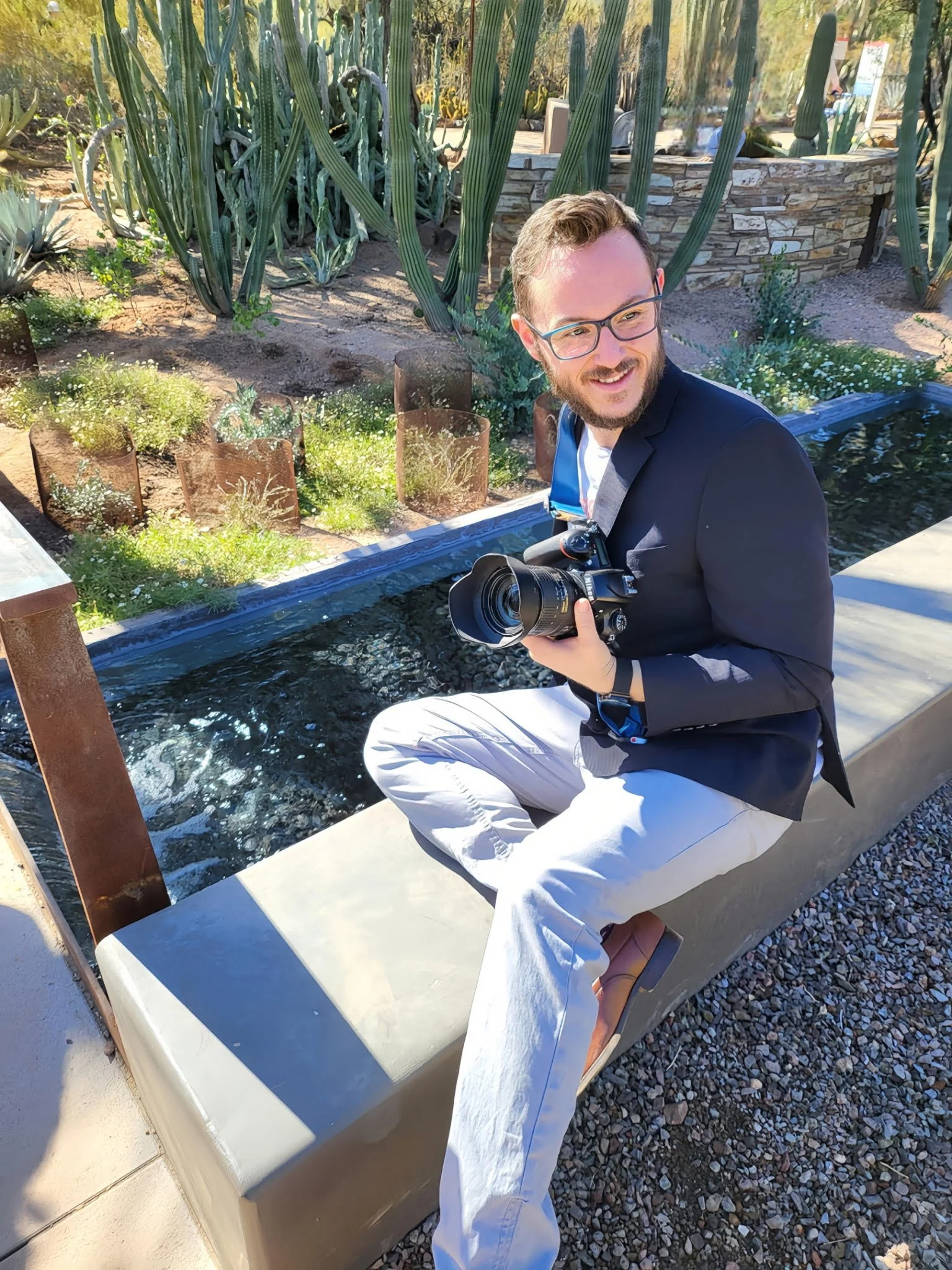
It’s all pens all the time for Rhys Wilson. Not only does he make pens, he works at Penchetta Pen and Knife store in Scottsdale, Arizona, the only remaining pen and stationery shop in the Phoenix area out of what used to be a handful.
Fifteen years bartending and waiting tables burned him out. “Much as that can be fun and can be lucrative, it also really kind of mentally drained me – I’m a very introverted person overall, and it really takes a lot out of me to do all that interacting.” The pen part of the store has grown exponentially thanks to the explosion of online material about pens. “It’s really fun being able to have pens be the entirety of what I do.”
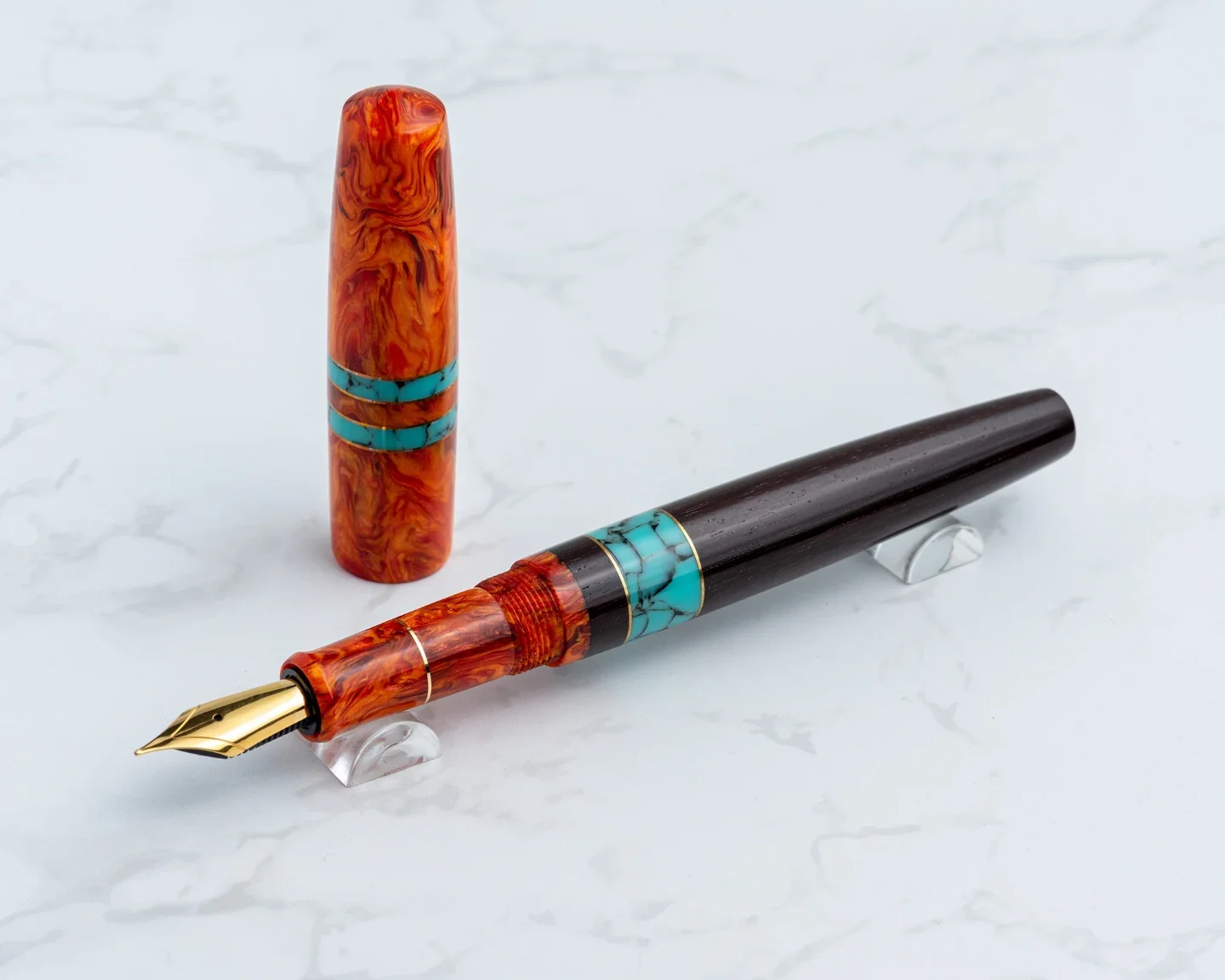
Pens kind of sneaked up on him. While he loved school supply season as a kid (like most of us did), he tended to prefer fancy mechanical pencils, and had to use disposable pens at work. “I could never carry anything super nice, because periodically I had to give it to a customer and a lot of the time they would disappear.” He and his fiancée were doing crafting in their spare time, and one of the things he made was epoxy resin camping knife handles. “There would always be some extra resin left, I wanted something to do with that extra resin – it’s kind of wasteful to throw it in the trash. I stumbled across a video from another resin artist who used his dregs to make little inlay rings. When I started doing those, all I had was a little drill press and it was kind of a pain in the butt to shape and polish them on a drill press!” His fiancée’s mom bought him a mini lathe, which happened to come with a pen mandrel. “I thought, well I have this, I might as well try it, so I made a couple pen kits and fell in love.”
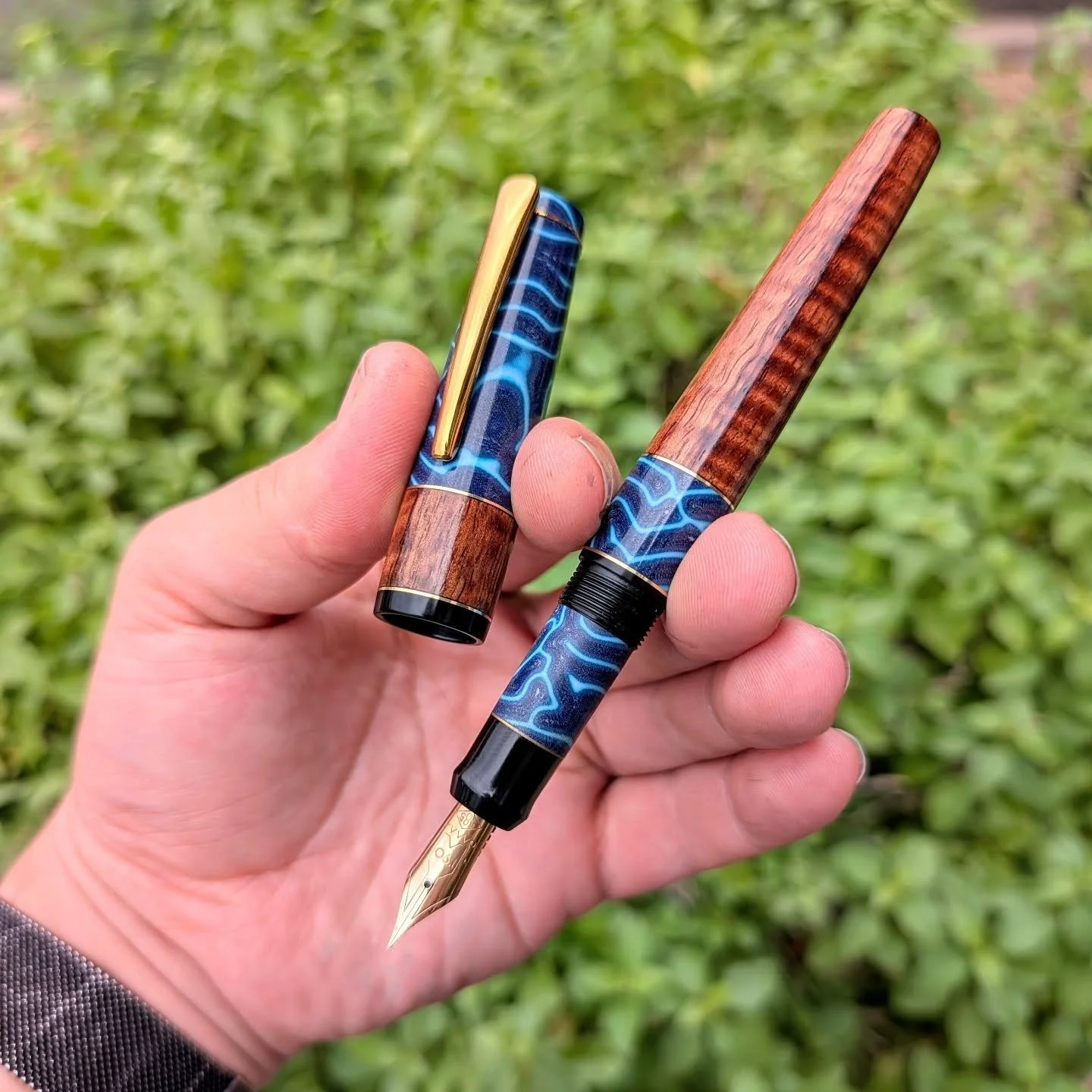
Wilson’s creative instincts quickly led him to feel somewhat restricted by pen kits. He began researching ways to customize kits, and “fell down the kitless pen rabbit hole.” YouTube content from Turner’s Warehouse and RJB Wood Turner facilitated his explorations. Like many makers, it wasn’t long before he began seeking ways to make more involved pens. “My favorite thing is trying new things and seeing what works and what doesn’t.”
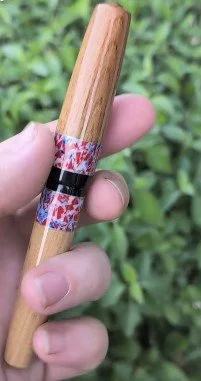
Just because he was fairly new at the process didn’t mean he kept it plain. “My very very first kitless pen ever that I made was actually a hybrid with acrylic in the wood. So I’ve always done the slightly more complicated stuff, and I’m getting better and better at it with more experience and better tools. It’s also fun to get some of these really really cool hand poured resins and with a simple design let material speak for itself. Some of the most beautiful pens are just simple.”
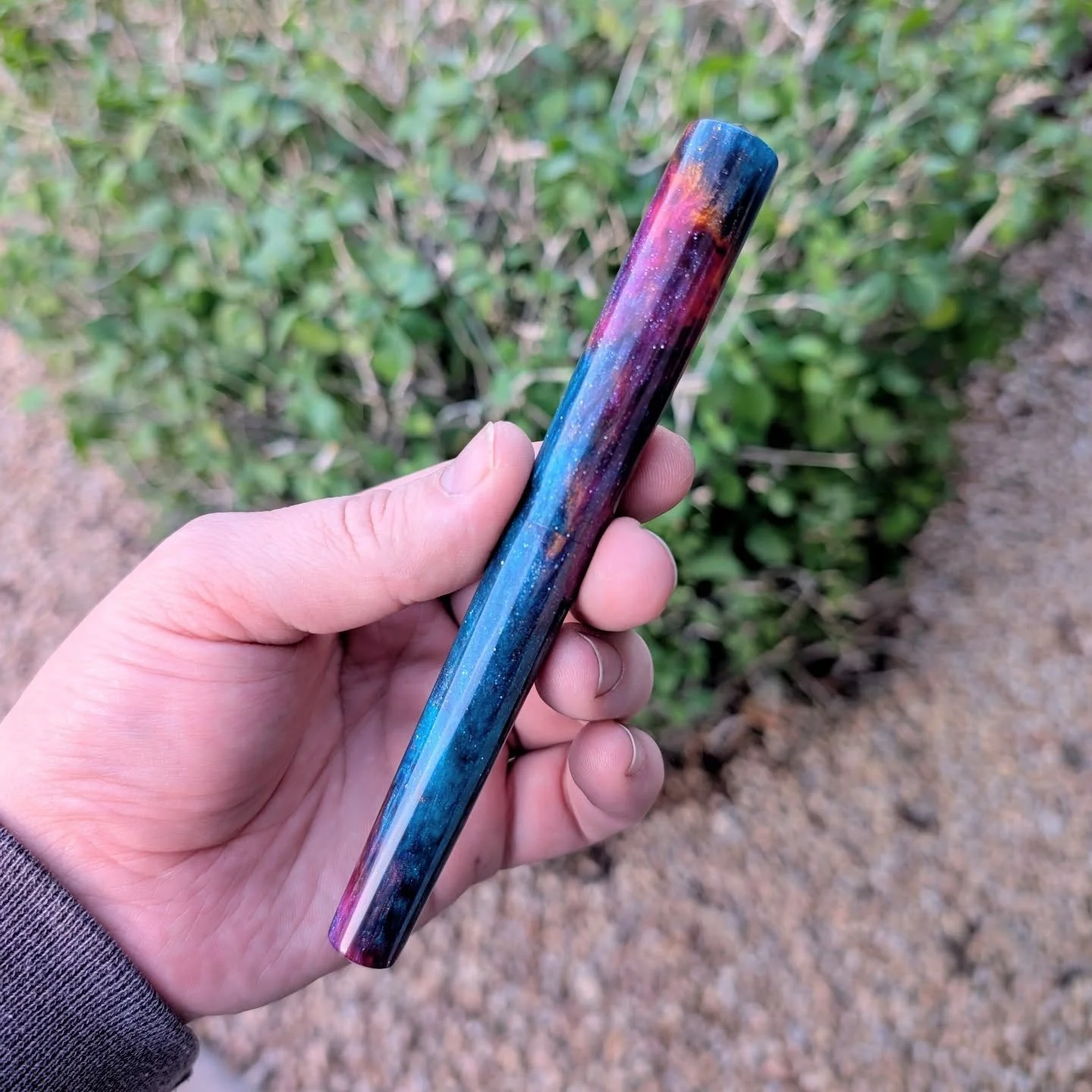
Despite starting out with a resin craft, Wilson is not drawn to make his own blanks. “I have made some myself, but it’s an art form in and of itself and one that didn’t quite grab me the way the pens did. There are already so many people doing really cool blanks that I don’t necessarily feel a need to throw my hat in the game, I’m showcasing their awesome work with what I do.” His favorite materials to work with are acrylics – “They are easier to finish than some of the urethane resins, they are denser and have some of that luxe feel” – and also ebonite, which he loves for its natural, warm feel in the hand.
This perhaps explains why his favorite pen he didn’t make for himself is an ebonite Sailor King of Pen. He also loves a black ebonite pen he made that’s finished with urushi lacquer. “I was contacted by a person in Australia who asked me to make an ebonite pen that would take urushi lacquer. He said that if I made two pens and sent them to him, he would pay for one of them, then urushi the other one and send it back to me. I said YES PLEASE. This is one of my most prized possessions.” Is there a color theme here?? Not really; his first pen was a silver LAMY AL-Star.
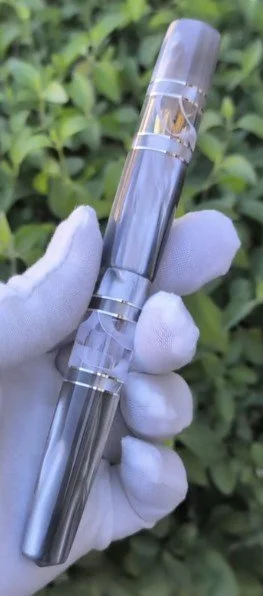
Moving forward, Wilson wants to explore more metal work, both for aesthetic results and for feel. “I know as a maker that quality things can be lightweight, but there’s just something I find that we as humans have in our brains, that equates heft and weightiness to quality especially on slightly more expensive stuff. I think having a good heft to something really helps sell it as a good value to somebody when they first hold it.” That means saving up for a metal lathe to add to his toolkit, and exploring more metals for things like accent bands. “I’d love to be able to do titanium accent bands, there’s so much you can bring to that with color, or anodization, but it’s a very very hard material to work with. Trying to do that by hand on the wood lathe would be I think rather dangerous.”
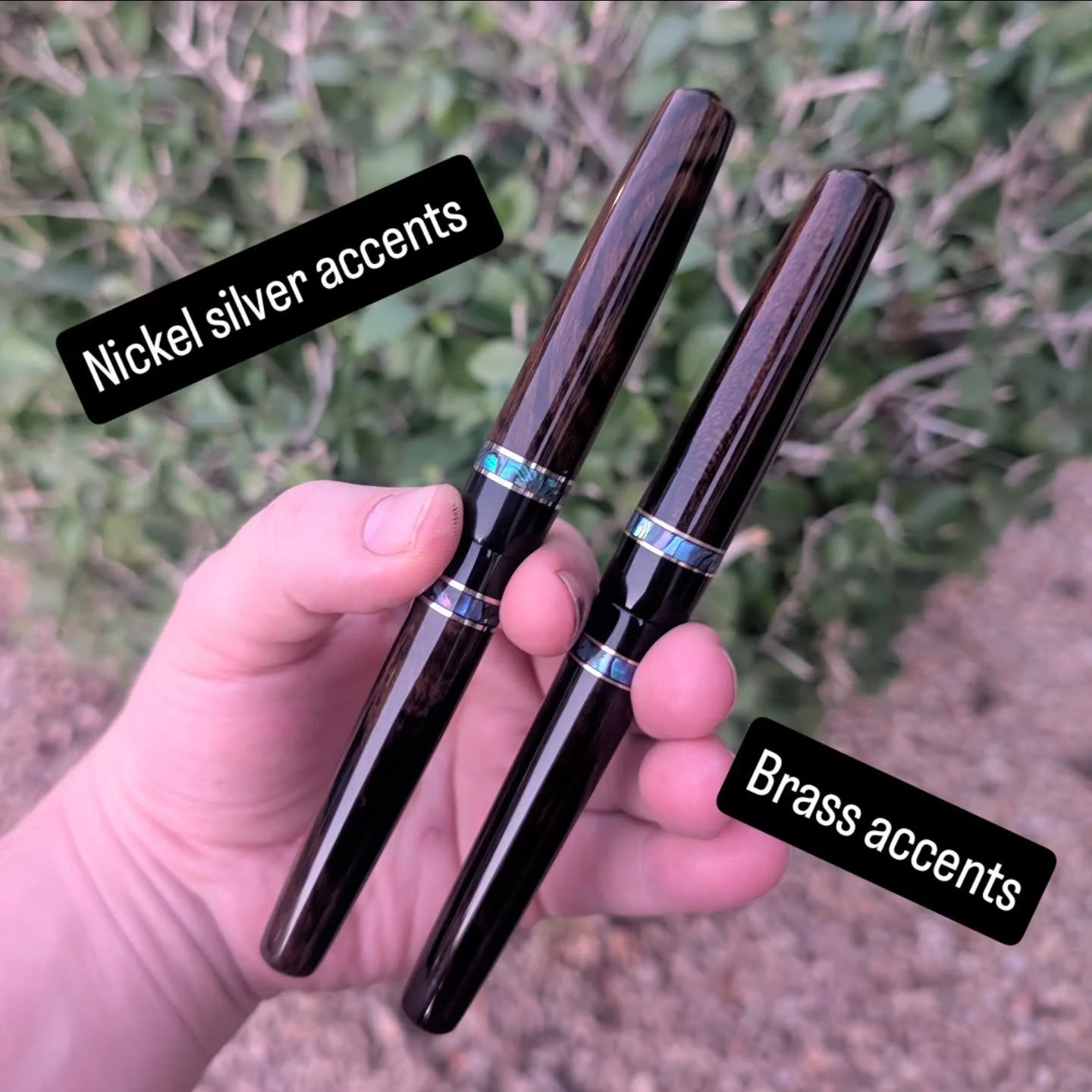
Wilson does take pen commissions, although he has what he describes as a love/hate relationship with them. “I do really enjoy taking somebody’s idea and bringing it to life, but that can really be hard sometimes, and some folks are more particular than others about having that, call it perfection. It’s possible to get everything perfect when you’re doing things by hand, given enough time. Taking the time to get things perfect is hard. Finding where I’m willing to let small things slide has been interesting, because I can get really perfectionist with things. These are handmade objects, and there is a level of wabi-sabi that most people are willing to embrace in a handmade object.”
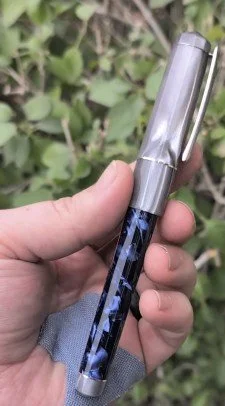
Wilson says he has a little bit of impostor syndrome as a fairly new maker in a community of seasoned artists. “That has actually been a huge part of working at Penchetta that has been helpful for me, being able to compare my stuff with these $2000 Visconti Homo Sapiens special editions and whatnot, seeing the level of fit and finish on pens that cost considerably more than even my most expensive pen to date.“
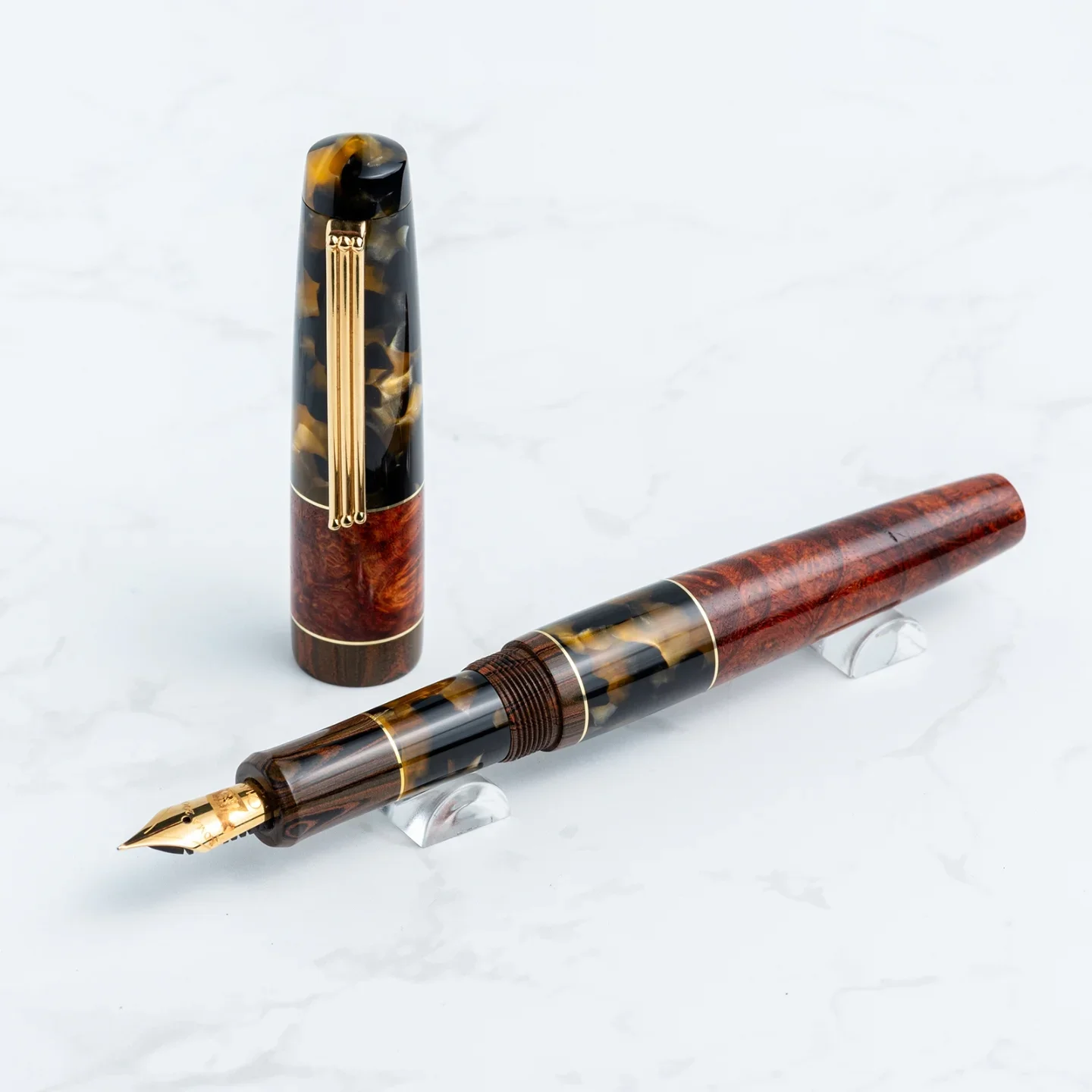
The most satisfying part of making pens for Wilson is “being able to take something out of my head, put it into the real world, and not just do that but have it be something that somebody could, ideally, pass down to a kid, or to a grandchild, or something like that.” That’s one of the reasons that while he enjoys making the resin pens, he loves making the more heirloom quality “functional art” pieces. “What I really like is finding those pairings of wood and resins that you may not expect, that really arrest you when you see them.”
Rhys Wilson’s work can be seen on his Instagram @rhyss_piecess_, his website Rhys’ Pieces, and maybe at the San Francisco Pen Show.
Enjoy reading The Pen Addict? Then consider becoming a member to receive additional weekly content, giveaways, and discounts in The Pen Addict shop. Plus, you support me and the site directly, for which I am very grateful.
Membership starts at just $5/month, with a discounted annual option available. To find out more about membership click here and join us!