Posts filed under Esterbrook

Esterbrook Dollar Pen Review

The Esterbrook Dollar Pen was one of the pens I acquired at the 2014 Atlanta Pen Show. I didn't really have an Esterbrook on my list when I went to the show, but I went home with two of them. I completely underestimated the charm and unique attributes of these pens, and I just couldn't tear myself away. I had to have them.

A little background

I bought the pens from Carl Daniel at a smaller booth at the back of the room. I remember stopping at the booth several times to handle a few of the pens that were calling to me. He was extremely friendly and offered all kinds of fascinating history tidbits about the pens I was holding. That was part of the allure that snagged me – the history. It put the context in living color.

Esterbrooks weren't on my list before because I really had no interest in antique pens. I had nothing against them, but I hadn't been bitten by the bug. Seeing these pens in person, I pretty much had no choice.

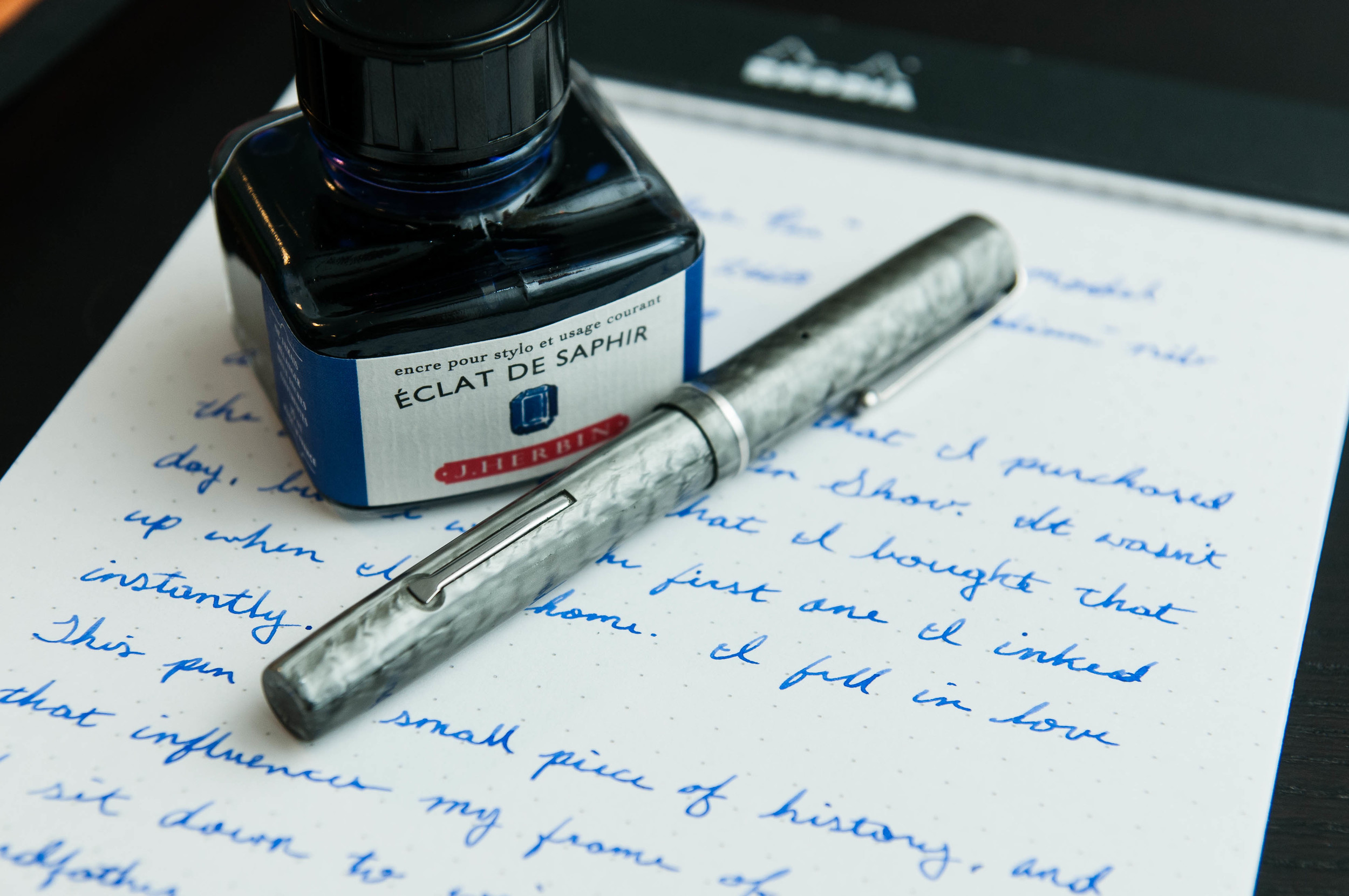
The first model I chose was one of the early "Dollar Pens." From what Carl told me and what I can find online, it's a gray demi model from circa 1939. It's not in perfect, mint condition, and that's part of the allure for me. It's a real pen that's been used. Someone wrote with this, and it still writes today. It has one job, and it does that job with excellence, even ~75 years later.

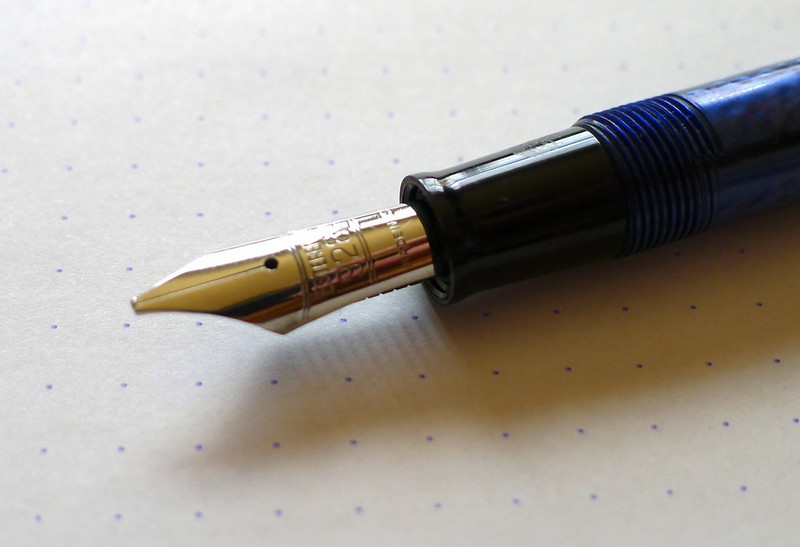
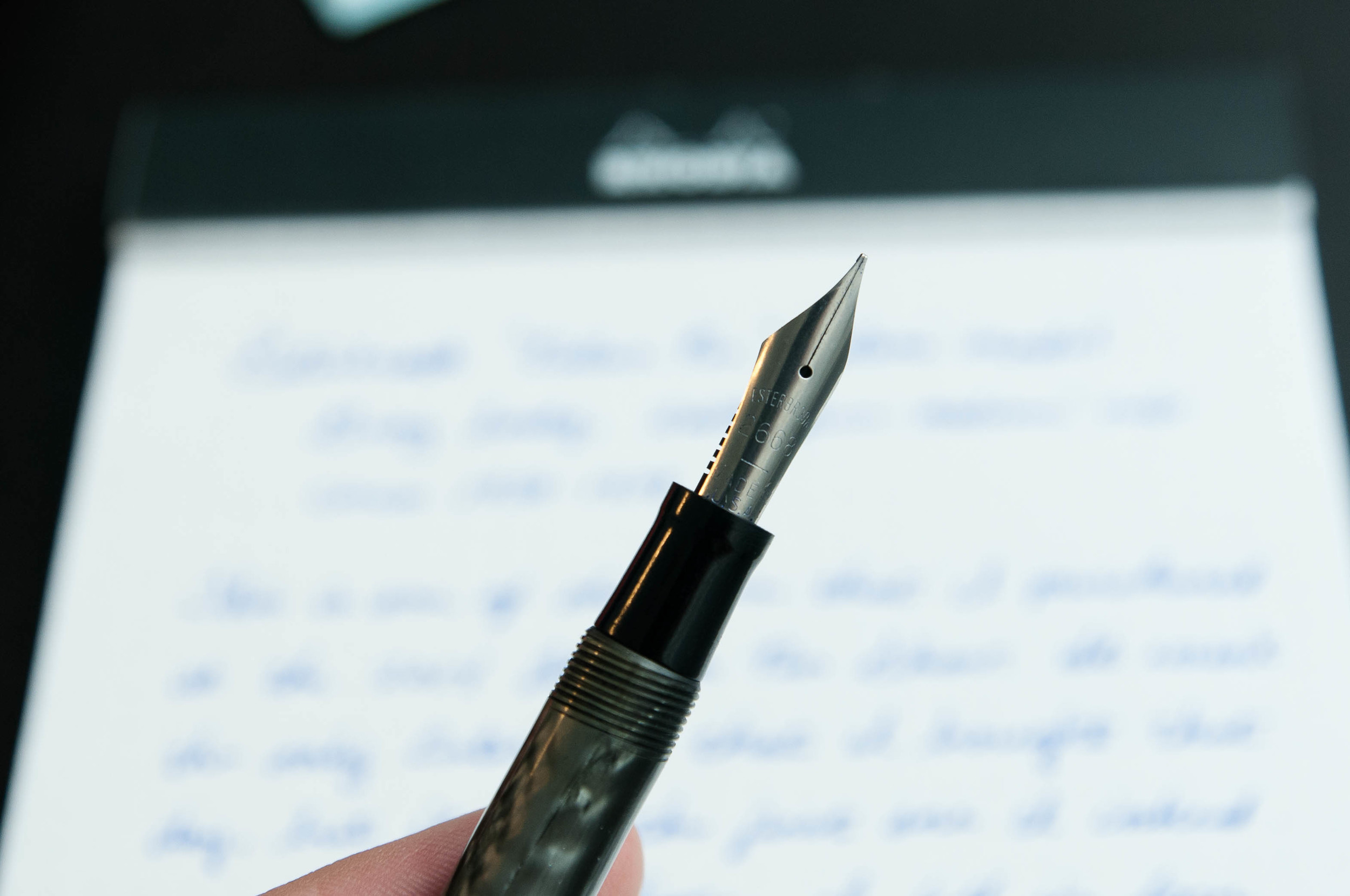
The nib that came with the pen is a model 1551 – firm medium (student). The nib unit was of an old variety that had a shallow feed. The shallow feeds are apparently prone to leaking, so the vendor included a new-old-stock 2668 nib unit with the pen. I installed the 2668 nib when I got home, and that's all I've been using since.

Now, the pen

I fell in love with this pen the minute I inked it up and started writing with it. I don't know why, but I wasn't expecting it to write so flawlessly. I thought I would possibly end up tweaking and adjusting it a bit before it would write well. No, the pen filled with ink and wrote buttery smooth and consistent from the beginning.

Size

Even though this pen is a short model, it feels like an average full-size pen when posted. When capped, it's somewhere between a TWSBI Mini and a Kaweco Sport. When posted, it's the longest of the three. I've written with the pen for long periods without any complaints. It's a great workhorse pen that I throw in my pen case almost every day. I only paid $30 for the pen, but I treat it like one of my > $100 pens. It's special to me.

Filling mechanism

Ah, the lever filling mechanism. I can't help but make a quick aside about this filling system. As a boy, I loved the scene in Indiana Jones and the Last Crusade where Professor Henry Jones struggles with a solider inside of a German tank, and manages to win the fight by squirting ink in the soldier's eyes. Cheesy, I know, but it's a childhood favorite. I doubt a lever-filler can actually squirt ink with that much force anyway. Back to the point, though.

The lever filling mechanism actually works really well. A small complaint that I have is that it's difficult to get my fingernail under the tiny lever handle sometimes, but that's just a minor gripe. Drop the nib into the ink, work the lever a few times, and you're good to go.

In my experience, the pen doesn't hold much ink. It's definitely much less than a standard Lamy converter, and more like the squeeze converter that comes with the Pilot Metropolitan. Also, another complaint is that you can't tell how much ink is left. You know when the ink starts turning a lighter shade that you only have a few more words left.
Writing

The firm medium nib is a pleasure to write with. There are pens that cost a lot more than this one, and they can't hold a candle to it. I know that each nib is unique and that I might have gotten a little lucky with this one, but that's alright. It's the pen that I have, and I absolutely love it.

The nib is long, which is nice for keeping a good grip on the pen. It's never had a problem starting, skipping, or scratching. I couldn't be happier with it.

And sometimes, depending on the paper and ink combination, the nib acts somewhat like a stub. I've found inks and paper with low saturation properties tend to behave differently with the nib. The tip of the nib is rounded on the top and bottom, but the sides are fairly square. I'm guessing that's what is causing the stub behavior at times. Wet inks do not show any sort of stub behavior, however.

One of the coolest parts about the Esterbrooks is that you can easily swap out the nibs. The nib and feed unit simply unscrew from the section, very similar to how the Edison Beaumont or new Kawecos work.
Overall

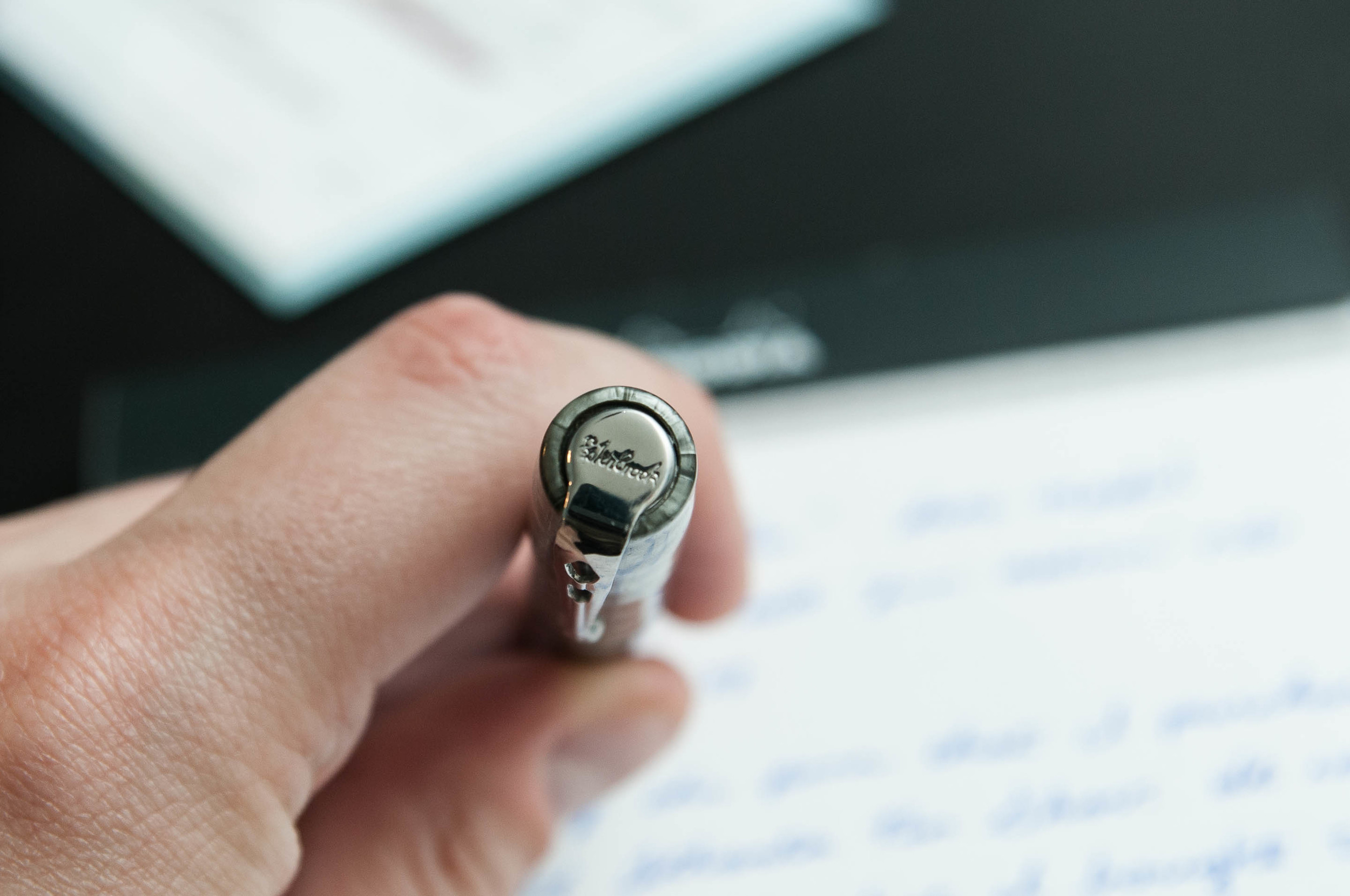
This is easily one of my favorite pens, and I'm really glad I took the chance to try one out. It can be a bit nerve-wracking to purchase an antique pen that may or may not actually operate as a functional writing instrument. In my case, I found a good dealer who does a good job of restoring the pens. Being as new to this as I am, I can't really offer any advice other than to find a reputable seller who cares about these pens. If you're fortunate enough to have a pen show near you, that's a fantastic place to see lots of vintage pens and knowledgable, friendly people.

This is one of my favorite new pens, and I can confidently say that I will be expanding my Esterbrook collection.

(You can find more from Jeff online at Draft Evolution, Twitter, and App.net.)

Posted on May 14, 2014 and filed under Esterbrook, Fountain Pens, Pen Reviews.

Esterbrook J Fountain Pen Review

Esterbrook Capped.jpg

(This is a guest post by Garrett Kubat. You can find more from Garrett on Twitter @gazkubat.)

The Esterbrook J is my first vintage fountain pen. Of the pens that I own it is one of the most consistent workhorses that I can rely on to write. It writes when I need it to and only stops when the nib leaves the paper. The reliability is a huge plus in this vintage fountain pen. Reliability means that it can go from a novelty item to something that can be used every day. My estimates put this particular fountain pen to have been manufactured around 1948. I came to this conclusion by the fact the pen and lid both have the black plastic "jewels" on the ends. If someone more knowledgeable than I has a more accurate estimate I would be glad to hear it.

I purchased the pen from Brian and Lisa Anderson on their wonderful website for $60.00. They had others for sale that were cheaper, and I had read that eBay regularly sold them for even around half the price, but I was smitten by the blue colour and how I knew it would be a functional pen. Pens are beautiful, but I would rather have an ugly pen that wrote than a gorgeous one that didn't. That being said I was able to have the best of both worlds with this pen. This particular pen seems to be in a near flawless condition with no worn spots or scratches.

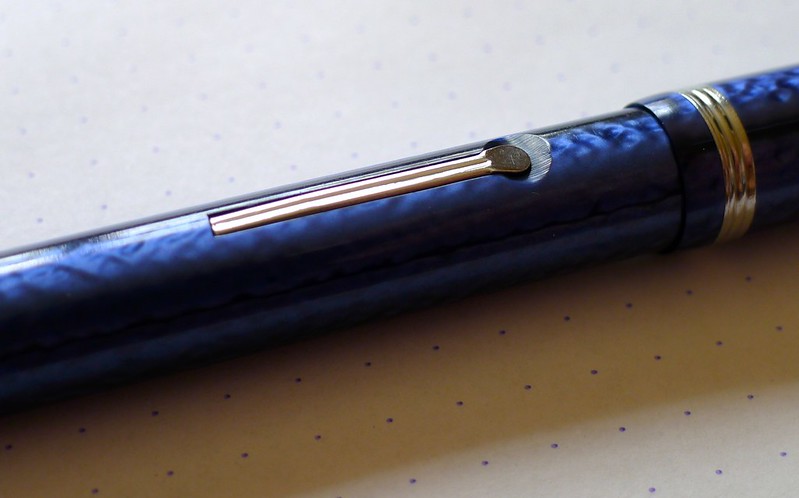
Esterbrook Clip.jpg

I would credit Brian and Lisa with the exceptional restoration I assume this pen received, but the state of the pen also speaks to how well these pens were made. They were made to be an affordable pen that used cheap but durable materials and were solidly crafted. It feels durable and write consistently, just like another amazing pen: The Lamy Safari. There are obvious differences but the two greatest similarities are they are long-lasting and reliable.

One element that makes this pen unique amongst the pens I own is the filling mechanism. Within the pen is an internal sack that can be depressed by the lever on the barrel of the pen. When the sack is depressed and the nib placed in ink all you do is push the lever back flush with the pen and allow the ink to flow into the pen. The ink capacity is not up there with say a TWSBI but it holds enough that I am not worried about running out of ink if I take the pen with me for the day.

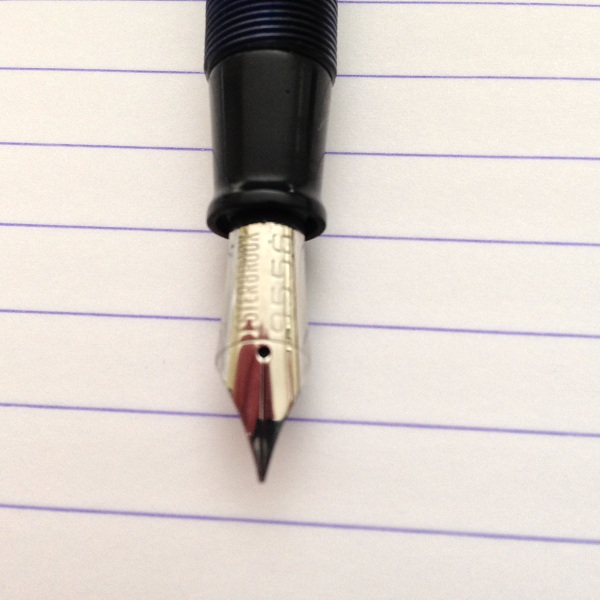
Esterbrook 9556 Nib.jpg

This is an excellent choice to begin the vintage fountain pen journey with. The pens come in a variety of colours as well as other models like the LJ (Full length but slimmer than the J) and the SJ (shorter and thinner than the J). They can be found at a relatively affordable price and the large amount of nibs available makes these extremely versatile. An extensive list is available on Esterbrook.net, which is managed by the aforementioned Brian Anderson. I only have the 9556 (Fine Writing) and the 9555 (Gregg Shorthand) but I would love to get my hands on a stub nib.

This is my only vintage fountain pen so I can't compare it to others but I would say it stacks up well to a Lamy Safari, it was made to last and (most importantly) write.

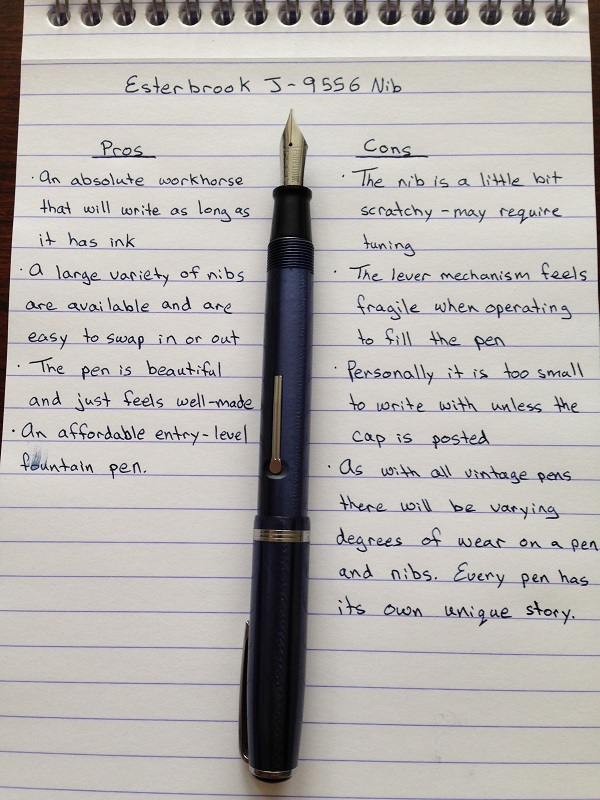
Esterbrook ProsCons.jpg
Esterbrook Writing Sample.jpg
Posted on December 16, 2013 and filed under Esterbrook, Fountain Pens, Pen Reviews.

My Fountain Pen Education: The Esterbrook LJ

Esterbrook

As my knowledge and experience with fountain pens has grown I am finding that my tastes have grown broader. Where before I would only consider a handful of the newest, modern pens I am now looking more and more at vintage models to add to my growing arsenal. Enter Esterbrook.

According to the article on Wikipedia (because everything you read on the internet is true), Esterbrook was once the largest pen manufacturer in the US, producing up to 600,000 pens a day at its peak. How that is even possible in the mid 1900's I have no idea, but we are all benefitting from that prodigious production now. Esterbrook pens provide one of the best values in vintage fountain pens today.

Entry price is one of the main reasons I wanted an Esterbrook. There are many, many options available in the $20-$30 range, and fully restored models go for as little as $40. But honestly, the design of Esterbrook pens is what got me, regardless of price. From bright colors and swirls, to solid black, to Cracked Ice, their range of designs has nearly everyone covered.

Esterbrook

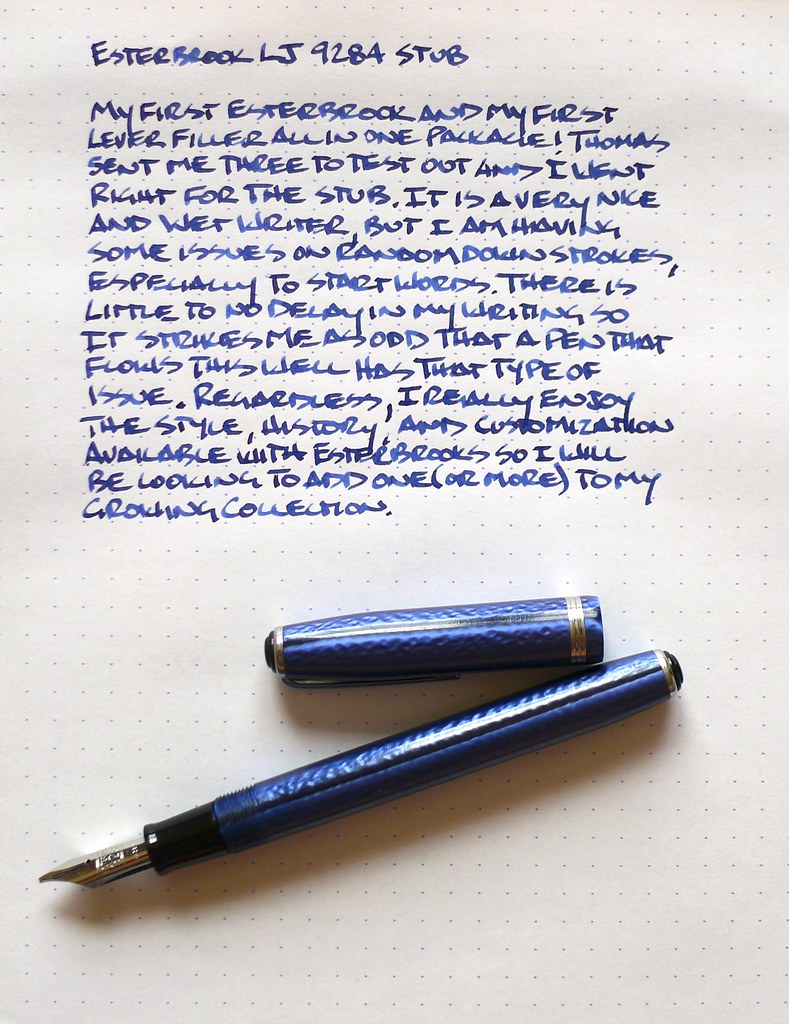
I wanted to start with one of the basics, so my friend Thomas sent me one of his to whet my appetite: The Esterbrook LJ Double Jewel in blue. The pattern and color are classic Esterbrook - you will see these pretty regularly in fact. But it was so good looking I went for a similar style when I made my first Esterbrook purchase at the Atlanta Pen Show.

While the vintage look and style would be enough to sell most people I left the best part for last. The amount of nibs available to customize an Esterbrook with is AMAZING! I asked Thomas to try out a stub nib, so he sent along a #9284 to try out. When I bought my own, Brian Anderson swapped in a #9550, an extra fine nib that I have enjoyed. My friend Ana, an Esterbrook junkie herself, sent me the chart in her post "Buying a Vintage Esterbrook", and I also used Brian's reference chart at Esterbrook.net to narrow down my choices. That was much harder than it seems.

Esterbrook

Manufacturers today aren't going to go to the lengths that Esterbrook did to make "The World's Most Personal Fountain Pen". Sure, some customization options are available but barely a fraction of what Esterbrook was able to accomplish. If you are looking for a vintage fountain pen to fit you perfectly you need look no further than Esterbrook.

Posted on June 24, 2013 and filed under Fountain Pens, Pen Reviews, Esterbrook.