Posts filed under Fountain Pens

Review: Pelikano Fountain Pen - 2010 Edition

This review is by Kalina Wilson, who can also be found at geminica.com.


Pelikano7 The Pelikano Fountain Pen has been around for 50 years as a sturdy, easy-to-use fountain pen aimed at school kids. Pelikan has redesigned the pen several times over the years; this version is new for 2010.  


The Pelikano writes smooth and wet, gliding easily across the paper with ink flow that doesn't let up at any speed. Probably due to this abundant ink flow, the line width seems to depend largely on the surface. 


Pelikano1


On absorbent papers the width of the "fine" nib is similar to a Lamy Safari EF, but on non-absorbent papers (or sketching over watercolors, as shown above) the line gets quite broad.


Pelikano5 As with previous designs, the Pelikano 2010 is available in a few nib sizes, colors, and customized for left-handed and right-handed writers.  It currently retails for $18.40 at JetPens.


Like our friend the Pen Addict, I favor a fine line or else a variable line that is quite fine at its minimum width so this one is a bit broad for me. That said, the ease with which it lays down a whole lot of ink is quite alluring. I have no other fountain pen that will effortlessly fill an area with ink like this one will. The sketch to the right was made on a relatively absorbent paper, but it was still easy to get a thick, rich ink fill.


Pelikano6 The grip on the pen feels very comfortable. Fingers naturally end up where they are intended to be.  The body is lightweight and unobtrusive. The cap is not as unobtrusive;  it doesn't feel like it is intended to be posted, and wobbles around on the end of the pen. I notice it a little, but it's not so bad that it stays on my mind while drawing.


The bright side of the cap is that it snaps closed very snugly over the nib. Between the cap and the design of the nib housing, this pen feels... safe.  My fingers don't come into contact with the ink at all.  There has been no ink leakage at all.  Any time you have a large amount of ink in any pen in your bag, there is at least some small chance of disaster - but this pen feels quite secure.


Pelikano2 The Pelikano takes international standard ink cartridges as well as a special long cartridge that appears to hold twice as much ink.  I don't really like the way these cartridges connect to the pen - it takes a little pushing to get the cartridge to connect, and it's hard to be certain when it is all the way on.  However, it is nice to know I could travel with this pen and have no problem finding extra cartridges.  Between the easy-to-find cartridges, clean nib, and affordable price point as far as fountain pens go ($18.40), this would be a good choice for on-the-road sketching.


Pelikano3


I do wish there weren't two holes in the bottom of the body because otherwise this would be a great choice for an eyedropper conversion.  You can use a silicone sealant to close up those holes but personally I would never be able to trust the pen enough to travel with it after that.   If you want to use your own inks, the other option is the cartridge converter ($5.50).


Pelikano4 This pen was a pleasant surprise, despite the broad line.  I'll probably fill it with black ink and use it in combination with a finer-tipped fountain pen to achieve two different line weights.


 If you like a broader line or tend to have flow issues due to writing or drawing quickly, this pen could be a great match for you!


Posted on July 27, 2011 and filed under Fountain Pens, Geminica, Guest Post, Pelikan, Pen Reviews.

Review: The Noodler's Flex Pen, Revisited

This review is by Kalina Wilson, who can also be found at geminica.com.


Not long ago I reviewed the Noodler's flex pen with mixed results.  I wanted to love it, but my pen just couldn't keep up a steady flow of ink. Thinking it was just a matter of proper adjustment I spent hours trying every bit of advice online, even carving into the ebonite feed, but the pen got no more usable. Instead of giving me a graceful, sweeping line I was ending up with awful chicken scratch because so much labor was involved in making the pen flow.


Img102 It must be concluded that at least some of these pens aren't very good straight out of the box. That's not too surprising - it's often the case with affordable fountain pens, and  the Noodler's is very affordable at $14.  At least the Noodler's Flex is made to be easily worked on, with easy disassembly and a workable feed. It's a great intention, design, and pricepoint, you can't knock that. Still, I was disappointed that I was spending more time fiddling with my flex pen than actually drawing with it.


Now to the GOOD NEWS.


In June, a few online suppliers received new shipments of the flex pens, and I picked one up in 'Vulcan Coral' from Goulet Pens.  


This one flows like a dream.  Straight out of the box! No struggle required, though I did wash the nib in soap and water as always.  I love sketching with this thing, and am already angling to grab another one next time they're on the market (that June batch is already long gone, but online retailers can put you on a list to be alerted when they're coming back). Flex nibs have a learning curve attached for those of us that aren't used to them, but now that I'm spending more of my time learning instead of cursing, I'm making some progress. 


Img103 Does this mean the new Noodler's flex pens are better?  Or is it a game of chance, since each ebonite feed is slightly different than the next?  Did I irrevocably destroy my first pen during my efforts to salvage it? Is my new flex pen made out of magic?


Who knows.  But I can tell you this - a functioning Noodler's flex pen is a thing of beauty, and a great sketching tool for artists.  It's a gamble but the payoff might be the pen of your dreams.


Posted on July 25, 2011 and filed under Calligraphy Pens, Fountain Pens, Geminica, Noodler's Ink.

New Pilot Petit1 Mini Fountain Pen Review

Pilot Petit1 Review


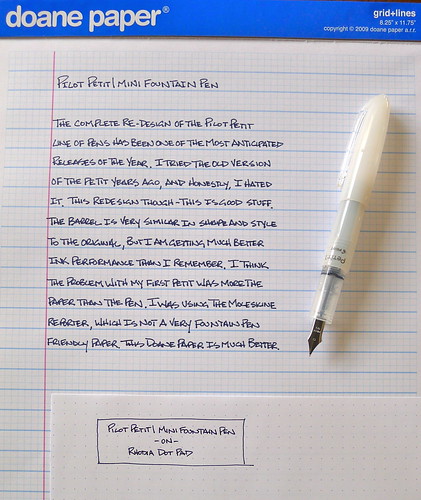
Almost exactly three years ago, I reviewed the original Pilot Petit1 fountain pen. Needless to say, I was not a fan at that time, but I have learned a lot of things since then. First and foremost, Moleskine paper is not fountain pen friendly. I alluded to that fact in the original review, but never followed up on different paper - until now.


The new line of the popular Pilot Petit series just recently came out, and included the traditional Petit1 fountain pen, but also added the Petit2 marker pen, and Petit3 brush pen. I went with the Petit1 first because I wanted to give it another shot, and this time on some good paper!


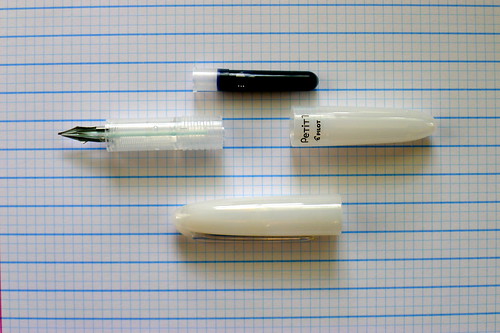
Pilot Petit1 Exploded View


Doane Paper has been my go to paper for years, and the Pilot Petit1 works like a champ on it. I chose blue black ink to test first (why is it that I think all fountain pens are supposed to have blue black ink?), and with its fine nib the Petit1 performed impressively, and I might even say flawlessly.


I got very clean and sharp lines on the Doane Paper. The ink dried into the page quickly, and while there was some show through on the back of the page, there was no bleeding through to the next page behind it. I also tested it on a Rhodia Dot Pad, and it performed superbly as well. The ink doesn't soak into the fibers of the Rhodia as much, so the line is finer, but doesn't dry as quickly.


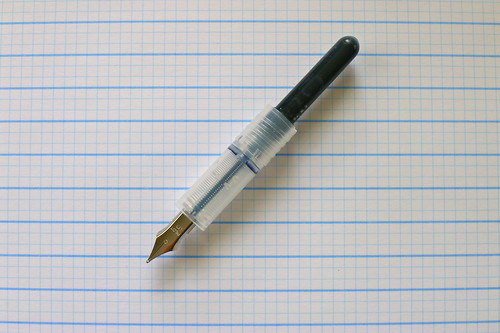
Pilot Petit1 Nib and Refill


Pilot has done a great job reintroducing the Petit line, making it fun and affordable for everyone to try out refillable fountain pens, marker pens, and brush pens. I can't wait to see more reviews on these.


Products used:


Pilot Petit1 Mini Fountain Pen - White Body - $3.00 from JetPens


Pilot Petit Pen Refill Cartridge Blue Black - $2.25 from JetPens


Doane Paper Writing Pad - $10.95/3-pack from Doane Paper

Posted on June 29, 2011 and filed under Fountain Pens, Pen Reviews, Petit, Pilot.