Posts filed under Fountain Pens

Franklin-Christoph Model 19 "1901" in Smoke and Cinnamaroon: A Review

(Susan M. Pigott is a fountain pen collector, pen and paperholic, photographer, and professor. You can find more from Susan on her blog Scribalishess.)

I don't know why I never considered purchasing a Franklin-Christoph fountain pen. I've seen a few photos of their pens in ice acrylic, and those didn't interest me. But after Franklin-Christoph came out with their monster 1.9 music nib, I found myself on their Web site looking at their pen offerings. One caught my eye: the Model 19. I liked the shape of the pen, and I saw they were working on a new color combination that I thought was unique and gorgeous–smoke with cinnamaroon bands.

I haunted the site daily, wondering when the new color would come out. Finally, I emailed them to get the date and received a response almost immediately: "They're done and should be on the Web site tomorrow!" The next day I ordered one.

The pen arrived a few days later, but I made myself wait until Friday, my writing day, to open it. It was well-packaged, and by that I mean an outer postal box, an inner postal box, bubble wrap, and packing paper around a plain white cardboard box with the Franklin-Christoph logo.

Inside was a maroon leather zip pouch with the pen, two blue ink cartridges, a couple of Franklin-Christoph business cards, and a Mike Masuyama card verifying that my medium 18K nib was ground by him into stub.

The pen is large. The barrel is .61 inches in diameter, and it's certainly the fattest pen I've used. It's a good thing they included the pen pouch, because Model 19 absolutely won't fit in my Franklin-Christoph Penvelope.

Penvelope.jpg

Although the barrel is wide, the grip gradually narrows from .50 inches to .425 closest to the nib. So, while the pen itself is much wider than my other fountain pens, when you compare the grips, they aren't drastically different.

Its length is more typical of fountain pens: 5.50 inches capped, 5.1 inches uncapped, and 6.62 inches posted (though I would never post this pen). At only 28.35 grams without ink, the pen isn't heavy for its size.

Made of thick acrylic, this version has swirls of dark and light gray with beautiful sheen. The cinnamaroon bands sparkle and offer a truly unusual contrast to the smoke colors.

The clip is rhodium plated and etched with four diamonds. I never use the clip on my pens, but this one seems sturdy.

The cap top is inscribed with the Franklin-Christoph logo, and "Franklin-Christoph" is etched into the cap where ordinarily you might find a cap ring.

The nib is a single-tone, rhodium-plated 18K gold nib with minimal styling. A yellow diamond with the logo adorns the nib. I'll admit I don't like this nib's design (the stainless steel nibs are actually prettier). The etched yellow diamond clashes with the rhodium plating of the nib. I wish they had simply etched the logo into the nib itself (like they do on the stainless steel nibs) and added scroll work.
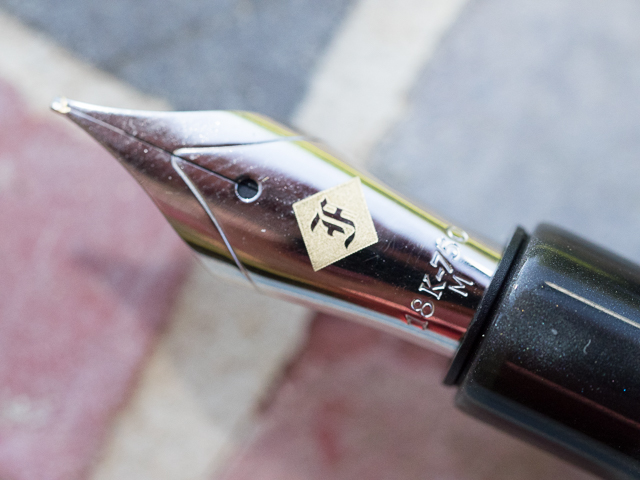
I like the size of the nib and the stub doesn't catch on the paper like some of my italic nibs do. Although the nib has no flex, it's springy, and you can get a little line variation if you press down.

I've noticed a few hard starts and a tiny bit of skipping with this nib. Normally I wash a new nib thoroughly before inking it, but I failed to do that this time. When I change ink, I'll do a good cleaning and see if the skipping stops. The problem may be related to the converter. I noticed that the ink pooled in the middle of the converter after the pen had been lying on its side for the evening. I had to force the ink down using the knob to get it flowing again.

The pen uses cartridges or an included converter. The cartridges look minuscule next to this big pen. The converter seems adequately sized, but I'm not impressed with its performance so far. It lacks a metal ball to keep the ink flowing. And, unlike other models in the Franklin-Christoph line, apparently you can't turn the Model 19 into an eyedropper.

Unfortunately, this pen is simply too wide for my small hands. I noticed that, after just a few pages of writing, my wrist felt fatigued, a problem I've not encountered with my other fountain pens. It's not the weight of the pen; the large barrel seems to be the main issue.

Franklin-Christoph offers a lifetime warranty on the pen, which tells me these pens are built to last. There's also a generous 30-day return policy, no questions asked.

You can order the Model 19 from Franklin-Christoph with a stainless steel nib in a variety of sizes for $195. If you want it with the impressively-sized music nib either in shiny stainless steel or the new stealth shadow, you'll pay $205. With 18K nibs from EF to B the cost is $285. For a Masuyama specialty nib in stainless steel you'll pay $210 and $300 for an 18K.

Pros

  • Stunning pen at a reasonable price. The smoke design with the cinnamaroon bands is unique and beautiful.
  • An amazing variety of nib choices in both steel and 18K gold.
  • Very light pen considering its size.
  • The Masuyama medium stub writes beautifully (but see below under cons).
  • Comes with a handy zippered pen pouch. You'll need this, as the pen won't fit in normal-sized pen loops or pen cases.
  • Prompt and courteous customer service.
  • Comes with a lifetime warranty.

Cons

  • This pen is large. If you have small hands it might not be comfortable for you.
  • I prefer piston-fillers over cartridge/converter pens. But converters are often easier to clean.
  • The converter does not move the ink to the feed without some user intervention, which is bothersome. This could be due to the ink I was using (Diamine Red Dragon). Some inks flow better than others.
  • My nib had some hard starts and a little bit of skipping, perhaps due to the converter/feed flow problem.
  • I don't particularly like the 18K nib design, but this is purely personal taste.
Posted on May 8, 2015 and filed under Pen Reviews, Franklin-Christoph, Fountain Pens.

Pelikan Souveran M1000 Fountain Pen Review

YES!

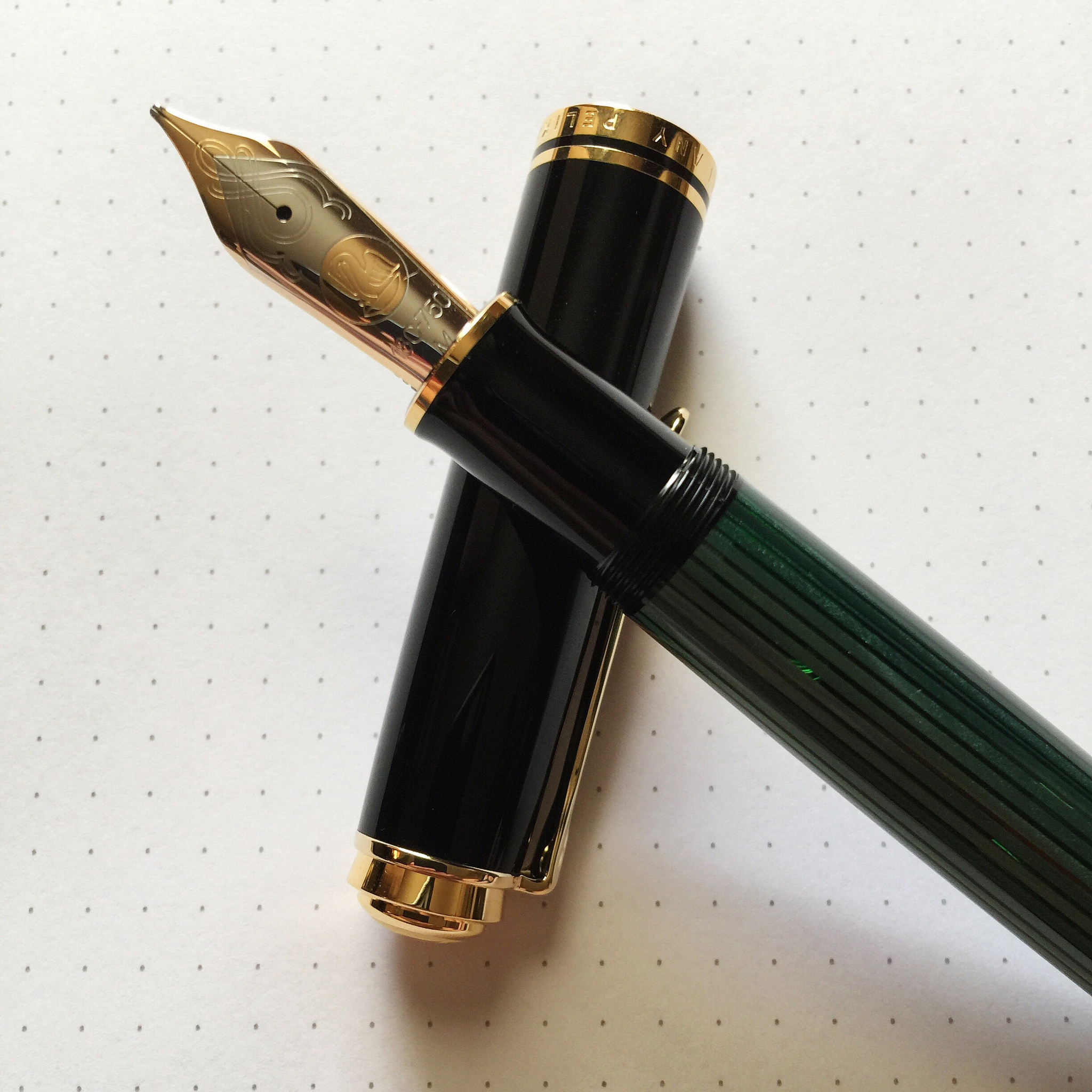
That was the answer I gave Massdrop when they asked if I would be interested in reviewing the Pelikan Souveran M1000 fountain pen for their latest pen drop. The M1000 represents the top of the food chain among Pelikan's main line of pens and I am excited to have this opportunity to give you my thoughts on it.

As a company, Pelikan is one of the most respected in the fountain pen industry. Their history traces back over 170 years, and their quality and care in manufacturing shows in every single product they make. I was a fan of Pelikan well prior to receiving the M1000, with models from the 200, 400, and 800 series already in my collection, and a 600 in route as I type this. So yes, I like Pelikans.

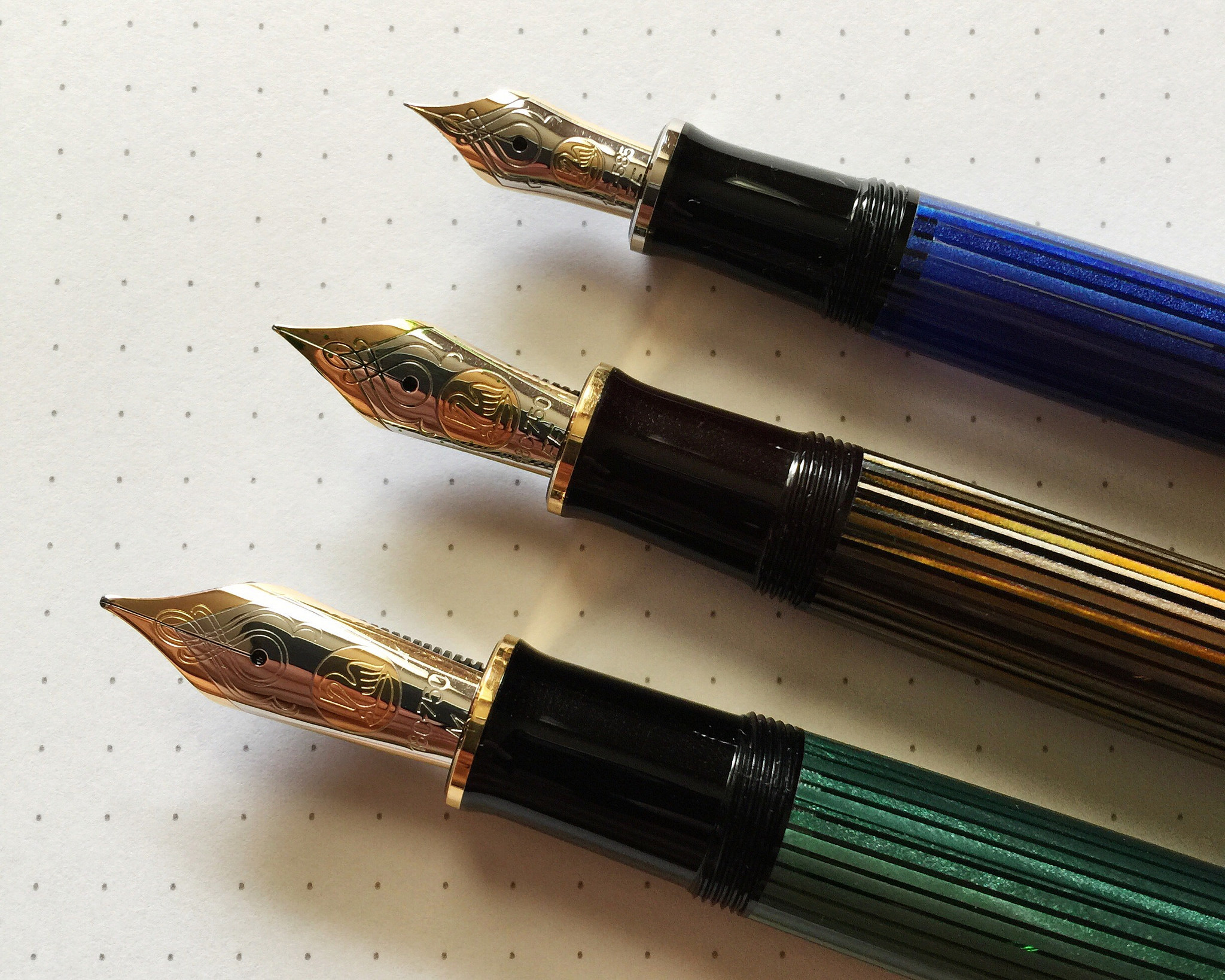
Top to bottom: M405, M800, M1000.

Top to bottom: M405, M800, M1000.

While it has the same general design and lineage as other Pelikans in the flock, the M1000 is a completely different bird from any I have used previously. It is largest pen in the series, checking in at 5.74 inches long when capped and 1.16 ounces strong. Posting this pen is a no-go unless you are Andre the Giant, but I don't post so it works for me. I thought it would be too big honestly, but my recent experiences with the M800 Tortoise had me prepared for what was in store.

The barrel is large - let's get that out of the way right now. Too large? I don't think so because it is light enough to not get in the way. It's not feather-light by any stretch, but the overall feel is something Pelikan clearly considered with this pen in giving it great balance and making for a great writing experience.

The nib is the real star of this pen. I have never seen, much less used, a nib this large. It is a thing beauty. And it is different. So different I had to research what exactly it was I was experiencing as I was writing with the M1000 for the first time.

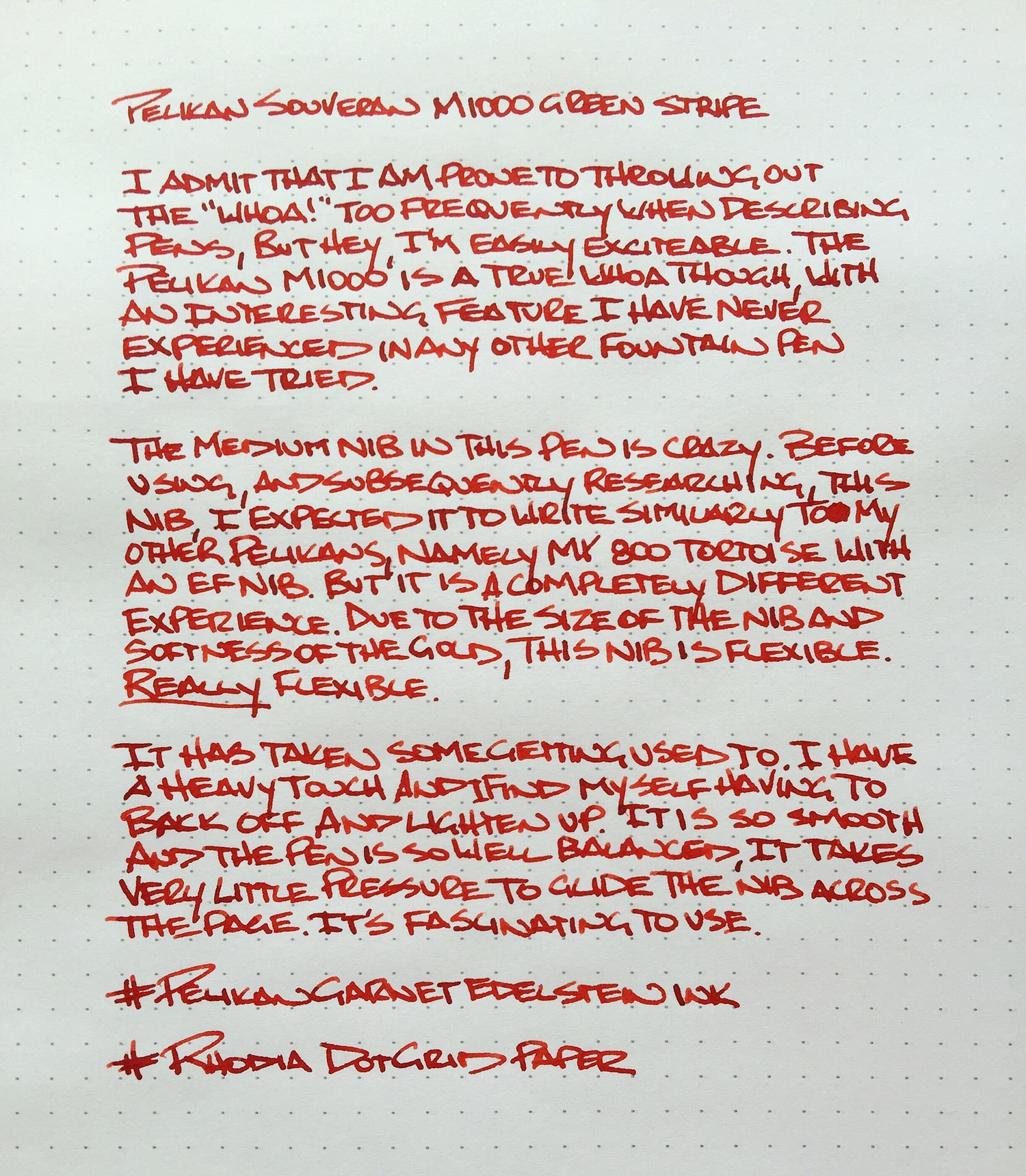
Gold, as most of you well know, is a soft material. With the size, thinness, and length of the tines in a nib this large, there is going to be some give when writing. It is not marketed as a flex nib pen, but you can't help but notice and feel the springiness when writing.

With my writing style (block print) the Medium nib took some getting used to. I had to use very light pressure and let the pen do all of the work. I got used to it quickly, but I can't help but think this nib is better suited for writers with a more flowing cursive style. My preferred nib is hard and firm, and this is the exact opposite.

This large 18k gold nib is a feature of the design. Many sites that sell it mention the difference in feel when comparing the M1000 to the M800 and below. It is a completely new writing experience that's for sure.

Will it fit your needs? If you have ever had the Pelikan M1000 on your wish list you will be hard pressed to find a better price. Massdrop only has 110 of the pens available, and nearly half are gone as I write this. Two barrel choices are avialable - Solid Black and Green Stripe, both with gold trim - and nibs ranging from EF to B.

Head over to Massdrop to check out all of the details. If you have never used Massdrop before, just sign up with your email address and you will be able to check this drop out, as well as the many other items they have for sale.

My thanks to Massdrop for providing this pen to me at no charge for review purposes.

Posted on March 17, 2015 and filed under Fountain Pens, Pelikan, Pen Reviews.

Visconti Opera Typhoon Blue Fountain Pen Review

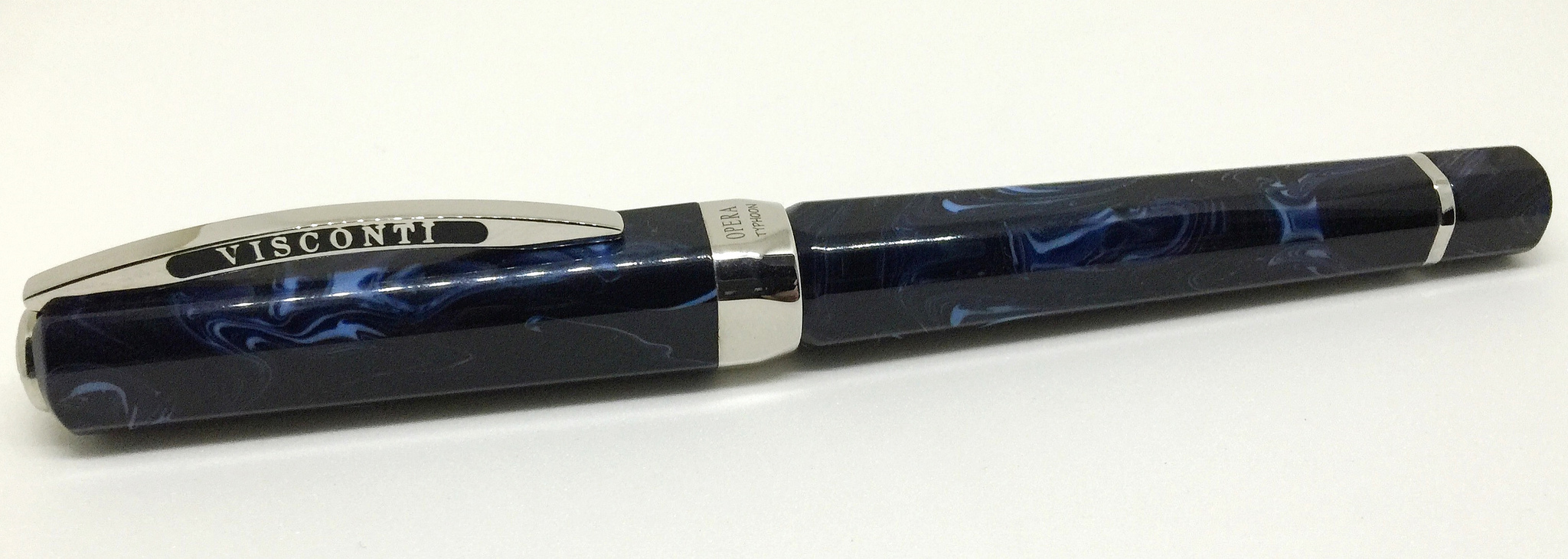
I picked up the this Visconti Opera Blue Typhoon at last years Atlanta Pen Show. It wasn't on the shopping list - the Visconti Wall Street was the pen I was hunting for - but I couldn't pass up a good deal, especially on a pen as pretty as this.

When you see pictures of the Opera Typhoon online, the first thing you are likely to notice is what they call the mosquito filler. This is what blew my mind well before purchasing this pen. It is a long, skinny, syringe-like apparatus that slides over the nib and section of the pen to help you fill the pen with ink easier. I love this idea because it eliminates some of the mess involved with filling fountain pens, similar to a snorkel filler. That is, when it works.

I gave the mosquito filler a few tries, but it does a poor job of filling the pen to capacity. It performs much worse than the built-in power filler (Visconti's piston mechanism in this pen) does. That's why you won't even see the mosquito filler pictured in this review. Don't buy the Opera Typhoon for that feature alone.

That small downer aside, there are several great reasons to check this pen out. Fist of all, the blue swirl resin barrel is spectacular. Pictures barely do this pen justice - see this one in person if you can because the color variation and depth of the swirl is amazing. It feels great too. There is some heft to it, allowing you to feel the density of the barrel when writing, but it is well balanced so you don't tire out quickly when writing.

Ink drawn into the rear chamber.

Ink drawn into the rear chamber.

The tubular Chromium nib is something I had never experienced before, both in material and design. I was expecting a wet writer based on all of my research on this pen, but found it to write on the dry side of the spectrum. Normally, that is my wheelhouse, but with larger pens and wider nibs (this one is a European fine nib) I want more ink flow. I shipped it off to Shawn Newton for a quick adjustment and it came back writing perfectly.

The way the tubular nib is designed allows you to write at a more vertical angle if that is your style. I used to write that way with gel and ballpoint pens so it was nice to try it out, but I still prefer a slanted, more traditional fountain pen writing angle, which the Typhoon handles perfectly as well.

As pretty as it is, and as cool as the nib is, I think my favorite feature is the double reservoir found in the pen. In a nutshell, there are two chambers in the barrel that can be sealed off from each other, if needed. For example, if you are traveling and are worried about the ink leaking, just point the nib in the air and unscrew the piston on the back of the pen to draw the ink into the rear reservoir. Screw the piston back down tight and that locks the ink into the rear, keeping ink from sitting in the writing chamber and helping prevent leaks when you least expect it. Reverse the process to release ink back into the bottom chamber and the Typhoon is ready to write immediately.

Ink back into the writing chamber.

Ink back into the writing chamber.

The feature list continues with what Visconti calls a "hook safe lock" that keeps the cap securely screwed onto the barrel. Think block threads with a bit more oomph. Visconti's clip design is one of its calling cards with its sleek, curved design and stamped logo. It clamps down firmly but has some travel built into it which allows you to raise it easily if needed.

Only 1000 pieces of this model were made, and with an MSRP of $695 it is a little panic inducing. That said, I see this pen going for much less in various places online. I paid less than $400 for mine, and Chatterly Luxuries currently has it on sale for $350, so that is the ballpark you should be looking to pay.

Would I recommend this pen to anyone looking for an interesting, unique fountain pen to add to their collection? No, I don't think I would, at least not without doing a ton of homework on it first. I enjoy mine, but don't go into this one blindly, and definitely shop around for the right price.

Posted on March 16, 2015 and filed under Fountain Pens, Pen Reviews, Visconti.