Posts filed under Fountain Pens

Lamy Imporium in Black and Gold: A Review

(Susan M. Pigott is a fountain pen collector, pen and paperholic, photographer, and professor. You can find more from Susan on her blog Scribalishess.)

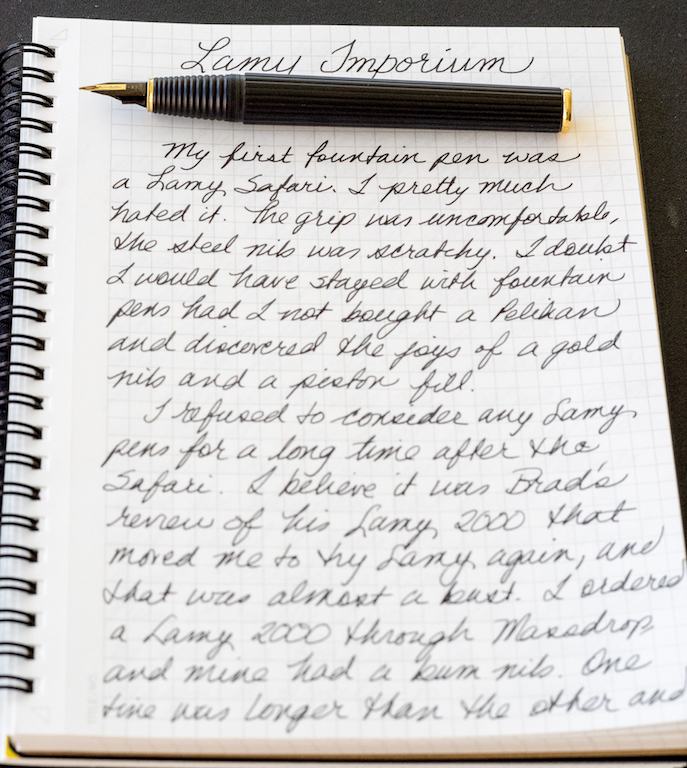
My first fountain pen was a Lamy Safari in metallic blue. I pretty much hated it. The grip was uncomfortable; the steel nib was scratchy; I didn't like the cartridges. I doubt I would have stuck with fountain pens had I not bought a Pelikan later that year and discovered the joys of a gold nib and a piston fill.

I refused to consider any more Lamy pens for a long time after the Safari. I believe it was Brad's review of his Lamy 2000 that convinced me to try the brand again, but that was almost a bust. I ordered a Lamy 2000 Makrolon through Massdrop, and when it arrived it had a bum nib. One tine was longer than the other, and there was this big divot on the top of the nib. Fortunately, Massdrop is an authorized Lamy dealer, so I was able to get a replacement nib. Now the pen writes like a dream, and it's one of my favorite pens.
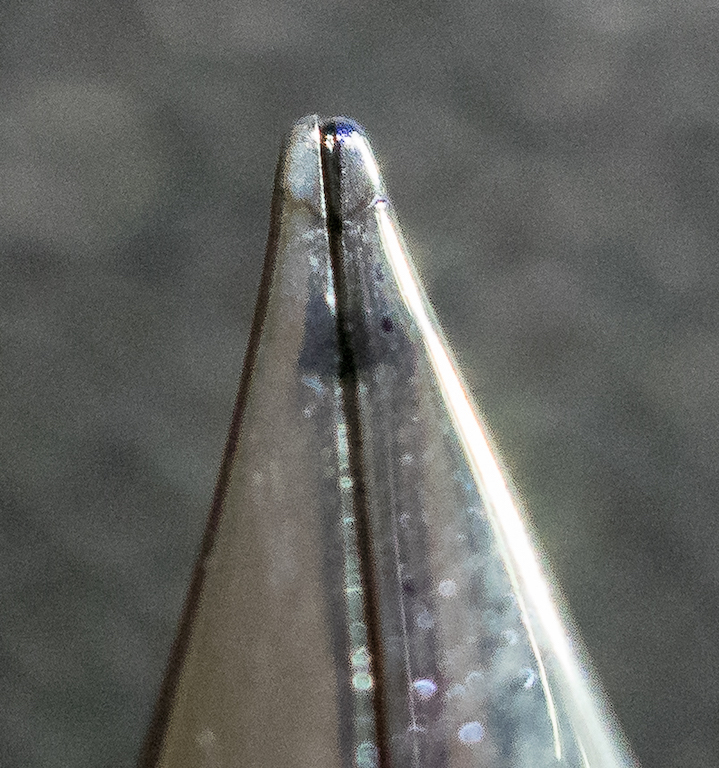
The bum Lamy nib.

The bum Lamy nib.

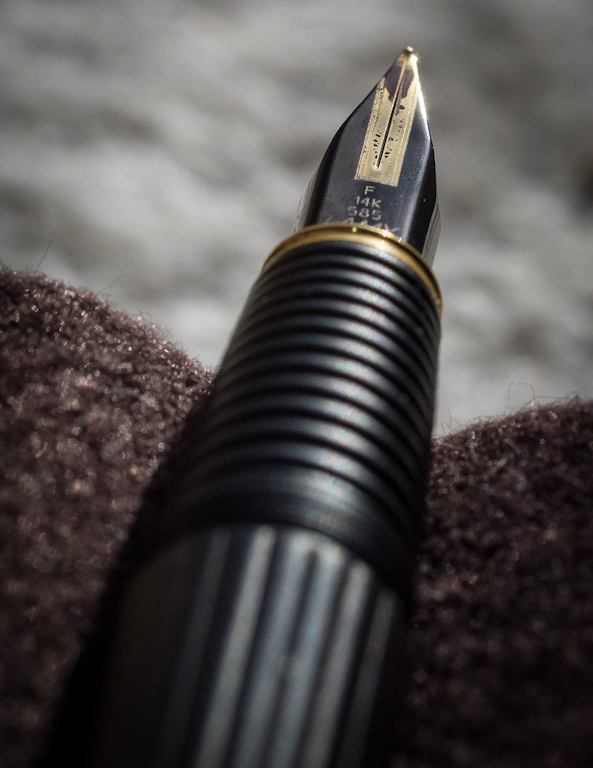
When I first saw shots of the Lamy Imporium, I was mesmerized. I loved the guilloche patterns, the clean lines of the cap, and the nib–oh, that nib! The black exterior with the gold center was just too cool. Then I saw the price. $520 for a Lamy? No way. Plus, initially I was told the pen wouldn't be sold in the US (that turned out to be incorrect). I quietly resigned myself to no Lamy Imporium.
But then Black Friday arrived, and I happened upon a sale at Pen Boutique. The Lamy Imporium was reduced plus Pen Boutique was offering an additional 20% off! I got my pen for around $320, which seemed considerably more reasonable.
The Imporium comes in a large, heavy box wrapped in tissue paper inside a white cardboard outer box. The box is black/gray with the Lamy name on top. The lid is hinged and when you open it, the pen is centered in the middle with a ribbon to keep it in place. The ribbon doesn't work. My Imporium had made its way to the outer edges of the box during shipping.

Underneath the presentation board is a cartridge, a cleaning cloth, and a booklet about the Lamy Imporium. It's nicely packaged, but in all honesty, a huge box like this seems unnecessary. I know the more expensive pens all come in big, heavy boxes (think Visconti and Omas), but Lamy could have crafted a much smaller, elegant box.

I'm not exactly sure what the Lamy Imporium is made of. Lamy states that the pen has been "partially galvanized" and "refined" with a black matte PVD coating, but what has been galvanized is never stated. I think that the underlying body of my pen is steel, but there's also a titanium version.

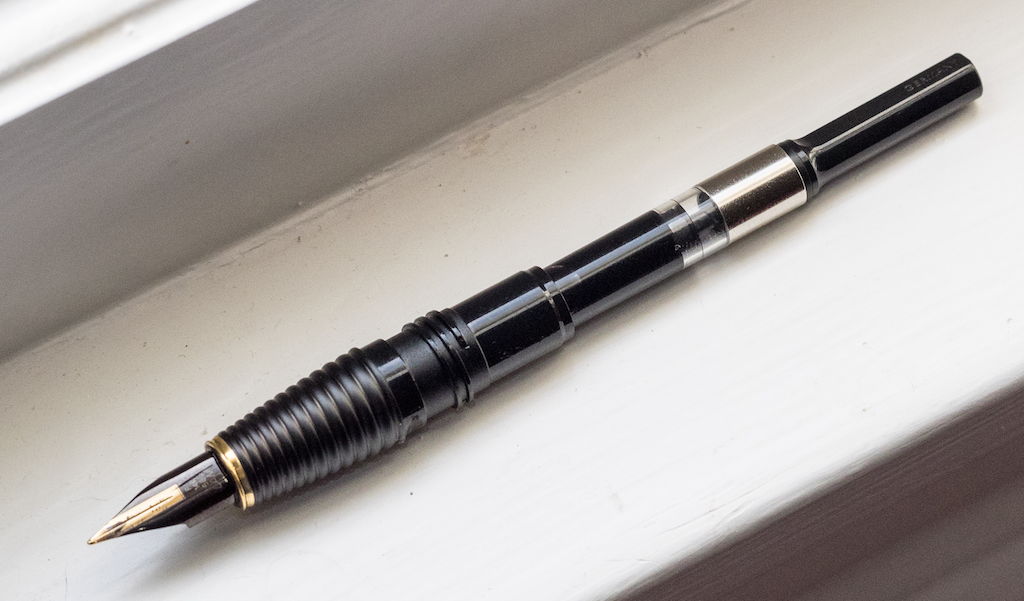
Regardless, it's a beautiful pen designed by Marco Bellini. The barrel and grip have contrasting horizontal and vertical guilloche patterns.
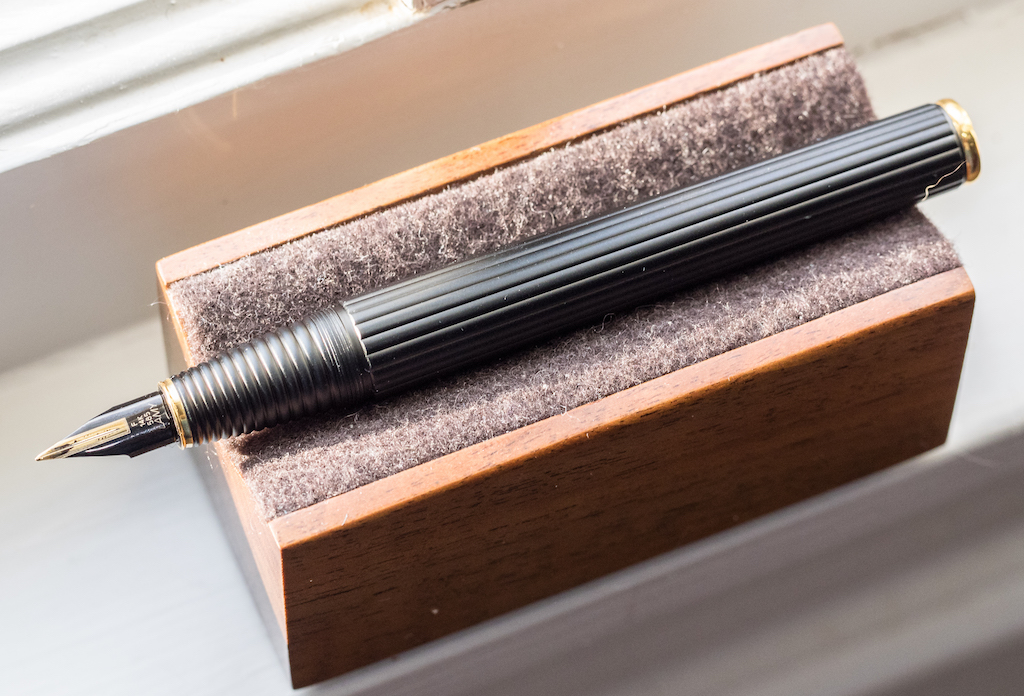
The screw-on cap is smooth with a gold-plated clip that nicely matches the cap's shape. The clip is spring loaded and opens and closes easily.

The only branding is the word "Lamy" on one side of the clip.

The barrel sports a gold ring where the nib and grip meet and a gold disc at the bottom.

The Imporium is a solid pen in the hand. It weighs 47 grams capped. It is 141mm/5.6 inches in length capped; 121mm/4.8 inches uncapped; and 169mm/6.7 inches posted. I write with it unposted (posted it is a bit ungainly), and the guilloche pattern on the grip helps to keep my fingertips from slipping on the coated metal surface. The ribs on the grip are rounded, and I don't find them to be at all uncomfortable.

The 14K EF nib is spectacular, writing more like a fine. Lamy describes the nib as "PVD-refined bicolour gold" that provides "a uniquely soft writing experience." I will say the nib writes smoothly and has unique feel. There's no flex, of course, but it has a bit of give when you press into it.

The pen is a cartridge/converter filler. I suppose a piston converter would have made the Imporium prohibitively heavy, but at this price point you sort of expect a piston.
I have a crazy affection for this pen. It grabbed me the moment I laid eyes on it, and I can't explain that rationally. It's just a black and gold guilloche pen. Big woo. But I think it's absolutely fantastic.

Pros

  • The Lamy Imporium is incredibly solid and well made.
  • The nib on this pen is fantastic. Not only is it unique with the black and gold contrasts, it writes beautifully.
  • I love the design of this pen with the guilloche patterns and the contrasting smooth cap. The gold accents add just the right amount of elegance.
  • Even though the pen is heavy, it is well balanced. The guilloche design makes the grip easy to hold.
  • If you don't like the black and gold, there's an all-black, stealth version and a titanium version.

Cons

  • Obviously the biggest negative about the Lamy Imporium is the cost. It is super expensive for what you get. I would never have bought one at the full price.
  • Some may find this pen too heavy for comfort.
Posted on December 30, 2015 and filed under Fountain Pens, Lamy, Pen Reviews.

Edison Pearlette Fountain Pen Review

(Jeff Abbott is a regular contributor at The Pen Addict. You can find more from Jeff online at Draft Evolution and Twitter.)

When I purchased my first Edison pen at the 2014 Atlanta Pen Show, I told myself that it wouldn't be my last. In that review, I spoke highly of the Beaumont that I had, and my feelings for that pen haven't changed a bit. So, it was no surprise to me that I was heavily drawn toward another Edison at the 2015 San Francisco Pen Show earlier this year in August.

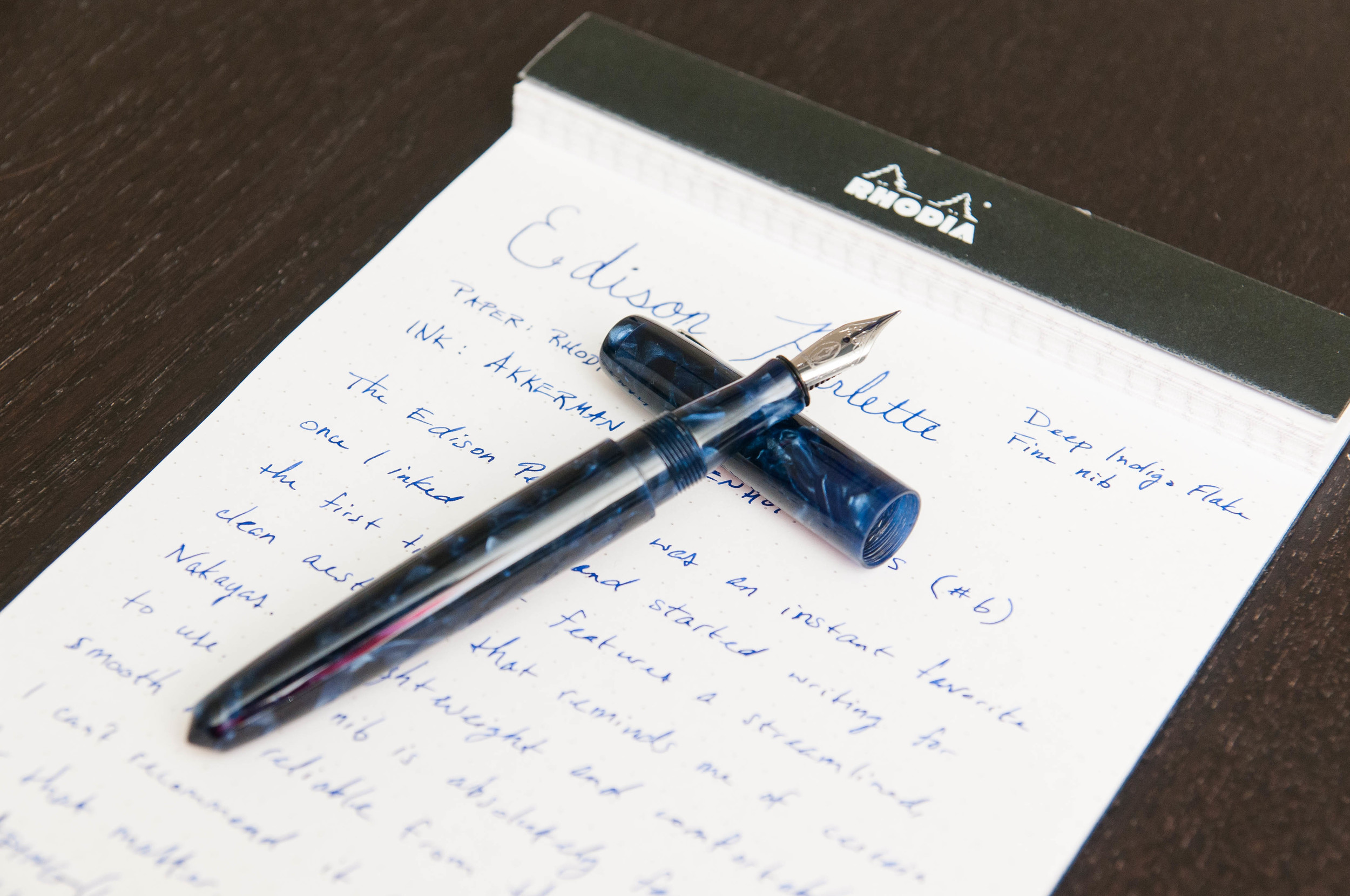
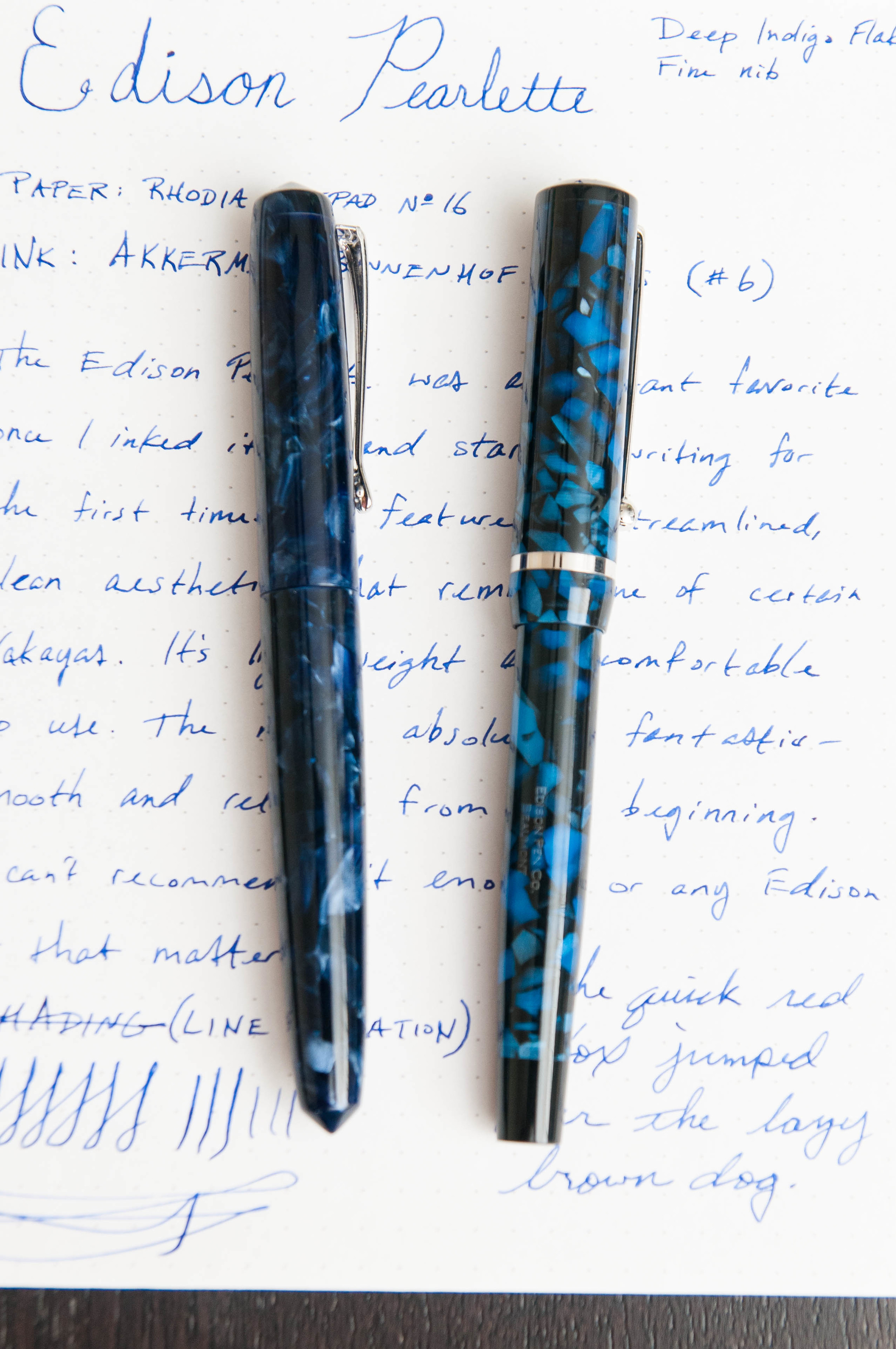
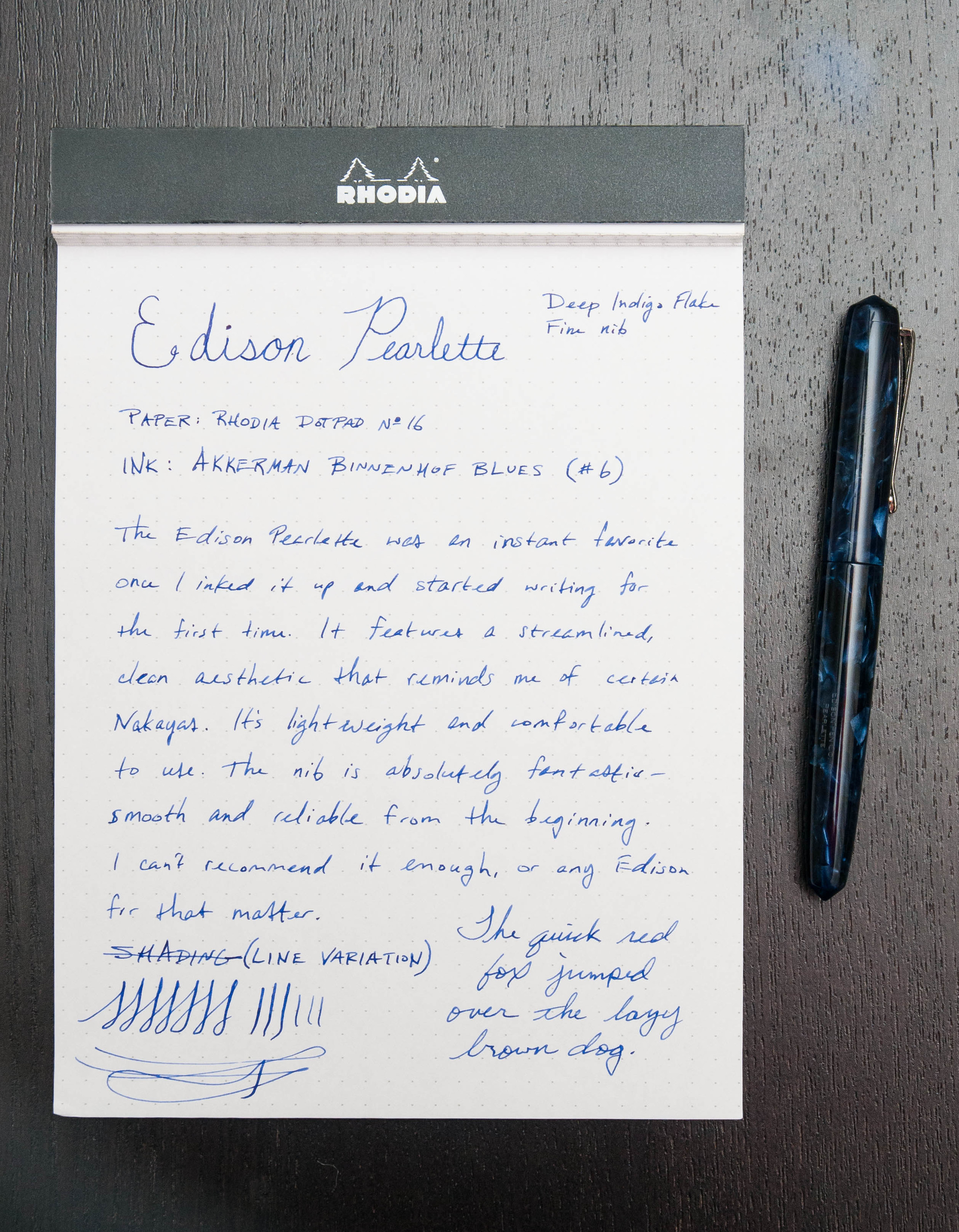
This year, I walked away with a brand new Edison Pearlette in Deep Indigo Flake with a fine steel nib. I've always been drawn to the shape of the Pearlette in general, and this year I decided to go for it. I have to admit, I was on the hunt for a more custom Pearlette, but I'm also a big fan of this blue flake material. And, like the last Edison review, I don't think this will be my last Edison...again.

Aesthetics

The Pearlette is part of the Edison's Production Line, which means they make the pen in three standard color options, along with the standard nib line-up. You have options of fantastic steel nibs, or gold nibs if that's more your thing. Since these pens are part of the production line, they're a bit more economical than the custom and limited pens from Edison. The regular steel nibbed Pearlette comes in at $149, with a $125 additional charge for a gold nib. Not bad at all for a high-quality, beautiful pen.

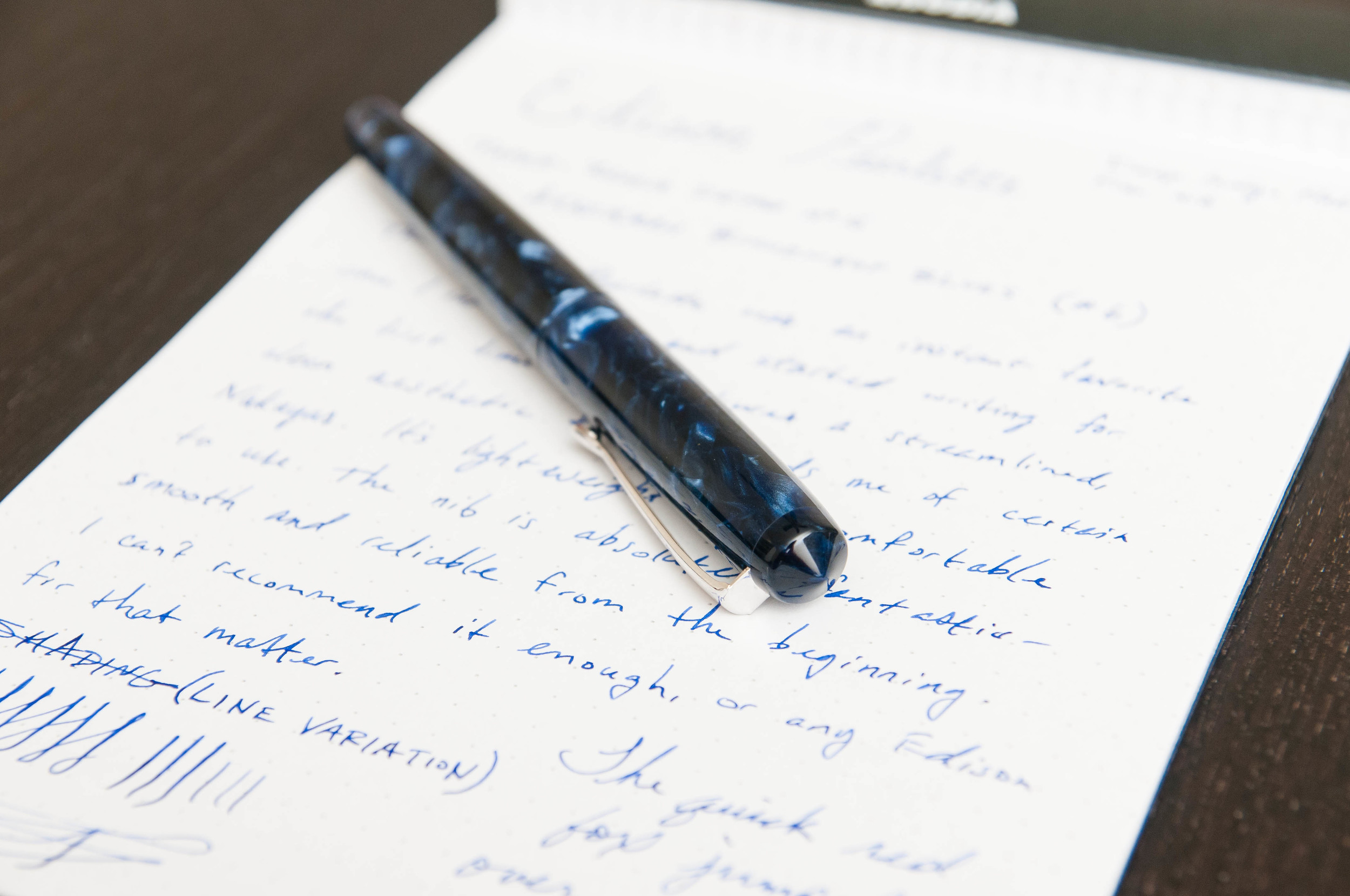
The Pearlette features a streamlined design that is equally minimal and mesmerizing. It reminds me of certain Nakaya models, and I think that's on purpose. In my opinion, you can't go wrong with the shape of this pen. It's elegant, clean, and balanced.

The size of the Pearlette is something between small and standard. It's right at 5.25 inches closed, and just under 4.75 when uncapped. This is a very comfortable size for me, but it's important to note that it is a smaller pen. This can be surprising when you only see pictures online of certain pens.

The "furniture" on the Deep Indigo Flake model is silver. The nib is the perfect size in relation to the body of the pen, which can sometimes be off in some pens. Apart from the clip and the nib, this pen is entirely resin. This makes the pen incredibly light and strong.

The cap screws on, and has very tight tolerances. When capping or uncapping the pen, it feels entirely sure and closes nicely without any gaps between the cap and the body. The pen will accept both a standard cartridge or a cartridge-converter, which Anderson pens included with my purchase. I've been using the converter exclusively since I can fill it with a matching Akkerman color.

The clip on the pen is fairly strong, but has a good bit of side to side give. Nothing alarming, but something to consider if you rely heavily on the clip. Personally, I'd love this pen in a clipless version to maintain the sleek aesthetic.

Overall, when you look at this pen, the shape draws you in, but the writing experience hooks you.

Writing

Picking this pen up and holding it in the writing position is what sold me. Before picking it up for a serious look, my thoughts were somewhere in the "I don't need another pen just because it's pretty" range, but that changed immediately after a quick test drive.

The grip is a fantastic shape for me. For reference, I hold pens using a fairly "standard" grip (standard as in how they try to teach it in grade school, but standard is really whatever works best for you). The grip is a tad small, which lends itself to smaller writing. I paired this pen with a fine nib, and I think that was an excellent choice.

The cap posts easily, but I typically use it unposted. Come to think of it, I very rarely post my pens unless they are a compact, short size (like Kawecos or the TWSBI mini).

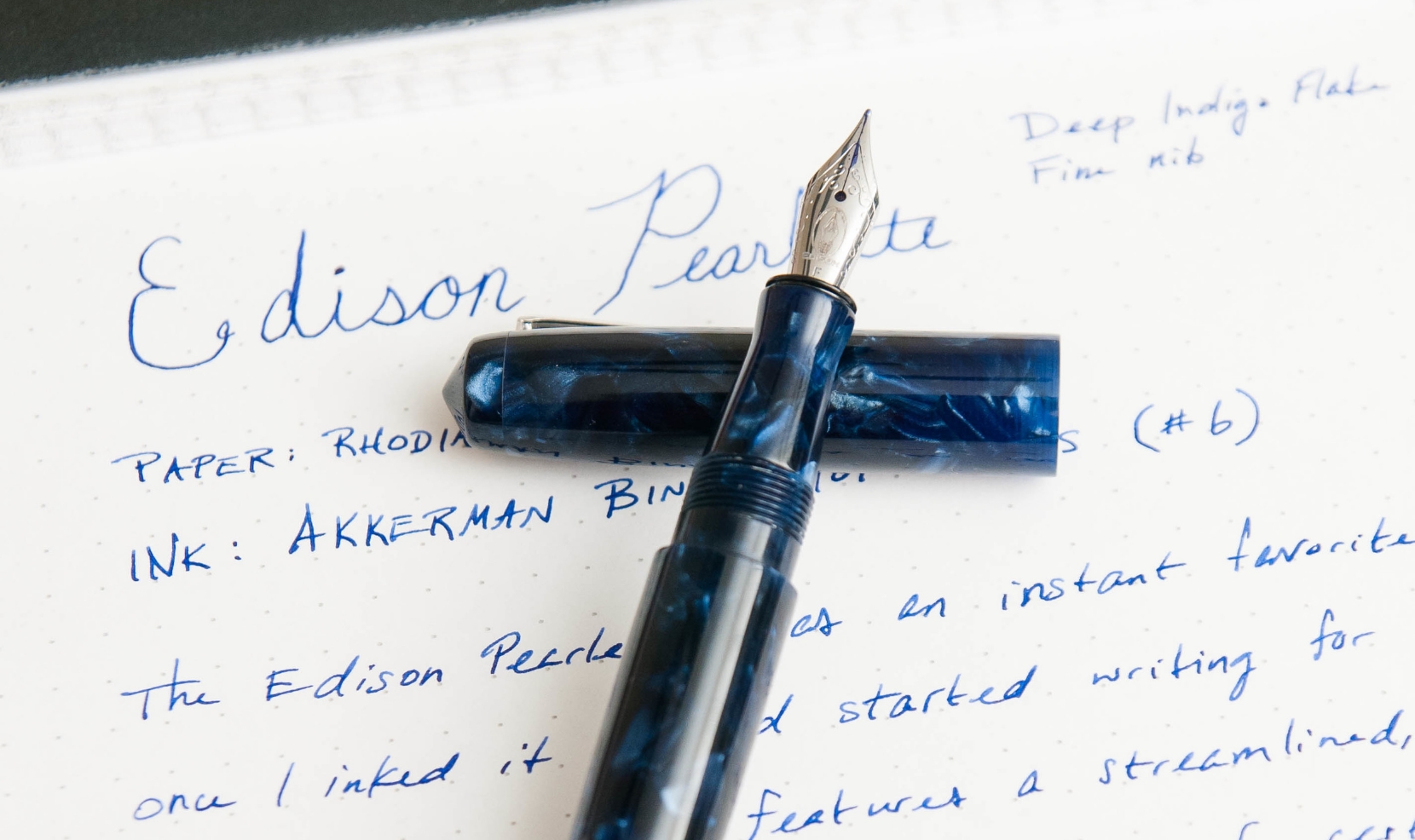
The nib wrote flawlessly from the beginning, and I've never had anything but good experiences since then. It's smooth, flows well, and starts quickly. This particular nib can get a bit dry after 3-5 days of being idle, but it's easy to get started again if you just lay the pen flat for a couple minutes. Also, the nib is minimally decorated with the Edison logo.

Another point about the nib is the amount of shading I can get out of it. This isn't a flexible nib by any stretch, but I'm impressed by the amount of variation I can get out of it without any modifications. All in all, it's a delightful pen that produces a very pleasant writing experience.

Conclusion

Now that I have two Edison pens in my collection, my hearty recommendation for someone new to the brand is still enthusiastic. I enjoy both of my Edison pens, both for their aesthetic qualities and the fantastic writing experiences they both offer. The only problem I'm noticing at this point is that I have a very narrow color scheme in my current collection, which is something I need to correct in the future.

Anderson Pens have all the Edison Production Line pens for sale, and if you're lucky enough to attend a show, you can pick one of these beauties up in person.

Posted on December 23, 2015 and filed under Edison, Fountain Pens, Pen Reviews.

Gimena Ebenus Fountain Pen: A Review

(Susan M. Pigott is a fountain pen collector, pen and paperholic, photographer, and professor. You can find more from Susan on her blog Scribalishess.)

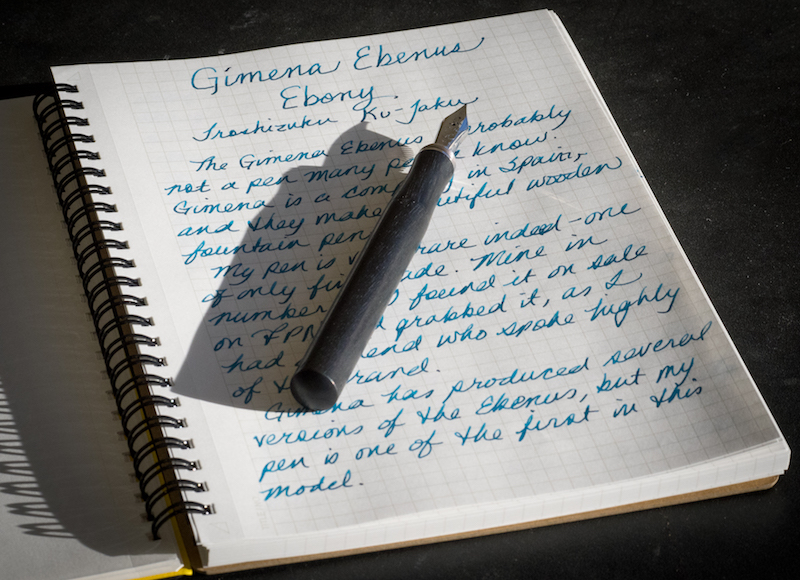
Gimena Pens may not be familiar to most Pen Addict readers. I had never heard of them until a friend mentioned their pens. Gimena is a company in Spain, and they make beautiful, handmade wooden fountain pens.

My Gimena Ebenus is a very rare pen–number two out of only five pens manufactured in 2010. I found it on the FPN classifieds and grabbed it immediately because I had heard such good things about the brand.

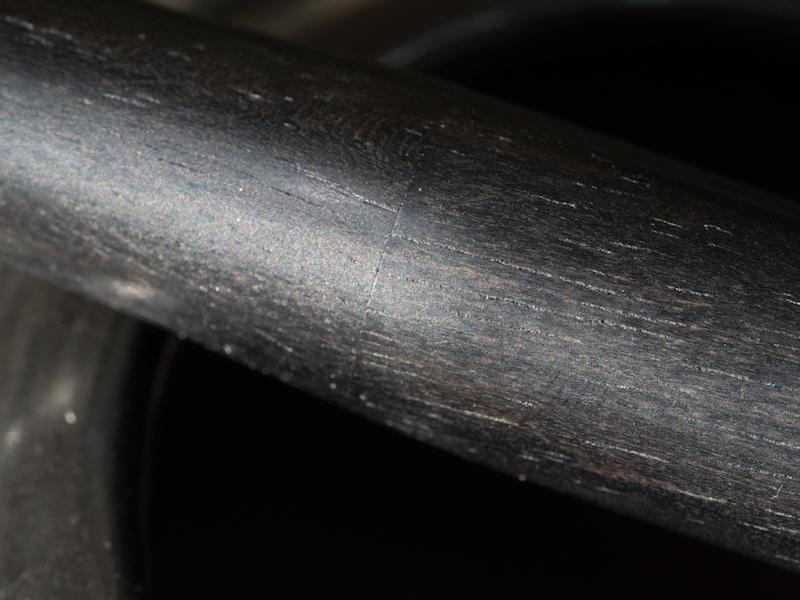
The Ebenus boasts a simple, clean design. The ebony wood is untreated (though I think one of the previous owners rubbed some oils into the pen, making the wood a creamy, darker black).

My pen is clipless, but you really should check out Gimena's website and look at their clips. They are leaf shaped and look like the elves of Lothlorien made them. If I buy another Gimena, it will definitely have a clip.

Photo Credit: Gimena Pens

Photo Credit: Gimena Pens

The only other design elements on the Ebenus are the Gimena logo carved into the finial . . .

. . . and the words "Gimena Ebenus 2/5" around the bottom of the barrel.

The cap screws smoothly onto rhodium-plated brass threads. The barrel attaches so seamlessly to the grip, I confess I didn't know how to open the pen to fill the converter at first! The craftsmanship is simply outstanding.

You can barely see where the barrel meets the grip

You can barely see where the barrel meets the grip

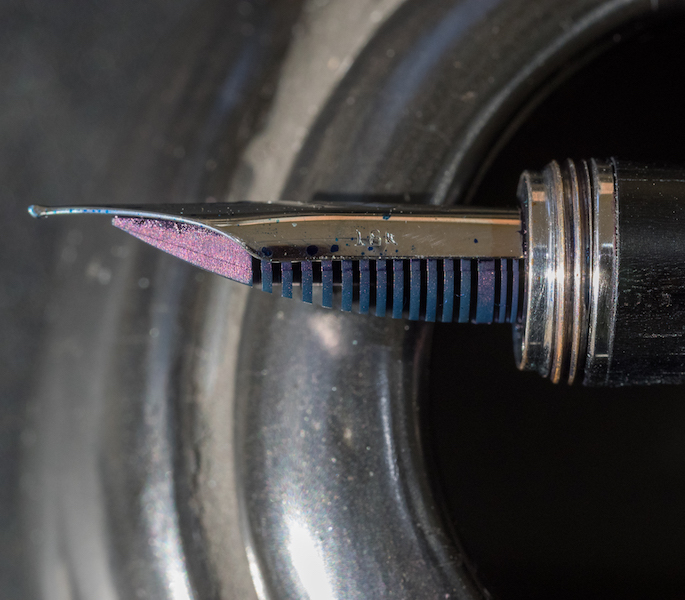
The nib is 18k gold plated in rhodium and diamond-engraved with the simple Gimena logo and the year of manufacture: 2010.

This is one huge and gorgeous nib and it is fitted with a special ebonite feed.

The medium nib writes a wonderfully smooth line and is almost stub-like. Unfortunately, I have experienced some difficulties with ink flow. Once the ink gets a little low in the converter, the pen exhibits hard starts and skipping. I have to unscrew the barrel, twist the converter to push the ink down, and re-screw the barrel. That isn't difficult, but it is annoying. I'm not sure if the problem is the converter, the feed, or the nib. Pablo Carrasco, of Gimena, is currently working with me to find a solution to the problem.

The pen balances nicely in the hand. It is the perfect size–neither too big or too small (it is 5.6 inches/142mm in length capped and 5.2inches/132mm uncapped). I haven't tried to post it as I don't want to risk marks on the barrel, and I never post my pens. The wood is not heavy (the pen weighs only 27 grams capped), but it feels solid and warms immediately to your hand. Even though my fingertips sometimes touch the threads at the grip while I'm writing, the threads are so smooth I don't notice them. Those rhodium-plated brass threads also add some weight to the pen. Besides, they're beautiful–who would've thought that threads could be part of the aesthetic of a pen?

My Gimena came in an incredible round zebrawood box with an onyx stone on top. I don't know if all Gimena pens come packaged this way or not. The original owner said the pen arrived in a generic box, but he returned it for some work on the feed. When Gimena sent it back, they put it in this zebrawood box.

I adore my Gimena Ebenus. It offers a simple elegance that mass-manufactured pens simply cannot match. Because Gimena pens are handmade in Spain, they cost a pretty penny–or, in this case, a pretty Euro. You're looking at spending a minimum of $500 or so depending on the pen design (there are currently eight models available); whether or not you choose a clip or roll stopper; and whether or not you want a special nib grind or flex nib. To me, these pens are worth the cost because they are so unique and expertly crafted.

My Ebenus model is no longer available (after all, only five were made). But Gimena produces several other versions of the Ebenus along with other models. Next on my list is the Erica with a leaf clip, of course.

Photo Credit: Gimena Pens

Photo Credit: Gimena Pens

Pros

  • Gimena pens are handmade out of various types of wood. The craftsmanship is top notch.
  • The 18K rhodium-plated Jowo nib is big and beautiful with a lovely engraving that suits the simplicity of the pen. The nib writes smooth as silk.
  • I've never owned a pen that warmed to my hand like my Ebenus. It is not weightless, but it's certainly not heavy. It just feels right.
  • Every bit of this pen is made of fine materials--ebony wood, rhodium-plated brass threads, an ebonite feed, and, of course, the 18K nib.

Cons

  • Handmade fountain pens are expensive, especially if you order them from another country.
  • I've had problems with ink flow–skipping and hard starts.
Posted on December 18, 2015 and filed under Gimena, Pen Reviews, Fountain Pens.