Posts filed under Fountain Pens

Visconti Traveling Inkwell: A Review

(Susan M. Pigott is a fountain pen collector, pen and paperholic, photographer, and professor. You can find more from Susan on her blog Scribalishess.)

The Visconti Traveling Inkwell is a conveniently-sized container for ink. The inkwell offers an alternative to traveling with heavy glass ink bottles. But at a retail price of $70.00 (at Goulet Pens), is it worth it?

I took my Visconti Inkwell with me on a recent trip to France. I slipped it in one of the slots of my Nock Hightower and carried it in my backpack the entire trip. It never leaked, and it went through every security check without anyone asking to examine it.

The Traveling Inkwell comes packaged in a Visconti faux-leather, clamshell box. Instructions for using the inkwell are included as is a glass eyedropper.

The inkwell is made of hard plastic and measures 5 inches (127mm) in length, a little over 1/2 inch (12.7mm) in width. It weighs only a few ounces without ink. With a capacity of 5.5 ml of ink, it will refill medium-sized pens about five times and large pens about three times. This blog post and video on Goulet is exceptionally helpful, explaining how to use the inkwell and listing pens that will and will not work.

The inkwell consists of a cap, a stopper, and the ink chamber.
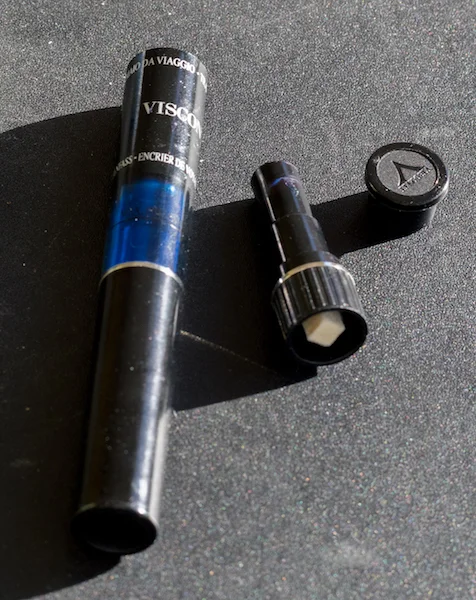
Removing the cap exposes a wick that can be removed for cleaning off your nib after filling.

The stopper provides a secure seal so that no ink escapes.

To fill the inkwell, you simply put the eyedropper in your chosen ink and squeeze to fill it.

Then you insert the eyedropper deep into the inkwell and squeeze out the ink.

You have to do this several times to fill the inkwell to the maximum capacity line. The glass eyedropper is a little cumbersome to use. You might want to use a pipette or a syringe instead.

When you want to fill your pen, remove the stopper, prepare your pen to receive ink, push the nib and section firmly into the inkwell to create a seal, and turn the inkwell upside down to fill your pen.

You can use the inkwell with any filling system, though each type requires a slightly different methodology to fill the pen. I recommend watching Brian Goulet's video on the inkwell to get a good overview on how to use it with different pen types.

I used the inkwell with my Pilot Custom 823, which is a vacuum filler. I pulled the pump all the way out, inserted the pen into the inkwell, pushed the pump . . . and made a huge mess–ink everywhere.

It was my own fault. I (a) didn't create a good enough seal and (b) pushed the pump in too quickly. As a result, ink spilled everywhere. My second attempt, after following the instructions more closely, resulted in a good fill.

The Visconti Traveling Inkwell can be used with most pens as long as they measure a minimum of 9.2 mm at the grip and a maximum of 13.2 mm according to Goulet. Brands like Pelikan, Montblanc, Visconti, Pilot (but not the Pilot VP), Platinum, etc., should all work fine. Pens with small diameters will not work with the inkwell. For example, the Faber-Castell Ambition, the Pilot Vanishing Point, and other small pens cannot create the necessary seal. Oversized pens also will not work because they don't fit into the inkwell.

A couple of pens that won't work: Pilot Vanishing Point, Faber-Castell Ambition.

A couple of pens that won't work: Pilot Vanishing Point, Faber-Castell Ambition.

The inkwell requires a little practice, so it's a good idea to try it out with water first (add a little ink so you can see the liquid). Once you know what you're doing, the inkwell makes it easy to fill your pens with the bonus that you can get a complete fill by manipulating the converter/piston/or pump slowly. Brian's video shows you how to get the best fill using each system.

Most brands will work regardless of the filling system: converter, piston, lever fill, etc.

Most brands will work regardless of the filling system: converter, piston, lever fill, etc.

So, is the Visconti Traveling Inkwell worth $70.00? I'm a bit torn on this question, to be honest. I didn't actually use the inkwell in France because my Pilot 823 holds so much ink, I never needed a refill. On previous trips, such as to Ireland, I took plastic ink bottles that I sealed in a plastic bag and packed in my luggage so I wouldn't have to put them through security. I filled my pens from those ink bottles just like I normally would. None of them leaked, but that may have been good luck. Since I don't travel often, I probably wouldn't purchase the Visconti Inkwell for myself, especially since, when I do travel, I like taking several ink colors and can do this with inexpensive plastic ink bottles.

Plastic Ink Bottle

Plastic Ink Bottle

What sets the Visconti Inkwell apart, however, is its pen-like shape (so it fits in most pen cases), its leak-free construction, and its ability to fill pens without a big mess (as long as you know what you're doing). If you're a frequent traveler, and you don't mind taking along just one color of ink, the Visconti is an excellent choice. It is much simpler to use than ink bottles, and you can take it in your carry-on without any problems.
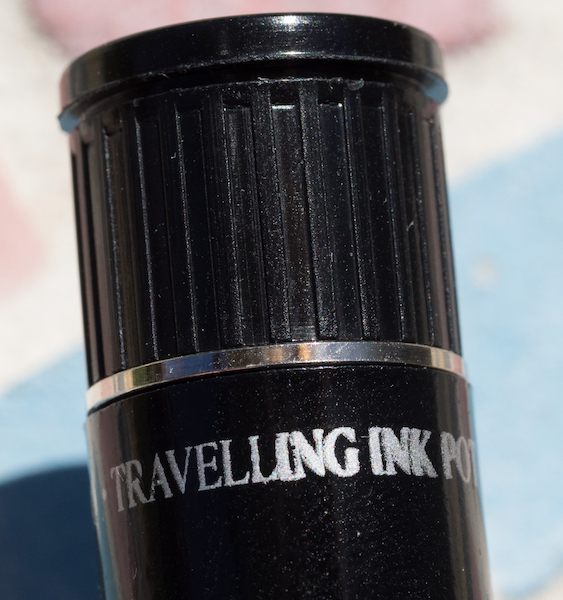
Even though I won't be galavanting through France again anytime soon (le sigh), I may take my Visconti Inkwell to work. I can keep it there to refill pens without a big mess when the need arises.

Pros

  • The Visconti Traveling Inkwell is well-constructed and leak-proof (at least I had no issues with it in my trip to France and back).
  • It is shaped like a fountain pen and is about the same size, so it fits in carrying cases made for fountain pens.
  • When used correctly, it makes filling a pen virtually mess-free, but practice first!
  • The inkwell works with the vast majority of fountain pens regardless of their filling system, making it quite versatile.

Cons

  • The Visconti Traveling Inkwell is expensive at $70.00.
  • If you want to take a variety of ink colors with you when you travel, you'll need to buy several inkwells.
  • The eyedropper that comes with the inkwell is a bit awkward to use and requires repeated fills in order to get the inkwell to capacity.
  • Small pens and oversized pens will not work with the inkwell.

(Goulet Pens provided this product at no charge to The Pen Addict for review purposes.)

Posted on April 1, 2016 and filed under Visconti, Fountain Pens.

Kaweco Mini Fountain Pen Converter Review

Image via JetPens.com

Image via JetPens.com

There was an attempt.

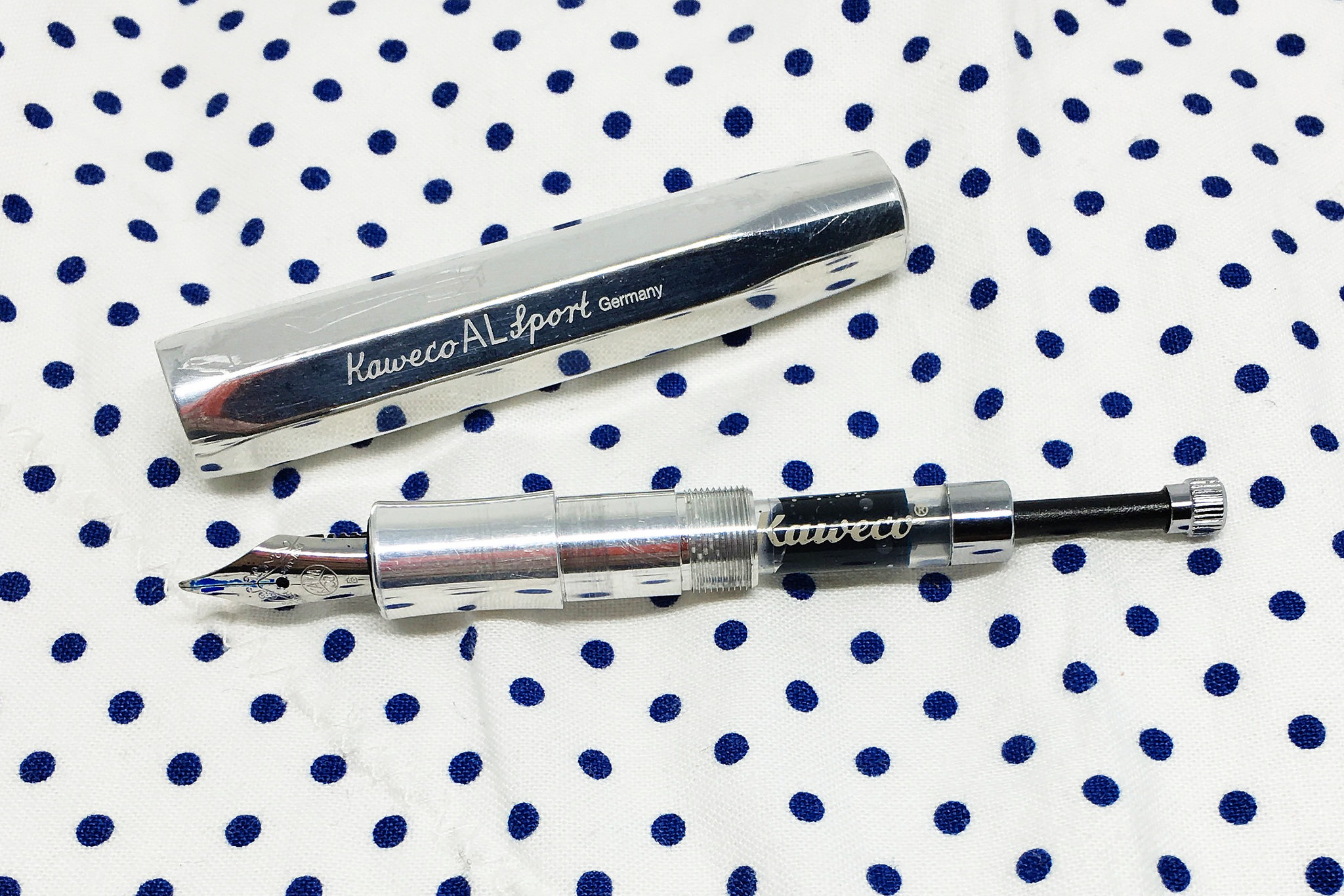
Those are my thoughts in a nutshell on the Kaweco Mini Fountain Pen Converter. This isn’t a bad product, but it’s not a good one either. Let’s dig in.

Converters for Kaweco fountain pens have always been sought after. The small barrels in the Sport and Liliput lines don’t take traditional converters - the barrels are too short. But people love their Kaweco’s - myself included - so news of any converter that fits is always met with excitement.

The previous attempt was the Kaweco Squeeze Converter, and it was a failure. Good idea, but it didn’t work. You could barely pull in enough ink to get you through the day, which made trying to use it a frustrating experience.

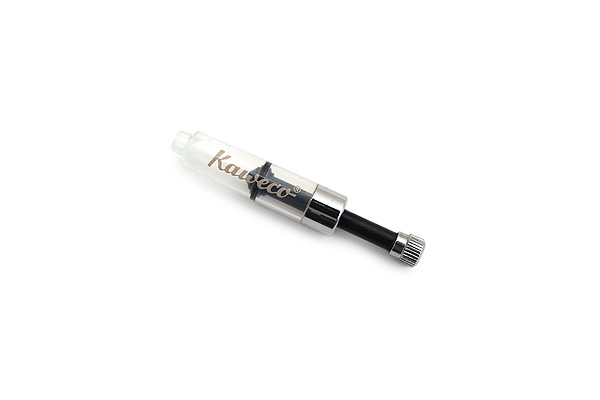
The new Mini Converter is a piston style converter that does pull in more ink than the Squeeze, but it is only slightly less frustrating to use.

Liliput for scale. If it doesn't fit, you must acquit.

Liliput for scale. If it doesn't fit, you must acquit.

First of all, it only fits the Sport models, not the Liliput. I didn’t realize this initially, thinking the piston rod would somehow remain flush with the end of the converter when filled. That’s not how this converter works. You attach it to the nib unit, dip the nib into the bottle, pull the piston back to fill, and leave it in that position. That added length doesn’t fit inside of the Liliput, as I found out the hard way when screwing the barrel back together. #InkyFingers

Once I realized the mistake I made, I grabbed an AL Sport and started over. The second issue, which you will see in the video below, is that it is a two handed operation to fill. That’s not abnormal, but due to the small size I had to stick my left thumb and index finger practically inside the top of the ink bottle to pull back the piston properly. There isn’t a lot of room to work with. And this bottle is 90% full. I imagine you will have an even harder time with ink bottles under 50% full.

Filling the new Kaweco Sport piston converter. #Kaweco #fountainpen

A video posted by Brad Dowdy (@penaddict) on

When I went to screw the AL Sport back together, the fully extended piston still hit the back end of the barrel. This caused ink to once again to come out of the nib as I tightened everything back up. In the end it fit, but it wasn’t a smooth process.

Kaweco converters add frustration to what should be a simple process. Including this one, they are 0-for-2 in making a functional product. I would love to be able to recommend one of these to you, but they just aren’t worth the headache.

This leaves you two options: Use short international cartridges or syringe fill empty cartridges from your ink bottles. Fortunately, we are seeing more short international options hit the market, including great colors from Waterman, Diamine, and Caran d’Ache. Waterman Mysterious Blue has been my go-to short cartridge recently, and works well with all of my Kaweco’s.

Time to move on to other ideas Kaweco.

(JetPens provided this product at no charge to The Pen Addict for review purposes.)
Posted on March 27, 2016 and filed under Kaweco, Fountain Pens.

Monteverde Invincia Orange Carbon Fiber Fountain Pen Review

(Jeff Abbott is a regular contributor at The Pen Addict. You can find more from Jeff online at Draft Evolution and Twitter.)

My experience with Monteverde is fairly limited, as I only have one fountain pen from the company. That being said, that one fountain pen is one of my favorite and most dependable pens I own.

The Artista was a complete impulse purchase — I had no clue about the company at the time, but I liked how it looked. That pen grew on me quickly for its smooth writing experience, mesmerizing demonstrator body, and silver accents. I still highly recommend that pen to new fountain pen users as a 2nd or 3rd pen after trying out cheaper pens.

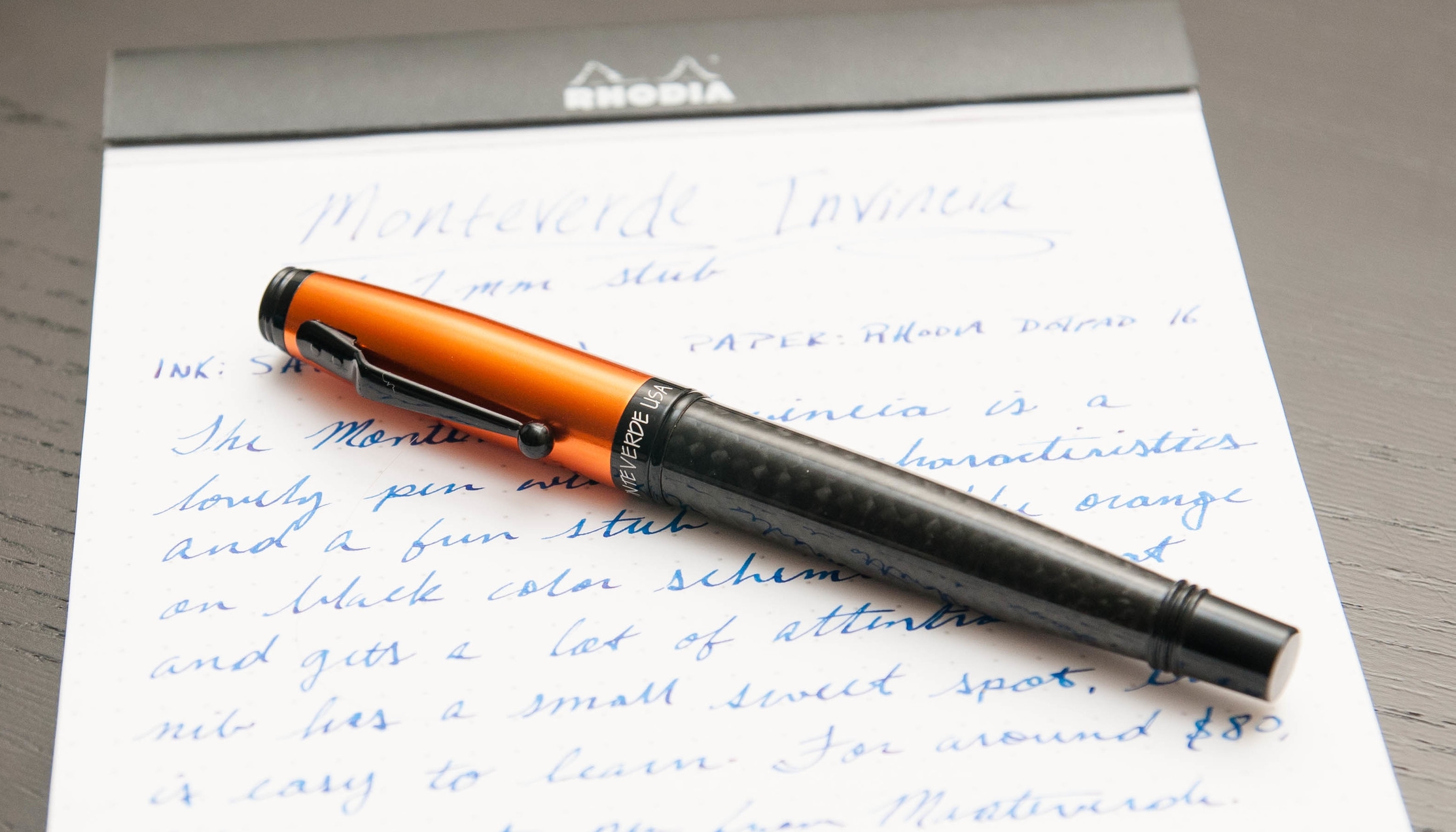
Trying out a Monteverde Invincia had me excited from the start. I've seen these pens at every pen show I've been to and have always been drawn to the design and colors. For some reason, I'd never pulled the trigger. Well, I finally had a chance to try one out and put it through the paces. The Invincia, like the Artista, is a solid fountain pen that many people will enjoy.

Look and feel

The Invincia has a nice heft to it that lets you know that the barrel and cap are made of some type of metal. It's not as heavy as a Karas Kustoms Ink, but not as light as a Pilot Metropolitan. It's a nice weight when writing unposted.

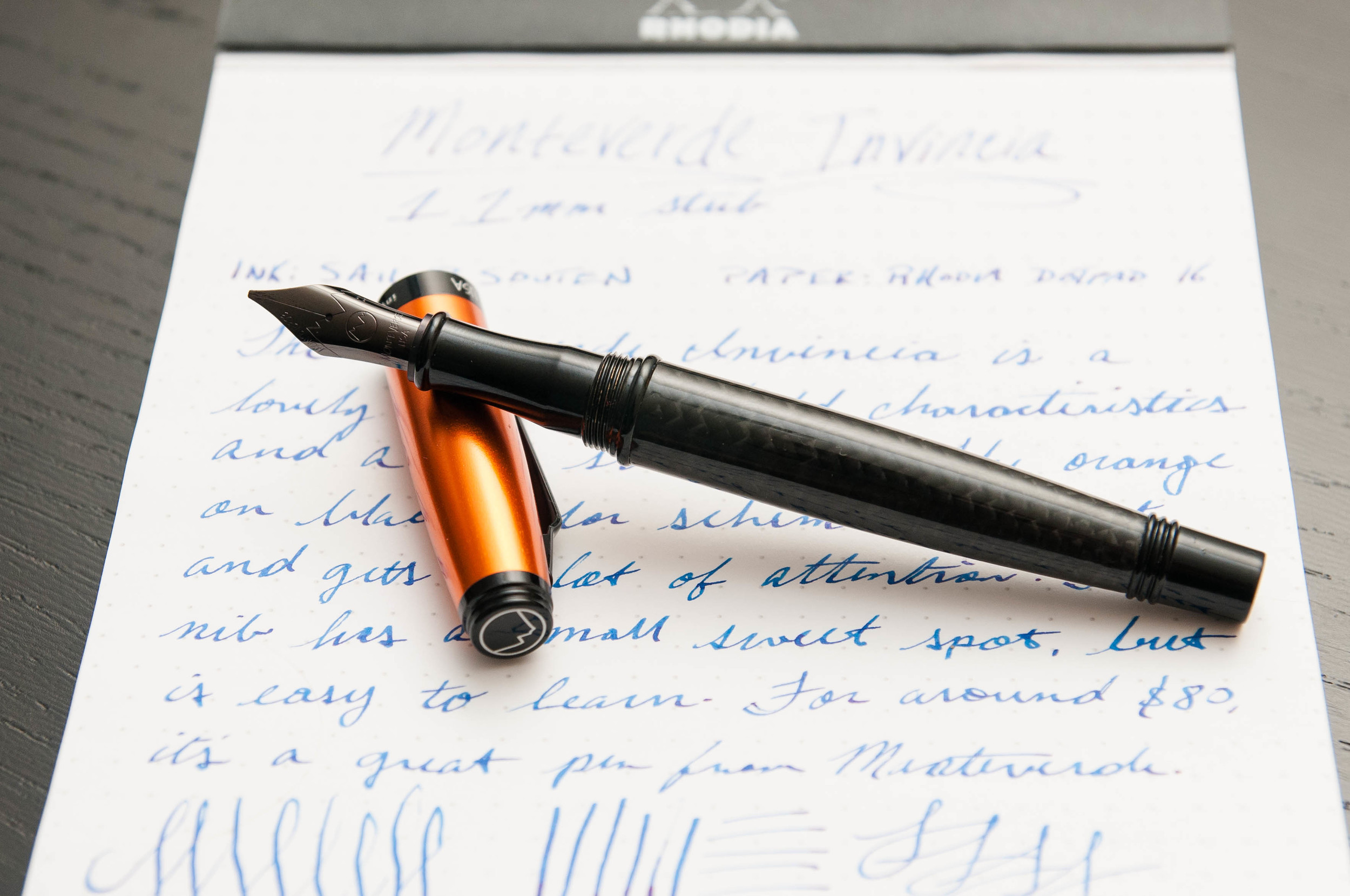
The model I have is the Orange Carbon Fiber. Now, the name implies that it's made out of an orange-colored carbon fiber material, but that's (sadly) not the case. Instead, the cap is a bright, shiny orange and the body is made of a carbon fiber (or carbon fiber imitation — I'm not good at telling the difference). Overall, it's a stunning combination of textures and colors. I love the dark gray carbon fiber mixed with the bright orange pop.

The clip is a unique shape, and one that I've only seen from Monteverde. It has a sharp angle just outside off the cap, but has a nice ball shape at the end to make clip use easy when clipping or removing it from different things.

The cap is a twist off, but only requires a quick turn to cap or uncap — not like your average screw lid. It's somewhere between a friction cap and a screw cap. I really like the secure motion of using the cap on this pen. I never have to wonder if I'm over-tightening or if it's really secured. The cap posts perfectly, but makes the pen feel a bit too top-heavy, so I normally write with it unposted.

The grip section is made of metal, and is very smooth and nicely contoured. There's a nice lip at the end of the grip to provide a place for your finger tips to rest when writing. For me, the grip section is very comfortable. Even though it's smooth, I haven't had any issues with grip or slippiness.

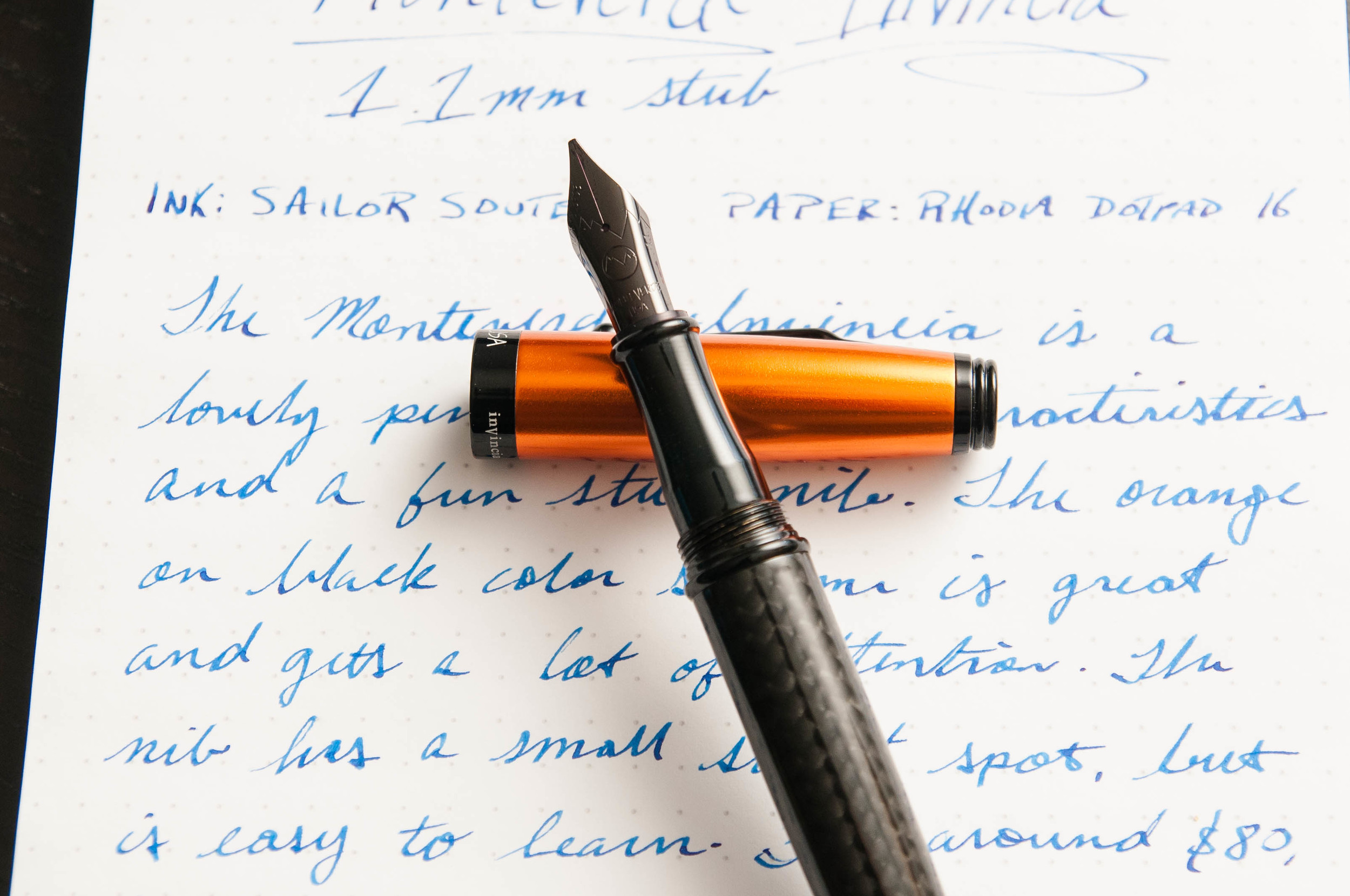
The nib on this pen is one of the most striking visual pieces. It's a long, elegant shape, but it's also completely black. It has minimal branding etched into it, so that shiny black goodness can really take the spotlight. I'm never expecting a black nib when I open a pen, and this one still delights me when I uncap the pen. It's a really well-shaped nib and the black color really sets it off.

Writing

A pen might look and feel amazing, but a bad nib can ultimately ruin it. These pens come with a range of nib options, from Fine, Medium, Broad, and Stub. The stub nib is a 1.1mm nib that lays a very nice line. I have the stub version, and I've mostly been happy with it.

First, the good things about the nib. It's smooth, flows well, and makes some fantastic line variations from the stub nib. Even though they call it a stub, it has some distinct line edges that resemble a couple of italic nibs I have. Stub nibs usually have softer edges, but each manufacturer interprets these nib sizes and specifications differently. In the case of Monteverde, it looks like the value a crisper line over a forgiving position. And that brings me into the bad part of the nib.

When you move into specialized nibs, one of the first things you'll encounter is certain characteristics and nuances that only exist in specialized nibs. For example, stub and italic nibs have a large flat edge designed to create dramatic line variation. The trade-off in these nibs is that there's a small "sweet spot" when using the pen. You have to hold the pen a certain way against the paper in order to keep it writing smoothly. If you rotate either way, it will either scratch, skip, stop, or a combination of all three.

In the case of the Monteverde stub nib, it has a fairly small sweet spot. It's nothing that I classify as a deal-breaker, but it is something that causes me some frustration. Like all pens, it has a personality when it comes to writing, and I've come to learn how it likes to be treated when writing. When held properly, it really is a beautiful, well-behaved nib.

That being said, specialized nibs create specialized opinions. What I dislike about a nib, another person might love. So, take my quibble with a grain of salt.

Overall

As a pen, the Invincia is beautiful, eye-catching, well-balanced, and fun to use. I love the amount of variation I can get from the steel stub nib, and I love the weight and feel of the pen in my hand when writing. Apart from my own nib preferences, this pen has no downsides for me. I'm happy that it's part of my collection alongside my Artista.

You can find the Invincia in a variety of colors and nib types from Goulet Pens. As I'm writing this, they have black, blue, lime green, and orange in stock, all of which look as nice as this one.

(Goulet Pens provided this product at no charge to The Pen Addict for review purposes.)

Posted on March 23, 2016 and filed under Monteverde, Fountain Pens, Pen Reviews.