Posts filed under Fountain Pens

Aurora Mare Limited Edition Fountain Pen: A Review

(Susan M. Pigott is a fountain pen collector, pen and paperholic, photographer, and professor. You can find more from Susan on her blog Scribalishess.)

Long ago I acquired a blue Auroloide Aurora Optima with a fine nib. The pen was lovely with its mottled blue celluloid and gold accents. But the nib was super scratchy and hard as a nail. As much as I loved the looks of the pen, I didn't like how it wrote, so I sold it. I assumed, based on my experience and on reviews of Aurora pens, that Aurora nibs were just scratchy (the politically correct expression is "they have feedback"), and I swore off Auroras for the time being.
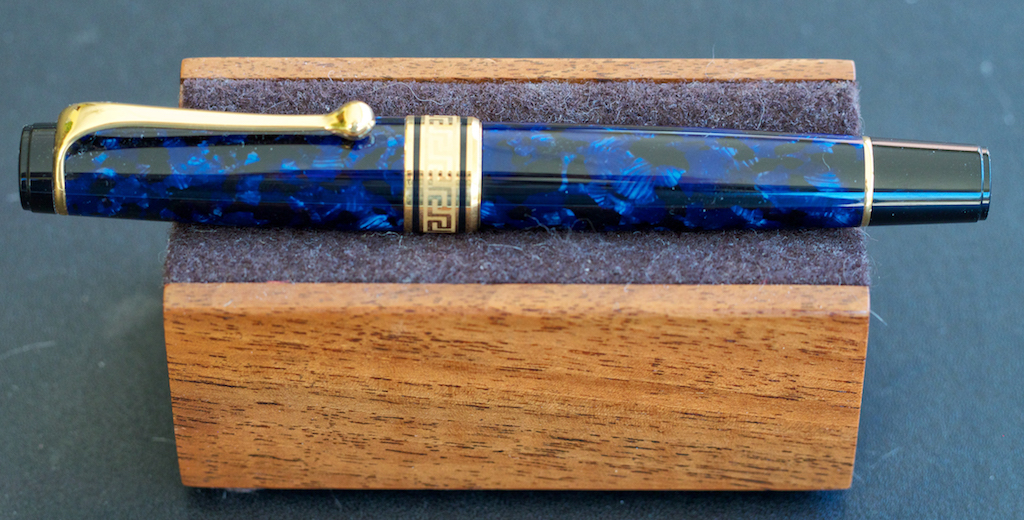
My original Aurora Optima

But there was one Aurora that always caught my eye because of its vibrant blue color: the Aurora Mare. Every time I saw a picture of this pen I swooned, tempted like Odysseus by its Siren song. What lashed me to the mast, however, was that first experience with an Aurora nib.

Then Pelikan announced an M800 they called Vibrant Blue. The color is almost indistinguishable from the Aurora Mare. I know that Pelikan nibs are generally smooth and trouble free, so I was tempted. But, the Vibrant Blue has rhodium accents and I prefer yellow gold. When I happened upon some unexpected cash (thank you Mother's Day), I decided to buy a gently-used Aurora Mare with a medium nib that I hoped would be less scratchy (plus it was about $200 less than the Pelikan Vibrant Blue).

My Aurora Mare came in its original packaging: a blue-velvet clamshell box with a pamphlet and bottle of black ink.
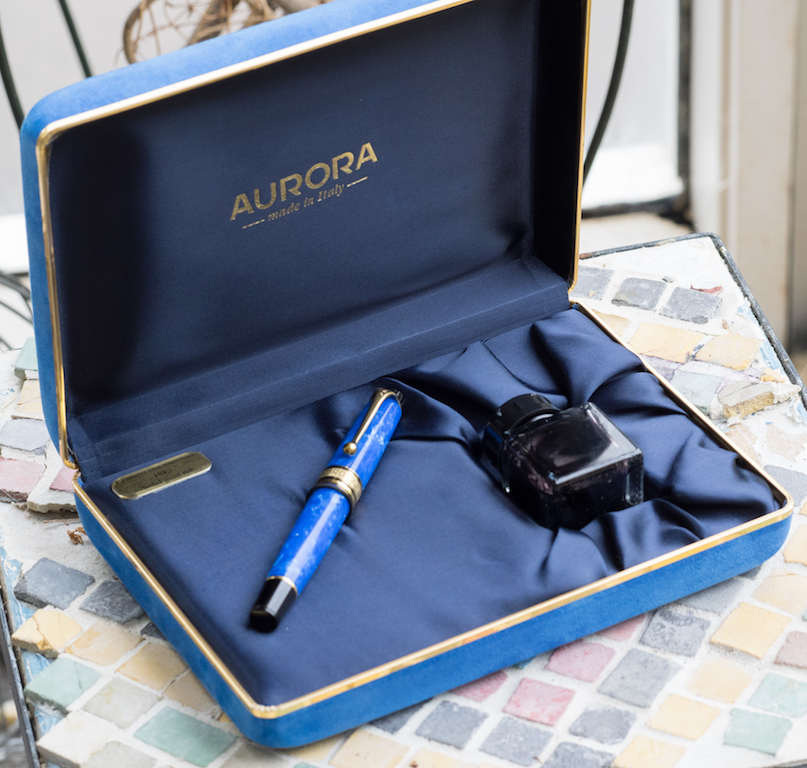
The minute I saw the Mare I knew I made the right decision. The pen sparkles like waves on the Caribbean Sea, especially in sunlight.
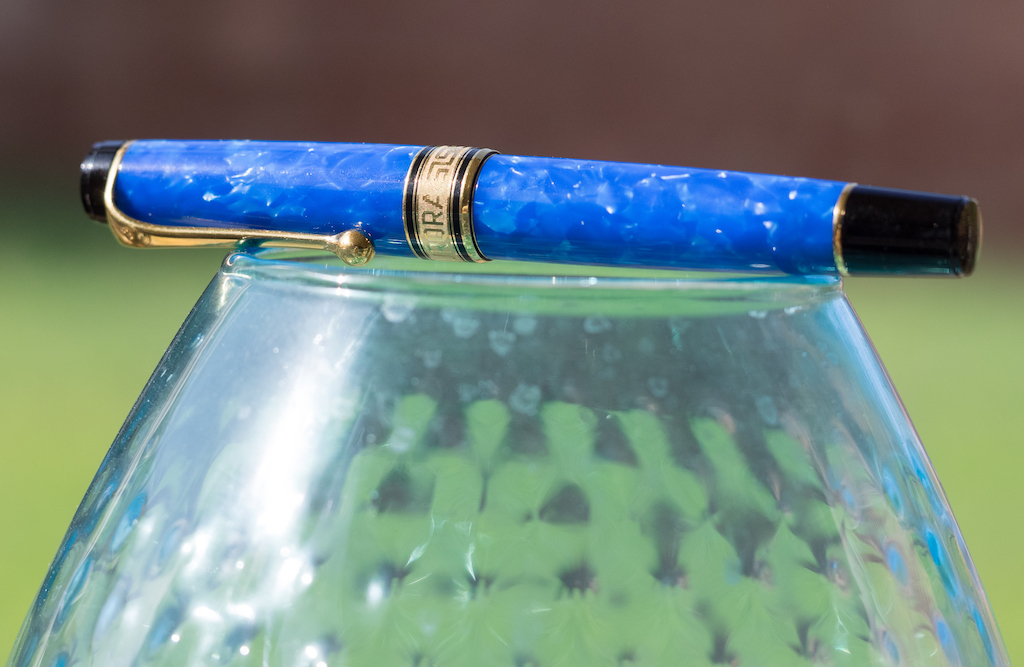
The screw-on cap has a black finial with the limited edition number printed on the side.

The clip is the usual Aurora shape with a ball on the end.

But the Mare has an additional feature: a tiny seahorse engraved at the top of the clip. I love this detail. It's not ostentatious, but it is a reminder that the Mare is patterned after the ocean.

The bottom of the cap is adorned with a gold ring that has the name "Aurora" and a Greek key pattern design.

Like all Aurora Optimas, the Mare is a fairly short pen. Unposted it measures almost 5 inches; posted it measures 6 inches. I write with it unposted and find it quite comfortable.

Aurora Mare Unposted
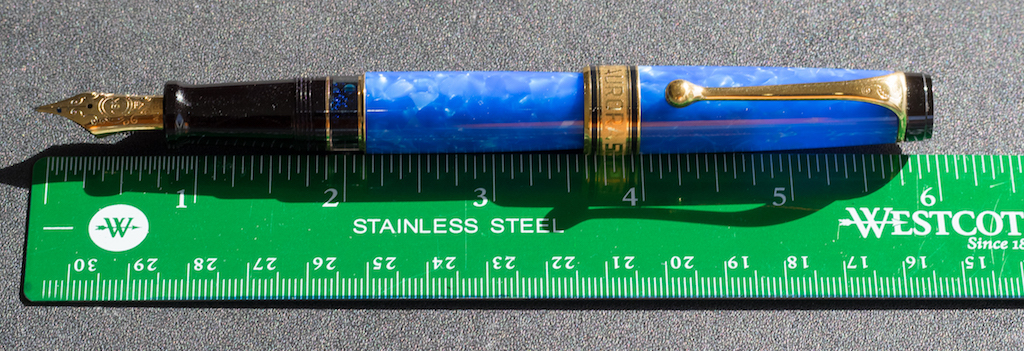
Aurora Mare Posted

The Aurora Mare is a piston filler, and the ink window gives you an indication of how much ink you have left. In the event that you run out of ink while writing, you can twist the piston knob counter-clockwise and access a hidden reserve of ink (one of the special features of many Aurora pens). The piston is smooth and works flawlessly.

The nib is decorated with intricate scrollwork. It is one of the most beautiful nibs available, in my view.

Aurora's website states that their nibs are handmade in Turin, Italy. That is something special since most modern fountain pen manufacturers no longer make their own nibs.
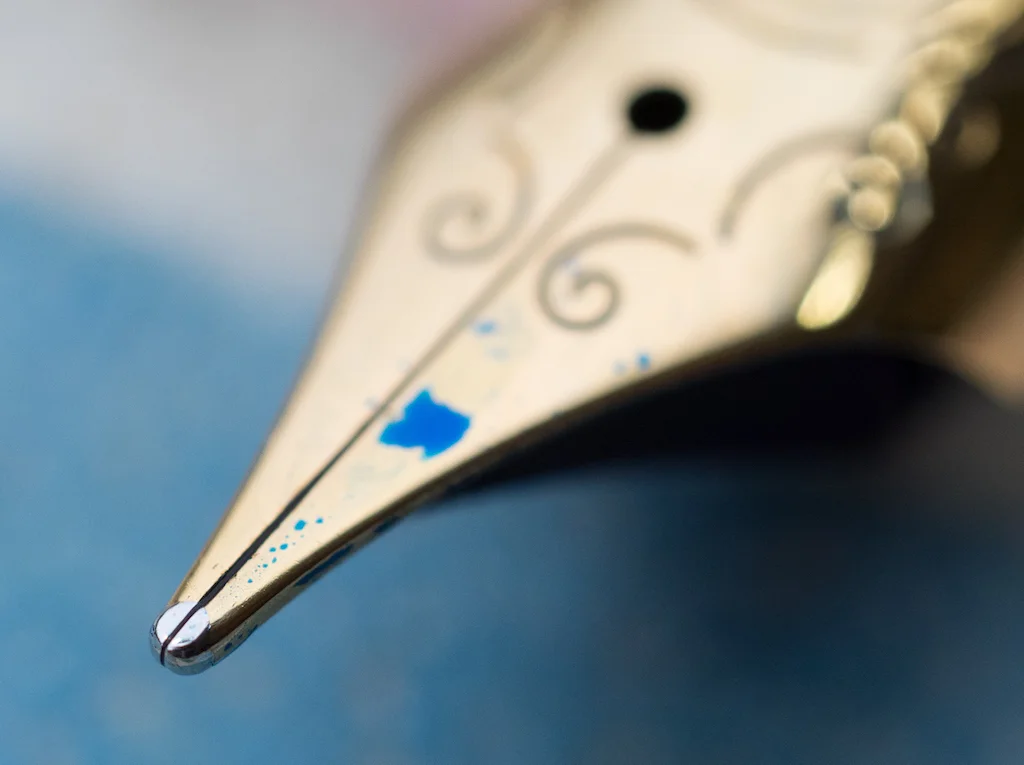
Mine is an 18k nib. It certainly doesn't offer any flex, but writing with this medium nib is smooth sailing. I don't know if I just had a bad nib on my original Optima; if the medium is simply less scratchy; or if I'm oblivious to the famous "Aurora feedback," but I am delighted with how beautifully this nib writes.

Pilot Iroshizuku Kon-Peki

The Aurora Mare is a limited edition pen (7,500 pens were made). You can find them at Goldspot Pens for $859.95. I've also seen them for sale from time-to-time on the FPN and FPG classifieds.

While others are admiring their Pelikan M800 Vibrant Blue pens, I am enjoying my gorgeous Aurora Mare inked with Iroshizuku Kon-Peki (a perfect match, by the way). You can't go wrong with either pen, but mine has a sea horse, just sayin'.

Pros

  • The Aurora Mare is one of the most gorgeous blue resin pens available. The color is absolutely stunning.
  • The pen is a piston filler and holds a good amount of ink (1.1ml) along with a special reservoir that gives you an extra page or so of writing.
  • Although some say that Aurora nibs give "feedback," my medium nib is smooth and trouble-free.
  • The pen is comfortable both unposted and posted.

Cons

  • At $859.95 retail, this is an expensive pen. But it can be found for much less used.
  • Some may find the pen to be too short, but that can be remedied by posting the cap.
Posted on June 3, 2016 and filed under Aurora, Fountain Pens, Pen Reviews.

The Pelikan M620 Grand Place Fountain Pen: A Review

(Susan M. Pigott is a fountain pen collector, pen and paperholic, photographer, and professor. You can find more from Susan on her blog Scribalishess.)

When the Pelikan M800 Grand Place came out earlier this year, I was sorely tempted to buy one. Like others, I found the swirl pattern appealing and distinct from Pelikan's striped models. But while I was looking at photos of the new Grand Place, I came upon the M620 Grand Place, a model that was produced in 2006. Although I liked the M800, I loved the M620. Why? Because, unlike the M800 which has a black grip and piston knob, the M620 grip and knob are a beautiful, sheeny copper.

Of course, the M620 version is no longer available from vendors. But once I fall for a pen, I am relentless in my pursuit. I looked on eBay where I found the pen offered without a nib for an exorbitant price. But that was essentially the only M620 Grand Place I could find.

So, I placed a "Want To Buy" ad on FPN and within a day or two I found a seller offering the pen with a fine nib for a reasonable price. It came from Singapore, so I had to wait a little while, but it arrived in perfect condition with all the original packaging.

Part of Pelikan's City Series, the Grand Place is named after the Grote Markt in Brussels. The square once housed an indoor market and the town's city hall.

The pen is comprised of brown, copper, and gold colors with swirls of blue interwoven. The chatoyance is mesmerizing.

As I said, what drew me to the M620 over the M800 model was the copper grip and piston knob. Both are made of shimmery copper resin that matches the rest of the pen perfectly. The black grip and knob on the M800 seems to drain the pen of its warmth, whereas the copper on the M620 enhances the golden tones.

The M600 is my favorite Pelikan size at 5.24 inches/133mm capped and 18 grams in weight. It's neither too short nor too long. And it's definitely not heavy. Many Pelikan enthusiasts prefer the more robust M800, but I favor the 600 size.

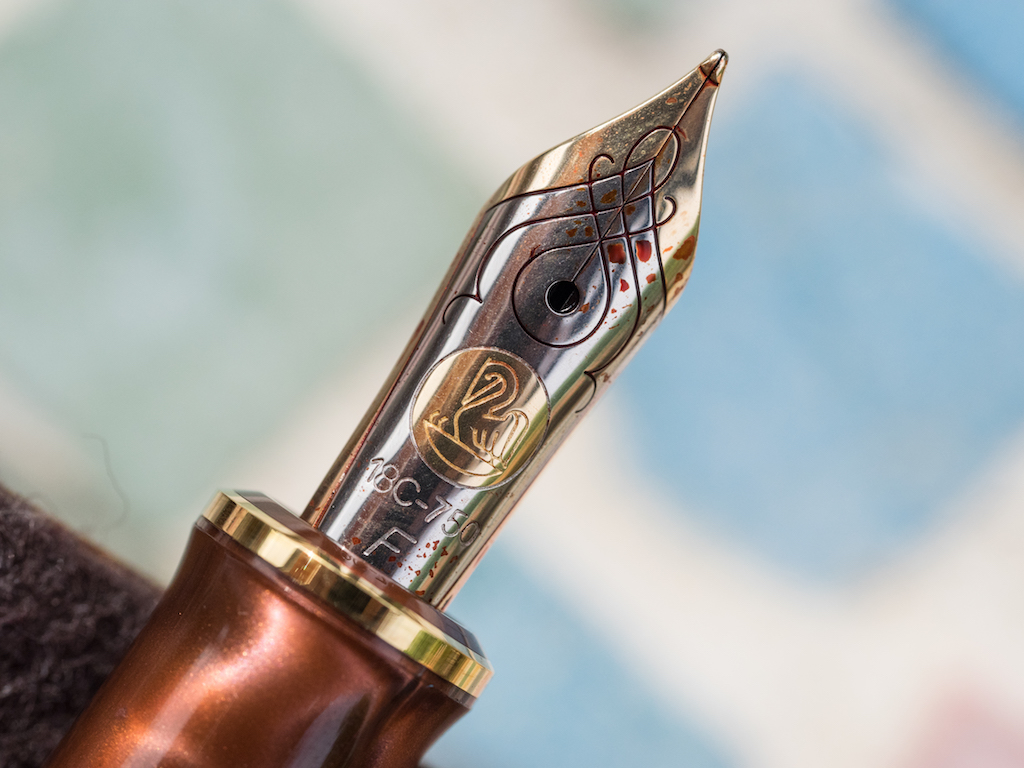
The nib is a two-tone fine with the ornate Pelikan design. I think Pelikan nibs are some of the most beautiful modern nibs you can buy. Plus, their nibs are smooth and problem free (in my experience). This one seems to be a true Western fine, wider than a Japanese fine but definitely not close to a medium.

The cap has the Pelikan logo in gold on a black finial. The beak-shaped clip is gold and the cap sports the usual "Pelikan Souverän Germany" on the ring.

Of course this model is a piston filler and holds a good amount of ink (1.3ml). I inked it with Diamine Ancient Copper for my written review. Ancient Copper is a perfect match for this pen. Too bad it gets funky if you leave it too long in a pen. By "funky" I mean that it gunks up your nib and sort of crystalizes. I no longer leave Ancient Copper in any pen for more than a few days, which is too bad, because it's a great color.

Pros

  • This is a gorgeous pen with an unusual swirl design and unique colors. Unlike the M800 version, the grip and piston knob are copper instead of black.
  • The M600 size is a good size for many writers. It isn't heavy but it's long enough to feel substantial.
  • The fine nib on my M620 writes smoothly and without any problems.

Cons

  • The M620 Grand Place is no longer available through vendors. If you are like me and want the M620, I'd suggest placing a "want to buy" ad like I did. But, you can also find the larger M800 with a black grip and piston knob at places like Goldspot Pens.
Posted on May 20, 2016 and filed under Pelikan, Pen Reviews, Fountain Pens.

Vintage Pens for People Who Think Vintage Pens Are Scary

(Ron Gilmour is a fountain pen enthusiast, would-be calligrapher, and librarian. You can find him online at Twitter @gilmour70 and Instagram.)

The vibrant online pen community, of which many Pen Addict readers and listeners are a part of, concerns itself primarily with modern pens. This is understandable, as modern pens are easily available and are consistent enough for reviews to be meaningful. For those who have no experience with vintage pens, the vintage world may seem like a foreign and sometimes puzzling place.

This posts and its successors are a modest attempt at encouraging the "modernists" among Pen Addict readers to dip their toes into the vintage world, which I swear isn't scary. These posts were inspired by an excellent post from Dr. Deans of Pen Economics entitled "Why Aren't Vintage Pens More Popular?".

Here's the plan. In this post, I will address a few common myths about vintage fountain pens, which I hope will convince you that they are worth trying out. In succeeding posts, I will highlight a few major vintage pen models that are easy to find, affordable, and reliable. On with the myths!

Vintage Pens are Expensive

Well, yes, some of them are, but so are some modern pens. The two major factors that account for high prices on vintage pens are condition and scarcity.

At the risk of stating the obvious, vintage pens have been around for a while. Some of the most popular models date from the 1930s and '40s. Some have had multiple owners, not all of whom may have been fastidious in their pen care habits. Consequently, if you insist on a pen in perfect condition, you can expect to pay for it. If you aren't too picky about aesthetics, you can get some great deals.

(Vocabulary note: If you see a vintage pen advertised as "NOS," that means "new old stock." Such a pen is as it came from the manufacturer and has presumably been sitting in a warehouse since WWII. Which is kind of sad, but great news if you want a pristine example of a vintage pen.)

The other major factor that can drive up the price of the pen is scarcity. This is a simple matter of supply and demand. If you're chasing down a rare pen, you can expect to pay quite a bit for it when you find it. If you're in the market for a vintage Sheaffer Balance and you're not picky about color, you can easily find one under $100 US (subject to condition), but if you must have it in the lovely "rose glow" color, expect to pay.

Recently, a possible third factor has emerged: flex. Pens with flexible nibs generally command a somewhat higher price than pens with firm nibs. This factor may become even more significant as the trendiness of flex nibs increases and fountain pen users frustrated with the sad state of "modern flex" wisely opt for vintage pens.

Vintage Pens are Hard to Buy

The many wonderful vendors who serve the modern pen community have spoiled us. They provide extensive information, detailed photos, and customer reviews about their products. Many of their websites are lovely. In contrast, Dr. Deans has compared the sites of some vintage vendors to Soviet prison camps. A little harsh, but many have at least a hint of the late '90s about them. Many vintage vendors are small (sometimes one-person) shops. They may not have professional photographers, web designers, or data-entry minions.

It might help to think of your transactions with vintage pen dealers as more like ordering a custom pen from Edison Pens or Shawn Newton than like ordering the latest TWSBI from Goulet Pens. It might take a few emails to secure the sale, but that gives you a chance to ask questions and engage with a fountain pen expert!

Keeping one's stock up-to-date on a website is a time-consuming task, especially when every item is unique. Vintage vendors may have items that aren't currently listed. If you tell a vendor what you're looking for, they can often oblige, even if the item isn't listed on their site. (That said, don't go asking vintage sellers about items outside their usual range of interest. It does no good to inquire about a vintage Pelikan from a vendor whose site clearly indicates a specialization in American pens.)

I've spoken so far about obtaining pens from specialist vendors, which is by far the safest way to go. The second best way is through non-vendor ads on the various fountain pen forums. My experience buying from the forums has been very good. Read the descriptions carefully, examine the photos, use common sense, and you'll probably have a good experience.

The final way to find a vintage pen is through online auction sites. This is a far riskier way to buy a pen. Personally, I only buy pens from online auction sites if the seller is a fountain pen specialist. Auction sites are filled with "I found this in mama's attic" ads and you should avoid those. A red flag is that non-pen-dealers on auction sites seem to describe everything as "rare," despite the fact that there are dozens of that model listed for sale. If the seller thinks a Pelikan 120 is "rare," then you don't want to buy from them.

At this point I'll mention a price factor that I omitted above: the reputation of the vendor. Other factors being equal, you may pay more for a pen from a reputable vintage dealer than from an auction site or a random ad on FPN. Personally, I regard the extra cost as a good investment. Specialist vintage dealers have reputations to protect and do not want unhappy customers. They have extensive knowledge of vintage pens and restoration methods. Sometimes they will even offer limited warranties. Going after the "too good to be true" deal from an unknown seller on an auction site is a recipe for disappointment.

Vintage Pens have Freaky Filling Mechanisms

Over the decades, there has been a winnowing of filling mechanisms. Most modern pens are either piston fillers or cartridge/converter pens. There has been a recent revival of interest in vacuum fillers (e.g., Pilot and TWSBI) and Edison Pens produces modern versions of the classic pump filler and pneumatic mechanisms.

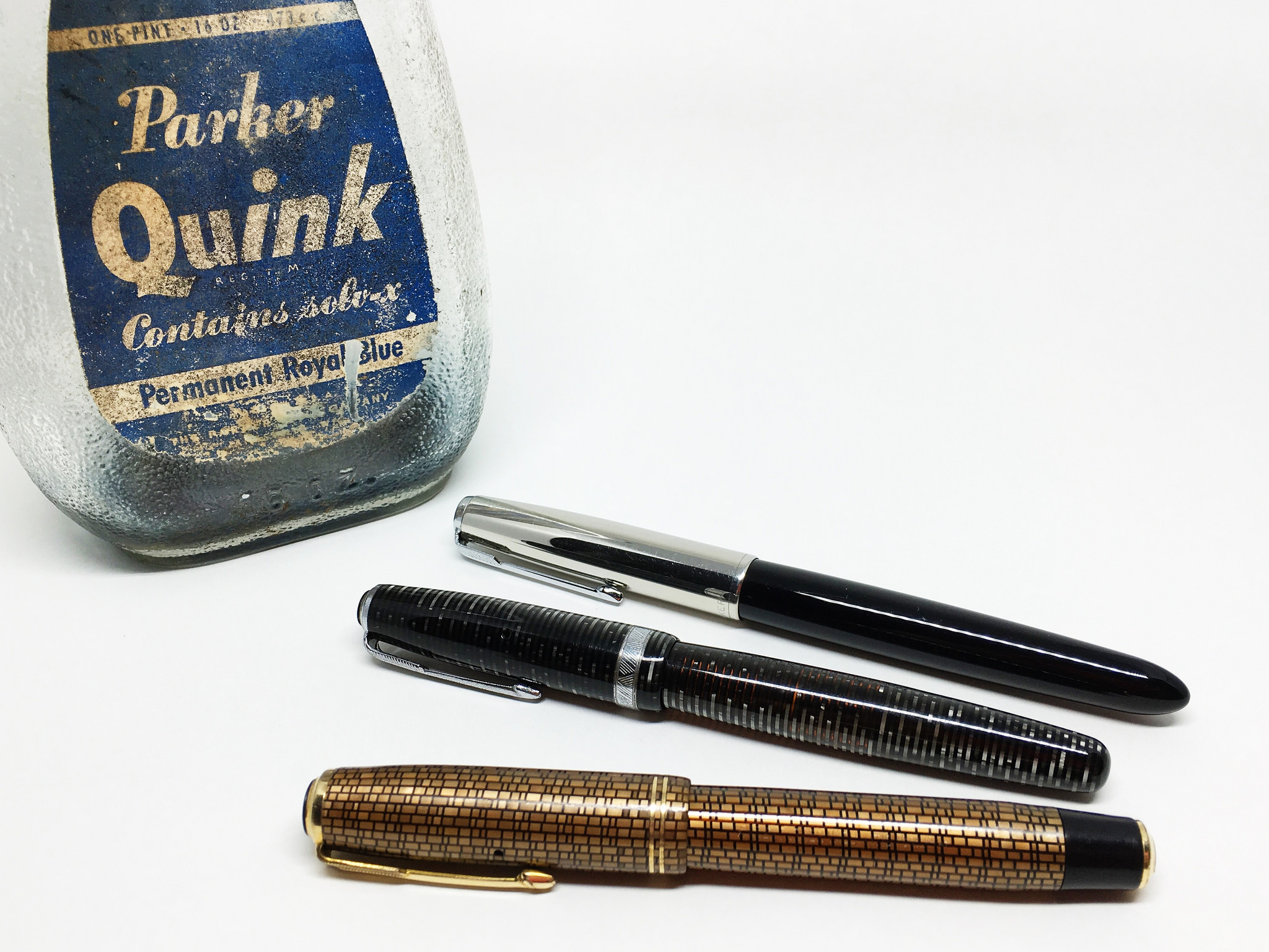
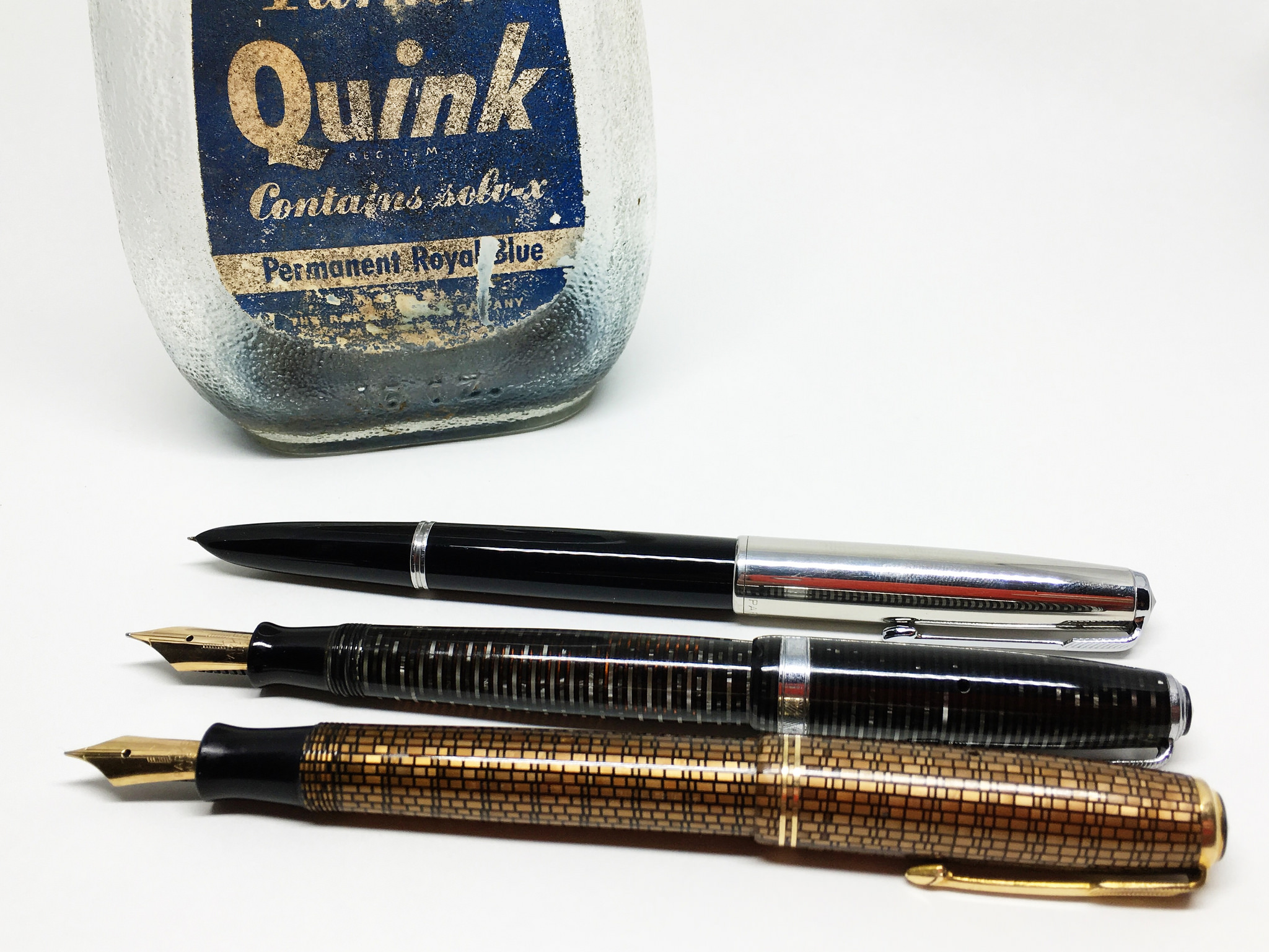
In Days of Yore, there were far more filling systems and companies competed in developing mechanisms that maximized ink capacity and minimized mess. Many of these systems are based around a "sac" or "bladder," a flexible ink container inside the pen. If you've ever used a squeeze converter from Pilot or Kaweco, you get the idea. Several filling systems used such an internal sac and were named for whatever mechanism was used to compress and expand that sac, but they're just variations on the "sac filler" theme. This includes lever-fillers, button-fillers, crescent-fillers, and others.

But sac fillers have drawbacks, as one might guess from their virtual absence in the modern fountain pen market. Sacs break down and require replacement. People tell me this is easy, but I've yet to try it myself. I'm not a very handy person and I prefer to send the pen to a repair person.

Furthermore, the ink capacity of a sac-filling pen is limited by the thickness of the sac wall itself. Maximum ink capacity requires a method that will fill the whole barrel with ink. Thus the one-time popularity of the Parker's "vacumatic" filler and the continuing enthusiasm for piston fillers.

Think of all this as a source of fun. I've yet to purchase a vintage pen that I couldn't fill and I doubt that you will either. At worst, you'll have to search YouTube.

I'll discuss filling mechanisms in more detail in later posts as they apply to specific models.

Vintage Pens are Delicate / Hard to Care For

Remember that vintage pens were created in an age when everyone used fountain pens, but when most people couldn't afford an arsenal of them. Many vintage fountain pens are tanks--built for daily use indefinitely.

I don't like to carry pens around. Most of my pens live at home, but I always have a pen or two at the office. I'll swap the "office pen" out every month or so. To qualify as an office pen, a pen must be drama free. I don't have time at work to fuss with a troublesome pen. And most of my office pens are vintage.

Nevertheless, there is a real possibility that you might need to have your vintage pens repaired at some point. Most of mine have made a trip to the repair shop at some point. Such repairs thus far have been fast and affordable, usually just involving replacing a sac or similar. There are plenty of good pen repairers out there and they are easily found by asking around on social media or perusing fountain pen web sites. The number of vintage pens I've sent off for repair roughly equals the number of modern pens that I've sent off to have their nibs adjusted, so I wouldn't count repair as an added cost for vintage.

A final note on caring for vintage pens: the ink question. Many owners of vintage pens, myself included, prefer to be conservative in their ink selections. Richard Binder has an excellent article on inks, and you may wish to stick to his recommendations for "safe" inks and save the sparkling, shimmering, and laser-proof inks for your modern pens. I recommend this primarily because modern pens are usually easier to thoroughly clean than vintage pens.

I hope that you've enjoyed this post and will stay tuned for the model-specific posts to come.

Posted on May 19, 2016 and filed under Fountain Pens, Parker, Vintage.