Posts filed under Fountain Pens

Sailor Pro Gear Slim Four Seasons Haruzora Spring Sky Fountain Pen Review

Out of the top three Japanese pen brands, Sailor does the best job of mixing in limited and seasonal releases alongside their primary fountain pen offerings. My favorite manufacturer, Pilot, is the the worst in this area, with Platinum not doing much either, unless it relates to a Japanese lake.

Sailor, on the other hand, seems to enjoy putting out a few extra releases each year. And whether they revolve around neon colors, seasons, cities, or galaxies, they always seem to be interesting.

In late 2015, Sailor released the Pro Gear Slims Four Seasons lineup, featuring four colors: Haruzora Spring Sky Manyou, Summer Woods Meigetsu, Autumn Moon Yukitsubaki, and Winter Camelia. All feature unique resin colors to match the seasons, and 14k Medium Fine nibs.
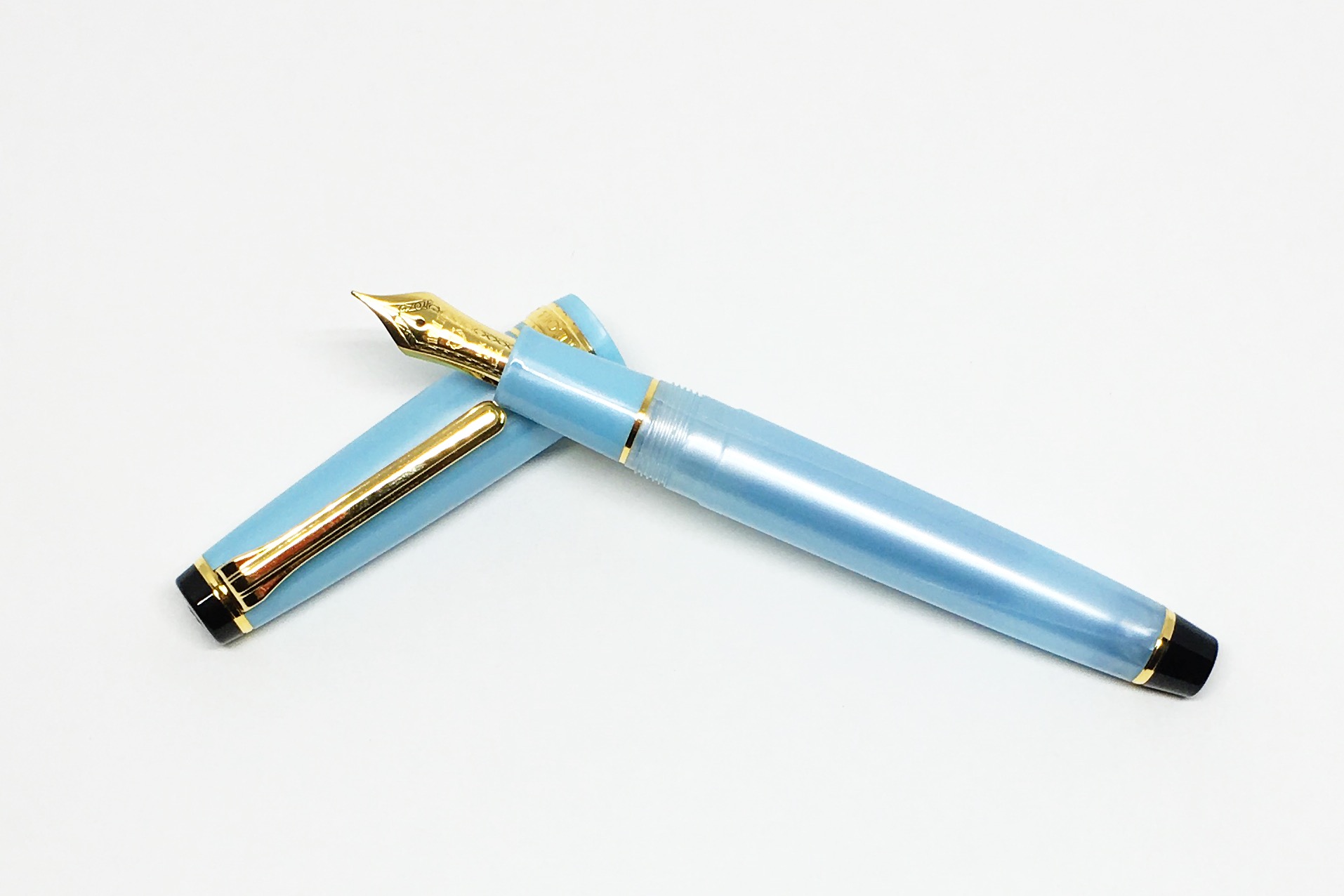
It was hard to choose which one I wanted to review from Goldspot. An argument could be made for any of them actually. I thought Haruzora Spring Sky with its bright metallic light blue barrel was the standout, and, judging by the response on social media, I think I chose correctly.

The stark black end caps matched with the bright blue barrel and gold trim makes every bit of this pen pop. Although the blue isn’t a perfect match, I find the look to be Tiffany-esque. It’s classy, clean, and eye-catching.

Bottom to top: Pro Gear Slim, Pro Gear, 1911, King of Pens

The Sailor Pro Gear Slim, often called the Sapporo, is the smallest and lightest of Sailor’s gold nib pens. Despite that, it is a comfortable writer for all but the biggest of hands. Even when posted it remains light and well-balanced.

Sailor nibs are considered some of the best in the world, but I personally rank them behind both Pilot and Platinum. That is relative of course, like how I said above that Pilot is the worst among the three with seasonal releases. They are still wonderful, as are Sailor nibs. They have more tooth when compared to the smoothness of Pilot and precision of Platinum. Placing them third among that group is like saying someone is the third best supermodel in the world.
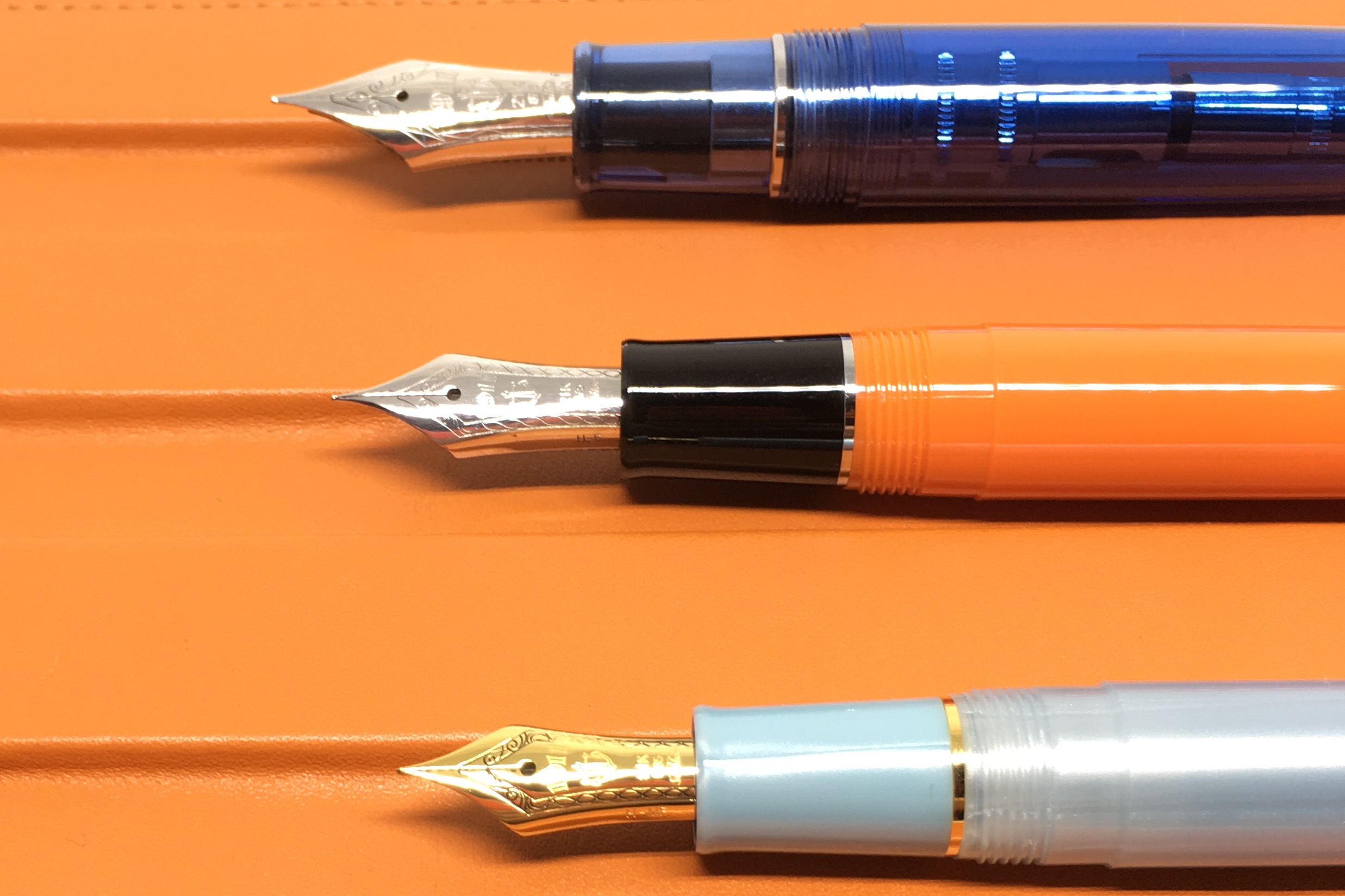
If you have never owned a Sailor fountain pen and were shopping for one of their gold nib models, my recommendation would be to go for the standard Pro Gear due to the larger barrel and nib. Yes, it is more expensive, but if it is your one and only Sailor it will make you the happiest in the long run I believe. If you have tried a Sailor and are familiar with the Sapporo size then you will certainly enjoy the unique colors of the Four Seasons series.

(Goldspot loaned this product at no charge to The Pen Addict for review purposes.)


Enjoy reading The Pen Addict? Then consider becoming a member to receive additional weekly content, giveaways, and discounts in The Pen Addict shop. Plus, you support me and the site directly, which I am very grateful for.

Membership starts at just $5/month, with a discounted annual option available. To find out more about membership click here and join us!

Posted on July 21, 2016 and filed under Sailor, Fountain Pens, Pen Reviews.

The Montblanc Heritage Rouge et Noir Coral Fountain Pen: A Review

(Susan M. Pigott is a fountain pen collector, pen and paperholic, photographer, and professor. You can find more from Susan on her blog Scribalishess.)

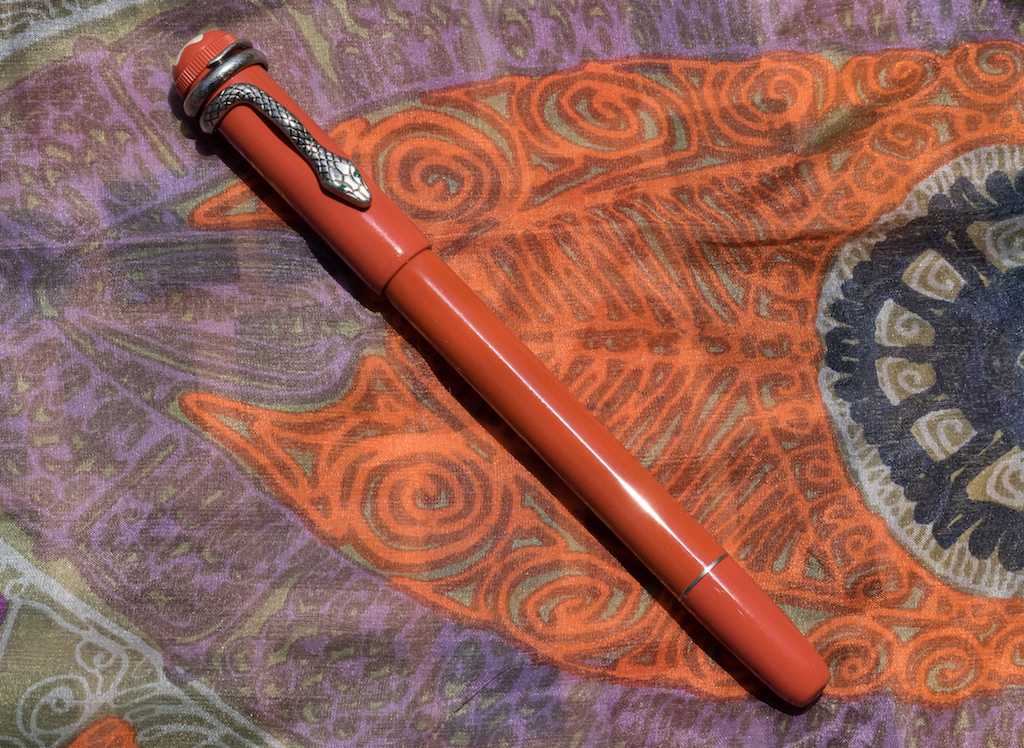
I've long been entranced by the Montblanc Agatha Christie Writer's Edition–that serpent clip and nib are so fabulous. When Montblanc announced the Heritage Rouge et Noir edition, I fell in love immediately. I mean, what's not to love? A Montblanc pen in coral (coral is the new black) and a serpent clip with green spinels for eyes and a serpent nib–all for a price significantly less than an Agatha? I knew I had to have one.

I ordered my pen from Appelboom and requested a special factory-made oblique medium nib.

"This," I told my beleaguered husband, "will be my Mother's Day, Anniversary, Birthday, and Christmas gift!"
"Okay," he said, "but you can't open it until Christmas."
"Sure!" I said. "I can totally wait until Christmas."

But, sacrifices have to be made for the Pen Addict. What's the point of waiting until December to review this pen when all of them might be sold by then? No. Pen Addict readers need to know whether or not they should buy this pen themselves. I am such a fountain pen martyr that I opened it for your sake, good readers. But, I promise that I will clean it thoroughly, put it back in its box, and save it for Christmas once I'm done with this review. Really!

The Montblanc Heritage Rouge et Noir is part of a retro series Montblanc embarked on with the Heritage 1912 (see my review here). The Heritage Rouge et Noir series–one in black, one in coral, and one in black ebonite–hearken back to the 1906 safety-pens, though the modern ones are piston fillers. Taking a cue from the past, the pens have large snowcaps/stars on their finials and a retro-looking serpent clip.

I chose the coral version because, frankly, I'm tired of black pens. Plus, the serpent on the coral version has green spinels for eyes whereas the black version has no jewels. The far more expensive ebonite version has rubies for the serpent's eyes.

The packaging for the Heritage Rouge et Noir is pretty understated for Montblanc. The pen is housed in a black and cream clamshell cardboard box (albeit a nice cardboard box) with a cream velvet interior. A leaflet accompanies the pen.

Aside from the added flare of the serpent clip and nib, this pen is a simple design. The barrel is made of lacquered metal with an antique-looking metal grip. The cap threads are on the nib end of the grip, so your fingers don't contact them. The piston knob is set off with a metal ring that matches the grip. The knob turns on metal threads, and I'm pretty sure there's a ball or agitator inside the piston housing to keep the ink flowing. I can hear it when I shake the pen.

The cap is made of resin with a large cream-colored snowcap/star with a ridged ring around the finial. These details evoke the look of the 1906 safety pens.

An old-style Montblanc logo is etched into the side and matches the cream color of the star.

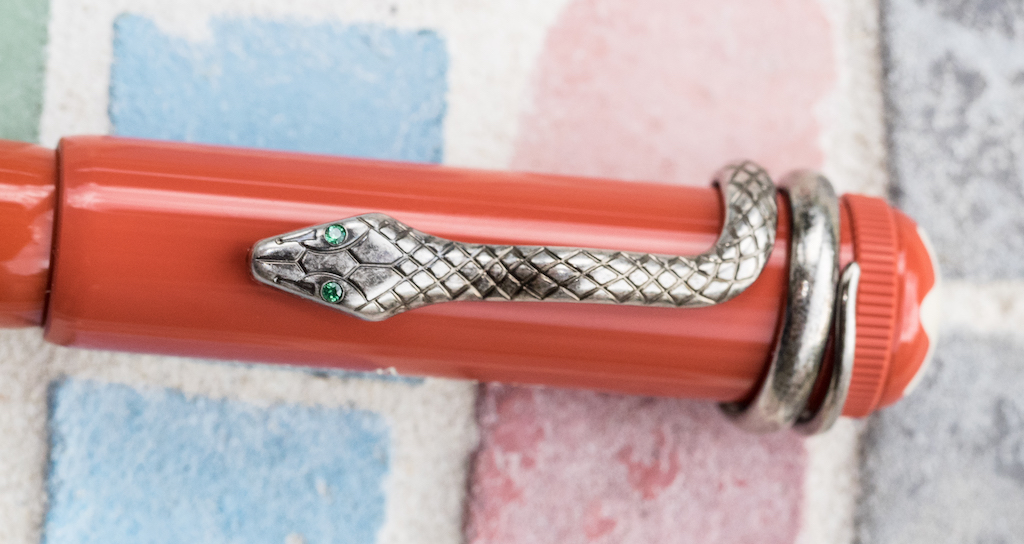
Of course, the highlight of the cap is the serpent clip. The tail wraps around the cap twice and the upper body of the serpent forms the clip. Montblanc says that the clip is made of a special alloy that has been "aged by a unique galvanic and stripping process." The green crystal serpent eyes glint in the sun and make me smile.

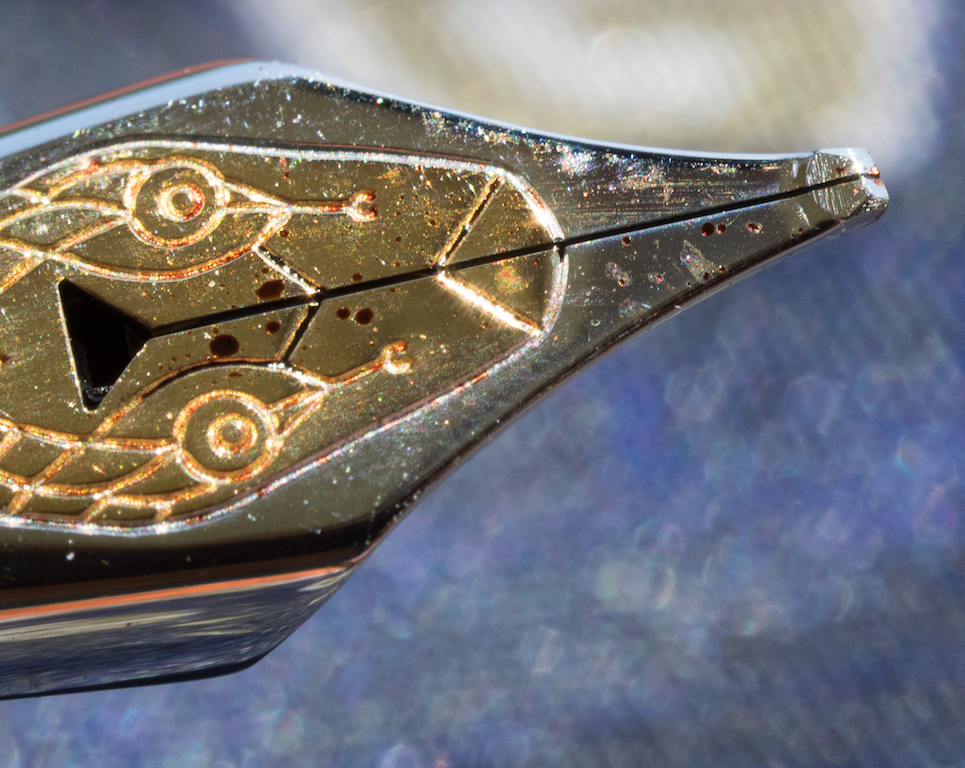
The nib is 14K gold, rhodium-plated with a golden engraved serpent (the black model has a single-tone nib, whereas the ebonite model also has a two-tone nib). The triangular breather hole nicely melds with the serpent's head. It is a striking design (pun intended).

The nib is small but in proportion with the rest of the pen. Unlike the Heritage 1912 nib which has a vintage, springy feel to it, this nib has no "give," unfortunately.

The oblique medium grind offers some line variation and accommodates my tendency to rotate the pen while writing. It took me a little practice to find the sweet spot, but, once I did, the nib wrote smoothly. For some reason the feed doesn't deliver as much ink as I'd like, so periodically I have to shake the pen to get the ink flowing more. It's not that the pen ever completely stops writing or skips, it's just that the ink flow slows down.

I should note that getting my Rouge et Noir with the OM nib took some time. I ordered the pen on April 9, but Appelboom didn't receive it until late June. The specialty nibs are simply not well stocked by Montblanc.

So. How does my Mother's Day, Anniversary, Birthday, and Christmas pen measure up? In terms of quality and beauty, this pen is outstanding and gorgeous. But, dang it, it's just too skinny. It measures 135mm in length, capped; 125mm uncapped; 160mm posted but is less than 10mm in diameter at the grip. Although the proportions are elegant and lean, it feels like a (rather heavy) Bic in the hand (horrors!).

The metal barrel gives the pen some heft, but my hand cramps up when I'm writing for any length of time. I love everything else about this pen, but I don't much enjoy writing with it, and that truly is a shame. Perhaps, with some time, adjusting my grip, and experimenting with different inks, I'll discover I can write with this pen without discomfort. Still, beauty and elegance won't heal hand cramps, so I may have to let this one go. Honestly, I think I really just want an Agatha, but this one almost scratched that itch.

The MB Heritage Rouge et Noir is available at many retailers and Montblanc boutiques. The list price for the black or coral resin versions is around $700.00. If you want the ebonite version, the list price is around $2,000.

Pros

  • The Montblanc Heritage Rouge et Noir is a well-crafted, retro-looking fountain pen.
  • Despite its svelt girth, the pen feels solid in the hand because the barrel is made of metal.
  • The serpent clip and nib are absolutely stunning. The coral color is a welcome departure from black.
  • It is a piston filler, though the ink capacity is rather small (less than 1ml).
  • The nib performs smoothly but does not have the spring of the MB Heritage 1912 nib.

Cons

  • Unfortunately, the pen is very thin in diameter. While this might not bother some people, others will find the pen uncomfortable to write with.
  • The pen is expensive (but that's true for all Montblancs).
  • The Rouge et Noir is quickly becoming more difficult to find. And, if you want a special nib, be aware that it takes a long time to obtain one.
  • I found the ink flow to be a bit stingy but need to experiment more with different inks.

I purchased this pen with my own money and was not compensated by Montblanc for this review.


Enjoy reading The Pen Addict? Then consider becoming a member to receive additional weekly content, giveaways, and discounts in The Pen Addict shop. Plus, you support me and the site directly, which I am very grateful for.

Membership starts at just $5/month, with a discounted annual option available. To find out more about membership click here and join us!

Posted on July 15, 2016 and filed under Montblanc, Fountain Pens, Pen Reviews.

The Parker 51

(Ron Gilmour is a fountain pen enthusiast, would-be calligrapher, and librarian. You can find him online at Twitter @gilmour70 and Instagram.)

Not long after I became interested in fountain pens, I found another enthusiast on FPN who lived in my town. We met up one day at a local coffee shop, bringing our pen cases and writing samples. He was very much into vintage pens, particularly Parkers. I remember he had a striped Duofold, which at the time I thought a bit gaudy. But he also had a Parker 51. I thought it was an interesting looking pen, and it wrote beautifully. I wanted one.

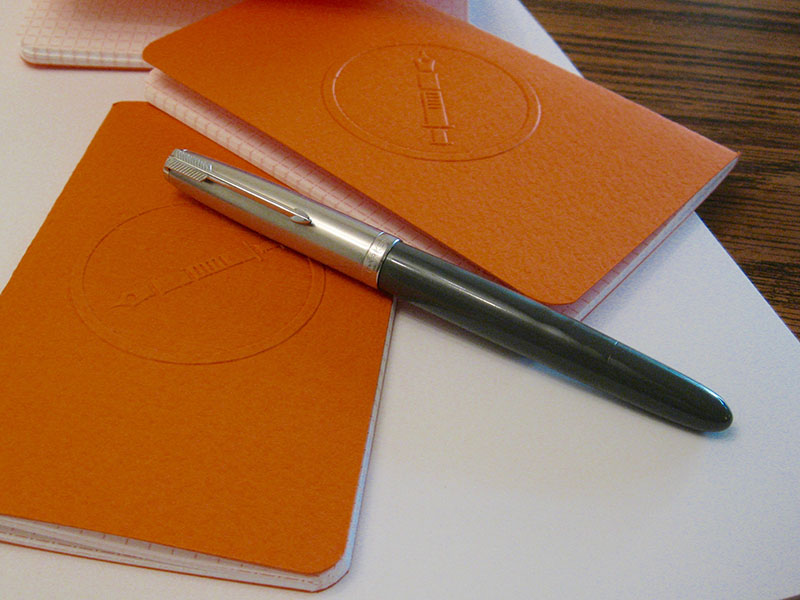
My friend advised me to watch the FPN classifieds, but also gave me the names of some vendors that I might contact to find a user-grade "51." I emailed one of the vendors, indicating that I was looking for a fully-functional, fine-nibbed 51 for under $100 and that I wasn't too fussy about color or cosmetic condition. The vendor was able to oblige and the pen I received remains one of my most reliable and frequently-inked pens: a vac-filling 51 in "dove gray."

The Parker 51 is one of the most popular fountain pens ever made and consequently, much has been written about its history. I won't rehash it all here. The pen was developed in 1939, the Parker company's 51st year in business, and went on sale in 1941. Since then, it has been altered and revived any number of times, most recently in 2002. This article will focus on the earlier versions of the pen.

The 51 was innovative in a number of ways. First was the design: sleek, modern, and oddly plain. No gorgeous, patterned celluloid, and, most surprisingly, a barely visible, "hooded" nib. This was a pen for use, not one for impressing your office-mates.

The hooded nib was not purely an aesthetic statement. It allowed for an internal ink reservoir (the "collector") to be located very near the nib. Imagine if you took a pen with a large nib and feed and then enclosed all but the tip of that nib within the pen body. The fin area of the feed could now be filled with ink and it wouldn't evaporate. That's a crude approximation of what's happening with the 51. Since the 51 was initially intended for use with a fast-drying ink, the issue of evaporation was especially important.

Another innovation was the slip cap (i.e., the cap didn't need to be screwed and unscrewed). Fountain pens had been made with slip caps before, but not with the secure closing mechanism that Parker developed for the "51." This pen could be uncapped in an instant, but there was no danger of the cap coming off accidentally.

The least innovative aspect of the 51 (at least originally) was its filling system: Parker re-used the system from their Vacumatic fountain pen. In 1948, they retired the vacumatic system and replaced it in the 51 with the Aero-metric filler. The Aero-metric filler is similar to a basic squeeze filler (think Pilot CON-20), but incorporates a breather tube so that ink is taken up faster than it is expelled when filling. The sac is mostly enclosed within a protective metal sheath and is compressed by pressing directly on a bar that runs along the length of the sac.

Buying a 51

The filling system is one of the main things you'll want to consider when buying a "51." For ease of filling, I recommend the Aero-metric, but if a very large ink capacity is important to you, you might prefer a vacumatic.

Much like its predecessor, the Vacumatic, the 51 was made in a huge number of styles, which changed throughout the lifespan of the model. The body color, the cap design and material, and the clip design all varied significantly. In each case, of course, rare variants will command higher prices. This is especially true of colors with high collecting caché, such as plum, burgundy, or Nassau green.

Unlike the Vacumatic, the 51 was not available in a lot of sizes. In fact, it was originally only available in one size, but a smaller "demi" model was introduced in 1947. If you're not buying the pen in person, it's always best to get exact measurements from the seller.

If you're purchasing an "ordinary" pen as a user rather than a collector, you can expect to pay roughly $90-160 US.

Filling

Filling the vacumatic 51 is essentially the same as filling a Parker Vacumatic, but with one added wrinkle. The combination of the collector behind the nib and the little opening around the feed means that there is a good chance that when you walk away from the ink bottle with your filled pen, you're transporting a trembling drop of ink just waiting to drip on your clothing or make a big mess on the page when you begin to write. One way to avoid this is to remove the pen from the ink bottle with the plunger in the down position. Then, when you release the plunger, any ink in the feed area will be sucked safely into the collector. Alternately, just give the tip of the pen a good wipe with a paper towel after you filling.

The Aero-metric filler is a bit simpler, although the warning about the last drop still applies. Immerse the tip of the pen in the ink bottle, squeeze the sac a few times slowly, and you're all filled up. Some models will even tell you exactly how many times to squeeze on the pressure bar.

Cleaning

Like the Parker Vacumatic, vacumatic-filling 51s are a pain to clean. With patience, though, you can repeatedly suck water into the pen and expel it until it comes out clean. The Aero-metric fillers are a bit easier, but the presence of the breather tube still makes complete expulsion of the sac contents challenging.

Due to the popularity of the "51," YouTube has many videos on how to take one apart for repair or deep cleaning. Personally, I would prefer sending the pen to a professional. Still, I would recommend these videos (especially those by Grandmia Pens) as a way to explore the internal design of the 51 without taking your own pen apart.

In Closing

If you're going to own one vintage pen, make it a Parker 51. They're readily available, not too expensive, and they make great workhorse pens for EDC or regular desk duty.

Further Reading


Enjoy reading The Pen Addict? Then consider becoming a member to receive additional weekly content, giveaways, and discounts in The Pen Addict shop. Plus, you support me and the site directly, which I am very grateful for.

Membership starts at just $5/month, with a discounted annual option available. To find out more about membership click here and join us!

Posted on July 7, 2016 and filed under Fountain Pens.