Posts filed under Fountain Pens

The Retro 1951 Tornado Prism EXT Fountain Pen: A Review

(Susan M. Pigott is a fountain pen collector, pen and paperholic, photographer, and professor. You can find more from Susan on her blog Scribalishess.)

When I saw the Retro 1951 Tornado Prism fountain pen on Jet Pens, I was immediately taken by its colorful patterns. It reminded me of a patchwork quilt. Although I had a few qualms about ordering a Retro Tornado fountain pen (I read some negative reviews a while back), I decided to give this one a try.

Packaged in a cylindrical cardboard box, the pen is nestled in the center like a spaceship ready for launch. It comes with a couple of cartridges and a converter.

The exterior of this pen is really nice. The colors and design set it apart from other fountain pens. The barrel and cap both have a light texture to them.

The barrel is made of metal as is the cap, the trims are chrome plated, but the grip is plastic. The reason the pen has the "EXT" in its name is the barrel is extended "to hold a converter, one standard international long ink cartridge, or two standard international short ink cartridges" (Jet Pens description).
The cap has the signature Retro 1951 finial with "Tornado by Retro 51" inscribed in the metal. The upper portion of the finial sports an engraved diamond pattern.

In my opinion, the top looks like it's missing something. Couldn't they have put a stylized "51" there or maybe a shiny, prism-like color of some sort?

In the usual Retro 51 style, the clip is metal and quite rigid. I suppose with some use it might loosen up, but you would need to work to get it onto a thick shirt pocket or a sheaf of papers.

Although the cap screws on to the barrel, it doesn't post well. You can jam it on the back of the pen, but it pops off pretty easily and throws off the balance of the pen anyway.

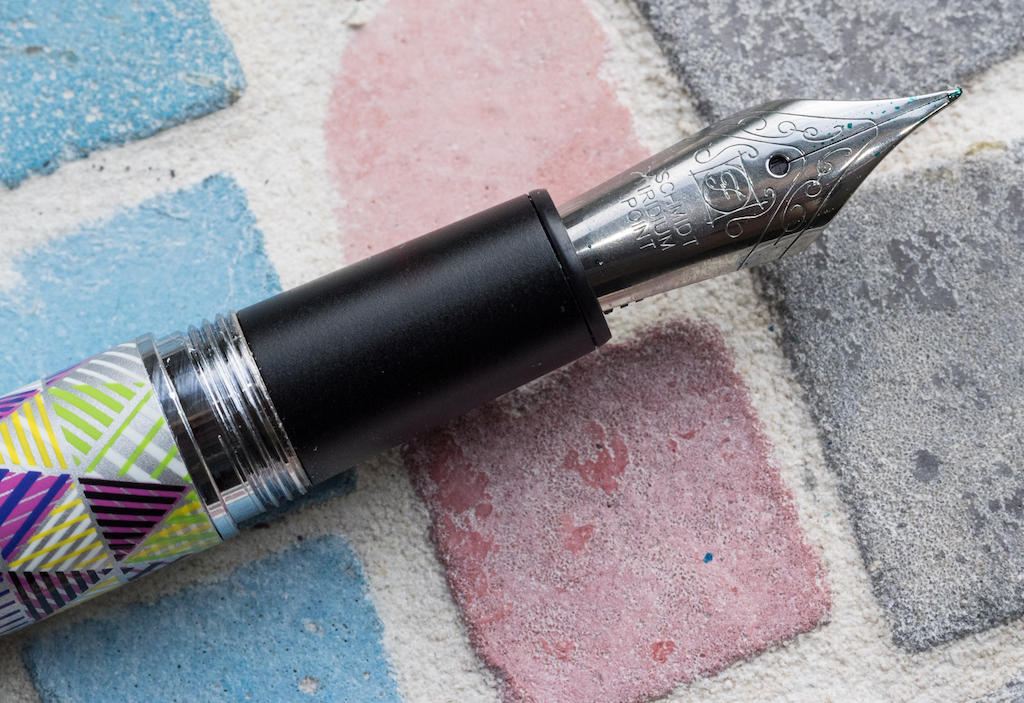
The nib is a Schmidt steel with an iridium tip. It has a basic scroll work design, along with a stylized "F" for the nib size and the Schmidt branding.
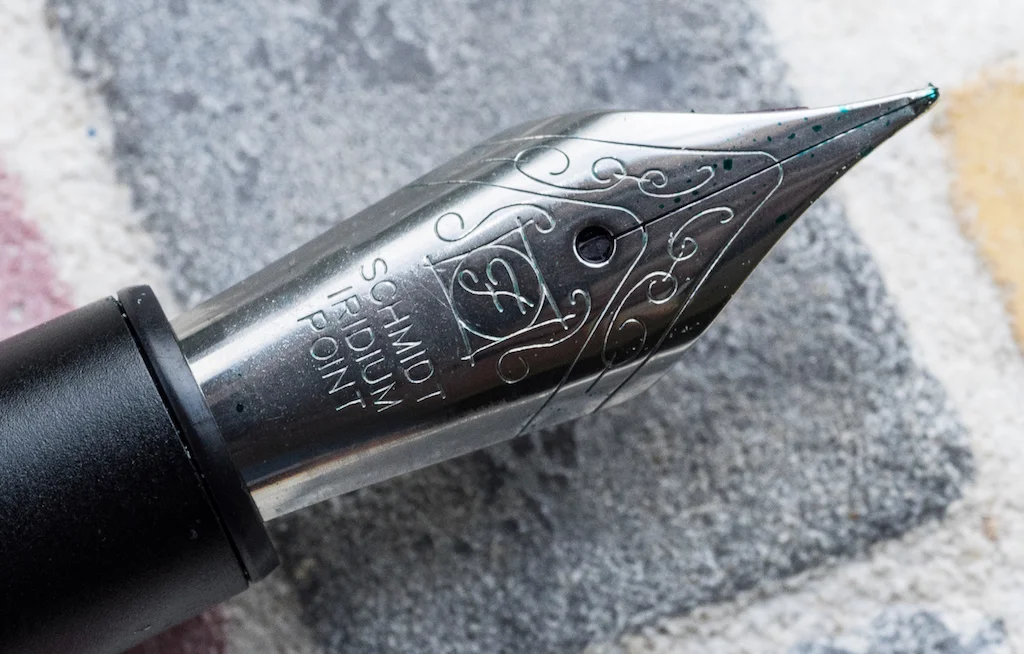
I honestly did not expect much from this nib, but it is fairly smooth with just a little feedback, depending on the paper. It seems to be a true western fine.

The converter is all plastic but works smoothly and holds a decent amount of ink.

Although the pen is light, the metal gives it just enough heft to feel substantial in the hand. I find it comfortable to write with for short periods, but after grading several papers with the pen, I experienced some hand cramping and fatigue. The grip is fairly narrow (10.1mm), and I suspect that's why my hand got tired.

The Retro 1951 Tornado Prism is a decent fountain pen for $44.50. My main concern is that the ink doesn't always flow perfectly, and you have to push it down into the feed with the converter. This intermittent ink flow causes some skipping, especially if your writing surface isn't perfectly flat.

The other concern is the cap. It screws on, but the threads aren't machined very well, so if you don't get the cap positioned just right, it gets stuck on the threads and you have to start over. I usually have to try two or three times to get the cap on correctly, and that's frustrating.

Overall, I like this pen and it will join my grading pen rotation. But, to be honest, my $12 Pilot Metropolitans are much more comfortable, better writers, and a lot cheaper than the Tornado. They remain my top-choice grading pens.

Pros

  • The unusual design and subtle texture make the Retro Tornado Prism a unique-looking fountain pen. It is a colorful and fun pen to use.
  • The pen is light, but not overly so, the metal body giving it some heft.
  • The Schmidt nib is reasonably smooth and writes a solid western fine line.
  • The plastic converter does its job fairly well. An agitator ball would help keep the ink flowing.
  • The Tornado makes a good EDC pen because it is metal and should hold up well to abuse.

Cons

  • Although the nib writes smoothly, the converter doesn't always supply enough ink to the feed and you have to push the ink down manually. I'm having this trouble with several of my converters. The only ones that don't seem to suffer from ink flow problems are those with agitator balls in them.
  • The cap does not screw onto the barrel smoothly most of the time. I think this is an issue of bad threading.
  • You cannot post this pen.

(JetPens provided this product at no charge to The Pen Addict for review purposes.)


Enjoy reading The Pen Addict? Then consider becoming a member to receive additional weekly content, giveaways, and discounts in The Pen Addict shop. Plus, you support me and the site directly, which I am very grateful for.

Membership starts at just $5/month, with a discounted annual option available. To find out more about membership click here and join us!

Posted on September 2, 2016 and filed under Retro 51, Fountain Pens, Pen Reviews.

The Sheaffer Balance

(Ron Gilmour is a fountain pen enthusiast, would-be calligrapher, and librarian. You can find him online at Twitter @gilmour70 and Instagram.)

One of the tragedies of history is that we can't see things with the eyes of the past. No matter how much we learn about Stravinsky's Rite of Spring, we can't hear it with the ears of the Parisian crowd who rioted at its premier in 1913. Novelty, by definition, cannot be replicated.

This is the case for the Sheaffer Balance. When we see it today, it looks like a pleasant, but perhaps nondescript fountain pen. There are no hooded nibs or bizarre filling mechanisms. But when it debuted in 1929, the Balance was revolutionary, simply because it was pointy.

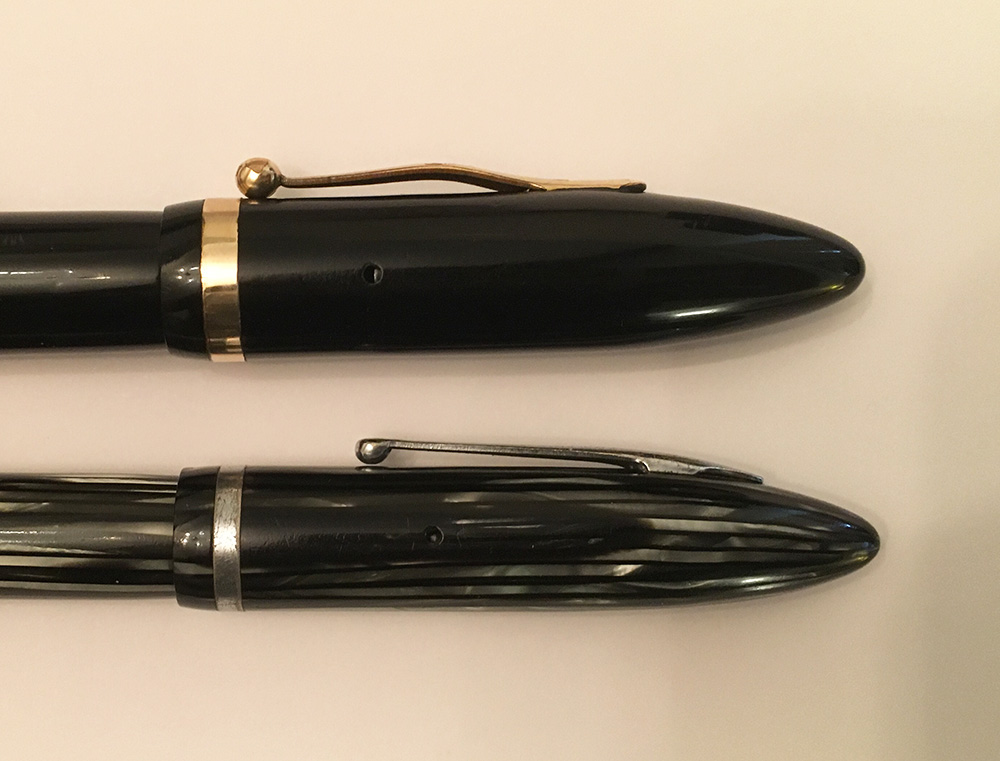
Torpedo-shaped pens are something we take for granted today, but early on, almost all fountain pens were flat-tops, or the ends were slightly rounded at best. With the gracefully tapered Balance, Sheaffer brought a new sleekness to the world of fountain pens.

For all the innovation of the design, the Balance is otherwise fairly traditional. Most are lever fillers. There's nothing unusual about the nibs. The materials, while lovely, don't necessarily stand out in a lineup of vintage pens.

The Balance debuted with a long clip that featured a full ball at the end and a sort of hump in the middle. Over time, Sheaffer modified the clip to make it more streamlined. The final version of the clip, called the "radius" clip, fits the streamlined aesthetic of the Balance nicely, but the early humped clips have a quirky charm.

As a modern user of vintage pens, you can think of the Sheaffer Balance (at least the lever-filling versions) as a solid everyday user, maybe an upgrade from an Esterbrook J.

Note: Sheaffer revived the Balance line with the Balance II in the late 1990s. This article is concerned only with the original Balance.

Buying a Balance

If you're shopping for a Balance, you'll need to consider size, material, and filling system.

As with many popular vintage pen models, the Balance was made in a variety of sizes, which varied both in length and girth. The slender models are quite thin and some may find them uncomfortable, so make sure you know the dimensions of the pen before you buy.

While all of the materials used for the Balance were once attractive, some of them haven't held up well over time. Two of the three materials with which the line was launched in 1929 have aging issues. The lovely jade green often darkens unevenly, while the "pearl" parts of the "pearl and black" models have mostly turned a peanut butter tan. Early Balance models not so afflicted will not be cheap.

Happily, there are some beautiful later materials that are quite common, especially the various longitudinally striated finishes like Marine Green, Grey Pearl, And Carmine.

In 1935, Sheaffer began using its "Vacuum-Fil" system on some Balance models. This filling system works like the modern TWSBI Vac models or the Pilot Custom 823. I recommend the lever fill pens over the Vacuum-Fil models, because the former are far easier to service. Repair of Vacuum-Fil Sheaffers is considered a specialty among pen repairers, so you may have difficulty getting one fixed if it develops a problem. That said, the Vacuum-Fil version does have the advantage of a greater ink capacity and, depending on the finish, an easier method of assessing the ink level in the pen.

Prices for the Balance range widely. I once picked up a slightly battered slender black model for $25 US. For a functional, but not pristine, full-size Balance in a common material, you can expect to pay about $100-175 US. Even the rarer and oversize models of the Balance don't generally bring the high prices of, say, rarer Parker Vacumatics. The Balance seems to top out around $500 US.

Filling a Balance

In terms of filling, the lever-fill Balances are no different than any other lever-fill pen. See this article on the Esterbrook J for detailed instructions.

To fill a Vacuum-Fil Balance, first unscrew the blind cap and pull the plunger back as far as it goes. Fully immerse the nib in the ink and then push the plunger back in. Wait a few seconds. Repeat this process to get a more complete fill. See Brian Goulet's video on filling the TWSBI Vac 700 for details on filling a similar pen. When the pen is filled, don't tighten the blind cap all the way down. Leaving it open a little will allow for better air exchange as you are writing.

Cleaning a Balance

Cleaning your Balance is just a matter of drawing water into the sac (in the case of lever-fill models) or the body (in Vacuum-Fil models) and expelling it repeatedly until the water comes out clean.

In Closing

For users of vintage fountain pens, the Sheaffer Balance is a solid choice. They offer a wide variety of sizes and finishes, are readily available, and easily repaired (at least the lever fill versions). If you're new to the vintage pen world, the Balance would make a great introduction, or a step up from an Esterbrook J.

Further Reading

Posted on August 25, 2016 and filed under Sheaffer, Fountain Pens.

Kaweco Squeeze Fountain Pen Converter Review

(Jeff Abbott is a regular contributor at The Pen Addict. You can find more from Jeff online at Draft Evolution and Twitter.)

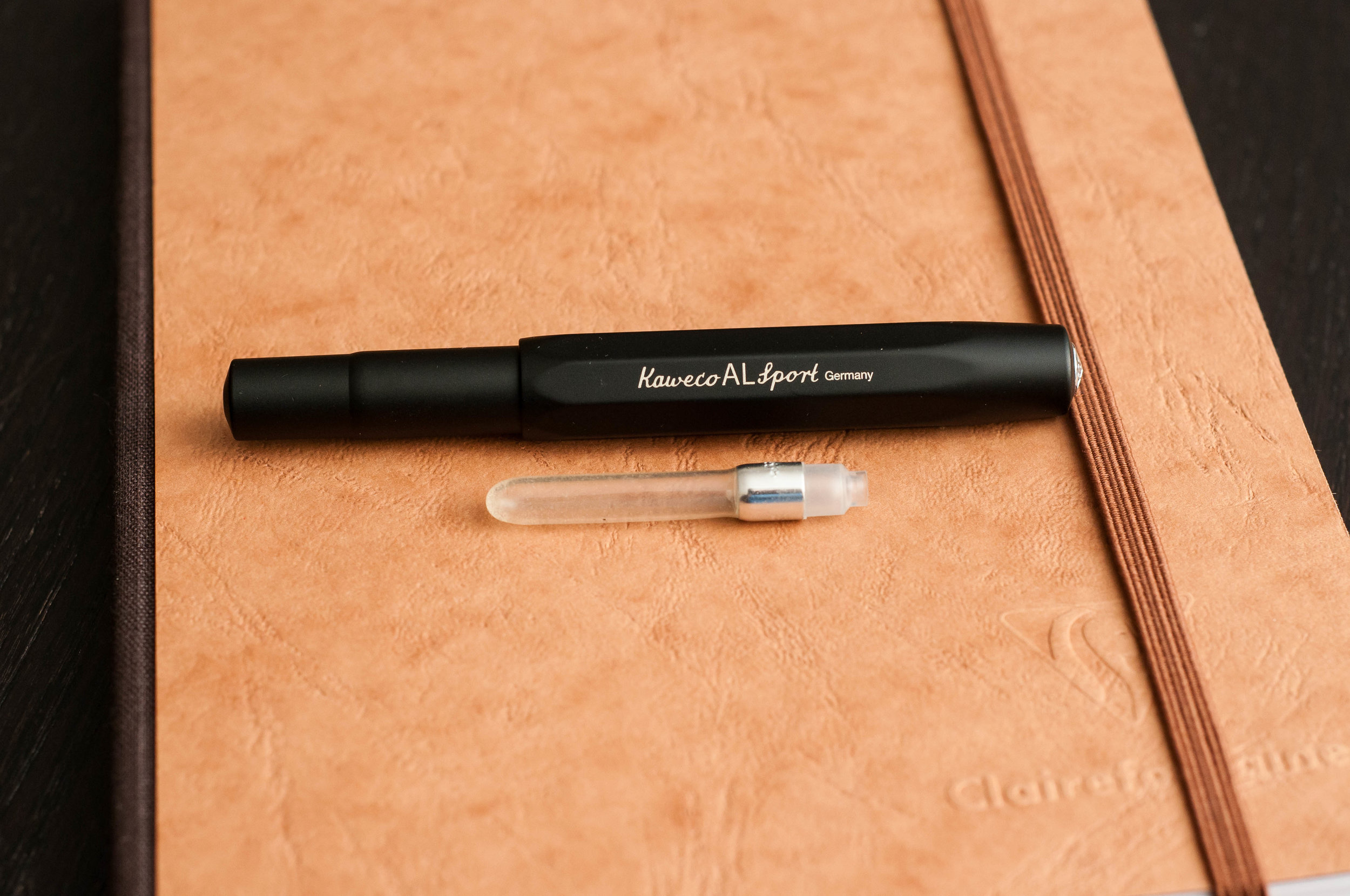
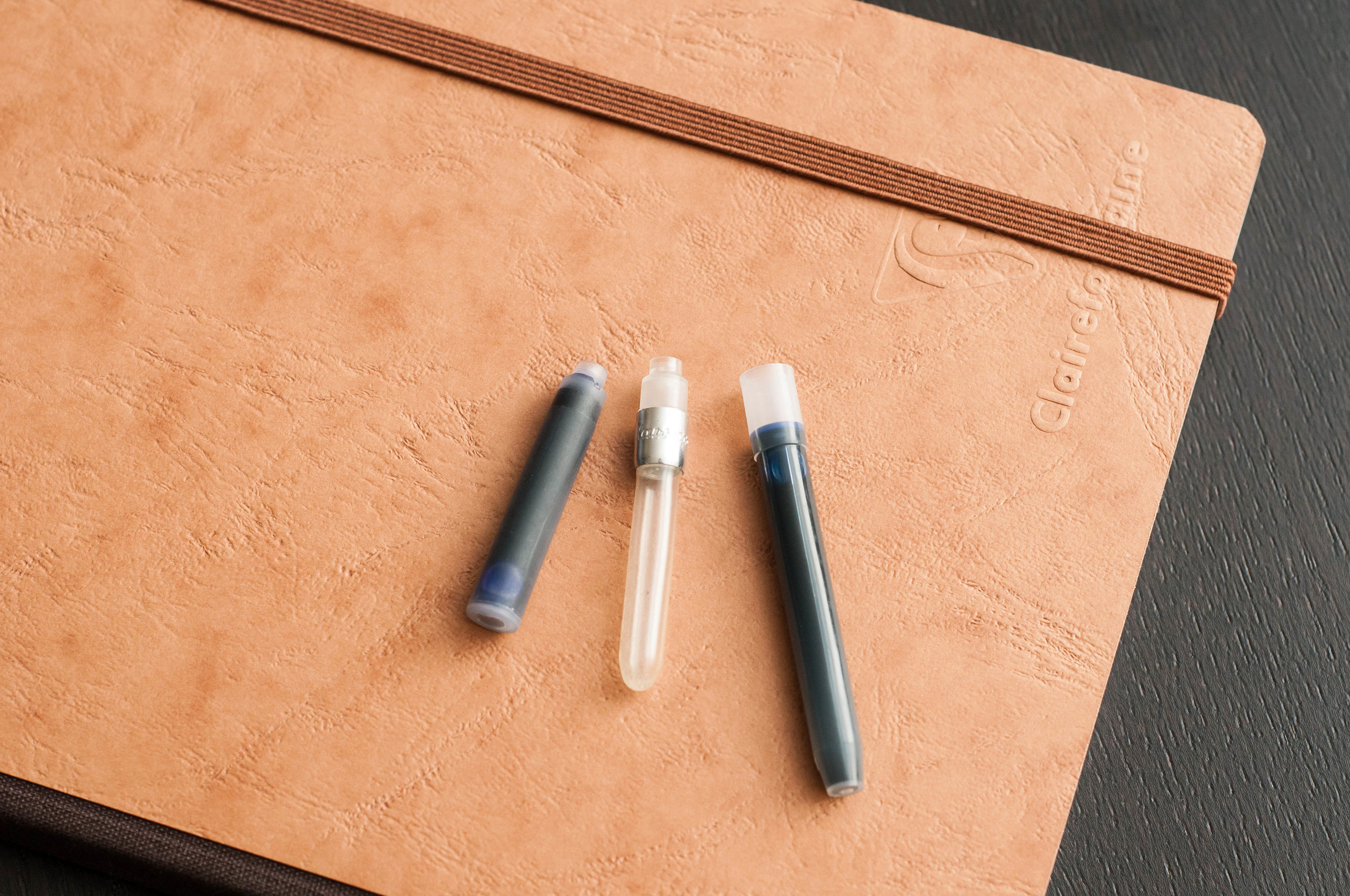
Every so often, you come across a new product that looks like it will solve a problem that you've been trying to remedy for quite a while. For me, the problem was Kaweco Sport pens and the lack of any converters. Before now, my only option was to reuse old cartridges by filling them with a syringe. The Kaweco Squeeze Converter looked like a perfect solution, so I ordered a couple. After all, the squeeze converters I've used from Pilot have been great, so this should be a great new addition for my Kaweco Sports.

The premise of the squeeze converter is great, but it doesn't quite live up my idealistic hopes. First off, these converters aren't pricey. When I bought them, they were $3 a piece. For converters, that's cheap. So, take the cost into consideration when I say that this is the worst converter I've ever used, and I probably won't bother using them again after the pens run out of ink.

Every now and then, you land on a dud. The Kaweco Squeeze converter is that dud for me, but it was worth the shot to try them out. The idea is still great — and the product would be great if a couple of major design flaws were corrected.

In practice, the squeeze converter is extremely simple to operate. Simply pop it into a pen that uses international short cartridges (two different Kaweco Sports in my case), dunk the nib in ink, and squeeze the bulb to expel the air and soak up the ink. The Kaweco converter does this, but not very well.

Basically, the problems boil down to:

  • I could only ever achieve a 1/3 full converter no matter how hard I tried to expel all the air from the bulb. 1/3 of a converter is not much ink at all.
  • The floppy design (which is necessary to expel air and creation suction) means that you must be careful when handling it. If you're planning to use a syringe to fill the converter 100%, I'll be astonished if you can fit the full converter to your pen without making a mess. I sure couldn't.
  • The pens I used were never "leakers" — meaning, they never had any nib creep while the cap was on. With these converters installed, a good amount of ink ends up on the nib while the pen is being transported. For example, if I put the cap on the pen and set it down on the table, there will be spots of ink on the nib when I re-open it. I tested this several times and my only conclusion is that the floppy nature of the converter means that it bounces slightly when the pen is jarred, which causes some ink to leak out of the nib. Really uncool.
  • They're annoying to clean properly.

These converters are usable, but I wouldn't recommend them to anyone. They're messy, inefficient, and don't hold much ink at all.

That doesn't mean that all bulb converters are bad. Take the Pilot CON-20 or the converter that ships with the Pilot Metropolitan for example. Same concept, but pilot has put a metal cage around the bulb to protect it, along with a window that allows you to pump the bulb. The Pilot CON-20 costs a mere $0.30 more than the Kaweco converter, so I have a hard time believing that this design choice was related to cost on Kaweco's part.

Overall, this is a product that has potential with some design changes, but not worth your time as it stands today. Spend your $3 on some silicone grease to turn your Kaweco Sport into an eyedropper, or reuse old cartridges by filling them with a syringe instead!

(JetPens provided this product at no charge to The Pen Addict for review purposes.)


Enjoy reading The Pen Addict? Then consider becoming a member to receive additional weekly content, giveaways, and discounts in The Pen Addict shop. Plus, you support me and the site directly, which I am very grateful for.

Membership starts at just $5/month, with a discounted annual option available. To find out more about membership click here and join us!
Posted on August 24, 2016 and filed under Kaweco, Fountain Pens.