Posts filed under Fountain Pens

Aurora 88 Sole Fountain Pen: A Review

(Susan M. Pigott is a fountain pen collector, pen and paperholic, photographer, and professor. You can find more from Susan on her blog Scribalishess.)

I've had my eye on the Aurora Sole (both the Optima and 88) for quite some time. In fact, I almost purchased the Optima Sole a few months ago, but couldn't decide between it and the 88. If I were to buy one, it probably would be the 88 simply because I like the shape of the pen, but the Optima Sole is just as beautiful and is certainly less expensive (if you can find one).

The Aurora 88 Sole is a limited edition of 888 pieces to celebrate Aurora's 70th anniversary of the 88 model. This limited edition pen comes with a high price tag, $895 retail, though most pen vendors sell it for a little less than that. It is currently $715 at Vanness Pens.

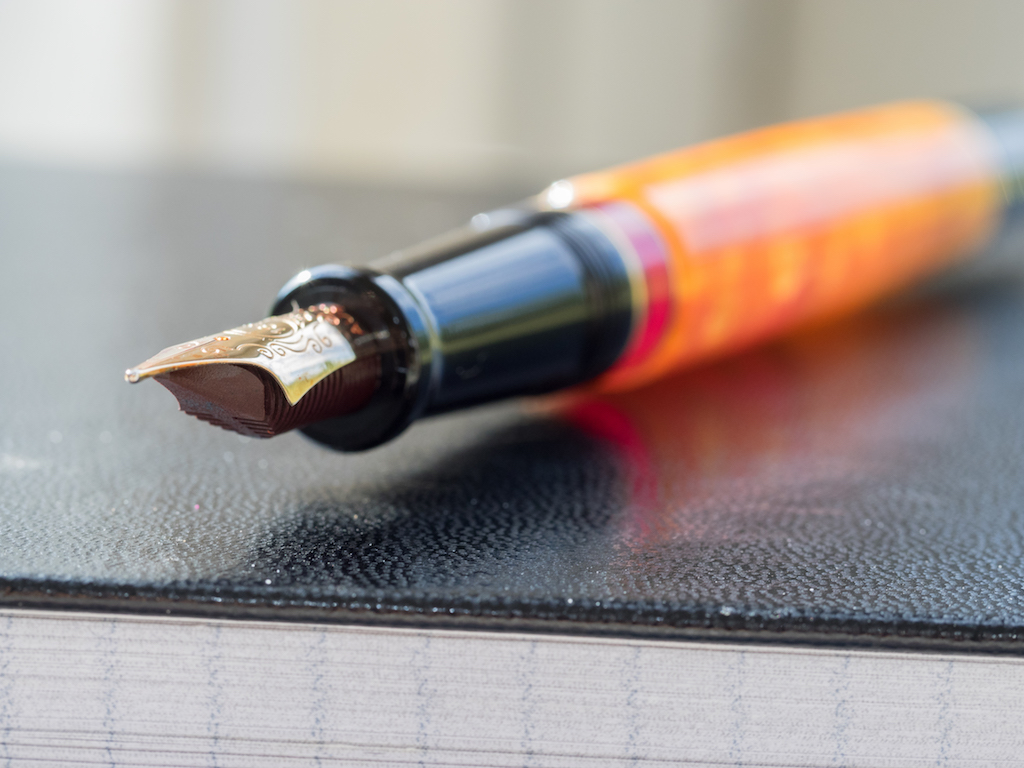
Made from marbled Auroloide (a cellulose acetate derivative), the pen looks as though it is lit from within. The material is absolutely stunning, especially in sunlight.

The cap finial, piston, and grip are made of black resin. The cap is encircled by Aurora's distinctive clip and a gold band inscribed with the Aurora name in cursive.
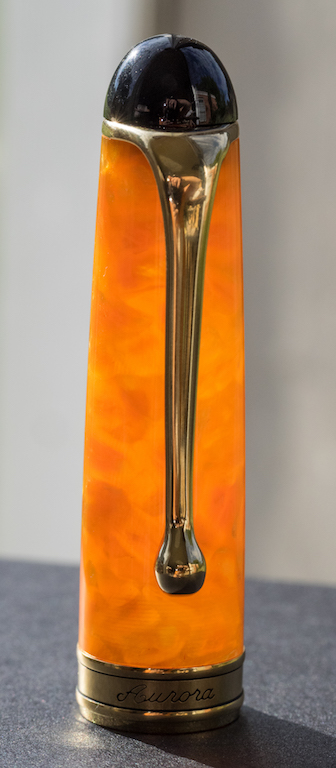
The limited edition number is engraved on the back of the cap near the finial in gold. This pen is number 242 out of 888.

Auroras come with a small ink window (about 5mm in width) that lets you keep track of how much ink is in the pen. But, if you run out, there's a reservoir with a bit more ink that will allow you to write one more page. Just unscrew the piston knob and keep writing. The piston works smoothly and draws in about 1.1ml of ink.

My favorite size nib in the Aurora line is the medium. It is smooth and stiff with just a hint of feedback typical of Aurora nibs. By "feedback" I don't mean "scratchy." Aurora nibs just have a tactile pull to them when you write. The scroll work on the nib is beautiful and that's one reason Aurora pens are among my favorite brands. Their nibs are still made in house and are outstanding.

The feed is made of ebonite and the nib size is imprinted on it.

The 88 is a cigar-style design well suited for most people. It's a medium-sized pen, measuring about 133mm capped, 128mm uncapped, and 155mm posted. Posting gives the pen more heft and length if you need that for comfortable writing. The 88 is slightly longer than the Optima, but when you compare them uncapped, the length from the tip of the nib through the grip is exactly the same. The difference in size is found in the length of the barrel.

The Aurora 88 is such a comfortable pen. The length and weight are perfect for my hand, and I love the raised lip design on the grip that keeps your fingers in place.

I think the Sole is one of the prettiest of all Aurora Auroloides. It is a bright marbled orange/yellow that simply glows. However, it should be noted that the Auroloide is translucent and the black portions of the pen show through. If you use a dark ink, that will show as well. I'm not bothered by the translucency, but some may think that the black showing through detracts from the beauty of the pen.

Pros

  • The Aurora 88 Sole is a beautiful limited edition fountain pen. Collectors will definitely want to have a pristine model for their collections, but it's too good of a writer to keep behind glass.
  • Aurora nibs are made in house and are exceptional both in design and performance.
  • I think the medium nib is the best size of Aurora nib, though I like the broad as well. It writes smoothly with just a bit of feedback.
  • The material on this pen is stunning. It is like carrying a ray of sunshine in your hand.
  • Aurora knows good pen design, and the 88 is a classic. The size is a perfect fit for most hands, and it's a piston filler (one of the most popular filling methods).

Cons

  • At $895 retail, the Aurora 88 Sole is very expensive. If you like the material but don't want to pay that much, you might be able to find a used Aurora Optima Sole for about half that price.
  • Some people may find the feedback from Aurora nibs annoying. The nibs are also very stiff, so if you prefer nibs with a bit of spring, Aurora may not be the brand for you.
  • Because the Auroloide is translucent, the black portions of the pen show through, and that might be a deal-breaker for some.

(Kenro Industries provided this product on loan to The Pen Addict for review purposes.)


Enjoy reading The Pen Addict? Then consider becoming a member to receive additional weekly content, giveaways, and discounts in The Pen Addict shop. Plus, you support me and the site directly, which I am very grateful for.

Membership starts at just $5/month, with a discounted annual option available. To find out more about membership click here and join us!

If BB8 had a fountain pen, it would be the Aurora 88 Sole.

Posted on September 30, 2016 and filed under Aurora, Fountain Pens, Pen Reviews.

The Sheaffer Snorkel

(Ron Gilmour is a fountain pen enthusiast, would-be calligrapher, and librarian. You can find him online at Twitter @gilmour70 and Instagram.)

In the early 1950s, Sheaffer faced significant challenges on at least two fronts. First, there was the tremendous popularity of the Parker 51, with its sleek, modern design. Second, the ballpoint pen was making inroads, boasting ease of use with no messy dipping or filling.

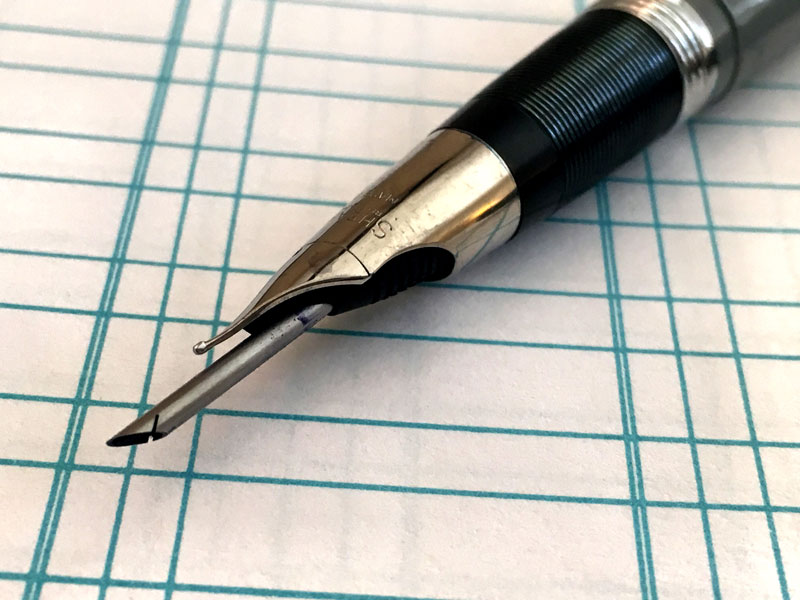
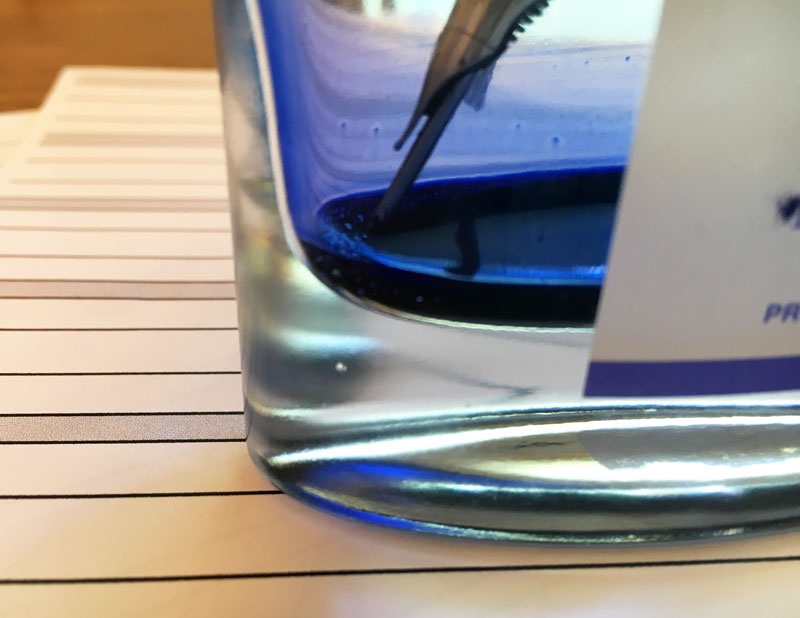
Sheaffer responded with the Snorkel. Its look was clearly influenced by the 51, but with some uniquely Sheaffer elements. Best of all, it could be filled without any mess thanks to a tube that extended from the feed to suck up ink. This meant that the nib need not be submerged to fill the pen.

Most modern fountain pen users are unlikely to be put off by the alleged messiness of filling a pen, but the Snorkel's eponymous tube is unbeatable for getting those last precious drops out of an ink bottle.

Buying a Snorkel

The Snorkel is such a uniformly great pen that your choices in selecting one will be largely aesthetic. Personally, I'm a fan of the tubular "Triumph"-style nib, but Snorkels are also available with conventional nibs.

The original color range was fairly subdued, but starting in the mid-1950s the palette expanded to include colors of Fiestaware-like vibrancy. There were all-metal models (these were rarer), and very attractive "Crest" and "Clipper" models with plastic bodies and metal caps. (See David Isaacson's article for explanations of the 13(!) model names used for the Snorkel.)

For a functional, but "nothing special," Snorkel, you can expect to pay roughly $70-150 US.

Filling

For a pen that boasts the most complex filling system in the history of fountain pens, the Snorkel is surprisingly easy to fill.

Unscrew the blind cap and pull back. This will expose the metal "Touchdown" tube that surrounds the ink sac, and will also cause the snorkel tube to extend. Put the end of the snorkel tube in the ink and push the blind cap back into position. As you tighten the blind cap, the snorkel tube will retract into the feed. You're ready to write.

Cleaning

In principle, cleaning a Snorkel isn't much different from any other sac-filling pen. Just draw water up into the sac and expel it. Repeat until the water comes out clean. In practice, this is easier than cleaning a lever-filling pen, since the Snorkel's filling mechanism can be operated more quickly.

In Closing

The Snorkel is a solid pen that will not disappoint. As with all vintage Sheaffers, the nibs are excellent, though generally very firm. The relatively low cost on the secondary market and the large number of models and colors makes the pen a nice option for a collection as well as a great user.

If you like the idea of the snorkel tube, but don't like the slim body of the Snorkel, you might look at the Sheaffer PFM, a later model that uses the same filling mechanism, but has a chunkier build and a beautiful inlaid nib.

Further Reading

Brian Gray's explanation of his pneumatic filling mechanism discusses how a similar filling mechanism works and includes a helpful video.

David Isaacson's Sheaffer Snorkel Collector's Guide helps to decipher the profusion of model names for the Snorkel.

Richard Binder's extensive profile page on the Snorkel is helpful for determining the age of your Snorkel and lists many of the colors.

Richard Binder's Anatomy of a Fountain Pen III: Sheaffer's Snorkel explains the complex internal workings of the filling mechanism, with detailed diagrams.

Posted on September 28, 2016 and filed under Sheaffer, Fountain Pens, Pen Reviews.

Visconti Homo Sapiens London Fog: A Review

(Susan M. Pigott is a fountain pen collector, pen and paperholic, photographer, and professor. You can find more from Susan on her blog Scribalishess.)

The Visconti London Fog is another pen in the Homo Sapiens series that came out earlier this year. Originally, I had no plans to purchase one – I like the Crystal Swirls model better, but it is no longer available. Still, the more photographs I saw of the London Fog, the more it grew on me. So, I decided to pull the trigger.

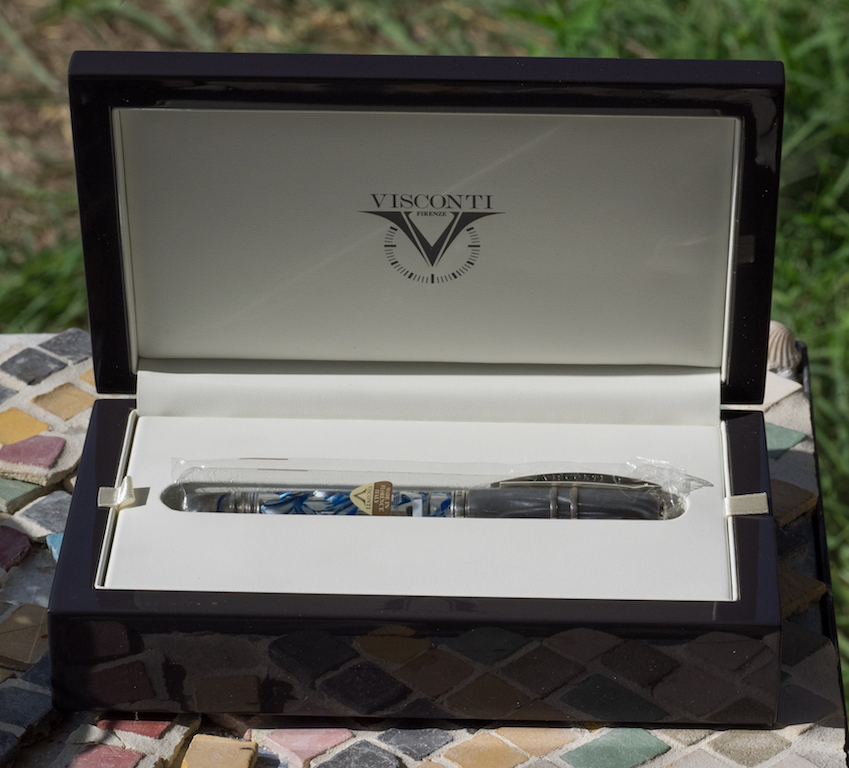
The pen comes packaged in a large Visconti box. They are masters of ornate pens and flashy boxes. I never quite know what to do with such large, heavy boxes, so I just stow them in my office closet in case I decide to sell my pens later.

This pen is, to put it mildly, majestic. It is large (146mm capped, 130mm uncapped, 170mm posted) and weighty (40 grams), but I have come to love big pens. My right hand doesn't get cramps when I write with a pen like the London Fog.

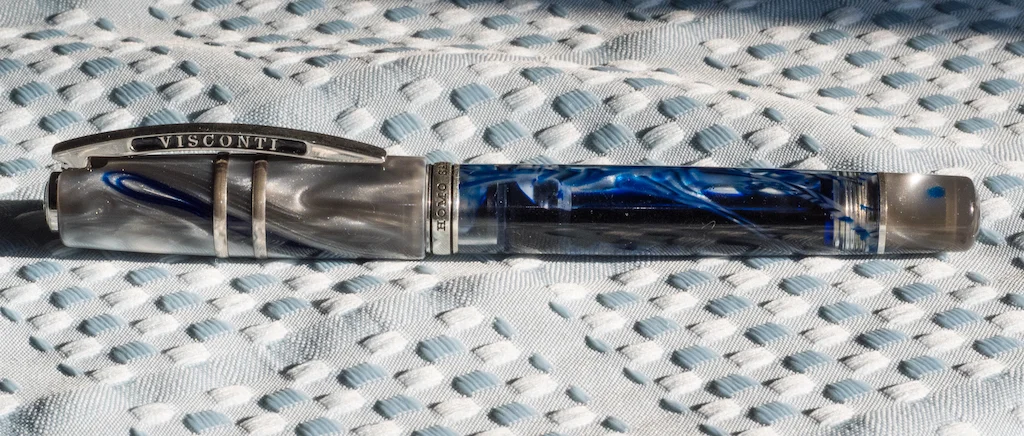
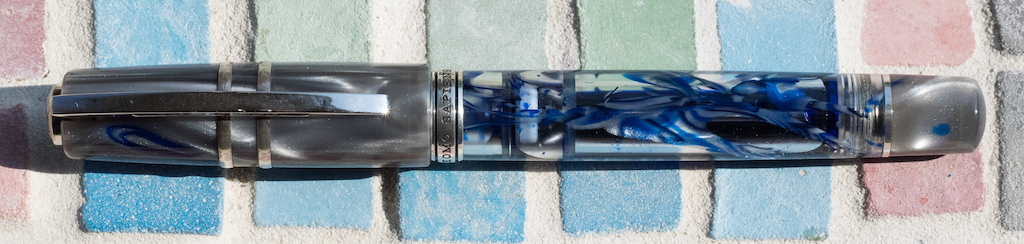
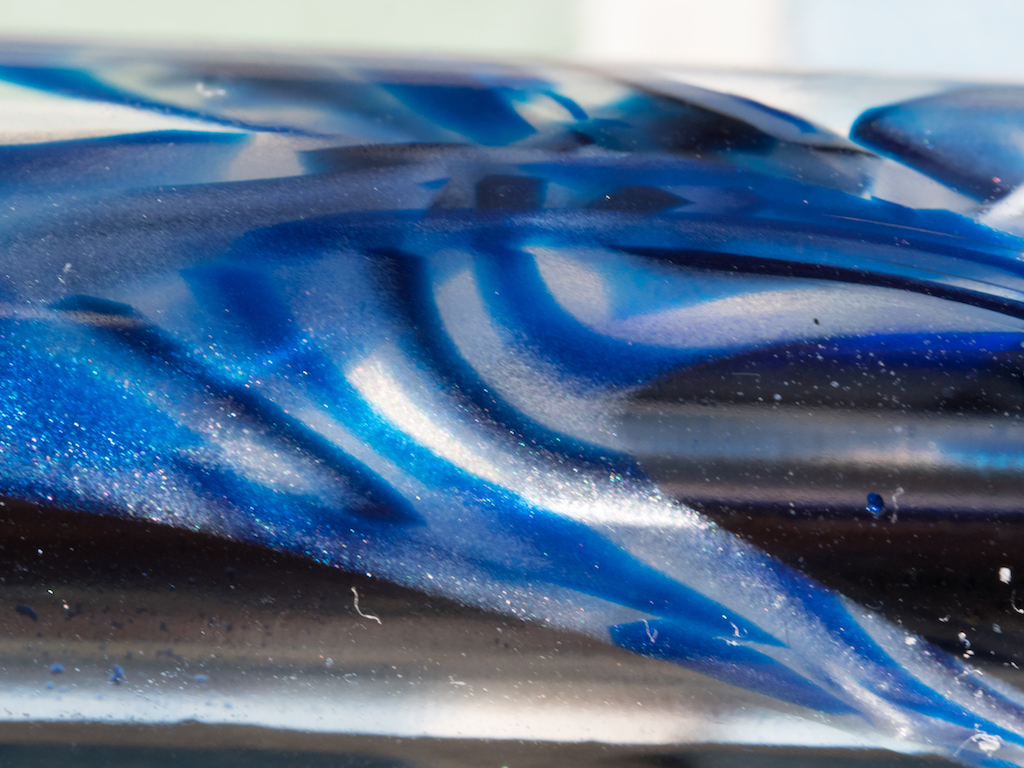
The cap, grip, and piston knob are made of acrylic that is mostly silver/grey with dark blue swirls. The material sparkles in the sunshine.

The barrel is made of clear acrylic with celluloid ribbons of silver/grey and blue. Acryloid is Visconti's name for this special material that is a mix of acrylic and celluloid in microscopically thin strips. Whatever it's called, it really is fantastic. The layers swim like tropical fish through the clear acrylic. The combination of demonstrator with beautiful artistic swirls makes for a stunning pen.

The cap is quite heavy due to the sterling silver clip, rings, and finial. I do not recommend posting it because it throws the balance of the pen off, but to each his/her own. As with other Visconti pens, the finial is removable. You can replace it with the Visconti "My Pen" system. I think this pen would look gorgeous with a lapis lazuli stone, but that will have to wait for a day when I have money again.

The cap is also adorned with two silver rings and the iconic Visconti clip which is spring loaded.

Visconti's special "Hook Safe Lock" system is how the cap attaches to the barrel. I really like this system because the cap is so easy to get off and on. It is much easier than a thread system that requires multiple turns. The Visconti "hooks" are smooth and do not interfere with one's grip on the pen.

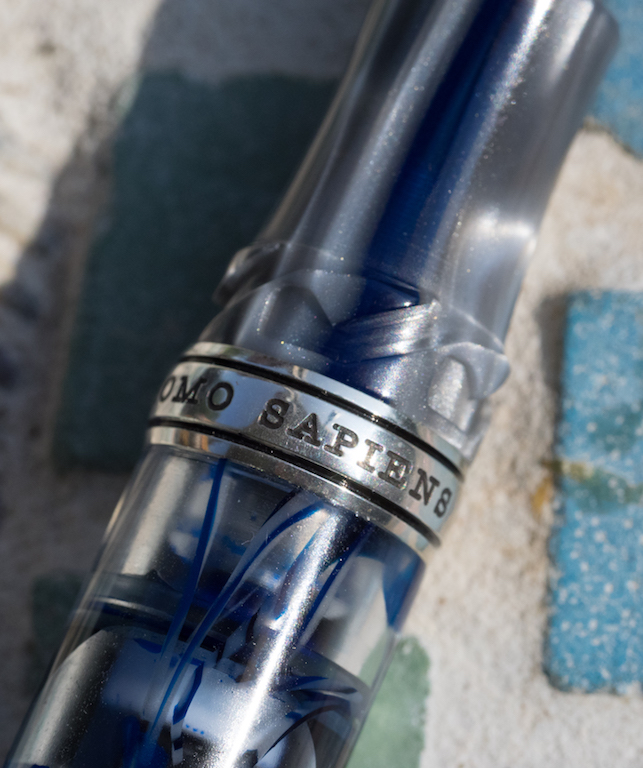
The barrel is adorned with a large silver ring engraved with "Homo Sapiens." It is simple and beautiful.

A plain silver ring connects the barrel to the piston knob. The piston unscrews to allow the user to pull the vacuum seal out to fill the pen. I haven't been able to get a complete fill on this pen, despite the "power filler" name. I don't know if I just need to practice more or if the system is not meant to fill the barrel completely with ink. I noticed that when the ink in the barrel got low, no ink went into the feed. I had to pull the piston out to let ink into the lower barrel. This got messy. I'll have to work with the system more to see if there's a problem with my pen or if you simply need to keep the barrel filled with ink for the feed to remain saturated.

I ordered my London Fog with a fine, 23K Palladium nib. The nib is springy and slightly flexible if you press into it. It is a joy to write with.

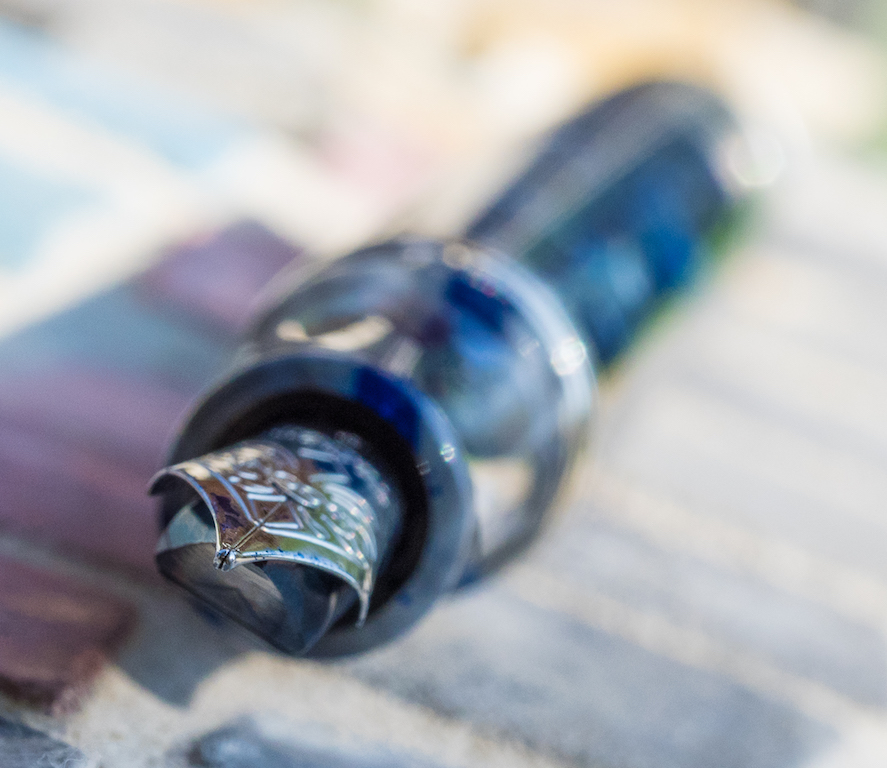
The nib is beautiful with Visconti's lovely scrolling and the moon-shaped breather hole.

When I ordered my London Fog, I requested two things. First, I wanted the pen to have lots of swirls. Some versions of these Visconti pens are mostly acrylic with just a few swirls. If you're going to pay this much for a pen, get as many swirls as you can! I strongly recommend that, if you can't purchase the London Fog at a physical store, you contact your online dealer and request photos of the pens in stock. That way you can choose the pen that has the look you want. The swirl factor was important to me.

Second, the other issue when ordering a Visconti is the nib. Almost every Visconti fountain pen I've purchased has had a bum nib. Maybe I've just been unlucky, but I have had to send all my Viscontis in for nib work. Not this time. When I placed my order with Bryant at Chatterly Luxuries, I asked him to make sure the nib was smooth and trouble-free. I am happy to say this is the first Visconti pen that I've received that has written well straight out of the box. Thank you, Bryant!

At a retail cost of $995, the London Fog is quite an investment. You can purchase this pen at a lower cost through Chatterly Luxuries (they can't advertise their price), but regardless, if you buy this pen, expect to pay a good amount for it. I am very happy with my purchase because this pen writes like a dream and is absolutely spectacular in appearance. Still, if I ever find a Crystal Swirls Visconti, I might just trade my London Fog for it.

Pros

  • The London Fog is a truly spectacular pen.
  • If you get a good nib, the Visconti really is a dream to write with. They aren't kidding with the "Dreamtouch" label! But make sure you have it tested before it is shipped.
  • I find the vacuum filling system to be adequate. I honestly prefer piston fillers. But, the pen holds a huge amount of ink (1.51 ml) if you can get a good fill.
  • The pen feels wonderful in the hand. It is hefty and large, but I've found pens like this reduce hand fatigue. I love writing with this pen.
  • The capping system is quick and effective.

Cons

  • The London Fog is an expensive pen, no doubt about that.
  • Vacuum fillers are notoriously difficult to clean.
  • Visconti nibs are hit or miss in my experience. If you get a good nib, it is truly a great writing experience. But, if you get a nib with the tines out of alignment or is dry or has baby's bottom, you are stuck with paying more for a nibmeister to adjust it. Visconti really needs to do a better job of quality control.

(I purchased this pen with my own funds and was not compensated for this review.)


Enjoy reading The Pen Addict? Then consider becoming a member to receive additional weekly content, giveaways, and discounts in The Pen Addict shop. Plus, you support me and the site directly, which I am very grateful for.

Membership starts at just $5/month, with a discounted annual option available. To find out more about membership click here and join us!

Posted on September 9, 2016 and filed under Visconti, Fountain Pens, Pen Reviews.