Posts filed under Fountain Pens

Aurora Optima Blue Auroloide Fountain Pen Review

(Jeff Abbott is a regular contributor at The Pen Addict. You can find more from Jeff online at Draft Evolution and Twitter.)

I've been spending some quality time with a couple of Aurora fountain pens lately, and I've been really happy with them for the most part. A few weeks ago, I was focused on the Nikargenta 88, but I've recently been spending a lot more attention with the Optima Auroloide. The Optima has roots in the 1930s, which is where the external aesthetic shines so well. Compared to the slim Nikargenta, it's thicker and more stout, but still offers a fantastic writing experience. No matter where the inspiration for this design came from, the combination of the shape, feel, and beautiful Auroloide material make this a real winner.

Aesthetics

Now, like I just mentioned, Aurora calls this material "Auroloide," which is their own name for the antique celluloid material they use. You've likely seen similar materials used in many, many other pens and manufacturers, and it never fails to stun when seen in person. Sure, photos look nice, but they don't fully capture the depth and charm that the material offers. The model I have is the blue Auroloide, and it has a combination of medium to dark blue hues that glisten under light. I'm extremely partial to blue, so I was in love from first sight, but the other colors look equally stunning based on the photos online.
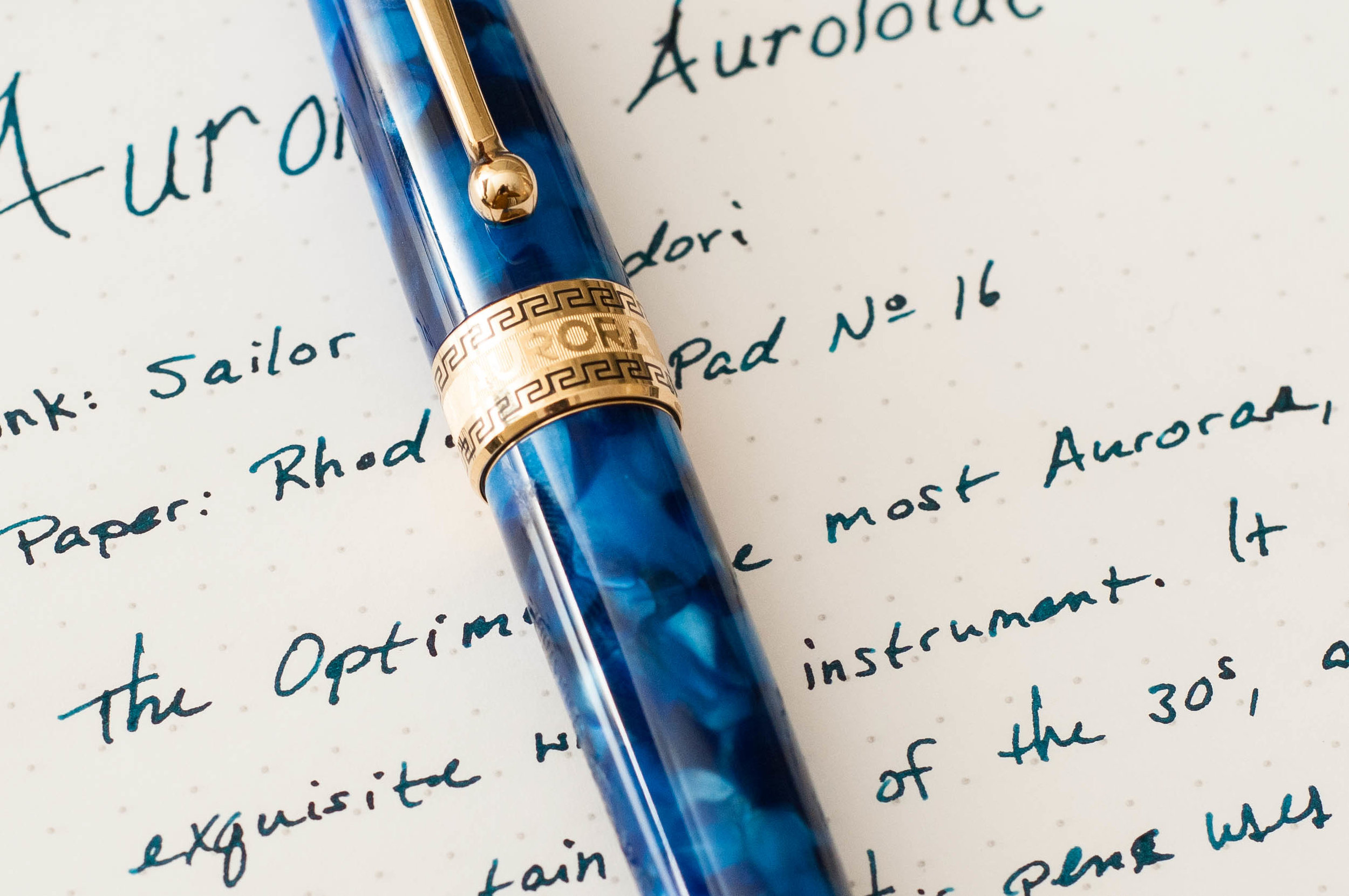
The shape of the pen is classic. The top and bottom are both flat, while the body widens to the middle section and tapers off to form a comfortable grip. The cap is large and ornate, featuring gold trim and prominent Aurora branding. The clip is strong, but features are very smooth, rounded tip that makes it easy to mount and dismount every kind of material.

Apart from the branding on the cap band, there's also a stamped brand on the body of the pen. I'm sure many manufacturers do this, but the first example that comes to mind is Edison Pen Company. They use the same stamp method that evokes an antique feeling and nods to the fountain pen champions of the 20th century.

Now, the nib on the Nikargenta was pretty, but it's a slim pen overall. Of course it has a petite nib to match the overall design. But, that's where the Optima has room to shine. With a stout body, this pen flaunts a bodacious 14k nib that never fails to catch my eye. It's tastefully adorned and fits the rest of the pen perfectly.

Apart from that, this pen is a piston filler, and has a spacious ink window between the body and section. It's never difficult to see how much ink is sloshing around inside the reservoir. And, surprisingly, this pen holds a lot of ink. I did not measure the exact amount of ink used, but it's very similar to a TWSBI 580. Very ample.

Writing Experience

The nib looks outstanding, but it also writes like a champ. The point on mine is a medium, and it performs very closely to the Nikargenta. It's not quite as smooth, but it falls well within satisfactory tolerances for a stock nib. It's an absolute pleasure to write with — never any skipping or hard starts. Ink flow is exceptional without being too wet. And, given the size of the nib, it showcases inks very well.

The grip section is smooth, polished plastic that ends with a small lip at the end to provide additional stability for your fingers. It's done in a way that is comfortable. Some pens that utilize this grip design can feel uncomfortable after a few minutes of writing because the lip edge is too dramatic or sharp. The Optima grip is smooth enough to maintain comfort for longer sessions. And, the overall diameter of the pen adds to that comfort as well.

Overall

I'm impressed again by the quality and craftsmanship found in the Aurora fountain pen line. The Optima is a pen designed with a nod to the pens of yesteryear, and it pulls this off with exceptional style and poise. Not only that, but it's a fantastic writer. The Optima is not a cheap pen, but the price is fair and justifiable in my opinion. It's a luxury writing instrument, and it feels like one when you use it. MSRP is between $500 and $550 for the fountain pen, depending on the color and trim. Anderson Pens sell the entire line of Aurora (fountain pens, rollerballs, ballpoints, and pencil), and the version pictured here runs for just under $495. In most of the fountain pen versions, you have a choice of EF, F, M, and B nibs.

(Kenro Industries provided this product on loan to The Pen Addict for review purposes.)


Enjoy reading The Pen Addict? Then consider becoming a member to receive additional weekly content, giveaways, and discounts in The Pen Addict shop. Plus, you support me and the site directly, which I am very grateful for.

Membership starts at just $5/month, with a discounted annual option available. To find out more about membership click here and join us!

Posted on November 30, 2016 and filed under Aurora, Fountain Pens, Pen Reviews.

Oldwin Art Deco Fountain Pen in Bleu Automne: A Review

(Susan M. Pigott is a fountain pen collector, pen and paperholic, photographer, and professor. You can find more from Susan on her blog Scribalishess.)

When I went to France last March, one of my objectives was to visit the Mora Stylos shop in Paris. Unfortunately, the only day we were near the shop was a Sunday, and they were closed. I would have loved to buy a pen directly from Monsieur Mora, but it was not to be.

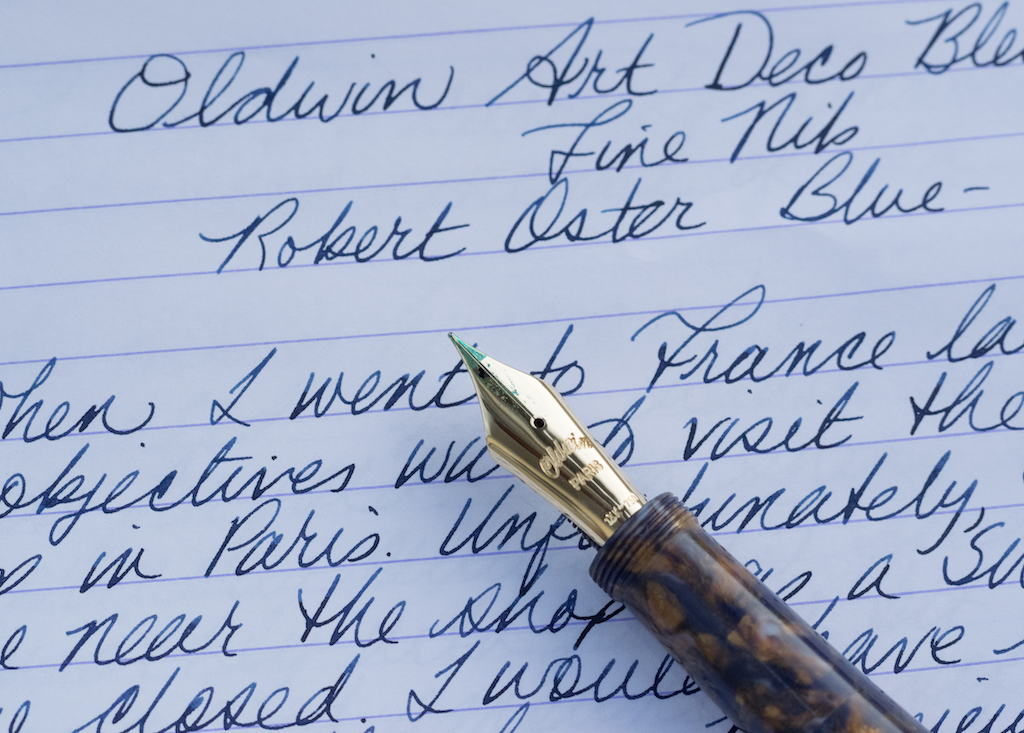
So, this fall, I began shopping for a pen on the Mora Stylos website. I decided on a beautiful celluloid called Bleu Automne in the Art Deco Oldwin style. The only nib choices were fine and medium. I chose a fine nib.

The pen took a little over a week to arrive from Paris. A letter from Monsieur Mora was enclosed and the pen was in a simple black hinged box.

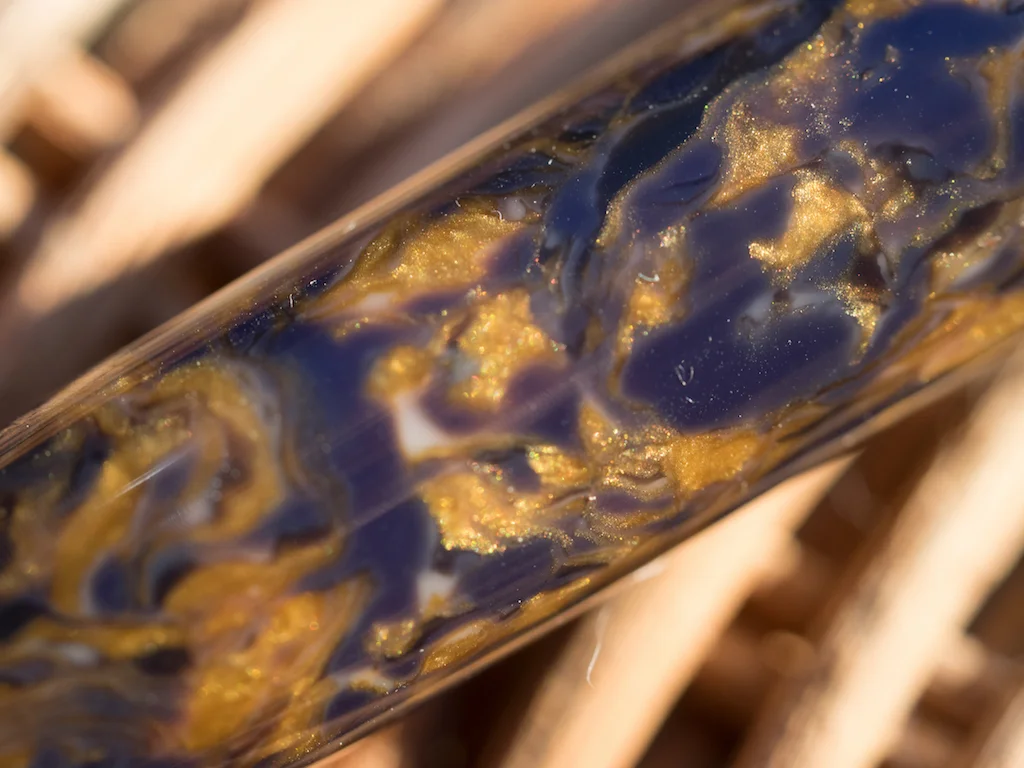
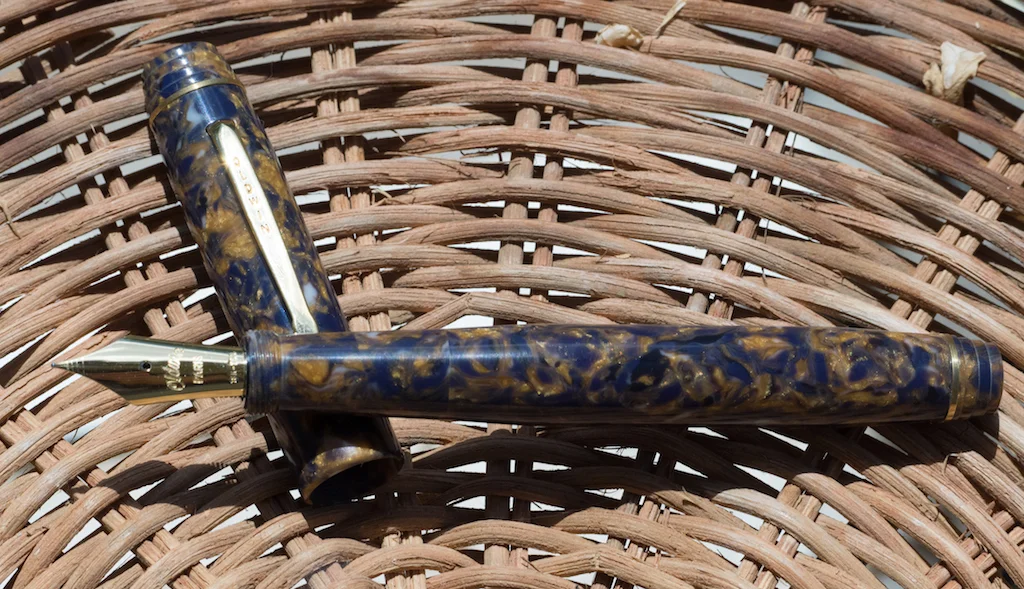
Talk about “oh la la!” I audibly gasped when I opened the box. Inside was an enormous pen in the most gorgeous celluloid I’ve ever seen. Bleu Automne is a combination of deep blue with golden and white swirls. The gold swirls sparkle in the sun. It is simply stunning.

The pen is large at 150mm capped and 135mm uncapped.

It’s really too large to post, though I suppose one could. Even though the pen is big, it isn’t heavy because the celluloid is light material. That said, the celluloid feels much more substantive than acrylic, and it warms to the hand.

The body details on this pen are exquisite. The cap and the bottom of the barrel are each encircled with a thin gold band. Then there are graduated steps leading to the slightly rounded finial and barrel bottom.

The bronze-plated clip inserts directly into the cap (there’s no clip ring). It’s a simple, rectangular clip inscribed with “Oldwin.”

The pen is a cartridge/converter and comes equipped with a Waterman converter. It holds a decent amount of ink.

The 18k nib on this pen is gigantic (German size 7) and glorious. It is decorated simply with the words “Oldwin” and “Paris” along with the gold content near the base.

Measured in millimeters

This shiny piece of solid gold sits atop an enormous feed.

The pen writes smoothly with a tiny bit of feedback. It has a softness to it, but it certainly doesn’t flex, and I wouldn’t call it “springy.” It’s a very responsive nib and is a delight to write with.

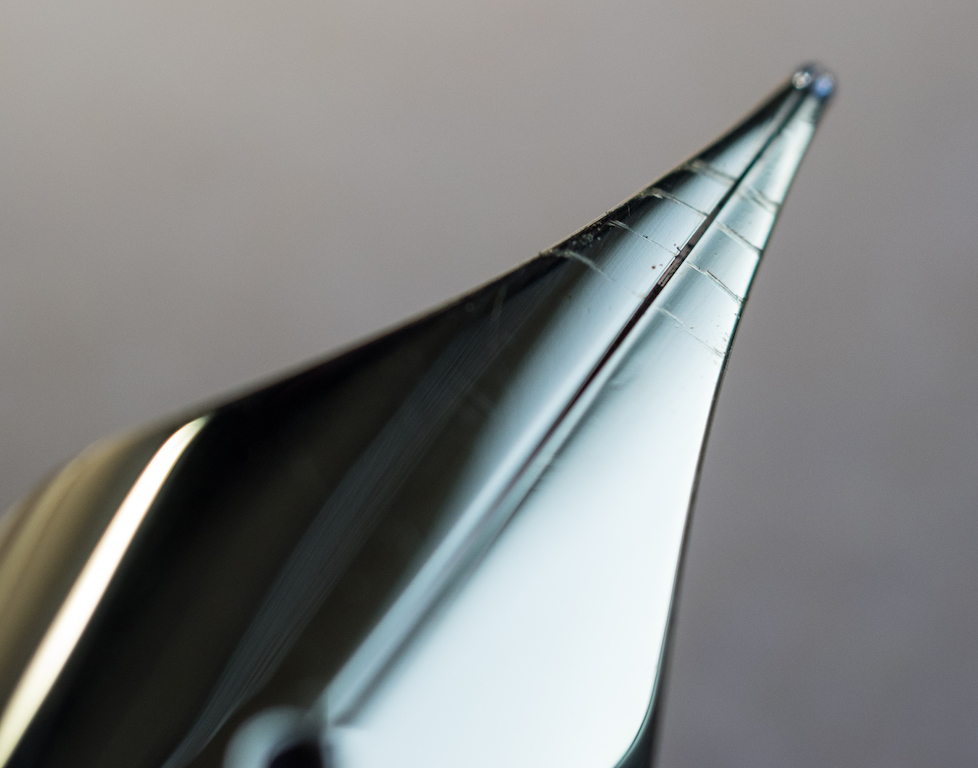
When I first received the pen, I discovered four parallel scratches on the nib. I’m still not sure what caused them, though I suspect they came from the clip screw inside the cap.

I notified Monsieur Mora about the problem, and he accepted the pen back for repair. He replaced the nib and fixed whatever caused the scratches. He shipped the pen back to me free of charge and even reimbursed me for the postage I paid to send him the pen. I call that excellent customer service.

The pen is now perfect and, I have to say, it is one of the most beautiful pens I own. Of course, handmade pens like this come at a price. My pen cost over $500, but I am very happy with my purchase.

If you ever visit Paris, I encourage you to visit Mora Stylos at 7 Rue de Tournon. It’s not too far from Shakespeare and Company.

Otherwise, you can view pens for sale on the Mora Stylos website. Just be careful! You’ll want to buy them all. Ils sont magnifiques!

Pros

  • The Oldwin is a hand-crafted, gorgeous oversized pen from Paris.
  • Bleu Automne celluloid is unique and incredibly beautiful.
  • The pen is well balanced even though it large.
  • The solid 18k gold nib is enormous and beautiful in its simplicity. It is a smooth, responsive nib.
  • Mora Stylos offers excellent customer service.

Cons

  • The pen is a cartridge/converter. For this size of a pen, it would be nice to have a piston or eyedropper option.
  • Mora Stylos pens are quite expensive, as you would expect.
  • Because the shop is in Paris, if you need repairs, you have to send it there. That is time consuming, but André Mora stands behind his product.

I purchased this pen from Mora Stylos with my own funds.


Enjoy reading The Pen Addict? Then consider becoming a member to receive additional weekly content, giveaways, and discounts in The Pen Addict shop. Plus, you support me and the site directly, which I am very grateful for.

Membership starts at just $5/month, with a discounted annual option available. To find out more about membership click here and join us!

Posted on November 25, 2016 and filed under Oldwin, Fountain Pens, Pen Reviews.

Kaweco Supra Eco Brass Fountain Pen Review

(Jeff Abbott is a regular contributor at The Pen Addict. You can find more from Jeff online at Draft Evolution and Twitter.)

A while back, I purchased my first Kaweco Liliput. It was the Brass Wave model with an EF nib, and I immediately fell in love with the form factor. A little later, I also picked up a stainless steel version, which strengthened my affection for the little Liliputs even more.

Fast forward a bit to 2016, and we have the Kaweco Supra. The name caught my attention when the pen was first announced because the only Supra I'm familiar with was one that Toyota made back in the day. Let's just they don't have much in common at all.

The Kaweco Supra take the idea of the Liliput and adds a bit of size and flexibility. An all copper body? Check. Threaded rear for posting the cap securely? Check. Slim size and cigar-like shape? Yep. So what does the Supra have that you can't find in the Liliput? Several things.

Size

The Supra is quite a bit larger than the Liliput. When you compare the Supra with a brass Liliput, there's an entire ounce of difference. That's significant when comparing pens. The Supra is 5.1 inches when capped, and the Liliput is 3.8 inches. Both are pocketable, but the Supra has a more normal diameter compared to the Liliput. I've always felt that the Liliput isn't ideal for long writing sessions, but the Supra take care of that concern with no problems. This is a full size pen that still breaks down to a small, pocketable superstar of a pen.

Flexibility

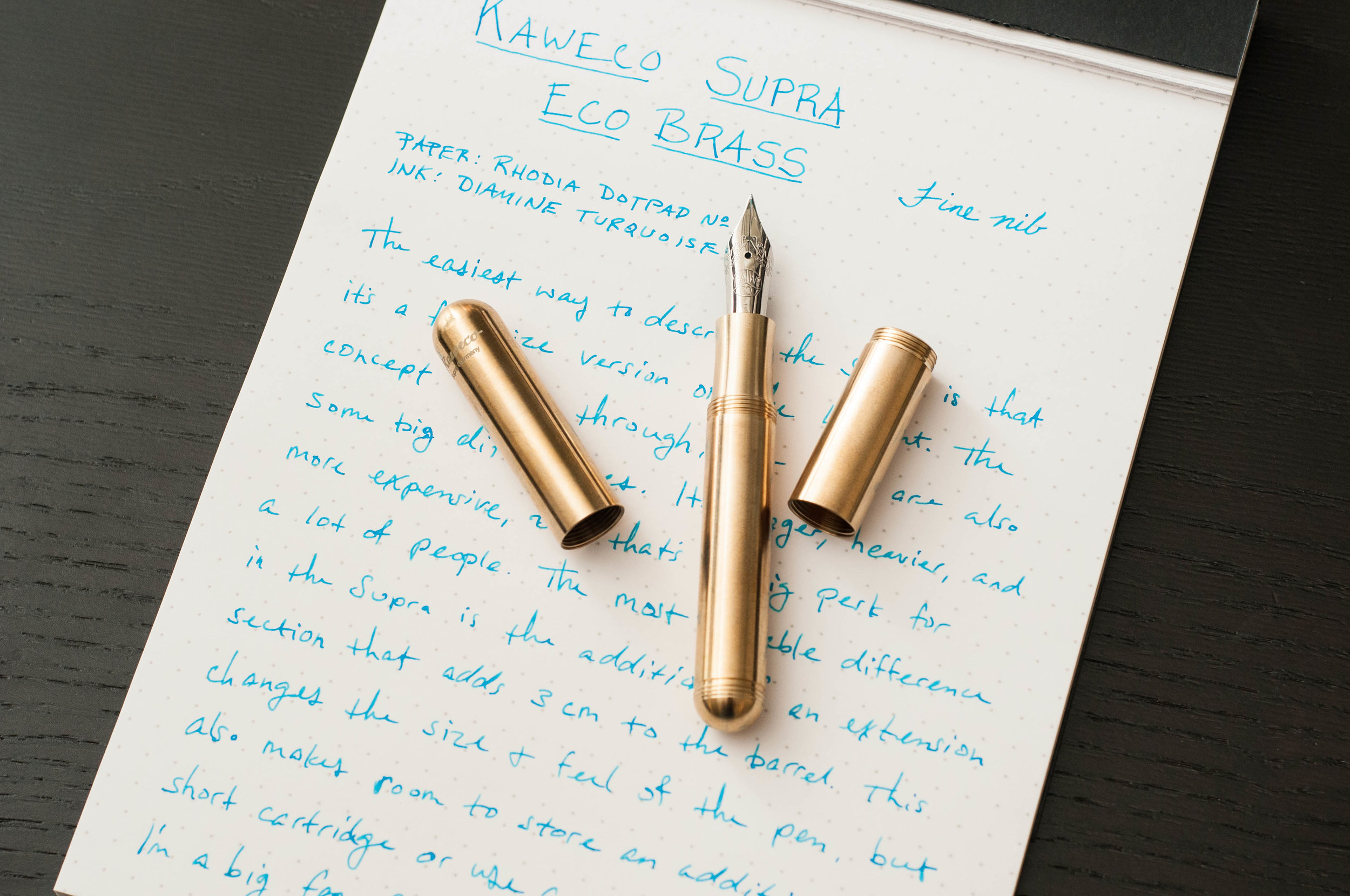
The Supra has another trick up its sleeve, though. Unlike the Liliput, it has an additional section piece that can be removed to reduce the overall size and weight of the pen. The extra section is 3 cm long, which is about a quarter of the overall length. When you remove this extra section, the Supra really is a big brother to the Liliput. But, I love the flexibility that this additional piece offers. For one, you can store an extra short cartridge in the pen, or you can use a full-size converter with the extra space. It also changes the weight and feel of the pen depending on the configuration you're using. For me, I prefer to use the pen unposted when the extra section is installed, but I prefer to use it posted when the extra section is removed. You can certainly post the cap with the section installed, but that makes for a pretty long pen. For me, it threw the balance off too much.

I love the Supra for its flexibility and quirk. It can be a bit hefty since it's solid brass, but it's still a good weight for writing. Of course, the brass will take on a new personality fairly quickly after you start using it. In just three weeks of use, I have some patina starting to show on the more heavily used areas of the pen. Over time, it will develop into a duller, warmer finish.

Personally, I would love a stainless steel version of the Supra as well. It would be a tad lighter, but wouldn't develop a patina. I have a love-hate relationship with brass pens. On one hand, I love the unique and aged look they take on over time. On the other hand, I sometimes feel annoyed by the texture that the oxidation creates. It makes the pen feel dirty in some cases.

But, don't let that bother you. Cleaning off the patina is a simple matter of letting it soak in white vinegar for 15 minutes followed by some mild scrubbing. After that, it's shiny and new again.

Writing

By now, you know I'm a fan of the exterior of the Supra, but let's talk a bit about the important part — the nib.

The nib on the Supra is also a step up over the Liliput (and many other common Kaweco models). It uses a large #6 nib that fits perfectly on this pen. It makes a statement and plays well with the overall aesthetic of the pen. I love the large nib, and I'm also very happy to report that it's an excellent writer. I've had trouble with Kawecos needing minor (and not-so-minor adjustments) in the past, so it was a relief to find this one worked well straight away.

The nib is smooth and delivers ink with constant flow. It's a stainless steel nib, so there's not any flex to report. What I can say is that it's a sturdy, reliable, and enjoyable nib.

Again, depending on how you configure the Supra, it will feel different when writing because of the changes in weight and balance. I look at that as a benefit, but I'm sure others would disagree.

I've used this pen for a solid three weeks and have been very happy with it so far. It does very well for extended writing sessions, but also is the perfect size for going along for off-site adventures in your pocket or bag. The brass material also means you'll pick up dings and scratches that add more character to it over time.

Conclusion

Overall, I'm really happy with this pen. It's a great product from Kaweco that is a "larger than life" take on one of my other favorite Kaweco products, the Liliput. Of course, the Supra is a bit more expensive than the Liliput, but that's easy to explain with the larger size and larger nib. I look forward to other variants of the Supra from Kaweco in the future!

Goldspot have the Supra in EF, F, M, B, and BB nib sizes.

(Goldspot provided this product at no charge to The Pen Addict for review purposes.)


Enjoy reading The Pen Addict? Then consider becoming a member to receive additional weekly content, giveaways, and discounts in The Pen Addict shop. Plus, you support me and the site directly, which I am very grateful for.

Membership starts at just $5/month, with a discounted annual option available. To find out more about membership click here and join us!

Posted on November 9, 2016 and filed under Kaweco, Fountain Pens, Pen Reviews.