Posts filed under Fountain Pens

Faber-Castell Ondoro Fountain Pen Review

As a brand, Faber-Castell has become more and more interesting to me. I know, I’m a little slow, seeing how they have been in existence for over 200 years. I always considered them a pencil company, and a great one at that, but could they make a quality fountain pen? I had my doubts, based on no facts whatsoever. And I’m glad to be proven totally and completely wrong.

The Faber-Castell Ambition set me down this path, and the Faber-Castell Ondoro Smoked Oak solidified my thoughts.

Fun fact: This isn’t my first Ondoro. I bought the Orange resin model a couple of years ago from one Stephen Brown. It had a broad nib, which I promptly had converted into a cursive italic. Despite this being a perfectly styled Brad pen, the nib and I never clicked, even after modification, so I sold it. I think my mistake was the modification, because what I have discovered in retrospect is that Faber-Castell nibs are perfect right out of the box.

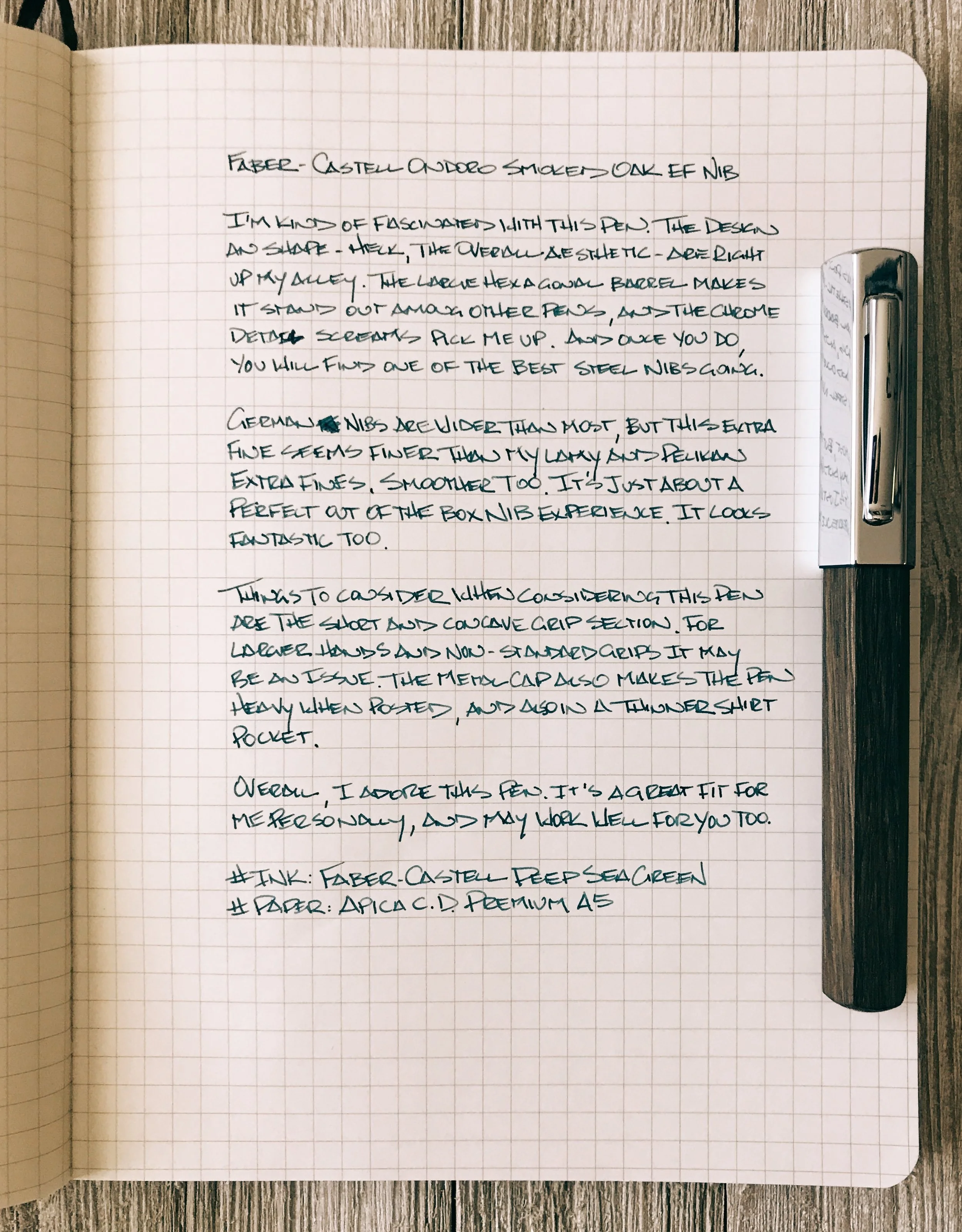
The Ambition in EF solidified that thought, so I chose another EF in the Ondoro since I love the design of the pen and missed having one after selling my first. I think it may be my favorite steel German nib too, better than both Lamy and Pelikan in this size. It is finer and firmer, allowing for a clean and defined lined. It looks great too, especially inked with something like Faber-Castell’s own Deep Sea Green.
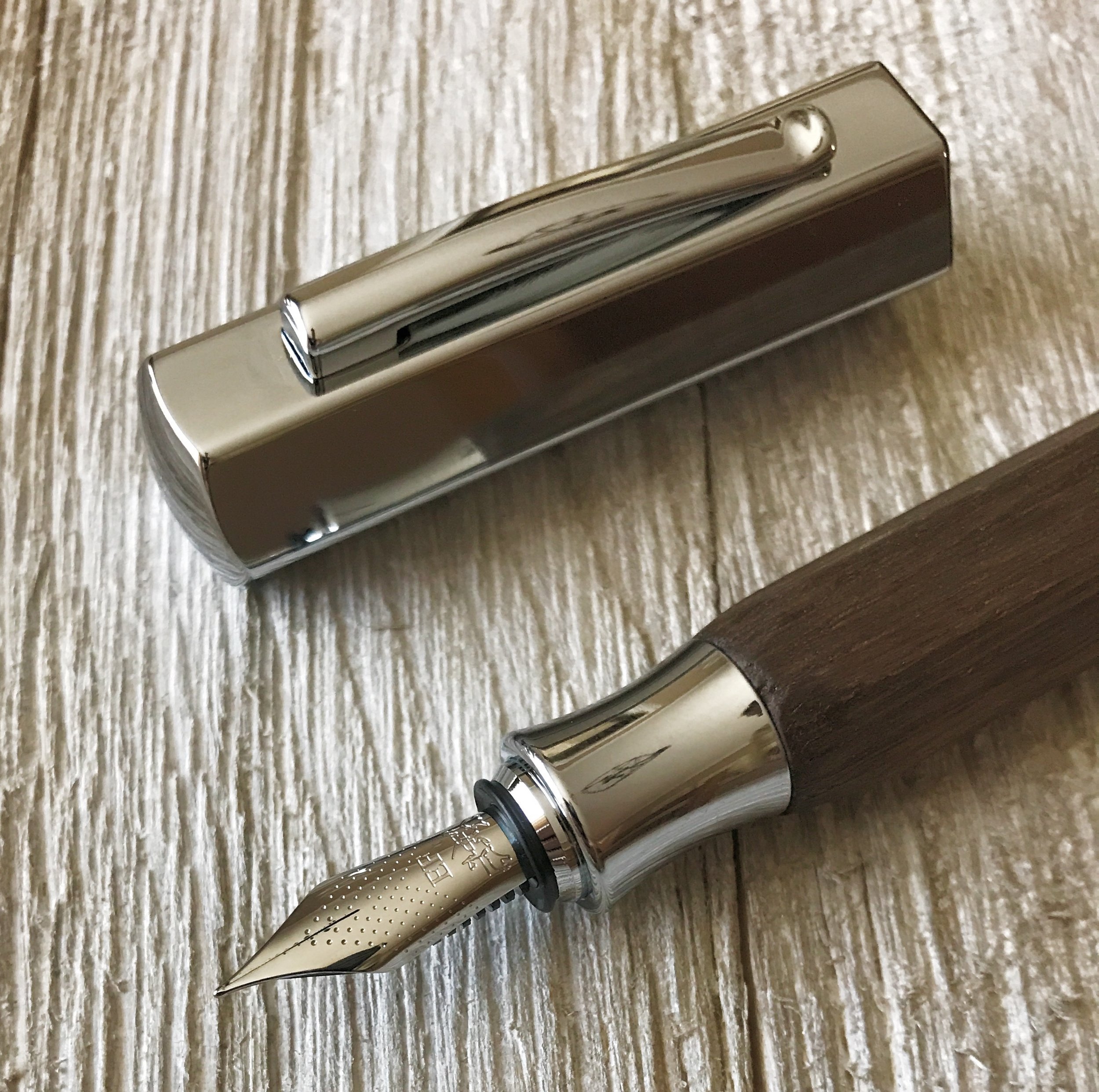
The Ondoro is described as a chunky pen, and that is accurate. The barrel is wide, and the cap is wider. It’s not a heavy pen though, and I find it comfortable to use. The Smoked Oak feels and looks great, and it comes in various resin models too, like the aforementioned Orange.

If there is one thing to consider with the Ondoro, it is the grip section. It’s short in length as well as concave. For my grip, which is very standard, it’s not an issue. If you have larger hands or a non-standard grip I could see it being an issue. The Ambition had similar questions with it’s lack of a grip section. Faber-Castell definitely does things differently in this area. Additionaly, the metal cap does make this pen heavy when posted as well as when clipped to something thin like a shirt pocket.

Price-wise, Faber-Castell pens aren’t cheap compared to the competition, but I think they are fairly priced. They are very similar to Pelikan in that regard. High quality German design and performance is generally worth the cost. If I enjoy a pen I never think twice about the price, and I certainly enjoy the Ondoro.

I’ve been mentioning how impressed I am with Faber-Castell as a brand for a while now. I think it is time to continue this exploration and see what else they have to offer.

(JetPens provided this product at no charge to The Pen Addict for review purposes.)


Enjoy reading The Pen Addict? Then consider becoming a member to receive additional weekly content, giveaways, and discounts in The Pen Addict shop. Plus, you support me and the site directly, which I am very grateful.

Membership starts at just $5/month, with a discounted annual option available. To find out more about membership click here and join us!
Posted on October 2, 2017 and filed under Faber-Castell, Fountain Pens, Pen Reviews.

Conklin Herringbone Burgundy Fountain Pen: A Review

(Susan M. Pigott is a fountain pen collector, pen and paperholic, photographer, and professor. You can find more from Susan on her blog Scribalishess.)

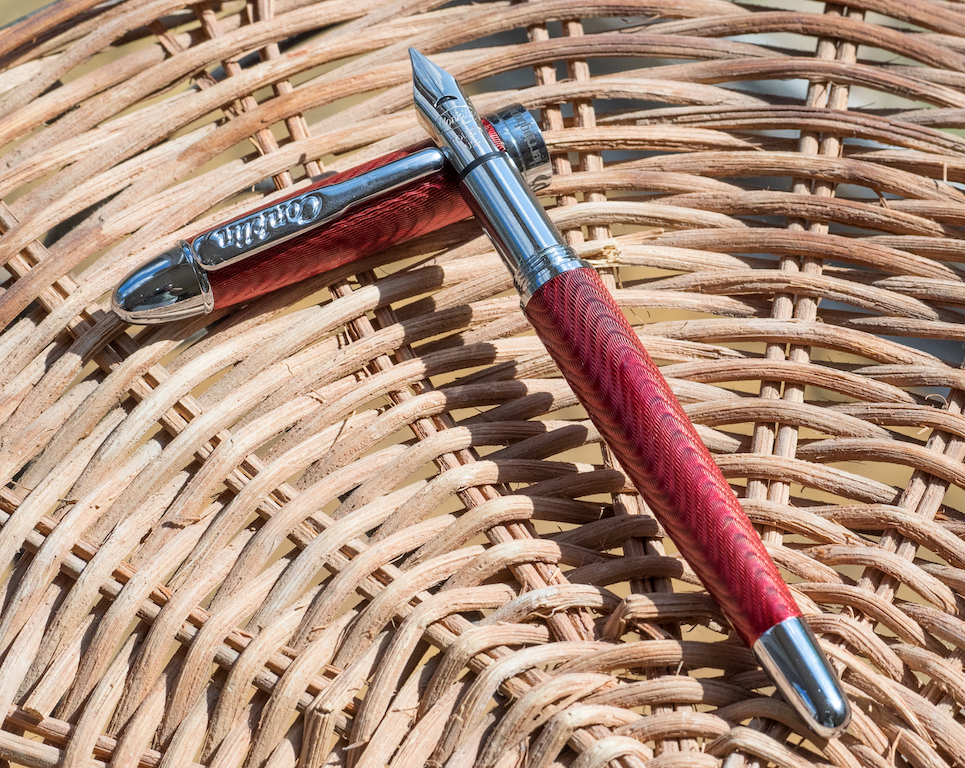
The Conklin Herringbone is a metal fountain pen etched with the herringbone pattern, then coated with lacquer and epoxy for a shiny finish. The herringbone pattern gives the pen a nice tactile feel, plus it is absolutely gorgeous in sunlight. Although this pen is called “burgundy red” it’s really more of a cherry red, in my opinion. Regardless of what you call the color, it’s quite striking.

The pen comes packaged in a blue clamshell box with a soft, cream interior.

Stainless steel, conical finials adorn the cap and the bottom of the pen’s barrel. Because it is made of metal, it’s a fairly heavy pen for its size, weighing 42 grams. It is 146mm capped, 125mm uncapped, and 160mm posted.

The screw-on cap comes with a solid clip engraved with the Conklin name. This clip will hold the pen firmly to a shirt pocket or a tablet.

The cap is also adorned with a stainless steel ring engraved with the word “Herringbone” and crescents on either side.

The Conklin Herringbone is a cartridge/converter fountain pen, and the converter holds about 1ml of ink.

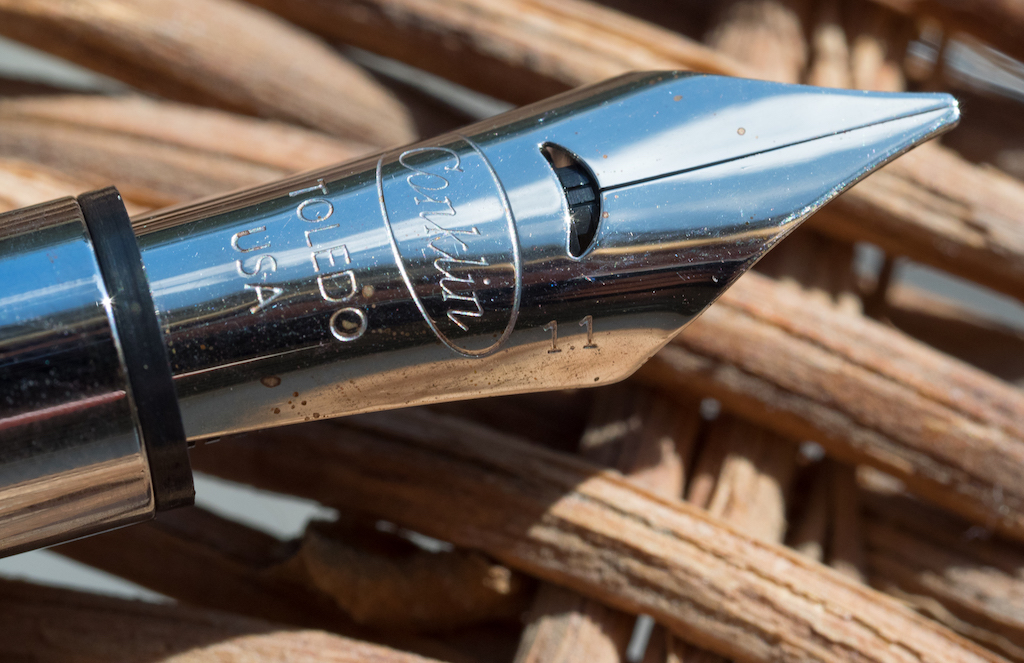
This pen came with a 1.1mm stainless steel stub nib. It has Conklin’s signature crescent-shaped breather hole and is engraved with the Conklin name, Toledo, USA, and the nib size.

Unfortunately (for me, at least), the grip is also stainless steel. I’ve discovered I’m not a fan of metal grips because they can become slippery if you have sweaty fingers (which I often do). The grip on the Conklin Herringbone is also pretty slim (9.1mm). I prefer wider grips because they prevent hand cramping, which is becoming more of a problem for me as I get older.

Aside from being a bit too narrow, the pen is comfortable in the hand. I’ve been using it at school for the last two weeks inked with Robert Oster Astorquiza Rot, and it has performed well in my Hobonichi notebook. I also tested it on a page of Baron Fig Mastermind paper which I keep at my desk to write notes. I spent some time writing out the alphabet and a quote from the current Harry Potter book my First Year Seminar is reading.

The pen writes well—I didn’t experience any hard starts or blobs while writing. However, I did notice that sometimes the pen skipped a little bit on the downstrokes of letters like “l” and “f.”

The Conklin Herringbone retails for $70.00, but you can purchase it on sale from Goldspot Pens for $55.95. It comes in burgundy red, gun metal gray, and navy blue, and you have a choice of fine, medium, and 1.1mm stub nibs.

Pros

  • I really like the look of the Conklin Herringbone. The pattern is eye-catching, and the lacquer and epoxy make it shine.
  • The pen is a reasonable size for most writers, though some may find it a little heavy since it’s made of metal. Others, like me, will find the grip to be too narrow for comfort.
  • The 1.1mm stub nib wrote well. On Tomoe River paper (in my Hobonichi) the nib produced a generously wet line. On the Baron Fig paper, the ink soaked in a bit more and the nib seemed less wet. Regardless, I found it wrote pretty consistently aside from a few skips on downstrokes.
  • This pen is reasonably priced, especially on sale.

Cons

  • Although I like hefty pens, I don’t care for thin, hefty pens. The Conklin Herringbone is too thin for my aging hands. I need a wider grip to write for long periods without hand cramps.
  • If you struggle using pens with metal grips, like I do, then you probably will not like this pen.
  • As stated above, the nib performed well, but skipped occasionally on downstrokes.

(Goldspot Pens loaned Pen Addict this Conklin Herringbone fountain pen for review purposes.)

Posted on September 22, 2017 and filed under Conklin, Fountain Pens, Pen Reviews.

Fred Faggionato Fountain Pen in Cherry Red Acetate: A Review

(Susan M. Pigott is a fountain pen collector, pen and paperholic, photographer, and professor. You can find more from Susan on her blog Scribalishess.)

Fred Faggionato is a French pen artisan who makes lacquer, acrylic, and acetate pens. Located in the south of France, in Saint-Maximin la Sainte-Baume, Faggionato follows “artisanal processes” to create his writing instruments. You can buy pens straight from the Faggionato website, but Papier-Plume, located in New Orleans, also sells the pens. They loaned the Pen Addict a gorgeous model for review: The PKS Acetate in cherry red.

PKS stands for Petrarch King Size, and this is the largest pen made by Faggionato. It is 144.3mm capped, 130.3mm uncapped, and 190mm posted. It is also rather wide in diameter, measuring 13.6mm. However, it is a light pen, weighing only 26 grams.

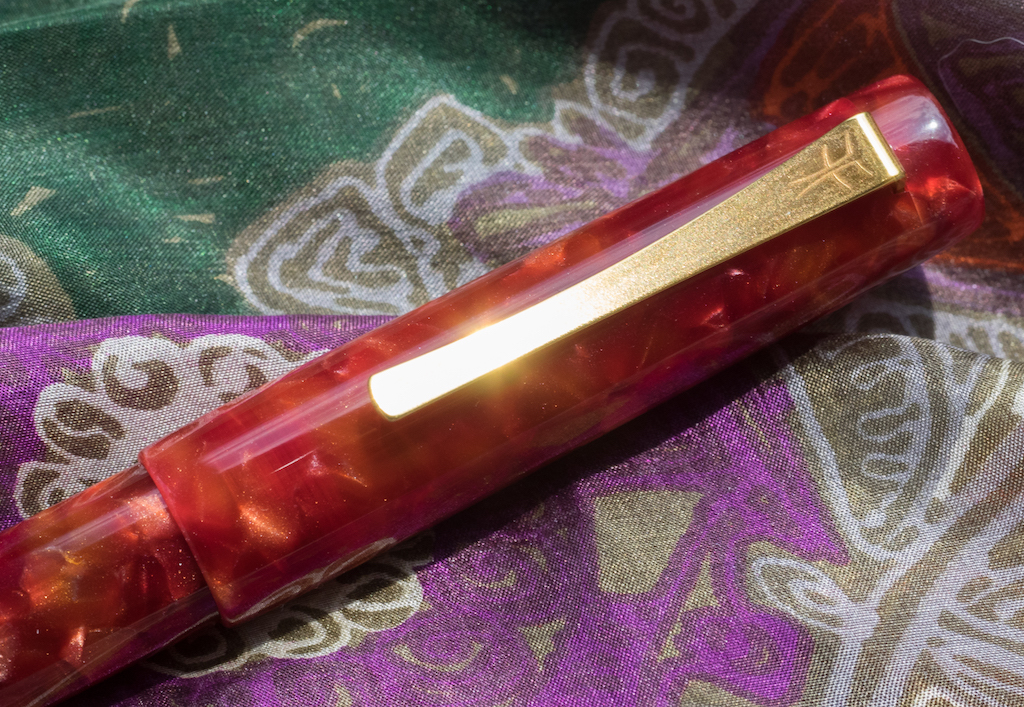
The cherry red acetate is a gorgeous color with flakes of dark and light red throughout. It sparkles in sunlight.

The pen has a flat top and bottom, and it is adorned only with a steel concave clip plated in gold with a matte finish.

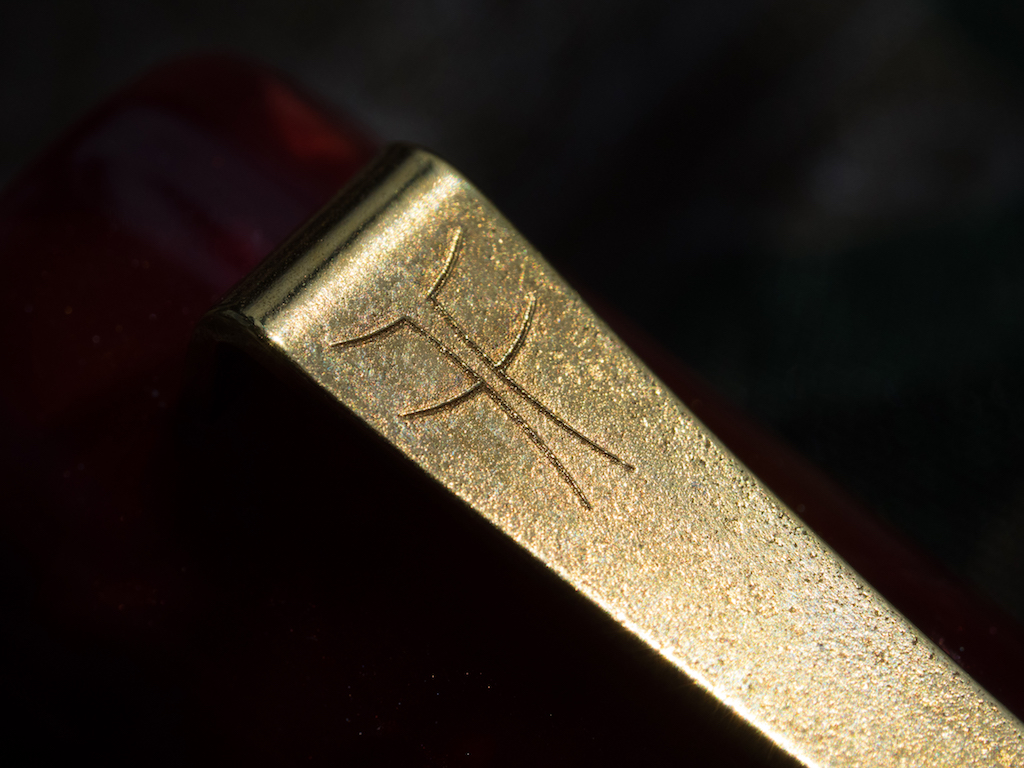
The Faggionato logo is engraved on the clip.

The cap screws on to the barrel tightly, though occasionally I had to fiddle with it to get the threads to line up. This pen is a cartridge/converter filler.

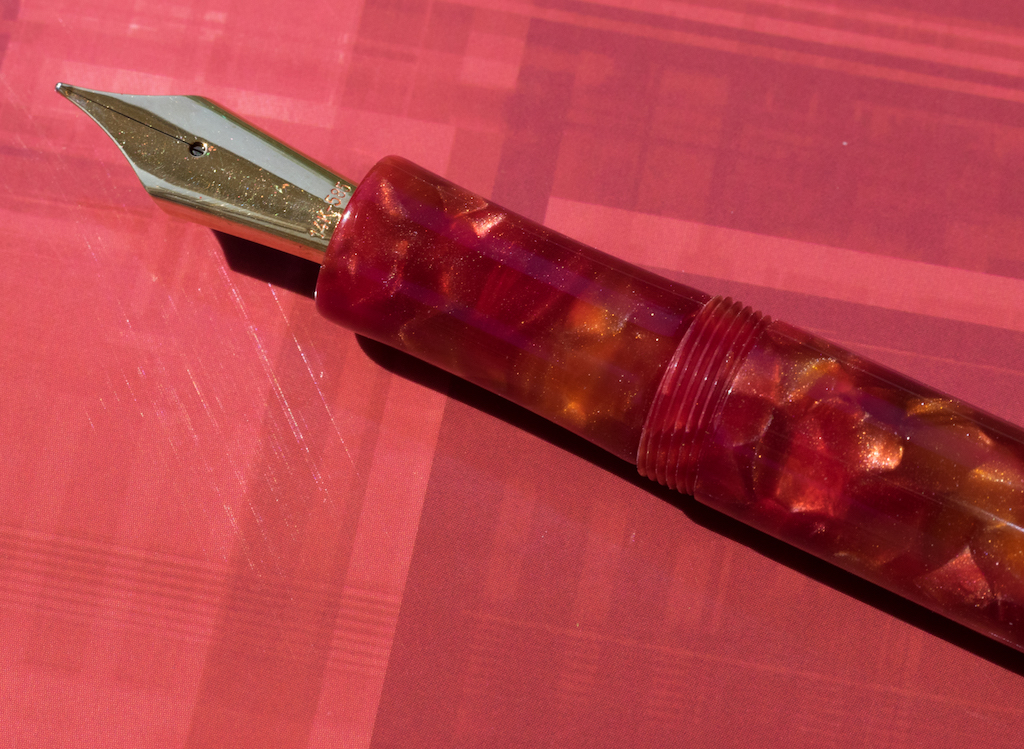
This particular model came with a medium #6 14k gold nib which is completely unadorned except for a breather hole and a stamp indicating the gold content. The feed is ebonite.

The section is slightly curved but is only a little less wide than the barrel. Those who prefer wider grips will appreciate the girth of this pen, but those who prefer narrower grips may find this pen bit large. Faggionato offers other pen shapes and sizes in addition to the PKS.

Even though the pen is large, I found it comfortable to write with. As I said, it is not a heavy pen, so it does not fatigue the hand. The medium nib is smooth. It is neither flexy nor bouncy, but it does have a slight amount of give, so I would not call it a “nail.” After about a page of writing, I noticed that the feed was going dry (you can see this where I was doing scrolls on the page). I had to open up the pen and push the ink down with the converter to get it going again.

MD Notebook Paper

I also wrote a page from the first chapter of Harry Potter and the Sorcerer’s Stone in my Clairefontaine French-ruled notebook. Once again, near the bottom of the page the ink flow stopped and I rebooted it with a twist of the converter. I’ve have several converter fountain pens that exhibit this problem. I suppose it is an issue of air bubbles in the converter or, perhaps, the ink clinging to the plastic. It’s not a deal-breaker for me, but it is irritating, especially if you’re trying to take notes in a class and have to stop to get the ink flowing again.

Faggionato Pen Company is new to me, so it was a pleasure to put this pen through its paces. The acetate is beautiful and the design boasts a simple aesthetic that I’m sure will appeal to many fountain pen enthusiasts. The model used in this review costs $385, but there are a variety of models on the Papier Plume site with steel nibs that are in the $200 range. I also suggest you also look at the lacquer pens from this maker, as they are quite striking (thought quite a bit more expensive!)

Pros

  • The PKS in cherry acetate is absolutely gorgeous material.
  • Although the PKS is a large-sized pen, it is not heavy, so those who like oversized pens but prefer less weight will like this model.
  • The 14k gold medium nib is smooth and has some give to it.
  • The Faggionato clip is unique. I like the matte gold-plating, artsy curve, and unobtrusive logo.

Cons

  • This particular model seems pretty expensive ($385) for a converter-filled pen. But these days, artisanal pens tend to range between $250 and $500, especially with gold nibs (I’m thinking of pen makers like Shawn Newton, Scriptorium, and Kanilea). The steel nibbed Faggionatos begin at the $200 range.
  • My pen wrote inconsistently. I could get almost a page written with no problems, but then the ink would dry up. I’m not sure if this is a feed or converter problem (maybe both).
  • Although I liked this Faggionato pen, it didn’t wow me like some of the pens by the makers listed above. That said, I was very impressed by his lacquer pens. But those are priced $650 and above.

(Papier Plume loaned this product to The Pen Addict for review purposes.)

Posted on September 15, 2017 and filed under Faggionato, Fountain Pens, Pen Reviews.