Posts filed under Fountain Pens

Tactile Turn Gist Delrin Fountain Pen Review

(Jeff Abbott is a regular contributor at The Pen Addict. You can find more from Jeff online at Draft Evolution and Twitter.)

Back in 2015, I reviewed the second generation of Tactile Turn's retractable pen — the Mover. I was enamored with that pen and loved carrying it around with me on my day-to-day errands and office work. I don't carry it around quite as much today, but my fondness for the pen hasn't changed at all. Recently, I was given the opportunity to try out a new version of Tactile Turn's popular Gist fountain pen. The Black and White Delrin fountain pen is a beauty, and it still manages to capture some of that early magic that I enjoyed so much with the Mover.

So, what is Delrin? My incredibly simplistic definition likely won't do it the full justice it deserves, but Delrin is a brand name of synthetic polymer thermoplastic material. It's incredibly lightweight while also being very durable and rigid. According to many machinists, it's a fantastic material for learning and practicing the art of turning pens due to being more cost effective and forgiving than other materials. Aside from that, it's also a really cool material that has a unique aesthetic and great performance. If you ever hold a pen made from Delrin, you might catch yourself thinking that it feels a lot like a Lamy 2000. And, you wouldn't be entirely wrong. The Lamy 2000 is made of Makrolon — another name brand thermoplastic polymer. While they aren't chemically identical, they're similar enough to share the same benefits and general characteristics.
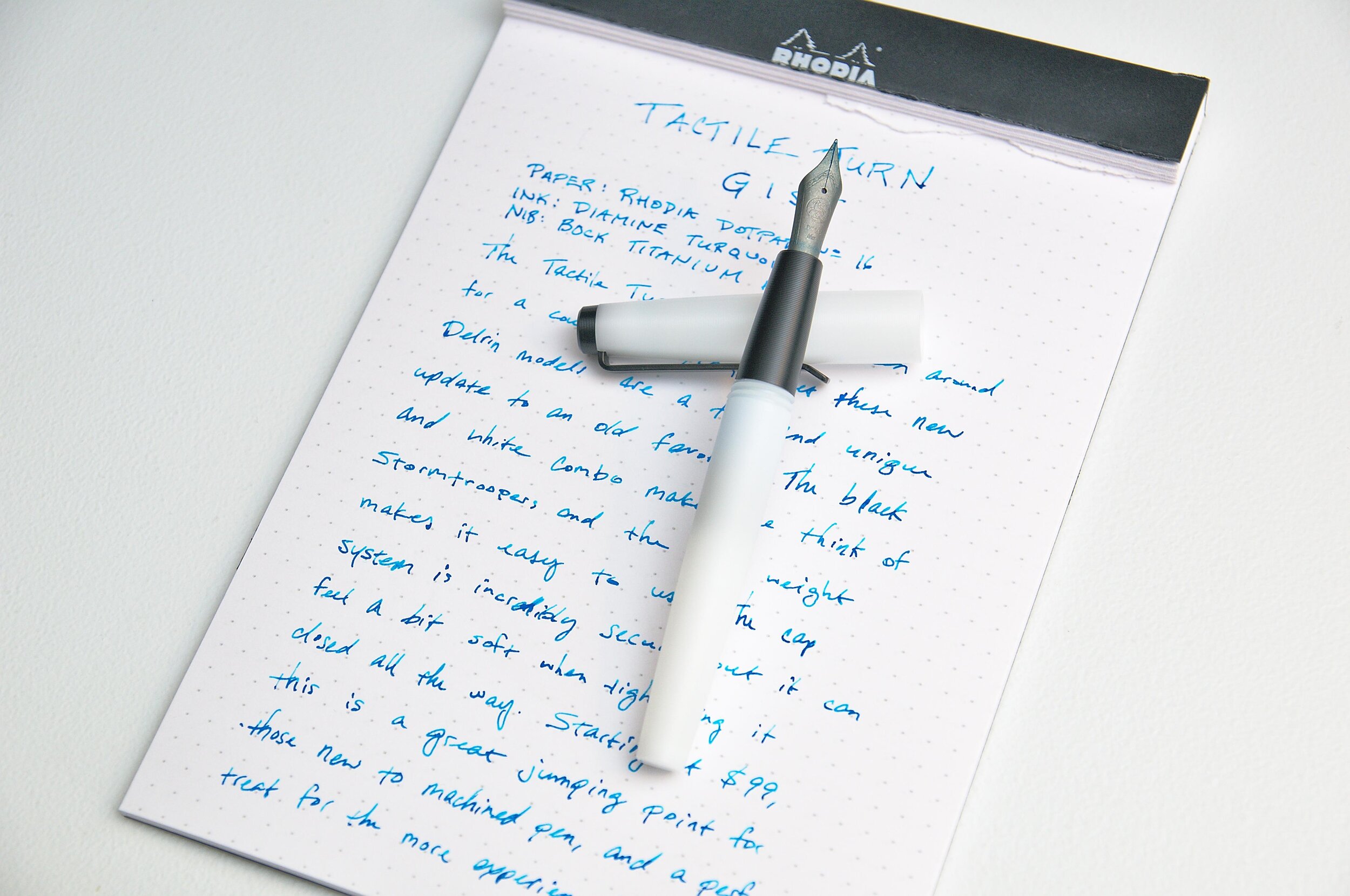
Compared to metal, plastics are a lot lighter. The aluminum, copper, and brass versions of the Gist are a good deal heavier than the Delrin version, but that doesn't mean the Delrin version is brittle, cheap, or disposable. We're not talking about the plastic material used in a Pilot G2 or Bic — Delrin (and other similar materials) are extremely durable, rigid, and strong. You can put this pen through a lot of abuse and it will just keep on working. Over time, it also develops a unique look. And, being a Tactile Turn pen, the Gist also has the characteristic grooves all along the cap, barrel, and grip section, adding extra grip that I really appreciate.

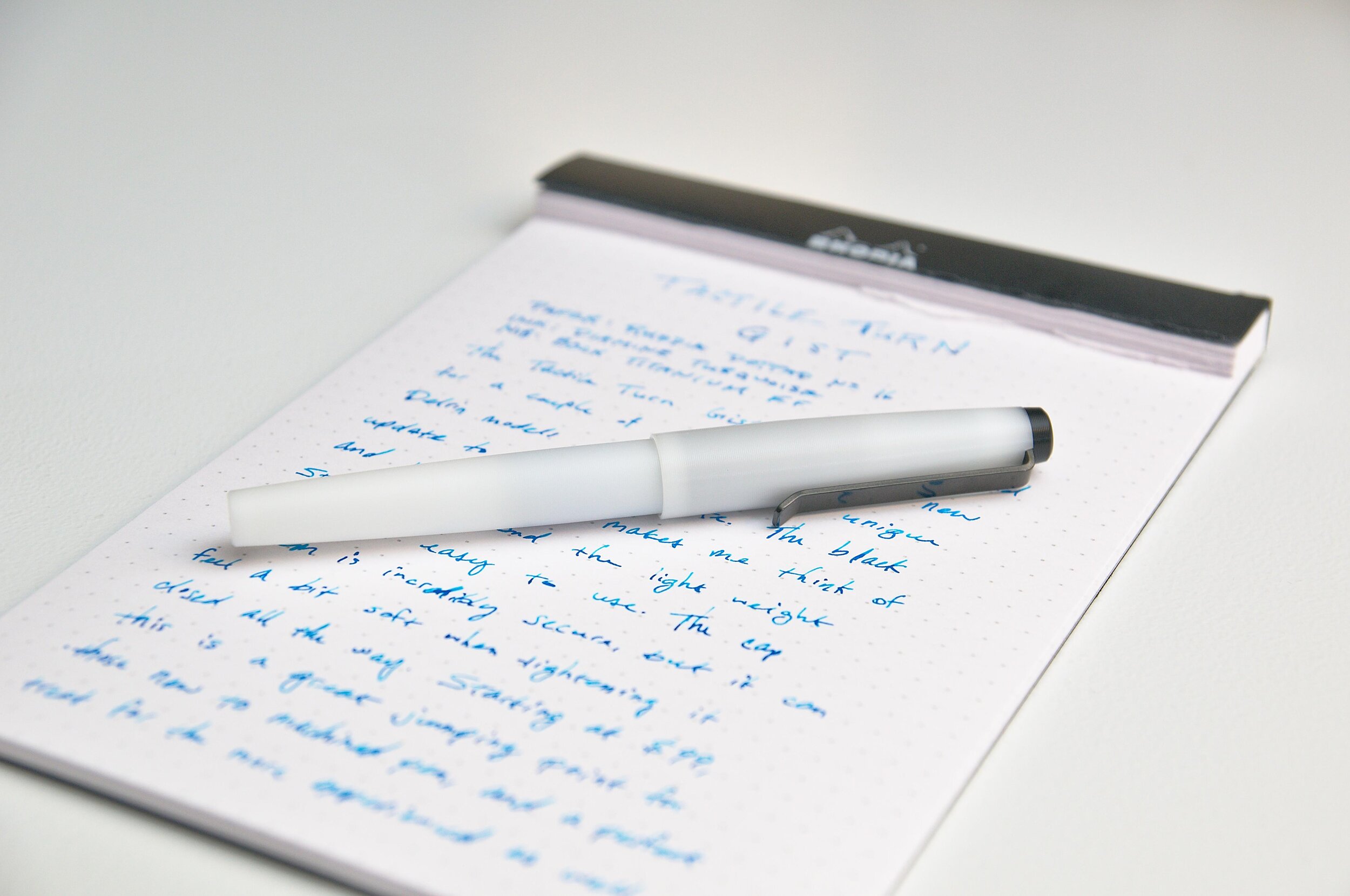
The Gist isn't a new pen by any means, but this new material and color combination is phenomenal. The creamy white matched up with the black trim is enticing, and it reminds me of a stormtrooper uniform. The cap and barrel are both slightly transparent, allowing some of the light to pass through if there's nothing inside the pen. In the cap, you can see where the grip section ends and the nib begins. In the body, you can see where the converter or the cartridge ends. I think it's great - something between a solid and demonstrator.

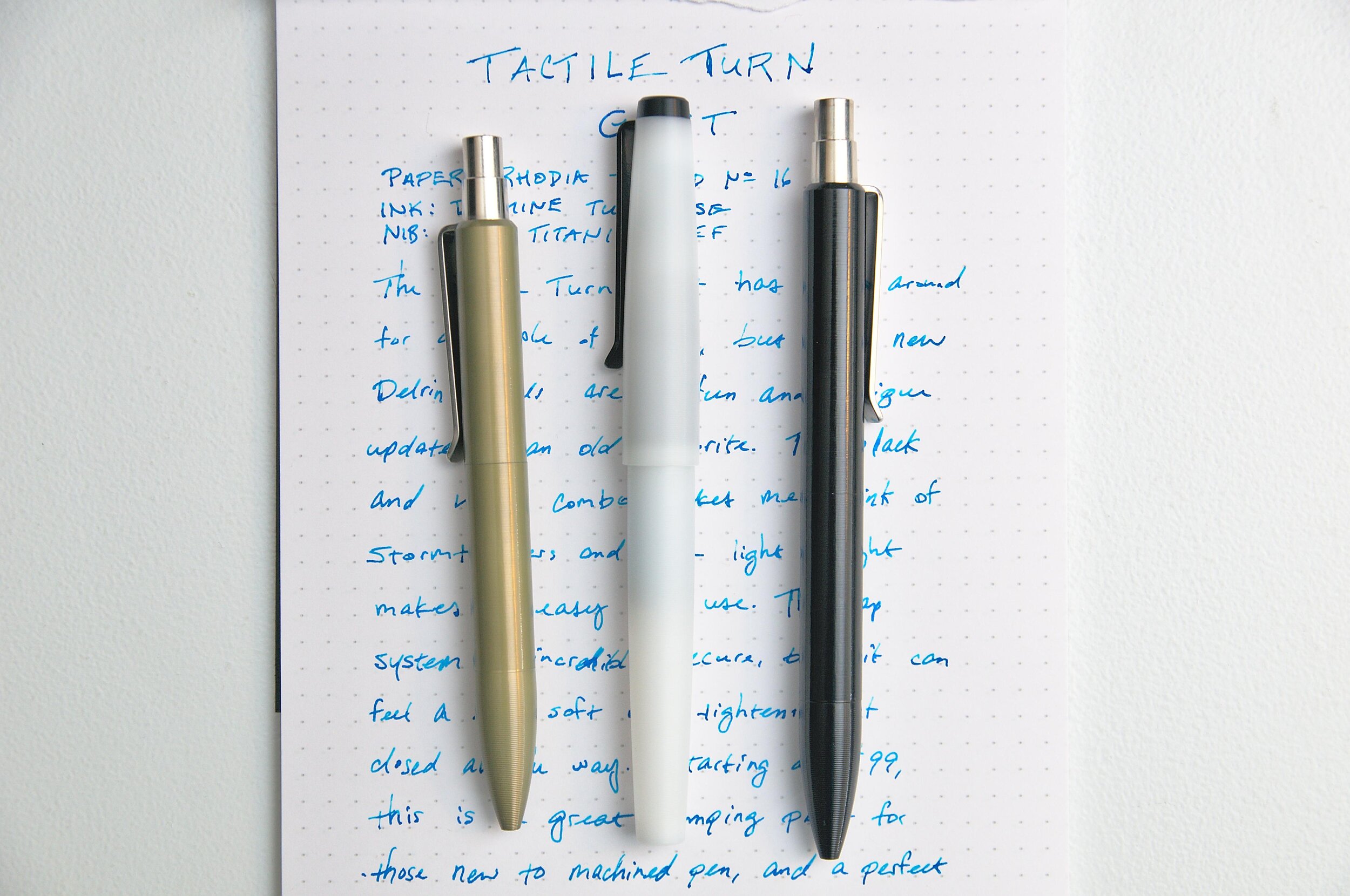
On the color combination I have, the grip section, the clip, and the finial are all black. The clip is metal, but everything is made of the same Delrin material. The contrast is great, but I recognize that not everyone will agree. And that's fine because there are other options. In Delrin, you can also choose a completely white model or a completely black model. With any Gist you purchase, you have the option of picking a black or silver clip. If you're not into the Delrin material, you can also choose from titanium, copper, or brass. And, if you're not a fountain pen fan, you can also pick any of these up in the rollerball configuration. You can browse all the different materials and colors on their website.

After uncapping the pen, you're greeted with a really well-balanced pen. The black section marries perfectly to the body, and the long #6 nib has just the right length to compliment the other components.

The section accepts either short international cartridges or an international converter. Keep in mind that longer or wider converters will not fit in this body, so just stick with the converter that comes with the pen.

After inking up the pen, I was excited to try out this titanium nib. I've used titanium nibs before, but never in a pen that I've been able to use for more than a few minutes. While I will say that the writing experience has been great, it was a bit disappointing that this nib writes like a medium instead of extra fine imprinted on the nib. I have nothing against medium nibs, but it's not what was advertised. That being said, I really like this nib and I've also decided that I'll probably go for a titanium nib any time I have the option. It's a lightweight and flexible material and has a great amount of tactile feedback that is similar to a steel nib. To me, this titanium nib is the perfect marriage of what I love about steel and gold nibs. Gold nibs are soft and flexible, while steel nibs have a more rigid stance and provide greater feedback from the page. The soft tactility of the titanium nib is fantastic.

The nib is fairly wet, but that's how I prefer wider nibs. And, given the soft nature of the material, it's also fairly easy to create some line variation if you apply a small amount of pressure on the down-strokes.
Writing with the pen is extremely comfortable. The grip section is long enough to provide plenty of space for my fingers and the way I hold the pen, and the threads that hold the cap are flat on top, meaning they don't irritate my fingers when they rest on the threads for longer periods of time. The length of the uncapped pen is perfect for my hand, but writing with the cap posted is also perfectly comfortable.

One area that I have complained when using this pen is opening and closing the cap. The unique threads are solid in operation, but the beginning and end of the threads aren't as sure-footed as I'd like. Threading the cap onto the body can feel a little mushy at times, and the same is true when I tighten the cap to the end of the threads. When tightening to the end, there isn't a distinguished feeling that I've reached the end of the threads. Sure, it gets tighter and requires more pressure, but I don't feel like I've ever reached the end of the road. On the other end, I feel like I sometimes have to fish around a bit for the threads to really grip correctly when I place the cap on the pen to close it. These are minor complaints, but they're worth pointing out. Keep in mind that I'm only using a single copy of the Gist for this review. This may be a very isolated issue that doesn't affect others.

Finally, when it comes down to price, the Gist is priced very fairly for a machined pen from a small shop. The Delrin pens start at $99. This price includes a steel nib in either EF, F, M, or B size and either a silver or black clip. For $60 more, you can choose from the same list of nib sizes but in titanium. If you opt for the brass, copper, or titanium materials, the price goes up accordingly.

The Tactile Turn Gist is a pen that I quickly fell in love with after using it for a few minutes. Despite the mislabeled nib, I love how this pen writes and how it feels in my hand while writing and even while capped. The Delrin material is incredibly rigid but has a familiar warmth that makes it fun to use. If it's in your price range and you like the aesthetic, I can't recommend this pen enough.

(JetPens provided this product at no charge to The Pen Addict for review purposes.)


Enjoy reading The Pen Addict? Then consider becoming a member to receive additional weekly content, giveaways, and discounts in The Pen Addict shop. Plus, you support me and the site directly, for which I am very grateful.

Membership starts at just $5/month, with a discounted annual option available. To find out more about membership click here and join us!

Posted on October 30, 2019 and filed under Tactile Turn, Fountain Pens, Pen Reviews.

Karas Kustoms Vertex (Acrylic): A Review

(Susan M. Pigott is a fountain pen collector, pen and paperholic, photographer, and professor. You can find more from Susan on her blog Scribalishess.)

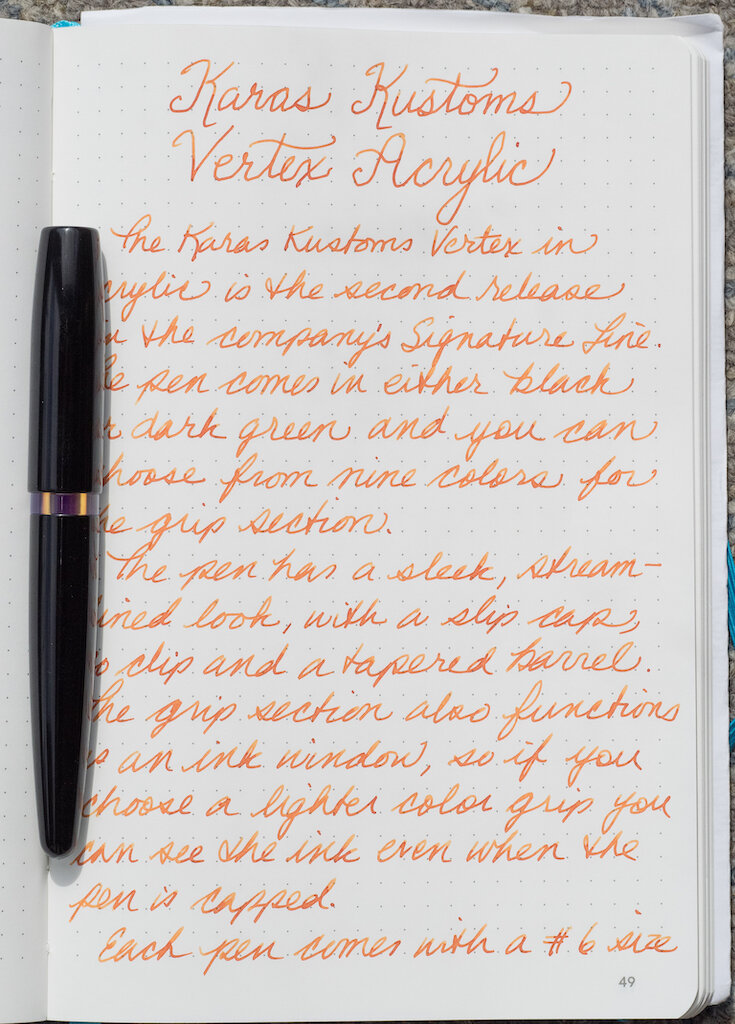
The Karas Kustoms Vertex in acrylic is the second release in the company’s Signature Line. The pen comes in either black or dark green acrylic, and you can choose from nine colors for the grip section.

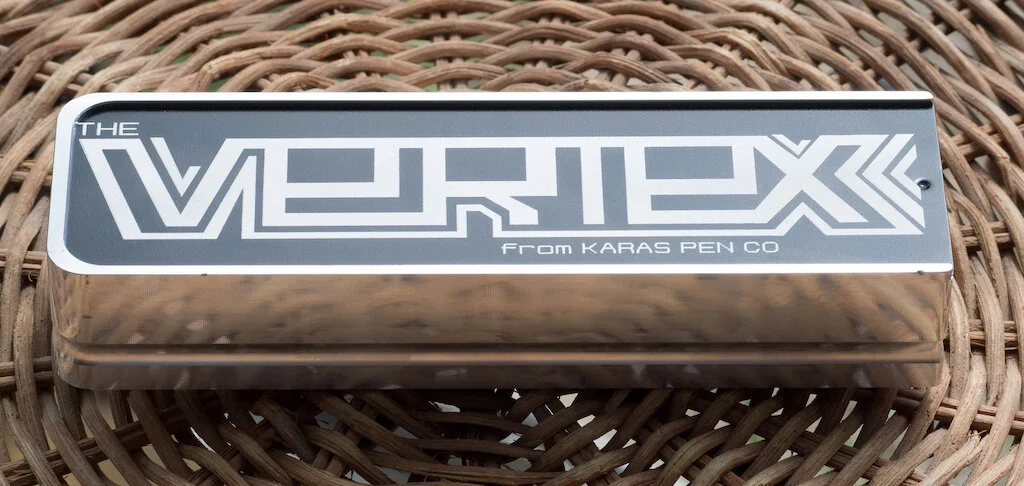
The pen comes in a rectangular machined box with a black, slip-in lid. The box itself is a work of art.

Although my pen didn’t come with a soft pipette or a cartridge, apparently these accessories are normally included with purchase.

The pen has a sleek, streamlined look, with a slip on cap, no clip, and a tapered barrel. It’s a small to medium-sized pen, measuring 5.24 inches/133mm capped, 5.11 inches/130mm uncapped, and 5.9 inches/150mm posted.

The cap posts deeply and securely on the barrel. Because the cap doesn’t have a clip and rolls easily, either post it or set it down vertically. The pen is light, weighing 18.73 grams posted and 12.5 grams unposted (filled with ink).

Although the cap top looks flat from side, it is actually concave, and this adds a little touch of flair to the design.

You have a huge selection when it comes to the grip color. It comes in nine colors: transparent amber, transparent blue, transparent orange, transparent red, transparent smoke, sea glass, Coke bottle, green apple, and UV clear “Italian Ice.” I fitted my pen with the Italian Ice grip. The grip is a nice size, measuring 10.74mm, and it screws onto the barrel seamlessly--no threads, no huge drop from barrel to grip. Another cool thing about the grip is that it acts as an ink window when the pen is capped.

The Vertex is intended to be used as an eyedropper, though you can use a standard international converter if you wish. Three o-rings are in the pen: in the barrel, in the grip, and in the cap, which means you don’t have to use silicone grease to prevent ink leakage. It’s a little hard to see the ink in the black barrel when you’re filling it, so go slowly.

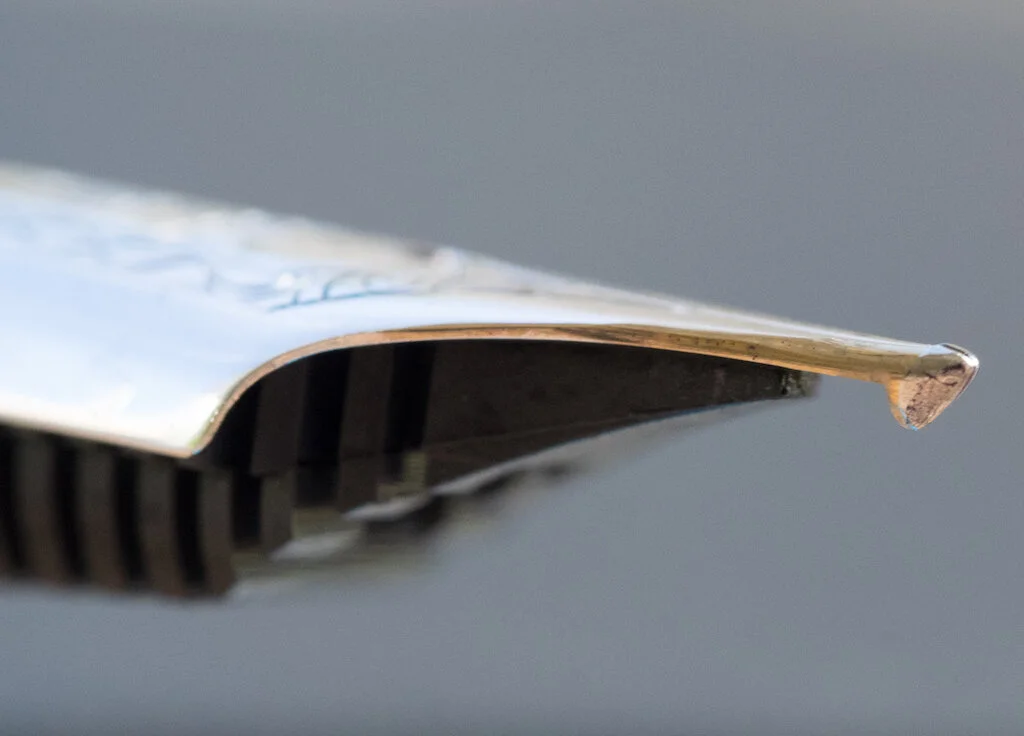
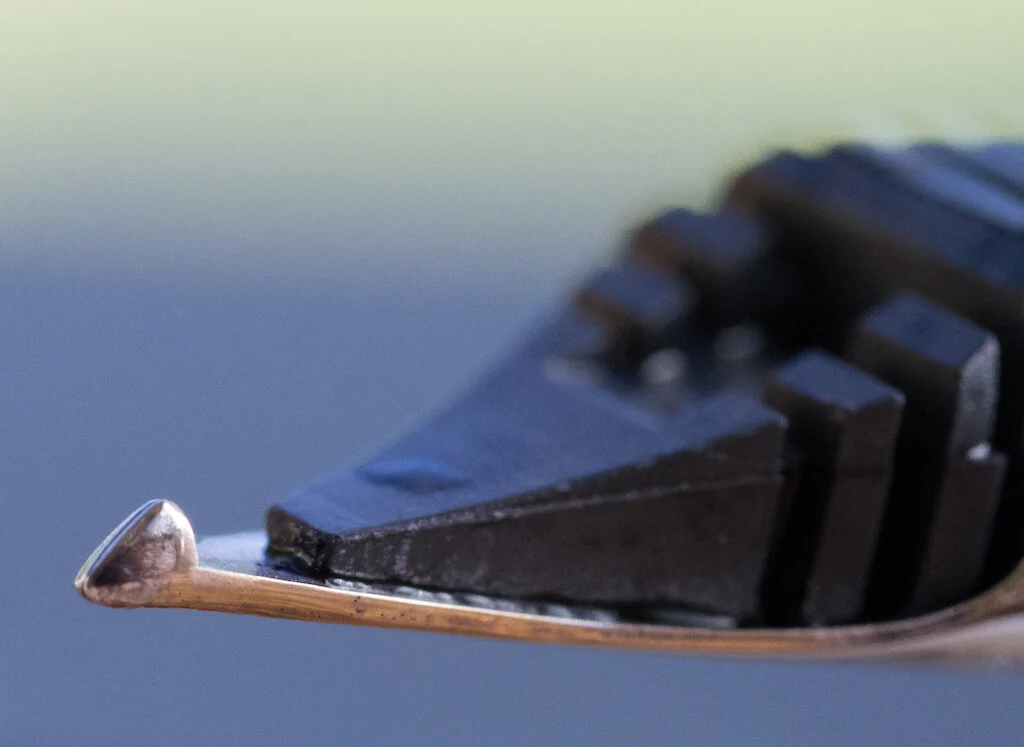
The pen comes standard with a #6 size steel Bock nib. My nib is a medium, and it writes smoothly. The nib sports an etched design with the Karas Kustoms logo and the nib size engraved.

I’ve experienced no burping, hard starts, or dryness when writing with the Vertex. The pen feels wonderful in the hand because of its seamless construction.

The only negative about the design is the slip cap combined with the eyedropper system. You have to be careful when you pop the cap off to avoid spurts of ink on your hands or clothes. So far, I’ve managed to remember to hold the pen with the nib pointed up, but I suspect one of these days I’ll forget and have a mess. The pen comes with a warning about this issue, but I wonder if a screw cap would have been a wiser decision.

The Vertex in acrylic is available from Karas Kustoms at the base price of $130. Steel nibs come in sizes EF, F, M, B, Stub 1.1, and Stub 1.5. You can upgrade to a two-tone steel nib (F, M, or B) for $3.00, a titanium nib (EF, F, M, or B) for $35, and a gold nib (B) for $80. You can also purchase the Vertex in Delrin models (black and white) for the same base price of $130.

(Karas Kustoms provided this product at no charge to The Pen Addict for review purposes.)


Enjoy reading The Pen Addict? Then consider becoming a member to receive additional weekly content, giveaways, and discounts in The Pen Addict shop. Plus, you support me and the site directly, for which I am very grateful.

Membership starts at just $5/month, with a discounted annual option available. To find out more about membership click here and join us!
Posted on October 11, 2019 and filed under Karas Kustoms, Fountain Pens, Pen Reviews.

Sailor Pro Gear Classic Graphite Lighthouse with Zoom Architect Nib: A Review

(Susan M. Pigott is a fountain pen collector, pen and paperholic, photographer, and professor. You can find more from Susan on her blog Scribalishess.)

Long ago I owned a Pelikan M200 with a fine Architect nib (also known as a Hebrew/Arabic Nib). It was a lovely, delicate thing, ground by the great Richard Binder. But, when I originally ordered it I was young and naïve, new to fountain pens, and I didn’t realize that the fine nib would not give me the line variation I craved for Hebrew characters. I eventually sold the pen.

I’ve been itching to try a Sailor Zoom nib with an Architect grind, and I knew exactly which nibmeister I wanted to do it: John Mottishaw at nibs.com. Deciding on a Sailor pen for the nib was extremely hard (so many choices), but I eventually settled on the Sailor Pro Gear Classic Graphite Lighthouse. This surprised me a bit, because why would I want a “boring” gray pen when Sailor has so many bright, cheery colors? I don’t know. I liked the subtle color and the clear finials on both ends, and a more “sober” pen seemed somehow fitting for writing Hebrew.

Even though the Sailor Graphite Lighthouse is a North American exclusive, it comes in a basic Sailor box. The only thing differentiating it from a regular Sailor is a bookmark--woot?

The pen itself is a dark gray color with rhodium trim, which complements the color perfectly.

As stated earlier, the cap and barrel finials are clear, offering a special detail that makes the pen look unique. I just wish it lit up like a real lighthouse!

The Pro Gear Classic is a small to medium-sized pen--small if you don’t post it and medium if you do. It measures 5.1 inches/130mm capped, 4.5 inches/115mm uncapped, and 5.9 inches/150mm posted. It’s a light pen, weighing only 25 grams capped and 16 grams uncapped with the converter filled with ink. I usually like much larger pens, but for some reason I’ve gravitated towards Pro Gear Classics. I own several of them.

The real story with this pen is the nib. All Sailor nibs are gorgeous, with beautiful scroll work and the Sailor anchor inscribed above the gold content.

The Zoom nib is like an extra broad but with a triangular shape and lots of tipping. It’s the perfect choice for an Architect grind.

I asked John to make my Architect “forgiving,” so he smoothed it out more than a traditional Architect grind so I could use it to write cursive.

It’s absolutely perfect--smooth and juicy, but I can also get clean vertical and horizontal strokes for Hebrew and block letters.

Upside down the nib writes extra, extra fine. I’m unlikely to use the nib this way, but it’s a nice option if you want to write marginalia.

I inked the Graphite Lighthouse with Sailor Ink Studio 123, and the two pair together beautifully. I can write in my usual cursive style with this nib, and the pen simply floats over the paper.

I am absolutely thrilled with this pen and the Zoom/Architect nib. Even though the Pro Gear Classic Graphic Lighthouse is mostly sold out, you can, of course, order almost any Sailor with a Zoom nib from nibs.com and request an Architect grind. If you do block printing more than cursive, you’ll definitely want a classic Architect grind. But, if you’re like me and want an Architect that allows you to do cursive as well, just ask John for a more forgiving nib, and he will send you the perfect grind.

(I purchased the Sailor Pro Gear Graphite Lighthouse with my own funds.)


Enjoy reading The Pen Addict? Then consider becoming a member to receive additional weekly content, giveaways, and discounts in The Pen Addict shop. Plus, you support me and the site directly, for which I am very grateful.

Membership starts at just $5/month, with a discounted annual option available. To find out more about membership click here and join us!

Posted on October 4, 2019 and filed under Sailor, Fountain Pens, Architect Nib, Pen Reviews.