Posts filed under Fountain Pens

Fountain Pens as a Left-Hander

Leonardo Pelikan

As much as I have enjoyed writing with pencils during my newfound left-handedness, I have struggled with using fountain pens. Why is that?

For starters, fountain pens are a more rigid writing experience. There are rules - such as the angle of attack with the nib, and the correct amount of pressure on the tines - that other writing instruments don't have.

In my case specifically, my preference for very fine nibs and nibs with a sharp edge (think cursive italic) work against me as I try to learn to write with my left hand. Now, life-long lefties should have no trouble with fountain pen nibs on the far ends of the writing spectrum. But coming in fresh, after decades of opposite hand writing, is more of a challenge for me given my current nib inventory.

So, how do I make my left-handed fountain pen writing experience more enjoyable? Use bigger nibs.
Leonardo Pelikan Nibs

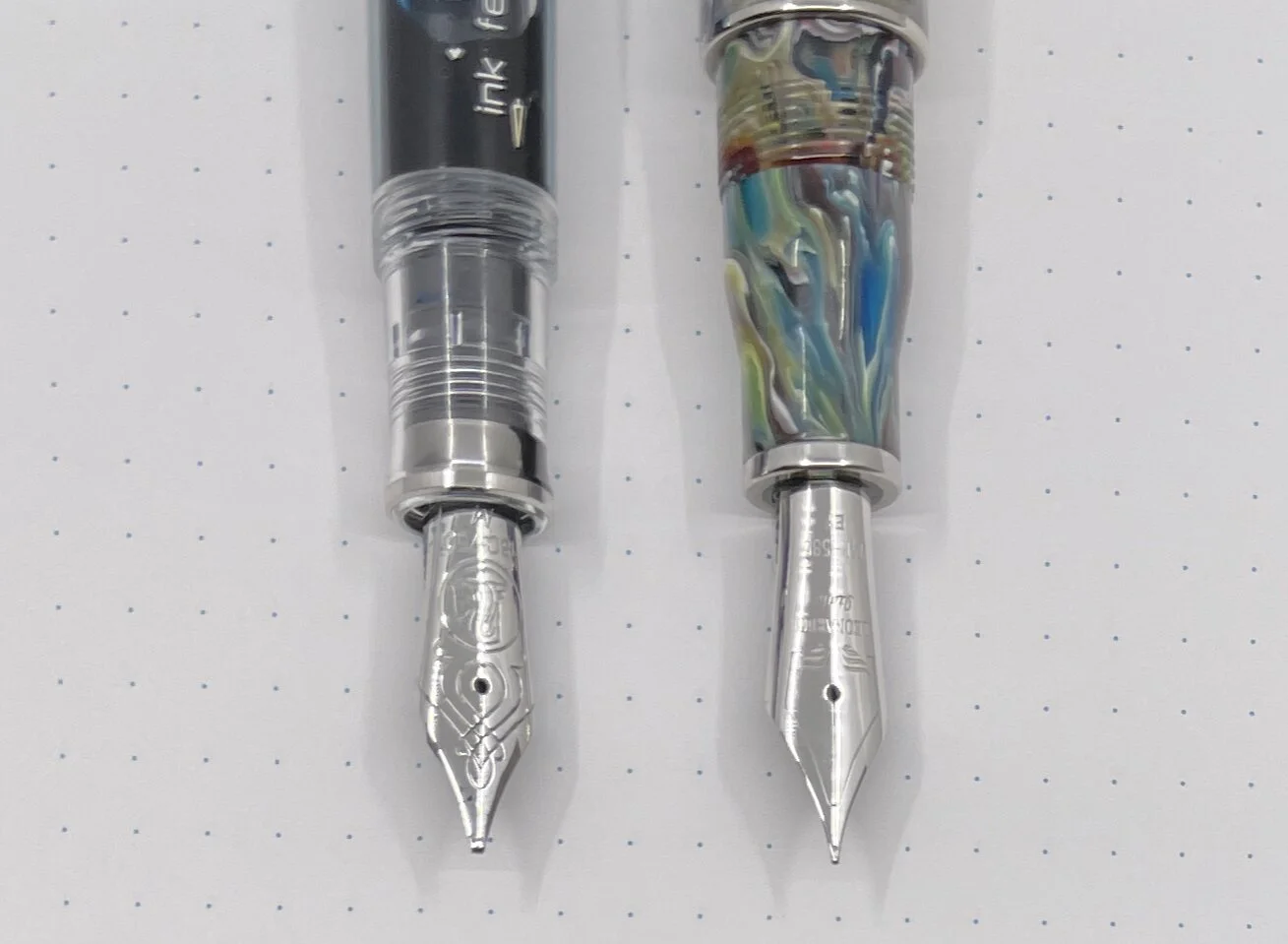
I knew exactly which one I'd go for too, seeing how I own so few of them. It's hard to beat Pelikan nibs when you are looking for an ultra-smooth, wide line, so I grabbed my M800 Demonstrator with a medium stub nib and inked it up with Akkerman Dutch Masters 05 Israel's Zeeblauw to play around with.

For comparison, I matched it up against my Leonardo Momento Zero Grande with a stock extra fine nib, inked with Akkerman 28 for good measure. This is normally one of my favorite all-around writing nibs when writing righty, but I haven't gotten along with it as well from the opposite side.
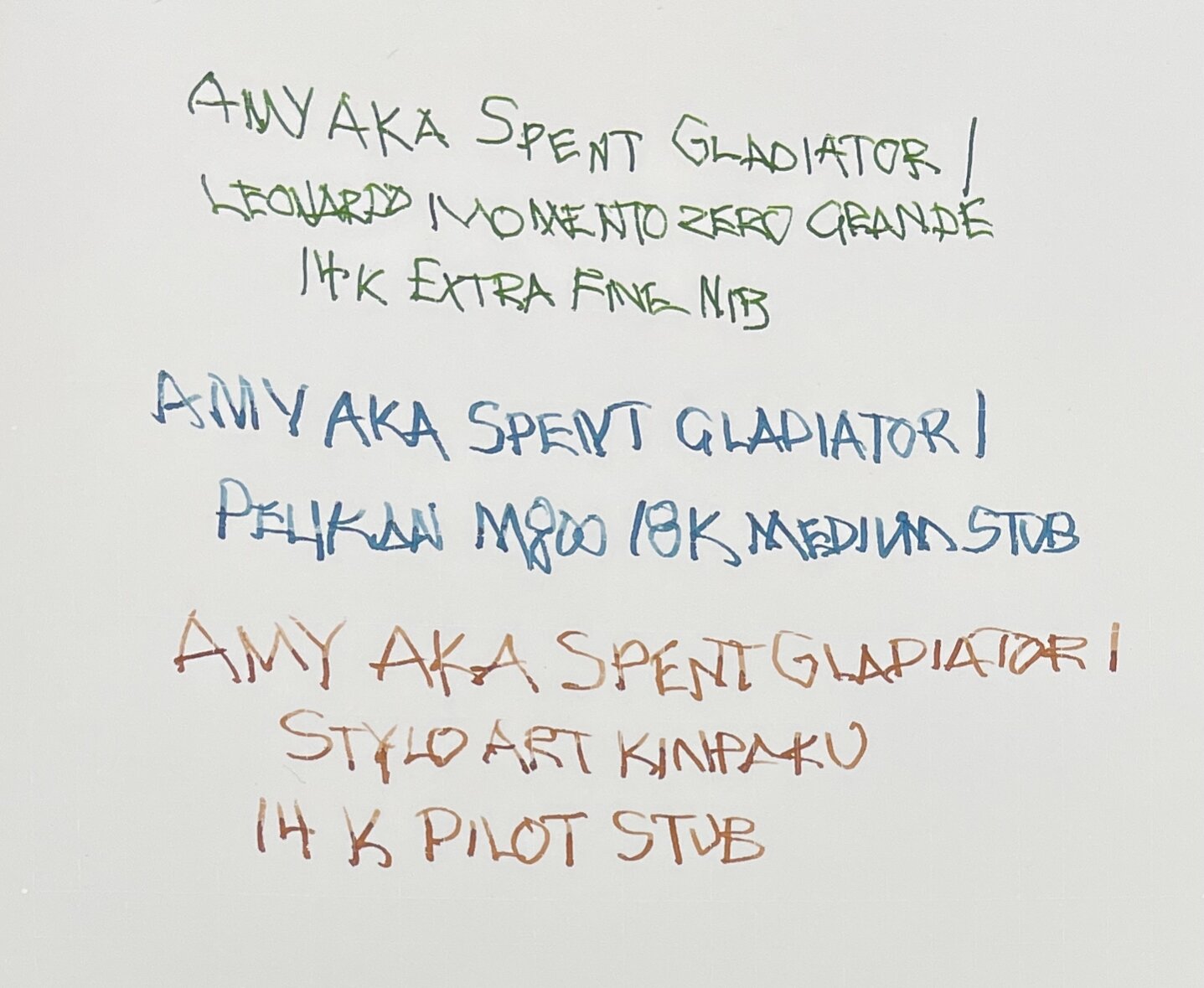
Left-handed Writing

The difference was immediately clear to me. My extra fine lines were shaky, and my medium stub lines had that nice “I’m just learning to write left-handed” look that I've come to enjoy. Like my pencils.

My writing state requires larger nibs for now. That's why pencils work so well, and why wider tipped fountain pen nibs do too.

I do miss my regular handwriting, and I hope to get back to it around the New Year. But until then, I'll keep learning about what works well for me now, and why. Maybe I'll try out gel pens next?
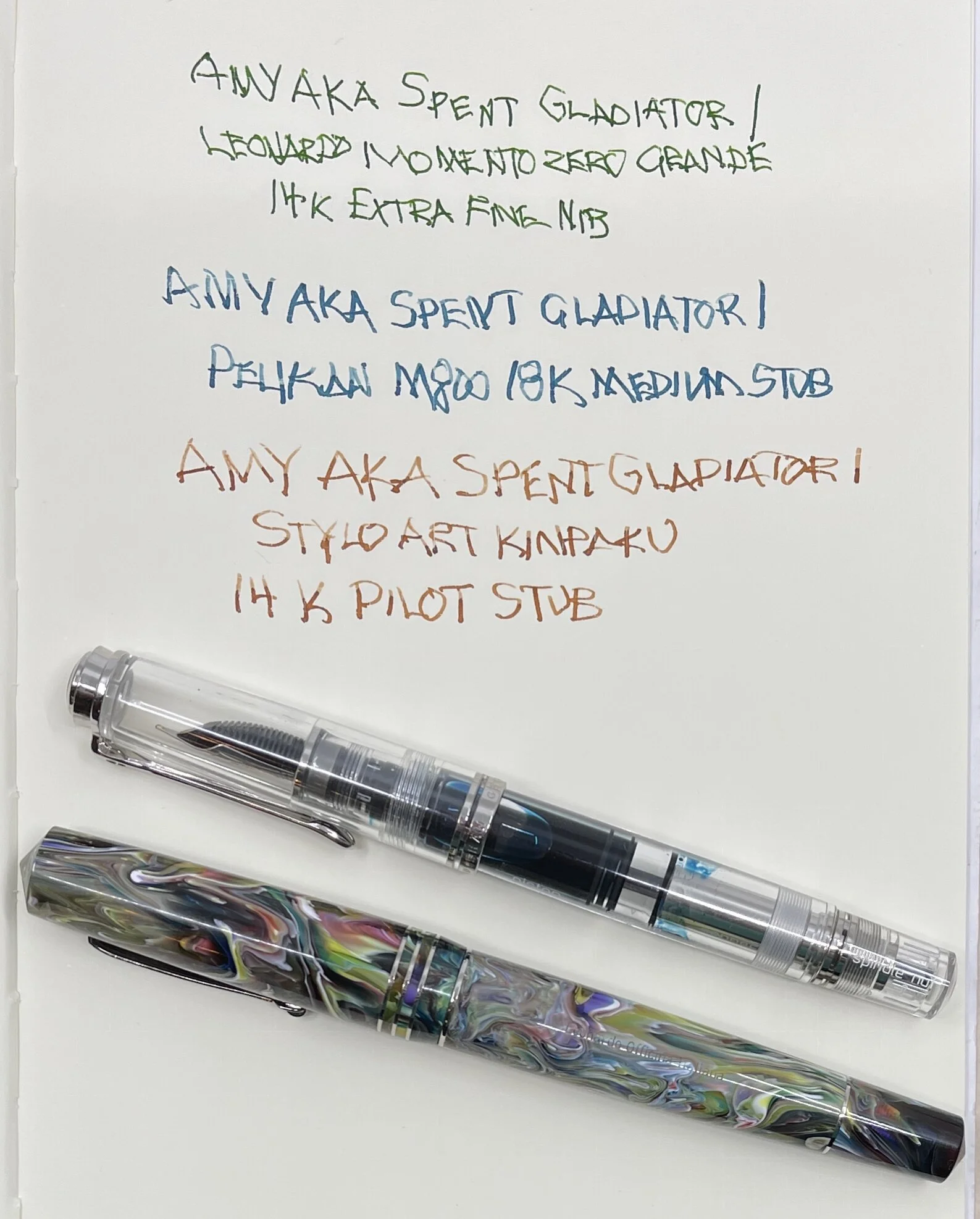
Left-handed writing pens
Posted on November 30, 2020 and filed under Fountain Pens, Left-handed.

Pineider Avatar UR Demo Fountain Pen in Amber: A Review

Pineider Avatar UR Demo Fountain Pen Review

(Susan M. Pigott is a fountain pen collector, pen and paperholic, photographer, and professor. You can find more from Susan on her blog Scribalishess.)

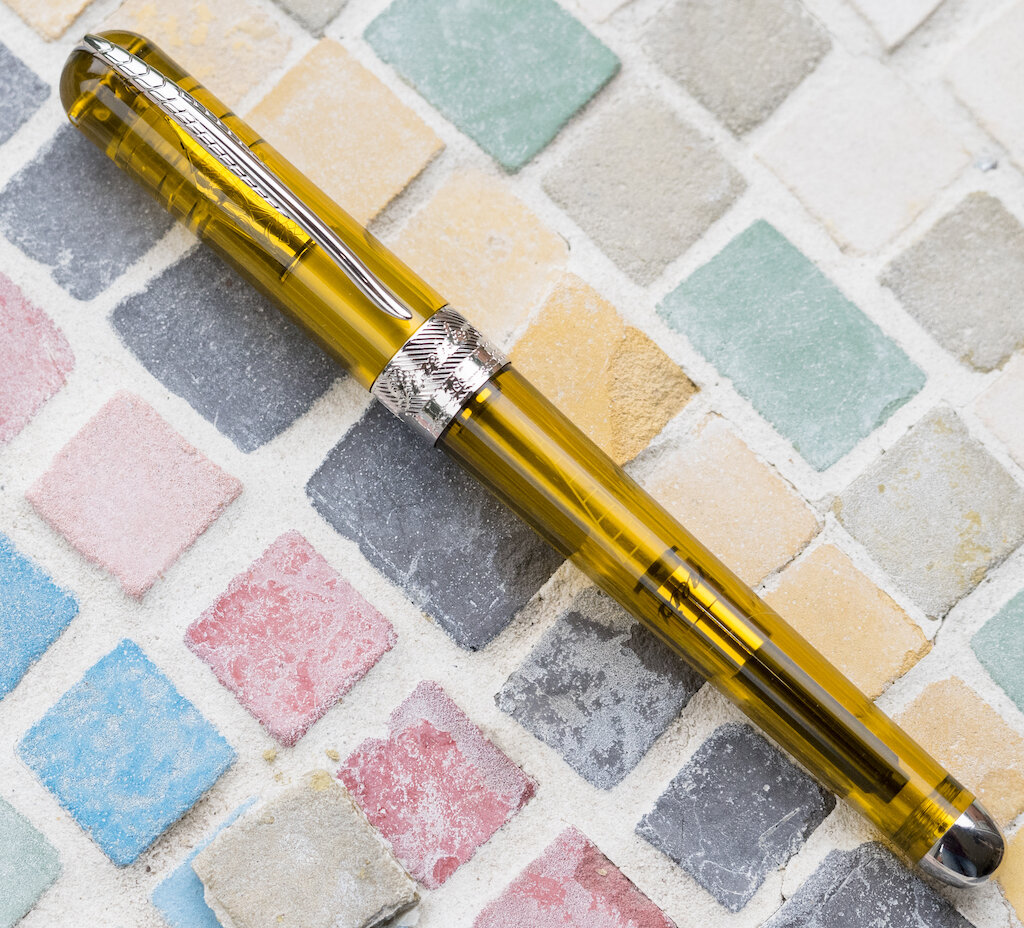
The Pineider Avatar Fountain Pen is made of a new material called "UltraResin" (thus the UR in the title). According to the pamphlet included with the pen, UltraResin is a mother of pearl compound resin that is resistant to breaks, oil, ink, variations in temperature, and UV rays. The company compares it to celluloid, stating that it has all the features of celluloid without the problems, such as crystallization and susceptibility to heat.

The pen comes in a classic-looking cardboard box, which contains the pen, the pamphlet, and instructions.

Pineider Avatar UR Demo Fountain Pen

The Avatar is 3D engineered so that it can be assembled without any glue. Trims are palladium plated, including the bottom tip.

Bottom Tip.jpgPineider Avatar UR Demo Fountain Pen Bottom

The clip is designed to resemble a quill and is spring loaded.

Pineider Avatar UR Demo Fountain Pen Clip

The cap band is engraved with the Pineider name and the skyline of Florence, Italy.

Pineider Avatar UR Demo Fountain Pen Cap Band

Using a sealed magnet, the cap locks securely merely by placing it onto the barrel--no twisting or fiddling necessary.

Pineider Avatar UR Demo Fountain Pen Converter
Pineider Avatar UR Demo Fountain Pen Ink Level

A converter is included with the pen. It has the Pineider logo on it and an ink level gauge as well.

Measuring 5.79 in/147mm (capped), 5.24 in/133mm (uncapped), and 6.46 in/164mm posted, the Avatar is a medium-sized pen. It is rather heavy at 30 grams (capped/posted) and 17.8 grams uncapped/unposted. The cap posts securely but makes the pen unbalanced in the hand. I liked the weight and balance of the pen unposted.

Pineider Avatar UR Demo Fountain Pen Capped

For comfort, the grip is covered in rubber, which does make it easy to hold while writing. However, ink somehow seeped beneath the rubber grip and stained it. Pineider's website states that the grip can be replaced easily, but I have no idea how to remove it.

Pineider Avatar UR Demo Fountain Pen Grip
Pineider Avatar UR Demo Fountain Pen Grip Ink

I'm quite confused about the nib. The pamphlet included with the pen states that the nib is a "large N6 Demi Flex." However, both the Pineider website and Goldspot identify it only as a steel nib. It has a futuristic look to it with the Pineider name engraved decoratively on both sides of the nib.

Pineider Avatar UR Demo Fountain Pen Nib

If this is supposed to be a "Demi Flex" or "Semi Flex" nib, it certainly does not live up to the name. There's absolutely no give to it at all. I tried applying some pressure to produce line variation and this is what resulted:

Pineider Avatar UR Demo Fountain Pen Lines

Otherwise, the fine nib writes smoothly, even though the tines are a bit misaligned.

Pineider Avatar UR Demo Fountain Pen Tines

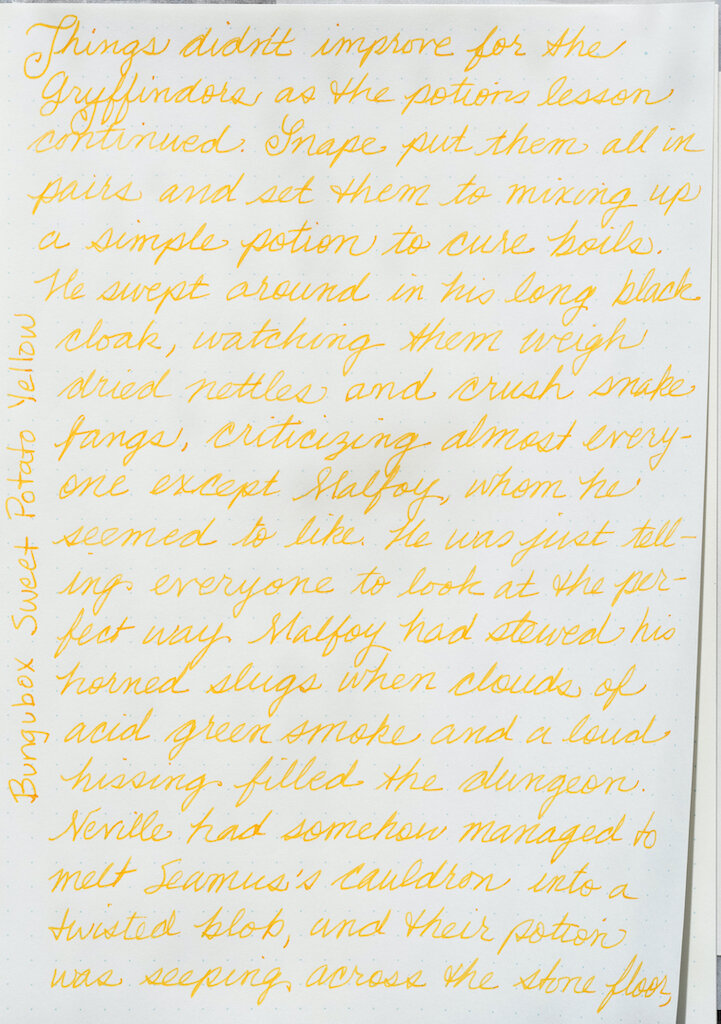
I used Bungubox Sweet Potato Yellow to create my writing samples. The ink flowed well, and the writing experience was pleasant. However, the cap apparently doesn't seal completely, because after leaving the pen unused, I experienced hard starts--actually no starts. I had to force ink down into the nib unit in order to begin writing again. Other than that problem, I experienced no skipping, scratchiness, or other issues.

Pineider Avatar UR Demo Fountain Pen Alphabet
Pineider Avatar UR Demo Fountain Pen Letters
Pineider Avatar UR Demo Fountain Pen Writing

The Pineider Avatar is a beautifully designed pen. You can really appreciate the engineering that went into it when you examine it closely. The palladium plated accents complement the pen, and I particularly like the easy on and off cap.

Although the rubber grip offers a soft and stable surface for your fingers, the fact that ink can get underneath and stain it is disappointing. I'm not particularly fond of the ink level measurement on the converter and don't see why it's necessary at all, especially with a demonstrator pen.

I haven't tried dropping the pen to see if it lives up to its "almost unbreakable" description, but the UltraResin material does seem substantial in the hand. That said, the company's claim that UltraResin is comparable to celluloid isn't convincing, at least for the demo models. The opaque models (in various colors) look a bit more like celluloid.

You can purchase the Pineider Avatar UR in Amber for $157.95 from Goldspot.

(Goldspot provided this product at no charge to The Pen Addict for review purposes.)


Enjoy reading The Pen Addict? Then consider becoming a member to receive additional weekly content, giveaways, and discounts in The Pen Addict shop. Plus, you support me and the site directly, for which I am very grateful.

Membership starts at just $5/month, with a discounted annual option available. To find out more about membership click here and join us!

Pineider Avatar Fountain Pen Review
Posted on November 13, 2020 and filed under Pineider, Fountain Pens, Pen Reviews.

Sailor Compass 1911 Fountain Pen Review

Sailor Compass 1911 Fountain Pen Review

(Jeff Abbott is a regular contributor at The Pen Addict. You can find more from Jeff online at Draft Evolution and Twitter.)

The sub-$100 price range can be difficult for a lot of pen manufacturers to succeed in. For some, this is where they excel at offering great value and excellent writing instruments for the price (ever heard of TWSBI?). On the other hand, being able to deliver high-end luxury writing instruments doesn't also make you an expert at delivering lower cost, affordable items that compete well with brands that operate exclusively in that space. That doesn't mean you shouldn't try, though! And that's exactly what Sailor is doing with the Compass 1911 fountain pen line.

Sailor Compass 1911 Fountain Pen

The Compass 1911 borrows a familiar shape from the high-end 1911 fountain pen line, but uses more affordable materials in order to hit a much lower price bracket: $50 MSRP. On top of that, the Compass 1911 even comes with two black ink cartridges and (wait for it) a cartridge converter. I've definitely criticized Sailor in the past for not including a cheap converter with their $200+ fountain pens. At that price range, it seems petty to discount it from the hinged box that contains the pen. In the $50 price range, it's a fantastic bonus that I would never expect.

Sailor Compass 1911 Fountain Pen Nib

But the value gets better from there since no one really sells goods for the MSRP. As of now, you can find the Sailor Compass 1911 for just under $40 at Goldspot. For that price, is an excellent value for a beginning fountain pen kit. But, how does it perform as a pen? Can Sailor scale down their excellent writing to an ultra affordable, entry-level pen?

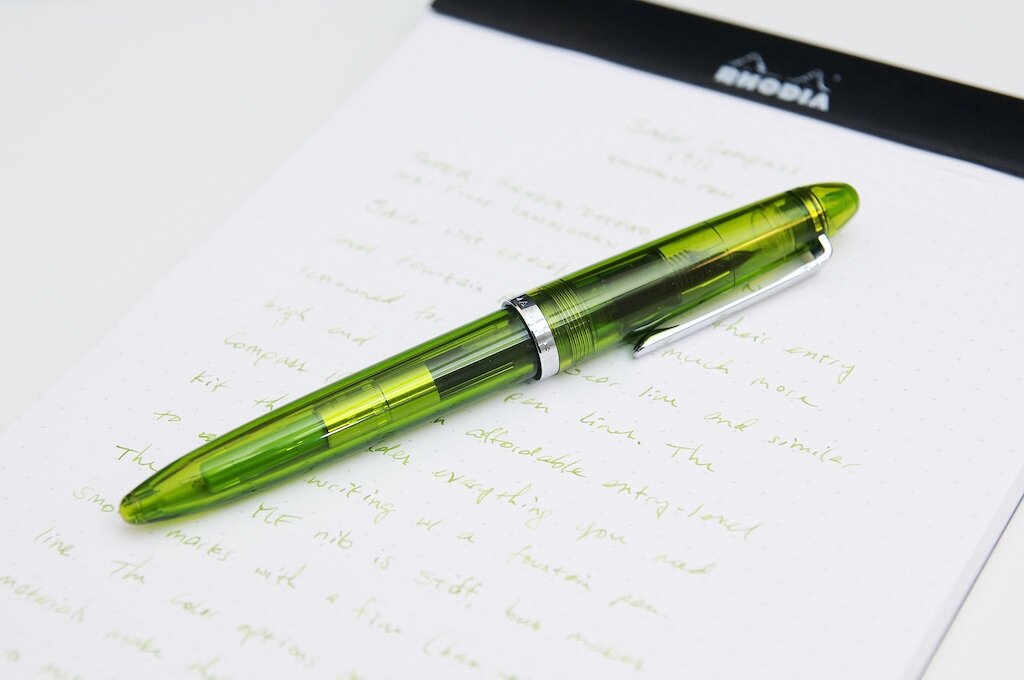
Across the lineup, the Compass 1911 feature semi-transparent materials in a variety of fun colors. The trim is silver in every case, and there also aren't any nib choices to make. Every pen comes with a stainless steel medium fine nib. While this is a bold decision, I certainly agree with this being a default option for a nib size. Others won't appreciate it and will look for larger or smaller alternatives, but for most people that don't really know what nib size to use yet, it's a pretty good starting point.

Sailor Compass 1911 Fountain Pen Converter

The pen is fairly lightweight, but doesn't feel brittle or delicate. It can definitely withstand some abuse from being thrown in bags and pockets. The screw-on cap posts securely to the back of the pen, and I find it extremely comfortable to write with the cap posted or non-posted. Both lengths are great for writing. In all, the materials used in the body and cap feel great for such an affordable pen. Even the converter seems well-made.

Moving on to the more important part of the pen, the nib is incredibly plain compared to Sailor's more expensive options. Even though it's plain and looks a little cheap, this nib is a solid performer. The MF nib is stiff as a nail and writes smoothly and reliably. It's always such a joy to ink up a pen straight out of the box and find that it writes beautifully without any fuss. The Sailor Compass 1911 is one of these pens, and an excellent first option for those that are curious about the world of fountain pens. I also enjoy that the material used for the feed is transparent as well, which shows off the ink color you've chosen. For my Olive version of the pen, I went with Pilot Iroshizuku Chiku-rin to compliment the light green transparent color of the body. The green feed just makes it even better.

Sailor Compass 1911 Fountain Pen Comparison

To be honest, I wasn't sure what to expect when I opened this box. I've been disappointed in the past by some of Sailor's sub-$100 offerings, and I thought this might be another lackluster attempt to break into that price range. The Compass 1911 won't disrupt what TWSBI, Pilot, Lamy, Kaweco, or other brands that offer pens in the same price range are already doing, but it is a fantastic offering from the brand that directly translates what kind of quality and dependable writing experience you can expect from their more luxurious offerings. Here's to hoping they continue experimenting in this fun category.

The review unit featured here is the Olive color option, but you can also pick from Clear, Brown, Yellow, Green, Purple, Blue, Pink, and Red. At $40, they're a fantastic deal for a gift or a personal treat.

(Goldspot provided this product at no charge to The Pen Addict for review purposes.)


Enjoy reading The Pen Addict? Then consider becoming a member to receive additional weekly content, giveaways, and discounts in The Pen Addict shop. Plus, you support me and the site directly, for which I am very grateful.

Membership starts at just $5/month, with a discounted annual option available. To find out more about membership click here and join us!

Sailor Compass 1911
Posted on November 11, 2020 and filed under Sailor, Fountain Pens, Pen Reviews.