Posts filed under Fountain Pens

Sample Vials - A Mini FAQ

(Kimberly (she/her) took the express train down the fountain pen/stationery rabbit hole and doesn't want to be rescued. She can be found on Instagram @allthehobbies because there really are many, many hobbies!. This post contains affiliate links.)

If I had a dollar for every time someone asked me which sample vials to get, or how to prevent them leaking, I’d have lots of dollars…..at least $30, which would get me another bottle or two of ink! And with the holidays coming up and people sending ink samples for Inkvent (this started before you, Diamine!), I thought I’d share what I’ve learned about sample vials with you so you’re good to go!

What’s a sample vial? It’s typically a 5ml plastic vial with a screw top cap that is commonly used in the fountain pen world to store ink samples. There are other containers used for samples, but the ones I’m focusing on are the ones traditionally used and sold by pen shops for ink samples (pictured below).
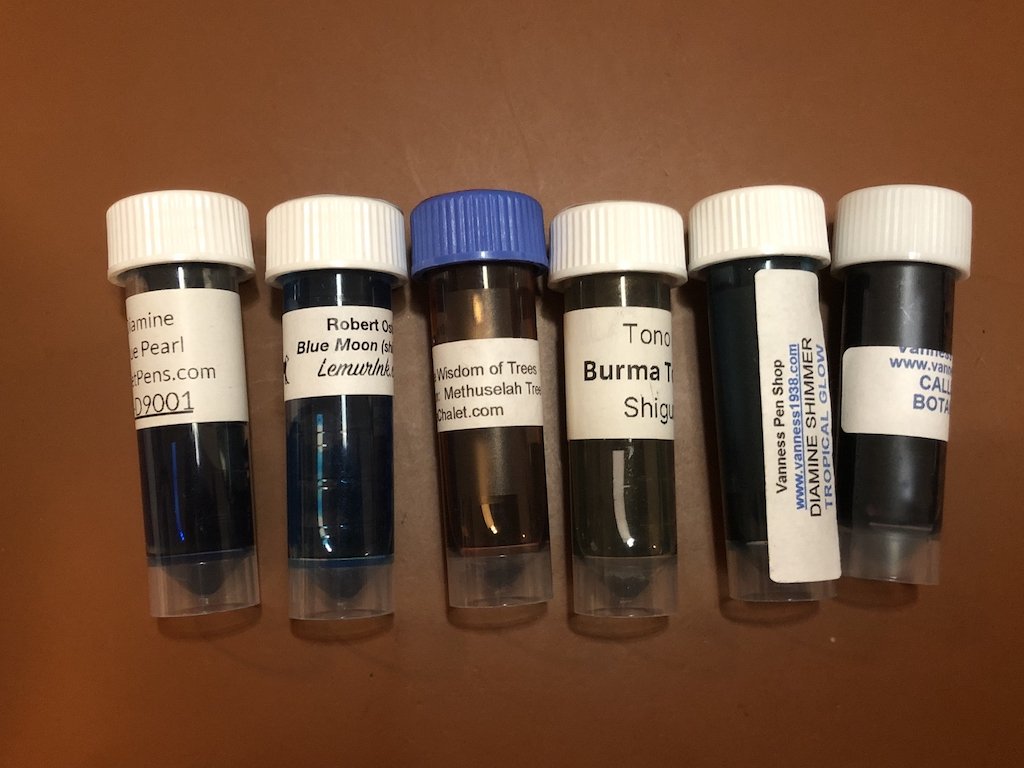
Samples from Goulet, LemurInk, Pen Chalet, Shigure Ink, Vanness (older and newer vials, respectively.)

What are sample vials used for, besides ink samples?

  • Nibs (I store them nib pointing up so they don’t get banged around the bottom) and use a small piece of wadded up paper towel or non-biodegradable foam for padding if you need to transport or ship it. Don’t use biodegradable foam because it can start degrading/falling apart if your nib/feed is remotely damp and may start molding.
  • Non-ink fluids like White Lightning, Rapid-o-eze, pen flush, even water - great for a quick dip when you don’t wanna lick your finger or, gasp, lick your nib to get it going. Tip: I also use this for skin care when I don’t have travel sizes of stuff like toner, essence, serum, nail polish remover, etc.
  • Feeds, housings, screws, even tiny Kaweco converters, wax beads - pretty much anything!

How can I tell if I have a good vial or not? In the past, I’ve used vials from Stockwell Scientific and they’ve been excellent and rarely leak. I suspect that many of the vials made for scientific uses are made by the same companies so there may be similar ones under other brand names. I often hear “don’t get the blue capped ones because they leak”, but that’s actually not quite right. Don’t be fooled into thinking that only certain colored caps leak/don’t leak. Here are the two ways I can tell a “good” vial from a lesser one by inspecting the top of the cap:

  • Look for a dimple in the very top (the purpose of which is unknown to me)
  • Check for a slightly rounded edge from top to side. The lesser quality vials tend to have a pretty sharp edge.
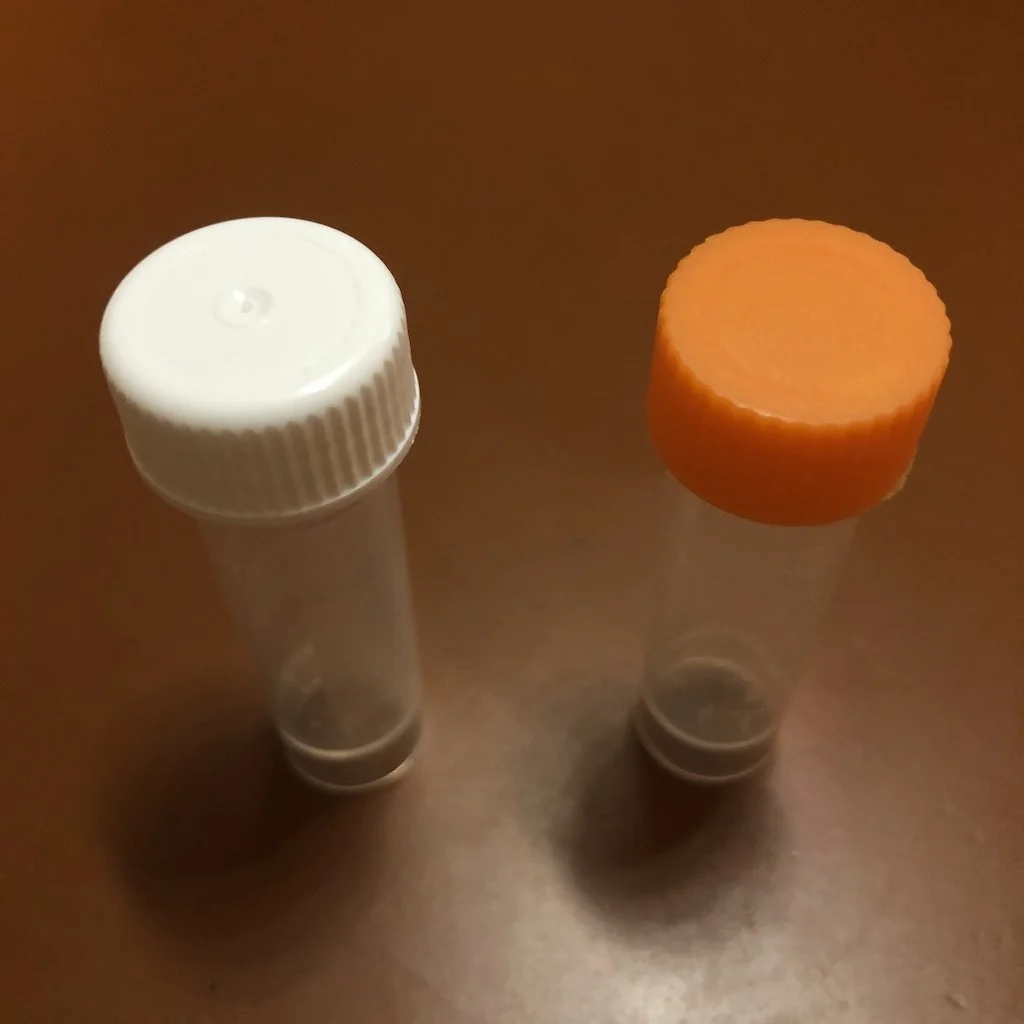
Left: Stockwell Scientific vial, Right: inexpensive vials from eBay. Notice the dimple on the top of the white cap as well as the curved edge at the top vs the 90 degree edge from top to side on the orange cap.

With the pandemic, the high quality vials have been taken up by scientific research companies, making them harder to find and at higher cost. The vials that some of the pen shops are using now are different, but I haven’t had any leaks with these vials either, so I would feel good recommending them in lieu of the Stockwell Scientific ones. You also don’t have to buy them in 250 or 1000 quantities either, lol.

But I already have some vials that may not be as good, do I need to buy new ones?

  • Vials aren’t 100% leakproof, not even the good ones I’ve used. While the good ones rarely leak, I’ve seen ~20-25% failure rate on the other ones. Consider using those vials for non-ink storage purposes, for storing inks upright, or for giving to local friends, e.g. not via mail. I actually buy these cheaper vials for storing my nib units.
  • If you want to use your vials for mailing, make sure you inspect the cap closely. You’re looking for signs of a missing or broken cap seal, or where it has dislodged partially (or fully) from the cap. These will make it very likely that you’ll get a leaky vial which no amount of parafilm can save (more later).
    • Note that I haven’t found any gaskets or rubber seals in the good vials. It’s like they were designed not to need them. You do need to make sure you’ve screwed the cap all the way. There is an initial resistance that makes you think you’re done but you need to screw past that until it’s definitely on tight.
  • If the cap seal isn’t fully seated, gently push it back down and make sure it’s in all the way. If the seal is broken or missing, consider not using that cap.

Notice that the orange cap has no seal/gasket, whereas this clear cap does. I would totally use the clear cap/vial for ink before the orange one.

What’s this parafilm stuff and do I need it? According to wikipedia, “Parafilm is a semi-transparent, flexible film….is ductile, malleable, non-toxic, tasteless and odorless, and self-sealing thermoplastic.” In short, among other things, you can use it to help seal a vial. As I mentioned above, if you have a bad seal on your cap, parafilm won’t keep the ink in, though it may minimize how much leaks out (and sometimes, it won’t do that either). And no, you don’t have to use it. I don’t think any of the pen shops that sell samples use parafilm and they have a really good track record of not having leaky samples. I’m a little on the paranoid side, having received and sent leaky samples, so I take it one step further by wrapping the sealed vial in parafilm. You can buy parafilm here, though that’s a bajillion times more than anyone needs in a lifetime. I would recommend asking your pen group (local or otherwise) if they can send you some for a couple bucks.

How do I use parafilm?

  1. Parafilm comes in monstrous rolls, usually in 2” or 4” widths, so you’ll need to cut it down to size. You can get 3 strips of parafilm out of every 2” square, so cut them into 1/3s.
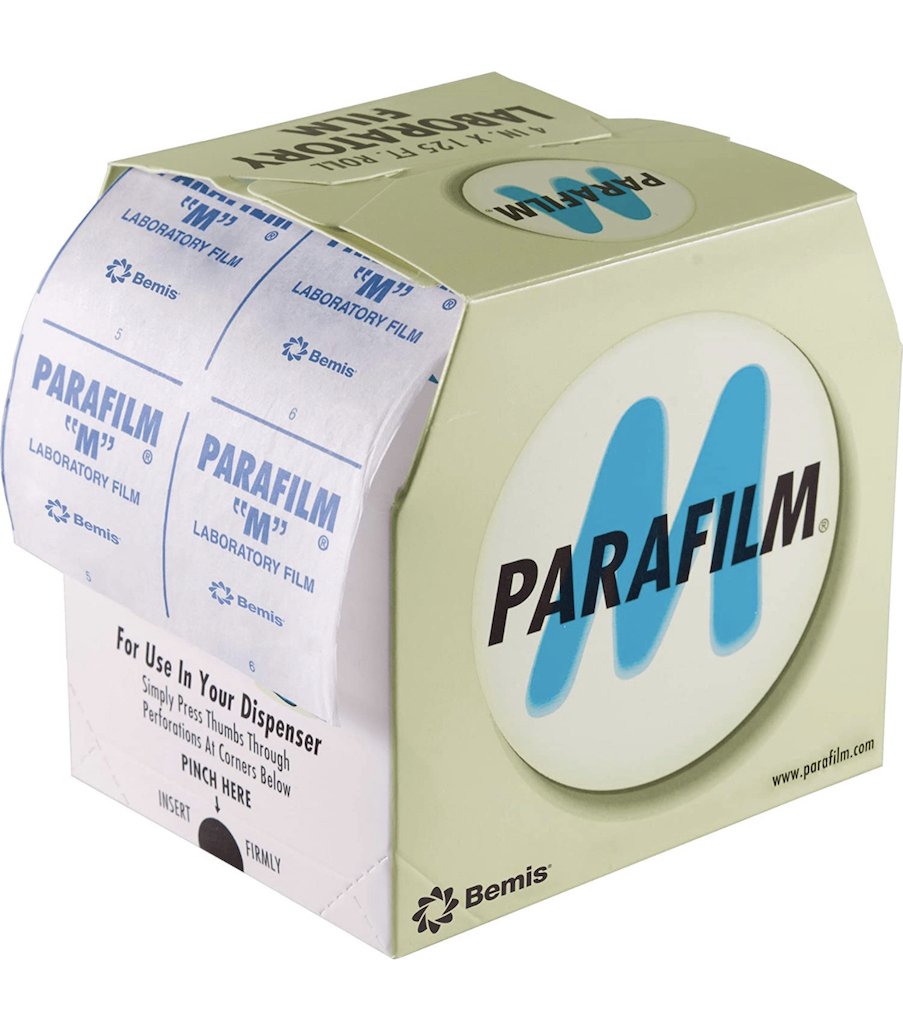
This is what mine would look like if it wasn’t in storage (photo from Amazon.)

I have a roll of 4” wide parafilm. Cut to 2” squares. Then cut further to get 3 strips per square. As you can see, it doesn’t have to be straight or exact.

  1. Remove backing from the strip. Parafilm isn’t sticky like an adhesive but it does stick to itself, so the backing is there to prevent that. Sometimes it’s easy to get the backing separated from the parafilm and sometimes not. When it isn’t cooperating, I will gently tear the backing which will allow me to remove it from the parafilm.

Other times, you have to resort to a gentle tear.

  1. Hold one end of the parafilm with your thumb against the vial and gently stretch the other end with your other hand, while simultaneously wrapping it around the base of the cap and onto the vial. Keep going until you’re done.

Gotta hold it down to get it started (wrapping)Stretch and roll the vial around (tada) Nice and tight and no leaks!

Stretch and roll the vial around.
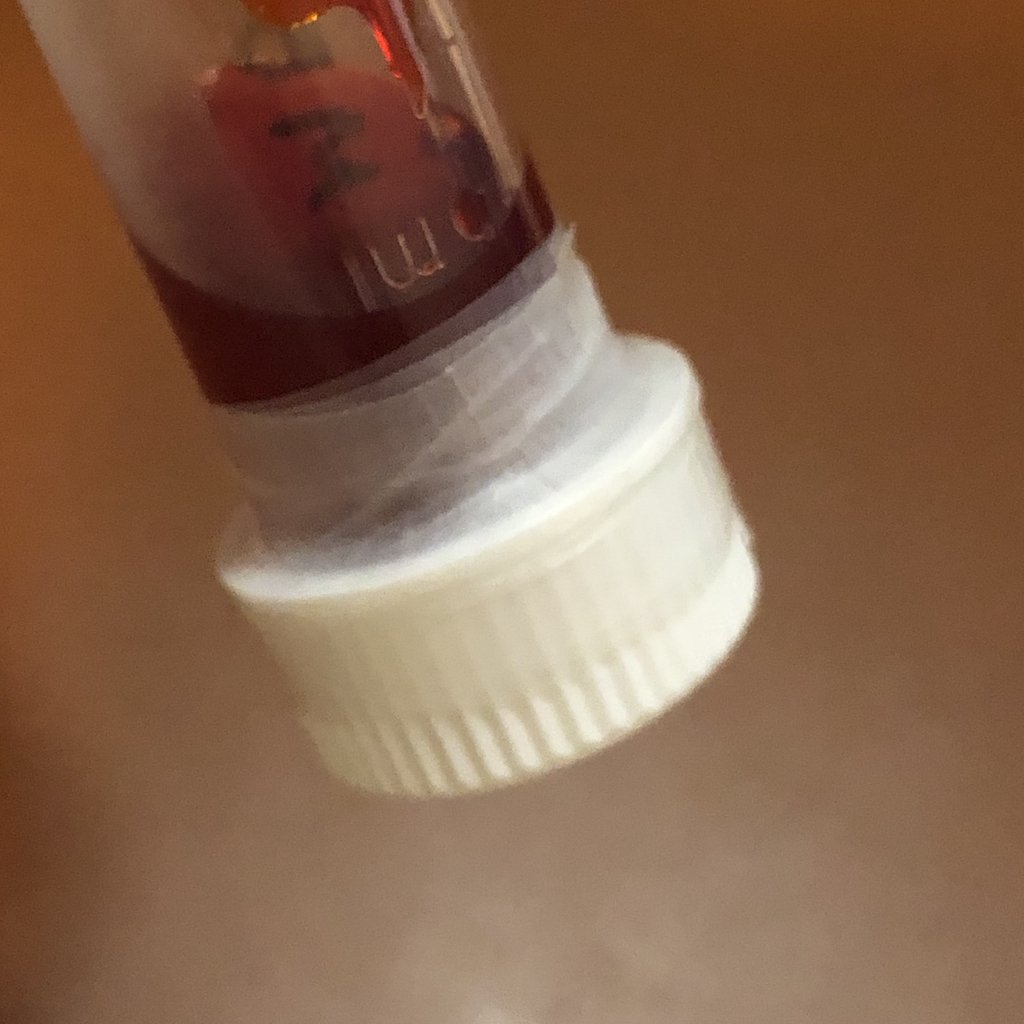
Nice and tight and no leaks!

NOTE: Do not parafilm the vial before capping. I have found that this will cause leaks more often than it will prevent leaks.

How should I ship ink samples (or bottles)? While it’s tempting to ship ink samples or bottles in a padded envelope to save a few bucks on shipping, you’re risking damage and leakage. Do the following at a minimum:

  • Make sure your caps are sealed tightly
  • Put your samples in a ziplock baggie.
  • Pad the samples well -- I usually wrap all the samples together in a paper towel before putting them in a bag. Then use bubble wrap or other padding when packing them in a box. (I save and reuse bubble wrap from other purchases)
  • Avoid sending ink when the weather is near or below freezing - ink expands when frozen and can break glass bottles and cause leaks from vials as well. Make sure your recipient will be able to get the inks before it sits in an outdoor mailbox for too long.

If you wanna go all out:

  • Add labels to the cap and vials and ink the cap label.
  • Parafilm each sample. You can also parafilm bottles but usually they are less likely to leak if they are packed well.
  • Put each sample in its own baggie (I use 2”x3” baggies which you can easily find on Amazon or your local craft/hobby shop)
    • If you wanna be even more extra, add a label to each baggie (this is helpful if there is a leak which sometimes happens despite your precautions)

If I don’t have tons of samples to make, I will go to this extreme, lol.

  • Put all samples in yet another bag
  • Continue packing as per above

Other tips:

  • Bring extra vials, parafilm, labels and baggies when going to pen meetups or pen shows. You may have the opportunity to snag a sample from a friend’s new bottle of ink!
  • Don’t forget to bring a blunt tip syringe or pipette for getting ink into your vial! (Pro tip: Robert Oster ink bottles pour easily and cleanly into vials, no syringe needed!)
  • Bring a small box with some padding in case you are flying and need to bring inks home.

That’s it! I hope this is helpful as you ink-able your friends with ink samples!

(All products have been purchased by me. I have received no compensation for including the products shown in this article. None of the links are affiliate links.)
Posted on October 29, 2021 and filed under Accessories Review, Fountain Pens.

Monami 153 Neo Fountain Pen Review

(Jeff Abbott is a regular contributor at The Pen Addict. You can find more from Jeff online at Draft Evolution and Twitter.)

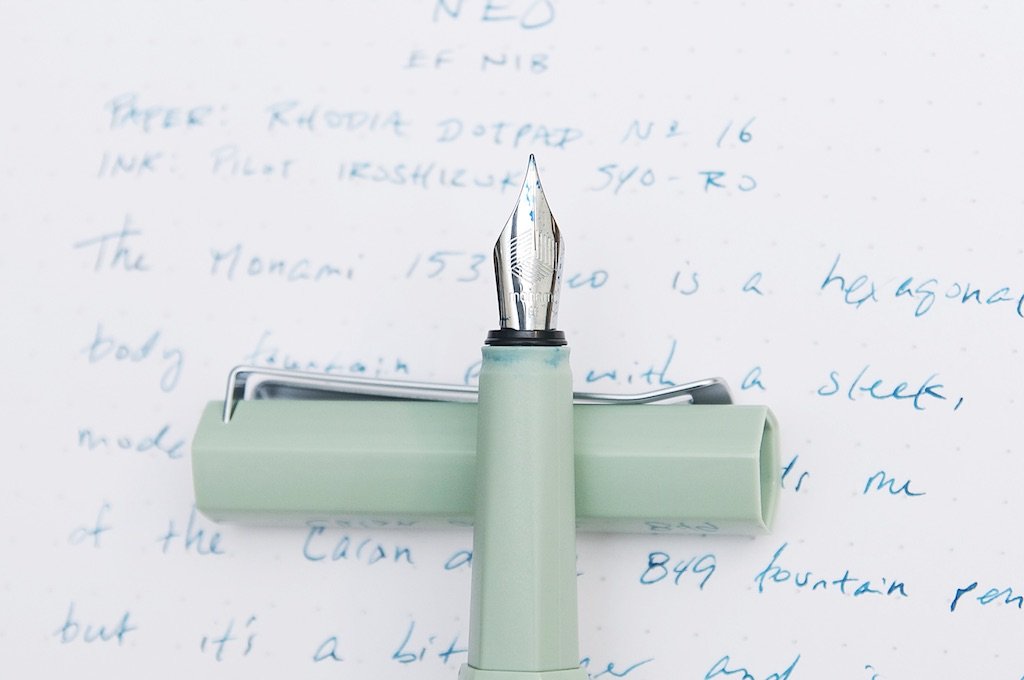
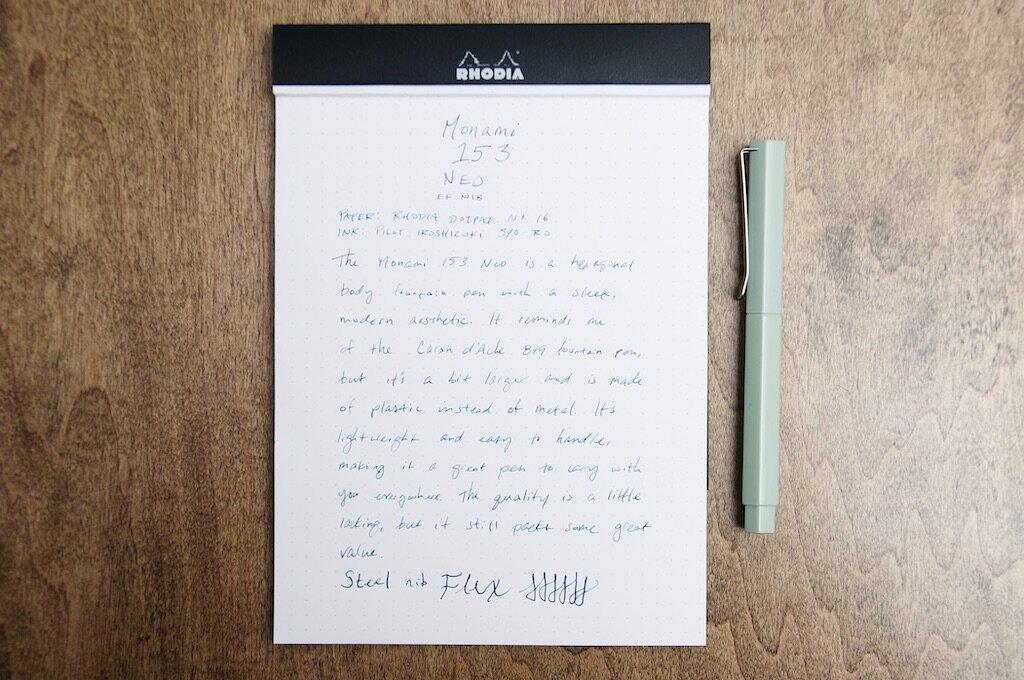
The Monami 153 Neo is a modern fountain pen that features a hexagonal barrel shape and a petite nib to match the sleek aesthetic. The edges that make up the hexagonal points are smooth and rounded off so that it feels good in the hand — not too jagged. It looks great, feels great in the hand, and comes in at under $30 — so how does it write?

The 153 Neo is actually a solid fountain pen. The price tag might make some people weary about the quality and longevity of a pen that should realistically hold up to a lot of abuse. In this case, I think the Neo does a good job of providing value and ruggedness in a stylish package.

The exterior of the pen is sleek and minimal. The only branding to be found is on the top of the cap — a small logo that appears to be etched into the metal. There's also a very small "Monami" brand etched into one side of the split clip. The branding doesn't jump out at all, and you actually have to look closely to find the Monami brand name. One thing that really bugs me about this pen is how the logo isn't etched dead center on the top of the cap. It's off quite a bit, and I think this shows that Monami isn't 100% focused on fit and finish with their products. When the branding and design is so minimal, you really can't afford any mistakes without losing some of that appeal. It definitely makes the pen feel cheaper.

The clip is strong enough to be useful but still easy to use. It reminds me of the Lamy Safari and AL-Star clip, but flattened. I really like that they went with a blasted matte finish on the clip instead of something shiny and polished. It keeps the attention on the body, which is what I think is most interesting about this pen.

The hexagonal body shape isn't a new concept. In fact, on first opening this pen and inspecting what was inside, I was a little annoyed to find what I assumed to be a knock-off Caran d'Ache 849. The inspiration is undeniable, but I think that the changes that Monami incorporated make it stand apart just enough to avoid any accusations. Still, it's way too similar to the 849 in my book. I doubt there's any kind of patent on pens that have a hexagonal barrel — plenty of companies do it well — but the 153 Neo just feels like a copy cat when put side by side with a 849.

Regardless of design inspirations, it's a solid body and cap. The cap pulls off easily and posts securely. Since it's a friction fit cap, there's also a mechanism built in that ensures the lines of the pen body and cap always line up perfectly. I always try to make my Caran d'Ache 849 line up when I put the cap on, so I appreciate that I can skip that step with this pen.

The body and cap have a semi-gloss finish that provides just enough shine to attract your eyes without taking away from the color and shape of the pen. The grip section, however, is a matte color with a more tactile feel than the shiny exterior. The grip is another area where I have some complaints about quality. There are obvious seams on the grip from the injection molding process. It would be one thing if the seams were aligned to the hexagonal joints, but they happen on the flat parts of the grip section, adding an awkward line that feels out of place. I think this could have been removed with some more fit and finish, but that's not something Monami chose to do.

Another problem I have with the grip section material (and this is a big one) is how it stained immediately when I submerged the nib and section into an ink bottle. This is usually no big deal, right? Just wipe away the excess ink after you fill it and you're good to go. With the Monami, the lowest part of the section that was submerged in the ink still has an obvious blue-green stain from the Iroshizuku syo-ro ink I used. To be fair, syo-ro is a really gentle ink and I've never had any staining issues with it before. I think this is directly due to the material and finish that Monami used on the grip section. Thank goodness I didn't dip the section any further into the bottle, or it would be an even bigger stain! I'm sure I could remove the stain with some rubbing alcohol or some other kind of cleaner, but that's really difficult to do when there's ink in the pen. It's so close to the section and nearly impossible to clean without more ink spilling out onto the rag or whatever I use to clean it. This is frustrating, but the pen is still completely usable. I should experiment with other inks to see if they also stain the section, but I'm not sure it's worth it. It's already stained now, so what does it matter?

Moving down to another positive attribute of this pen: the nib! The steel nib is an EF and writes beautifully. It makes a small mark without being scratching, and the ink flow is perfect. There's a Monami brand and some minimal decoration stamped onto the nib, along with an "EF" to indicate the tip size. Unfortunately, EF is the only nib option for this pen.

I've really enjoyed writing with this pen. The size and weight are perfect for my hand, and the tactile grip section is great at providing grip without getting slippery after a few moments of use. I love how the cap always lines up with the body when capped or posted, and I love the lines that run up and down the body to create some visual interest on an otherwise plain pen.

Can I recommend it? Nope. It comes with a couple of black ink cartridges and a converter, so that's nice — but this doesn't come close to the feeling I get when opening up a new Pilot Metropolitan, Lamy Safari, Kaweco Sport, or even one of the new entry level TWSBIs. I'm not able to get over what I feel is a blatant copy of the iconic Caran d'Ache design combined with the staining issue on the grip section. If it weren't for the material choice in the grip, I'm not sure I'd mind as much. But at $26, the competition is excellent and you don't have any room for these kinds of mistakes. Plus, any of those pens listed above offer more color choices and nib sizes.

My advice? Go with one of the pens I mentioned above; if you want a hexagonal fountain pen, go with the classic 849 instead. They're almost twice the price as this Monami, but the quality is easily triple. And again, lots of colors and nib sizes to choose from!

(JetPens provided this product at no charge to The Pen Addict for review purposes.)


Enjoy reading The Pen Addict? Then consider becoming a member to receive additional weekly content, giveaways, and discounts in The Pen Addict shop. Plus, you support me and the site directly, for which I am very grateful.

Membership starts at just $5/month, with a discounted annual option available. To find out more about membership click here and join us!

Posted on October 20, 2021 and filed under Monami, Fountain Pens, Pen Reviews.

Kaweco AL Sport, Vibrant Violet - A Quick Look

(Kimberly (she/her) took the express train down the fountain pen/stationery rabbit hole and doesn't want to be rescued. She can be found on Instagram @allthehobbies because there really are many, many hobbies!.)

This isn’t the first time that the Kaweco AL Sport has been reviewed on The Pen Addict and probably won’t be the last. Jeff wrote a great article about the Light Blue AL Sport and I highly recommend you give it a read because I don’t have much to add that isn’t already there. Here’s a quick run down:

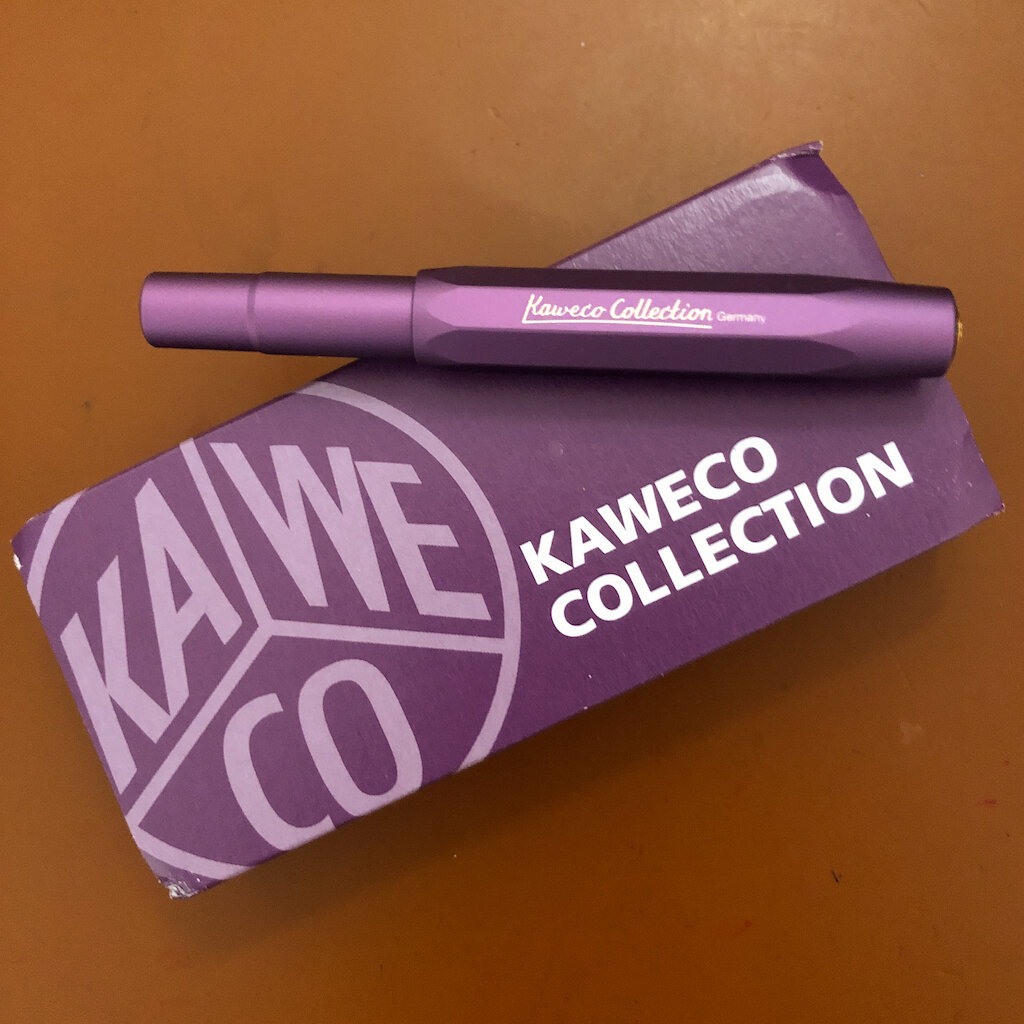
The AL Sport is the aluminum sibling to the Kaweco Sport which is made from resin (the AL is short for aluminum - clever, right?). Being aluminum, it is more durable and about twice the weight of the Sport (.68 oz/19g vs 0.3 oz/8.5g). It comes with a Kaweco blue cartridge, but you can also purchase other accessories including a pocket clip or converter (I prefer the piston converter to the squeeze one and usually use a converter so I can prime the feed if I need to, plus I rarely need/want a cartridge’s worth of ink). This Vibrant Violet AL Sport is a special edition that comes in a metal tin with a specially designed outer box sleeve. The pen is fitted with a gold-colored steel nib, and has “Kaweco Collection Germany” written in gold on the cap. As of this writing, this limited production Vibrant Violet is still available, with an EF, F, M, or B nib size for $90 USD/70 EU.

Kaweco and box.JPG

Aside from the material being aluminum as opposed to resin, the other key difference is the ability to unscrew the nib unit from the AL Sport models. The regular Sport nib housing is often glued to the grip, so you have to pull the nib and feed if you want to swap nibs. With the AL Sport, you simply unscrew the entire nib unit and you’re ready to switch nibs.

Purple pen lovers rejoiced as there were several purple Kawecos that came out this year. The first was the Kaweco Sport, Lavender, which was released earlier in Spring 2021. The other 2021 purple Kaweco was an exclusive Violet Sport for Galen Leather. The Vibrant Violet is the second addition to the Kaweco Collection (the Lavender was the first). The color is a beautiful purple with a bit of magenta tone. It is a darker shade of purple than the AL Sport Lilac, which was a limited edition from a couple of years ago, but a lighter, redder shade than the Galen Violet one, which is also transparent. A bit of trivia on the Lilac Sport: Kaweco incorrectly printed “Kaweco Sport” on the barrel instead of “Kaweco Collection”, prompting some avid fans to collect both versions (I’m not one of them, lol).

Lavender, Lilac, Vibrant Violet, Violet (Galen Leather).

Lavender, Lilac, Vibrant Violet, Violet (Galen Leather).

Over the years, there have been reports of quality control issues with Kaweco’s nibs in the Sport/AL Sport lines in terms of nib size consistency as well as quality of writing experience. I am a big Kaweco Sport/AL Sport fan (I always have at least one inked up) and have only had one Sport whose nib made me want to throw it at a wall, but otherwise they’ve been great writers out of the box even if the nib size wasn’t always spot on. I had already bought this pen and had it inked up prior to this pen showing up for review. Mine has a Broad nib and is currently inked with Papier Plume Mardi Gras Indians Purple in a Kaweco mini converter. The review pen has a Medium nib and I’ve chosen to use the same ink and converter to see how it wrote and to compare line widths. The Medium wrote perfectly out of the box. I didn’t flush it prior to use (though I always recommend it as one of the first troubleshooting steps). It gave me a medium line width and was indeed finer than the broad lines. It hasn’t been a big issue for me but I’ve encountered it, the most inconsistent line widths were between EF and F, and F and M. I’ve never mistaken a Broad for a Medium or BB.

Medium vs Broad - yup, they produced different line widths as expected. Neither were too fine nor too wide.

Medium vs Broad - yup, they produced different line widths as expected. Neither were too fine nor too wide.

I had a tough time picking matching inks because the purple has some red/pink tones to it and not as much blue as other purple inks. It also depends on the nib size of your pen as well as how dark you want your writing to be.

Robert Osterd Velvet Crush (better in a Medium or Broad nib), Colorverse Project #3 Deep Purple, Papier Plume Mardi Gras Indians Purple, Kala Nostalgia Star Garnet, Diamine Amazing Amethyst (which is a much closer match in person than in the photo), and Akkerman #13 Simplisties Violet.

Robert Osterd Velvet Crush (better in a Medium or Broad nib), Colorverse Project #3 Deep Purple, Papier Plume Mardi Gras Indians Purple, Kala Nostalgia Star Garnet, Diamine Amazing Amethyst (which is a much closer match in person than in the photo), and Akkerman #13 Simplisties Violet.

Writing sample on Clairefontaine Triomphe, 90gsm.

Writing sample on Clairefontaine Triomphe, 90gsm.

As I’ve mentioned, I am a big Kaweco Sport fan as well as purple pen fan, so when this was announced, it was a no-brainer for me. One of the few drawbacks I have about this pen is its diminutive size. Even though it is postable, it is definitely a pocket pen. So if you don’t like small pens, you’ll probably want to pass on this one. As for me, I think they did a great job on the color and both of the pens worked flawlessly right out of the box. I can’t wait to see what the next Kaweco Collection pen is going to be.

(Thank you to Goldspot Pens for providing this product at no charge to The Pen Addict for review purposes. The Broad one was paid for by my own funds.)

Posted on October 1, 2021 and filed under Kaweco, Fountain Pens, Pen Reviews.