
Posts filed under Ink Reviews

Bung Box Blue Black Ink Review

(Jeff Abbott is a regular contributor at The Pen Addict. You can find more from Jeff online at Draft Evolution and Twitter.)

As I experiment with more blue-black inks, it's becoming more clear that "blue-black" can mean a number of things. It doesn't always mean that the ink is just a really dark blue. Sometimes, the ink also has some green, gray, or purple hints as well. Some are darker than others, some shade well, and the list goes on. Blue-blacks are not created equal, which has made the process of trying new ones pretty exciting.

Quite a while back, I picked up a bottle of Bung Box Blue-Black, but in the bustle of moving, settling, and catching up on work, it got buried in the ink box for quite a while. Imagine my surprise when I was organizing my inks a few weeks back and discovered this little unopened gem! After that, I inked it up immediately to give a whirl in everyday writing tasks. While I wasn't very impressed at first, this ink won me over after a few days.

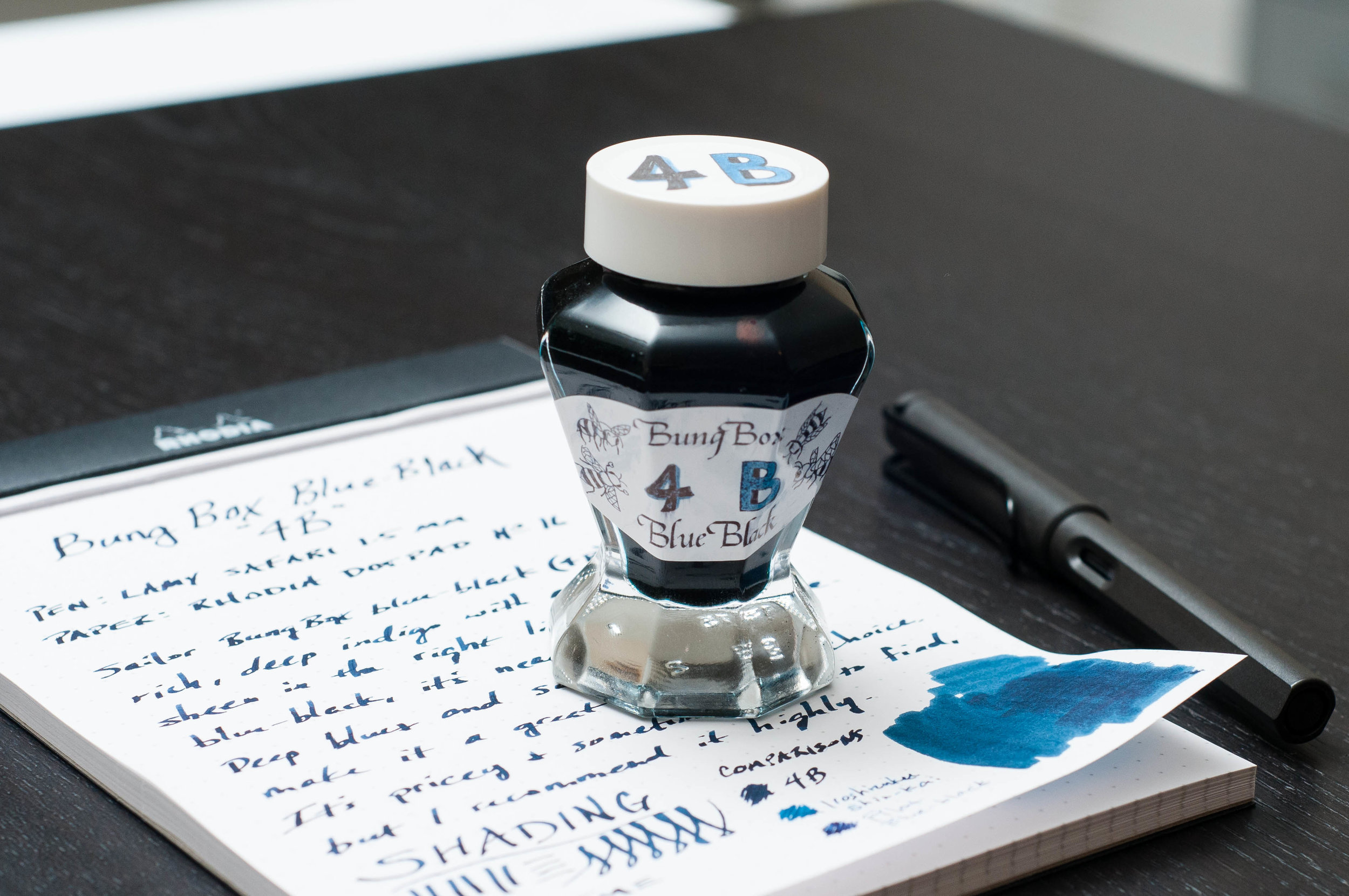
The color of this particular blue-black is undeniably indigo. There are no traces of purple or gray in this ink, but you can see some green in the swatch in my photos. In normal writing, I can't see any green. It's dark, rich, and blue all the way. Depending on the individual character of the pen you're using, it may be lighter or darker, but even in my "dry" pens, it's fairly dark.

There is some shading seen in this ink, but I wouldn't call it dramatic. It's subdued and classy, with just enough shading to be noticed if you're looking. Of course, the wider the nib, the more chances of tapping into the shading potential of this ink.

One surprising characteristic of this ink that I didn't notice for a while is a slight red sheen. It only comes out in certain lighting, but it's definitely there. Again, it's a subtle sheen and you have to look for it while holding the paper at a particular angle.

The writing experience is top-notch. This is a well-behaved ink that writes smoothly and is gentle on pens. The dry time is a little slow (coming in around 20 - 25 seconds in the 1.1mm stub), but does dry quicker than the test in my pictures if you're using a smaller, dryer nib. Still, it's something to consider if fast dry time is important to you (as in, this isn't a better option).

The only downsides I can see are the price and availability. It's pricey (over $40 usually) and not well-stocked, but that's generally true of all Bung Box inks. Vanness Pens is a good place to purchase this ink, and they typically have it in stock in a 50ml bottle or a 4ml sample vial.

Overall, I've been really happy with this blue-black! It's a rich, dark shade of blue, and it has subtle shading characteristics that make it stand apart from other blue-blacks. This is a high-quality choice for blue-black fans to try out at some point.


Enjoy reading The Pen Addict? Then consider becoming a member to receive additional weekly content, giveaways, and discounts in The Pen Addict shop. Plus, you support me and the site directly, which I am very grateful for.

Membership starts at just $5/month, with a discounted annual option available. To find out more about membership click here and join us!
Posted on September 14, 2016 and filed under Sailor, Bung Box, Ink Reviews.

Pilot Iroshizuku Ku-jaku Ink Review

(Jeff Abbott is a regular contributor at The Pen Addict. You can find more from Jeff online at Draft Evolution and Twitter.)

While this ink might be new to me, it's been around for quite some time as part of the Pilot Iroshizuku line. As you might know, some of my favorite inks come from this line, and this one is no exception. Iroshizuku Ku-jaku (Peacock) is a fantastic ink that I've immensely enjoyed using.

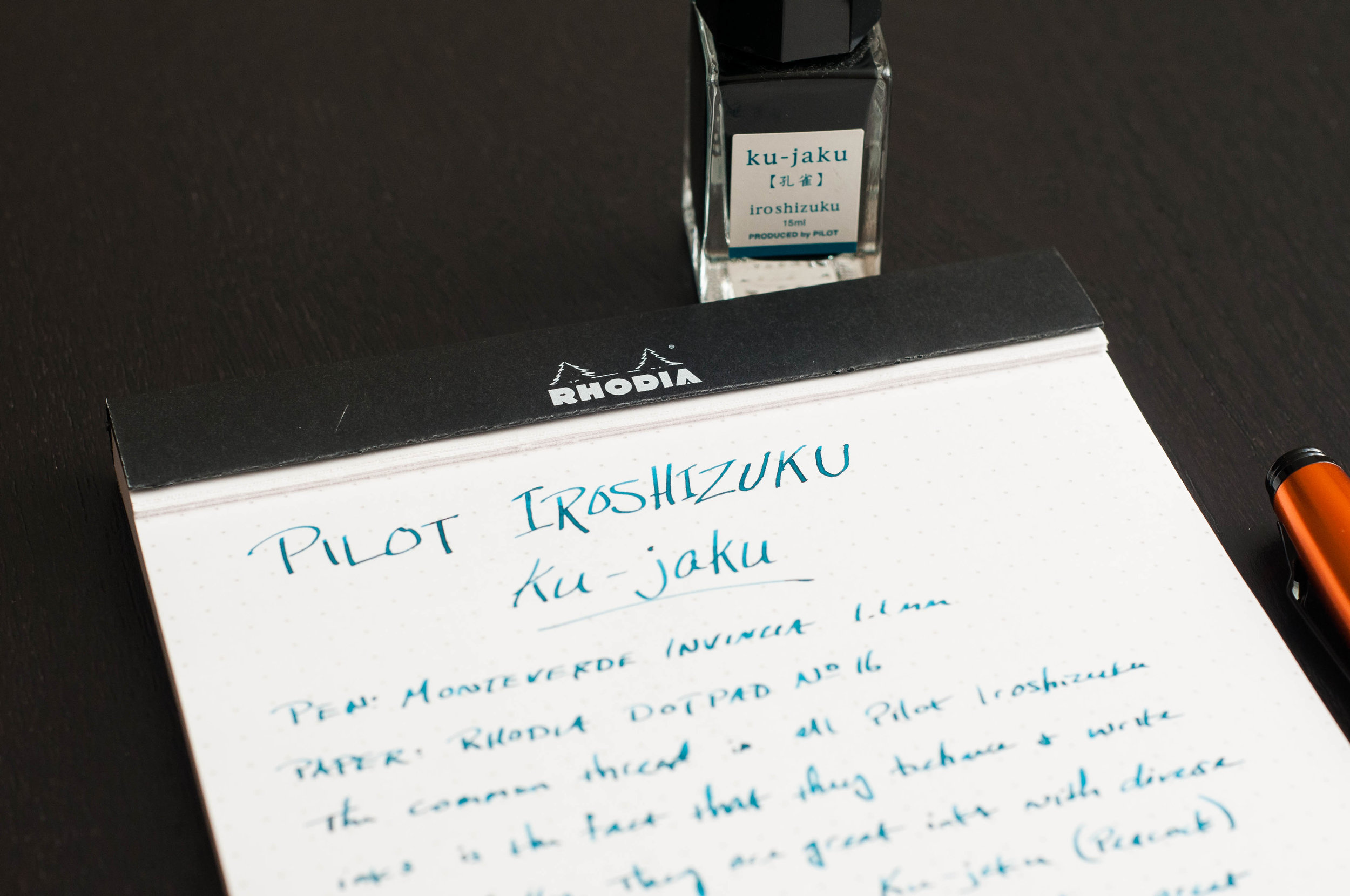
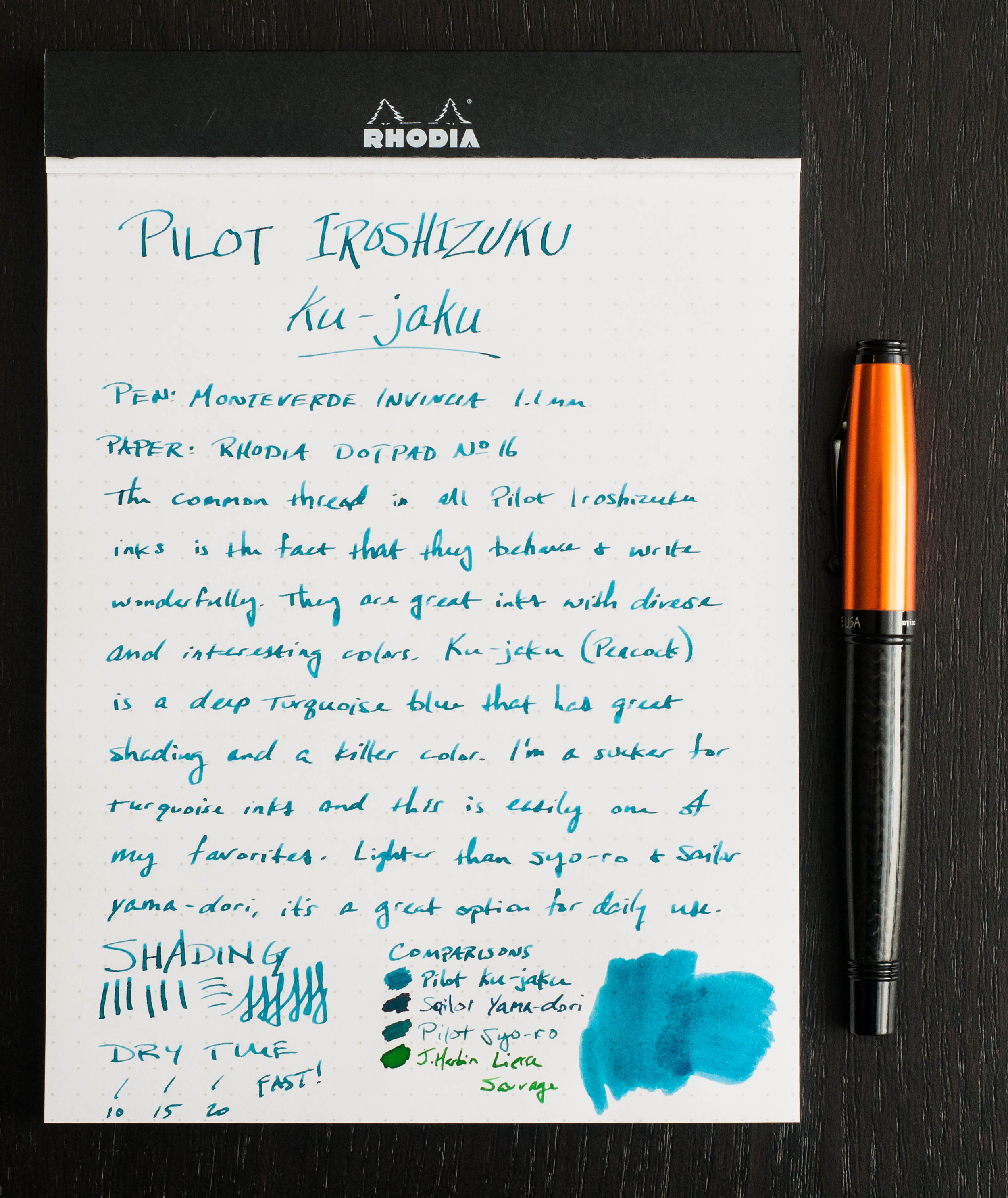
First off, Ku-jaku is a "deep turquoise blue" ink that acts exactly like every other Iroshizuku ink — beautifully. As far as my ink color preferences go, turquoise is probably my favorite variety. I've reviewed Iroshizuku Syo-ro, Sailor Jentle Yama-dori, and Franklin Christoph's Midnight Emerald, and they all share a common shade of dark turquoise with excellent shading. Ku-jaku is no different. The only problem for me is that it's impossible to pick a favorite out of this line-up.

First off, Ku-jaku is a tad lighter than the other inks I've mentioned. Because of this, you can see a lot more of the blue-green popping off the page when you write. This probably makes it less "business-friendly," but it's worth it. Being called "peacock," you have to understand that this ink has to show off its colors. And, if you use a broader or specialized nib, it has no problem showing it off.

Just like the other dark turquoise inks in my list, Ku-jaku also shades beautifully. Shading is a big factor for all of my favorite inks, and the subtle changes that I see in Ku-jaku are marvelous. The light end of the spectrum is a medium, electric green that deepens into a dark blue-green that reminds me of the sea. If you're a fan of shading, this ink will not let you down.

When it comes to dry times, Ku-jaku is pretty fast. In my tests, the ink was dry by 20 seconds, but pretty much smudge-proof by about 12-15 seconds. Only a very deliberate and heavy rub would smudge the ink after about 12 seconds. This is a great drying time and something to consider if fast drying inks are important to you.

Feathering is non-existent if you're using decent paper, and show-through is minimal. Really, every aspect of this ink is on-par with all of the Iroshizuku offerings.

Of course, you can pick this up in a 15ml bottle or a larger 50ml bottle. I opted for the smaller bottle on my first time around, but I'll definitely go for the larger one when it's time to replenish my stock. So far, this ink has been going fast due to the popularity.

It's an Iroshizuku, so you know it will behave well. All that's left to consider is the color. Turquoise fans will love it, but it might have limited value if you already own some of the comparable inks mentioned here. Still, it's unique enough to merit space on my shelf!

(JetPens provided this product at no charge to The Pen Addict for review purposes.)


Enjoy reading The Pen Addict? Then consider becoming a member to receive additional weekly content, giveaways, and discounts in The Pen Addict shop. Plus, you support me and the site directly, which I am very grateful for.

Membership starts at just $5/month, with a discounted annual option available. To find out more about membership click here and join us!
Posted on August 31, 2016 and filed under Pilot, Iroshizuku, Ink Reviews.

KWZ Ink - Honey: A Review

(Susan M. Pigott is a fountain pen collector, pen and paperholic, photographer, and professor. You can find more from Susan on her blog Scribalishess.)

KWZ Ink (pronounced "kah-veh-zeh") is a new ink on my radar. I had never heard of it until I started seeing reviews for various colors of this ink. The color that really intrigued me was Honey. So, I purchased a bottle from Vanness Pens.

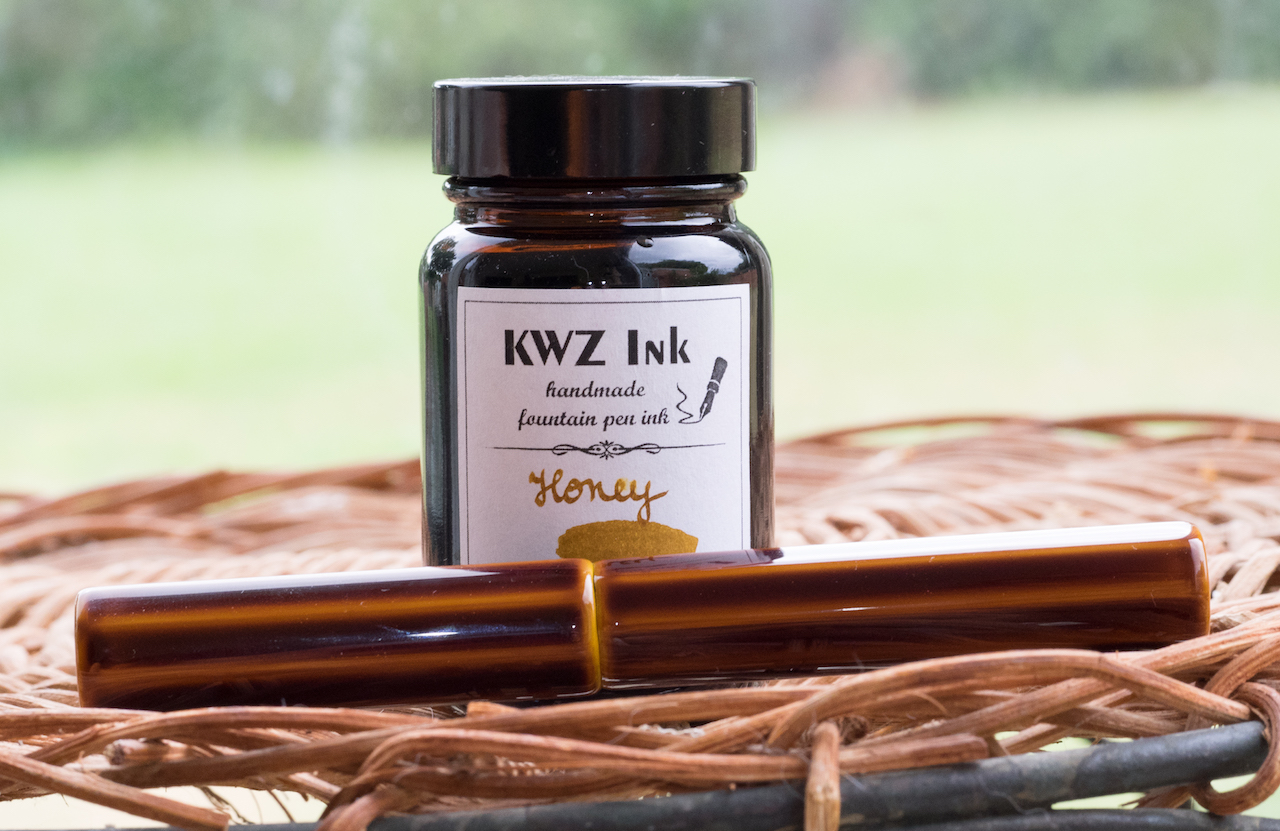
The ink is packaged in a nondescript white box. The bottle itself is simple as well, which speaks to the handmade manufacturing of this ink. The focus is on producing unique colors not on fancy bottles.

The first thing you notice upon opening this ink is the distinct aroma. Sometimes it smells sort of like a medicinal vanilla. Other times, perhaps because the ink's name influences your brain, it smells like honey. Regardless, it is very . . . aromatic. I contacted Vanness after opening the bottle because the strong smell concerned me. They reassured me that the smell is normal. More on the origins of the strong odor later.

The ink itself certainly reminds one of the color of honey.

It is a beautiful amber with truly excellent shading capabilities, even with fine nibs. The ink flows well – in fact, this is a rather wet ink, especially with broad nibs. The ink is not waterproof.

I've been using KWZ Honey in my Danitrio Hakkaku with a flex stub nib. As you can see, the shading is spectacular with this nib.

I also inked my Pilot Custom 832 with a medium (really more like a fine) nib. Even with this finer nib, the shading is excellent. I really love this color.

I compared it with my other brown/amber inks, and really nothing comes close except Sailor Uca Arcuata which is definitely more greenish.

But then there's the smell. This has obviously caused concern amongst customers because there are at least two threads on Fountain Pen Network about the smell (here and here). Initially, some ascribed it to Phenol which is used as a preservative in Sailor inks. But it definitely does not smell like Phenol. Eventually, the owner of KWZ wrote a response on FPN to explain the smell without giving away too many secrets of his formula.

Hello. No I do not use phenol. I will quote my answer I did send to one of the users lately regarding the smell: "In case of Iron Gall inks the strong smell is caused by gallic and tannic acids - both compounds have relatively strong odor.
Both our standard inks and Iron Gall inks use similar compounds for stabilization. Our inks contain large number of compounds which stabilize and improve them in various ways, for example preservatives, antioxidants, corrosion inhibitors, free radical scavengers and more. What has probably the strongest smell is fungicide - in case of this compound this is naturally occurring compound widely used in different branches, including medicine and cosmetics. Additives we use in our inks are approved to be used in food industry or approved for contact with humans in form of cosmetics for example.
Considering allergies - our inks in some conditions might be source of salicylic and/or benzoic acid. I'm very cautious about what I do use in ink making, and will certainly not use toxic compounds in ink making. This is for both safety of users, environment and also my health. We have to remember that concentration of preservative in ink is pretty low (less than 0,05-0,08%) while I have to handle pure substance or highly concentrated solutions while preparing ink."

KWZ Ink is made in Poland by Konrad Żurawski (according to the KWZ website). Now that the ink is becoming more popular because of the unique colors, I wonder if the owner will have to expand production. There certainly seems to be great demand. I contacted Vanness and got myself on an email list so I would be notified when they had more KWZ Honey in stock. The minute I got the email, I purchased mine because it doesn't tend to stay in stock long.

You can purchase KWZ Ink in a wide variety of colors from Vanness Pens for $12.00 per 60ml bottle. Ink samples are also available for $2.00. KWZ Iron Gall inks are a little more expensive at $14.00 per 60ml bottle.

My next bottle will probably be Brown Pink, but at $12.00 I may buy several, including the delightfully-named "Rotten Green." I think that might make an appropriate grading ink, don't you?


Enjoy reading The Pen Addict? Then consider becoming a member to receive additional weekly content, giveaways, and discounts in The Pen Addict shop. Plus, you support me and the site directly, which I am very grateful for.

Membership starts at just $5/month, with a discounted annual option available. To find out more about membership click here and join us!
Posted on August 26, 2016 and filed under KWZ, Ink Reviews.