Posts filed under Ink Reviews

Lamy Pacific Blue Al-Star Pen And Ink Review

(Jeff Abbott is a regular contributor at The Pen Addict. You can find more from Jeff online at Draft Evolution and Twitter.)

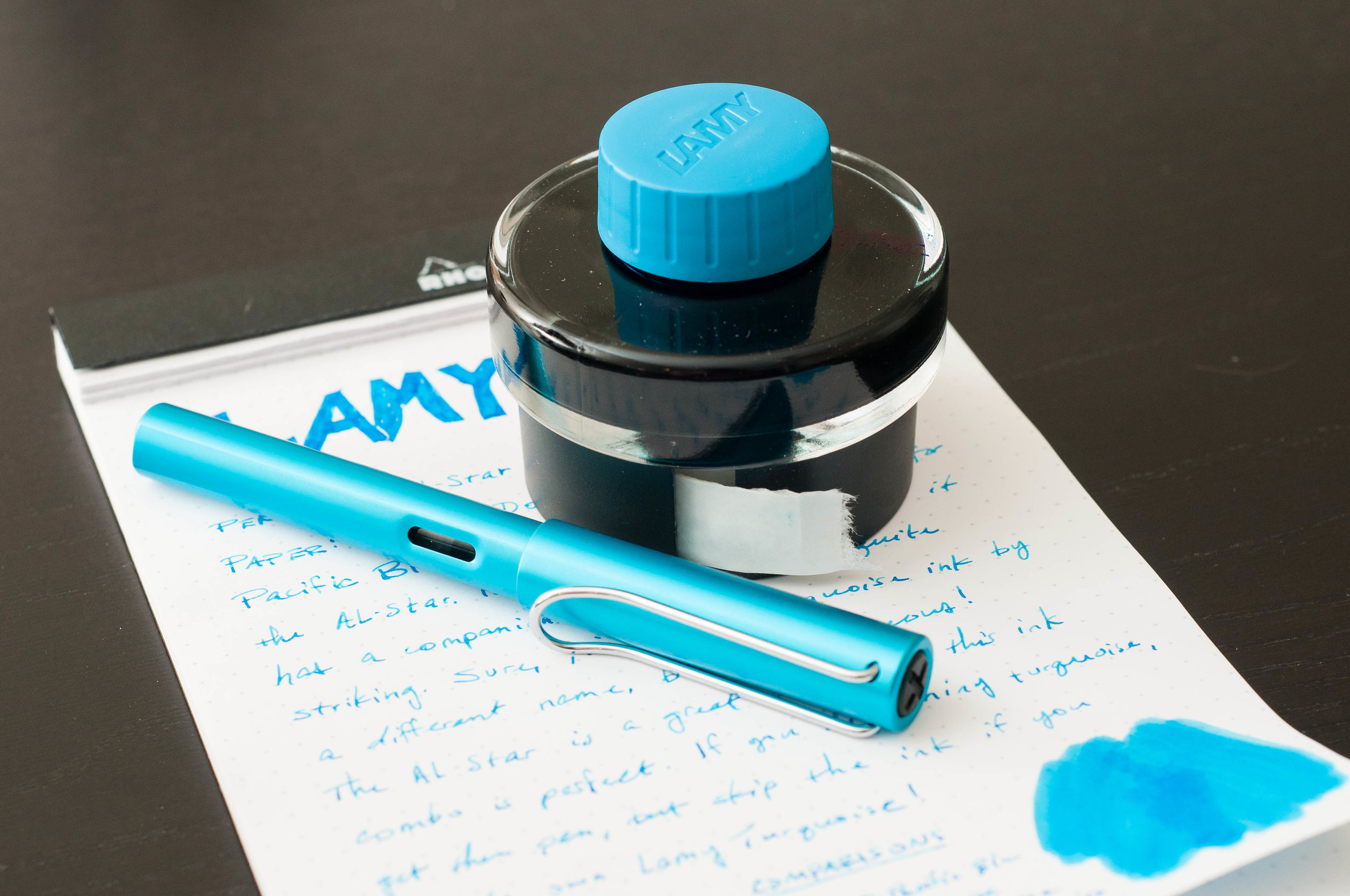
Every year, Lamy release a limited edition color of their popular Al-Star line, along with a companion ink of the same color. This year, I'm especially excited for the limited edition color: Pacific Blue. I'm admittedly a huge fan of turquoise and teal, and this pen is a delicious, shiny color that fits my bill perfectly. Pair that with an equally gorgeous turquoise ink, and we're all set for a killer combo.

The Pacific Blue Al-Star

You might love the new color, or it might make you cringe. Either way, it's impossible to miss. This is a loud, shocking, electric blue with subtle green undertones that set it off. Obviously, the color is inspired from the Pacific Ocean, and it does a great job of factoring in all the factors of the sea. When looking at this pen, it somehow looks as if it might be partially liquid while it sits on the desk. For me, it's a color that makes me extremely happy, and I love the pen for that.
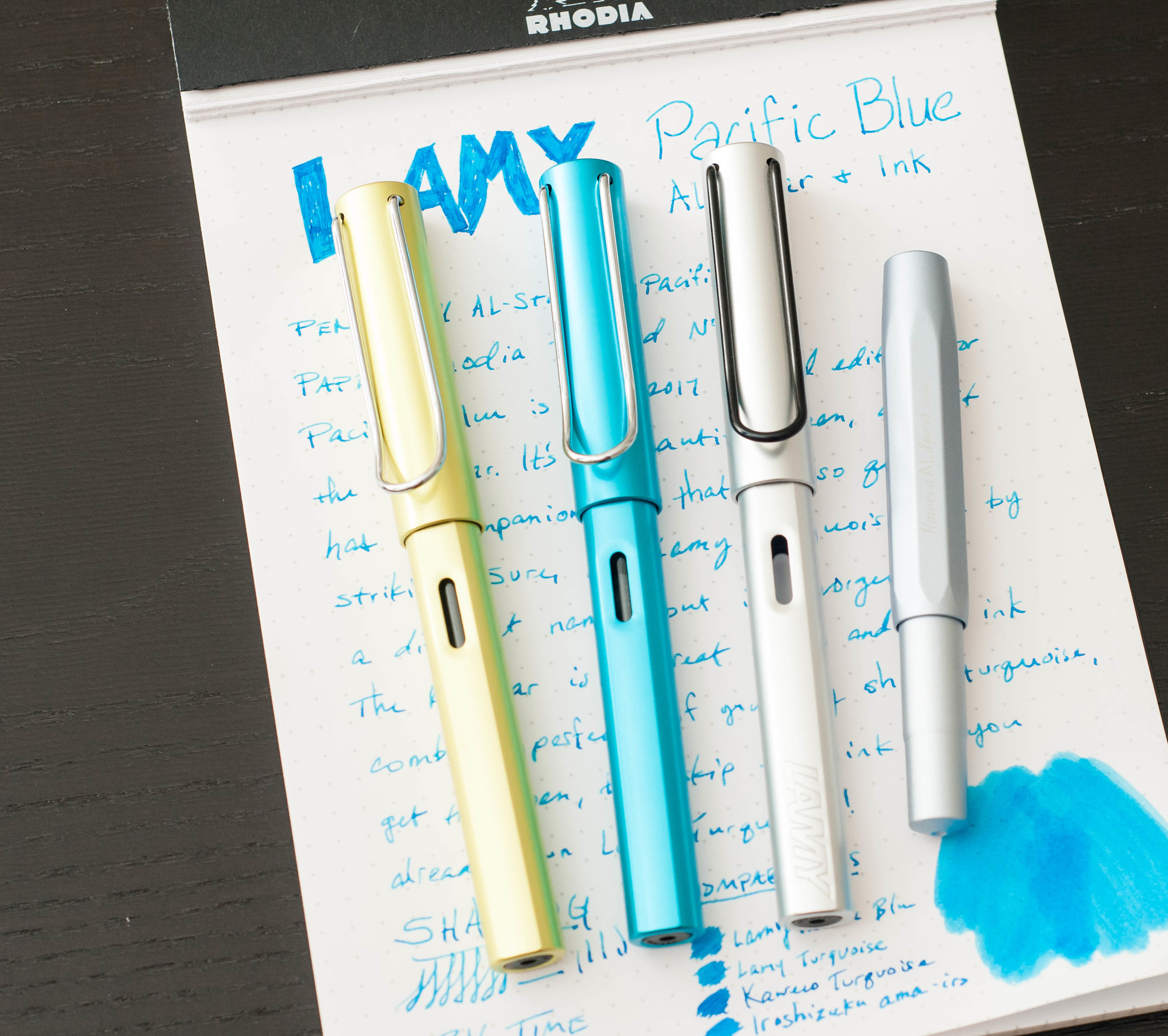
Since the only difference with this Al-Star is the color, I won't spend a lot of time on the details. Check out my review of the Charged Green Al-Star from 2016. Everything holds true for this copy as well!

The Lamy Al-Star is a solid fountain pen. It's not as affordable as the Safari line, and some people enjoy the Safari line more for many great reasons, but the Al-Star hits a nice balance of design, weight, feel, and awesome colors that set it apart from the Safari. If you haven't tried out an Al-Star (or a Safari...), then I highly recommend picking up this limited edition color.

The Lamy Al-Star in Pacific Blue is $36.00 and available with an EF, F, or M nib. Remember that Lamy nibs are easy to swap out with another size as well. Each Al-Star ships with a single blue cartridge, or you can purchase a cartridge-converter separately.

Lamy Pacific Blue ink

The other half of this year's Lamy special edition combo is the Pacific Blue ink. You might have heard, but it's no secret that Pacific Blue is, in fact, the same ink as Lamy Turquoise. I don't understand why Lamy released Turquoise under a limited edition moniker instead of formulating a unique ink, but that's not the point of this review. As such, keep that in mind if you already own Lamy Turquoise! You can safely skip this ink knowing that you already have it.

Lamy Pacific Blue is a beautiful turquoise ink that leans toward the lighter and blue spectrum. For example, I found that Kaweco Turquoise was a bit darker than the Lamy version. Iroshizuku ama-iro is actually very similar to Pacific Blue, but I think it has better shading qualities. Regardless, it's a gorgeous blue-green that radiates on the page! I love using this ink because of the color, and it's been difficult for me to switch back to Ama-iro over the past week. It's a great color.

Shading is great with this ink, which is something I haven't been very excited about with other Lamy inks. There isn't a massive range of variation, but it's tasteful. Again, it's intended to remind you of the Pacific ocean, so a degree of shading is expected. Lamy delivers this with high marks. The shading behavior is easy to notice in this medium nib, but it shows off a bit more in larger nibs. There's a minimal degree of shading in small nibs, but that shouldn't be a surprise.

The ink performs really well. I've not had any issues with skipping, starting, or clogging. Cleaning is a breeze, and lubrication is very balanced.

I haven't been able to detect any bleeding or feathering so far on my normal papers. There's a degree of feathering on cheap copy paper, but that is expected. Being on the light side, show-through isn't a problem in most cases. Using Rhodia paper, the opposite side of the page is completely usable after the top side is used.

Dry time is average compared to other fountain pen inks I use. It dries consistently by 15 seconds, while pooled areas take about 20 seconds to dry completely. Not bad, but not exceptional.

One unique feature with any Lamy bottled ink is the ink blotter included at the base of the bottle. This is convenient for cleaning the grip section and nib after you fill it with ink. These blotting strips do a great job and prevent you from using a tissue or paper towel to do the same job. Much less waste.

You can purchase Lamy Pacific blue in a 50ml bottle, or as a 5-pack of cartridges. Personally, I think the bottle is a better bargain. And remember — if you already own Lamy Turquoise, you don't need this!

(JetPens provided this product at no charge to The Pen Addict for review purposes.)


Enjoy reading The Pen Addict? Then consider becoming a member to receive additional weekly content, giveaways, and discounts in The Pen Addict shop. Plus, you support me and the site directly, which I am very grateful for.

Membership starts at just $5/month, with a discounted annual option available. To find out more about membership click here and join us!

Posted on March 1, 2017 and filed under Lamy, Fountain Pens, Ink Reviews, Pen Reviews.

Pilot Iroshizuku Murasaki-Shikibu Ink Review

(Jeff Abbott is a regular contributor at The Pen Addict. You can find more from Jeff online at Draft Evolution and Twitter.)

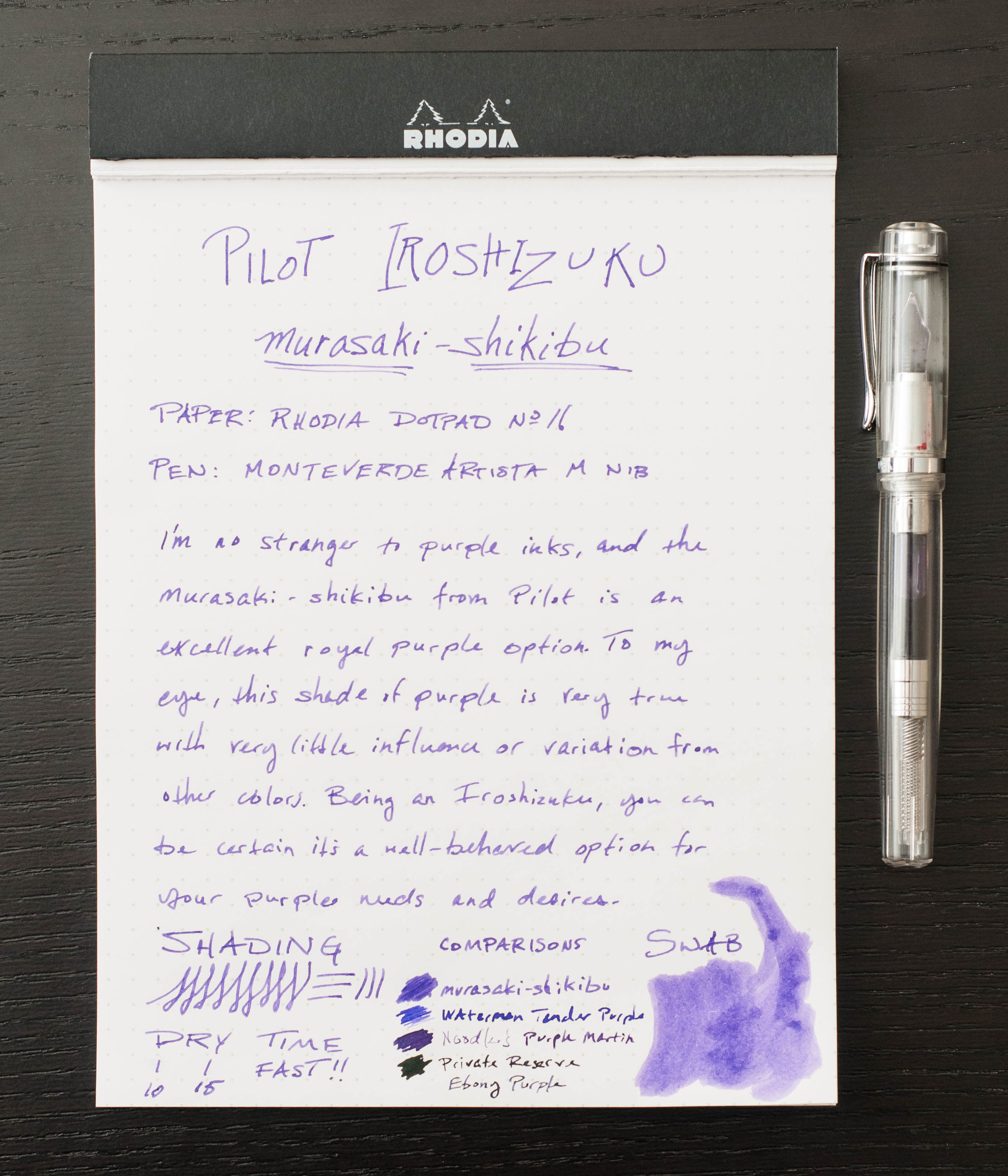
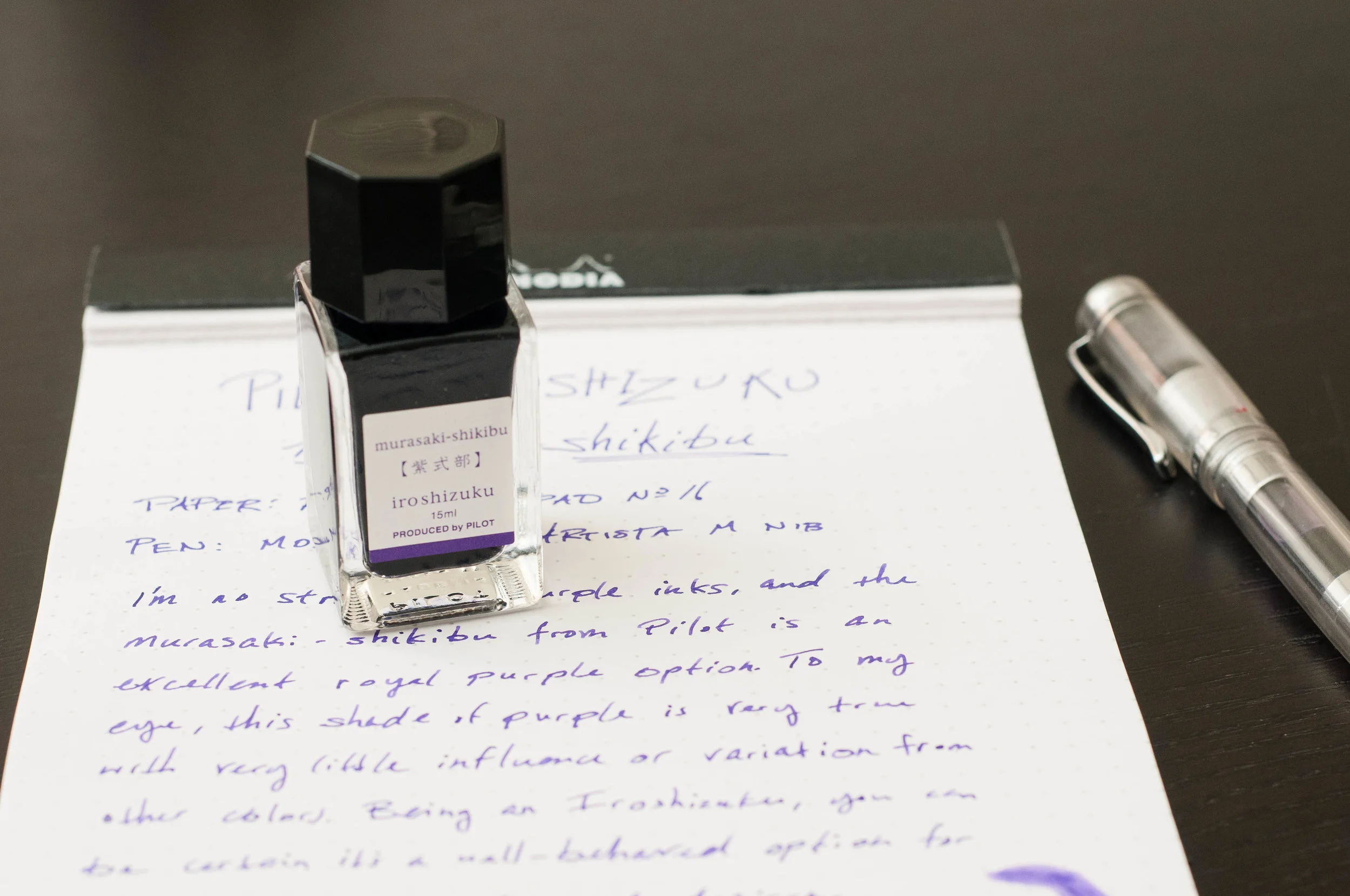
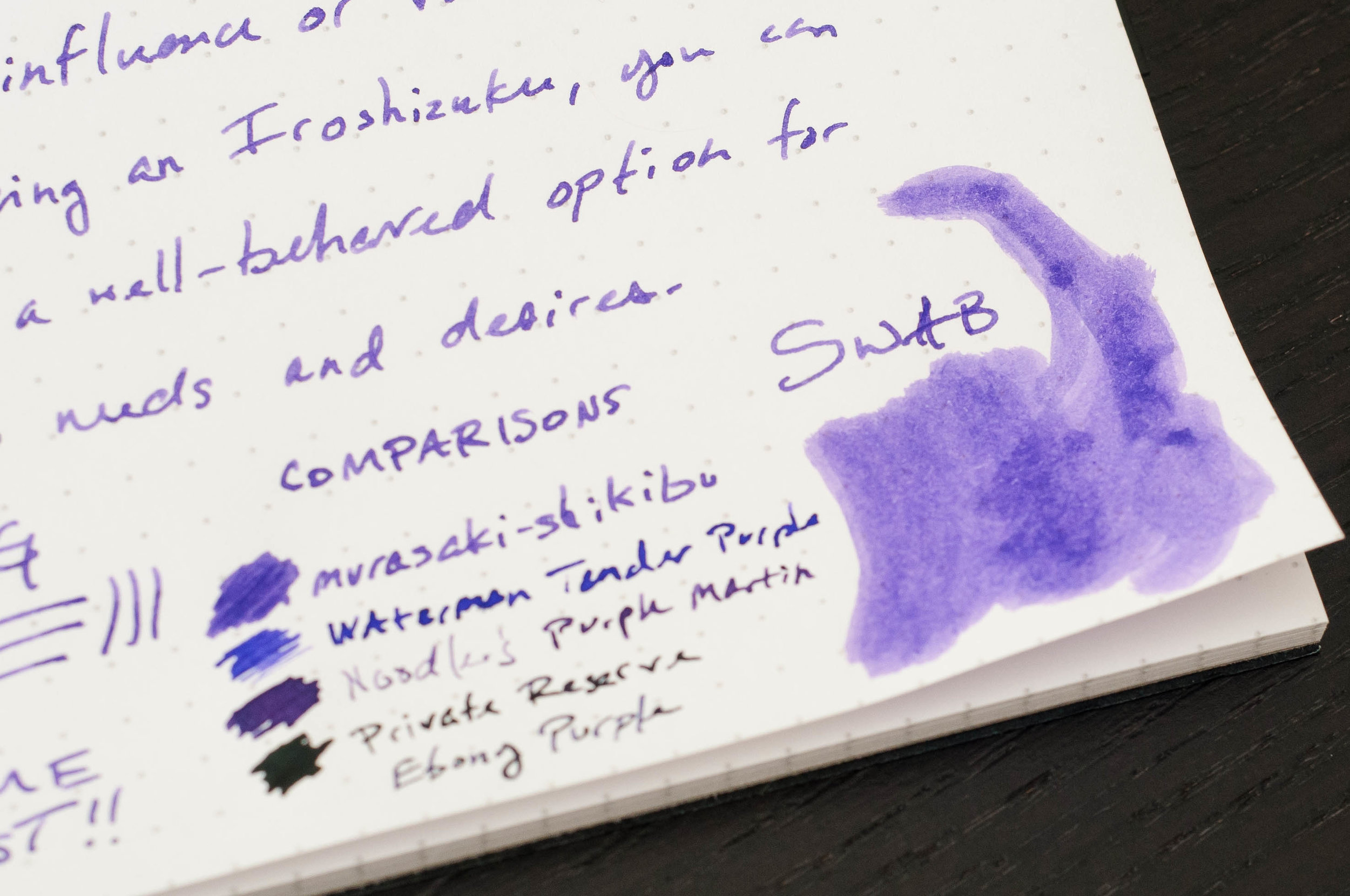
I've tried out several different purple/violet inks over the years, and I'm always surprised by how much variation an ink can achieve in the purple hue. Dark purple, light purple, blue and gray notes, etc. I've always enjoyed using Waterman Tender Purple, but it's a bit bright and has some blue notes. Pilot Iroshizuku Murasaki-shikibu is a purple ink that I think hits a perfect balance of "purple" that works well when you want a standard purple ink to use in your pen.

Most of my previous experience with purple and violet inks is darker than what Murasaki-shikibu offers, and that's part of the delight I enjoy when using it. It's not so bright that it calls unnecessary attention, but it stands out enough to be fun. KWC Gummiberry is a fun ink, but it's also quite a bit darker than this Pilot. Sometimes, a solid standard purple is in the cards, and this is now one of my go-to inks for that purpose.

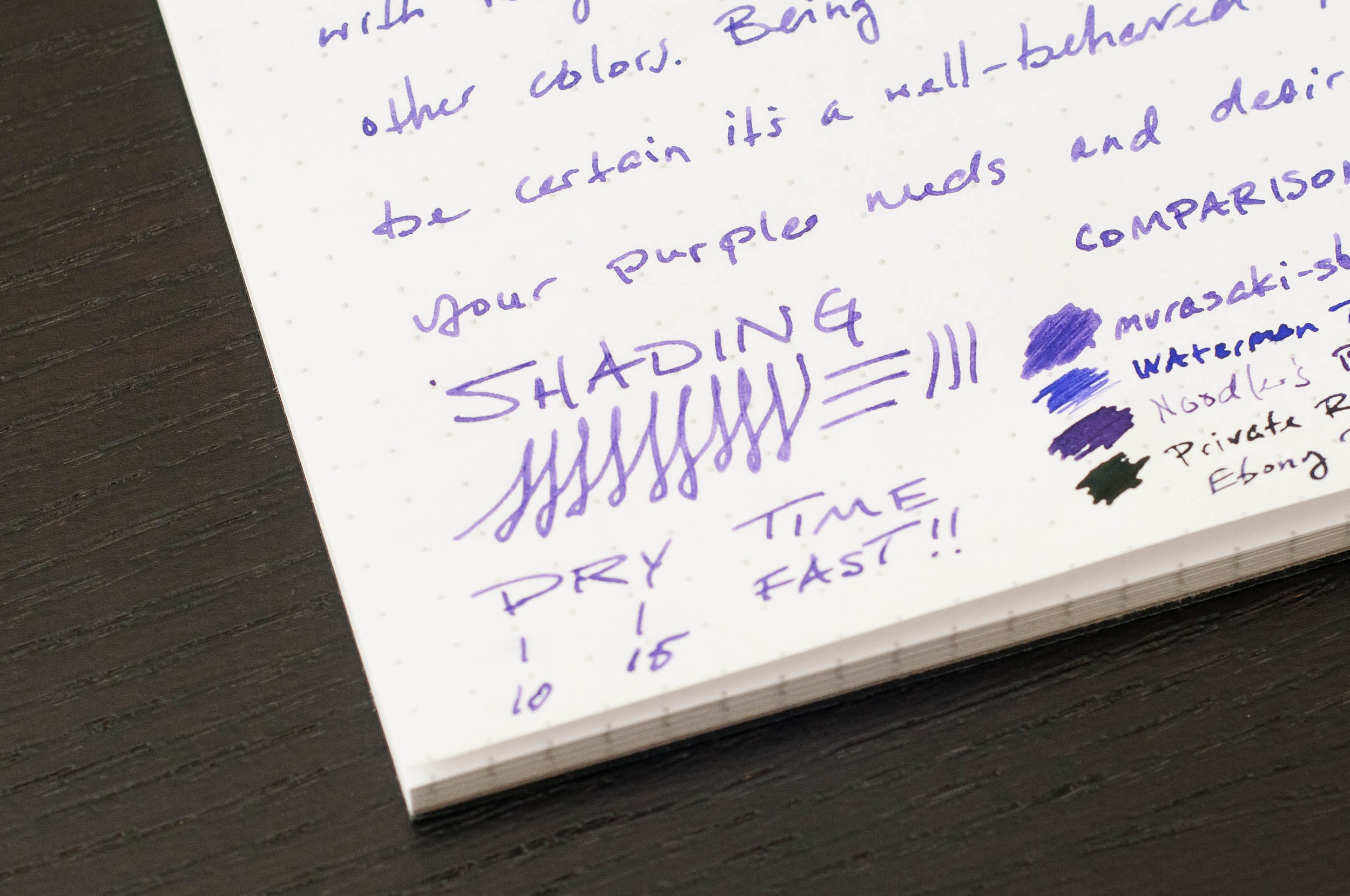
There is some noticeable shading in this ink, but it's not dramatic. In some cases, you have to search for it on the page. Obviously, the shading effect is more pronounced with a large or stub/italic nib, but it's fairly minor in a medium and smaller. Still, you'll notice shading in some spots, and it's pleasant. When using a larger stub or italic nib, the shading comes out easier, but it's still not dramatic compared to other inks in the Iroshizuku line.

The flow and performance of the ink is fantastic. Easy starts, no skipping, and very forgiving when you forget to cap the pen for a few minutes. The Monteverde I used for this review can sometimes lay down too much ink, but that wasn't a problem with the Murasaki-shikibu. I also used this in a notoriously dry EF Kaweco and had no issues with it. This ink produces very good flow.

Like the Chiku-rin I reviewed, I was really impressed (shocked) by the dry time of this ink. I tried several times and always came back to the 10-second mark consistently. That's an incredibly fast dry time for any fountain pen ink. This is definitely something you should consider if fast dry times are high on your list.

Feathering and bleeding are almost non-existent with this ink, although it does tend to show-through to the back of the page quite easily. This is to be expected for any medium or dark ink, so it's just another point of consideration. Probably not Field Notes friendly, but perfectly fine for thicker, more absorbent papers.

Purple inks aren't always in my rotation, but they continue to fascinate me. Everyone's brain is wired differently when it comes to color, and mine is naturally drawn to bright blues, rich blue greens, fiery oranges, and deep pinks. This purple hits the mark for me when it comes to the definition of purple in my head. It lays down a smooth, clean line and the color is light enough to pop, but still dark enough to produce rich pools of purple goodness. It's definitely worth a try if you're in the market for a solid purple.

Murasaki-shikibu is available in a standard 50ml bottle as well as a smaller 15ml bottle.

(JetPens provided this product at no charge to The Pen Addict for review purposes.)


Enjoy reading The Pen Addict? Then consider becoming a member to receive additional weekly content, giveaways, and discounts in The Pen Addict shop. Plus, you support me and the site directly, which I am very grateful for.

Membership starts at just $5/month, with a discounted annual option available. To find out more about membership click here and join us!
Posted on February 22, 2017 and filed under Pilot, Iroshizuku, Ink Reviews.

Nagasawa Kobe 21 Taison-Ji (Temple Yellow) Ink: A Review

(Susan M. Pigott is a fountain pen collector, pen and paperholic, photographer, and professor. You can find more from Susan on her blog Scribalishess.)

The Nagasawa Stationery Shop is located in Kobe, Japan. It carries a line of more than fifty Sailor inks, many of which are now available through Vanness Pens.

I ordered a sample of Nagasawa Kobe 21, Taisan-Ji (Temple Yellow) specifically for my prototype Omas Burkina because I like matchy inks.

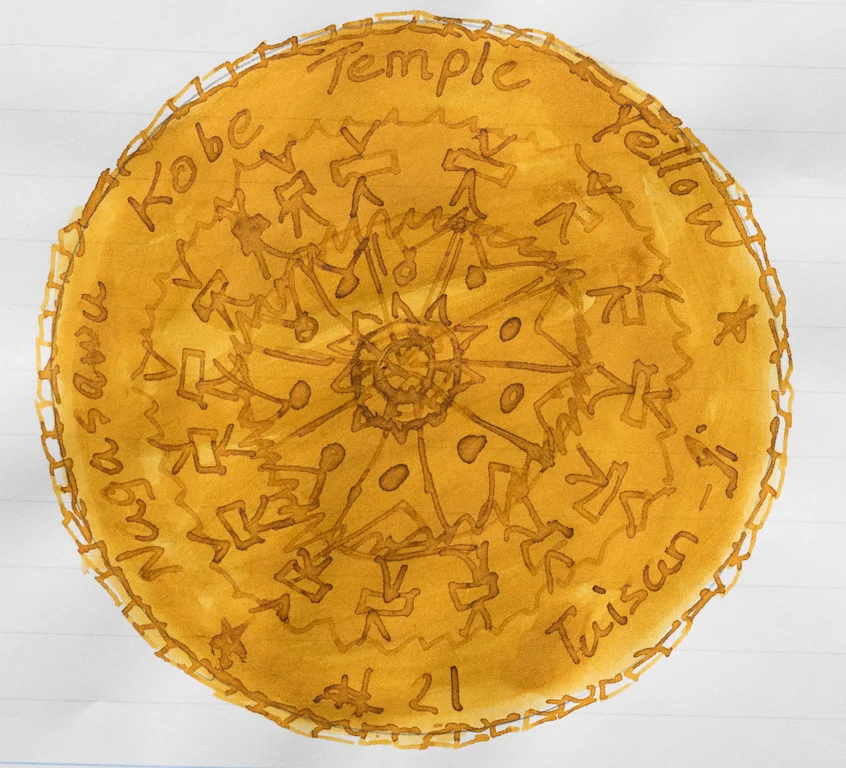
Temple Yellow is a beautiful amber ink with amazing shading properties. In my ink testing, I found it to be a rich color, very wet, but definitely not waterproof.

Chromatography reveals vivid lime green and deep orange colors mixed to create this brownish-yellow.

The ink splats demonstrate a dark brown sheen.

Because the ink is very wet, it can smear easily, especially if you’re a leftie. But, once it dries it is such a gorgeous color and the shading is wonderful, especially where the ink pools.

I thought KWZ Honey (review here) might be a much cheaper alternative, but it’s much more brown than Temple Yellow. Pelikan Amber is a close match, but it is a limited edition color (out of stock everywhere I checked) and also expensive.

Kobe Temple Yellow is $30.00 for a 50ml bottle at Vanness Pens. You can get a 4ml sample for $3.00.


Enjoy reading The Pen Addict? Then consider becoming a member to receive additional weekly content, giveaways, and discounts in The Pen Addict shop. Plus, you support me and the site directly, which I am very grateful for.

Membership starts at just $5/month, with a discounted annual option available. To find out more about membership click here and join us!
Posted on February 17, 2017 and filed under Kobe, Ink Reviews.