Posts filed under Iroshizuku

Pilot Iroshizuku Ku-jaku Ink Review

(Jeff Abbott is a regular contributor at The Pen Addict. You can find more from Jeff online at Draft Evolution and Twitter.)

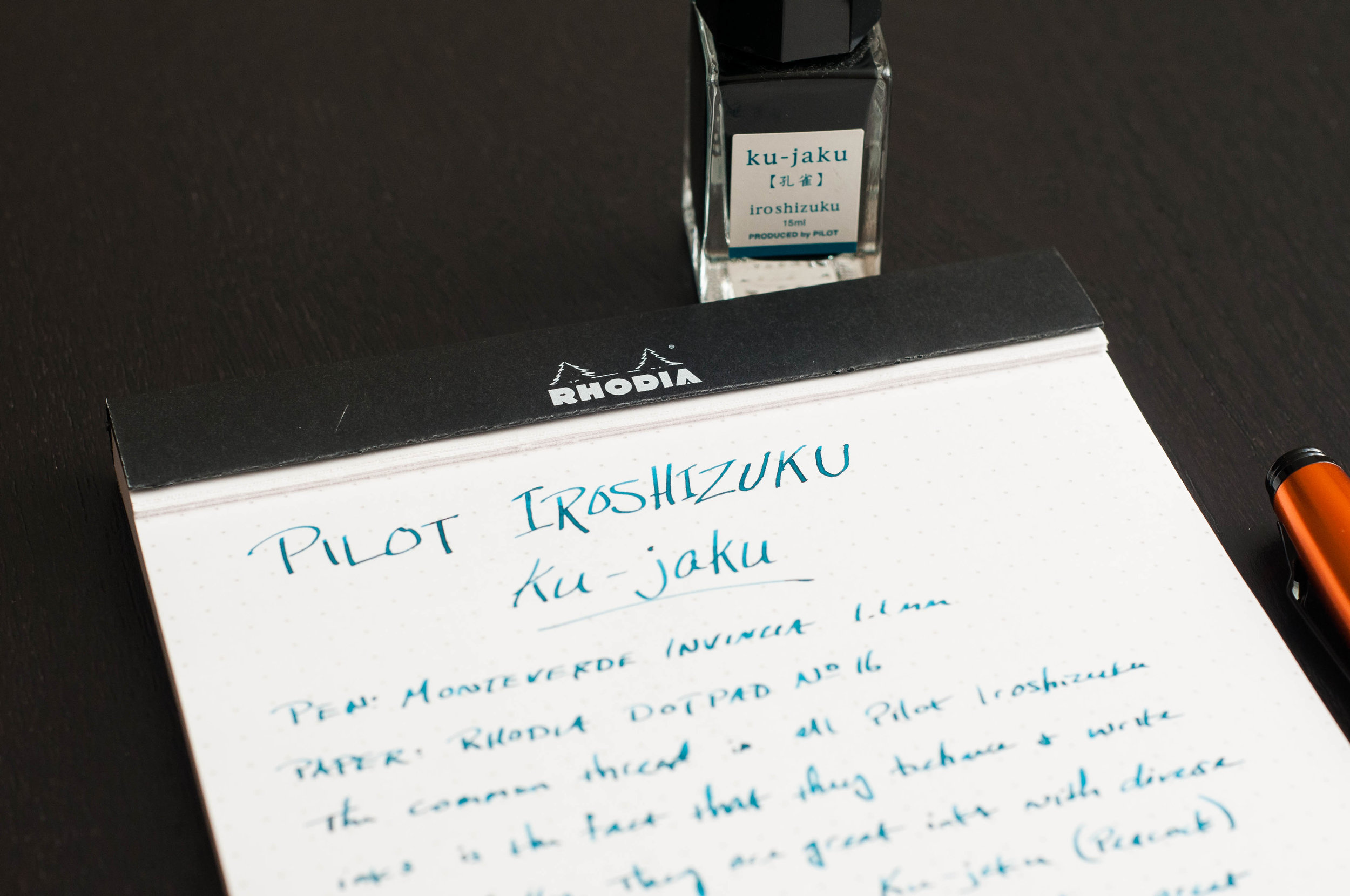
While this ink might be new to me, it's been around for quite some time as part of the Pilot Iroshizuku line. As you might know, some of my favorite inks come from this line, and this one is no exception. Iroshizuku Ku-jaku (Peacock) is a fantastic ink that I've immensely enjoyed using.

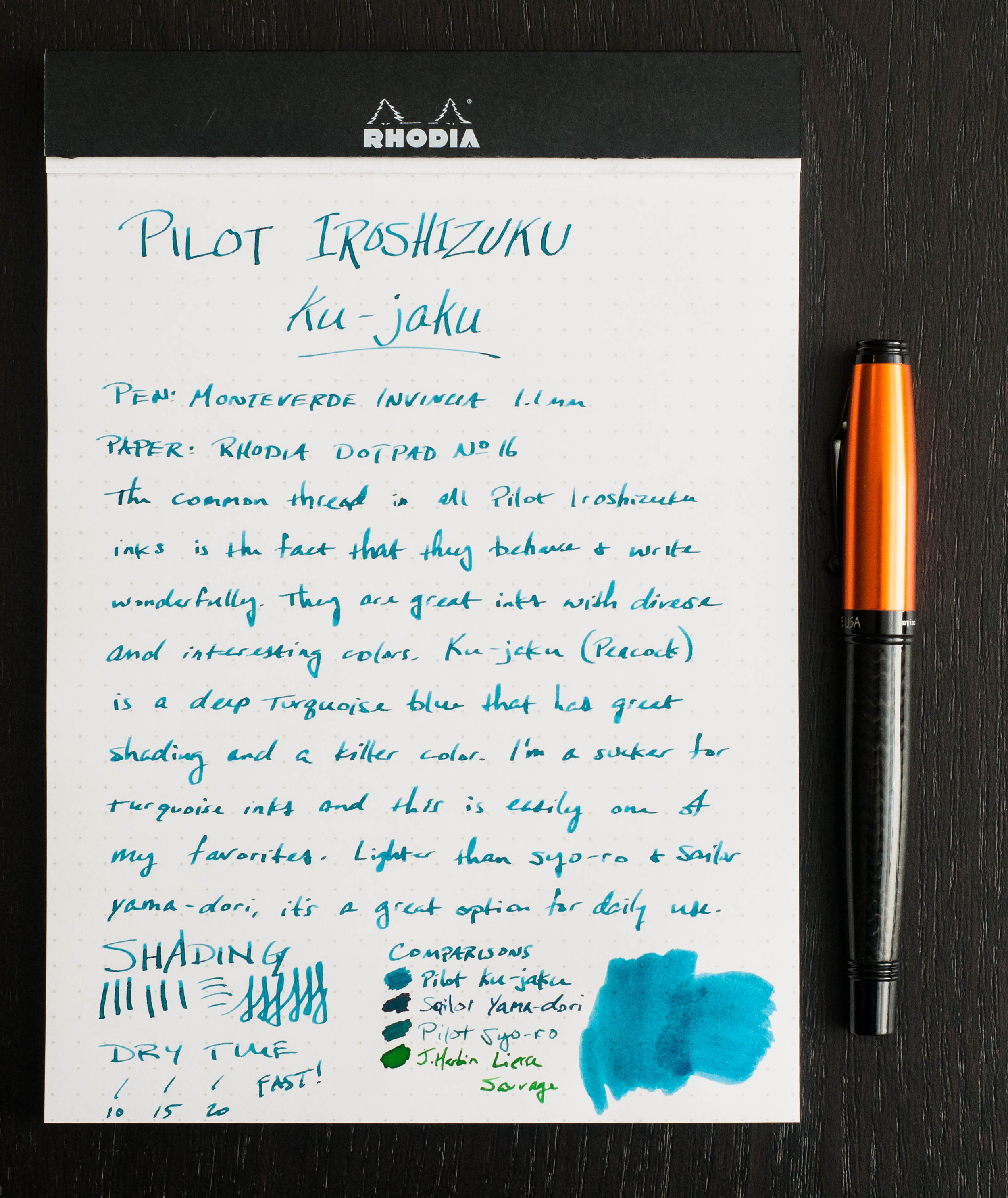
First off, Ku-jaku is a "deep turquoise blue" ink that acts exactly like every other Iroshizuku ink — beautifully. As far as my ink color preferences go, turquoise is probably my favorite variety. I've reviewed Iroshizuku Syo-ro, Sailor Jentle Yama-dori, and Franklin Christoph's Midnight Emerald, and they all share a common shade of dark turquoise with excellent shading. Ku-jaku is no different. The only problem for me is that it's impossible to pick a favorite out of this line-up.

First off, Ku-jaku is a tad lighter than the other inks I've mentioned. Because of this, you can see a lot more of the blue-green popping off the page when you write. This probably makes it less "business-friendly," but it's worth it. Being called "peacock," you have to understand that this ink has to show off its colors. And, if you use a broader or specialized nib, it has no problem showing it off.

Just like the other dark turquoise inks in my list, Ku-jaku also shades beautifully. Shading is a big factor for all of my favorite inks, and the subtle changes that I see in Ku-jaku are marvelous. The light end of the spectrum is a medium, electric green that deepens into a dark blue-green that reminds me of the sea. If you're a fan of shading, this ink will not let you down.

When it comes to dry times, Ku-jaku is pretty fast. In my tests, the ink was dry by 20 seconds, but pretty much smudge-proof by about 12-15 seconds. Only a very deliberate and heavy rub would smudge the ink after about 12 seconds. This is a great drying time and something to consider if fast drying inks are important to you.

Feathering is non-existent if you're using decent paper, and show-through is minimal. Really, every aspect of this ink is on-par with all of the Iroshizuku offerings.

Of course, you can pick this up in a 15ml bottle or a larger 50ml bottle. I opted for the smaller bottle on my first time around, but I'll definitely go for the larger one when it's time to replenish my stock. So far, this ink has been going fast due to the popularity.

It's an Iroshizuku, so you know it will behave well. All that's left to consider is the color. Turquoise fans will love it, but it might have limited value if you already own some of the comparable inks mentioned here. Still, it's unique enough to merit space on my shelf!

(JetPens provided this product at no charge to The Pen Addict for review purposes.)


Enjoy reading The Pen Addict? Then consider becoming a member to receive additional weekly content, giveaways, and discounts in The Pen Addict shop. Plus, you support me and the site directly, which I am very grateful for.

Membership starts at just $5/month, with a discounted annual option available. To find out more about membership click here and join us!
Posted on August 31, 2016 and filed under Pilot, Iroshizuku, Ink Reviews.

Pilot Iroshizuku Ama-iro Ink Review

(Jeff Abbott is a regular contributor at The Pen Addict. You can find more from Jeff online at Draft Evolution and Twitter.)

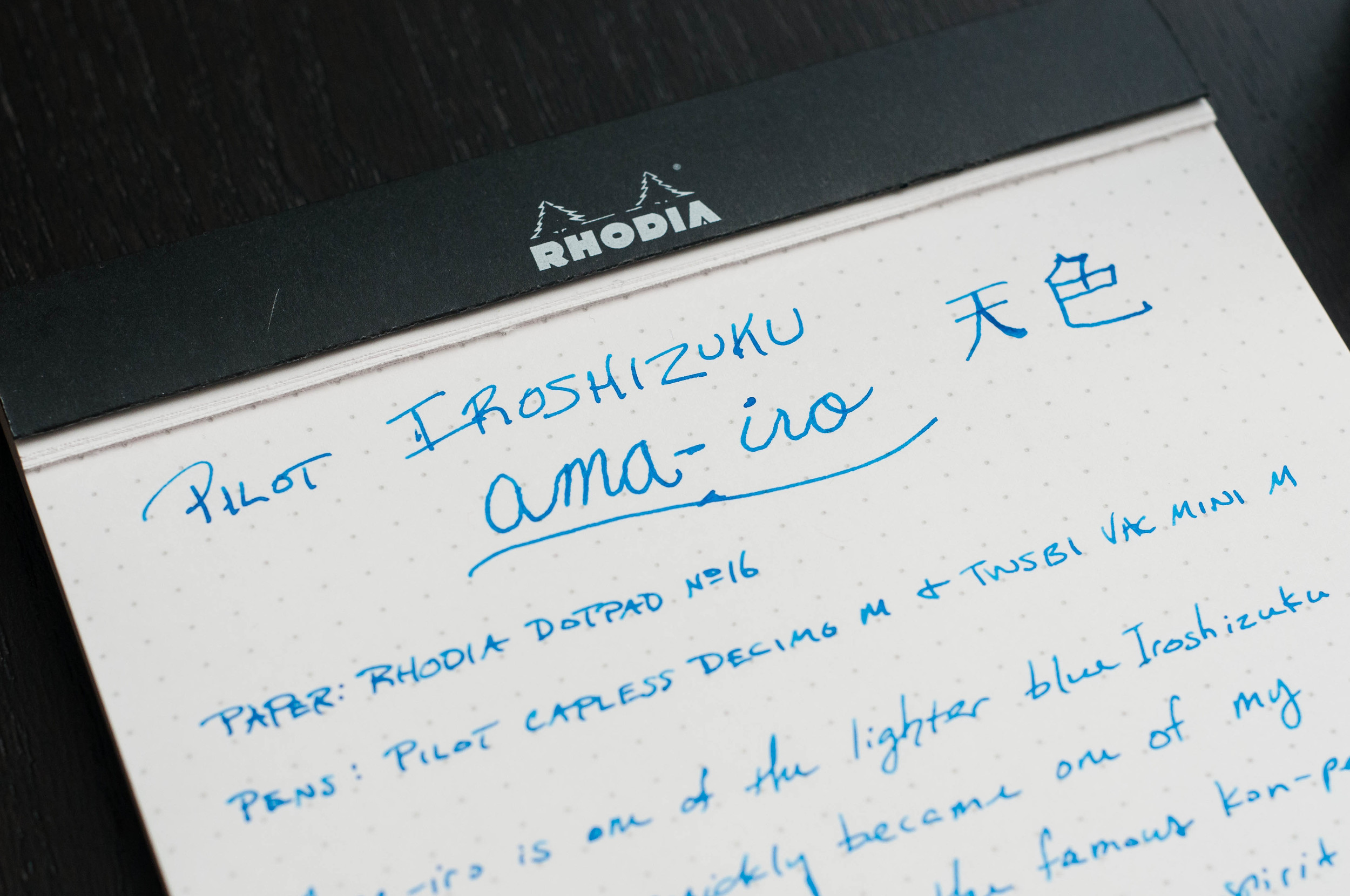
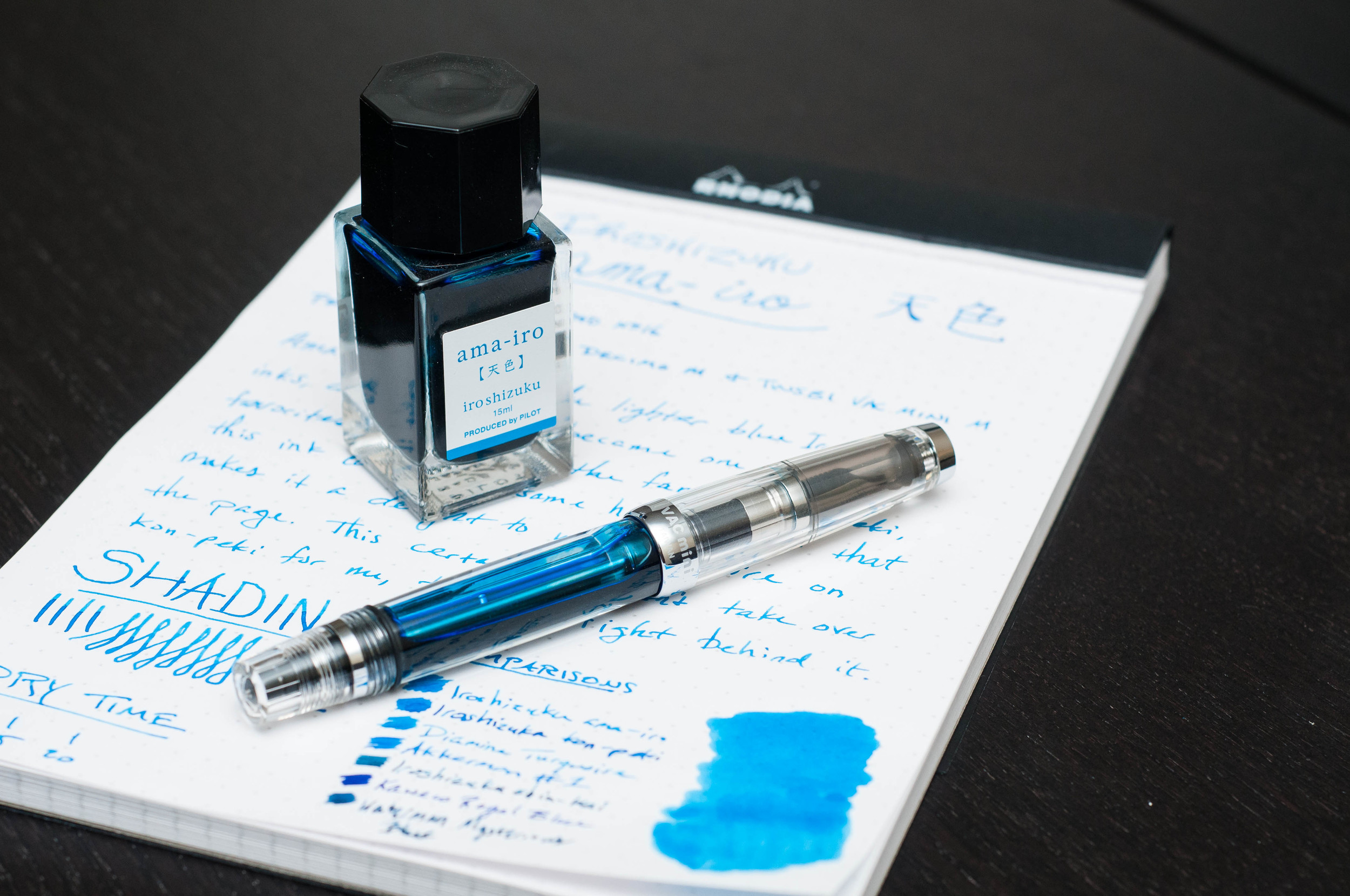
For the longest time, I thought Pilot Iroshizuku Kon-peki was my favorite blue ink from the Iroshizuku line. It's bright, has great shading properties, dries relatively fast, and looks great everywhere. I always shied away from Ama-iro because it looked too light — almost transparent. Well, I eventually cracked and decided to give Ama-iro a shot, and I'm really glad I did.

I've never used an Iroshizuku ink that I disliked, so I was sure that Ama-iro would be a nice ink that lacked the "wow" factor of others. The name translates to "Sky," which is very fitting given the light, bright blue hue. In my book, they could also call it "Bora Bora" because it looks like the clear blue waters of Indonesian island paradise.

Like I said, I didn't go into this ink thinking I would care for it. To my surprise, I was completely wrong. This is just another example that shows you should never assume anything. Immediately after inking it up, I was enamored with the light blue shade that had a beautiful shading behavior. In a matter of minutes, I went from "meh" to "love it."

What makes the Ama-iro so great? Well, the color. If you've used an Iroshizuku ink before, you know what to expect. It's an incredibly well-behaved ink with beautiful color characteristics, great flow, and pretty bottles. The Iroshizuku inks are my favorite of any other brand. That said, I was 100% sure that I would never find an ink that compares to my beloved Kon-peki, and I'm sure there are plenty of folks that hold that same opinion. Let it be known, this opinion has not changed, but Ama-iro is nipping at the heels of this special title. It's closing the gap with every stroke from my pen.

The sky can be different colors depending on weather conditions and what locale you're currently in. For me, this color reminds me of a clear, sunny day in Colorado — somewhere around 6,000 ft. elevation. They're clean, crisp, and rich with color. That's exactly what this blue is like. It's not just a flat light blue — it's rich and has amazing depth.

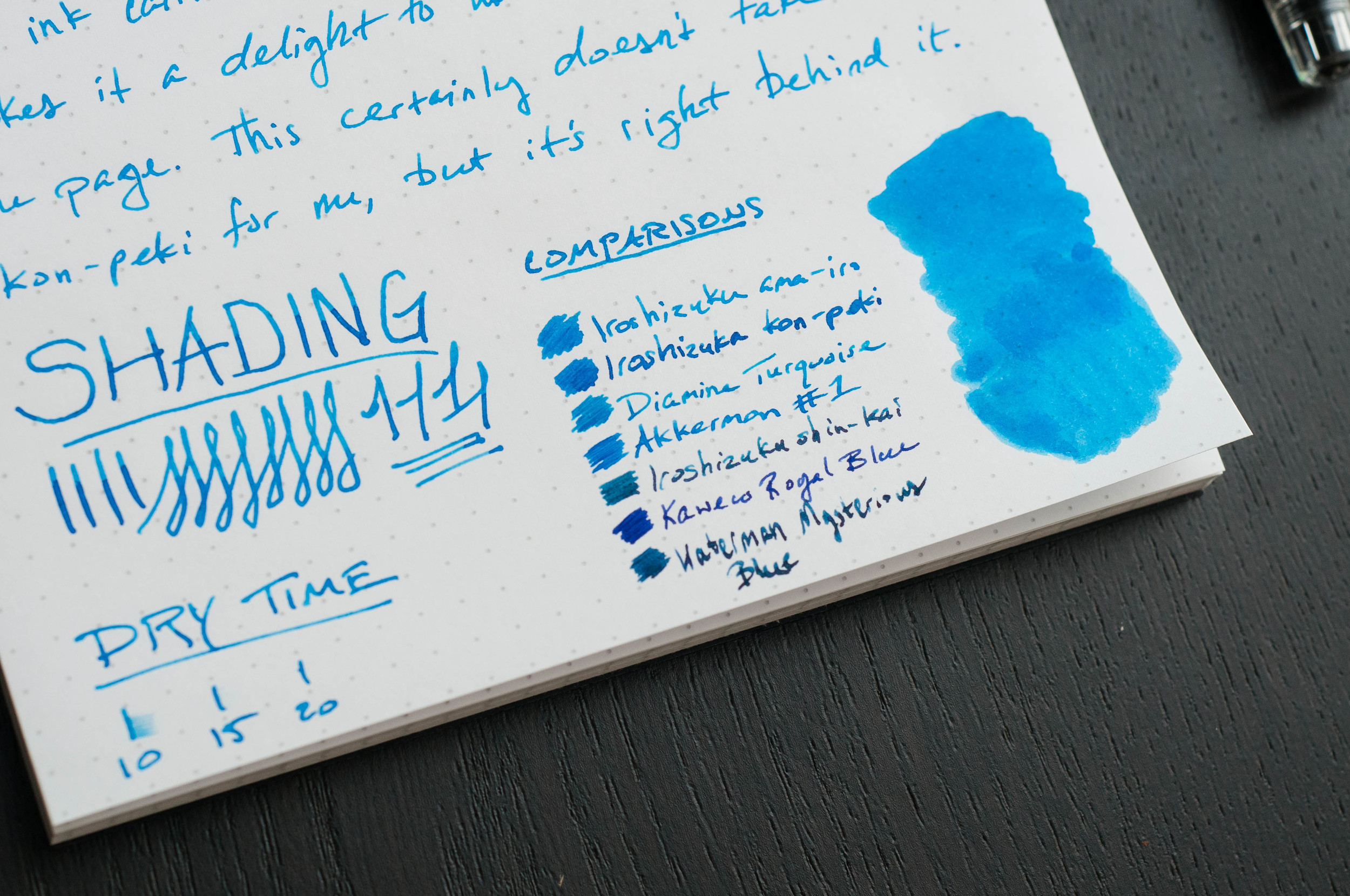
My favorite characteristic of this ink is its ability to shade to a medium blue. I've used the ink in several pens, and I love using it in wetter, broader nibs that can really show off the shading. It really is something to behold.

Another favorite feature of this ink is the dry time. I clocked it somewhere between 10 and 15 seconds when using a Japanese medium nib and a European medium nib. Not the fastest dry time, but definitely impressive.

Apart from that, all the other characteristics of this ink are in line with all the other Iroshizuku line. Great flow, easy to clean up, no bleeding or feathering, and minimal show-through.

If your favorite blue ink is Iroshizuku Kon-peki, you should give this ink a try. It's a great cousin to add to your collection for those days when you need some bright sky cheer.

JetPens sell this particular ink in two sizes: 50ml bottles and 15ml bottles. Pick up the smaller size if you aren't sure it's the right color for you! I hope you are as pleasantly surprised as I was.

(JetPens provided this product at no charge to The Pen Addict for review purposes.)

Posted on June 1, 2016 and filed under Pilot, Iroshizuku, Ink Reviews.

Pilot Iroshizuku Syo-ro Ink Review

(Jeff Abbott is a regular contributor at The Pen Addict. You can find more from Jeff online at Draft Evolution and Twitter.)

Pilot Iroshizuku inks are well-known for being great fountain pen inks, and I'm sure we've all tried our fair share of different colors from the brand. For many of us, some of our favorite inks come from this line, and for good reason.

I've long been a fan of their Kon-peki ink, which is a bright blue that pops off any page. But, it can be a bit too much pop for some moods. Another favorite color of mine for fountain pen inks is turquoise mixed with other colors to tone down the gemstone feel. Sailor Yama-dori is a wonderful ink, and I've recently come to love Franklin Christoph's Midnight Emerald. Both of these inks are dark, subdued, and expose beautiful levels of depth when writing. So, it was only inevitable that I try the Iroshizuku color that somewhat matches the same spectrum. In short, it's an exceptional ink with a beautiful color.

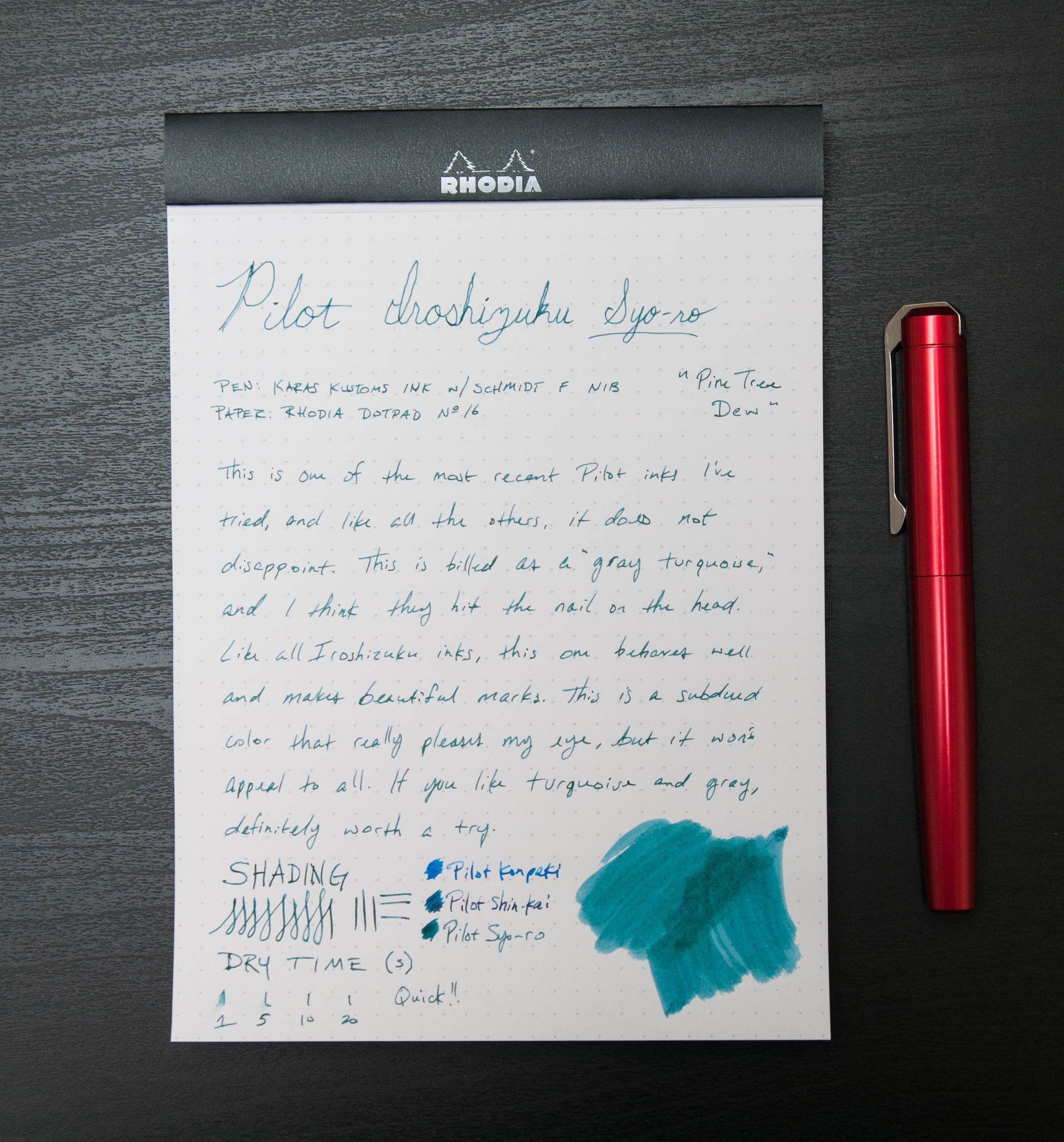
Pilot Iroshizuku Syo-ro is labeled as "Pine Tree Dew" on JetPens' site, which boils down to "Gray Turquoise." In this case, I think the word arrangement is perfect — it's definitely a turquoise ink with a bit of gray mixed in, not the other way around. There's plenty of color in the ink, but it's subdued enough to make it elegant and intriguing. I like inks that make you look twice or second-guess your first assumption.

If you've ever tried an Iroshizuku ink, you know what to expect. If you never have tried them, you're in for a treat. Like all other in this brand, the Syo-ro ink is smooth, quick-drying, and resists feathering and bleeding on pretty much all papers (with the exception being cheap copy paper). There's a fair amount of shading to create the beautiful level of depth in the colors, and it works well with a pen that has some flex.

I've tried some other green inks in the past that I hoped would match the characteristics in this ink. Sadly, most of them looked dull on the page after the ink dried. With Syo-ro, the color is still bright and present after the ink has dried. The color looks like it has life, which exactly what I want from an ink that I use daily.

Show-through, bleeding, and feathering are minimal with this ink. It's remarkably well-behaved in many circumstances, and it's gentle on your pens as well. Cleaning is an easy exercise.

Dry time on this ink keeps surprising me. In most cases on my Rhodia pad, I could only create a tiny smudge on the 10-second mark. This is very quick for a fountain pen ink, and something to keep in mind if that attribute is important to you. Keep in mind, though, that this will vary based on the nib and feed unit for every pen you use.

I really have nothing bad to say about this ink. Sure, the Iroshizuku inks aren't the cheapest, but that's for good reason. When you buy an ink from this line, you know that it will perform well. The only thing you have to decide is what color, or how many.

Syo-ro is available from JetPens in two sizes: a 50ml bottle and a 15ml sample bottle. With the 15ml bottle being half the price of the 50ml bottle, it's hard to justify choosing it. It might make more sense if it was a 25ml bottle to match the price difference, or if the price was more in line with a bottle that is only 30% of the larger one. At any rate, if you like turquoise and fountain pens, this is one you don't want to miss.

(JetPens provided this product at no charge to The Pen Addict for review purposes.)

Posted on February 10, 2016 and filed under Ink Reviews, Iroshizuku, Pilot.