Posts filed under Kakimori

Colorverse vs Kakimori - Dip Nib Showdown

(Kimberly (she/her) took the express train down the fountain pen/stationery rabbit hole and doesn't want to be rescued. She can be found on Instagram @allthehobbies because there really are many, many hobbies!.)

I first reviewed the Kakimori dip nibs (along with several others) in my dip nib comparison article a while back, so I was very excited when I heard that Colorverse was coming out with their own version of the dip nib, called the Shuttle nib.

I am using the same methodology for the Colorverse Shuttle nibs as I did last time with the others:

  1. Ink - I am using Waterman Serenity Blue as a baseline for the swatches/writing samples. This is most nib grinders’ preferred ink of choice as it has consistent flow, does not stain and is good for vintage pens. I also picked a shimmer ink to see if it behaved differently. I capped and shook the vial between each test.
  2. Paper - I used a combination of a 68 gsm Tomoe River notebook, a 80 gsm Rhodia graph pad, and the standard sized Col-O-Ring cards made from 160gsm paper.
  3. Cleaning - I have used the steel Kakimori dip nib as my primary swatching tool for the past couple of years, so it has been rinsed/cleaned/wiped many times. I use tap water to rinse between uses.
  4. I use a syringe to gently shoot water downwards towards the tip of the nib.
  5. I do not dip the nib/holder into water and swish for cleaning, so I don’t get ink stuck inside the holder.
  6. Writing - Aside from the name of the dip nib, I tried to write the same text on the different papers so you can see how much writing I could get out of one dip. For the Colorverse nibs, I will write a line without an initial cleaning, so I can see whether it writes on first use. Then I will rinse/dry it before rewriting the line again.
  7. Swatches - I am making a broad line swatch as well as my typical Col-O-Ring swatches with both sets of nibs.

Note: After about 6 months of use, the Kakimori dip pen holder started allowing the dip nib to slide out of the ferrule (the “round thingy” that holds dip nibs in place). I showed a video to Kakimori, who ended up replacing the holder. Unfortunately, the replacement started doing the same thing some months later, so I stopped using that holder. I have also since misplaced it, so I don’t have any comparison photos of it next to the Colorverse holder.
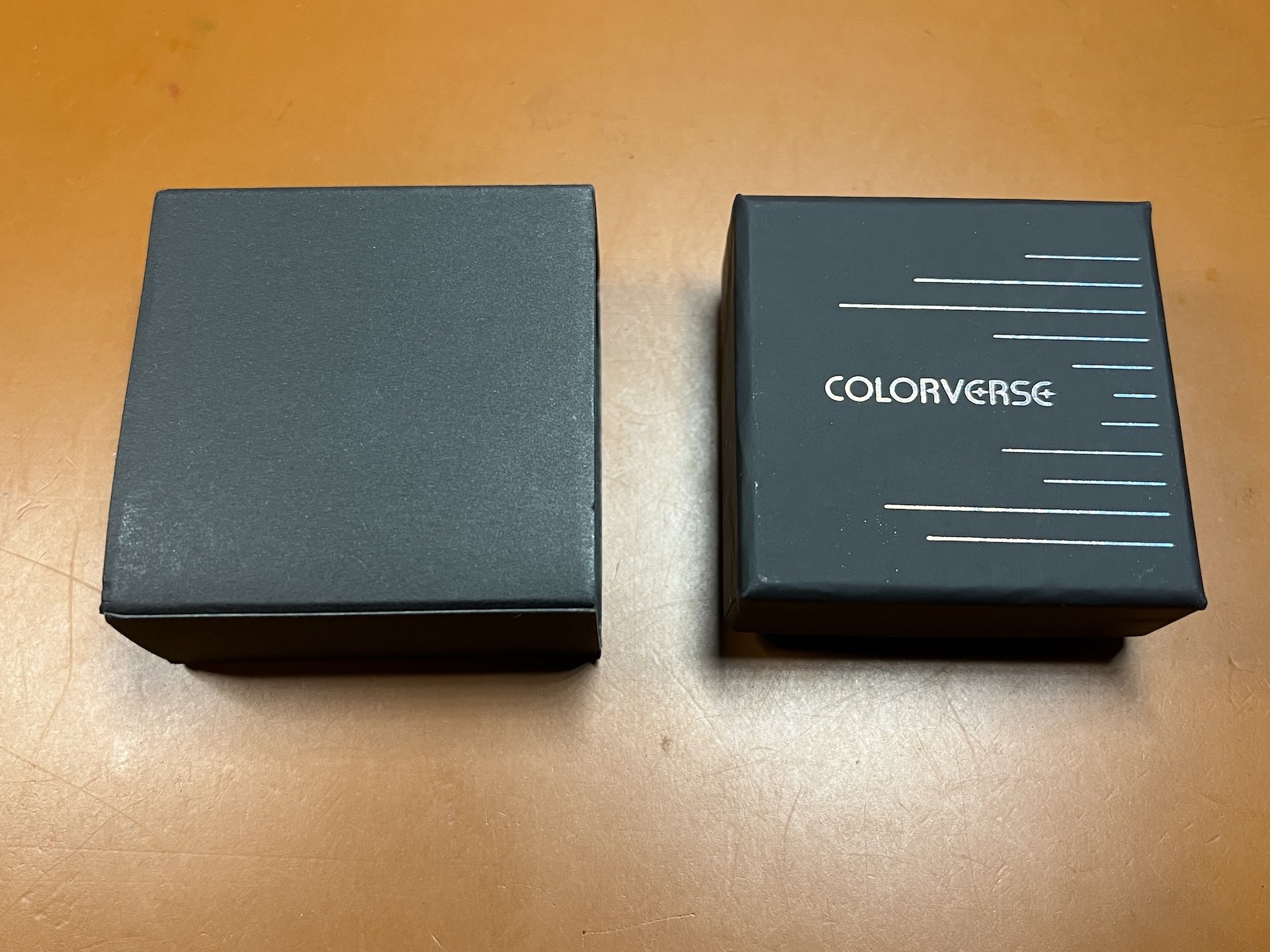
Colorverse Shuttle Nib Box

The Colorverse Shuttle nib is packaged in a black box with holographic logo/design (right), which is then encased in a simple black box sleeve (left). The nib holder is similarly packaged but in a longer box (not pictured).

The Kakimori’s packaging (left) has a very different aesthetic. For lack of better words, I would say it feels more organic, while the Colorverse packaging gives off a very modern, space-like vibe, appropriate for its Shuttle namesake.
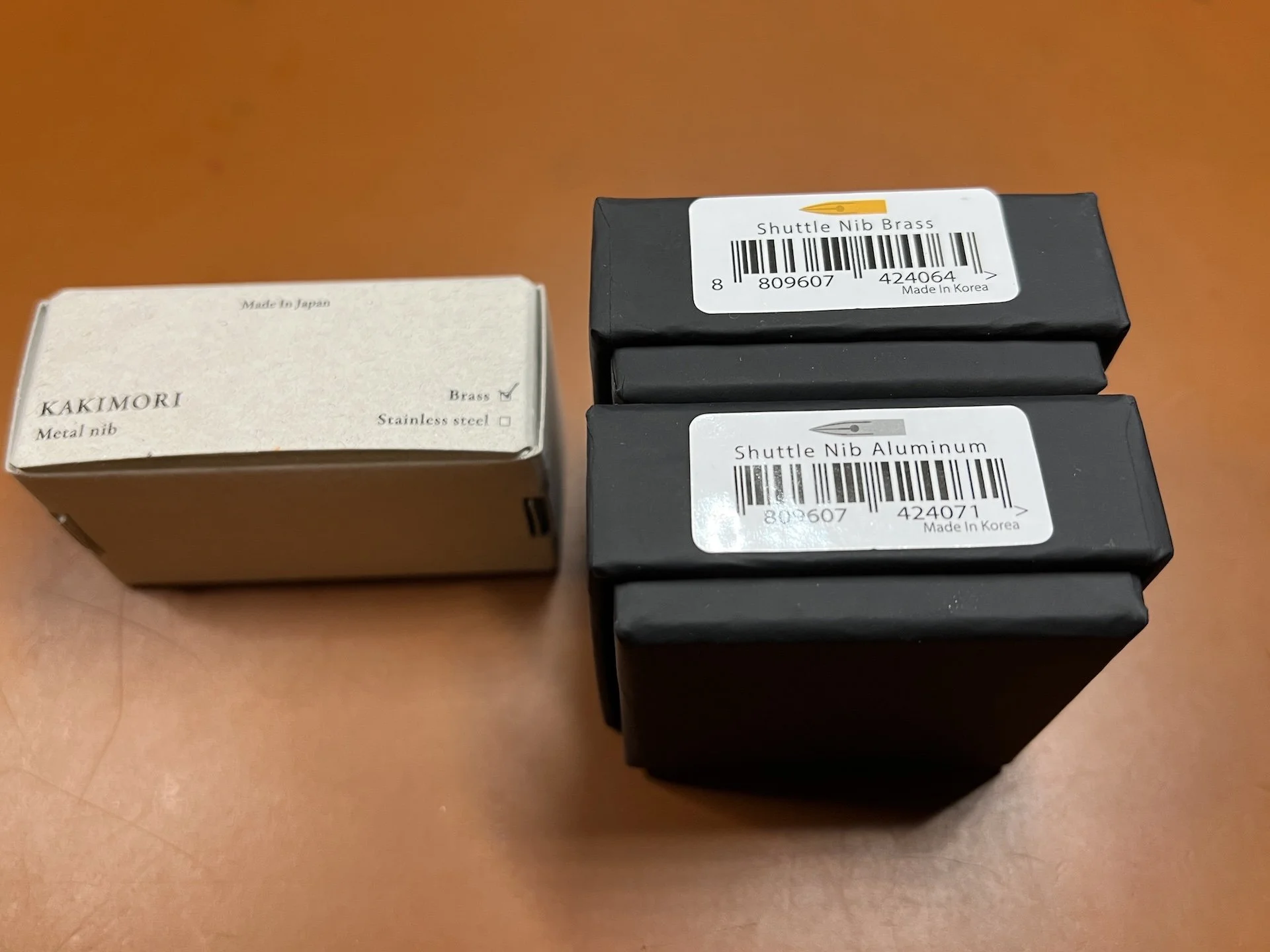
The hand marked check matches the rest of the Kakimori’s packaging aesthetic. Easy to see at a glance Colorverse’s brass or steel nib.

Before I get into the nitty gritty, let’s just get this out there ‘cause I know you’re dying to know if they are compatible with other holders. And the answer is YES! Both the Colorverse Shuttle and Kakimori dip nibs fit in standard ferrule nib holders, and yes, both will fit into the other’s nib holders as well! This is great news for folks who already have nib holders for the Kakimori or other dip nibs (neither will work in oblique nib holders).

Colorverse Shuttle aluminum nib in a Tachikawa holder, Kakimori steel dip nib in the Colorverse Shuttle holder, and Shuttle brass nib in a Speedball holder.

You can easily fit a Zebra G or pretty much any other standard dip nib in the Colorverse Shuttle holder.

There’s no denying that the shape of the Shuttle nib is similar to that of the Kakimori, but they are also a bit different. The Shuttle is a longer nib and has sharper channel grooves than the Kakimori. It is also more narrow and pointed, while the Kakimori is a bit broader and more “rounded”. Both of these differences factor into how the nib feels when using them at more extreme lower angles.
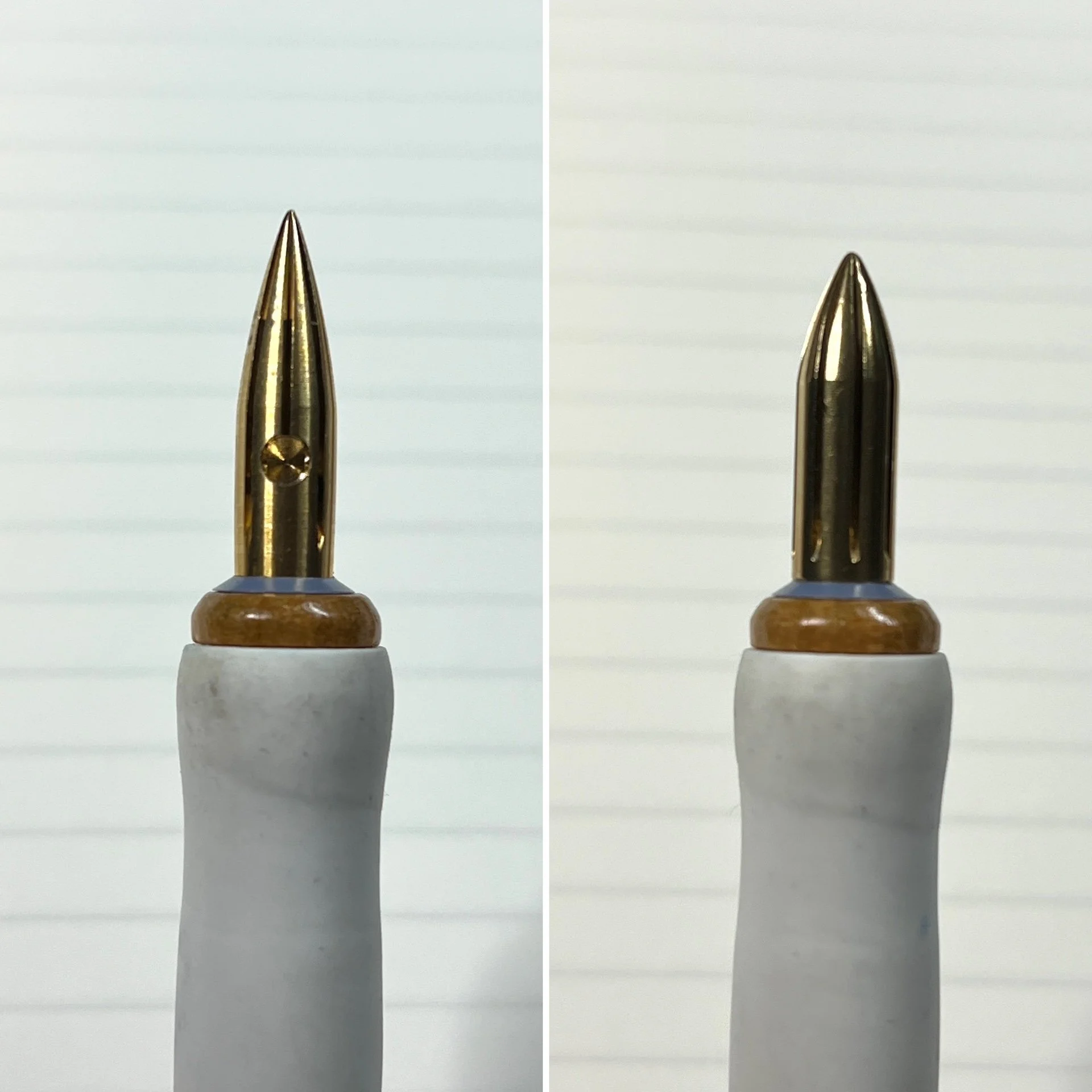
Colorverse Shuttle nib on the left, and the Kakimori nib on the right. Both are Brass and are in the Tachikawa holder, which has a standard dip nib ferrule.

Despite using a very light touch at more horizontal angles, the swatches still show “scratch marks” where the nib scratches the Col-O-Ring. I didn’t feel this quite as much on the much smoother TR 68 gsm paper, but neither performed quite as smoothly as the Kakimori.

The Colorverse Shuttle nib (Aluminum) in the Shuttle nib holder (also Aluminum.)

The Colorverse Shuttle nib holder has a ridged grip section, which is neither too smooth nor too sharp. It makes it easy to hold without your fingers slipping. It is slim with a bit of heft to it, unlike a traditional wood or plastic dip pen holder which is very light. As such, it can be a bit uncomfortable for long term writing if you prefer a lighter pen or more girthy grip section or both. This nib holder is the Large model and is 7.4”/187 mm. There is also a Small one which is ~5.6”/142 mm.

Thanks to technology and poor photo editing skills, here is an approximation of the Kakimori holder (left silver) with the Colorverse Shuttle holder (right center). The holders on the left/right sides are from Tachikawa and Speedball.

The Shuttle nib holder doesn’t look like anything more than a ferrule in a ridged-grip long nib holder. The grip actually unscrews itself from the rest of the “barrel”, revealing a brass ferrule which is still attached. When attached, this piece and the grip form a gap which holds the dip nib in place. This brass piece is also detachable from the holder, making cleaning easy if you somehow manage to get ink back there. Unscrewing the section also makes it easier to fit into shorter cases/pouches.

Grip section unscrewed from the nib holder. You can see that the piece that holds the ferrule is still attached to the rest of the holder. It would be cool if you can get grips with different materials, designs, etc.

You can unscrew the ferrule if you need to disassemble it further to put it in a small case or for further cleaning. I wonder if the ferrule is replaceable - that would have solved the problems with my Kakimori holder.

For the writing sample below, the first part was done with the Shuttle nib right out of the box without any rinsing or cleaning. I did a quick wipe with a napkin to ensure no particles would get in the ink.
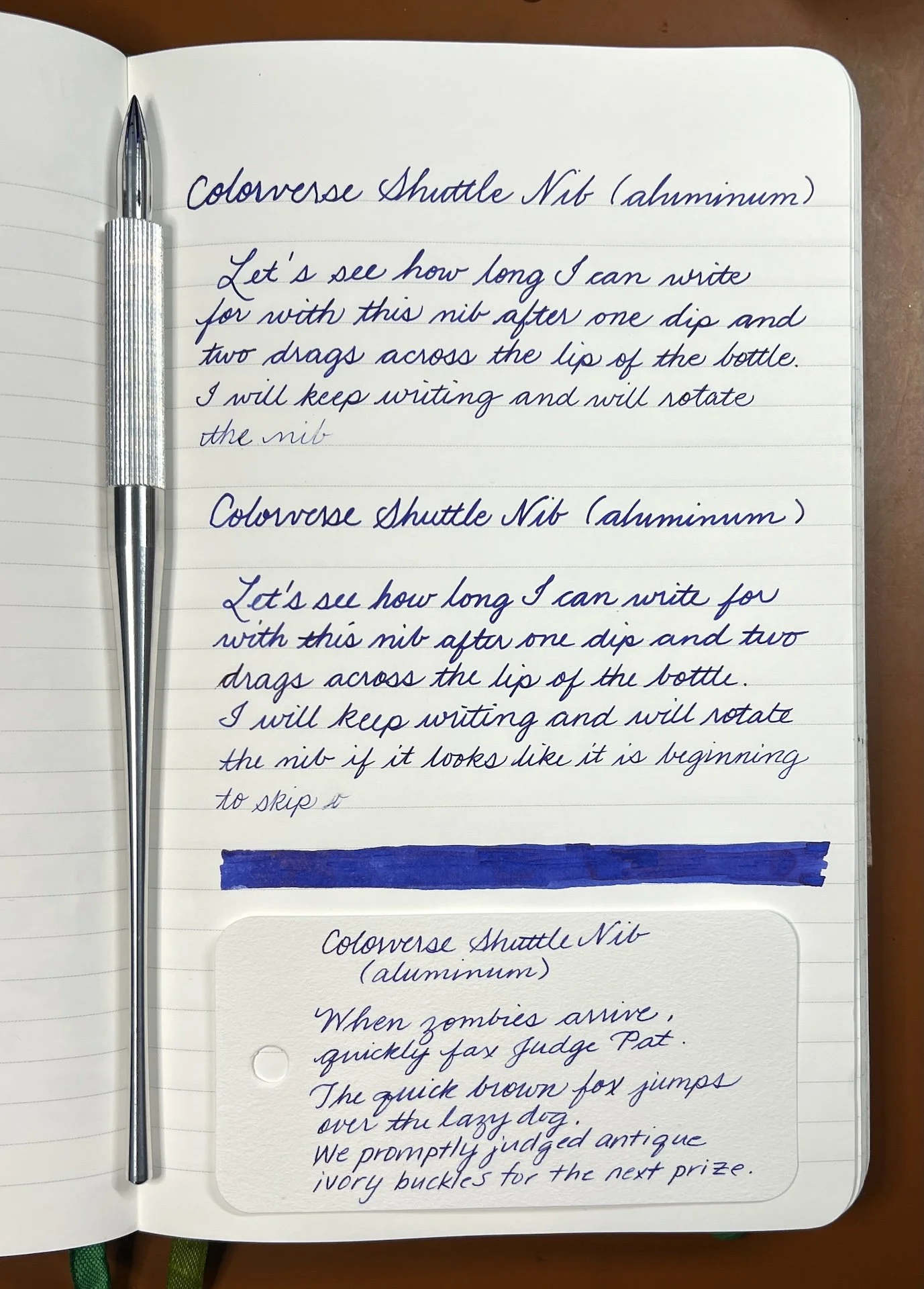
Header with 4 lines of text before running out of ink. A simple rinse and wipe before a new dip gets an additional line of text. No problems writing cursive or print on the slightly textured Col-O-Ring card either.

Making my swatch line with the Aluminum Shuttle nib. There is less of a curvature of the Shuttle nib, so I had to use a very low angle in order to not cut the paper or make much thinner lines.

Writing samples on Rhodia 80gsm (left) as well as writing at some different angles

This was really hard to do towards the bottom of the page of a super thick notebook, especially for someone like me who is also used to writing at 75 degrees.

One of the things that differentiates the Colorverse Shuttle nib from the Kakimori nib is a small reservoir which stores a wee bit of ink so you don’t have to dip it as often. I dipped it a few times because I could see that it was a surface tension bubble as opposed to ink in the reservoir.

Ink in the nib reservoir.

After dipping and confirming ink was in the reservoir, I managed to write a bit more than 1 page of A5 slim, which is about 3-4x what I got from a non-reservoir dip.

The number of pages you get will depend on multiple things including writing angle (my steep angle meant that ink flowed down faster initially), and how the reservoir is oriented (I had it facing up, but in another writing sample, I rotated it almost face down and got a lot more/too much ink flow).

Like I did with the Aluminum nib above, there was no cleaning of the brass nib prior to first writing. Not gonna lie, I absolutely HATED my Kakimori brass nib, so I was pretty nervous about how the brass Shuttle nib would perform. No need for worry as it wrote right away with zero problems whatsoever!

Header with 5.5 lines of text vs Aluminum’s Header + 4. Clean, wipe and re-dip gets an additional 3.5 lines of text.

Swatch line and Rhodia samples. I had a bit more trouble writing on the Col-O-Ring than I did with the Aluminum nib, which surprised me.

Different angles on TR 68gsm and Rhodia. I rotated the nib a bit while writing at the 20 degree angle on top, hence the drastic line width compared to the Rhodia sample.

After dipping and confirming ink was in the reservoir, I managed to write a few lines more with the Brass nib than I did with the Aluminum nib.

In general, the two Colorverse nibs wrote similarly for me from 45-75 degrees (these were all done as “below reservoir” dips, aka, not super saturated, but with plenty of ink to write with). The widths were a bit more noticeable around 30 degrees and even more so when lower than that.

The angles are approximate and how much ink is left on the nib will also affect its width. Colorverse Brass (top), Aluminum, Kakimori Brass, Aluminum.

Both the aluminum and brass Shuttle nibs handled shimmer without any issues.

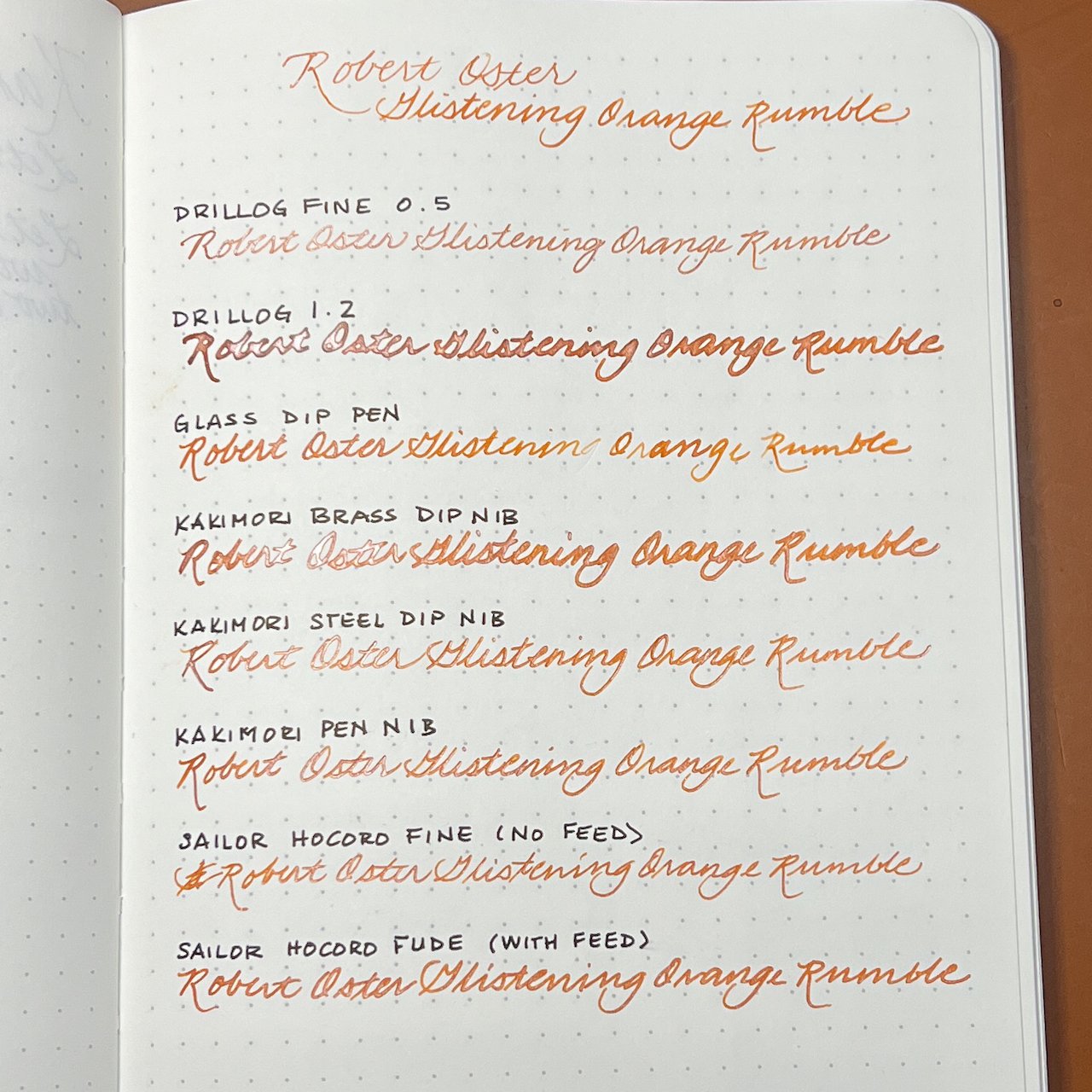
Alongside other dip nibs using the same Robert Oster Glistening Orange Rumble ink sample.

TLDR: If you don’t already have a Kakimori dip nib, the Colorverse Shuttle dip nib would be a good purchase, especially if you want to use it more for writing. I had a slight preference of the Brass because the line was just a wee bit thicker and held a bit more ink, though I probably would never use it for more a lot of writing (that’s what FPs are for, lol), But, I liked the Aluminum for writing on Col-O-Rings more than the brass. On smoother paper like Tomoe River, I liked either of Shuttle nibs a bit more than the Kakimori steel nib (and we all know how I feel about the Kakimori brass regardless of paper). However, given that my primary swatches are done on Col-O-Ring cards, the steel Kakimori feels smoother when making the large swathes of ink. You may like or dislike how either nib feels on different kinds of paper (like textured papers or watercolor paper versus Tomoe or Rhodia) or if you plan on using it for writing versus art, etc.

I would hands down get the Colorverse Shuttle nib holder over the Kakimori because I don’t have to worry about the nib eventually sliding out of the ferrule like what happened with 2 of their nib holders. Plus I like the ability to disassemble it in case of inky accidents.

The Colorverse Shuttle nibs cost $42 and $48 for the Aluminum and Brass, respectively. The nib holder in Aluminum costs $75 and $60 for the large and small, respectively, while the Brass holder is $85 and $67. They are priced similarly to their Kakimori equivalents. You can find the Colorverse Shuttle products on the Pen Realm website.

(Disclaimer: The two Colorverse Shuttle dip nibs and the nib holder were purchased from Pen Realm at the 2025 CA Pen Show. All of the other products are my own, including the Kakimori nibs and various holders.)

Posted on February 28, 2025 and filed under Colorverse, Kakimori, Dip Nib, Pen Reviews.

Kaweco + Kakimori = Perfect Swatching Tool!

(Kimberly (she/her) took the express train down the fountain pen/stationery rabbit hole and doesn't want to be rescued. She can be found on Instagram @allthehobbies because there really are many, many hobbies!.)

When I wrote this article on ink swatching over two years ago, I was using a glass dip pen, the back end of a plastic paintbrush, and a ruling pen for my swatching. Since then, I traded the glass dip pen for a Kakimori stainless steel dip nib and a few months ago, I recalled seeing an IG story where someone used a Kaweco SketchUp clutch pencil to hold their Kakimori dip nib and I knew I had to try it.

I bought a Kaweco SketchUp 5.6mm clutch pencil in Chrome on eBay, though you can find them from a variety of vendors including JetPens. Kaweco also makes the clutch pencil in 3.2 mm, so be sure to get it in the 5.6mm size as that is the one that can fit the nib.

The Kaweco SketchUp 5.6mm clutch pencil in Chrome.

Replaced the lead with the Kakimori steel dip nib.

For the past 4 months, I have been using it as my go-to for writing samples on swatch cards as well as making the lined swatches in my Endless Recorder. I had forgotten my trusty paintbrush when traveling for the holidays, so I used it to do the Col-O-Ring swatches too. Here are some things discovered:

  1. It is SO easy to clean the Kaweco + Kakimori! I don’t swish my Kakimori (because I don’t want it in dirty water), but I could swish if I wanted to and wipe it clean afterwards. Instead, I use a syringe at my desk to clean the nib into a dirty cup. I don’t have to worry about getting it onto the clutch mechanism since it is chrome-plated brass, and I can easily release the nib further if ink got past the clutch.
  1. The pencil’s clutch mechanism along with the long parallel sides of the nib makes it easy to adjust the Kakimori nib to be further in or out. Just don’t push it too far in because it could get stuck (you’d have to push the nib from the other end but it could potentially scratch/damage the sides of the nib).
  1. The clutch pencil is very sturdy and hefty without being overly heavy. It has a nice weight to it 1.56 oz/44.16 g) and I know it could withstand being dropped on the floor, though my hardwood floors might not appreciate that. Since I’m only using it for a few moments at a time, the weight isn’t something I really notice. That said, if you don’t want a nib holder that’s on the heavier side, you might prefer something lighter like this Tachikawa T-40 nib holder which also has the added of bonus of a cap to protect the nib. I have a similar Tachikawa holder without the cap for the brass Kakimori and that one weighs 0.39 oz/11.04 g with the nib. Kaweco also has the SketchUp 5.6 mm in other materials, like acrylic, which is lighter than the metal ones; they just aren’t as easy to find.

Kaweco SketchUp in Chrome and Brown Acrylic (note that the button is depressed further on the Chrome because the clutch is opened further to fit the nib.)

  1. Relatively inexpensive - Considering the heft and clutch mechanism, the clutch pencil is pretty affordable and retails for ~$40-45 depending on finish. The aluminum nib holder from Kakimori, on the other hand, goes for $72. Of course, you can also buy nib holders that are much less expensive, like the Tachikawa above, but they also won’t feel the same as the clutch pencil.
  1. I prefer the compact size of the Kaweco clutch pencil since other nib holders tend to be much longer. It fits easily in my pen accessories pouch which I take to meetups.

Here’s the clutch pencil next to a Kaweco AL Sport (The Little Witch) for comparison.

  1. You can “scratch” the paper when making swatches if you are using the tip (as opposed to the sides), especially if you go back and forth too quickly. Normally, I would say this isn’t because of the nib holder, but I think it happened more with the clutch pencil because the weight of it naturally put more pressure on the nib. I noticed this more if I didn’t change my writing angle while swatching. I have to remember to use the sides of the nib more when doing so, but it’s great for making clean lines for smaller swatches. Also, I can end up with a lot more ink than I want, so I’ve gone back to using the back end of a paintbrush for larger areas so the ink isn’t as concentrated.

Compare the relatively straight lines from the Kakimori (left) vs back of a paintbrush (yes, I am VERY backlogged with swatching.)

It is a little exaggerated here but you can see the scratchy lines that were pretty easy to make when using the tip of the nib to swatch the ink.

Swatching lines of ink (like Robert Oster’s Romeo & Juliet) is easy with the Kakimori.

I don’t remember exactly whose bright idea it was to share this combination on IG, but I thank them for it because both the pencil and nib have held up quite nicely. Now to keep working on my swatching backlog!

(Disclaimer: All items in this article were purchased by me.)


Enjoy reading The Pen Addict? Then consider becoming a member to receive additional weekly content, giveaways, and discounts in The Pen Addict shop. Plus, you support me and the site directly, for which I am very grateful.

Membership starts at just $5/month, with a discounted annual option available. To find out more about membership click here and join us!

Posted on February 16, 2024 and filed under Kaweco, Kakimori, Dip Nib.

Dippity doo dah, dippity yay - A Dip Nib Comparison

(Kimberly (she/her) took the express train down the fountain pen/stationery rabbit hole and doesn't want to be rescued. She can be found on Instagram @allthehobbies because there really are many, many hobbies!.)

….my oh my, what a wonderful day! Sorry, not sorry, for the ear worm but I decided to play with some dip nibs cuz it’s swatch time in December, AKA Inkvent! Even if you aren’t joining in Diamine’s Green Edition Inkvent for 2022, chances are good that you still want to swatch your inks at some point, right? So I thought it would be fun to do a little dip pen showdown - are you ready? Let’s go!

Methodology

Ok, this isn’t rocket science but I wanted to make sure the different dip nibs were on the same playing field, so here are the ground rules.

  1. Ink - I used Waterman Serenity Blue as a baseline for the swatches/writing samples. This is most nib grinders’ preferred ink of choice as it has consistent flow, does not stain and is good for vintage pens. I also picked a shimmer ink to see if it behaved differently. I capped and shook the vial between each test.
  2. Paper - I used a combination of a 68 gsm Tomoe River notebook, a 80 gsm Rhodia graph pad, and the standard sized Col-O-Ring cards made from 160gsm paper.
  3. Cleaning - Since I have used some of these for a long time and others I just got last week, some have been cleaned many times and some have not. I will make a note of which ones were cleaned prior to usage and which ones needed extra cleaning, if any. I will just use tap water to rinse between uses.
  4. Writing - Aside from the name of the dip nib, I tried to write the same text on the different papers so you can see how much writing I could get out of one dip. The exceptions are the Sailor Hocoro Fine Dip Nib and Kakimori Pen Nib where I wrote the first line without first cleaning the nib and then I did a quick water rinse/dry before rewriting the line again.
  5. Swatches - I made a broad line swatch for some but not all of the nibs. The finer dip nibs/ones without feeds aren’t really designed for depositing large amounts of ink.
Dip Pens

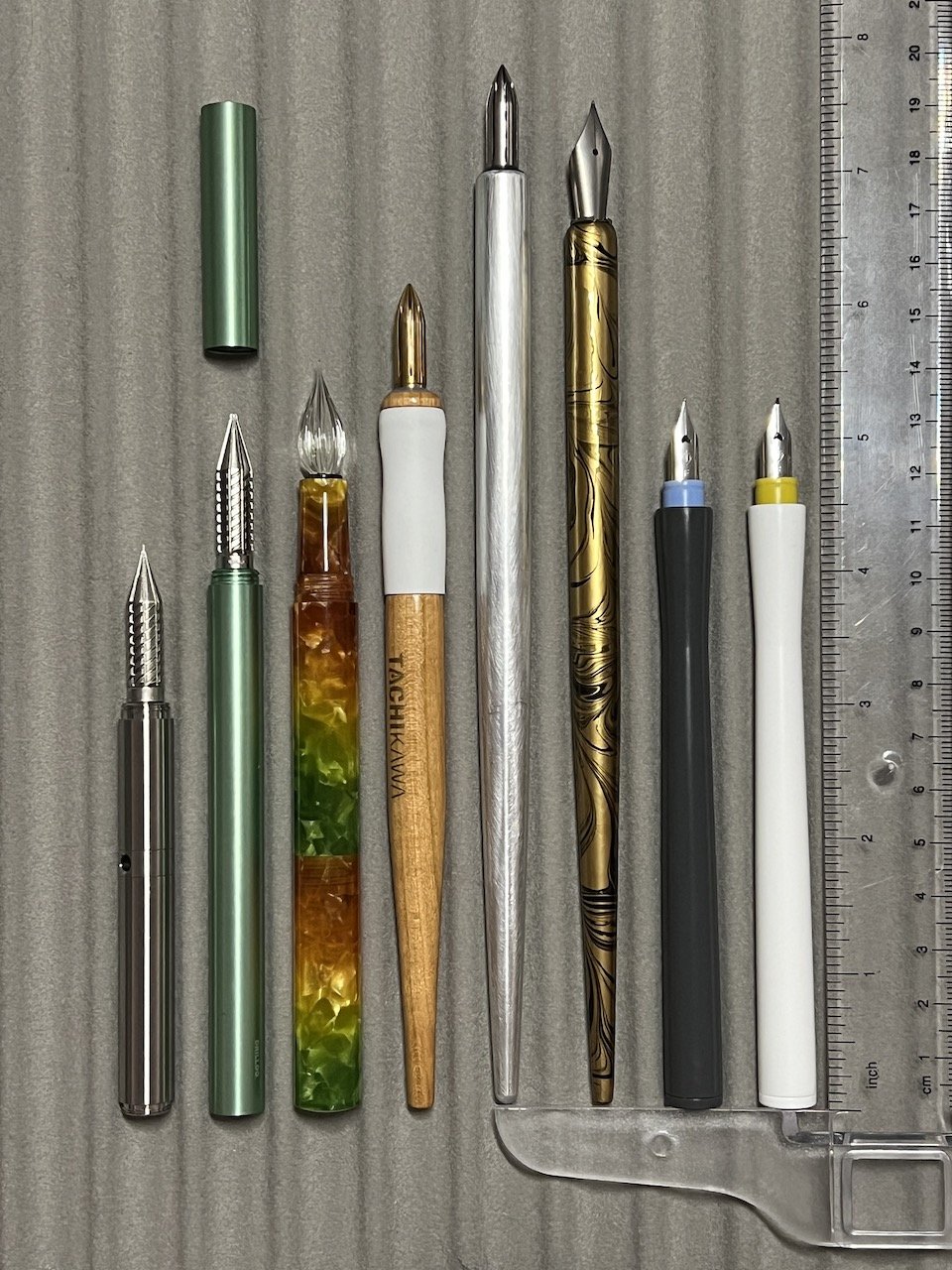
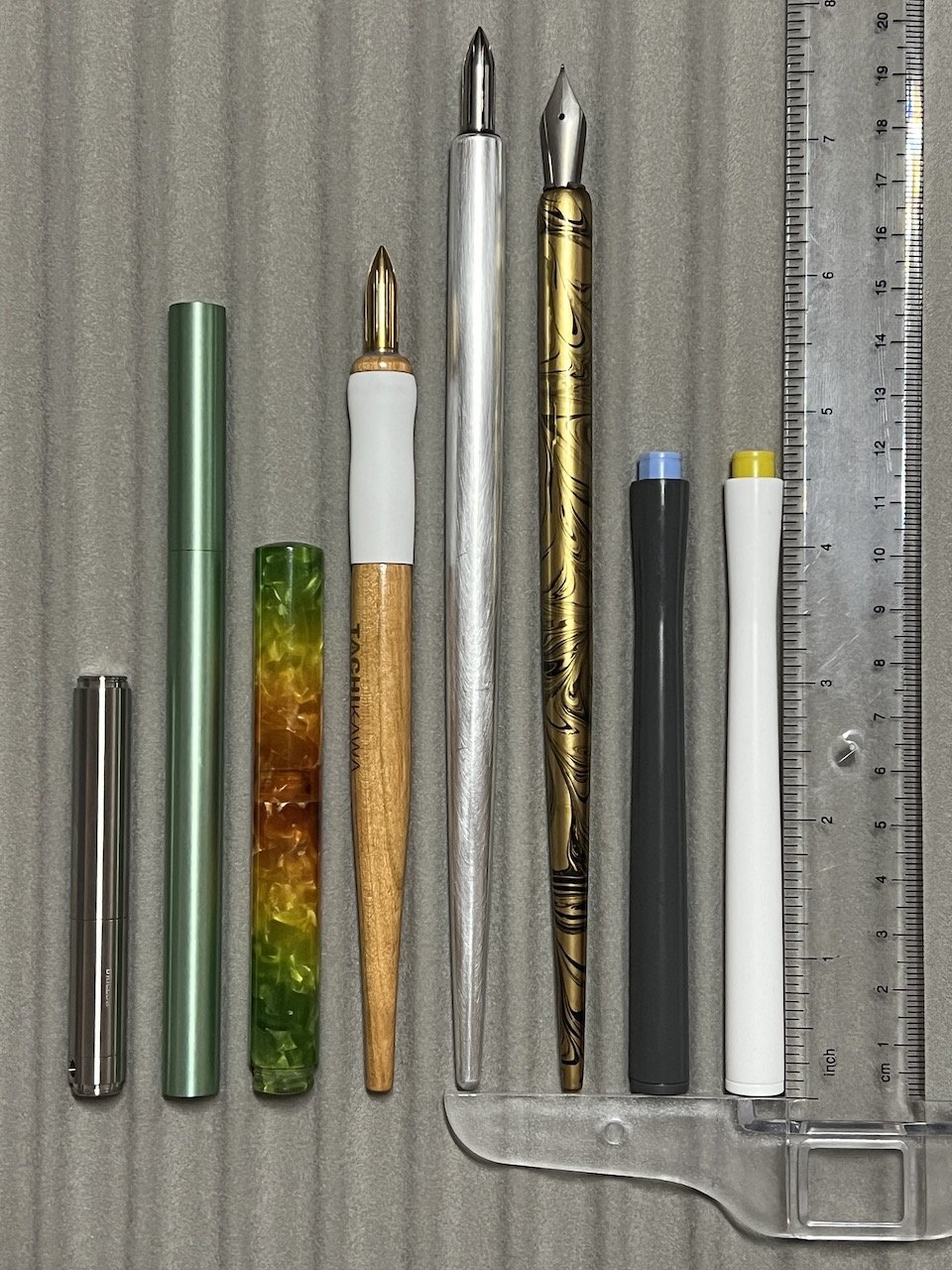
Short Drillog holder with 0.5 nib, Long Drillog holder with 1.2 nib, Glass Dip Pen, Brass Kakimori nib in a Tachikawa T36 holder, Stainless Steel Kakimori nib in an Aluminum Kakimori holder, Kakimori Pen Nib in a Speedball Marbled holder, Sailor Hocoro Fine and Fude Dip Pens.

Not all of these holders have caps, though you can get a Tachikawa holder with a cap which is handy for travel. Also, the length of the Kakimori is, of course, dependent on whatever holder you buy.

Dip Nibs/Pens

  1. Drillog Dip Pens/Nibs - The nibs and holders were sent to Brad for review by Drillog. They currently cost 16,280 Yen (currently ~$120) for the nibs - the holders are sold separately starting at 14,080 Yen (~$103).
  2. Glass Dip Pen - I purchased mine on eBay years ago (so the brand/name/price might be different) but you can still find them on eBay, like this one
  3. Kakimori Brass Dip Nib - I bought this from Yoseka - it is currently $54.50.
  4. Kakimori Stainless Steel Dip Nib - I bought mine new from someone on Instagram, but you can get the Kakimori Steel dip nib from Yoseka for $54.50 and the holder for $72.00. These Kakimori nibs are more widely available now than a few months ago.
  5. Kakimori Pen Nib - The Pen Nib for $28 as well as the Tachikawa Nib Holder were sent to Brad from St Louis Art Supply.
  6. Sailor Hocoro Fine Dip Nib (without feed) - I bought the Sailor Hocoro Fine in Grey from Stilo e Stile for 12.30 EU (~$13), but it also comes in white. The feeds were out of stock but are now back in stock here for an additional 2.05EU (~$2.15).
  7. Sailor Hocoro Fude Dip Nib (with feed) - I bought the Sailor Hocoro Fude in White from Stilo e Stile for 13.11EU (~14), but it also comes in grey. The feed was already part of the pen.
Drillog

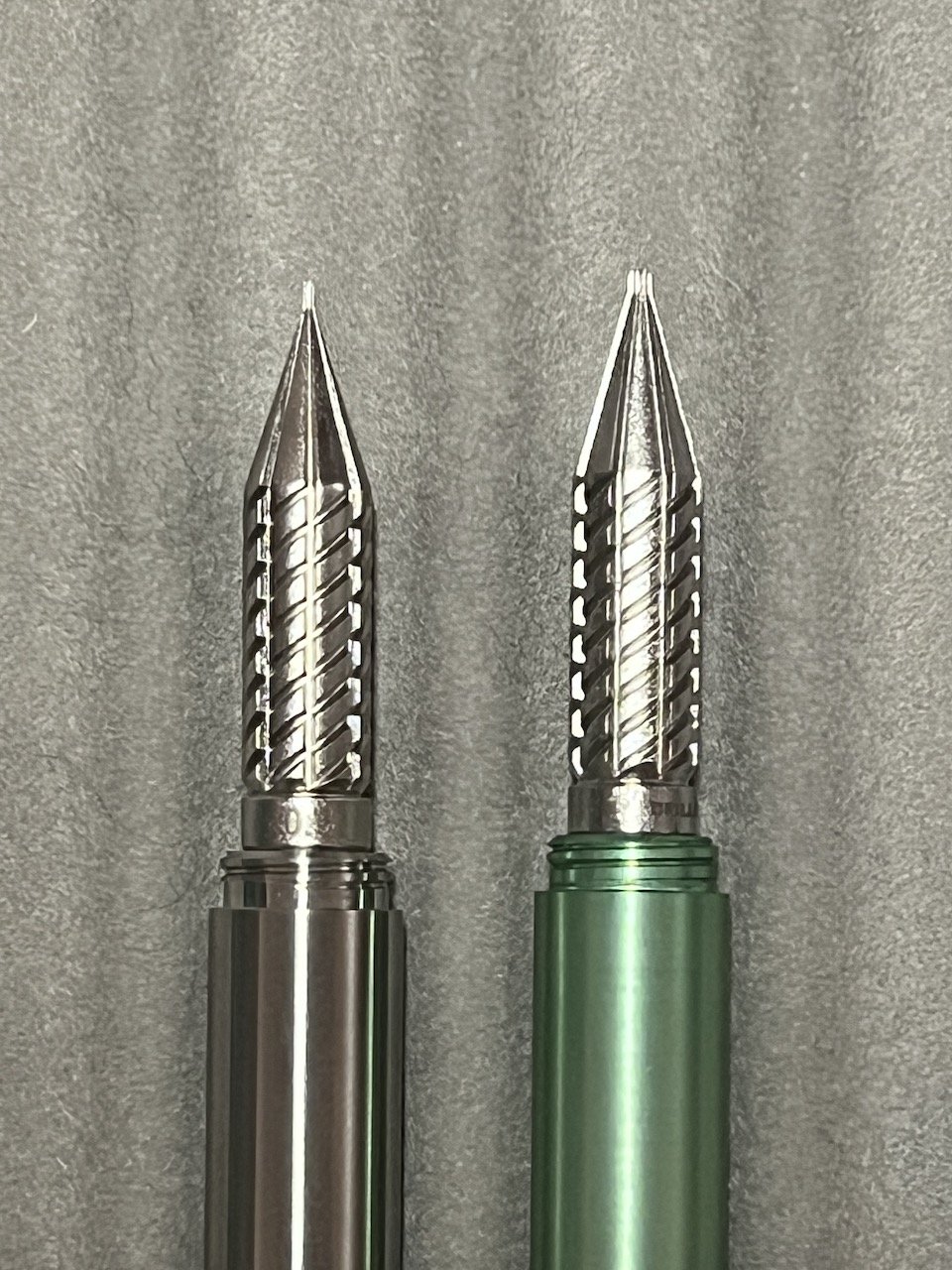
The Drillog 0.5 (left) and 1.2 (right) nibs - I am referring to the 0.5 as “Fine”.

Drillog

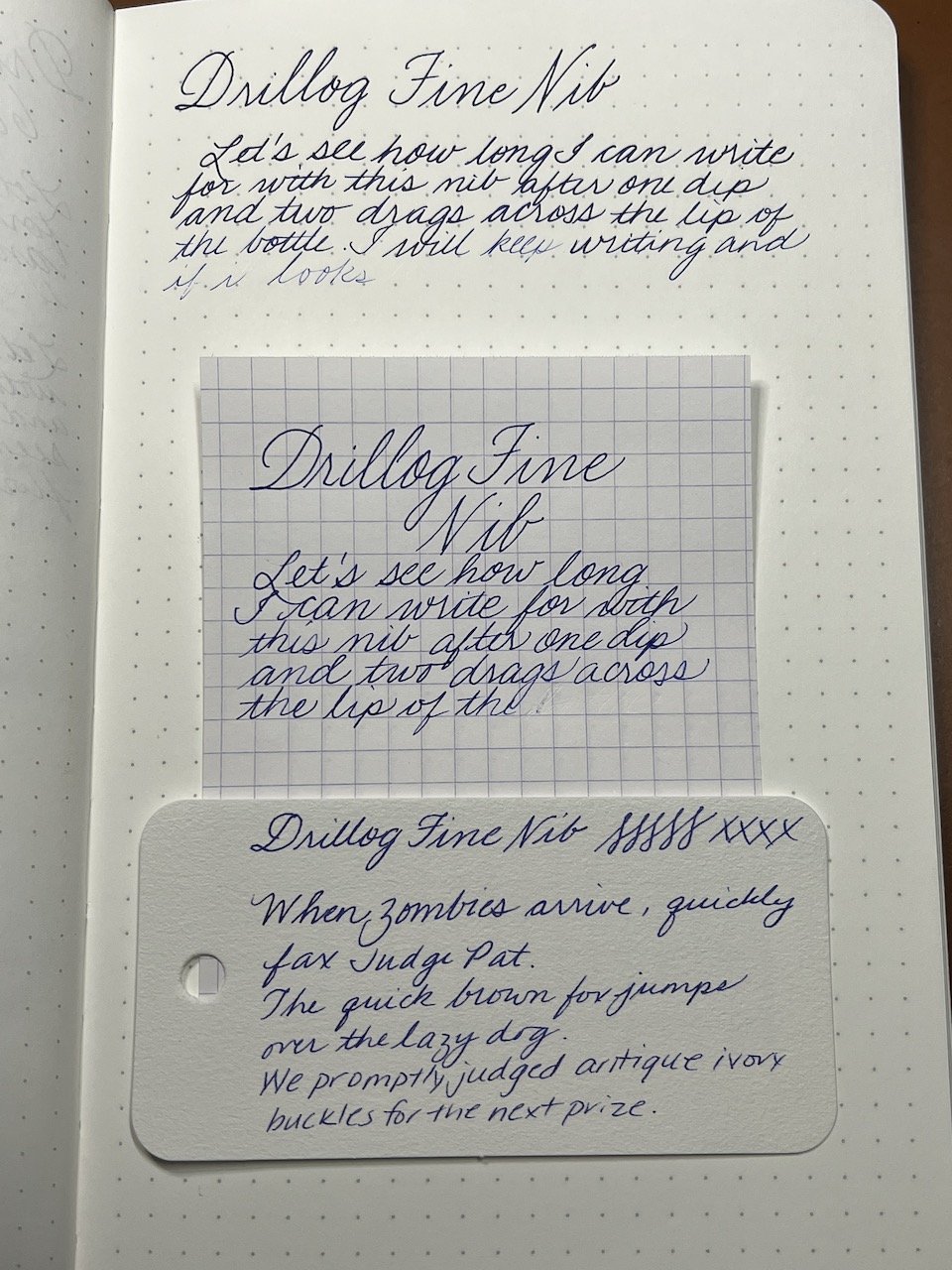
Drillog Fine writing sample - It writes similar to a Japanese Medium Fine or a Western Fine.

Drillog

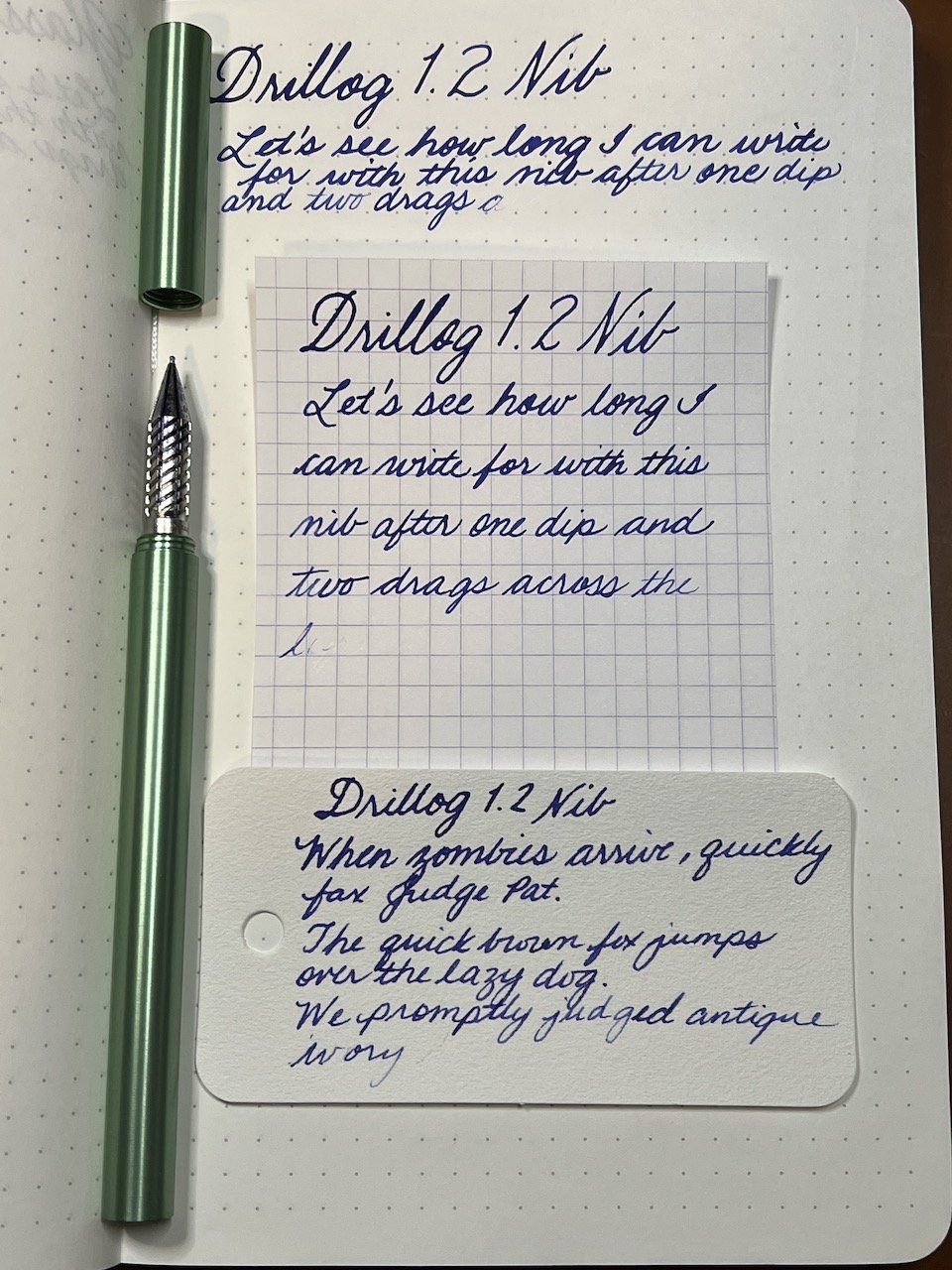
Drillog 1.2 writing sample - This didn’t write as much like a stub as I expected. Not surprising that the bigger tip means you don’t get as many words per dip.

Considering how expensive the Drillog nibs are, as well as their nibs being proprietary to their holders (though a couple of makers have figured out how to make their own Drillog holders), I was surprised at how poorly they performed. I had tried them a few times when I got them from Brad a few months ago and I couldn’t get them to write, so I set them aside for future testing. I was actually shocked that both of them wrote immediately with Waterman Serenity Blue but the Fine 0.5 did not want to write with the Robert Oster shimmer (the first line at the very top of the shimmer test page) until I dipped it again and the 1.2 was quite the gusher as well. The Fine also felt very scratchy. Writing on the Col-O-Ring was quite unpleasant as nib would catch on the subtle texture of the card. The Drillog Fine was probably my least favorite of them all and the 1.2 was kind of fun but a bit too wet/broad for me to use for swatching/writing samples. Lastly, because I hold my pens close to the nib and have a steep writing angle, I did not love how long the nibs were, as well as how far back I had to hold the pen due to the taper on the barrel. This is obviously a personal bias, but is something to keep in mind.

Glass Dip Pen

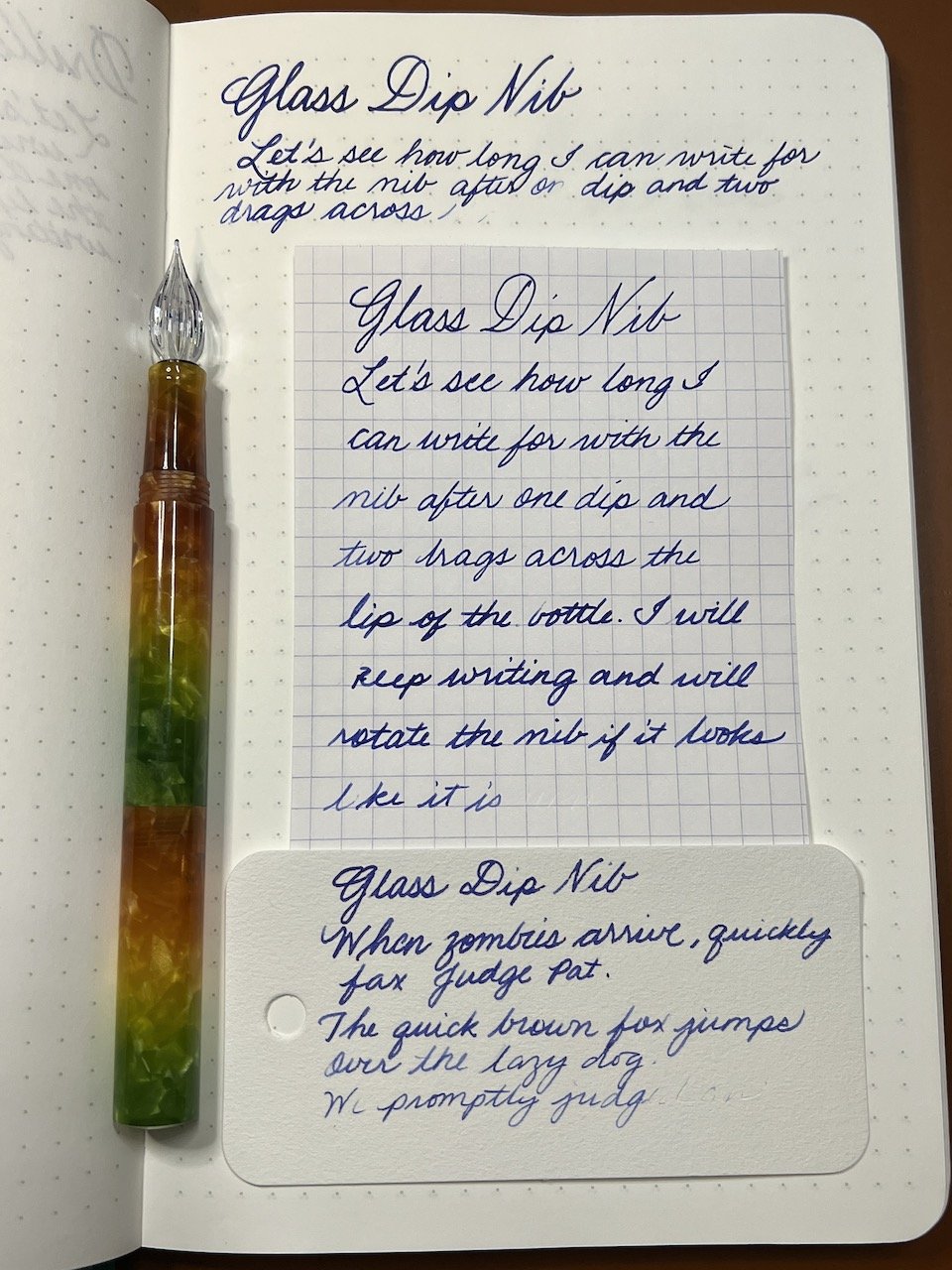
Glass dip pen writing sample - You can see when I rotated the nib to get more ink to the tip.

I have had mixed success with glass dip nibs over the years with some writing well, like this one, and others giving me inconsistent lines or having sweet spots that would only write if I rotated it just so. The other thing about glass dip nibs is that they are, well, made of glass, which makes them more fragile than all the other nibs that I tested which are metal. But they have traditionally been fairly inexpensive (though you can also get fancy glass dip pens from Japan for several hundred dollars) and I particularly like that this one has a cap, which can be screwed to post - I keep mine in my pen accessories case which I pack in my suitcase.

Kakimori Brass Nib

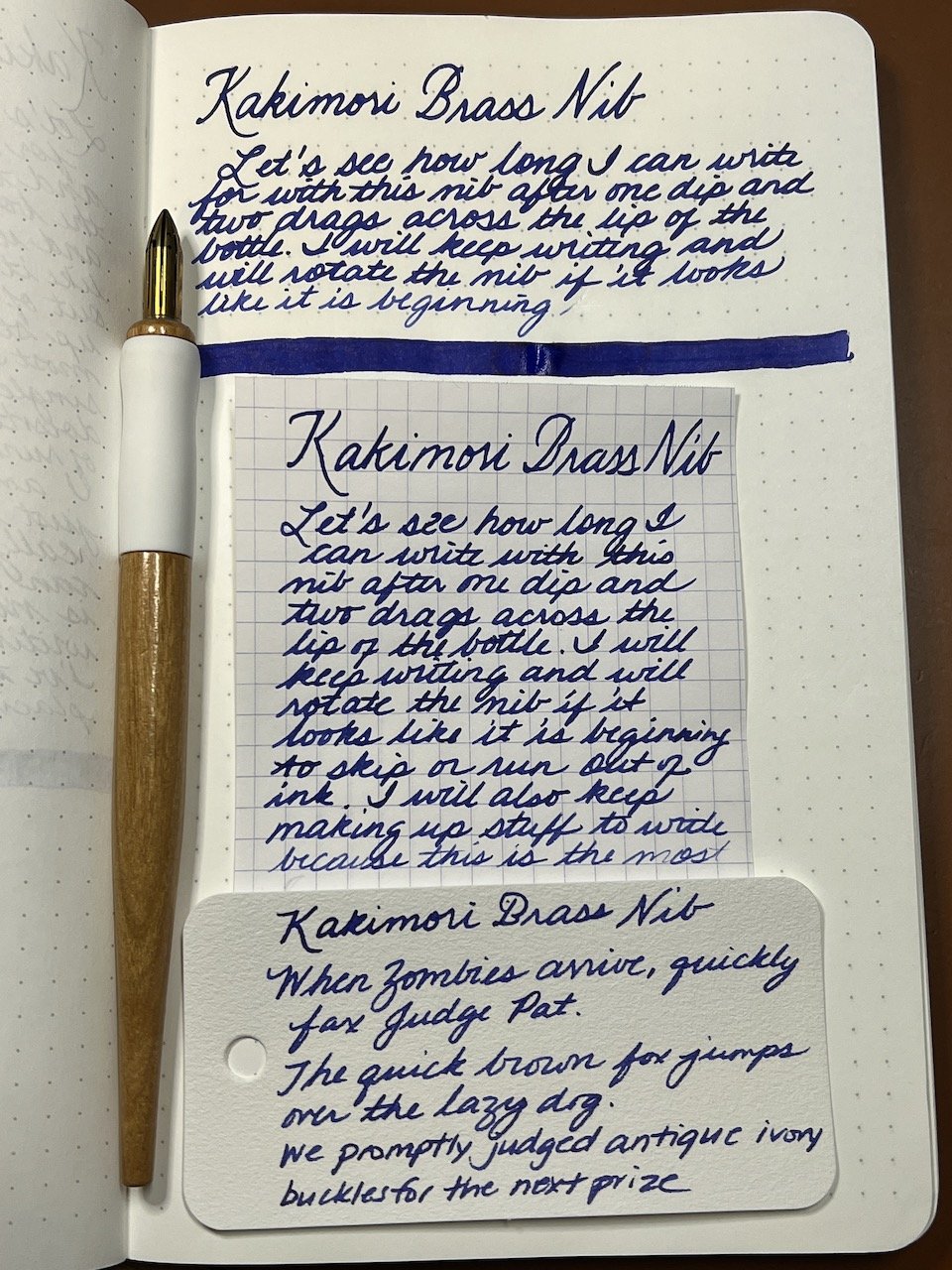
Kakimori Brass writing sample - Compare the line width to its Stainless Steel sibling below.

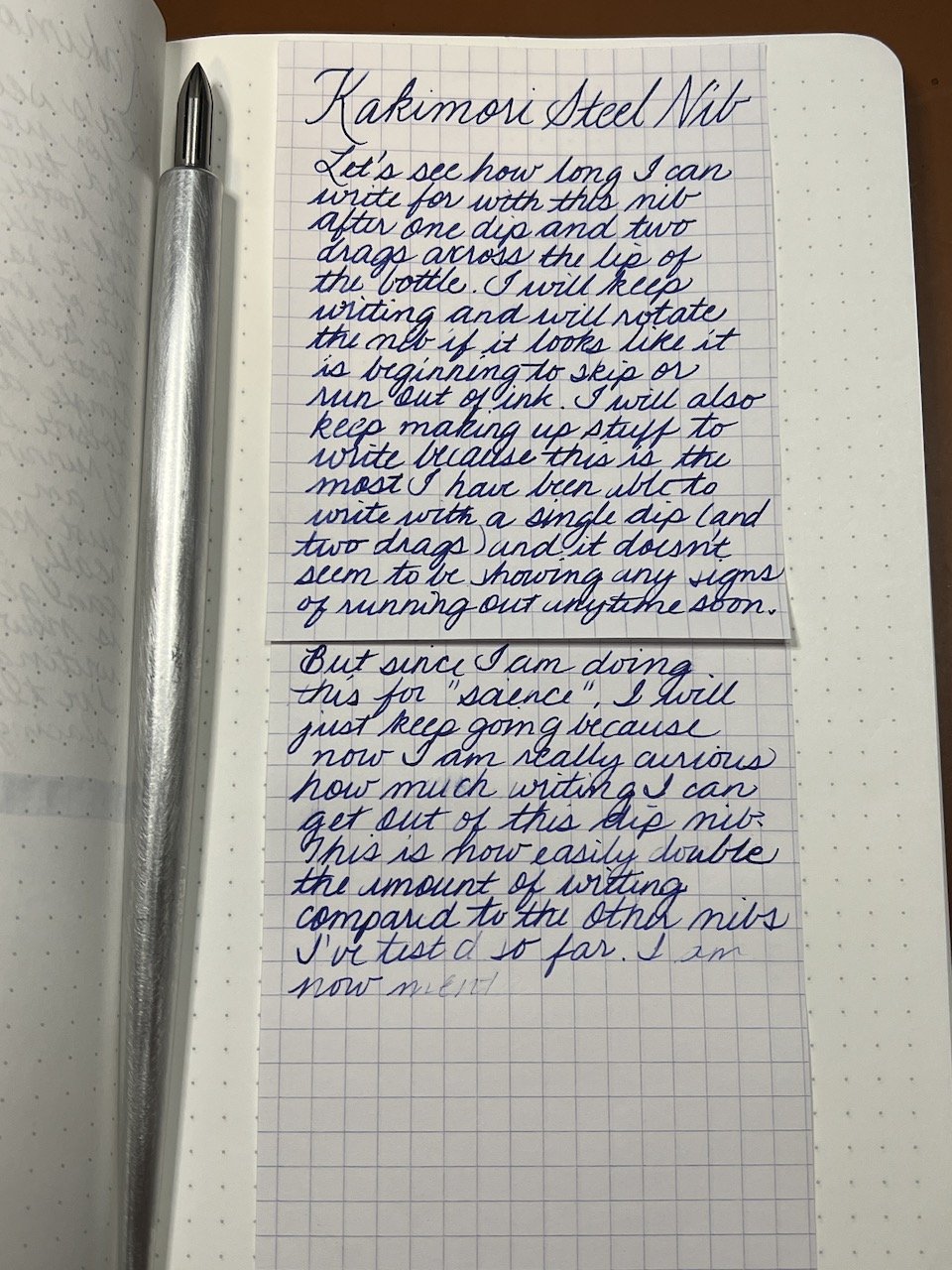
Kakimori Steel Nib
Kakimori Steel Nib

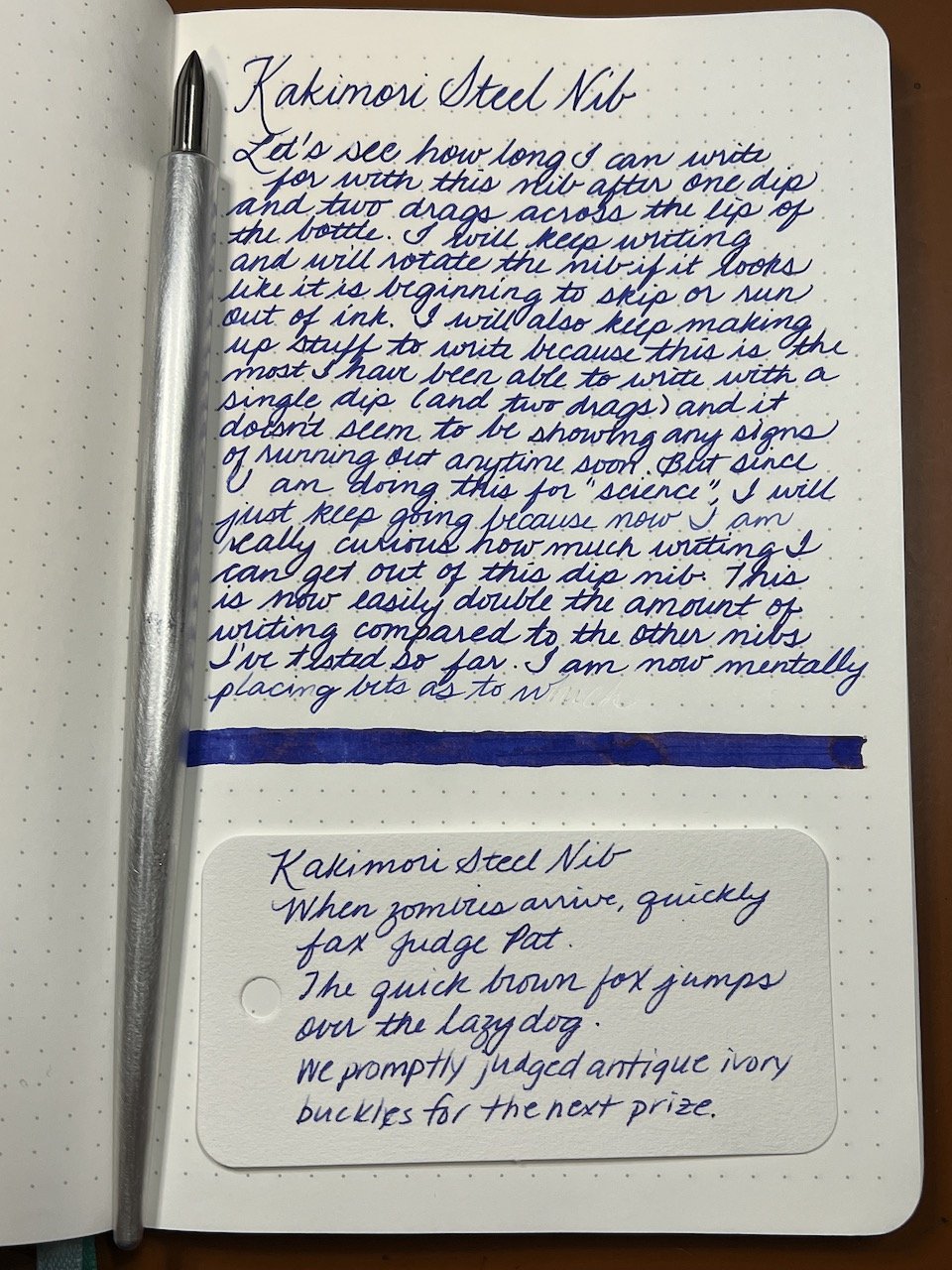
I was able to get significantly more writing with the Steel Kakimori because it didn’t make thicker/wetter lines like the Brass one.

My first experience with the Kakimori dip nib was with the brass one, since the steel one was sold out. I had a heck of a time getting it to write at all, and despite washing it several times with soap and water and a gentle toothbrush, it would either not write, or would blob ink. I even asked several folks to see if this was normal, but most of the others had the steel one. I was almost ready to call it quits but decided to just keep trying and then out of the blue it started working. I had been using that for swatching/writing samples for several months. When a steel one came up for sale on Instagram, I pounced on it and this one wrote right out of the box with no fuss. The Brass one seems to have much more flow and gives me a much broader line than the Steel one. I have been using the Kakimori Steel dip nib ever since I got it a couple months ago. I like that they can be used at a shallower angle to provide nice wide lines, which I use in one of my ink swatch journals.

Kakimori Steel Dip Nib

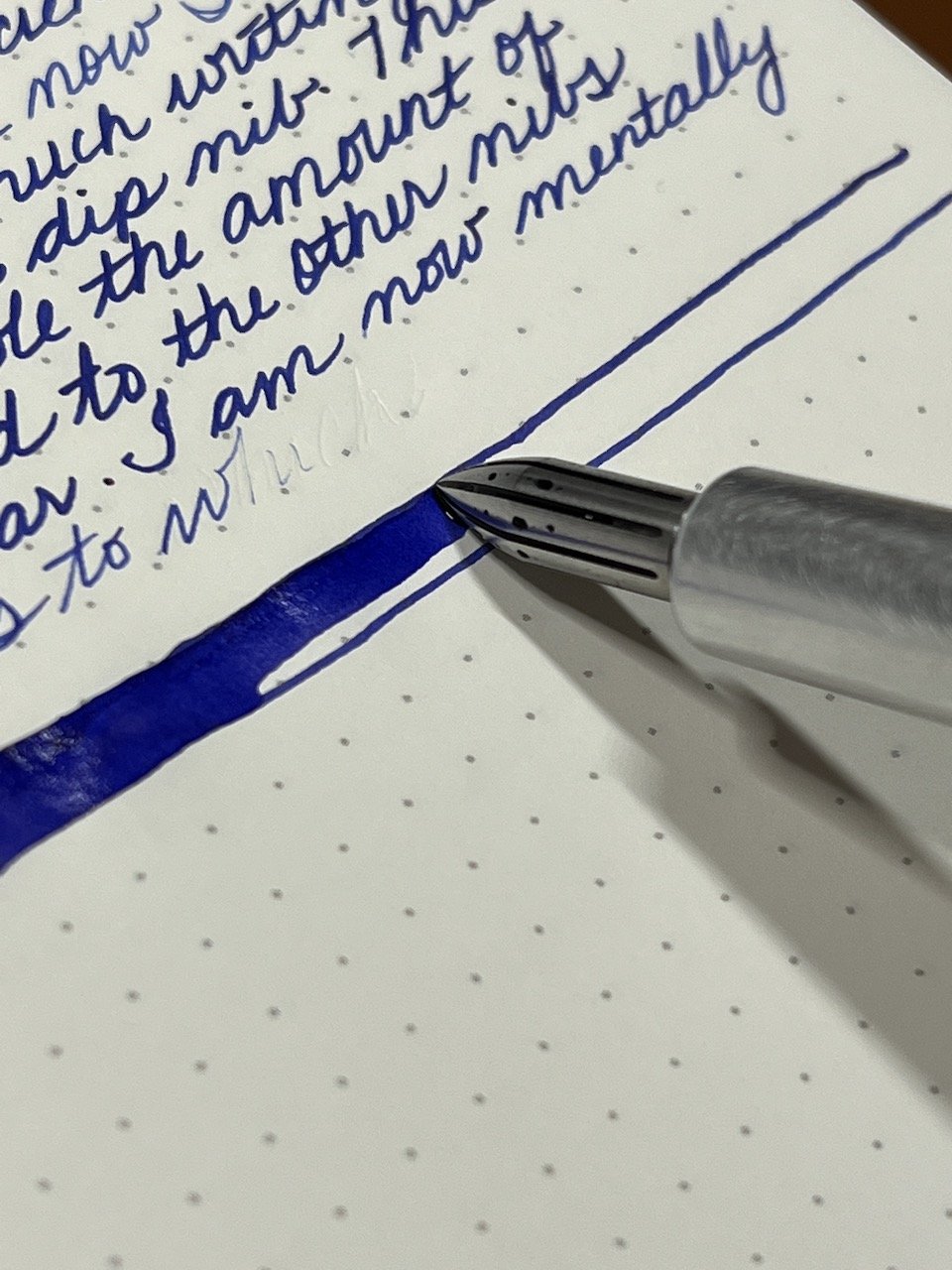
Wider lines of ink are easily made with either of the Kakimori dip nibs.

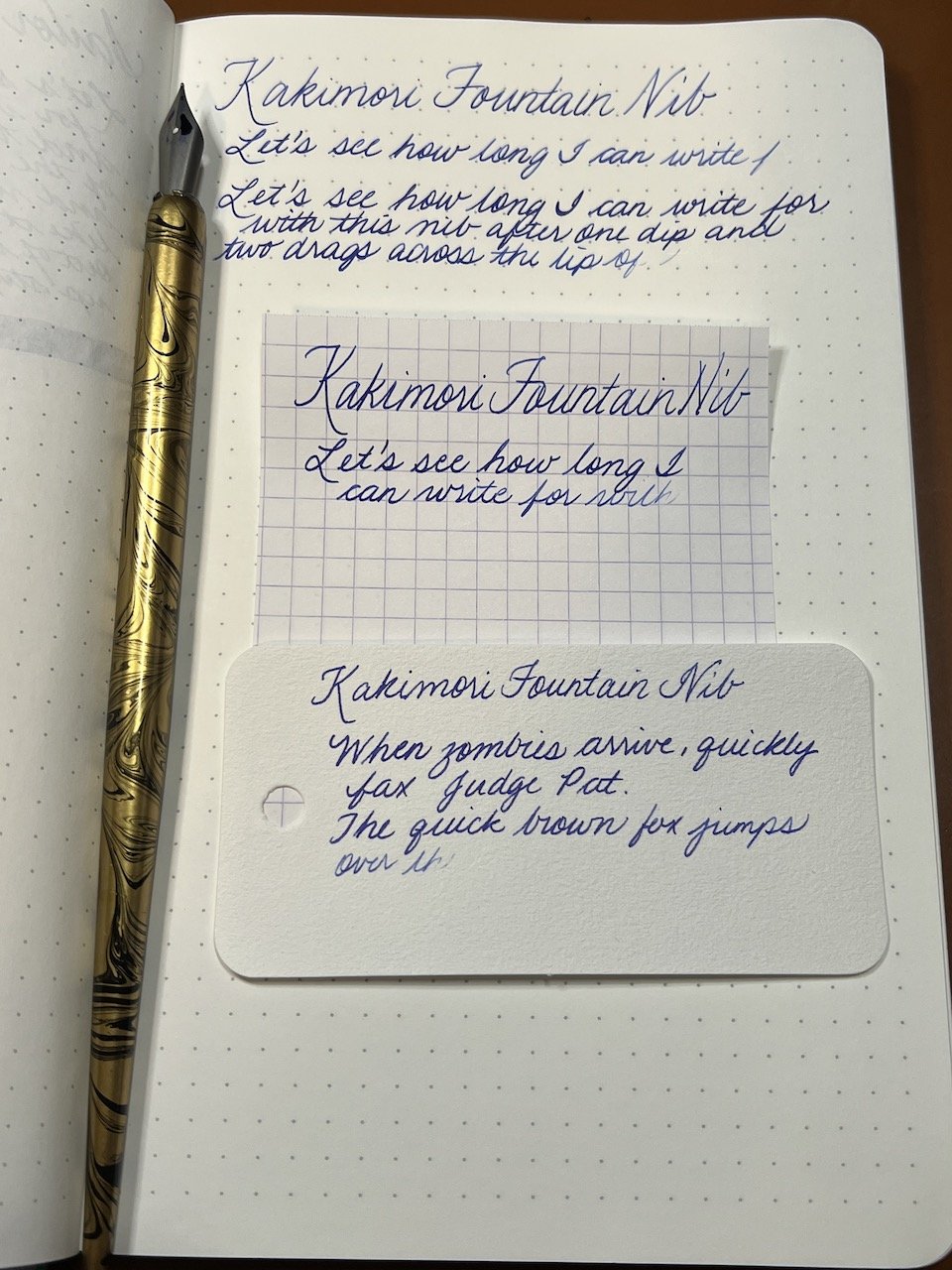
Like the Brass and Steel dip nibs, the Kakimori Pen Nib can also be fitted into any nib holder that has a ferrule. The Pen Nib has a nice fine line but because it does not have a feed or reservoir or channels to hold ink, it isn’t meant for a lot of writing between dips. Still, if I didn’t have a need for making wide lines in my ink journal, I could see using this for the writing sample part of ink swatching.

Kakimori Nib

I mistakenly wrote “Fountain Nib” instead of “Pen Nib” because it looks like a fountain pen nib.

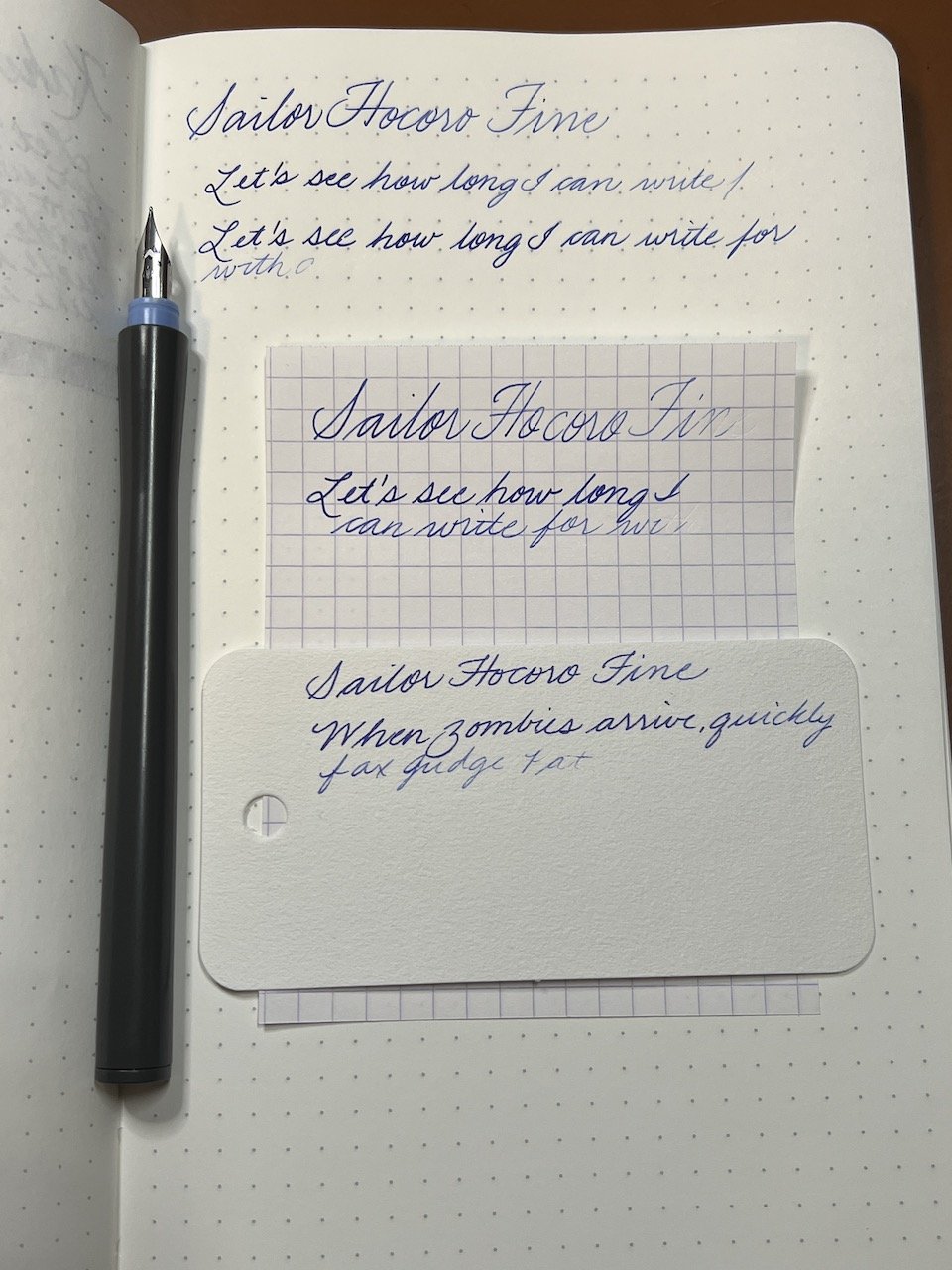
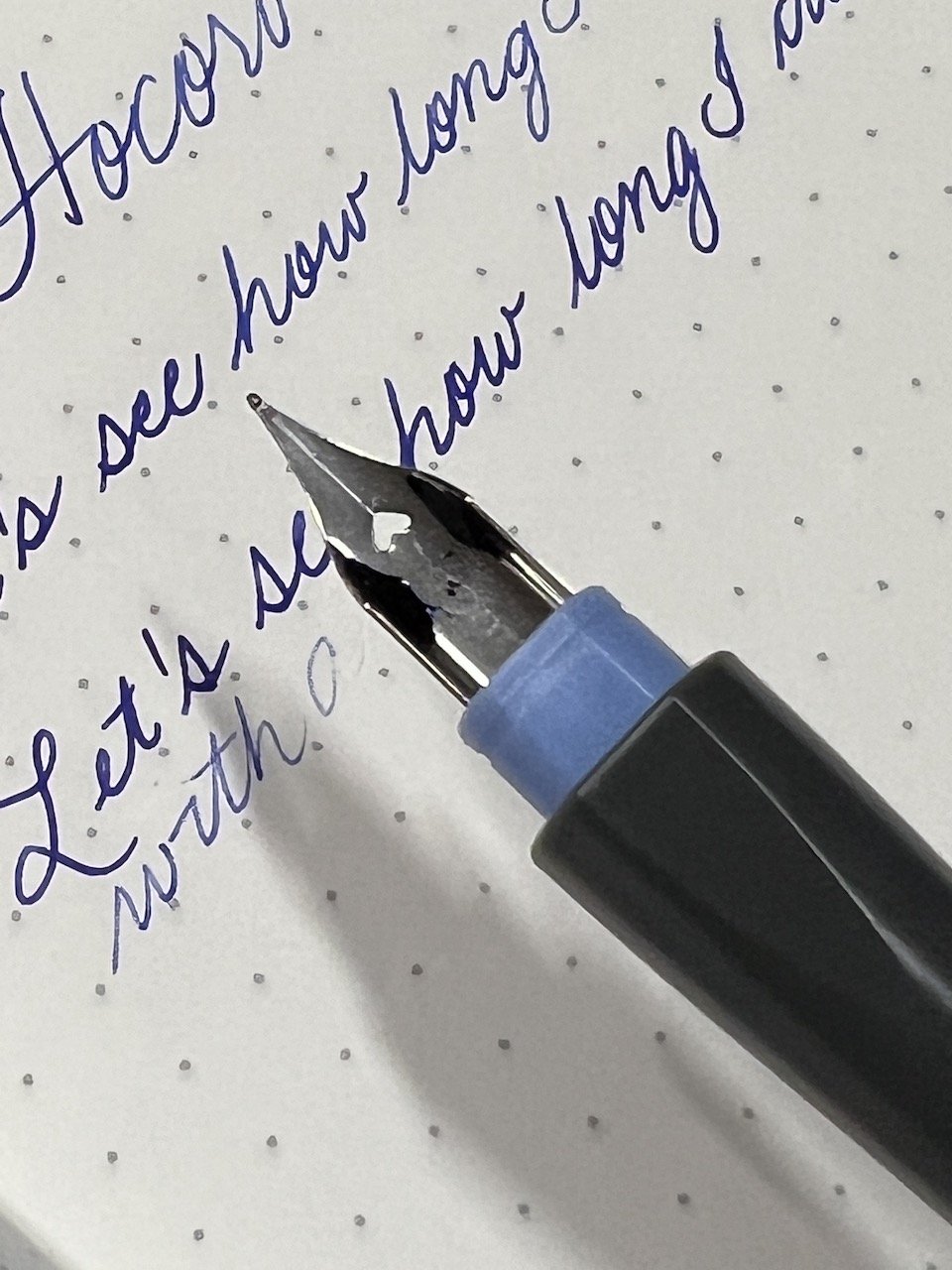
The Sailor Hocoro Dip Pen in Fine had an even fewer number of words it could write before running out. I first tried writing without cleaning the nib and then again after a water rinse and wipe. The lack of feed or channels makes it difficult to hold much ink. The Fude, on the other hand, wrote quite nicely and for a decent amount of lines. This is because there is an included feed which holds a bit more ink. I suspect the Fine will be much better when I am able to order the feed.

Sailor Hocoro

Not a lot of words with the Sailor Hocoro Fine nib - but this could be good for swatching where you are writing a few words.

Sailor Hocoro

No feed means nothing to hold onto the ink means fewer words.

Sailor Hocoro Fude

Sailor Hocoro Fude writing sample.

Sailor Hocoro Fude
Sailor Hocoro Fude Feed

You can get more words on the page even with the added line width due to the presence of a feed.

A few things I really like about the Hocoro Dip Pens: (1) they come in different sizes - Fine, Fude, 1.0 and 2.0 stubs, (2) there is no cap to lose because the nibs can be stored in the pen barrel so they don’t get damaged and (3) there is a flat bevel on the barrel so that it doesn’t roll around - I literally had to corral all the other dip pens on the table because they kept threatening to jump ship. And they are reasonably priced too.

Sailor Hocoro

Left shows the nib inserted into the barrel for storage. The grip section and nib unit are beveled so there is only one way to install or put away the nib. Right shows the other end of the barrel, which is also beveled.

Lastly, I thought I’d try something that wasn’t a tried and true ink like Waterman Serenity Blue so I picked a shimmer ink from my shimmer samples bag. I knew that Robert Oster Glistening Orange Rumble had a fair amount of shimmer, so I wanted to see if the shimmer (1) would cause any flow issues and (2) if you could see the shimmer on the page or if would it get stuck in the channels or immediately get dumped onto the first few characters.

Dip Nib Shimmer Ink

You can see the difference in line widths and as a result the difference in color/saturation.

Dip Nib Shimmer Ink

Angled so you can see some of the shimmer - All but the glass dip pen deposited the shimmer without any issues. The glass dip pen had very little shimmer and a couple of skips.

All of the nibs cleaned out pretty easily - I blasted a syringeful of water after using Waterman and also rinsed in the sink after using the RO shimmer ink. The glass dip nib took a little more effort than the others but it wasn’t too bad.

So what’s the TLDR version of all this?

  1. Drillog is way too expensive for what it is, and it didn’t behave well enough even if it was a fraction of the price.
  2. My favorite is probably the Kakimori Stainless Steel nib because it has a Medium line and can also deposit a wider line for swatches. I had a lot of trouble with the Brass and even now it’s too wet/thick for my preference. This could be fun if I did art.
  3. The Sailor Hocoro Fude Nib is my second favorite as it has a little bit of line variation and can write a decent number of words due to the feed. Can’t wait to try the Hocoro Fine with a feed.
  4. The others are fine (Get it? “Fine”? I’ll see myself out, lol) - they behave alright. It comes down to personal preference and budget.
  5. Dip pens with caps are extra cool.

Anyway, now that I’ve done this research, I’m going to use Kakimori Stainless Steel dip nib and the Sailor Hocoro Fude nib for my Diamine Inkvent swatching and see which one will be crowned the winner! Happy dipping to all, and to all a good write!

Diamine Inkvent

Happy Inkvent!


Enjoy reading The Pen Addict? Then consider becoming a member to receive additional weekly content, giveaways, and discounts in The Pen Addict shop. Plus, you support me and the site directly, for which I am very grateful.

Membership starts at just $5/month, with a discounted annual option available. To find out more about membership click here and join us!

Posted on December 2, 2022 and filed under Dip Nib, Kakimori, Sailor, Tachikawa, Waterman, Pen Reviews.