Posts filed under Lamy

Lamy ST Tri Multi Pen Review

(JetPens provided this product at no charge to The Pen Addict for review purposes.)

There's been a lot of multi pens cross my desk over the past several years, but I'm still so fascinated by the utilitarian function of this pen genre. It's also fun to see how different manufacturers tackle different design and usability problems to make their offerings competitive. Most of all, these multi pens mostly drum up a healthy dose of nostalgia.

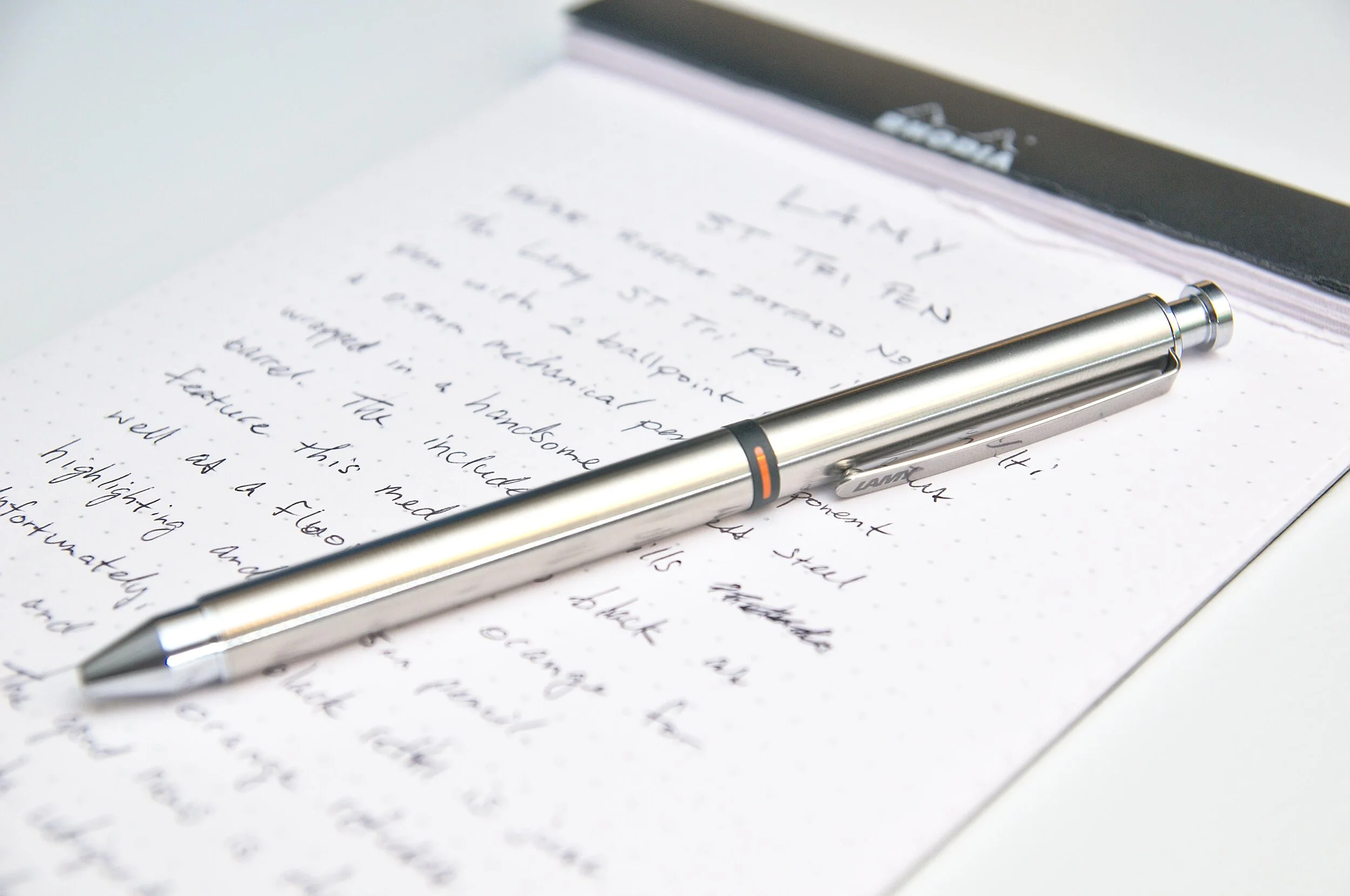
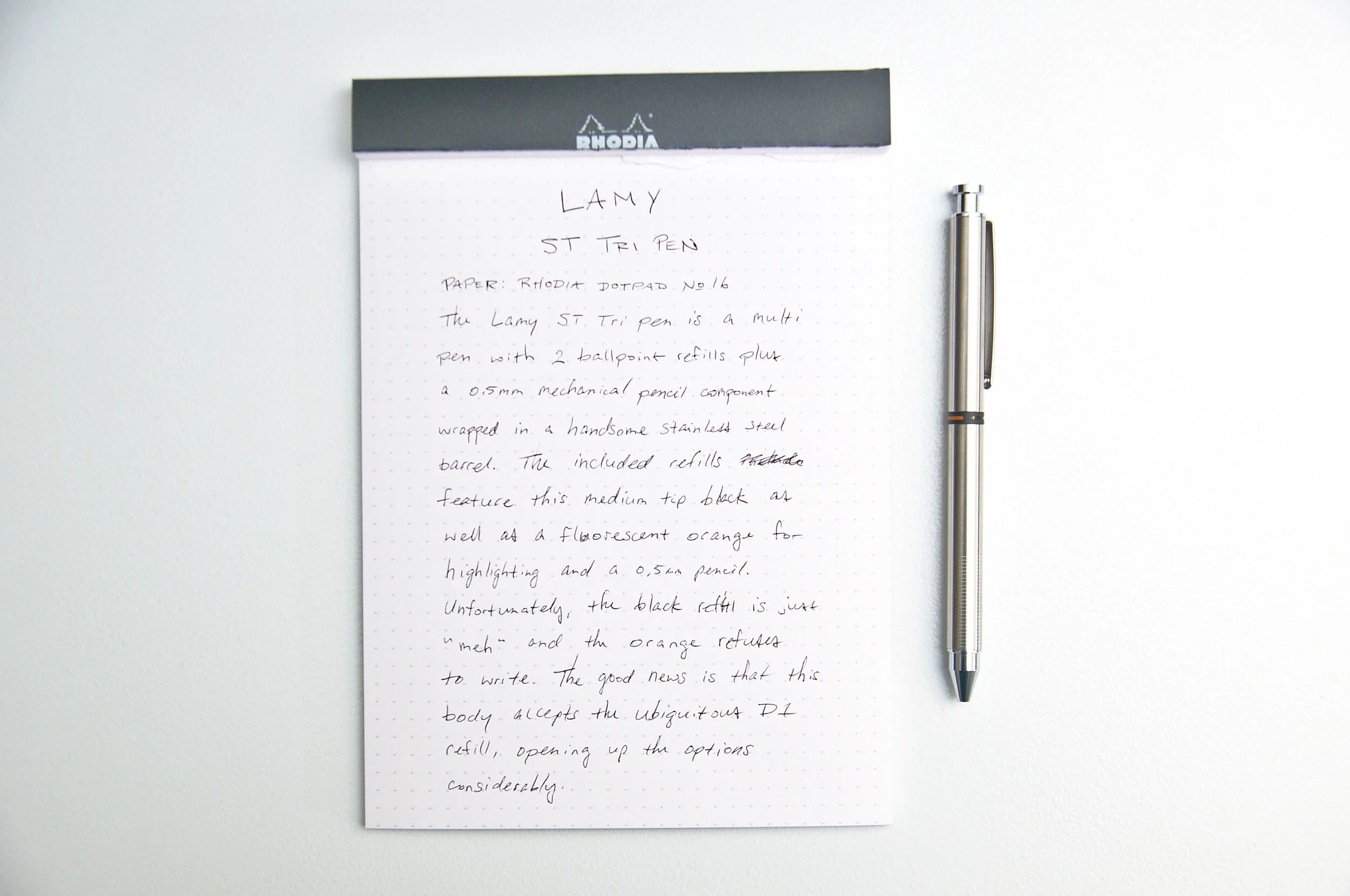
At the end of the day, these things all cost money and essentially do the same thing. Choosing the right one (since "all of them" isn't usually an acceptable response) can be difficult, but you can easily narrow down the options by knowing what you like. Personally, I really like the click tab method of selecting a color over the rotating selector. One of the coolest method is the gravity selector, which means that you select different refills by rotating the pen in your hand until the correct color is pointing up, then click the nock to extend that refill. Another major factor to consider is price. Multi pens can range quite a bit in price, and the new pen we're looking at today definitely falls into the higher range. The Lamy ST Tri multi pen is a stainless body that features two ballpoint refills and one 0.5mm mechanical pencil component. The model featured here ships with a black ballpoint and an orange fluorescent refill (meant for highlighting), but the orange refill in my unit was nonoperational from the get-go.
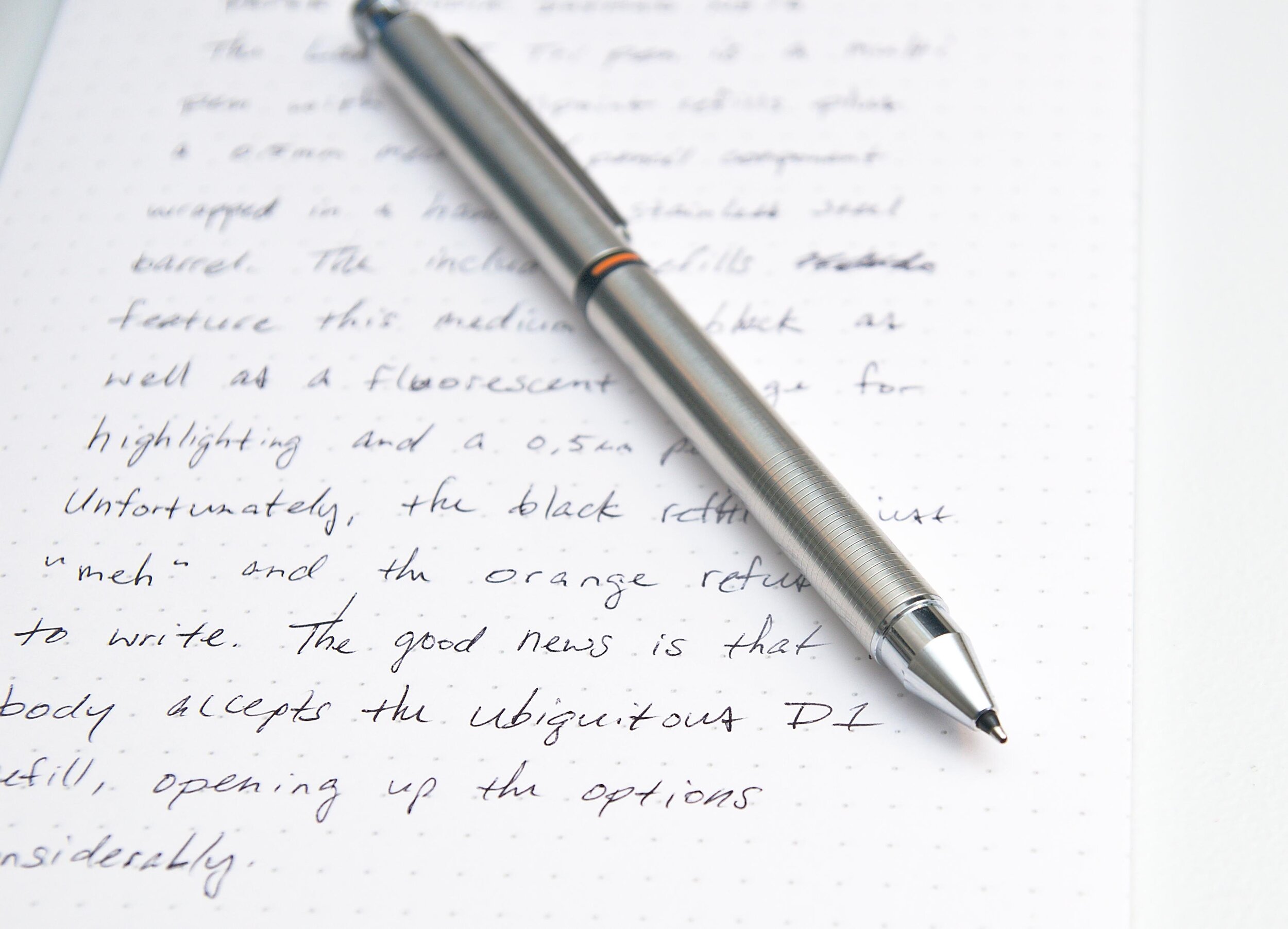
If you've ever shopped for multi pens before, you've probably come across the Zebra Sharbo X line, which is one of the more expensive options out there. The price relates directly to the materials and quality of the build, which is spot on with the Sharbo X. But the Lamy ST multi pen is here to possibly shake that up.

The Lamy ST is a well-built multi pen that's made out of stainless steel. Available in a couple of different colors and finishes, the ST is a premium pen with two refill slots and a mechanical pencil component. Similar to the Sharbo, you select different refills by twisting the grip section. The Lamy requires a firm pressure, but there's a satisfying chunk whenever the refill is extended completely to let you know it's ready to write. As you'd expect, the button on the top of the pen allows you to extend and retract the lead in the pencil component. A nice touch here is that the button is disabled when you don't have the mechanical pencil extended. Also, there's a tiny eraser hidden under the button cap in case you need to erase tiny mistakes.
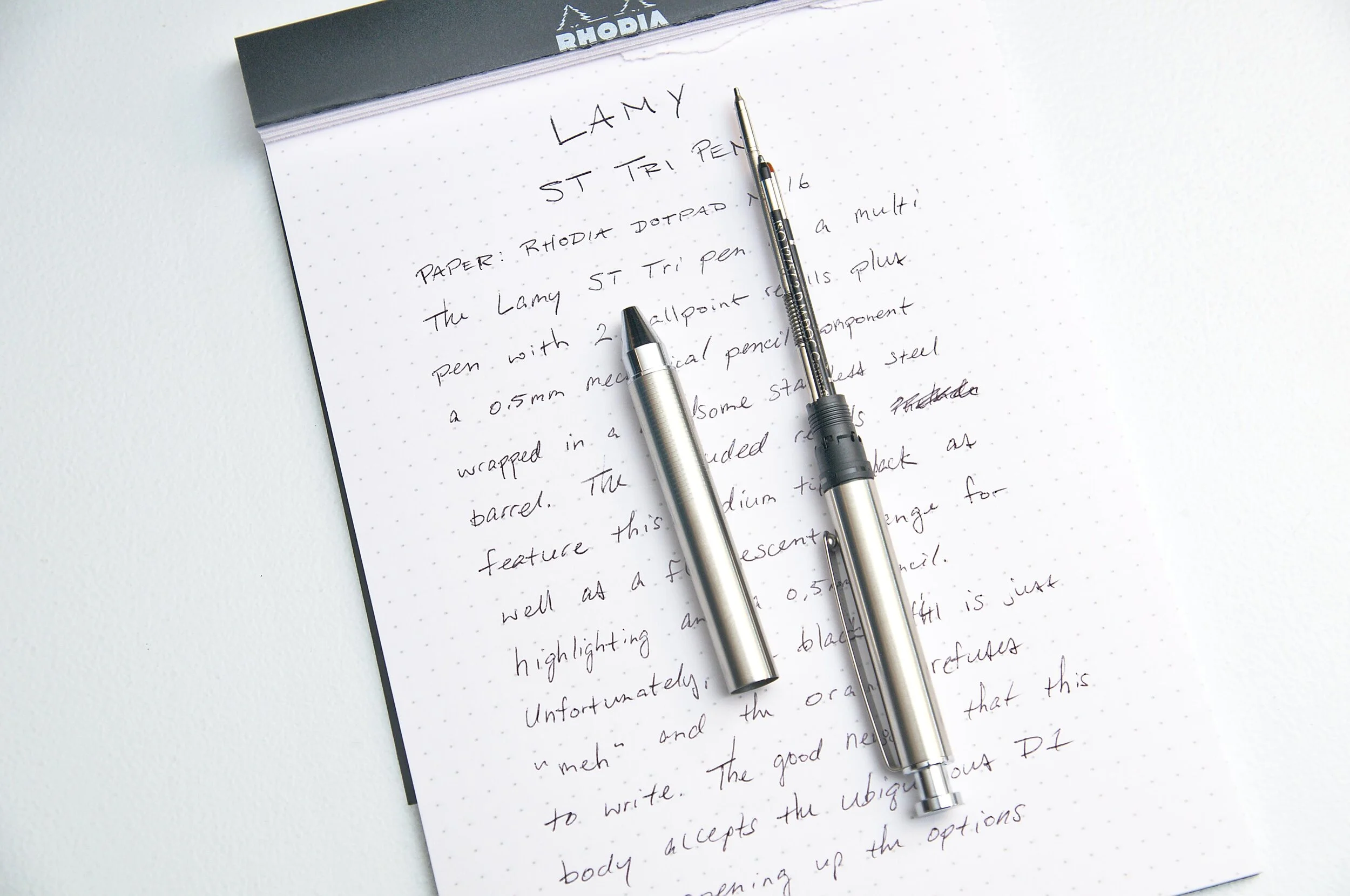
The ring that separates the grip section from the main body of the pen has three color indicators to let you know which way to turn to use a specific color. I don't like that Lamy took this approach since I might decide to use purple and green refills instead of the black and orange that is included with the pen. I much prefer a generic label or no label at all versus permanent colors. With a pen that costs more than $50, it's a little disappointing to see that this choice persisted through the design and evaluation phases at Lamy headquarters.

The grip section is really comfortable as long as your hands aren't sweating. The smooth stainless steel grip can get a little shifty at times. There's a small grip pattern etched into the grip, but it's not pronounced enough to offer any additional grip over the bare metal. If the etching was just a bit deeper or wider, it would be perfect.
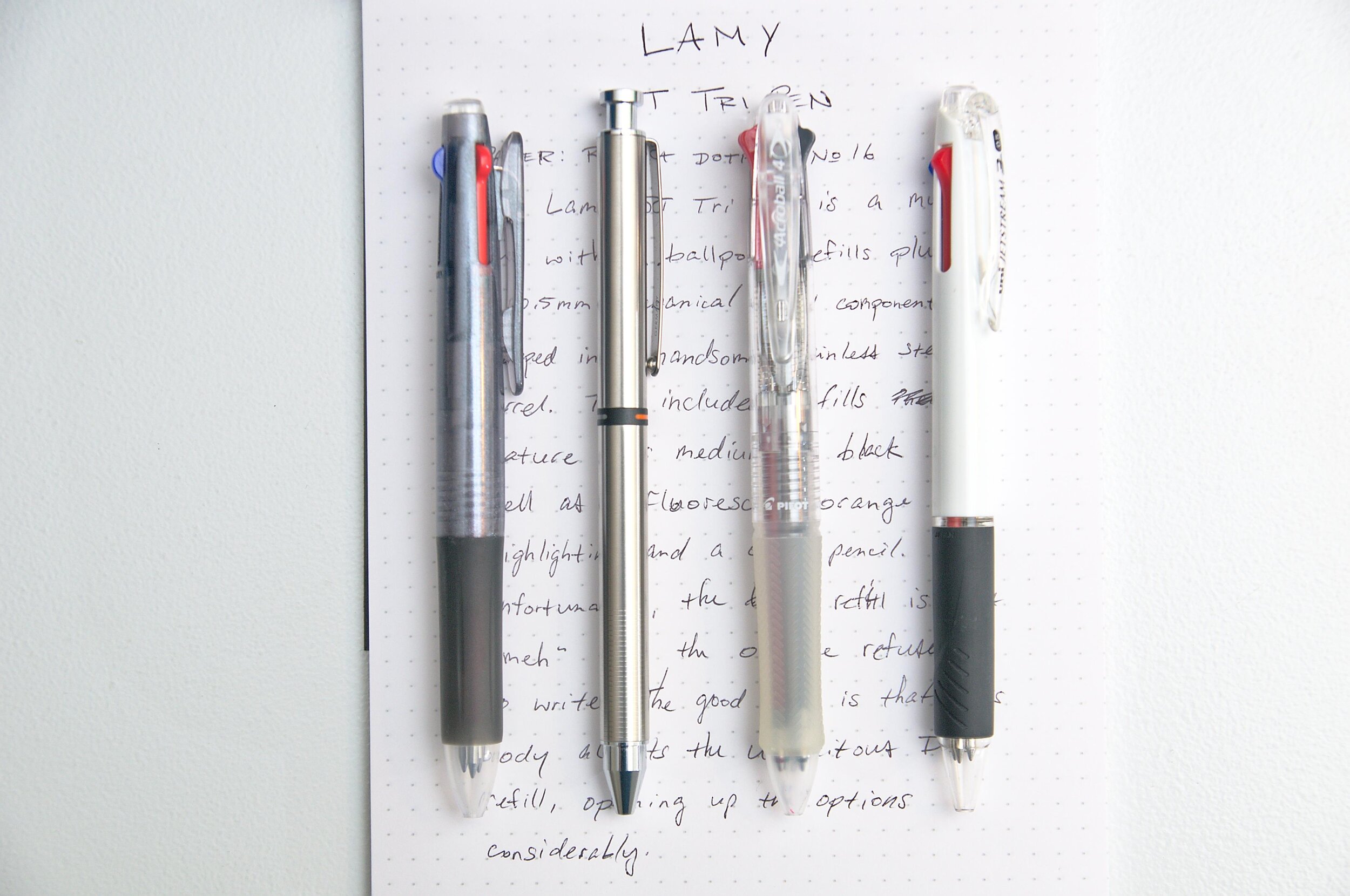
Like most multi pens, the ST is fairly long. This extra length adds stability and favorable balance when writing, but I wish Lamy made the choice to shorten the pen just a tad. This is a personal preference of mine — I would prefer the pen be more stow-able instead of longer for writing comfort. The steel body is begging to be used as a daily carry that can stand up to the test of time.

At the top of the pen, there's also a clip. Before now, I've never met a Lamy clip that I didn't like. The clip on this ST is weak and moves around quite a bit. The ring that holds the clip in place has a small 0.5mm gap that allows the clip to move back and forth in its slot. This doesn't drive me crazy, but it definitely annoys me due to the price point. The clip does its job as long as the pen doesn't get turned upside down.

Writing with the ST is comfortable, but let's talk about the included refills that Lamy packs in this pen. They're not good. The black medium tip refill is smooth, but it requires too much pressure to write. Plus, the ink isn't bold or crisp. The line is a murky dark gray that seems to second-guess itself at every turn. The orange highlight is a cool idea, but I really don't know if it holds up against the marketing since my unit refuses to write. I was looking forward to trying it out to see how transparent it is and how effective it is at calling out things on the page. Oh well — maybe next time. The mechanical pencil works flawlessly.

The factor refills aren't great, but don't despair yet! These are standard D1 refills, so you can swap them out for a plethora of different colors and tip sizes. Buying a few extra refills to customize your multi pen is something I recommend very heartily, but it's disappointing that Lamy chose mediocre refills as the standard on this pricey multi pen. On the flip-side, the Zebra Sharbo X line don't come with any refills out of the box, so it's a nice gesture.
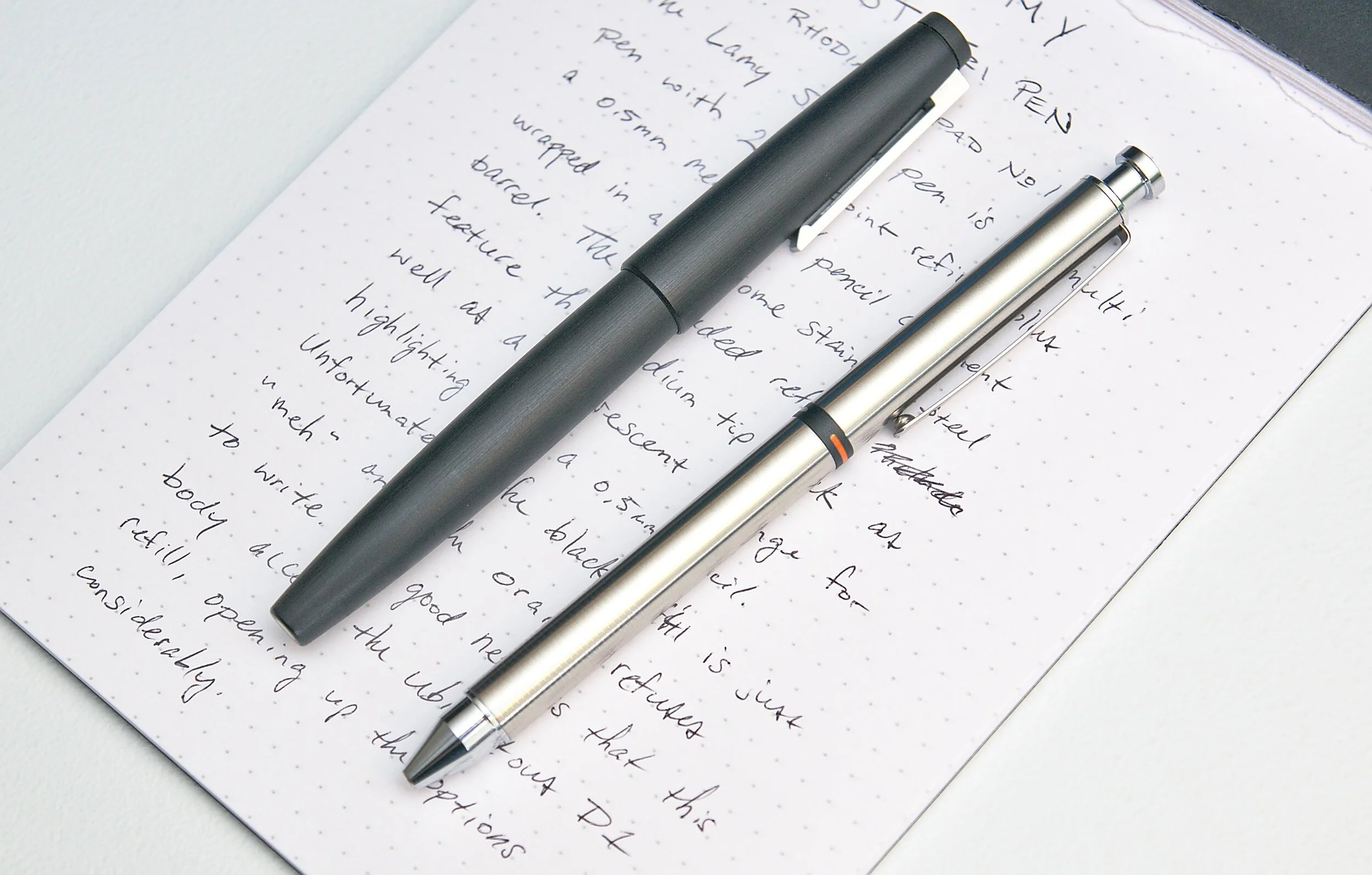
Apart from the stainless steel model featured in this review, you also have a choice of a matte black steel finish or a brushed stainless steel finish. The brushed finish costs a few dollars extra, but it's entirely worth it for the reason that you get a classic Lamy clip instead of the lackluster clip found on the stainless steel versions. Aside from the clip, the brushed finish just looks incredible. Again, this comes down to personal preference, but I think there's a clear winner here in terms of aesthetics.

It may sound like I'm being hard on the Lamy ST, and you're right. It's a decent multi pen that performs well. A few nags aside, it's a great option for a daily multi pen that you carry everywhere. It will certainly stand the test of time, and the fact that it uses standard D1 refills means you'll be able to customize it and easily buy replacement refills when you run out of ink. The bottom line is that this pen doesn't feel like a $70 item. If it were closer to $40, I would recommend it quickly. At $70, I feel like you get a lot more value out of the Zebra Sharbo X line, or even the top end of the Pilot/Uni/Zebra/Pentel/Sakura lines.

If you take one look at the Lamy ST and know that it fits a certain niche in your pen collection, then go for it. It's built well and will be a great pen. If you're interested in finding a premium multi pen made of metal, start elsewhere. You'll save a few bucks that you can spend on extra refill colors and tip sizes!

(JetPens provided this product at no charge to The Pen Addict for review purposes.)


Enjoy reading The Pen Addict? Then consider becoming a member to receive additional weekly content, giveaways, and discounts in The Pen Addict shop. Plus, you support me and the site directly, for which I am very grateful.

Membership starts at just $5/month, with a discounted annual option available. To find out more about membership click here and join us!
Posted on October 23, 2019 and filed under Lamy, Multi Pen, Pen Reviews.

Lamy Crystal Agate Ink: A Review

(Susan M. Pigott is a fountain pen collector, pen and paperholic, photographer, and professor. You can find more from Susan on her blog Scribalishess.)

The Lamy Crystal Ink line is named after various gemstones and includes eight colors: Agate, Azurite, Beryl, Obsidian, Peridot, Rhodonite, Ruby, and Topaz.

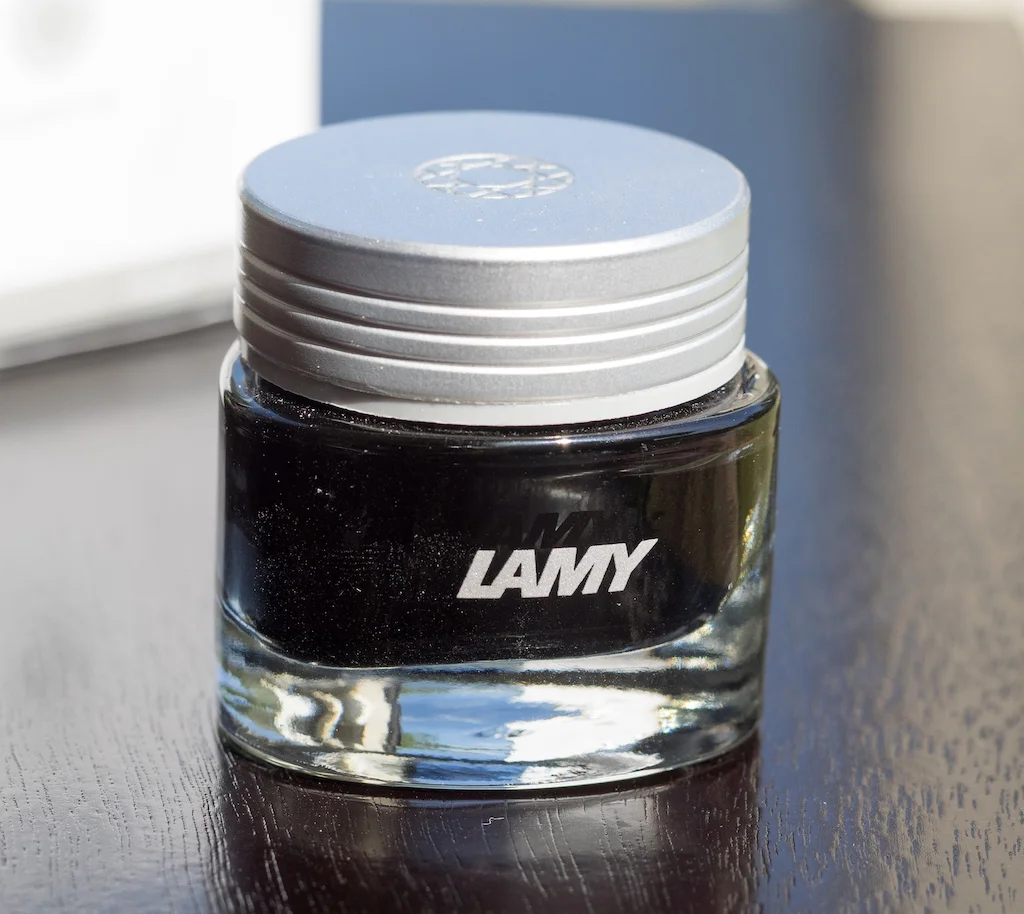
Lamy Crystal inks come in beautiful triangular-shaped bottles with silver caps. The bottles are deep enough that you can get a good fill even with large nibs.

I tested Lamy Crystal Agate on Rhodia Dot paper using Lamy Vistas in various nib sizes. Agate is a gray color that leans toward the green side of gray (unfortunately, I couldn’t capture the green cast to the ink in my photos). It’s fairly light when using fine, medium, and even broad nibs though in swabs it ranges from medium to dark. It’s a dry ink, and it is not waterproof.

On a Col-o-dex card with a dip pen, the ink is much darker, though it does not have much, if any, shading and has absolutely no sheen.

Chromatography reveals a good amount of gray, some lavender, and a tiny hint of blue and yellow. However, despite these other colors, Lamy Agate is a rather flat gray.

In a super wide nib (Handwritmic Ruling Pen), the ink has some shading, especially where it pooled, but, again, no sheen.

I am unimpressed with Lamy Crystal Agate. It’s a bland gray with a hint of green. It lacks any characteristics that might set it apart, such as excellent shading, sheen, or color variations. I reviewed several gray inks here, and I recommend Papier Plume Oyster with its beautiful blue-grey tones and nice shading and Kobe #10 Mikage Grey with its deep purple-grey hue, excellent shading, and sheen.

If you want a basic gray ink and don’t mind the green cast, Lamy Crystal Agate is available for purchase from Vanness Pens $16.00 for a 30ml bottle (and, if you hurry, it’s currently on sale for $14.00).

(Vanness Pens provided this product at no charge to The Pen Addict for review purposes.)

Posted on July 26, 2019 and filed under Lamy, Ink Reviews.

Lamy Aion Fountain Pen in Red Review

(Jeff Abbott is a regular contributor at The Pen Addict. You can find more from Jeff online at Draft Evolution and Twitter.)

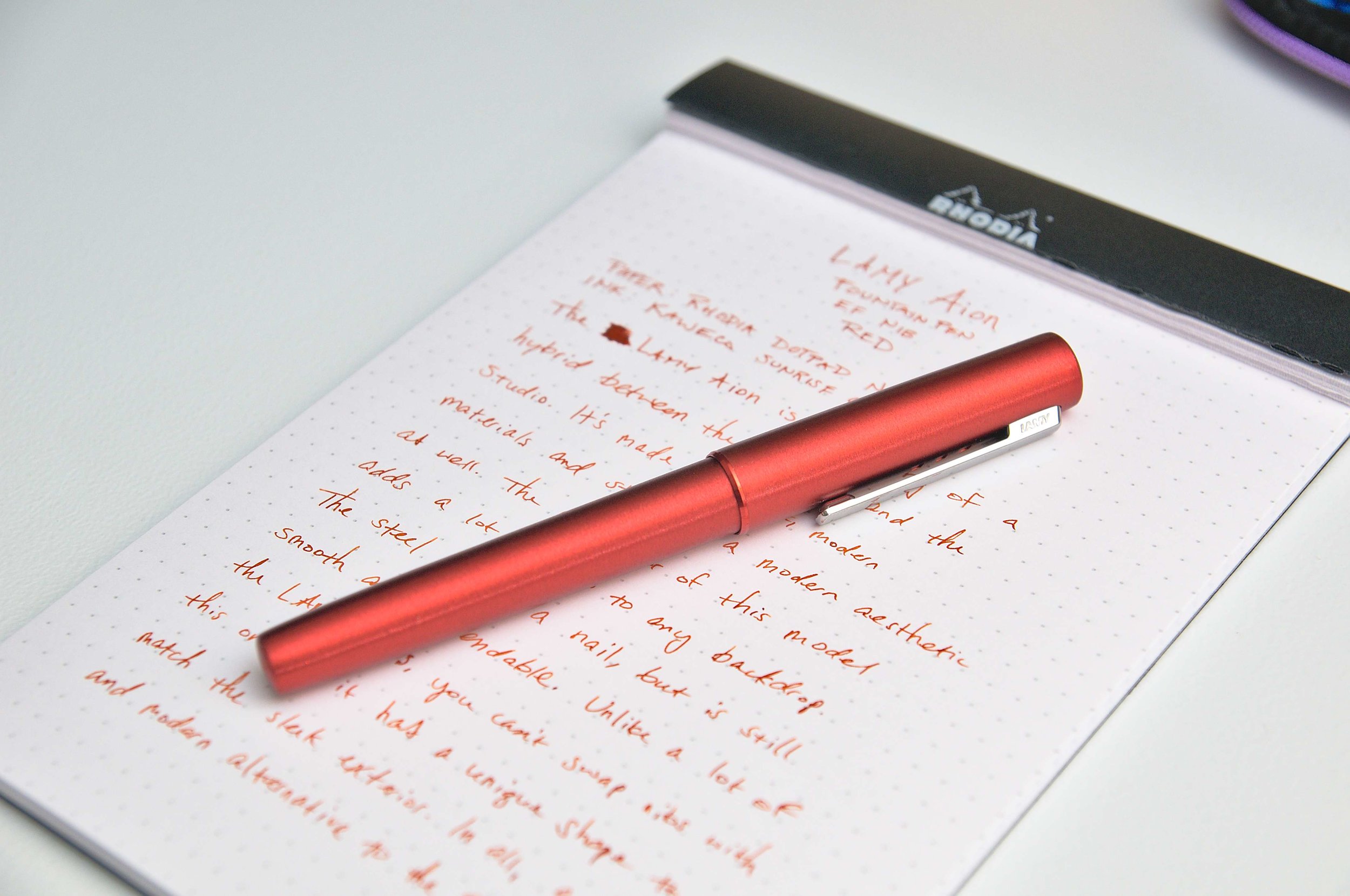
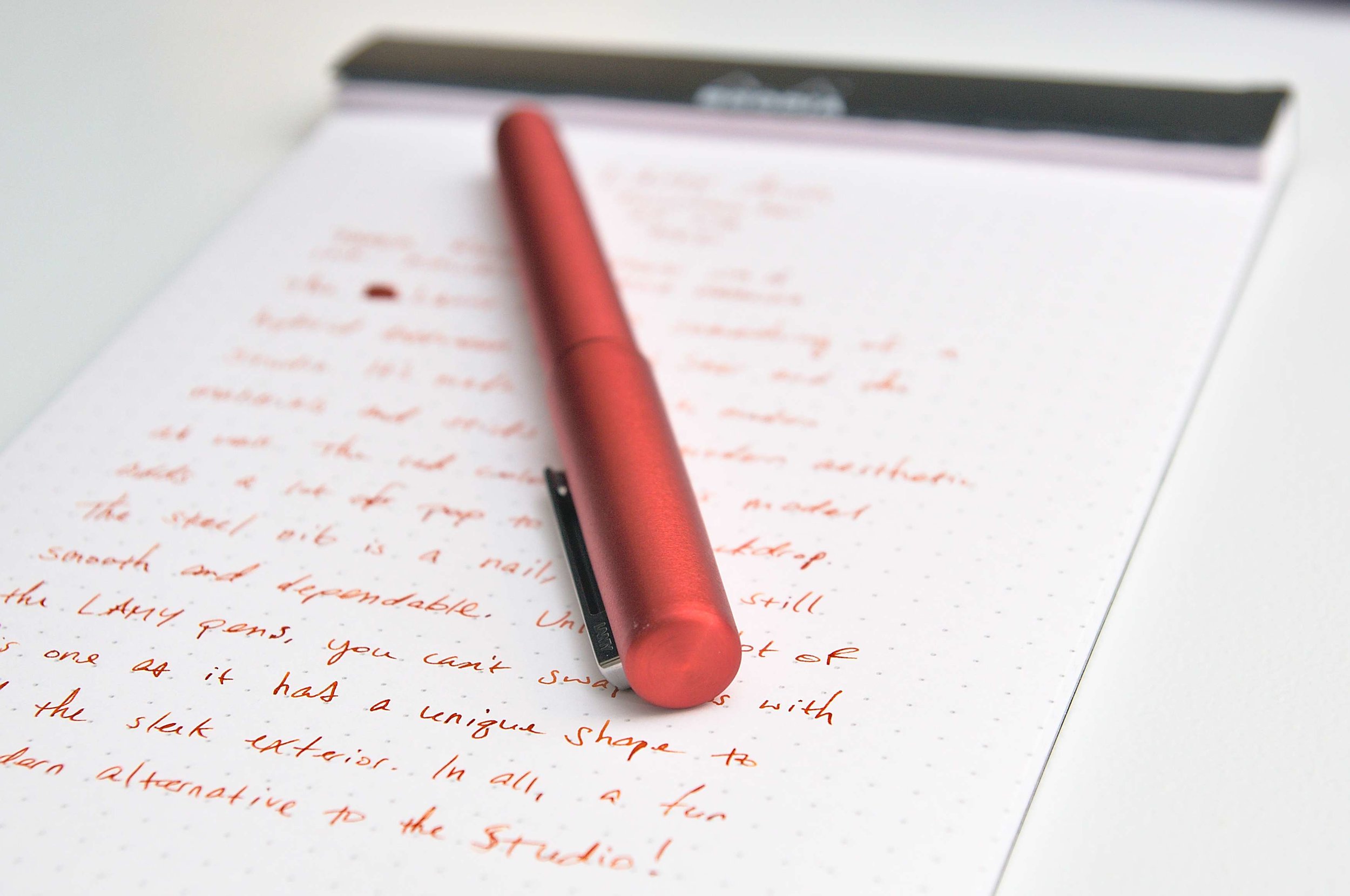
The Lamy Aion is a relatively new offering from the German brand, and I've been pretty slow about getting my hands on one. Now that I have one of these new pens in the fantastic red color, I can understand why I've seen so much about them. This pen doesn't replace any other pen in the Lamy line-up — but rather creates a new aesthetic offering in the Lamy Studio price-point.

After using this pen quite a bit, I've come to think of it as a more modern and sleeker AL Star. The pen is made entirely of aluminum, and it's roughly the same size as the less-expensive cousin. The aluminum is lightweight, but also feels incredibly durable. In places where the AL Star can feel somewhat thin and delicate, this is a welcome change. Like every other Lamy, the cap is a friction fit snap system. The motion of uncapping and capping the pen is satisfying. It requires enough pressure to operate that you won't be concerned about this pen uncapping itself in a pocket or bag when it's jostled around. Capping the pen has an equally satisfying ker-thunk as well.

The cap feels like it's weighted on the top end, giving the pen a top heavy feel when it's capped. However, when posted, this extra weight at the top of the pen provides a nice amount of balance to the nib when you're writing. The pen barrels fits into more than half of the cap, which is a good thing since this is a fairly long pen to begin with. When posted, it becomes almost too long.

There's also a new clip system for the Aion. Borrowing from the 2000, the Aion clip is spring-loaded, giving it excellent grip on pockets and bags. It's a very smooth motion and has a secure feel. I'm really impressed with this clip system and really with the Studio used something similar, as the Studio can be somewhat difficult to clip onto things.

The aluminum materials are quite nice on the Aion. According to the marketing literature, the barrel and cap are made of single pieces of aluminum. This gives them a high-quality, seamless feel that adds to the luxury of the pen. The barrel and cap are both brushed on the surface, which adds an interesting visual detail and a pleasing texture. The grip, on the other hand, is also made of aluminum, but has a blasted surface, resulting a smoother but still textured feel. The difference in texture also sets it apart visually from the barrel.

In almost every Lamy I've used (aside from the hooded 2000, of course), they use the same nib system, making it easy to swap and exchange nibs whenever you like. In an interesting departure, the Aion uses a unique nib shape, meaning you can't swap it with you other Lamy nibs. This is a bit disappointing since that's a major perk of the Lamy fountain pen system. The marketing literature explains this change as a decision to make the nib line up with the modern design of the Aion, but I don't think the Aion nib differs enough from the regular nibs to justify the unique fitting. They could have used the same standard Lamy nib without decreasing the modern aesthetic. Let's face it — all of Lamy's designs are fairly modern. That makes this nib change feel a bit off. Even the slightly-more-expensive Studio uses the common Lamy nibs.

Nib design choices aside, I've been incredibly happy with how it performs on paper. The nib is stainless steel and is as hard as a nail on the EF unit. The line is makes is consistent, thin, and sharp. Being as stiff as it is, there's absolutely no flex unless you apply enough pressure to also cut through the page. This nib is perfect for writing small and making exact marks. The orange ink (by the way, have I broken some unspoken rule by putting Kaweco ink in a Lamy pen??) compliments the red body perfectly, but flows out as smoothly as you can expect on such a fine nib.

The grip section may look smooth, but the blasted finish creates a fine and grippy texture that you can't see with the naked eye. When writing, I've had no trouble holding on to the pen through long writing sessions. Unlike the super-smooth grip of the Studio, the grip on the Aion is exception. The slow taper down toward the nib is also beneficial for gripping the pen. In all, this is an incredibly comfortable pen to use given the width and length of the barrel and the light weight of the pen. The textured grip just makes it even better.

You can certainly post the cap when writing with the Aion, and this will almost always come down to personal preference. It's already a "standard-size" pen, so I'd say posting isn't necessary. That said, the extra weight in the cap does change up the balance of the nib when writing, and I've actually really enjoyed it. If only the overall size of the pen wasn't so long in this configuration, I'd probably use it more. For me, the most comfortable position is unposted, but I've enjoyed playing around with the pen with the cap posted just for the novelty of feeling the balance thrown further back on my hand when writing. I assume this would be a great benefit for larger hands or higher grips (I have "medium" hands and a fairly low three-finger grip).

The new Lamy Aion comes in at just over $70. For that price, you get one free Lamy blue cartridge and a converter. The converter is definitely a nice touch and contributes to the premium feel of this pen. All together, the Aion is a premium Lamy fountain pen that offers an alternative to the heavier and more classic Studio option. While the Studio does offer some nicer finishes and gold nibs in the higher range, the "base" Studio compares directly in price to the Aion. This is great for buyers because you can pick from two excellent pens purely by which aesthetic speaks to you more. The $75-100 range for fountain pens is always a bit awkward as far as value goes, but I think the Aion manages to justify its price tag with the elegant aluminum materials, high-quality cap design, and great writing experience.

There are four color options available for the Lamy Aion: Red, Dark Blue, Olive Silver, and Black. All four color ways offer extra fine, fine, and medium nib options, while the Black and Olive Silver colors offer broad as well.

(JetPens provided this product at no charge to The Pen Addict for review purposes.)


Enjoy reading The Pen Addict? Then consider becoming a member to receive additional weekly content, giveaways, and discounts in The Pen Addict shop. Plus, you support me and the site directly, for which I am very grateful.

Membership starts at just $5/month, with a discounted annual option available. To find out more about membership click here and join us!

Posted on July 24, 2019 and filed under Lamy, Aion, Fountain Pens, Pen Reviews.