Posts filed under Mechanical Pencil

Tactile Turn Stainless Steel Pencil Review

(Jeff Abbott is a regular contributor at The Pen Addict. You can find more from Jeff online at Draft Evolution and Twitter.)

Tactile Turn is one of those names that the Pen Addict crowd have heard about at some point or another. Maybe you've seen the brand on Instagram, or seen one of the Kickstarter campaigns for their unique machined pens. Or, maybe you've seen one in person or even own one (or several) of these high-quality metal pens. Whatever the case may be, if you haven't heard of Tactile Turn before today, it's your lucky day.

Starting with a machined pen to hold either a Parker refill or a Pilot G2 refill, Tactile Turn made their debut many years ago with the Mover and Shaker pens. These are still available today, but not in their initial form. The team at Tactile Turn have iterated on these pens to make them the best possible version. They also make several other pen models, including a sliding bolt variety and even a fountain pen.

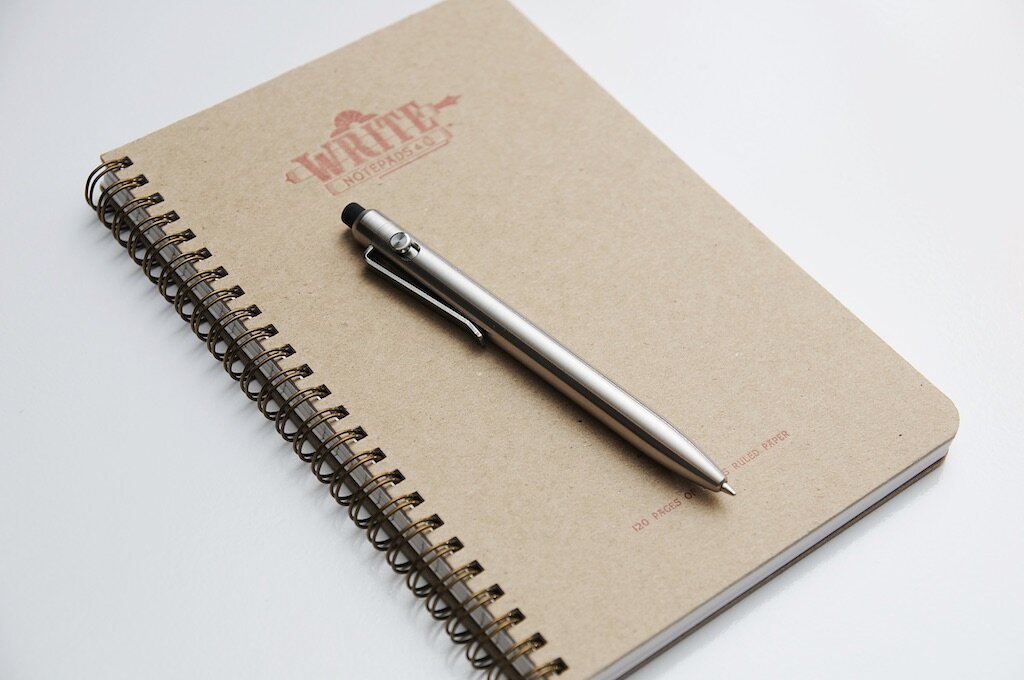
Most recently, the gang at Tactile Turn have produced an outstanding mechanical pencil that features the same design cues as the rest of their unique lineup. The mechanical pencil, dubbed the Pencil, borrows the shape and bolt design of the Bolt Action Pen but manages to squeeze in a mechanical pencil insert instead of a pen refill. And of course, what mechanical pencil would be whole without an eraser on top? The Pencil features a larger than normal black eraser for those mistakes that you just can't stand to leave on the page if you forgot your big eraser at home.

When purchasing the pencil, you can choose between a 0.5mm and 0.7mm lead size component, and you can also opt for a Damascus bolt over the standard titanium bolt. Not sure what Damascus is?

Titanium Damascus is different allows of titanium that are forged together and twisted to create a cool pattern. After they are machined, we heat them to bring out the pattern. Every bolt looks a little different. These are unique pieces and every one has variation from the next.

For an extra $20, I would go for the Damascus bolt every single time, and that applies to the Bolt Action Pen as well. The pop of blue-green-purple color on the all-business machined body is just too good to pass up.

The bolt is an interesting way to advance the pencil lead. Opposed to the Bolt Action Pen, which has a curved path for the bolt to slide down into action, the Pencil has a short 4mm path for the bolt to travel down. It doesn't feel entirely natural, but you can get used to it. Another aspect that doesn't feel entirely natural is the amount of force you have to use in order to advance the lead. It would be easier if the bolt was bigger or stuck out further, but that would ruin the aesthetic. Maybe a lighter spring on the internal pencil component would also help? Either way, I have found it slightly frustrating to operate the bolt on this pencil, but it's not a deal-breaker for me. After a little use, my thumb remembers how to operate it efficiently.

Another small design decision that gets under my skin is the fact that the lead pipe doesn't retract into the pencil body. This isn't something that you find on many mechanical pencils in general, but it's always nice to have. To be fair, I can't even imagine the engineering nightmare it would be to design a retracting lead component on this pen, and that's probably the end product lacks it. This omission doesn't detract from the pencil at all, as the point isn't very "pointy" and doesn't get stuck on things (like the insides of pockets) very easily as long as the lead is retracted.
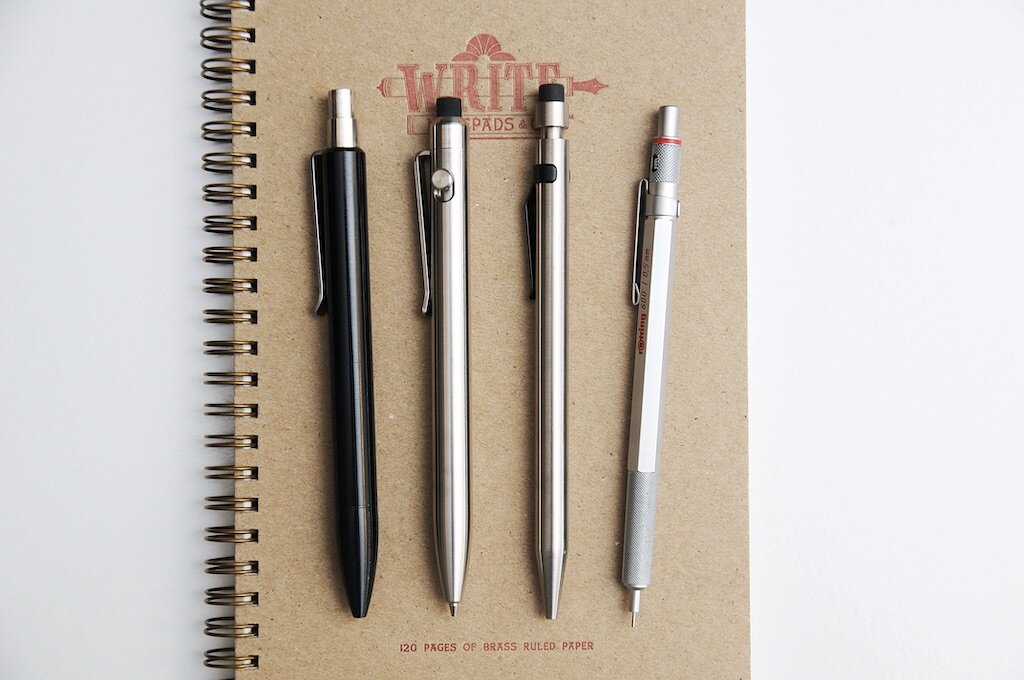
Moving on to the rest of the pencil, you'll certainly notice the heft of the stainless steel model as soon as you pick it up. It's not a lightweight pencil! The entire body features the same uniform grooves that go around the body to create a tiny and textured grip surface that feels great to hold. On top of feeling great, it also gives the pen part of its unique aesthetic that all of Tactile Turn's products boast.

The clip is the same clip that you'll find on all the other Tactile Turn pens, and it does a fantastic job. It's strong enough to keep the pencil attached to whatever you clip it into, and the aesthetic matches the rest of the pencil perfectly.

The eraser looks right at home on this pencil, and also offers an instant visual cue that this is indeed a pencil (in case you have several Tactile Turn pens laying around on your desk). I wish there was an option to purchase an alternative cap for the pen if you want to leave the eraser behind and prefer a more streamlined look for the top of the pen. An option like this would definitely diminish the utility of the pencil, but I'd buy one pretty quickly to add to my Pencil since I don't really need the eraser built into the top.

Writing with the Pencil takes a little getting used to because of the significant weight. Most of the mechanical pencils I use are extremely light, so this one is quite an adjustment. Of course, this is one of the heavier options available. If you prefer a lighter pencil, I'd go with the titanium or aluminum models.

The Tactile Turn Mechanical Pencil is certainly an attractive looking pencil that looks great on my desk, feels good in my hand, and does a good job at making marks on the page. A few design quirks aside, it's an excellent writing instrument that I would happily recommend to anyone that is drawn to the Tactile Turn aesthetic. The Stainless Steel model shown here starts at $89, but you can pick up an anodized aluminum version for $69, a copper or brass version for $79, or a titanium model for $99. With each model, you can spend an extra $20 to upgrade to a Damascus bolt over the standard titanium, and I'd highly recommend it.

(JetPens provided this product at no charge to The Pen Addict for review purposes.)

Posted on January 22, 2020 and filed under Tactile Turn, Mechanical Pencil, Pencil Reviews.

Staedtler 925-27 Color Series Drafting Pencil Review

(Jeff Abbott is a regular contributor at The Pen Addict. You can find more from Jeff online at Draft Evolution and Twitter.)

A lot of us got our start in fine-tuned stationery with precise drafting pencils. These were fairly easy to find in big box office supply stores, and even easier to find in college bookstores, art stores, and crafting supply stores. The specifications and features on these pencils went beyond the generic "0.5mm mechanical pencil" description, and that was deeply attractive to those of us that craved more precise control of our writing instruments and the ability to fine-tune our writing experience.

Drafting pencils have always held a special place in my heart. I would ransack my dad's supply in his oak roll-top desk when he wasn't home and explore all the old relics from his days as a drafting student in engineering school. Drafting pencils first introduced me to the concept that other lead sizes and lead holders existed outside of the 0.5mm and 0.7mm varieties we had access to during back to school shopping season. It was a fascinating and lasting glimpse into another world where it was obvious that people took these instruments very seriously, and that really resonated with me.

Fast forward a couple decades, and here we are. I have more pens and pencils than I'd rather count, and I'm aware of a vast majority of writing instruments and endless customization options. Even though my interests and preferences have expanded, I always remember the humble beginnings of the drafting pencil with great fondness. And that's why the Staedtler 925-75 drafting pencil is an interesting product that is worthy of attention.

The Staedtler 925-75 has a very boring name, but the color options are very exciting in a world of black, gray, and silver writing instruments. Drafting pencils are usually very business-centric instruments, but the playful color options of this Staedtler line is refreshing. I have the purple option here, and it really does add a nice pop of color to my desk amidst the many other pens and pencils that frequent the desk space. With pastel color options that include green, purple, yellow, pink, blue, and white, you can definitely find something that fits your palette preference.

Aside from the fun colors, these are actually solid drafting pencils. While they only offer a lead size of 0.5mm, the plastic construction is solid and lightweight, while also keeping costs down. On top of that, there's a small lead grade indicator ring on top of the pencil to help you keep track of what type of lead is in the pencil.

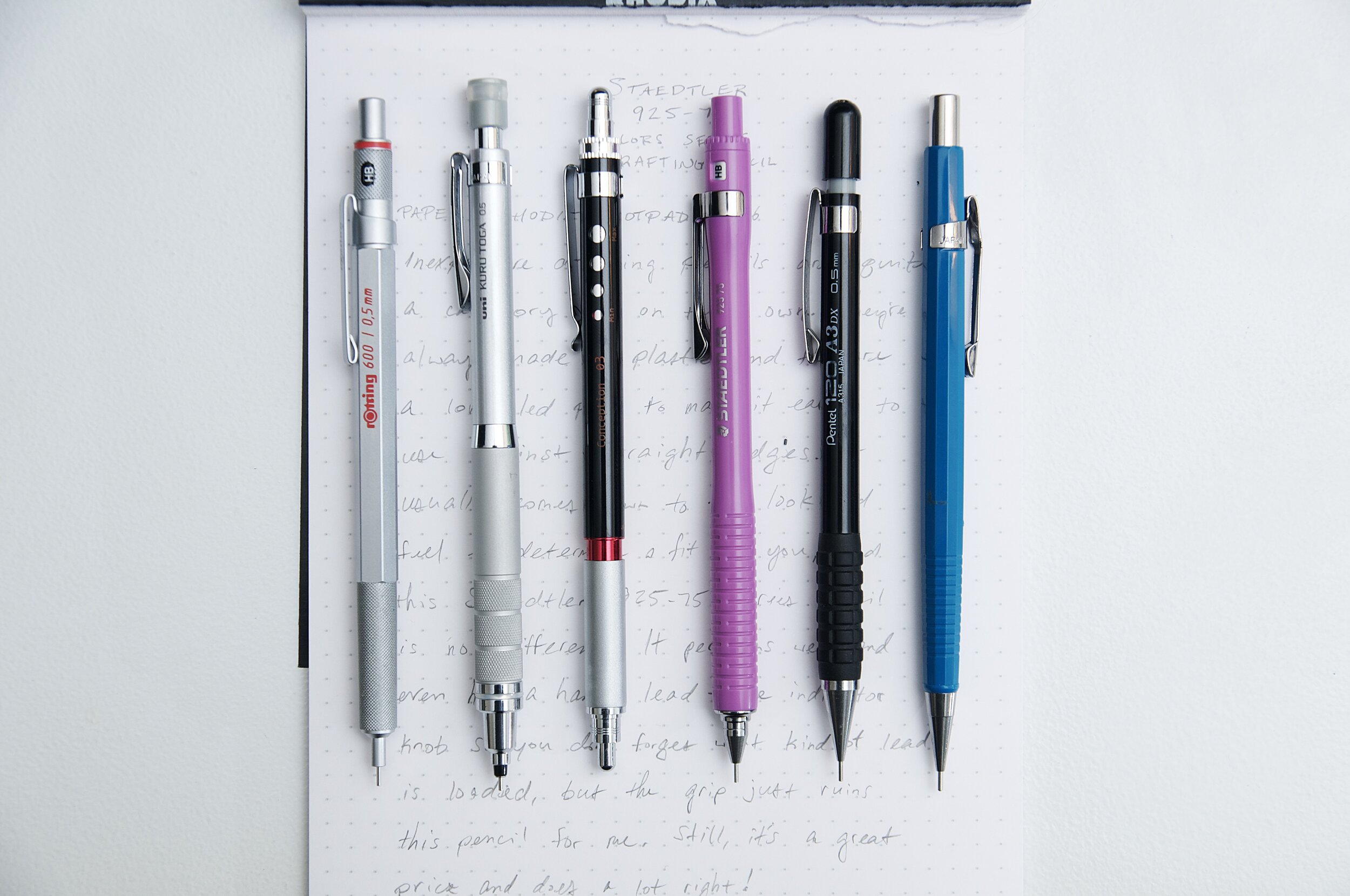
In concept, it's a great pencil at a great price, and I'm sure that it will work well for many. For me, the grip is just uncomfortable no matter how I hold it. As far as cheap drafting pencils go, I've always been very partial to the Pentel line — particularly the similarly-priced Sharp drafting pencils and the slightly more premium Pentel 120 A3DX pencils. At under six bucks for any of these, you can't go wrong. I just happen to prefer the grips on both of the Pentel models that I have.

The Staedtler pencil functions perfectly. The mechanical pencil mechanism is precise and crisp, and the material quality is top notch. The 4mm lead pipe provides excellent visibility and a nice solid piece to hold against a straight-edge when needed. It even includes the gratuitous (and mostly unusable) tiny eraser that doubles as the lead stopper. The inclusion of a lead grade ring indicator is nice, but it's too loose for me to trust. A slight bump of the ring is enough to move the indicator to a different lead type, which is annoying if you really rely on it. Comparing that to the Rotring 600 isn't fair given the price difference, but the Rotring lead grade ring has a good amount of friction that makes it really difficult to accidentally adjust it, while also being easy to adjust when you mean to.

At just over four bucks, it's hard to complain about such a great pencil. I really am splitting hairs when it comes to the Staedtler 925-75 line, and it mostly comes down to personal comfort and how the grip feels in my hand. It's an excellent pencil that ticks all the boxes in terms of how it performs as a mechanical pencil, and the price is really hard to beat for a drafting pencil!

If you like the colors of these pencils and need a good 0.5mm drafting pencil (or even a few for different lead grades), then give the Staedtler 925-27 a shot! It's a great pencil that will serve you well assuming you can agree with the grip.

(JetPens provided this product at no charge to The Pen Addict for review purposes.)


Enjoy reading The Pen Addict? Then consider becoming a member to receive additional weekly content, giveaways, and discounts in The Pen Addict shop. Plus, you support me and the site directly, for which I am very grateful.

Membership starts at just $5/month, with a discounted annual option available. To find out more about membership click here and join us!

Posted on December 11, 2019 and filed under Staedtler, Mechanical Pencil, Drafting Pencil, Pencil Reviews.

Pilot Birdy Switch Multi Pen(cil) Review

(Jeff Abbott is a regular contributor at The Pen Addict. You can find more from Jeff online at Draft Evolution and Twitter.)

Over the past few months, I've been trying out a collection of extremely small mechanical pencils. Earlier this year, I started this experiment with the adorable Zebra Techo TS-3, and was mostly happy with it as long as I threw in a couple of (pretty large) caveats:

Ultimately, I still like the Zebra Techo TS-3 strictly as a backup utilitarian option. It's not the first thing you reach for, and possibly not the second. But when all other options have failed or aren't nearby, it gets the job done.

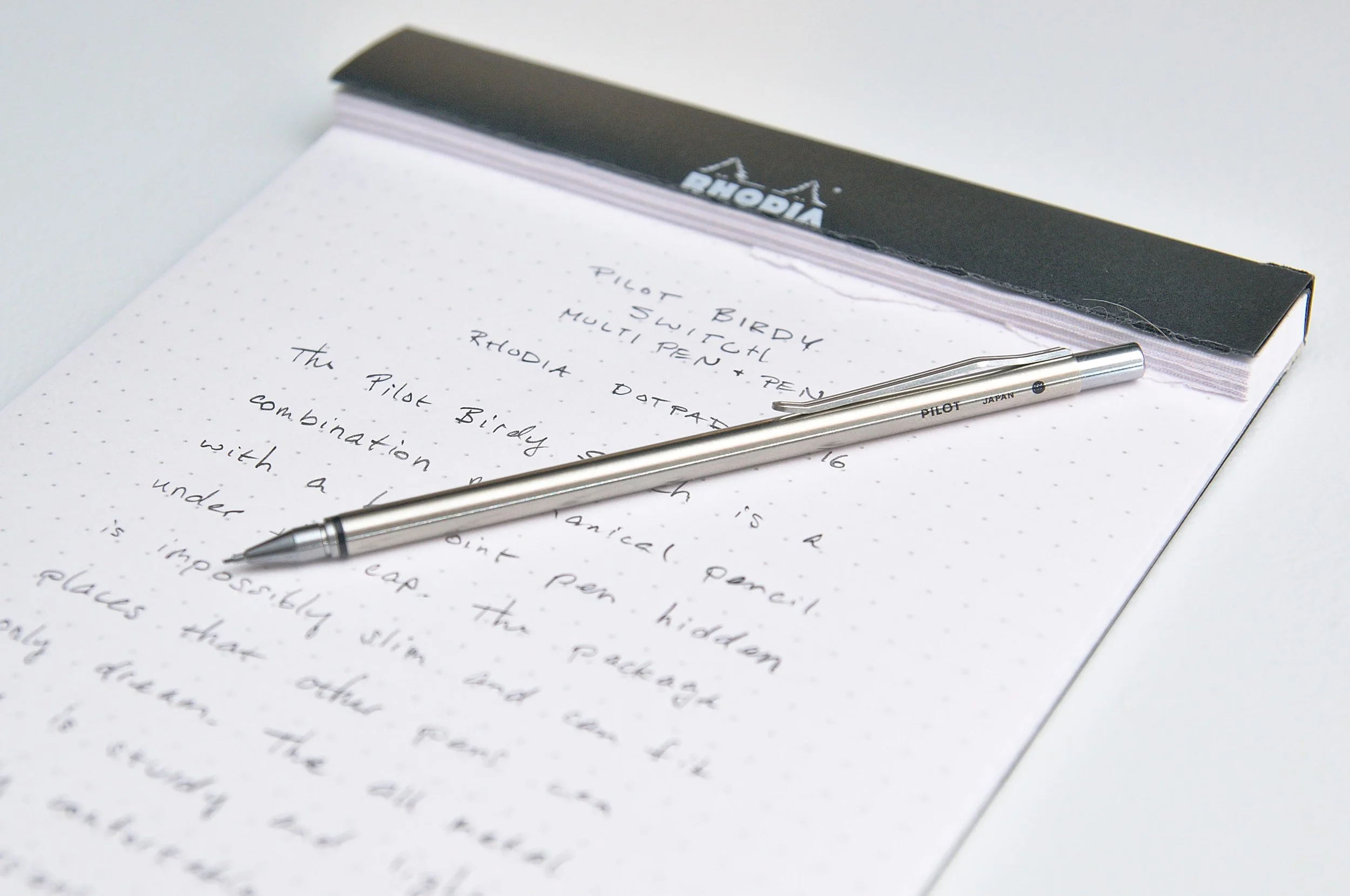
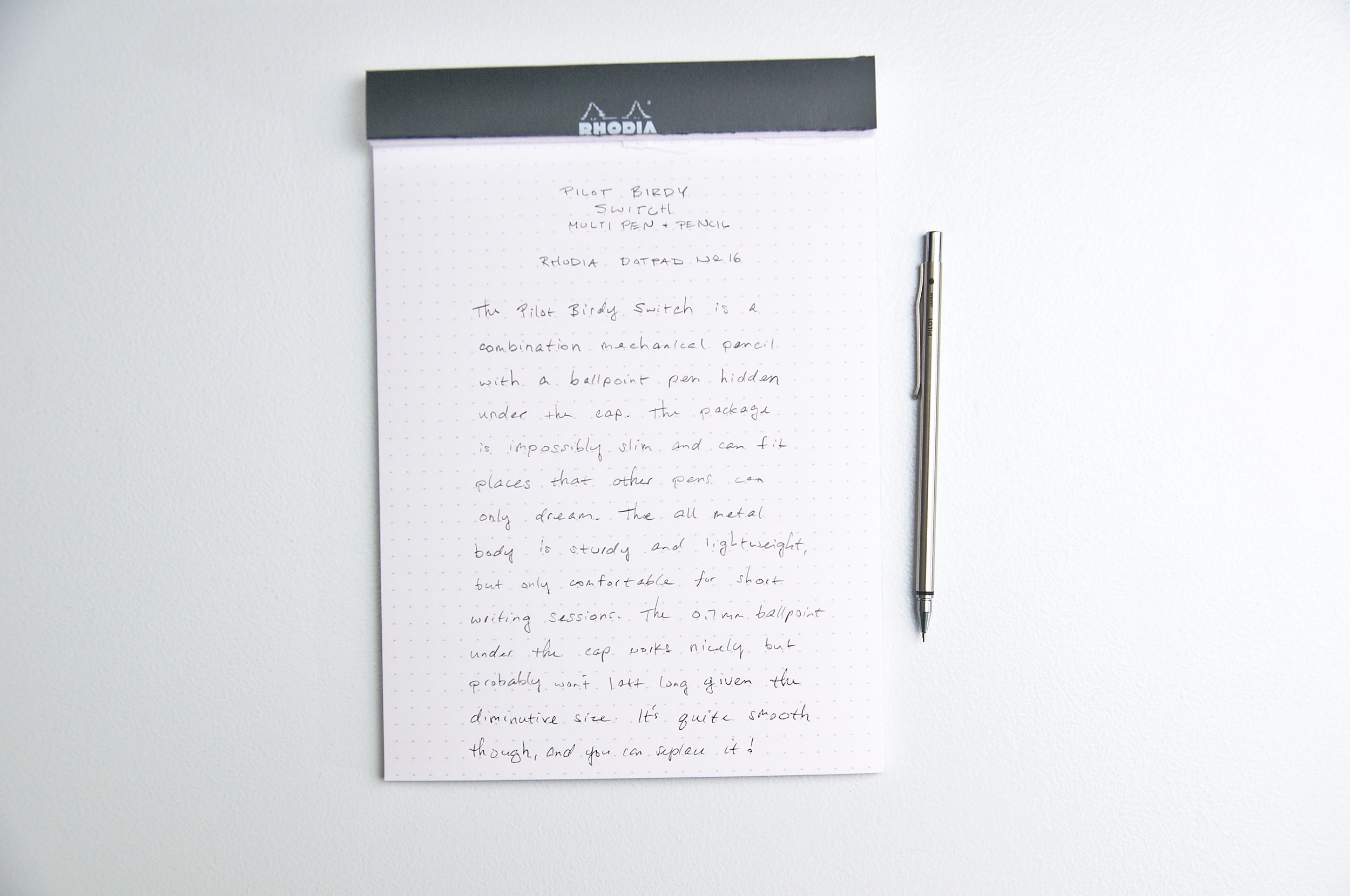
When I started using the Pilot Birdy Switch, my opinion was almost identical, but the added length of the Pilot, along with the additional hidden ballpoint pen, push it further down the line of utility. The Pilot Birdy is about the same diameter as the Zebra, which means it's not comfortable for long writing stints. This is certainly still in the "backup/last resort" category of writing instrument, but it's marginally more comfortable to use given the extra length.

But, the slim profile and relative short length still give it some major advantages in terms of where you can store it. Sliding this pen into between two pages of a notebook is easy and allows the notebook to still close without much of a bump or gap. And, the aluminum construction make it resilient enough to be stuffed and crammed into tight spaces that may exert a lot of pressure on the pencil. It handles these situations with ease. Like the Fisher Bullet, it just takes whatever you throw at it. Unlike the Fisher, the Pilot can definitely get a little stabby in your pocket if it is oriented the wrong way, so beware.

The main function of the Pilot Birdy Switch is a 0.5mm mechanical pencil. The pencil works great, and I haven't had any issues with it. I'm guessing it's the same mechanism that Pilot uses in their other multi pens, and I've always been happy with those. This one is just wrapped in a thin aluminum shell that makes it seem like you're writing with a long, bare multi pen refill instead of a real pen. But, that's what affords it the transport and utility points. To extend lead, click the cap. To retract it, hold down the cap and push the lead back into the tip. Unlike a lot of mechanical pencils, this one does not sport a tiny eraser or lead clog remover.

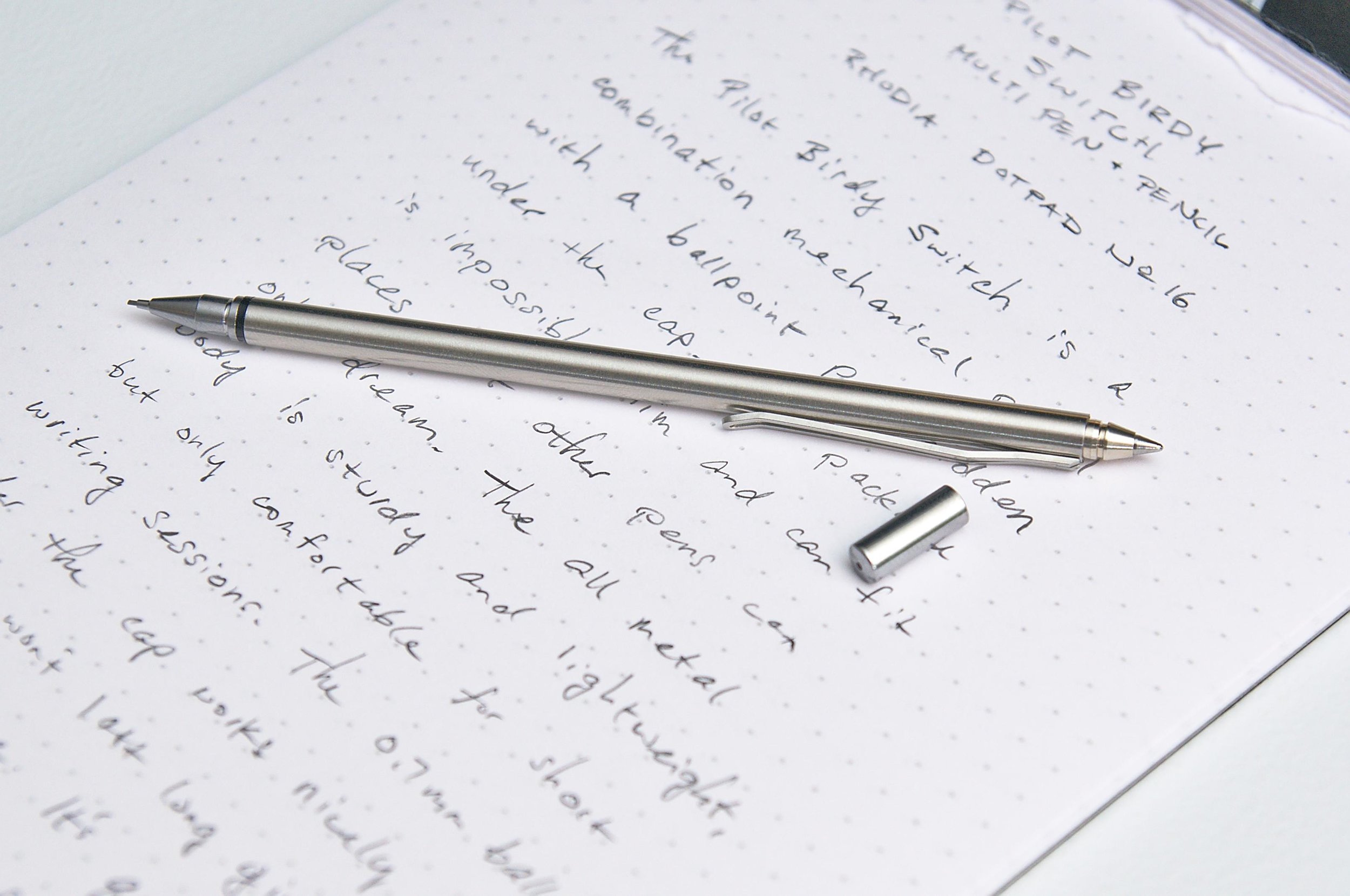
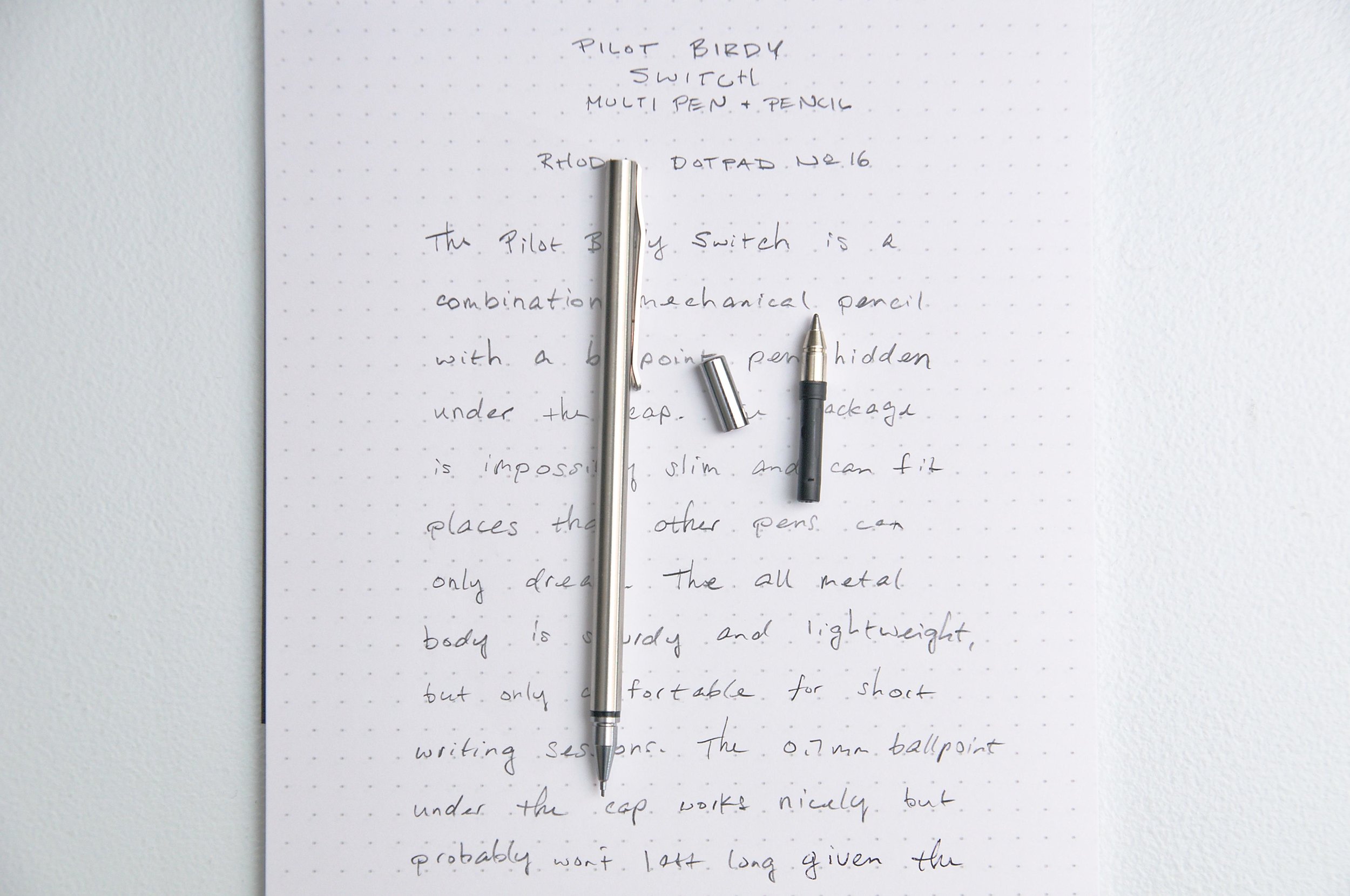
Instead, removing the cap reveals a tiny ballpoint pen. Honestly, I picked this pencil up in a JetPens order without fully reading the description. I just bought it because I was on a mini mechanical pencil kick, and all I needed to know was that it was a mechanical pencil. It wasn't until I got the pen, used it for a while, and then became curious how much lead was in the reservoir that I actually removed the cap. I was stunned to find the ballpoint tip! What a pleasant surprise. Of course, I tried writing with it and discovered that it's pretty smooth. I don't know for sure if it uses the same ink formula, but it feels a lot like the Pilot Acroball 0.7mm refill. This thing is tiny! Unfortunately, it only comes in black, but you can at least pick up refills.

Even more, I realized that the cap can post on top of the mechanical pencil component. When using the pen, the only thing that looks odd is the clip on the wrong end. This is such a simple and clever design. If you've ever written with a Vanishing Point, then you know whether or not you can comfortably use a pen with a clip next to your fingers, but the Birdy is obviously less comfortable given the size.

Still, having a pen of this size with both a pencil and a ballpoint pen is a great tool to have when you're in a pinch. The size makes it great for squeezing into a checkbook, wallet, purse, bag, notebook, and other small spaces. Like I said in the Zebra Techo TS-3 review, it's definitely not a workhorse writing instrument, but it's a great backup option. And at just $8.25, the Pilot Birdy Switch won't break the bank either.

(JetPens provided this product at no charge to The Pen Addict for review purposes.)


Enjoy reading The Pen Addict? Then consider becoming a member to receive additional weekly content, giveaways, and discounts in The Pen Addict shop. Plus, you support me and the site directly, for which I am very grateful.

Membership starts at just $5/month, with a discounted annual option available. To find out more about membership click here and join us!

Posted on October 2, 2019 and filed under Pilot, Ballpoint, Mechanical Pencil, Pen Reviews.