In over five years of writing this blog one thing has remained consistent since the start: Pen people are some of the nicest people on the planet. I have made some great friends, read some wonderful blogs, and most importantly, received a ton of support from like-minded individuals.
My pen friends are always eager to write a guest post or answer a question or ten. And sometimes, they are willing to send some of their prized possessions my way to test out. I know how attached I am to my pens, so for readers to send me a bit of their collection to try just blows me away.
Recently, I have struck up a friendship with a fountain pen aficionado I'll call Thomas, because that's his name. Thomas has read the blog for a while and listened to the podcast and has heard me catch the fountain pen bug something fierce. By reading and listening to my often times incoherent ramblings, Thomas felt he had a pretty good idea of what type of fountain pens I might like and should try. Luckily for me, Thomas has quite the collection and was willing to loan out a few of his prized possessions to me for review.
I am calling this series My Fountain Pen Education, since that's what this is. My experience with fountain pens has been limited so far, so getting to use, explore, and enjoy pens I may have never been able to handle without a large, upfront monetary outlay is an unbelievable treat. I consider myself very fortunate, and I hope I do these pens justice when sharing them with you.
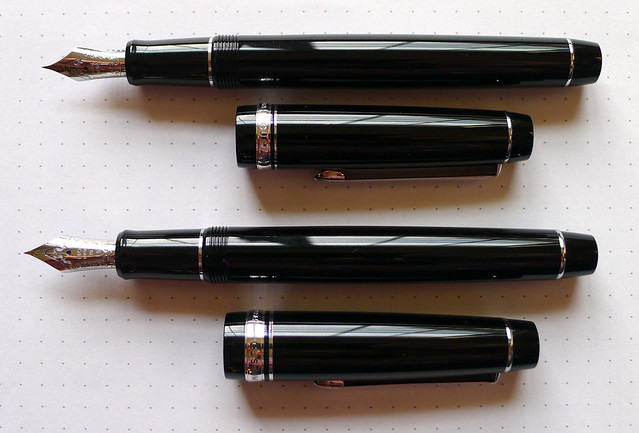
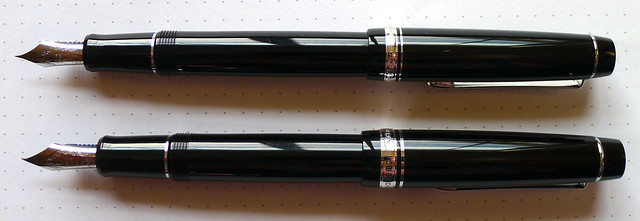
The Pilot Custom Heritage 91 (top) and the related Pilot Custom Heritage 912 were part of the first batch of pens that arrived on my doorstep. While similar looking at first glance, there are actually quite a few differences between the two models. The 91 is slightly lighter (17g) and shorter (137mm) than the heavier (20g) and longer (140mm) 912. The most obvious difference to the naked eye is the nib size. The 91 uses a #5 nib, while the 912 uses a #10.
What are these #5 and #10 nib numbers you speak of? I'm glad you asked, because I had to look it up myself. In general, it denotes the physical size of the nib - the higher the number, the larger the nib (and I don't mean tip size like, EF or M). And as best as I can tell, it is manufacturer specific. Kmpn has a great visual on his blog of the range of Pilot nibs.
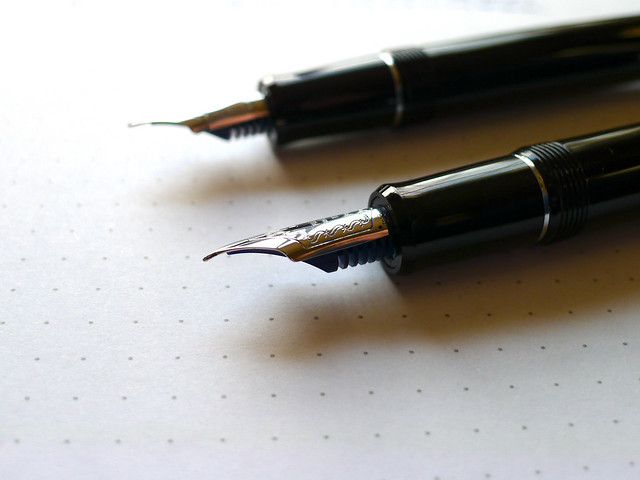
While learning that was helpful, what really piqued my interest with these two pens was the unique nib found on the 912. You can see it in the image just above. It is called a Posting nib, or PO for short. And I'll be honest with you - it scared the crap out of me! How do I use this thing? Am I going to damage it somehow?
This nib was designed for early Japanese post office cards, which required a firm, fine, and dark line to work well on their soft paper. Pilot designed this downturned nib to accomplish all of these things and still offer it today in several pen models.
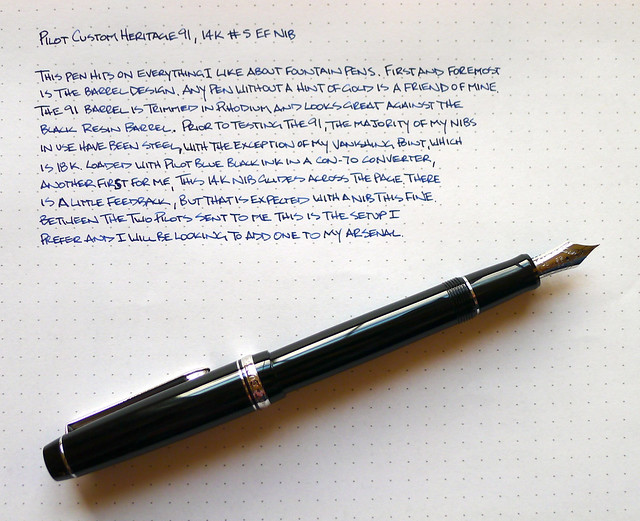
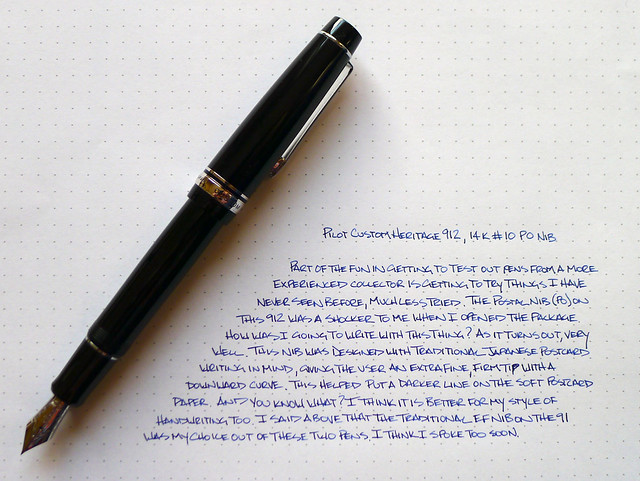
It took me a while to get used to the Posting nib when writing with it, and honestly I didn't care that much for it, especially in comparison to the more standard 14K EF nib found in the 91. I actually wrote the handwritten review for the 91 first and was raving about it. I love the look and feel of the pen and was dead set on it being the one I added to my wish list.
But something happened on the way to Japan. I did the handwritten review for the 912 immediately after the 91 and something clicked between me and the Posting nib. What exactly I'm not sure, but my handwriting turned out much better. Maybe it was forgetting what the nib looked like and just putting the words down on the page in my normal style. Regardless of what it was, I was hooked.
My education would not be complete without discussing the converter in these pens - the Pilot CON-70. (Update: Thomas has informed me in the comments that the 91 ships with the CON-50 and he upgraded it to the CON-70) The CON-70 is a larger capacity converter for the Pilot pens that can handle the added size. It uses a very simple push button plunger that you depress, and upon release, it sucks the ink right up into the converter. Super simple. Peaceable Writer has a great video of it in action (and was also a benefactor of the amazing Thomas).
So, after all the praise, what are the negatives of the Pilot Custom Heritage? From a usage perspective, there really aren't any. It is a beautiful pen that pushes all of my buttons. Black barrel, silver trim, fine nib, good ink flow, balanced when posted, comfortable when not. It is a true workhorse.
The only downside is the availability. This is a Japan-only model, and no US based retailers carry them that I have seen. If you are willing to go the eBay route, there are a few vendors that carry a wide array of models and nib sizes. With shipping, a Pilot Custom Heritage will run you in the $150-$200 range depending on the options.
I am adding the 912 with a PO nib to my wish list, and not just at the bottom. This pen is rocketing right to the top spot and I am doing my shopping research as we speak.
Or, maybe I just won't send this one back to Thomas.
Just kidding!
Maybe.