Posts filed under Pen Reviews

Franklin-Christoph Model 19 "1901" in Smoke and Cinnamaroon: A Review

(Susan M. Pigott is a fountain pen collector, pen and paperholic, photographer, and professor. You can find more from Susan on her blog Scribalishess.)

I don't know why I never considered purchasing a Franklin-Christoph fountain pen. I've seen a few photos of their pens in ice acrylic, and those didn't interest me. But after Franklin-Christoph came out with their monster 1.9 music nib, I found myself on their Web site looking at their pen offerings. One caught my eye: the Model 19. I liked the shape of the pen, and I saw they were working on a new color combination that I thought was unique and gorgeous–smoke with cinnamaroon bands.

I haunted the site daily, wondering when the new color would come out. Finally, I emailed them to get the date and received a response almost immediately: "They're done and should be on the Web site tomorrow!" The next day I ordered one.

The pen arrived a few days later, but I made myself wait until Friday, my writing day, to open it. It was well-packaged, and by that I mean an outer postal box, an inner postal box, bubble wrap, and packing paper around a plain white cardboard box with the Franklin-Christoph logo.

Inside was a maroon leather zip pouch with the pen, two blue ink cartridges, a couple of Franklin-Christoph business cards, and a Mike Masuyama card verifying that my medium 18K nib was ground by him into stub.

The pen is large. The barrel is .61 inches in diameter, and it's certainly the fattest pen I've used. It's a good thing they included the pen pouch, because Model 19 absolutely won't fit in my Franklin-Christoph Penvelope.

Penvelope.jpg

Although the barrel is wide, the grip gradually narrows from .50 inches to .425 closest to the nib. So, while the pen itself is much wider than my other fountain pens, when you compare the grips, they aren't drastically different.

Its length is more typical of fountain pens: 5.50 inches capped, 5.1 inches uncapped, and 6.62 inches posted (though I would never post this pen). At only 28.35 grams without ink, the pen isn't heavy for its size.

Made of thick acrylic, this version has swirls of dark and light gray with beautiful sheen. The cinnamaroon bands sparkle and offer a truly unusual contrast to the smoke colors.

The clip is rhodium plated and etched with four diamonds. I never use the clip on my pens, but this one seems sturdy.

The cap top is inscribed with the Franklin-Christoph logo, and "Franklin-Christoph" is etched into the cap where ordinarily you might find a cap ring.

The nib is a single-tone, rhodium-plated 18K gold nib with minimal styling. A yellow diamond with the logo adorns the nib. I'll admit I don't like this nib's design (the stainless steel nibs are actually prettier). The etched yellow diamond clashes with the rhodium plating of the nib. I wish they had simply etched the logo into the nib itself (like they do on the stainless steel nibs) and added scroll work.
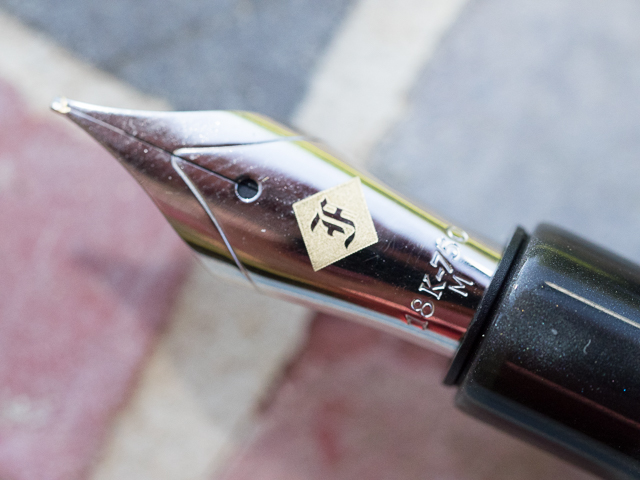
I like the size of the nib and the stub doesn't catch on the paper like some of my italic nibs do. Although the nib has no flex, it's springy, and you can get a little line variation if you press down.

I've noticed a few hard starts and a tiny bit of skipping with this nib. Normally I wash a new nib thoroughly before inking it, but I failed to do that this time. When I change ink, I'll do a good cleaning and see if the skipping stops. The problem may be related to the converter. I noticed that the ink pooled in the middle of the converter after the pen had been lying on its side for the evening. I had to force the ink down using the knob to get it flowing again.

The pen uses cartridges or an included converter. The cartridges look minuscule next to this big pen. The converter seems adequately sized, but I'm not impressed with its performance so far. It lacks a metal ball to keep the ink flowing. And, unlike other models in the Franklin-Christoph line, apparently you can't turn the Model 19 into an eyedropper.

Unfortunately, this pen is simply too wide for my small hands. I noticed that, after just a few pages of writing, my wrist felt fatigued, a problem I've not encountered with my other fountain pens. It's not the weight of the pen; the large barrel seems to be the main issue.

Franklin-Christoph offers a lifetime warranty on the pen, which tells me these pens are built to last. There's also a generous 30-day return policy, no questions asked.

You can order the Model 19 from Franklin-Christoph with a stainless steel nib in a variety of sizes for $195. If you want it with the impressively-sized music nib either in shiny stainless steel or the new stealth shadow, you'll pay $205. With 18K nibs from EF to B the cost is $285. For a Masuyama specialty nib in stainless steel you'll pay $210 and $300 for an 18K.

Pros

  • Stunning pen at a reasonable price. The smoke design with the cinnamaroon bands is unique and beautiful.
  • An amazing variety of nib choices in both steel and 18K gold.
  • Very light pen considering its size.
  • The Masuyama medium stub writes beautifully (but see below under cons).
  • Comes with a handy zippered pen pouch. You'll need this, as the pen won't fit in normal-sized pen loops or pen cases.
  • Prompt and courteous customer service.
  • Comes with a lifetime warranty.

Cons

  • This pen is large. If you have small hands it might not be comfortable for you.
  • I prefer piston-fillers over cartridge/converter pens. But converters are often easier to clean.
  • The converter does not move the ink to the feed without some user intervention, which is bothersome. This could be due to the ink I was using (Diamine Red Dragon). Some inks flow better than others.
  • My nib had some hard starts and a little bit of skipping, perhaps due to the converter/feed flow problem.
  • I don't particularly like the 18K nib design, but this is purely personal taste.
Posted on May 8, 2015 and filed under Pen Reviews, Franklin-Christoph, Fountain Pens.

Kaweco Skyline Sport Fountain Pen Review

(Susan M. Pigott is a fountain pen collector, pen and paperholic, photographer, and professor. You can find more from Susan on her blog Scribalishess.)

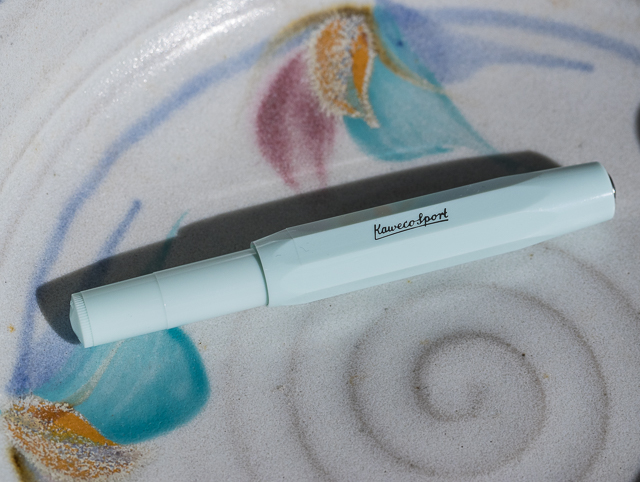
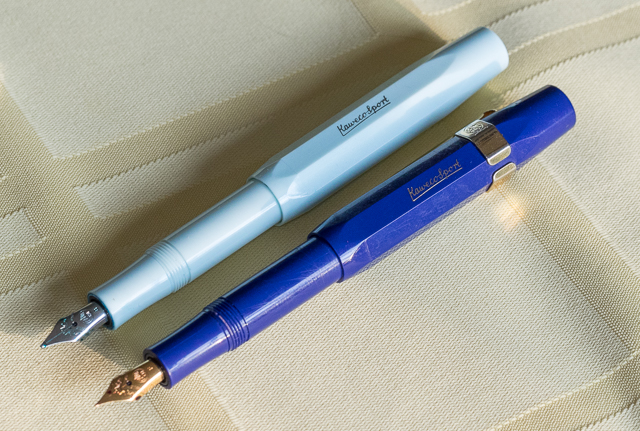
The Kaweco Skyline Sport is one of Kaweco's many diminutive fountain pens. Only 4.1 inches long when capped, the pen lengthens to 5.2 inches posted which makes it comfortable for writing. The pen's body is made of plastic, and the nib is steel. The Skyline Sport comes in three colors: gray, black, and mint. I chose mint because it is an unusual color and reminds me of spring. I don't really see much of a difference between the Skyline Sport and the Classic Sport. JetPens says that the Classic is 5.3 inches posted vs. the Skyline at 5.2 inches, but they look the same length to me. The only other difference I could find is that the Classic comes with gold-plated nibs and the Skyline with chrome-plated.

The packaging is nothing special--just a simple black, cardboard box with the pen in a plastic sleeve. The pen comes with one blue cartridge, so if you buy a Kaweco, plan on ordering additional cartridges and/or purchasing a converter to use your own bottled ink.

The pen is simple but beautiful, with clean lines and minimal adornments. The cap has a metal medallion on top with the Kaweco logo, and "Kaweco Sport" is engraved on the pen's body.

The pen does not come with a clip, though you can purchase one for $6.75. The clip I bought for my original Kaweco Sport isn't very functional. If you exert any pressure to clip it to a notebook or a pocket, it slips right off the barrel. I like the design of Kaweco's new deco clips, so I might buy one just to enhance the Skyline's appearance.

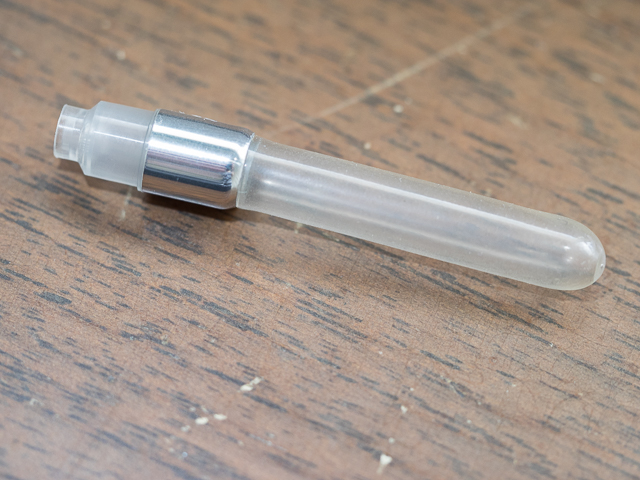
Because I don't like being limited to cartridges, I purchased Kaweco's squeeze converter ($3.00).

The converter is tiny and is impossible to fill without a huge mess. I tried filling the converter first, dipping its opening into the ink and squeezing, and I wound up with Diamine Mint all over my hands. Then I attached the converter to the nib unit and tried filling through the nib. No matter how many times I squeezed the converter, I could only get a tiny amount of ink to go in the sac. So, I resorted to squeezing, pulling the nib out, turning the tip up, tapping on the sac to get the ink to go to the bottom, and quickly dipping and squeezing again. After several attempts and very inky fingers, I was able to get the converter mostly full.

To put it bluntly, the converter is a pain to use. It might be better to purchase a syringe to fill the converter or to fill empty cartridges. Or you can easily convert the Kaweco into an eyedropper by putting silicone grease on the threads and filling the body of the pen with ink. One other thing I discovered about the converter: dark inks stain the plastic sac.

I was looking forward to trying Kaweco's broad nib. My Kaweco Sport has a fine nib that writes quite well. I wanted to see if the broad nib offered more line variation. Unfortunately, I'm disappointed with the broad nib.

After writing with it for a day, my hand grew tired because I had to put a good amount of pressure on the nib to get the ink to flow. I soaked the nib and feed in some pen wash while I was at work, rinsed, reassembled, and let the pen sit for a while, nib down, to let the ink soak into the feed. This seemed to help, at first. I got good ink flow and the pen wrote smoothly. But after a few pages, the flow petered out, and I was having to use some pressure again. The nib probably needs adjusting.

I don't really expect much from a $23.75 pen with a steel nib. But my other Kaweco writes quite well, and I don't have to use any pressure at all. From what I've read on the fountain pen forums, Kaweco nibs vary in quality from pen to pen, which is unfortunate.

Interestingly, the difference between the fine and broad nibs isn't all that noticeable. I expected the broad nib to be much wider than it is. When put side-by-side with a fine nib, the broad nib looks substantially larger.

But when you write with it, the portion of the broad nib that actually touches the paper is small.

Writing samples from the broad and the fine nib just don't look very different. The broad nib seems more like a medium, if that.

The Skyline Sport is made of plastic, and it feels rather cheap in the hand. The plastic has a few rough spots, but overall the grip is smooth and the threads aren't annoying.

However, as you can see in the photo of my older Kaweco Sport, the plastic scratches easily with everyday use. Posting the cap leaves indentations in the barrel.

One advantage of the Kaweco Skyline's small size, is that it fits easily into a pocket or purse. My Kaweco Sport kept getting lost in the depths of my bag, so now I keep it in the zippered plastic pocket of my small Midori notebook (it won't fit in the pen loop because the cap is too big).

Pros

  • Small, convenient size
  • The Skyline model comes a unique mint color as well as black and gray
  • Inexpensive. but you get what you pay for
  • If you are lucky enough to get a decent nib, the Kaweco writes quite smoothly

Cons

  • The pen seems cheaply made, has some rough spots, and the body scratches easily
  • The cartridges hold a small amount of ink
  • The converter is fiddly and messy to use
  • The broad nib, so far, writes dry and requires pressure to keep the ink flowing

You can purchase the Kaweco Skyline Sport Mint at JetPens for $23.75. Cartridge refills cost $2.30 for six. The Kaweco squeeze converter is $3.00. And a chrome Sport N Clip is $6.75.

Posted on April 24, 2015 and filed under Kaweco, Pen Reviews.

Uni-ball Signo Limited Edition Hello Kitty Gel Ink Pen Review

Image via JetPens

Image via JetPens

I have a Hello Kitty pen, and I'm not afraid to use it.

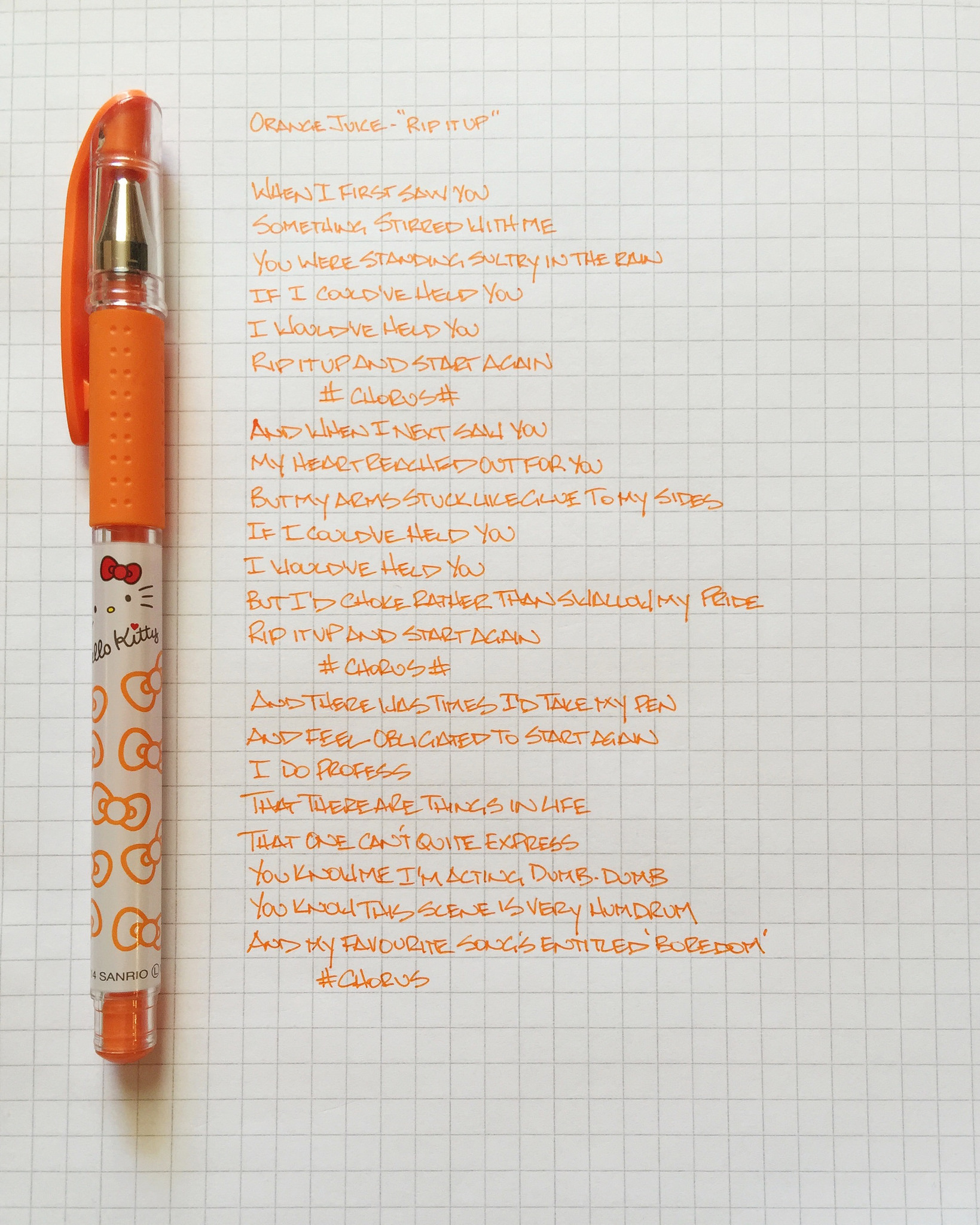
I mean look at this pen - it's amazingly well done. I wouldn't expect anything less from Uni-ball, especially with their premier gel ink pen lineup in the UM-153. And including one of Japan's most timeless characters in Hello Kitty they had to get this right. And they did.

The Uni-ball Signo UM-151, also know as the DX, is the best gel ink pen on the market, especially in the sub-0.5mm range. It has been atop the rankings in my Top 5 Pens list for ages, and is a joy to use. Pilot Hi-Tec-C owners may want to challenge you to a duel over statements like these, but their pen will likely misfire when challenging you, leaving you to walk away unscathed. I should know, I used to be one of those people.

What makes the DX so good is the consistency and sharpness of the line. It is always ready to write, and when it does, it does so perfectly. The colors are brilliant too. Uni-ball has the best non-standard colors in my opinion, just like the orange seen here.

In a non-surprising twist, the Hello Kitty Signo DX is fyling off the shelves at JetPens. Five of the eight colors are out of stock, and being a limited edition, I don't know if and when they will be back. If you are interested in picking one, or several, up keep your eyes peeled.

(JetPens provided this product at no charge to The Pen Addict for review purposes.)

Posted on April 6, 2015 and filed under Pen Reviews, Signo DX, Uni-Ball.