
Posts filed under Pen Reviews

The Pilot Explorer, Revisited

(Jeff Abbott is a regular contributor at The Pen Addict. You can find more from Jeff online at Draft Evolution and Twitter.)

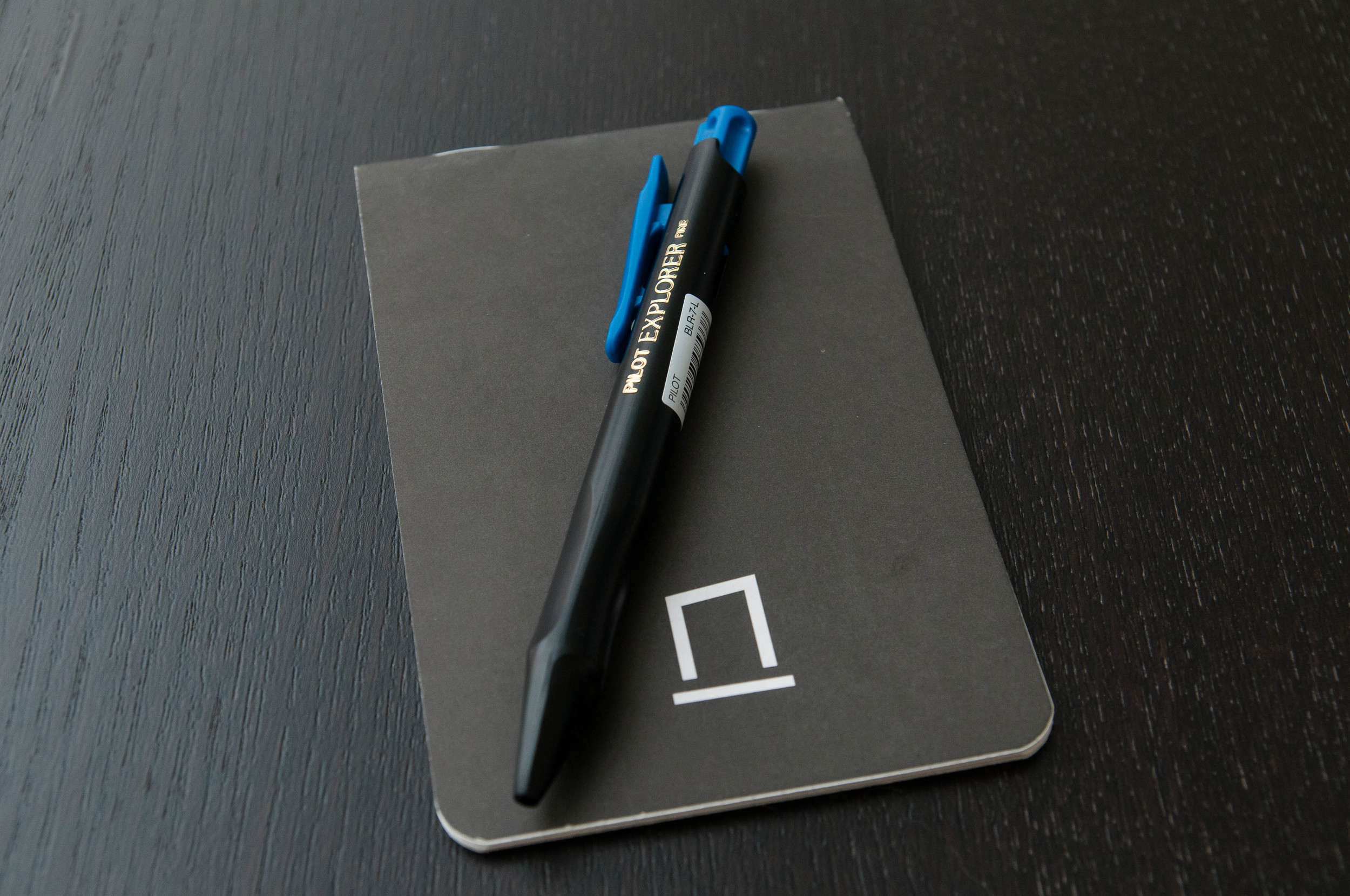
The Pilot Explorer is one of those pens that we've probably all seen if we were of writing age through the 80s and 90s. From what I remember, it was an easy pen to find in the day. Any big box retailer that sold pens probably had the Explorer on the shelf, and probably also sold it in boxes of a dozen if that's the kind of thing they were into.

But today, alas, the Explorer is a dying breed. These pens are seriously difficult to come by. Unless you have a personal stash, know someone with a personal stash, or come across some at an auction or random store, you're pretty much out of luck. From what I've seen, there aren't any retailers that knowingly stock this pen.

That being said, why does it matter? Why should a discontinued pen be something we talk about? Well, it's a unique, quirky design for a pen, but it's also one heck of a writer. Yes, there are many, many pens that can out-perform, out-class, and appeal to larger groups, but this is acknowledging something that was a great product that vanished for unknown reasons. We're reliving the glory days, man! "I lived through the Explorer era — you know, before they were famous and celebrated." If that's you, you know exactly what we're talking about.

More importantly, this is one of those pens that excelled over the standard offerings in the retail stores at the time. This is pre-Signo 207, and I'm pretty sure pre-Pilot Precise days, so you can imagine what else you had to choose from at the stores. That's right — Bics and PaperMates. Ick.

Anyway, by today's standards, this pen doesn't win any awards, but it's still a well-performing pen that can keep up with the best of the retail offerings out there today.

Look and feel

This is probably the category that will polarize the most people. Two things: it has a grip style built into the body, so if you use a "non-standard" grip, it might be uncomfortable or unusable for you. Second, it has a unique look that people either love or dislike. I kind of lean toward the dislike fence, but view it more as an ugly duckling. This bad boy paved the way for other well-functioning but better looking pens.

The pen is fairly light, which makes it comfortable to use. Lucky for me, I use a fairly standard grip when writing, so this feels right at home. One thing I've noticed with this pen and refill is that you have to use a light touch when writing. If you start pressing down at all, it will dig into the page and get scratchy really quickly.

The knock has a really nice click sound when you click it down or release it with the integrated clip. For being a pretty cheap pen in the day, it's built really well. I don't know if they're refillable, but I'd feel pretty safe guessing that they're not. I'm sure some people could figure out a way to refill them, but it's not easy. I mean, Pilot put the pen together at some point, so it's only logical that you could take it apart without destroying it.
Writing

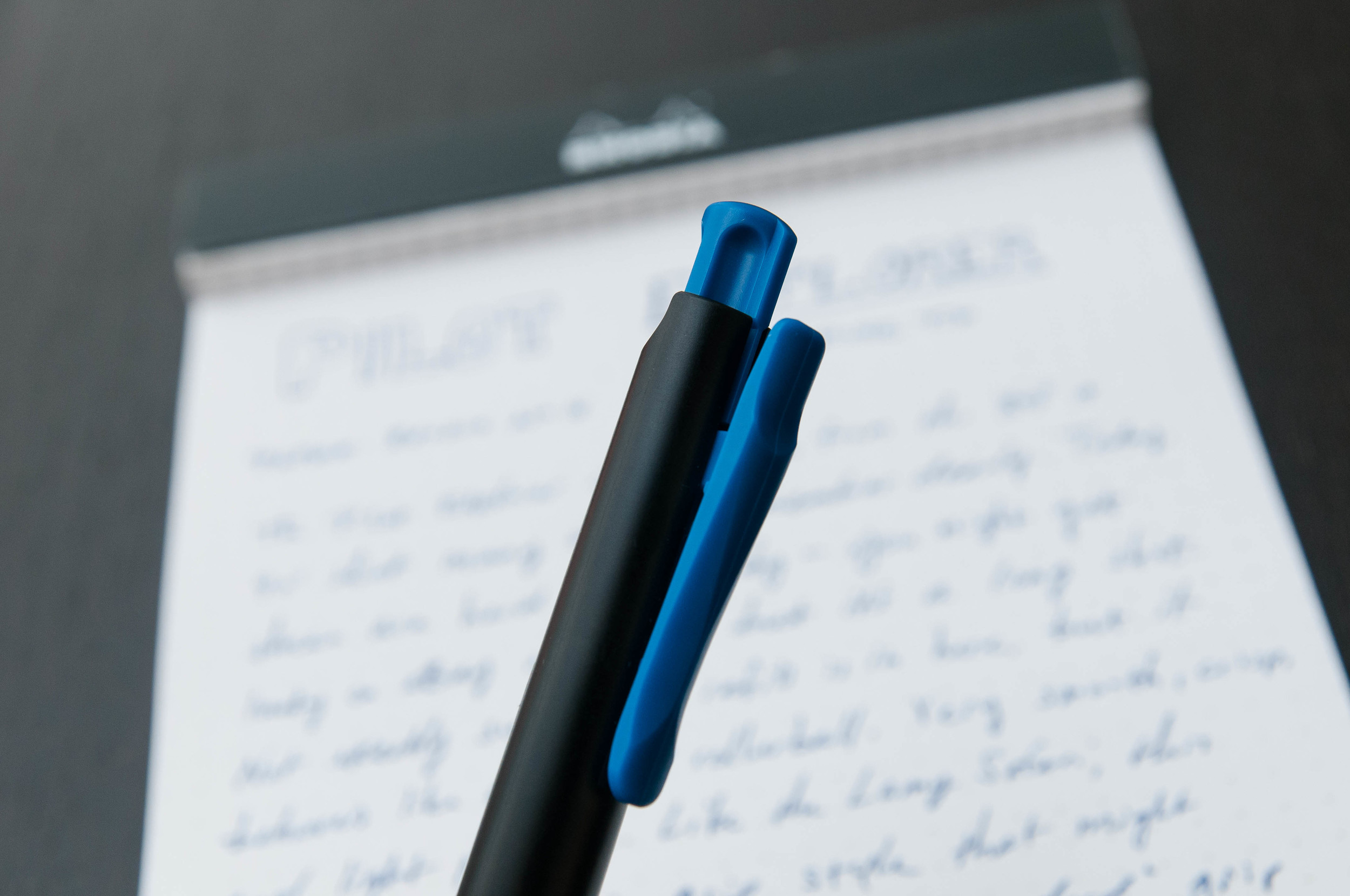
Like I said before, and like you can see in the pictures, this pen has a suggested grip for writing. If you use that grip, then that's great. If you don't, well...let's hope you can work around it. Just like Lamy, the Pilot Explorer is pretty opinionated on the grip topic. Once you get past that, you realize that this pen writes really well. The ink flow is great, but not too wet, and the lines are dark yet crisp. On different papers, I haven't noticed much (if any) feathering or show through.

The blue in this pen is extremely dark for a stock blue. It looks more like a blue-black to my eyes. The writing experience with this pen reminds me of using a Pilot Precise V5, which is a very good thing.

Conclusion

The Pilot Explorer is a fine pen. It writes really well, and it feels good in my hand. If I could buy these off the shelf today, they'd be high in my list of "best pens you can buy from big box retailers." Instead, it's now a treasure item that people stumble upon in random places, which has its own merits and rewards.

Growing up, it wasn't uncommon to find these pens lying around in a parking lot, at the bottom of a locker, or attached to a clipboard that someone gave you to fill out insurance paperwork at an office. It was ubiquitous. And then, for some unknown reason, Pilot decided enough was enough. It was an unwise decision, and one I hope they rectify at some point in the future. Great pen, great refill.

Posted on August 5, 2015 and filed under Explorer, Pilot, Pen Reviews.

Pilot Futayaku Double Sided Brush Pen Review

(This is a guest post by Nick Folz. You can find more of Nick and his work on Twitter, Instagram, and Tumblr.)

Here is the crux of my problem with brush pens - they are the imperfect imitation of an attainable thing. They are a cover band. They are the movie version of a beloved book. They are turkey bacon. They are not brushes, they are barely brush-like.

The problem with every felt tip brush pen I have ever used is the lack of "snap" or "spring." Sure, a real brush can be a bit unforgiving at times, but it's worth it for that je ne sais quoi when the ink meets the page and line thickens right where you want it too and as the brush lifts and the tip flicks back to its original shape leaving a line tapered to perfection like a wisp of smoke. Sweet ink bliss.

So, now you know how I feel about this sort of thing. This is a review of the Pilot Futayaku Double Sided Brush Pen. It's tips are felt. Hold on to your butts.

When I picked this thing up I didn’t want to compare it to a brush. I really didn’t. Promise. I figured that I would end up aggravated, so I wanted to take my own advice and treat it as something else. A tool, which it is. A tool that knows it's failures and has a built in compensation. In that way it ceases trying to be an imitation and embraces the functionality it does have.

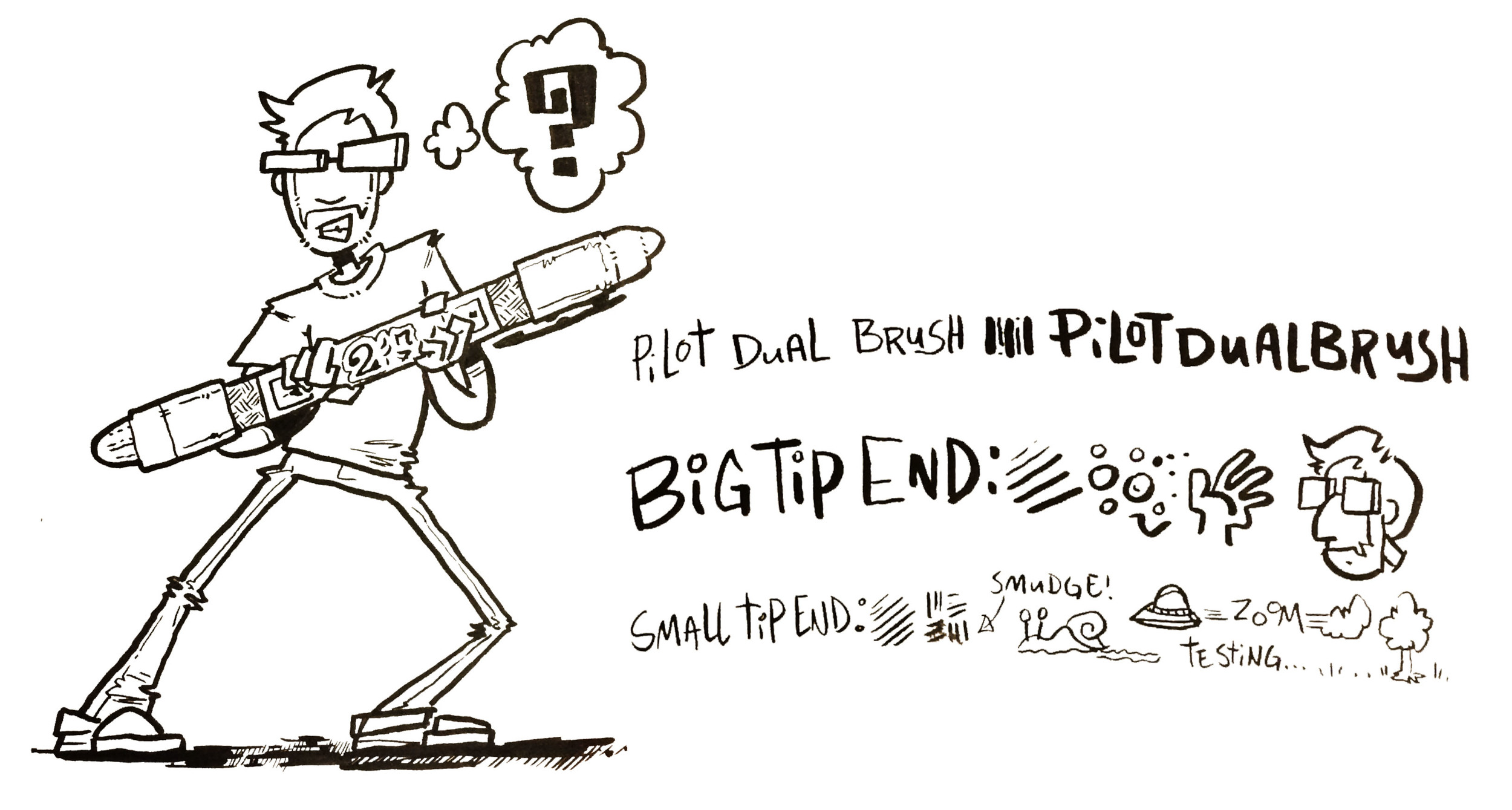
This pen has, you guessed it, two tips. One large, one small. The small side's largest line width is precisely the thinnest of the wide side. They meet in the middle. The difference between to the two tips is so perfectly divided that it leads to an amount of flexibility I’ve not found in another felt tip brush pen. I know that it sounds lazy, but flipping the pen to use the other side is so much better than stopping to dig for another pen.

It has double caps; one for each side and the large end cap has a clip. You can switch cap sides, the large cap fits the small side and vice versa. The caps also nest within one another, so you can always fit the one on top of the other side you aren't using, stacking two caps on one end. This seems like a no-brainer, but so many dual pens do it wrong or poorly. The pen isn't unwieldy long either. It is lightweight, but not so much that it’s thrown off when one side has both caps.

Ink delivery is smooth and consistent. About a 4 second dry time and you are safe to touch the paper. This helps when re-positioning your hand over previously laid lines to use the other side of the pen, which is great because that is exactly how I was using this pen. The dual nature of the pen works wonders with my workflow and felt like it was the antidote to my problems with other brush pens.

I stopped expecting to get the variance of line width that a real brush would give me and leaned into the predictability of the line widths and their limitations. The damn pen has two tips, make sure you use both. The lines are easier to control and leave a smoother stroke, where sometimes a brush will echo the minor shakes of my hand. In that respect, it actually trumps a brush in performance. This pen could be a more forgiving alternative, not replacement, to a brush. Now, it didn't disappear in my hand like I was suddenly communicating directly to the paper as ink incarnate, like I sometimes feel with brushes (we've all been there, am I right?). But it was like using a well-made tool whose makers understood the limitation of what the tool was and perfected it because of that.

The Futayaku is available at JetPens and is well worth dropping one on your cart to have a new pocket friend ready to ink up a page.

(Disclaimer: This product was provided for me free of cost but I am not otherwise being compensated for this review. The opinions contained are my own.)

Posted on July 30, 2015 and filed under Brush Pen, Pen Reviews, Pilot.

Sailor Professional Gear Transparent Orange Review

Sailor Pro Gear Transparent Orange.jpg

Being the fan of Japanese pens that I am it’s no surprise how much I enjoy the Sailor brand of pens. I’ve owned or tested most of their main line products, and there is no better fit for me personally than the barrel size, shape, and weight of the Pro Gear.

The Sailor Pro Gear Slim is smaller, lighter, and narrower, as is the 1911 Standard. The 1911 Large is similar in feel and weight, but the rounded end caps aren’t as aesthetically pleasing to me. The only one I haven’t compared side by side to the Pro Gear (King of Pens excluded) are any of the Realo models, which are similar in size to its Professional Gear and 1911 conterparts but use a piston filling system.

All of this is to say that everything about the Pro Gear fits what I am looking for in a pen to a tee.

The Transparent Orange model has been on my shopping list since I became interested in fountain pens several years ago. It’s loud and scary and breaks every traditional fountain pen mold. And I love it for that. The pink and green models are just as vibrant and I would be happy to own any or all of them and flaunt them whenever I could.

Goldspot Pens kindly loaned me this pen with a medium 21k gold nib for review. I inked it up with one of my favorite inks - Sailor Jentle Blue Black - and it wrote perfectly right out of the box. Japanese medium nibs are a sweet spot in my opinion. Fine enough to maintain nice line control, and wide enough to show off the ink on the page. And just look at that nib - it’s beautiful!

Being the fan of demonstrator pens that I am, I’m used to seeing converters and other internal mechanics inside pen barrels. With this Pro Gear, I have to say seeing the converter inside isn’t the greatest visual. Would I prefer a piston mechanism instead? Sure, but this is a small con in what is a pen full of pros. When I’m writing with it I don’t notice it at all.

All in all, borrowing this pen from Goldspot has only confirmed that I want to add one to my collection. It looks great, writes wonderfully, and is an excellent example of a Japanese brand having fun with a traditional writing instrument.

My thanks to Goldspot Pens for loaning me this pen for the purposes of this review.

Posted on July 27, 2015 and filed under Pen Reviews, Sailor.