Posts filed under Pen Reviews

Fresh From Japan: Zebra Sarasa Dry and Uni-ball Air

My friend June Thomas teased us all about her pending tour of Japan in Episode 189 of The Pen Addict Podcast. She made it back safe and sound, and a little care package from her made its way into my mailbox last week.

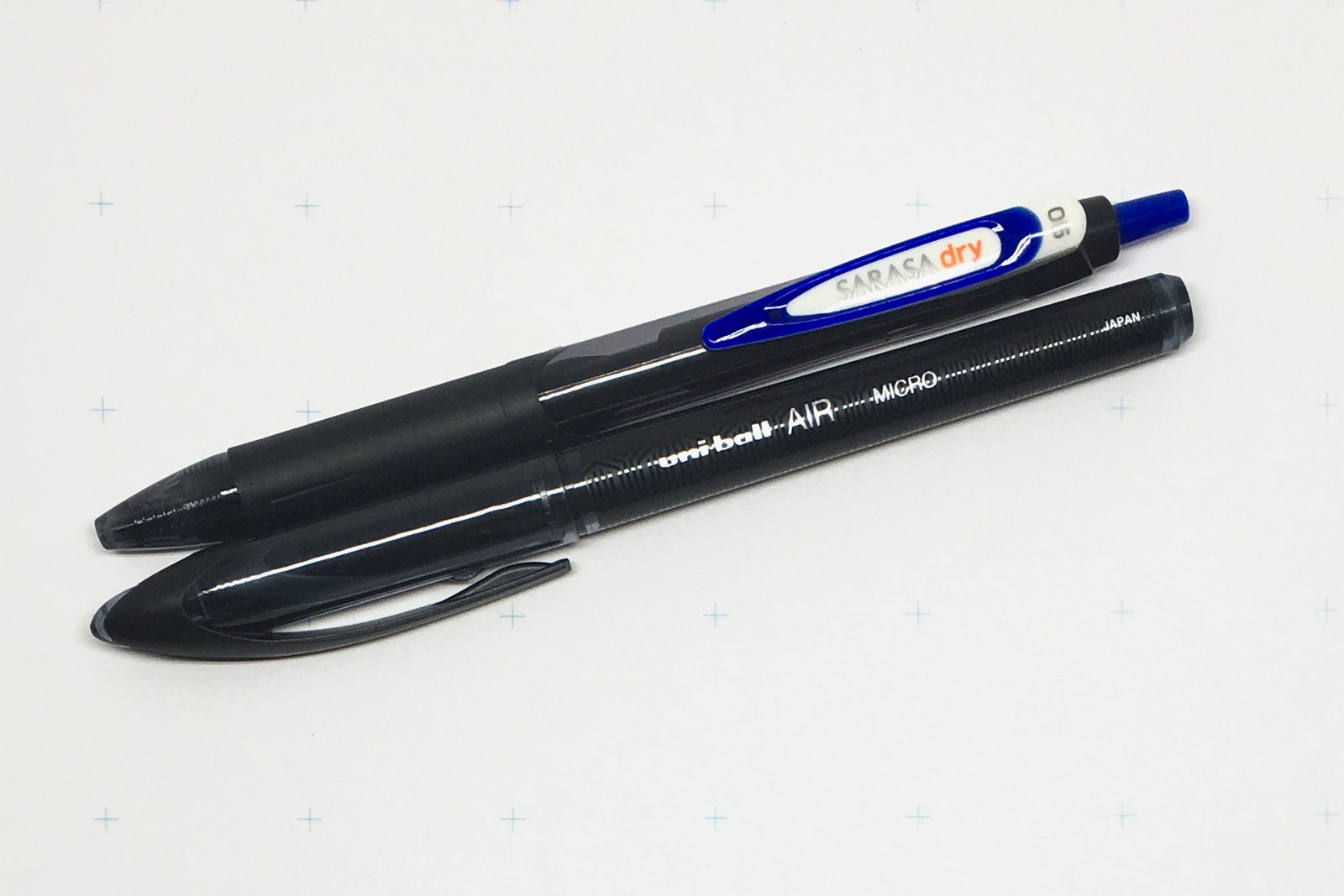
Aside from the tissue and mask handouts (which are amazing!) I was anxious to try both of the pens. The Zebra Sarasa Dry I had only seen on the Zebra Japan site, and while I own the Uni-ball Air, the Micro tip size is a new one for me. Here are my first thoughts on both of these pens:
Zebra Sarasa Dry Gel 0.5 mm Blue

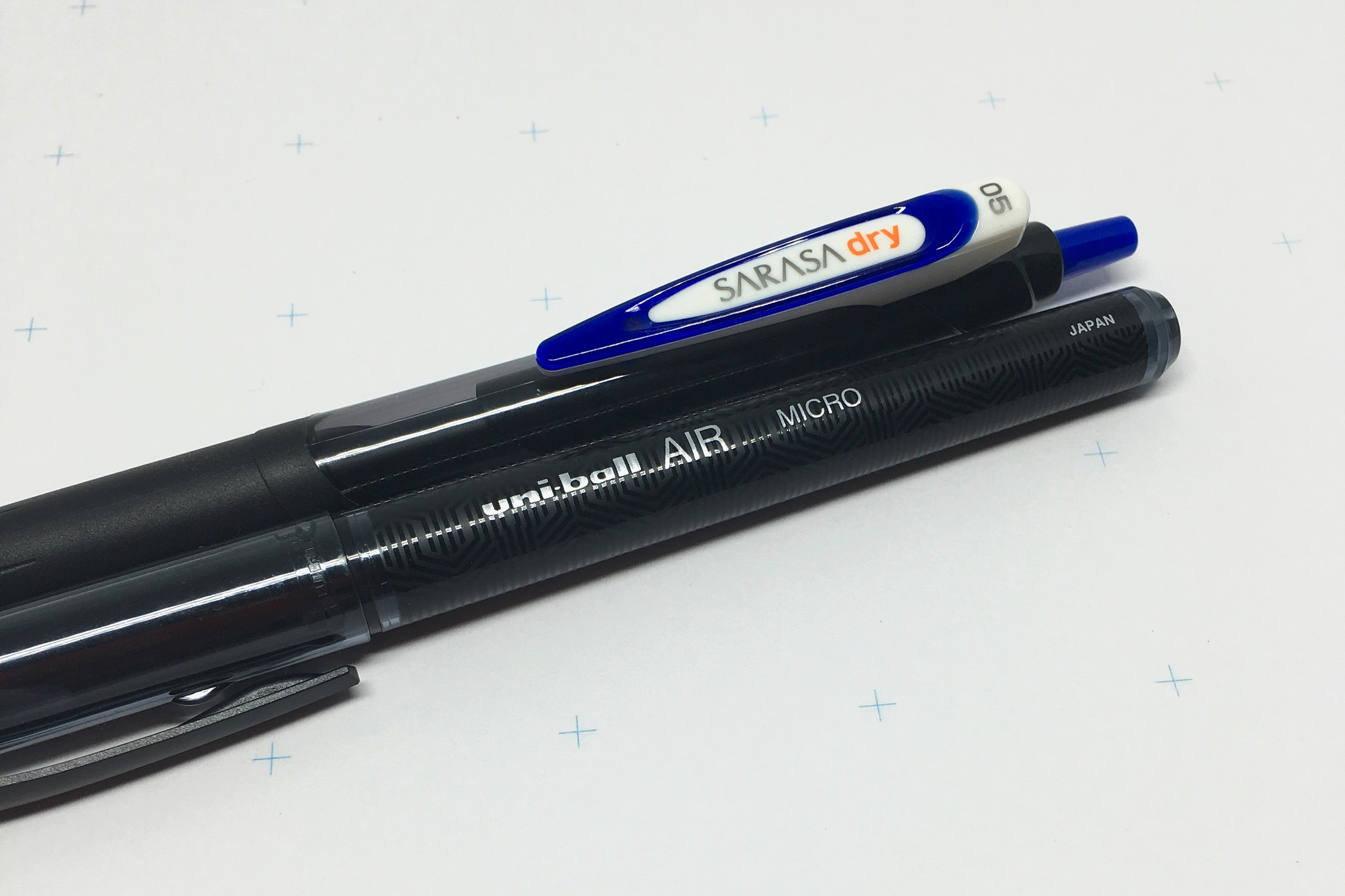
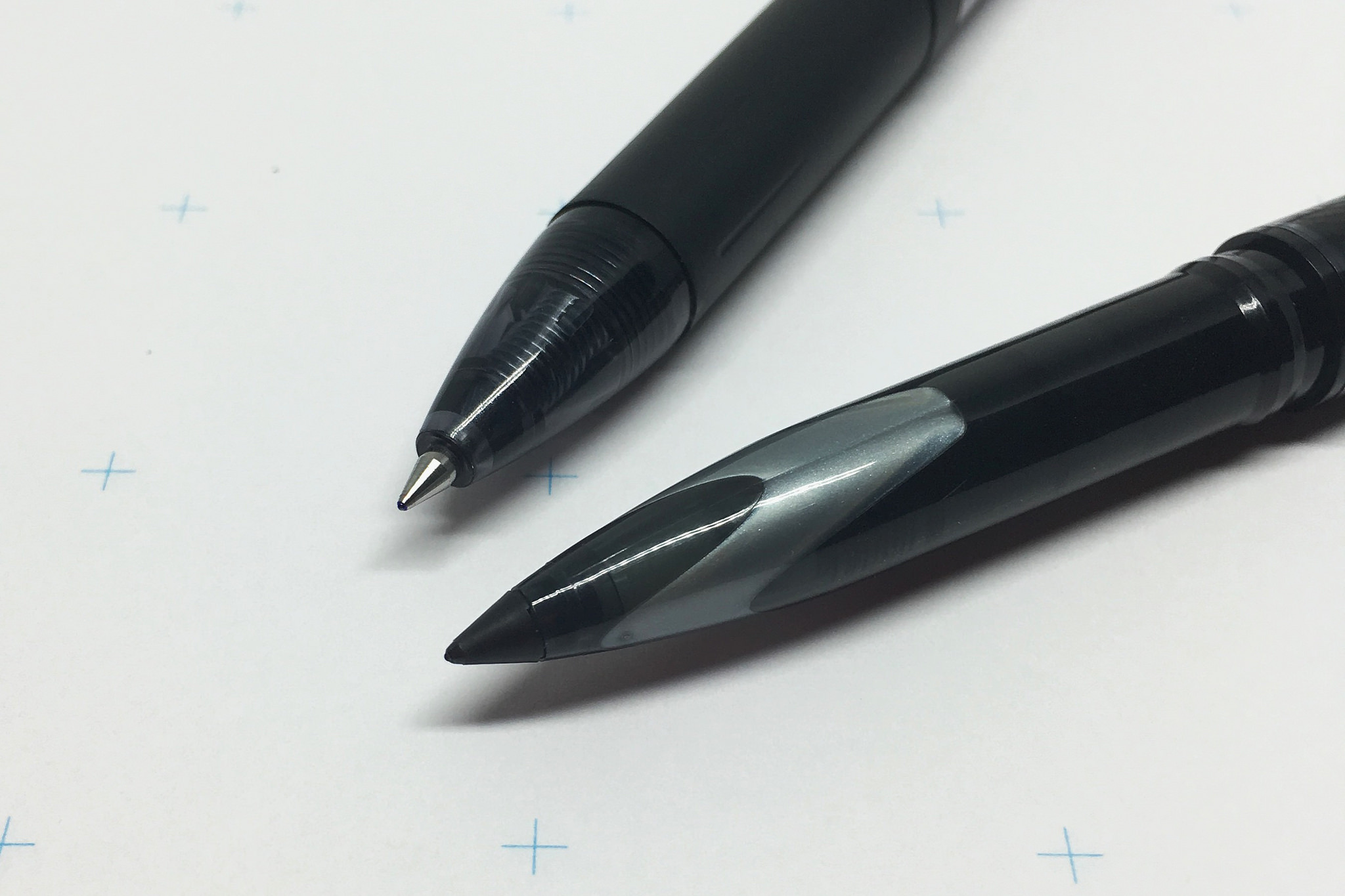
The first question I had about this pen wasn’t to see if the fast-drying gel ink worked, but how close this pen compares to an all time favorite: the Zebra Sarasa Clip. It does, but just a little. The clip is too bulky on the Dry Gel model for me, although the grip may be a bit better. They are close.

The more important aspect, of course, is the ink performance. It lives up to the marketing, drying almost immediately after going on the page. I ran my finger along the line when writing, as in this video, and there was no ink smear or ink transfer to my finger. Clean, and impressive.

Finally, how new is this ink technology from Zebra? I was thinking this Japanese model was newish, but as I dug around, Zebra USA has marketed the Sarasa Gel as Zebra Sarasa Rapid Dry Ink Gel for what looks like a year or two. I rarely visit office supply stores any more so I haven’t noticed this. Plus, this model of Sarasa is nowhere near as good as the Clip model.

So this begs the question: Has anyone used one of the Rapid Dry models, and does is work as well?

Uni-ball Air 0.5 mm Black

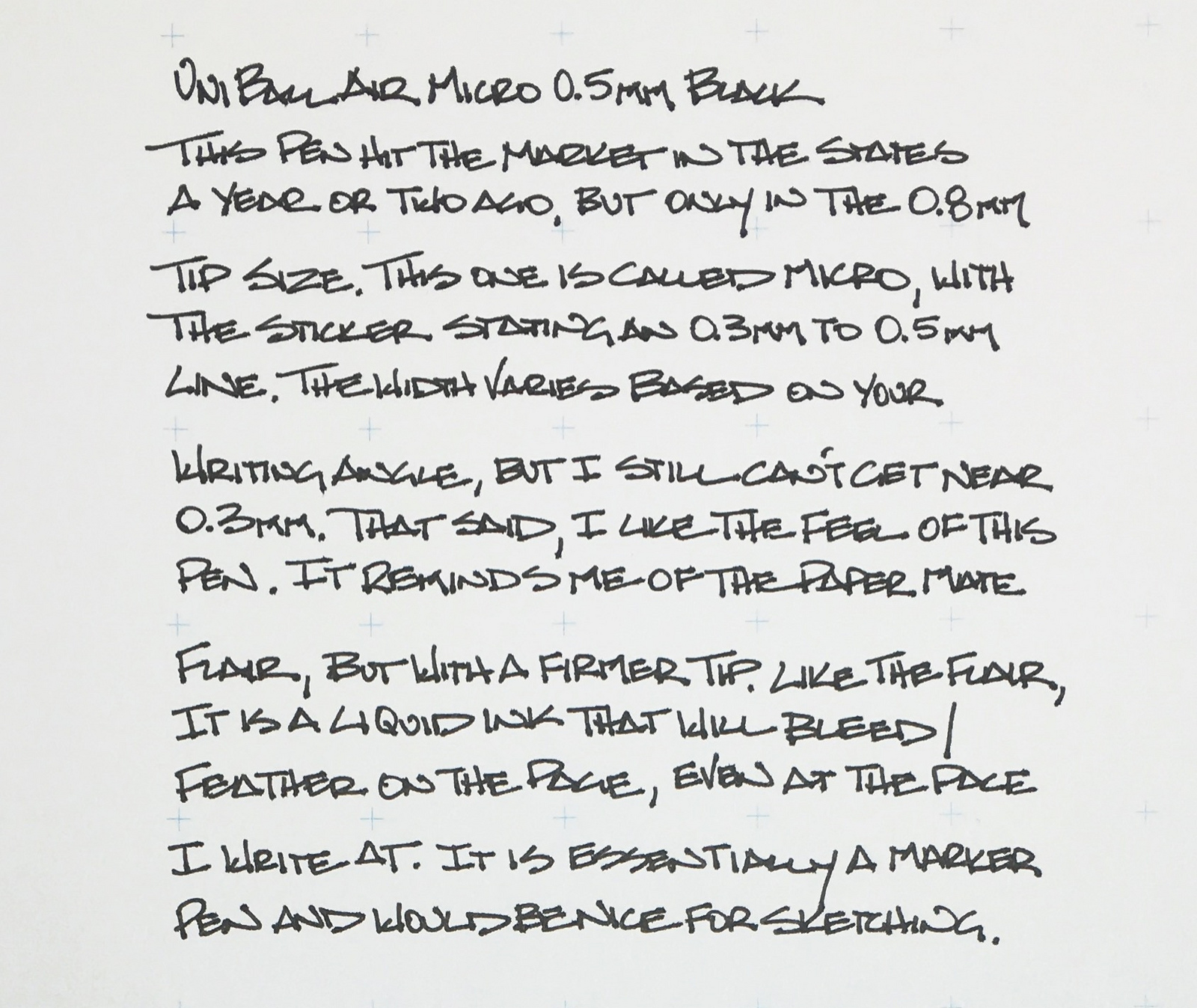
This oddity of a pen has been around in the US market for a while, but only in the 0.7 mm model. I bought a pack of those, and wasn’t sure what to make of it. More of a felt tip marker than rollerball, the Air leaves wide, wet lines. The 0.7 mm is fine, but I of course prefer the 0.5 mm model that June sent me. It’s still wide, but now it is closer to one of my favorite off the shelf pens in the Paper Mate Flair.

Since it is a liquid ink pen and due to the style of the tip, a lot of ink gets transferred to the page, causing some feathering and bleeding. I am a fast writer, and no matter how fast I go I can’t outrun a small amount of ink pooling at the end of my letters. That’s ok, as long as you understand what this pen is good for and if it suits your needs. Tiny writers need not apply.
Both of these pens are decent choices when used for a specific need or in the right circumstances. That makes them good, but not great. Thanks for sending me these to test out June!
Posted on May 30, 2016 and filed under Zebra, Sarasa, Uni-Ball, Pen Reviews.

Kuretake Zig Cartoonist Menso Brush Small Kolinsky Hair Review

(This is a guest post by Nick Folz. You can find more of Nick and his work on his blog, Smallberry Drive, Twitter, and Instagram.)

Whew! I'll do my best to unpack that name as I go. The first thing you should notice is that this is a brush.

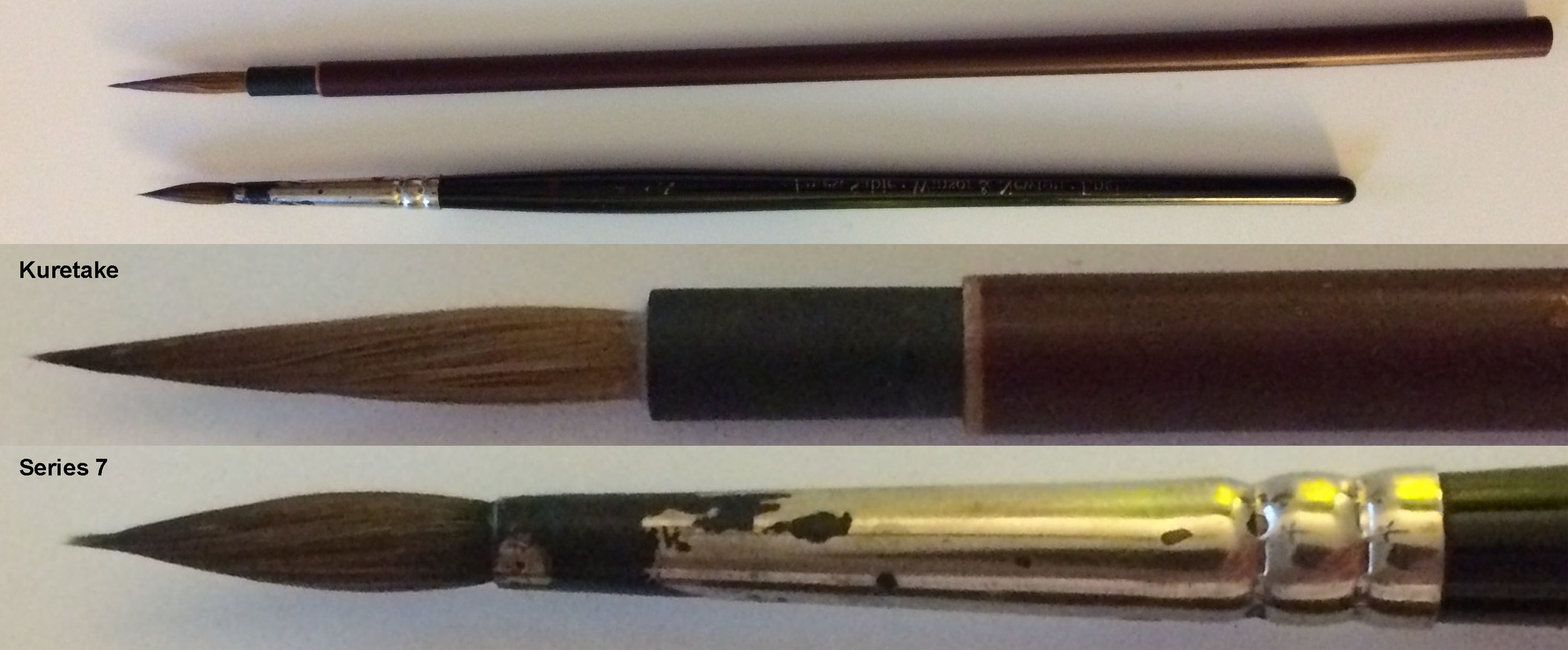
I really like brushes, and I have quite a few. They vary from a cheap, clear plastic handed short brush that was in a bag of twenty other brushes I bought from a big box store for $2.50, to the Windsor & Newton Series 7 Kolinsky Sable Pointed Round #3 that ran me $45 and got as birthday present. I often go by the same advice that my mom gave me on cooking spaghetti noodles "You got to throw some at the wall and see what sticks" and buy a variety of brushes just to see which one I gravitate towards. Brush differences can be completely obvious or very subtle, a lot of times the only thing separating a brush you could pick up for spare change and one they keep behind the counter is the varnish on the handle. There has been virtually no correlation between price and how often I reach for the brush. Plenty of my friends disagree, but I insist that the emperor is a total nudist.

Menso means small or details

The Kuretake brush in question tapers to a very small tip and it is fantastic for the thinnest of lines. The general shape of the bristled tip comes into play here and I will do my best to explain why with a story. I once knew a sign painter, a 60 year old guy whose clothes were perpetually covered in paint and whose hands were more cracked than the pepper at a fancy restaurant. He also did pinstripes for auto body places. I was curious, so he brought in his pin striping kit. To my surprise the brush was almost no handle but the bristles were four inches long. I asked about it and he showed me, once the very tip of the bristles touched the surface of whatever he was painting on, the sheer amount of distance in bristles between his hand and the contact made any hand shake or tremor disappear. So the length of the brush acts like an insulator or a shock, absorbing the inconsistency.

This brush with the longer than average tip has the same effect, very smooth lines, especially when drawing towards you with a low degree angle. This will also produce a consistent line width, For more variance and thinner lines try it out at more of a 90 degree angle, but watch your hand control. I found myself tilting it to a low angle for the smooth, consistent lines when outlining and longer ink strokes, and switching to a high 90 degree angle for details and finishing touches. The wide variety of uses makes this a versatile enough brush to be the only one I keep in my bag at the moment.

Kolinsky means weasel hair

Kolinsky hair brushes are held in high regard for one main reason, they have tendency to snap back into shape. This makes the action of the brush more pleasurable on the page and cuts down on time trying to reshape your brush into a fine tip in between ink dips. I was a little worried about this brush being able to snap back since the length of the bristles were so long, but they never failed to spring back on their own. The shape of the brush really lends itself to longer line work and bring up another shape issue worth noting in brushes, ink retention. Typically, the more rounded the base of the bristles, the more ink you can load into the tip. The needle-esque shape of this tip made me worry I would be dipping early and often, but it could hold much more than I thought it would and would often have enough to do large areas of black. It didn't hold more than my Series 7 but it was darn close.

One of the areas where this shines is the personality of the dry brush, Often times I would dry it out by dabbing it on the side of the ink well and then rolling it on a paper towel and make patterns with the drying brush (see the inside of the tree trunk), then go back and add further ink. It is really pleasurable and the unique long tip makes a variety of fun shapes and patterns that a hand more skilled than mine could make beautiful things with.

Sure it's not a pen, or even a pencil, but if you were ever thinking of trying out brushes or if you have a few brushes you like but none you love, this brush would be worth checking out. It has quickly replaced three brushes I kept in my art bag and I have not found myself wanting.

The Kuretake Zig Cartoonist Menso Kolinsky Hair Brush is available at Jetpens.com for $14 along with its horse and goat hair bretheren.

(JetPens provided this product at no charge to The Pen Addict for review purposes.)

Posted on May 26, 2016 and filed under Brush, Kuretake, Pen Reviews.

The Pelikan M620 Grand Place Fountain Pen: A Review

(Susan M. Pigott is a fountain pen collector, pen and paperholic, photographer, and professor. You can find more from Susan on her blog Scribalishess.)

When the Pelikan M800 Grand Place came out earlier this year, I was sorely tempted to buy one. Like others, I found the swirl pattern appealing and distinct from Pelikan's striped models. But while I was looking at photos of the new Grand Place, I came upon the M620 Grand Place, a model that was produced in 2006. Although I liked the M800, I loved the M620. Why? Because, unlike the M800 which has a black grip and piston knob, the M620 grip and knob are a beautiful, sheeny copper.

Of course, the M620 version is no longer available from vendors. But once I fall for a pen, I am relentless in my pursuit. I looked on eBay where I found the pen offered without a nib for an exorbitant price. But that was essentially the only M620 Grand Place I could find.

So, I placed a "Want To Buy" ad on FPN and within a day or two I found a seller offering the pen with a fine nib for a reasonable price. It came from Singapore, so I had to wait a little while, but it arrived in perfect condition with all the original packaging.

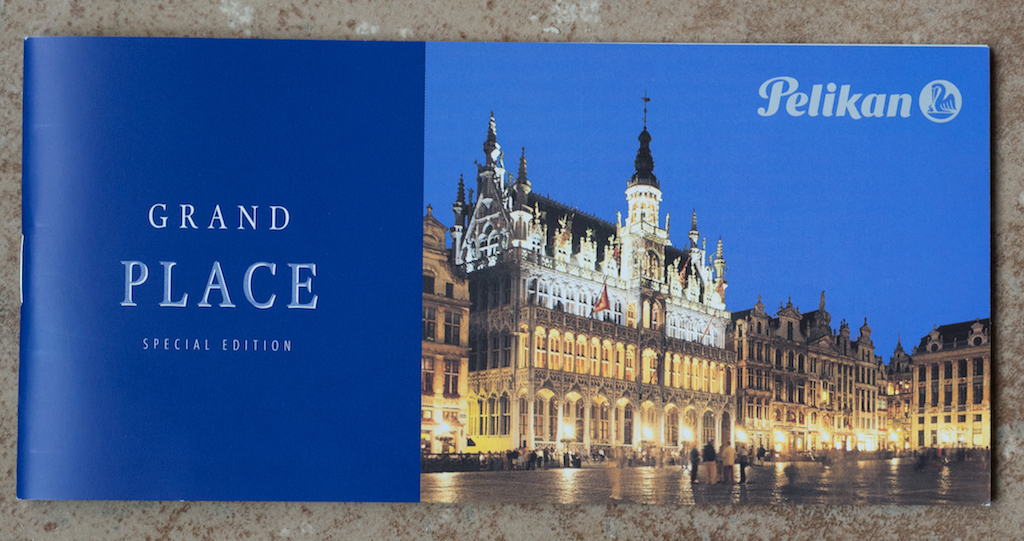
Part of Pelikan's City Series, the Grand Place is named after the Grote Markt in Brussels. The square once housed an indoor market and the town's city hall.

The pen is comprised of brown, copper, and gold colors with swirls of blue interwoven. The chatoyance is mesmerizing.

As I said, what drew me to the M620 over the M800 model was the copper grip and piston knob. Both are made of shimmery copper resin that matches the rest of the pen perfectly. The black grip and knob on the M800 seems to drain the pen of its warmth, whereas the copper on the M620 enhances the golden tones.

The M600 is my favorite Pelikan size at 5.24 inches/133mm capped and 18 grams in weight. It's neither too short nor too long. And it's definitely not heavy. Many Pelikan enthusiasts prefer the more robust M800, but I favor the 600 size.

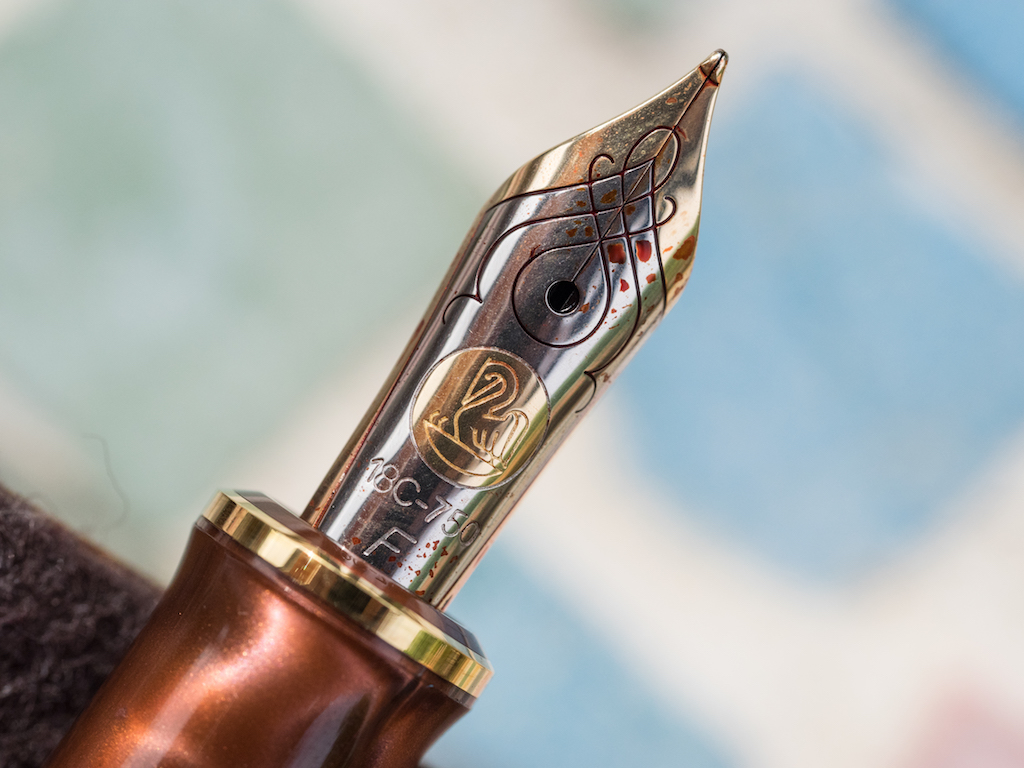
The nib is a two-tone fine with the ornate Pelikan design. I think Pelikan nibs are some of the most beautiful modern nibs you can buy. Plus, their nibs are smooth and problem free (in my experience). This one seems to be a true Western fine, wider than a Japanese fine but definitely not close to a medium.

The cap has the Pelikan logo in gold on a black finial. The beak-shaped clip is gold and the cap sports the usual "Pelikan Souverän Germany" on the ring.

Of course this model is a piston filler and holds a good amount of ink (1.3ml). I inked it with Diamine Ancient Copper for my written review. Ancient Copper is a perfect match for this pen. Too bad it gets funky if you leave it too long in a pen. By "funky" I mean that it gunks up your nib and sort of crystalizes. I no longer leave Ancient Copper in any pen for more than a few days, which is too bad, because it's a great color.

Pros

  • This is a gorgeous pen with an unusual swirl design and unique colors. Unlike the M800 version, the grip and piston knob are copper instead of black.
  • The M600 size is a good size for many writers. It isn't heavy but it's long enough to feel substantial.
  • The fine nib on my M620 writes smoothly and without any problems.

Cons

  • The M620 Grand Place is no longer available through vendors. If you are like me and want the M620, I'd suggest placing a "want to buy" ad like I did. But, you can also find the larger M800 with a black grip and piston knob at places like Goldspot Pens.
Posted on May 20, 2016 and filed under Pelikan, Pen Reviews, Fountain Pens.