Posts filed under Pen Reviews

JetPens Blue Black Pen Sampler Review

One of the reasons I love stationery is that you don’t have to spend much to get something great. Whether it is a $2 pen or a $4 pad of paper, I promise you there are great products out there waiting to be discovered that are 10 times better than the junk found in your office supply cabinet.

If you are unsure how to get started finding your next favorite pen, JetPens offers up many sampler packs, like this Blue Black Pen Sampler. There are many sampler choices actually, but since I’m a blue black ink fan I wanted to see how well they put this one together.

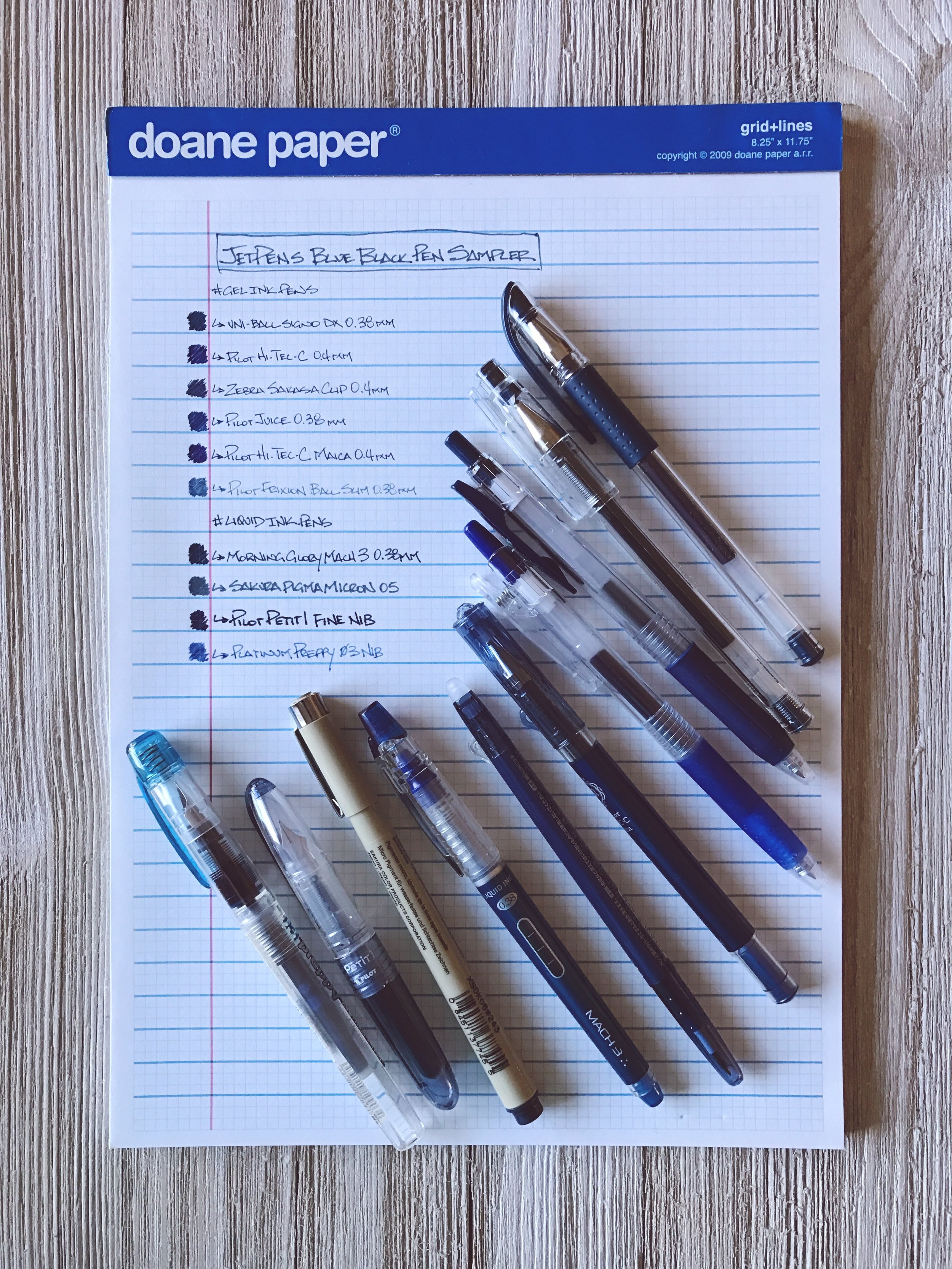
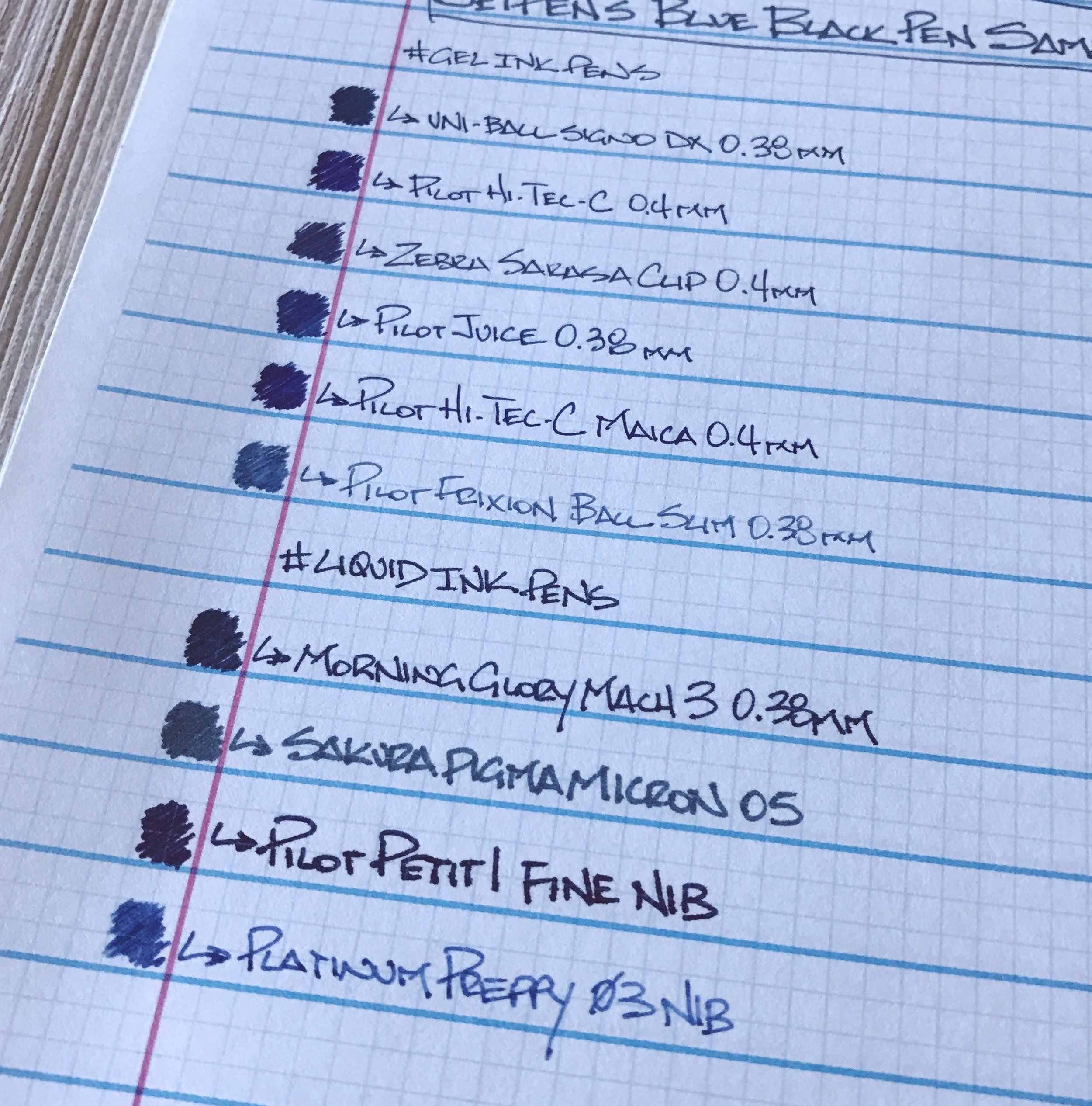
Since this is a general color sampler, not an ink type specific sampler (like only gel ink pens), you get a good variety. Here is the lineup:

Pilot Hi-Tec-C Gel Pen - 0.4 mm - Blue Black

Pilot Hi-Tec-C Maica Gel Pen - 0.4 mm - Blue Black

Uni-ball Signo UM-151 Gel Pen - 0.38 mm - Blue Black

Zebra Sarasa Push Clip Gel Pen - 0.4 mm - Blue Black

Pilot Juice Gel Pen - 0.38 mm - Blue Black

Pilot FriXion Ball Slim Gel Pen - 0.38 mm - Blue Black

Morning Glory Mach 3 Rollerball Pen - 0.38 mm - Blue Black

Sakura Pigma Micron Pen - Size 05 - 0.45 mm - Blue Black

Platinum Preppy Fountain Pen - Blue Black - 03 Fine Nib

Pilot Petit1 Mini Fountain Pen - Blue Black - Fine Nib

For those playing at home, that is six gel ink pens, one liquid ink rollerball, one drawing pen, and two fountain pens. Let’s break these down into two groups for review: Gel and liquid.
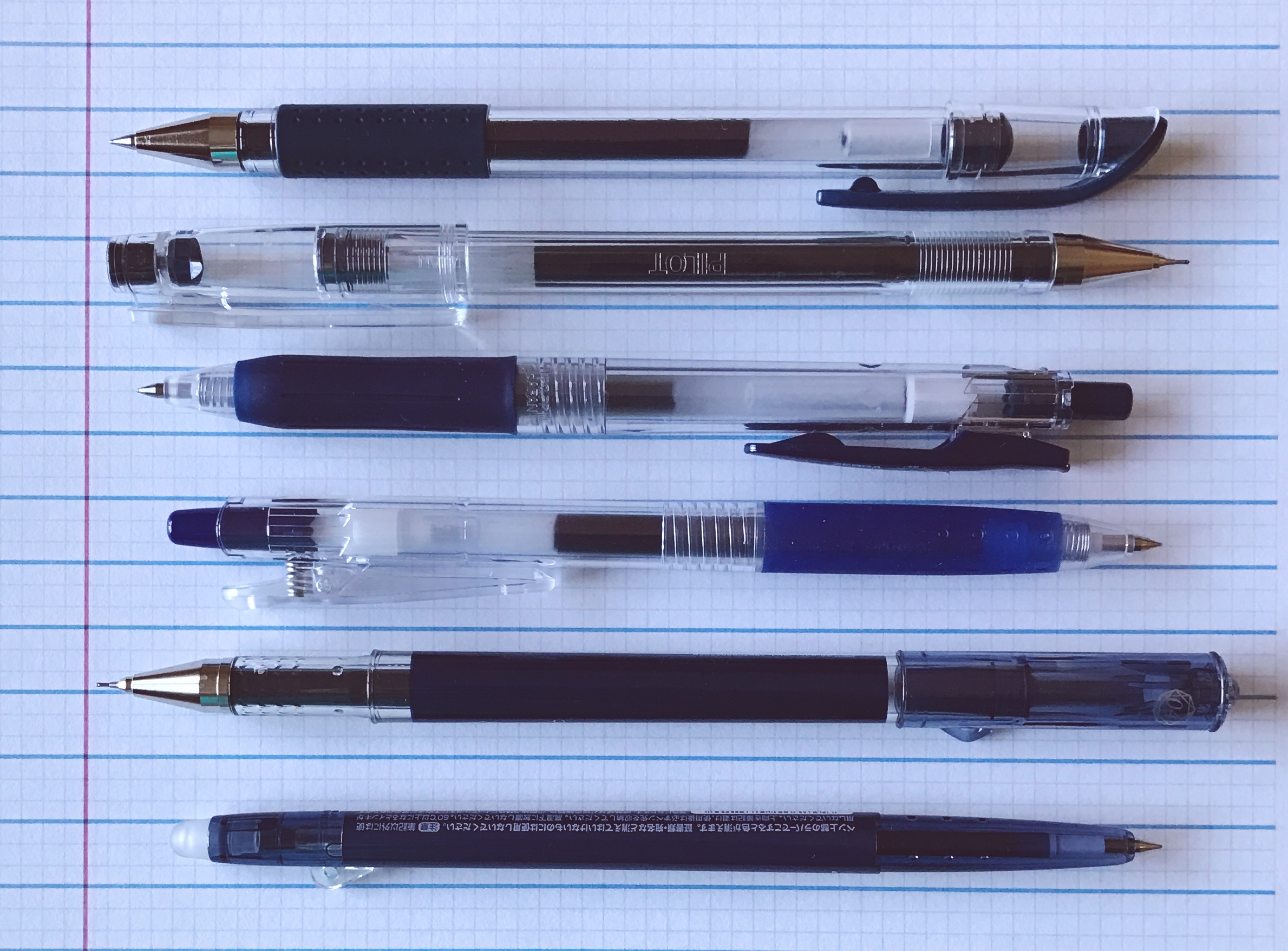
The gel ink group has several of my Top 5 favorite pens. The Uni-ball Signo UM-151, aka the DX, is my number one gel ink pen, but not in blue black ink. I think Uni-ball’s blue black ink colors fall behind both Pilot and Zebra. The pen itself needs to be part of this group for its excellence, I just prefer other colors in it.

The two Pilot Hi-Tec-C models use identical refills with different barrels, and I prefer the simplicity of the original. The Maica isn’t bad, it’s more that i am used to and comfortable with the O.G. barrel. The Juice refill is awesome, but the barrel is just ok. The Sarasa Clip may be the best combination of everything in one individual pen. The FriXion model is cool to play with but I would prefer having the Ball Knock model instead of the Slim.

If I’m taking this specific ink color into consideration when ranking these pens, I choose the Zebra Sarasa Clip first, standard Pilot Hi-Tec-C second, Pilot Juice third, then everything else.
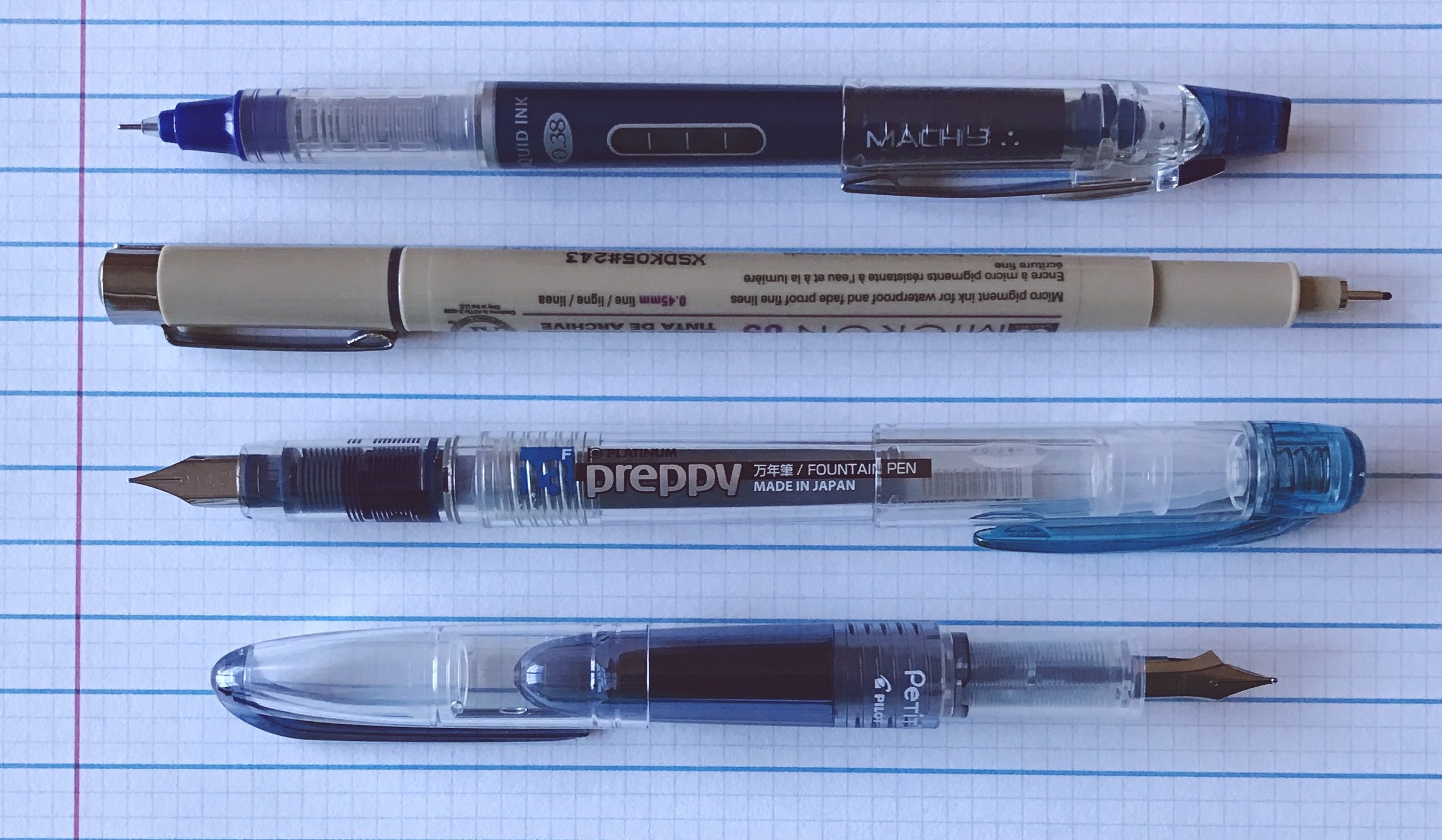
On the liquid ink side of the ledger there is much more variance in the style of pen. The Mach 3 Rollerball is awesome, and is perennially underrated. It’s a liquid ink pen, so there are more paper performance considerations than with gel ink pens. That said, it is a wonderful performer and a pen everyone should consider.

The Micron, while a traditional favorite of mine, is done no favors in this lineup. The 05 tip is too wide, and the blue black ink color is odd. Give me an 03 black Micron any day over this model.

The two fountain pens are great choices, with the Platinum Preppy reigning superior over the Pilot Petit. The Preppy is an all around great pen, while the Petit requires some sacrifices due to its size. It is cool though, and I see what it is included in this set.
Overall, I can’t really argue with anything JetPens has done here. If I were to take a stab at this set, I would make a few changes.

Out: Sakura Pigma Micron, In: Sakura Pigma Fine ESDK

Out: Pilot Hi-Tec-C Maica, In: Pilot Fude-Makase Color Brush Pen

Out: Pilot Petit1, In: Uni-ball Vision Elite Rollerball

I think with those changes this set is improved with more styles, more variance, and better pens.

Regardless, this set is excellent as it is currently set up, giving you a wide variety of blue black ink pens for an average cost of $2.60 per pen. It’s hard to beat when you are a fan of trying out new pens and new ink colors.

(JetPens provided this product at no charge to The Pen Addict for review purposes.)


Enjoy reading The Pen Addict? Then consider becoming a member to receive additional weekly content, giveaways, and discounts in The Pen Addict shop. Plus, you support me and the site directly, which I am very grateful for.

Membership starts at just $5/month, with a discounted annual option available. To find out more about membership click here and join us!

Posted on February 27, 2017 and filed under Morning Glory, Pilot, Platinum, Sakura, Zebra, Pen Reviews.

Shawn Newton Custom Sumpter in Le Tigre Cebloplast/Celluloid: A Review

(Susan M. Pigott is a fountain pen collector, pen and paperholic, photographer, and professor. You can find more from Susan on her blog Scribalishess.)

I saw the Le Tigre cebloplast/celluloid (a vintage material) on Shawn Newton’s Instagram last summer. I immediately emailed him to see if I could have a pen made from the stuff. Initially he said he could only make a barrel from it since he only had a little of the material. But, fortunately, he found more hidden somewhere in his holy of holies of stock. I would get an entire pen made of Le Tigre. Rawr!

I placed my order July 7, and Shawn gave me an estimated ship date of March 2017. Jaw drop. Yes, Shawn’s work is mega-popular, and that means a wait of at least six months (my pen actually arrived the first week of February).

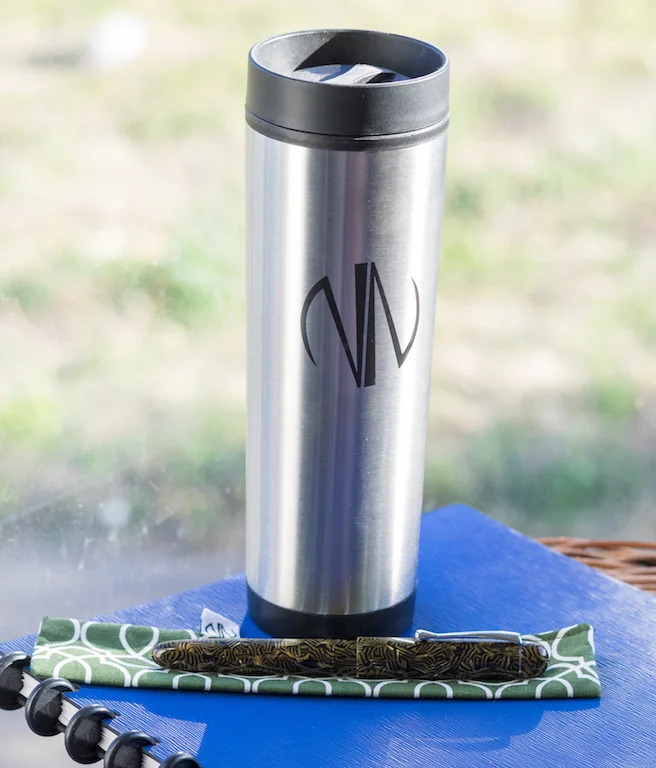
As always with Shawn Newton pens, the wait was worth it. My pen was shipped in a Newton-branded steel tumbler with a lovely pen wrap made by his wife.

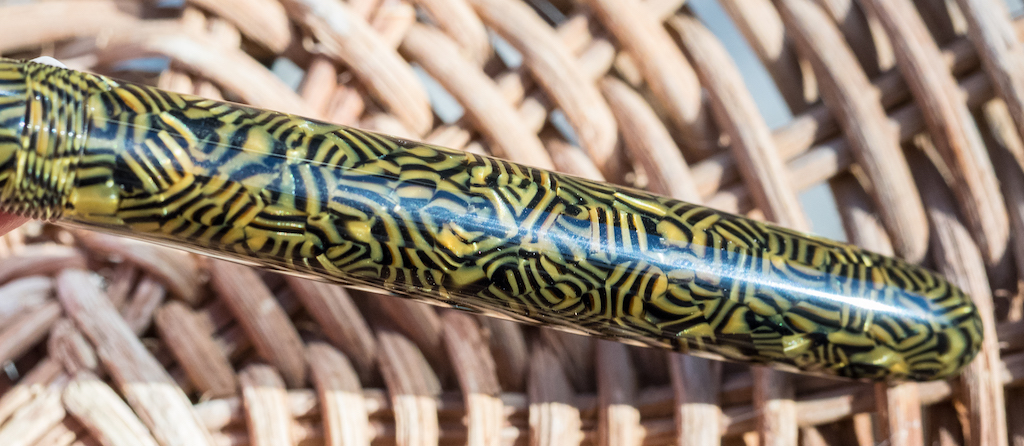
Le Tigre cebloplast is outrageously gorgeous—green, yellow, and black striped with tons of chatoyance. The material has so much depth and color and is quite unique.

Shawn told me to be careful with this pen. The Le Tigre is a vintage material, and if I were to drop the pen on a hard floor, it would likely shatter.

The pen itself is light (cebloplast/celluloid is light material) and of medium length (148mm capped, 133mm uncapped, 177mm posted). On Shawn’s site this pen is listed as a small Sumpter. The Sumpter is a classic cigar-shaped pen with a screw-on cap and a plain steel clip.

It is a cartridge/converter (converter included).

I lucked out and got it with an 18K rhodium-plated fine nib etched with the Newton logo.

I’ve purchased three pens from Shawn, and this fine nib is the very best writer of the three. In fact, it’s one of the best writers of all my pens.

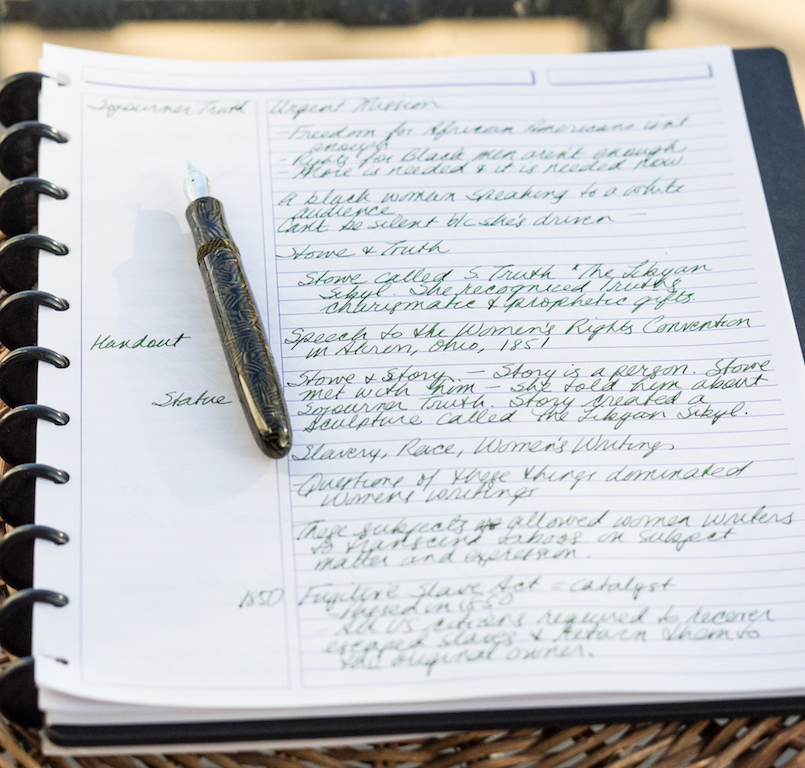
It writes so smoothly and with the perfect amount of wetness, and the nib has a wonderful bounce to it. I inked it with Sailor Jentle Epinard which matches the color of the cebloplast nicely. I used it today in my Women Writer’s class to take notes. I was writing as fast as I possibly could, and the nib and feed kept up without any problems.

Thus far, this is my favorite Shawn Newton custom pen. I love the unique, vintage material. The Sumpter shape is classic and uncomplicated. And this baby writes like a champ. Just don’t drop it, Susan. Do. Not. Drop.

Pros

  • One of the best things about custom pen makers like Shawn is you can get a brand new pen in vintage material.
  • The Sumpter is a classic, simple design that feels well balanced in the hand.
  • The standard 18K fine nib I got with this pen is simply excellent—one of the best writers in my collection.
  • I like cartridge/converter pens, so I’m happy with this system. But if you prefer piston fillers, you can have Shawn make your pen with a piston at additional cost.
  • Shawn is so much fun to work with. He didn’t get to be super creative on this pen because the small amount of Le Tigre cebloplast limited our options. But you can have a pen made in any number of configurations with virtually any material. The only limits are your imagination and the size of your wallet.

Cons

  • The Le Tigre material is vintage, and I don’t think Shawn has any more. Sorry (not sorry). I believe I got the last of it.
  • The small Sumpter might be too small and light for people who like weighty, large pens. But, you can always ask Shawn to add metal rings and/or a metal barrel to a pen if you want more weight.
  • The one bad thing about this vintage cebloplast is it’s super delicate, and I’m a klutz. Kid gloves with this pen, folks.
Posted on February 24, 2017 and filed under Newton Pens, Fountain Pens, Pen Reviews.

The Wink Pen: A Review

(Susan M. Pigott is a fountain pen collector, pen and paperholic, photographer, and professor. You can find more from Susan on her blog Scribalishess.)

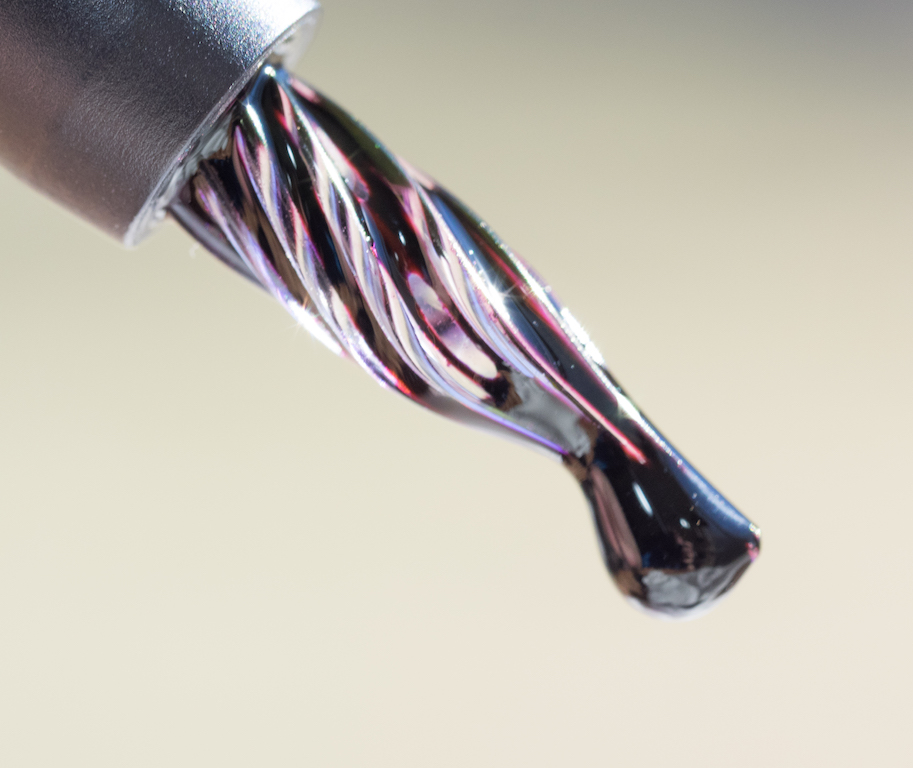
The Wink Pen is a unique concept, combining a glass nib with a converter and a demonstrator body.

The idea came about when the creator, Jessica Chan, decided to combine a writing instrument with sustainable, alternative liquids. Chan collaborated with Matthew Malone, an engineer, to create a prototype pen that could be used with wine, juice, and other liquids. They launched a successful Kickstarter campaign in 2015 (Source: booklet included with the Wink Pen).

The Wink Pen arrives in beautiful packaging. A sophisticated looking black cardboard and metal box opens to reveal the pen wrapped in a soft, satin-like cloth.

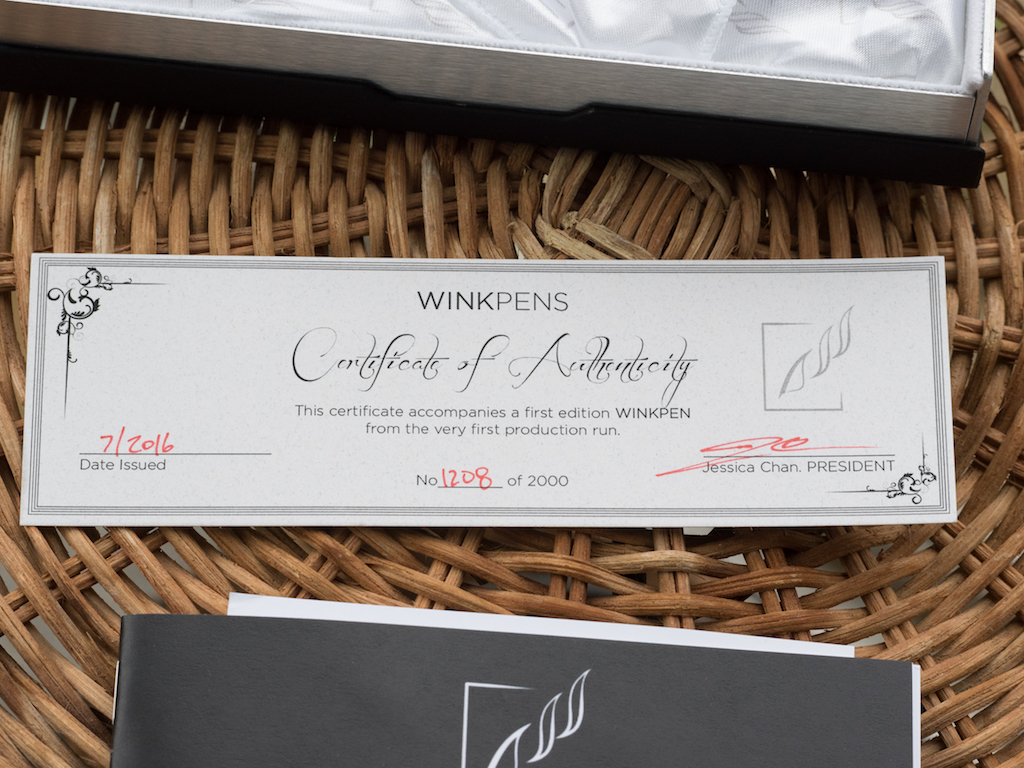
Included are the booklet that describes the history of Winkpens, a certificate of authenticity, and a cardboard sleeve that provides usage instructions.

The pen can be completely dissassembled, which is good since it is meant to be used with a variety of liquids. The pen is comprised of a glass nib, a coupler, a converter, a barrel cap, the pen cap, and the glass barrel.

The cap has a clip with the initials of the creator (J.C.) engraved near the top. The Winkpen logo is on the finial.

To use the pen, fill the converter with your desired liquid, insert it into the coupler, push the glass barrel and barrel cap on, and twist the barrel cap until liquid starts dripping from the nib.

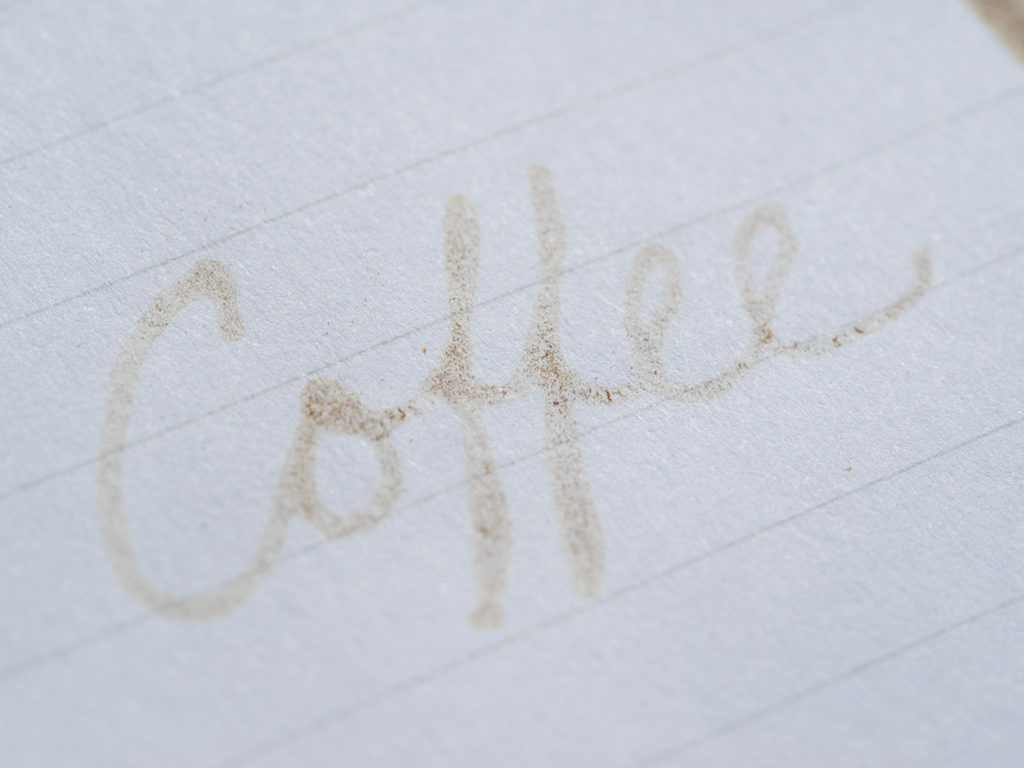
The pen is designed to work with low viscosity liquids. I tried it first with coffee:

Then Cabernet Sauvignon wine:

Unfortunately, as excited as I was to try unusual liquids in the pen, it didn’t work very well. In order to write even a couple of letters with the coffee or wine, I had to twist the barrel knob to get a blob of liquid to come out. The converter couldn’t deliver enough liquid to the glass nib to write continuously. My conclusion: the pen doesn’t work well with low viscosity liquids. It would be easier just to use a dip pen.

I will say the paper you write on makes a difference. My first tests were on Maruman Septcouleur paper which is pretty slick and Moo Notebook paper (very high quality with little texture). When I wrote with wine on Maruman sketch paper I had much better results with color saturation. But I still had to wet the nib constantly.

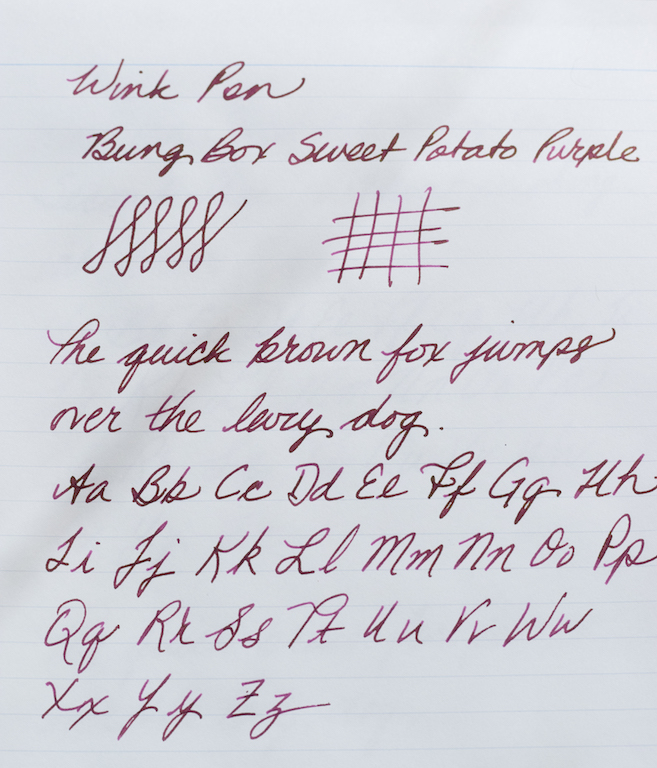
The pen works just fine with fountain pen ink. I tested it with Callifolio Aurora and Bung Box Sweet Potato Purple. The Callifolio worked fairly well, though I had to turn the pen to keep the ink flowing.

The Bung Box Sweet Potato ink worked perfectly.

Although I love the original idea of using the Wink Pen with any liquid, my experiments were frustrating. The liquids I tried simply would not keep flowing from the converter. I found using the pen with coffee and wine to be messy and inconsistent. Therefore, I’m not sure what advantage the Wink Pen offers when compared with a regular glass dip pen.

However, the Wink Pen works quite well with regular ink. Those who enjoy the feel of a glass nib but prefer the convenience of a converter (less mess), will like the Wink Pen.

You can purchase a first edition Wink Pen from Winkpens for $65 (originally $129). I did not find any information on the website about forthcoming editions of the pen.

Pros

  • The Wink Pen is an unusual combination of a glass nib with a converter-filled pen.
  • The pen writes well with regular fountain pen ink.
  • The pen is simple to assemble and dissassemble which makes it easy to clean—important if you choose to use wine or coffee as ink.
  • The glass nib writes smoothly and is beautiful when inked with saturated colors.

Cons

  • Unfortunately, writing with alternative liquids, which is the main intent of the Wink Pen, was frustrating. Coffee and wine were too wet and the flow too inconsistent to write more than a few letters.
  • I found that I had to twist the barrel cap to force liquid out every few letters, which sort of defeats the purpose of having a converter-based glass-nibbed pen. This was not a problem with regular fountain pen ink.

(Wink Pens provided this product at no charge to The Pen Addict for review purposes.)

Posted on February 3, 2017 and filed under Wink, Fountain Pens, Pen Reviews.