Posts filed under Pen Reviews

ensso XS Minimalist Pocket Fountain Pen Review

(Jeff Abbott is a regular contributor at The Pen Addict. You can find more from Jeff online at Draft Evolution and Twitter.)

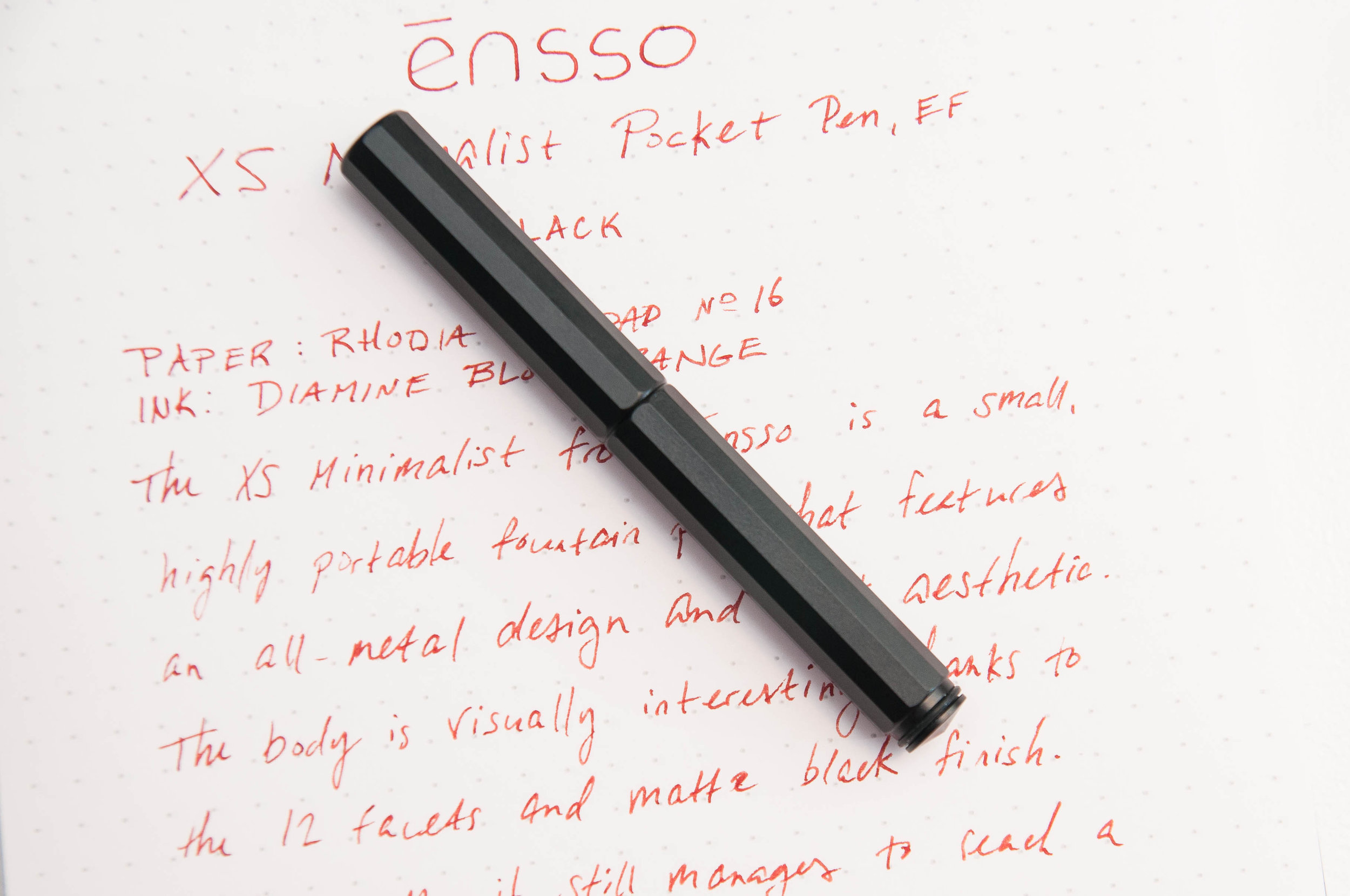
Just a few years ago, the portable fountain pen market was pretty bare. On top of that, finding something made of metal was even more difficult. Today, there are so many options available that it can be tough to make a choice. The latest of these that I've had the pleasure of using is the XS Minimalist Pocket fountain pen from ensso (stylized as ēnsso).
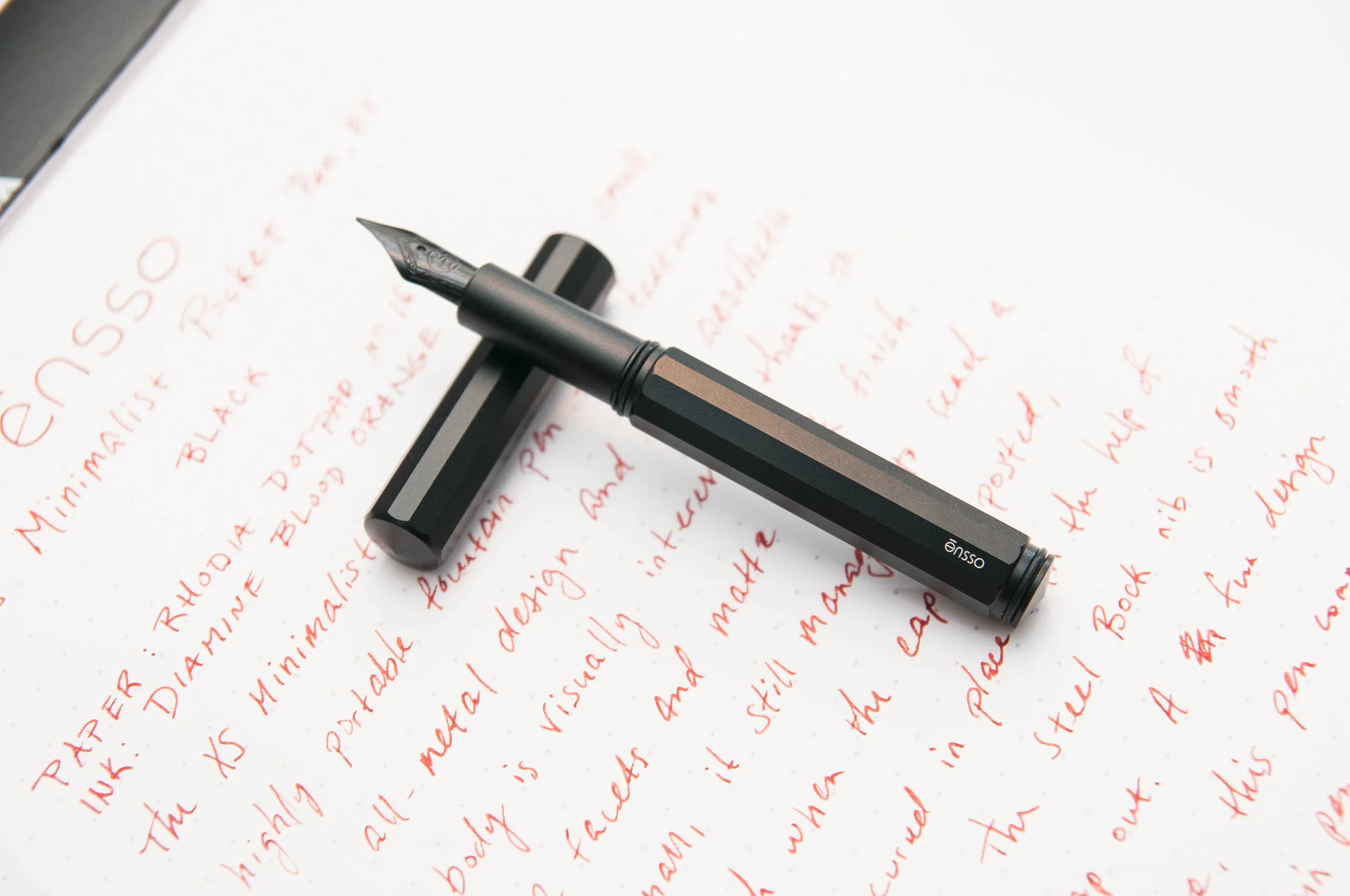
If you've ever used a pocket fountain pen before, the XS Minimalist will be very familiar. Unlike most of the pocket pens I've used, however, the XS uses a friction fit cap instead of a threaded cap system. To aid in the fit, there are small o-rings on the grip section and back of the pen to provide additional friction for the cap. It's always important that you can trust the cap will stay on a pen meant to go in your pocket or bag, and the XS delivers that secure fit.

The multi-faceted barrel adds even more visual interest to the pen, and also provides a nice grip when handling it. My particular idiosyncrasies mean that I always make sure the facets line up properly when capping the pen, but it looks fine when they don't line up as well.

The top of the cap and the bottom of the pen barrel both feature a nice convex dimple that reminds me of a metal spinning top. It's a visual feature that shows off the attention to detail that the designers put into this pen.

The only visible branding is a very small ensso logo on the rear of the barrel. It's tastefully done and doesn't detract from the overall design at all.

The most direct comparison I can make regarding the size of this pen is the Kaweco Liliput. The pens are roughly the same length and diameter when open and closed. Where the Liliput is completely round, the faceted barrel of the XS sets it apart. Still, if you've used a Liliput, you can use that experience to determine if you'd enjoy the XS since the size and writing feel is so similar.

The XS rocks a steel Bock nib with a black finish. It matches the rest of the aesthetic perfectly. The EF nib on my pen is smooth and reliable, putting down a nice line with plenty of ink delivery. The great thing about using Bock nibs is that you can easily swap out the nib with another unit from ensso, or you can even replace it with other Bock nib units of the same size.

The XS takes a short international cartridge, and I haven't even experimented with seeing what converters might fit just because of the minuscule size of the barrel. There are a couple of converter options, but not worth the hassle for a pen of this size and given the easy nature of cartridges. This is a pocket pen, after all — the ability to quickly throw in a new cartridge is part of the ideal use case.

The ensso XS Minimalist Pocket fountain pen is a beautiful little pen that stows away easily but opens up to be a completely useful fountain pen. The subtle aesthetic lends itself to the daily carry category and can also stand up to the various levels of abuse that everyday objects have to endure.

The aluminum finish and brass innards mean that this pen will last. Along with a sample cartridge, ensso include a couple of extra o-rings in case the installed rings come off or break over time. It's clear that ensso intend this pen to be used, abused, and cherished as it comes along with you everywhere.

The XS Minimalist is available in the black finish featured here or a silver version. The XS is priced at $59, which is a fair price for the materials used and the great aesthetic it delivers. If you're a fan of brass pens, you can also buy the XS in a completely brass model for a few bucks more.

(This pen was purchased with my own funds via the Kickstarter campaign.)


Enjoy reading The Pen Addict? Then consider becoming a member to receive additional weekly content, giveaways, and discounts in The Pen Addict shop. Plus, you support me and the site directly, for which I am very grateful.

Membership starts at just $5/month, with a discounted annual option available. To find out more about membership click here and join us!

Posted on January 16, 2019 and filed under Ensso, Fountain Pens, Pen Reviews.

Zebra Justfit Mojini Line Highlighter

(Sarah Read is an author, editor, yarn artist, and pen/paper/ink addict. You can find more about her at her website and on Twitter.)

A new semester is starting! It's time to pack away the holidays, dust off the textbooks, and re-stock the school supplies. Whether you've got a mountain of studies on the horizon, or just need to color-code your calendar or planner, highlighters are essential. The Zebra Justfit highlighters have impressed me in the past, so I was excited to give the Mojini Line Highlighters a try.

When you're in a study crunch, a highlighter is just a highlighter--but this one has a few features that might help make things go more smoothly.

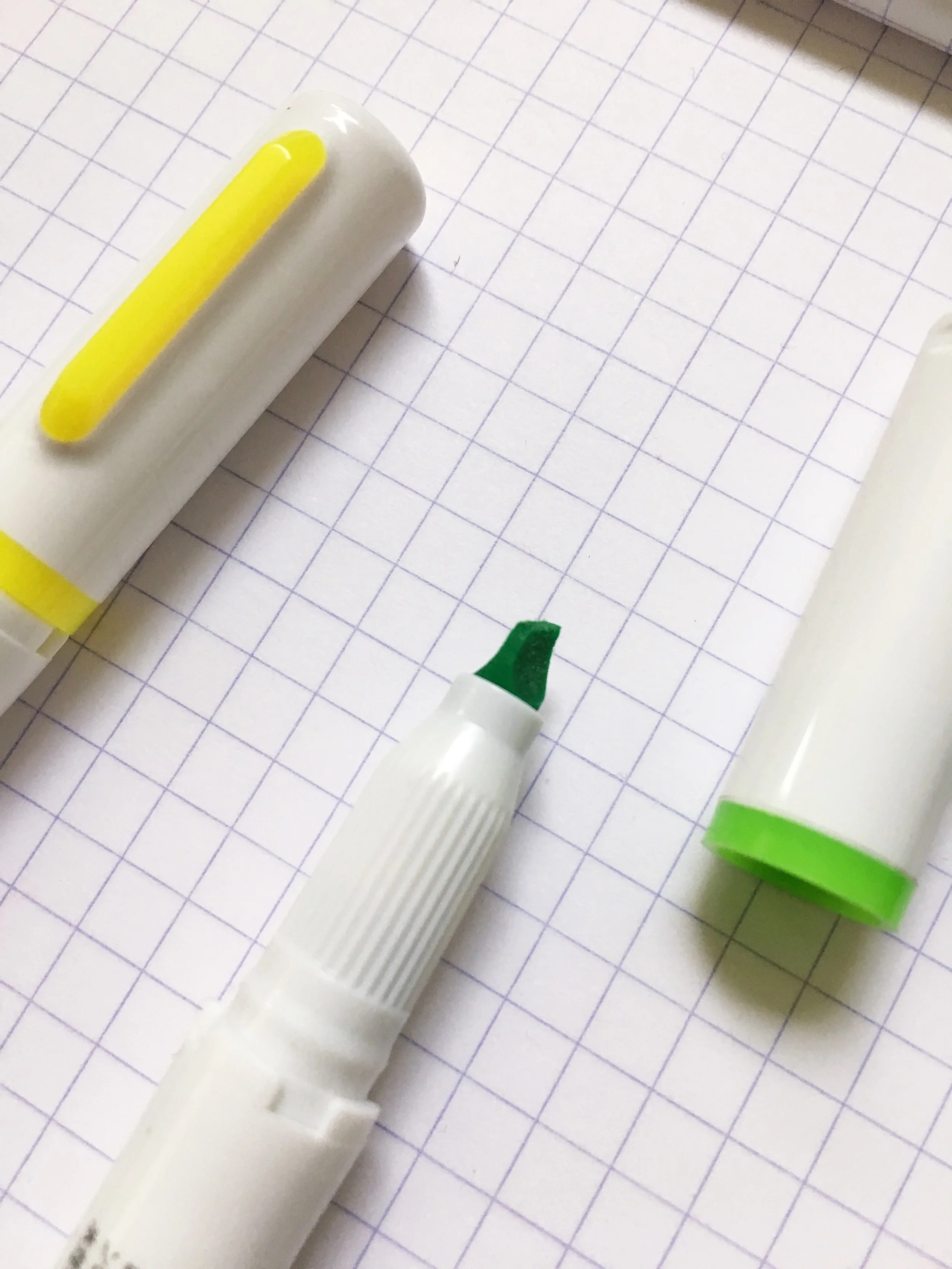
The chisel tip has a very narrow profile and flexible felt, so it glides a little extra smoothly across the page. And the flex means you don't have to line the tip up with the text perfectly to get straight, even lines. It will bend itself into a neat 4mm line, even over curved pages.

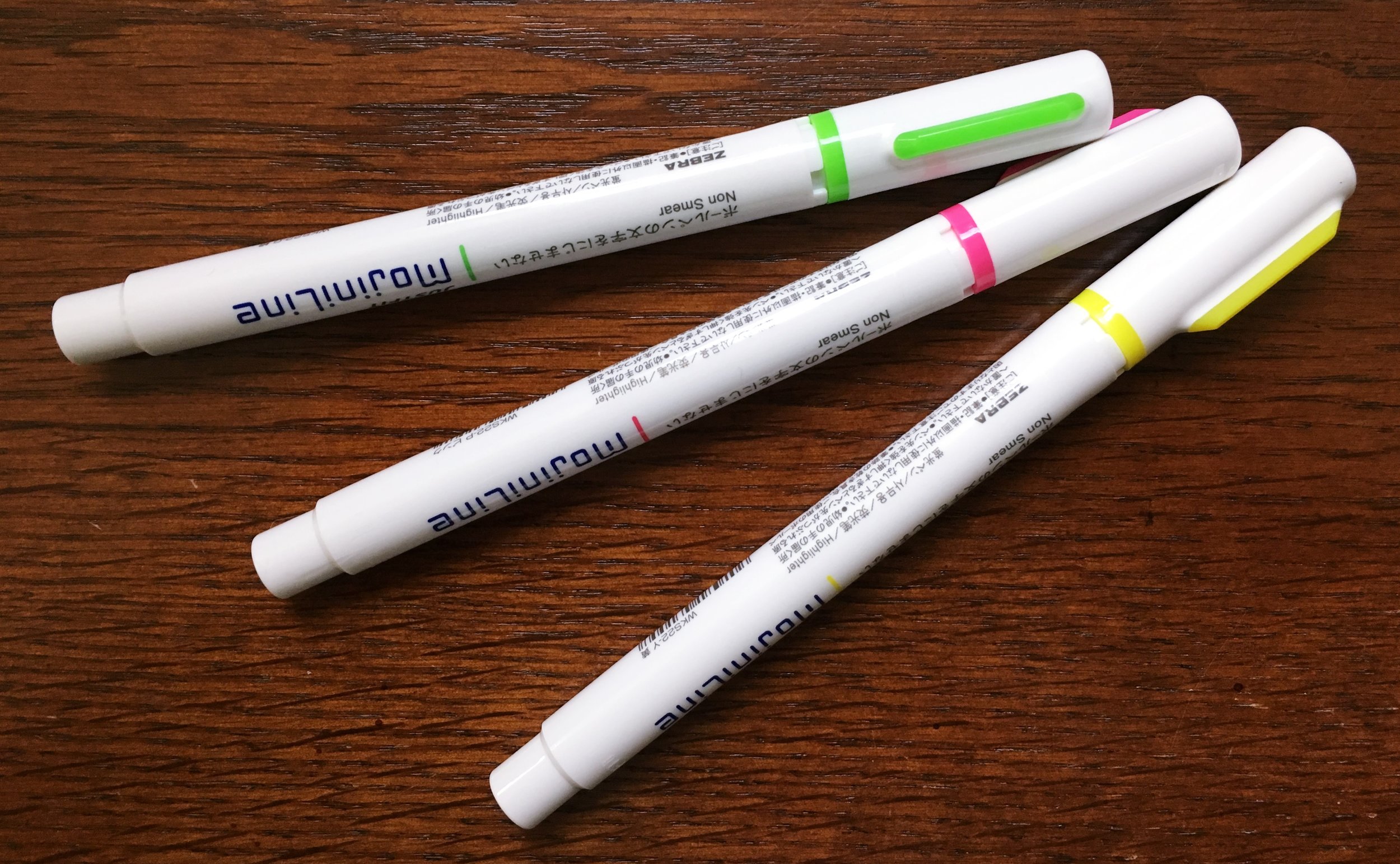
The construction of the marker is really good. It feels solid and durable--almost too nice to be disposable, but, alas, it is not refillable. There is a fair amount of branding and text on the white plastic of the pen body. There is a color band on the body and on the cap roll-stopper to indicate the ink color. The cap closes and posts very well. I wish the roll-stopper was a clip. I tend to use my highlighters as bookmarks and clip them to the pages I'm studying--but most highlighters do have clips, so I suppose it's nice that there are some without, for those who prefer that.

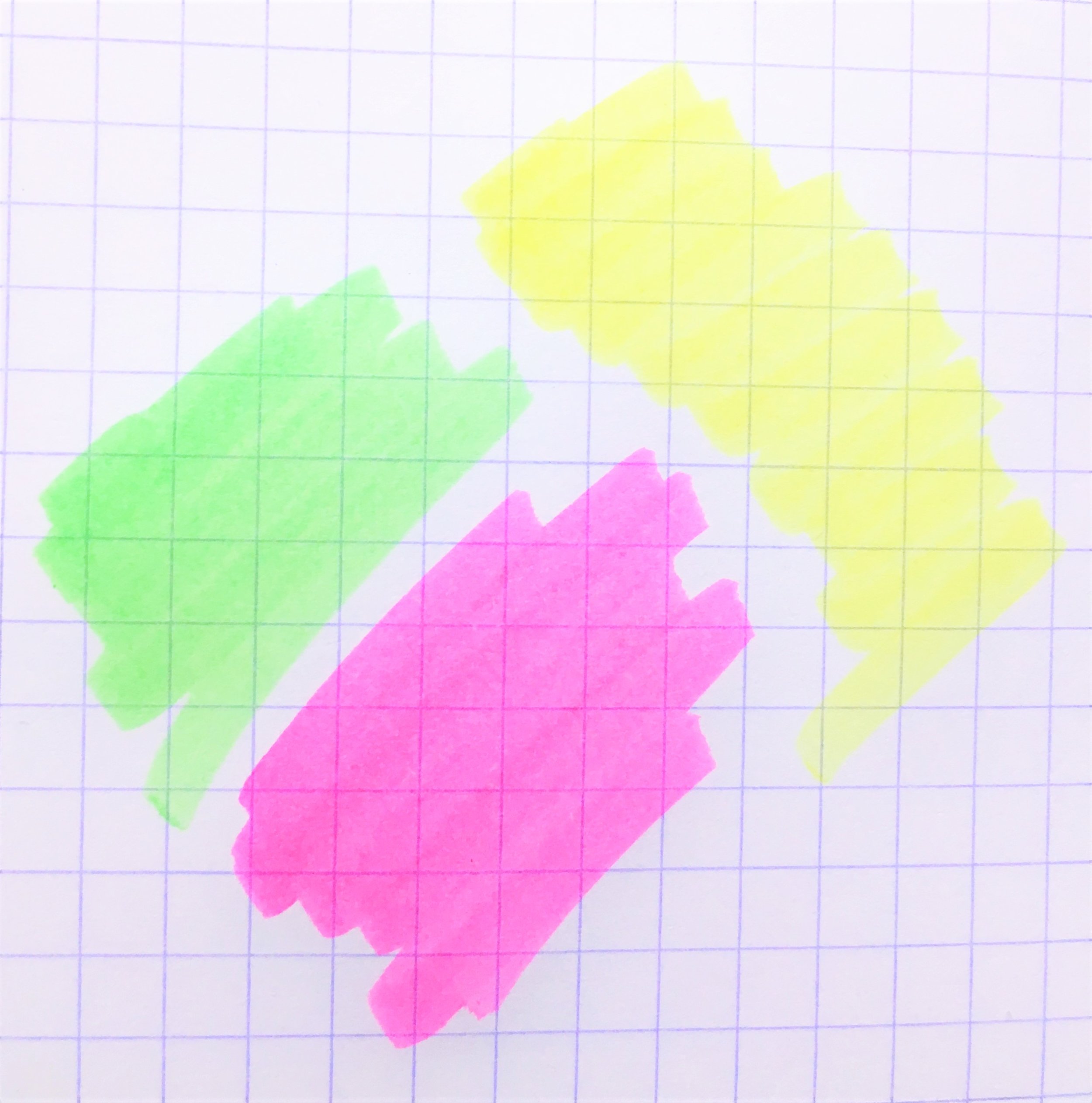
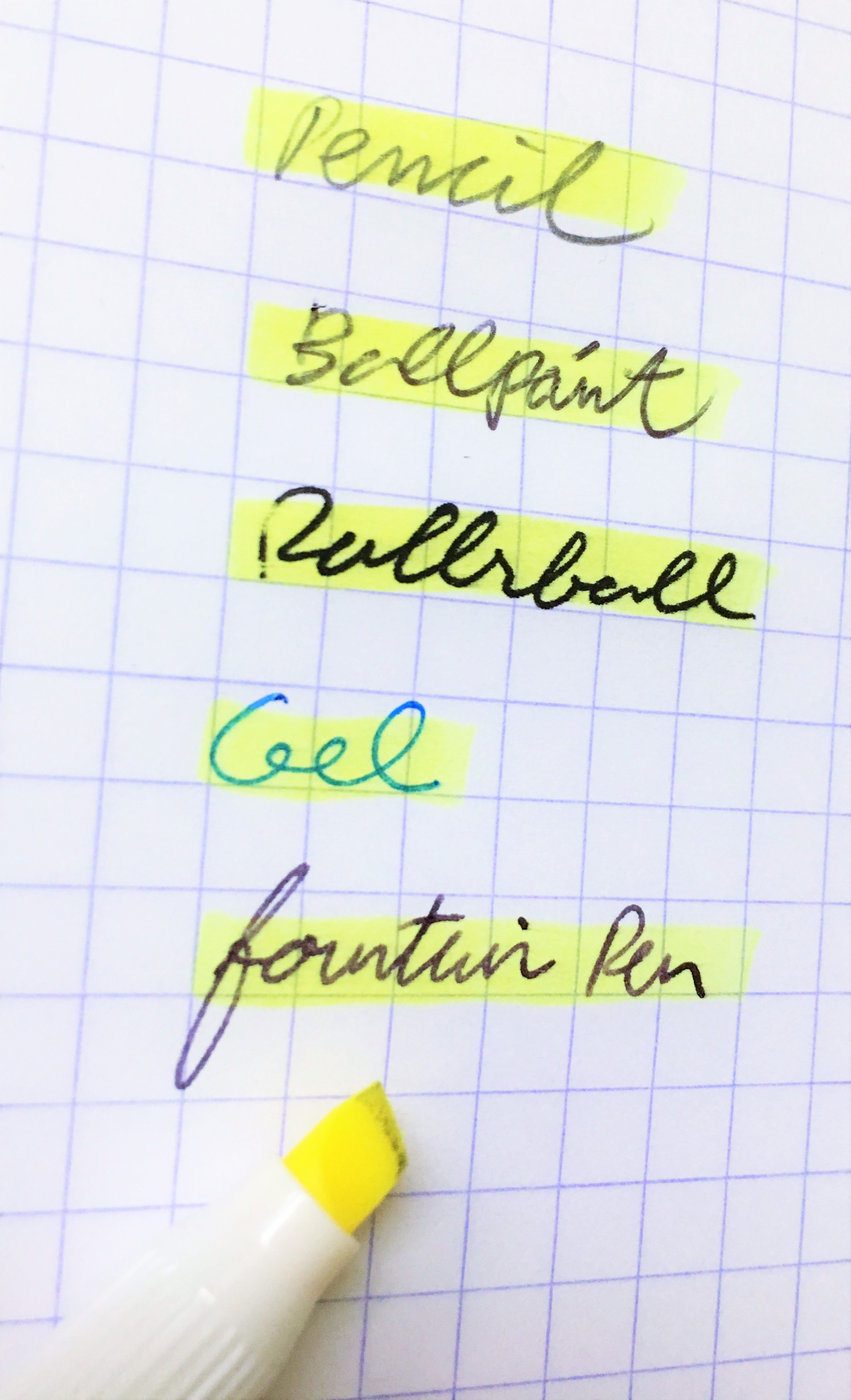
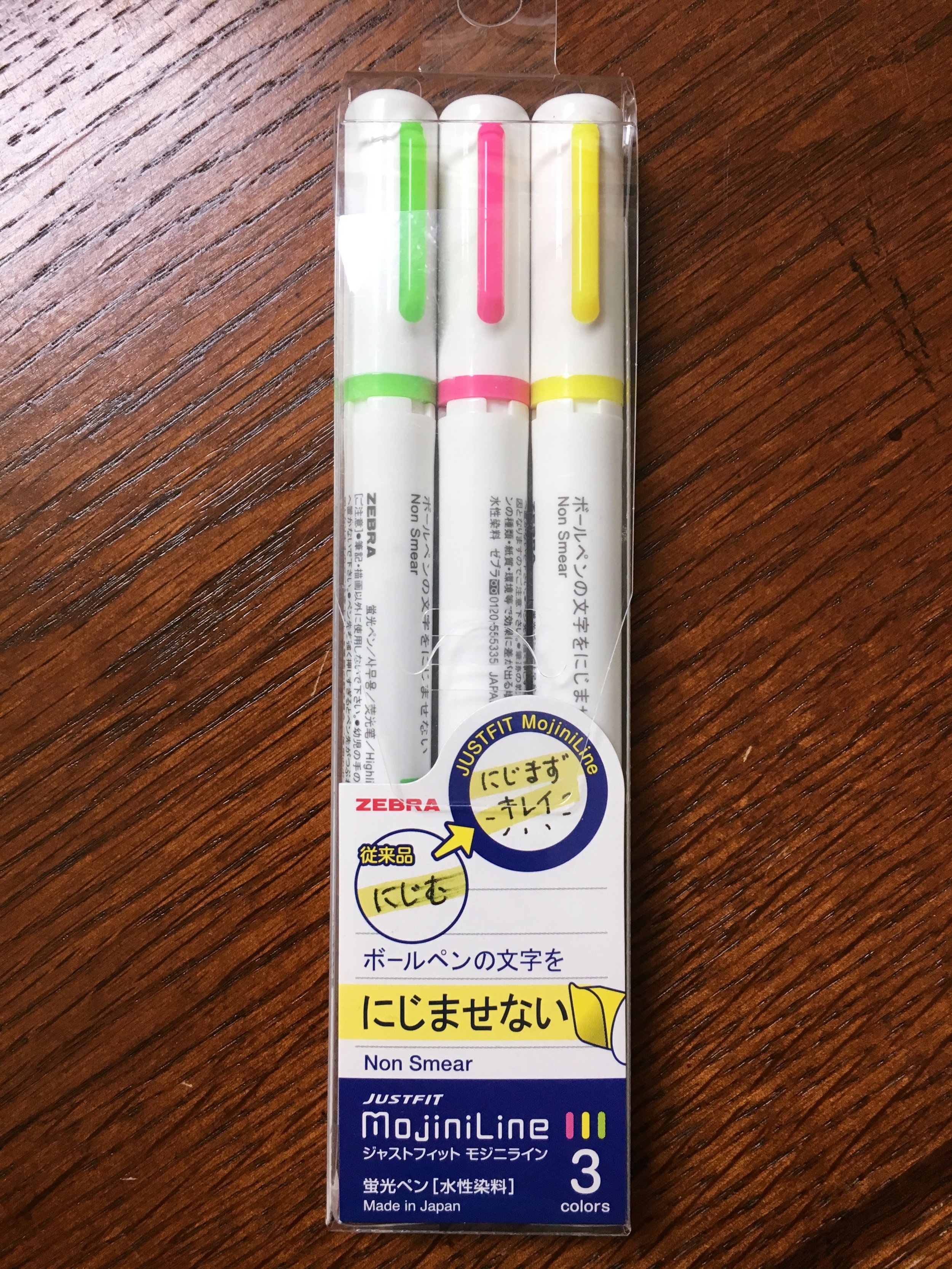
The ink is the main feature of this particular highlighter. The colors are standard fare. This 3-pack has yellow, green, and pink. Blue and red are available separately or in the five-color pack. The ink isn't too bright, doesn't bleed, dries very quickly, and doesn't smudge. All great things, especially if you're highlighting on both sides of thin paper or on notes written with liquid inks.

While I didn't notice any significant smearing, there was some discoloration to the tip of the marker, so not all the ink stayed put. That discolored area did then leave a dingy line when I used it next. I've yet to find a felt-tip highlighter that entirely dodged that issue, though.

This 3-pack is priced at $4.95, and individual highlighters are $1.95. It's a fair price, I think, for the quality.

Now that we've had this little diversion, I think it's best we get back to our studies.

(JetPens provided this product at no charge to The Pen Addict for review purposes.)


Enjoy reading The Pen Addict? Then consider becoming a member to receive additional weekly content, giveaways, and discounts in The Pen Addict shop. Plus, you support me and the site directly, for which I am very grateful.

Membership starts at just $5/month, with a discounted annual option available. To find out more about membership click here and join us!
Posted on January 10, 2019 and filed under Zebra, Highlighter, Pen Reviews.

Nakaya Portable Cigar Ishime-Kanshitsu Midori: A Review

One of the pens on my “holy grail” list was a Nakaya in the Ishime-Kanshitsu Midori finish. I finally purchased one in June 2018 from Nibs.com and chose the Nakaya Portable Cigar model. I can honestly say this is one of the most beautiful pens I own.

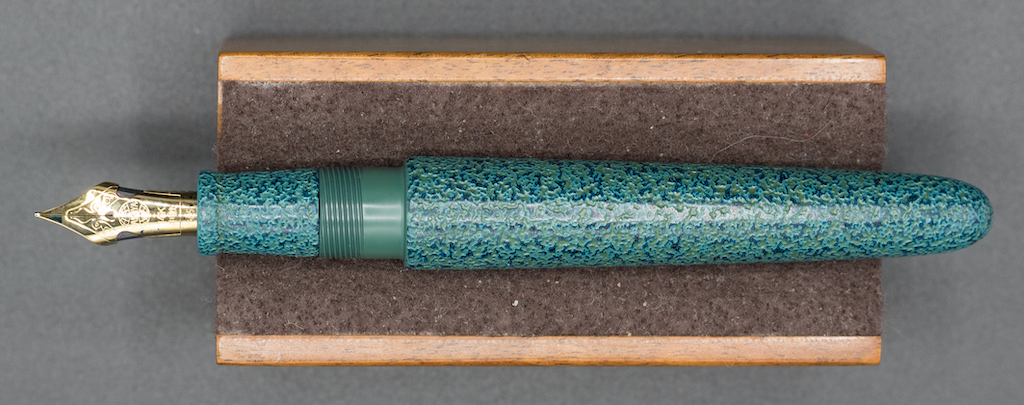
Ishime-Kanshitsu is a special process that creates a stone-like texture on an ebonite pen. “Ishi” means “stone” in Japanese and “Kanshitsu” is the layering process. Creating an Ishime-Kanshitsu surface takes three months. Urushi powder is sprinkled on the body of the pen to create the texture. Charcoal is rubbed over the surface to sharpen the Urushi grains. Then, layers of lacquer are applied to harden the body. Finally, a silver lacquer is applied (Source: Nibs.com). The results are extraordinary--just look at the various colors and details in the picture below.

Obviously, this time-intensive process creates a writing instrument that is also a work of art. The Ishime-Kanshitsu texture feels wonderful on one’s fingers and it is extraordinarily beautiful in person.

I chose the Nakaya Portable Cigar model because I didn’t have another Nakaya in this model and because the simple cigar shape shows off the textured surface well. This is a large pen (5.9 inches/150mm capped, which is just a tiny bit longer than a Montblanc 149, and 5.1 inches/130mm uncapped), but the ebonite and Urushi composition means that it weighs very little. This pen is not meant to be posted.

I chose a 14K medium-soft Nakaya nib and had it modified by John Mottishaw into an elastic nib. An elastic nib is different from a flex nib. It is a very soft nib with special cut outs that allow the nib to curve up from the feed like a paintbrush on paper (see the photos below).

The tines don’t really separate much, but you can get a bit of line variation with this nib.

I enjoy writing with this nib more than any other nib I own. It is remarkably smooth, and writing each letter is like painting a tiny picture. Writing with an elastic nib is a soothing experience because you must write more slowly since you are essentially painting words. It’s unlike any other nib I’ve ever used, and it’s very zen-like.

That said, I initially had some difficulties with my nib. It seemed starved for ink. Writing (even with my preferred Iroshizuku inks) felt dry, and I encountered lots of hard starts and skipping. I sent the pen back to nibs.com and they worked some magic on the feed and the nib. When it came back, the nib wrote much better. It produces a lovely, wet line and it no longer skips. I do still experience some hard starts on down strokes, but overall the nib functions quite well.

One of the main weaknesses of any Nakaya pen is the converter (it is the same as the Platinum converter). I don’t know why Nakaya insists on this tiny converter that works properly only when it’s mostly full. Once you use half the ink, a huge bubble develops in the converter and you have to manually push the ink down to continue writing. They could, at least, insert a ball into the converter to prevent this from happening (in fact, I’m thinking about doing this myself using a ball from an unused cartridge I own). What would be better is if they would create a superior converter.

I’m quite happy with my Nakaya Ishime-Kanshitsu Midori pen. I love the texture, shape, balance, and nib on this pen. It is simply a joy to use. Of course, such beauty comes with a steep price. I paid $1,280 for this model with an elastic nib. As always, the question of whether or not a pen is “worth it” is dependent upon the person who uses the pen. I feel this pen is worth every penny because of its unparalleled beauty and because the elastic nib is so wonderful to write with (now that it’s been properly adjusted).

Here are a few more pictures of this beauty for you to enjoy. I must say, it is one of my most photogenic pens!


Enjoy reading The Pen Addict? Then consider becoming a member to receive additional weekly content, giveaways, and discounts in The Pen Addict shop. Plus, you support me and the site directly, for which I am very grateful.

Membership starts at just $5/month, with a discounted annual option available. To find out more about membership click here and join us!

Posted on January 4, 2019 and filed under Nakaya, Fountain Pens, Pen Reviews.