Posts filed under Pen Reviews

Franklin-Christoph Steel Flex Nib Review

My flex nib writing style will never be confused for the glorious strokes of Azizah at Gourmet Pens, or the frolicking fun of Ana at The Well-Appointed Desk. But my style is my style, and I love the flair that flex nibs add to my block print writing style.

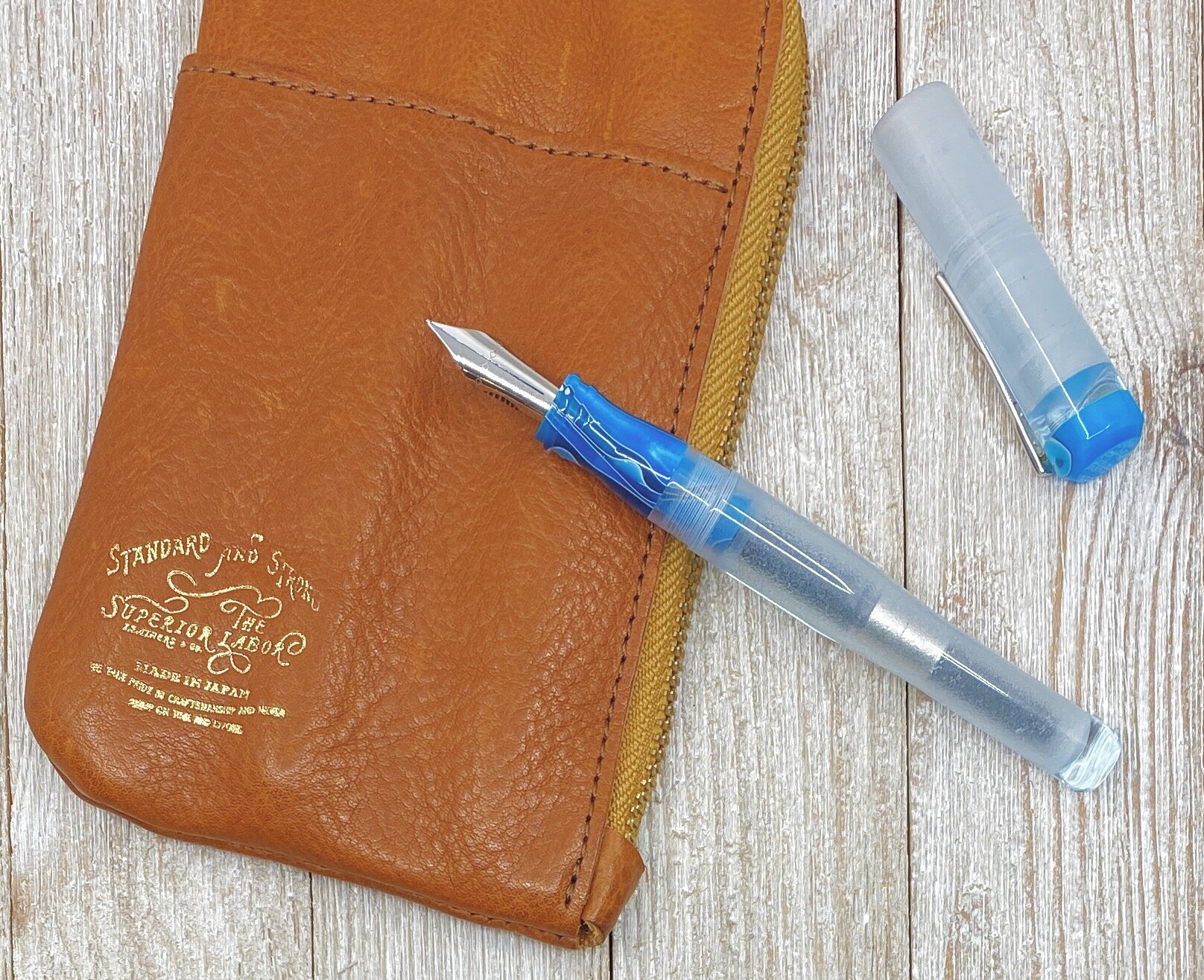
The latest flex nib to cross my path is the Franklin-Christoph #6 Steel Extra Fine, and it’s a good one. Now, you know my stance on nearly all modern flex nibs - they should be classified as soft nibs, not flex, for the most part - and this F-C nib is no different. But, as with other modern flex nibs I’ve tested, that doesn’t mean it isn’t excellent in it’s own right.

The F-C steel flex nib is characterized by the lengthy slit running up almost 90% of the exposed nib, along with slight scallops carved out of the wings. This type of steel nib is not new to the market, but it is the first time one has crossed my desk.

From strictly a flex perspective, there is a good amount of line variation, but not a massive range like you get from vintage flex nibs or dip nibs. Nor should there be. That’s the expectation from those nibs - not this one. And that is the expectation you should have going into any modern flex nib purchase.
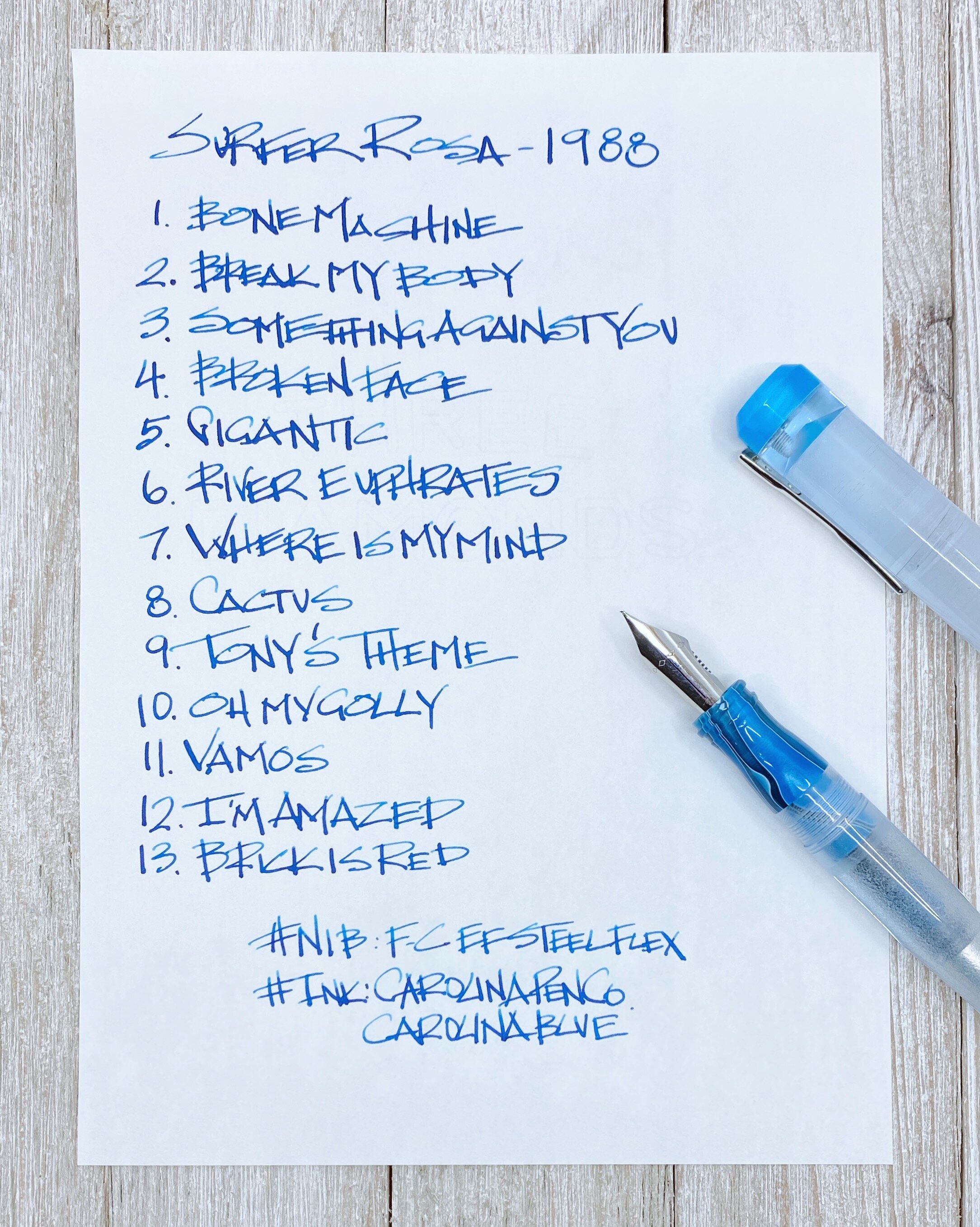
For my handwriting style, this nib helps my letters pop off the page. My heavy hand spreads the tines on the downstroke for wide lines, then relaxes for thinner lines from side to side. For a nib marked as EF I would like to see a finer fine line, but that’s a minor complaint for a nib that writes so well.

I compared this nib to two other soft nibs in my collection - the Aurora Optima Flex, and the Pilot Falcon - to get a feel for how similar or different they are. I assumed the Falcon would be an outlier, and it was. It has a much finer fine line, and a narrow wide line, but it might have the widest range if you know how to use it properly.
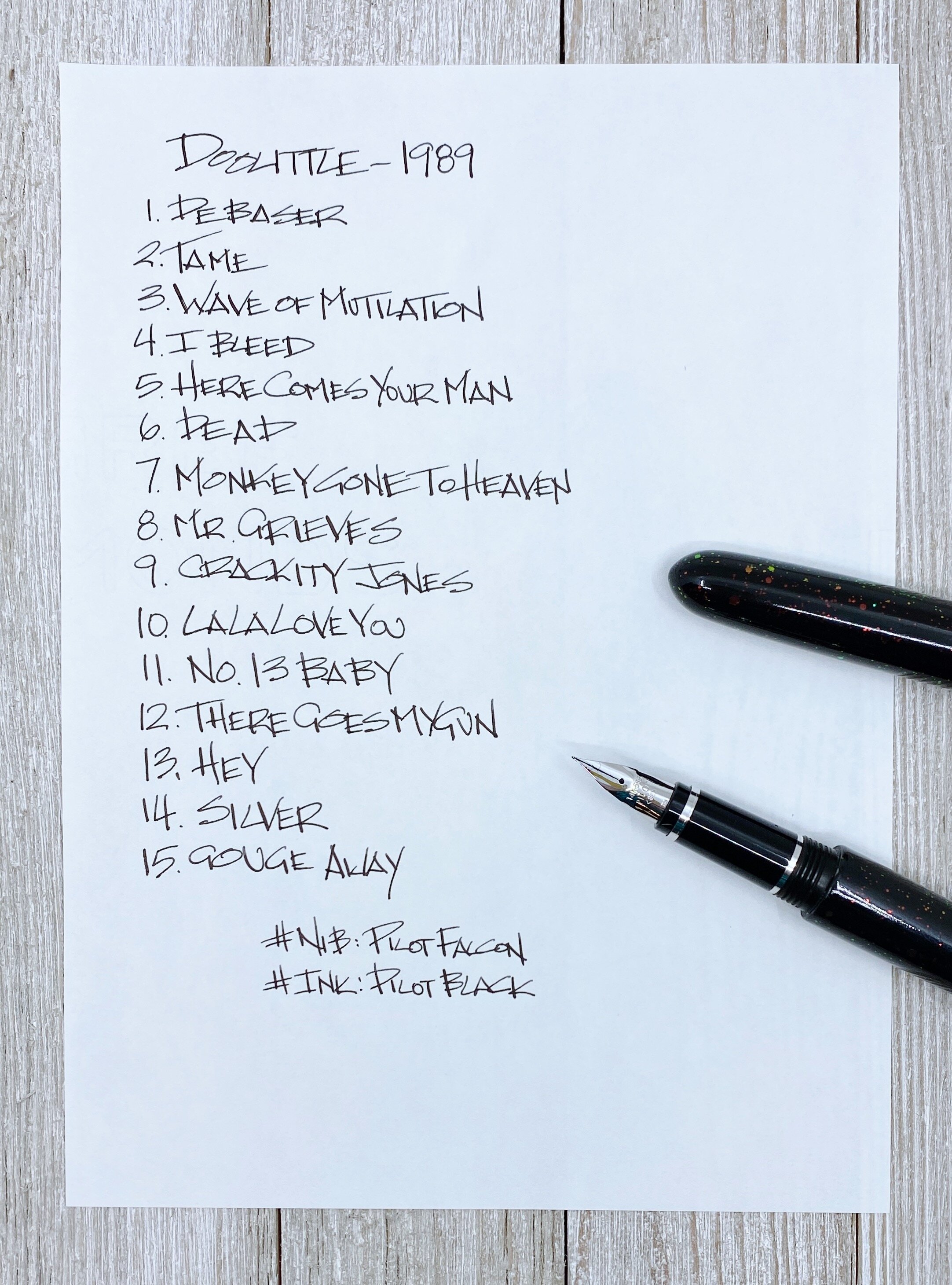
The other two are shockingly similar. I’ve talked about how much I enjoy writing with the Aurora flex nib due to how cool it makes my handwriting look, and the Franklin-Christoph is similar to that. Shockingly similar I’d say. They both begin with a fine line and expand to a broad line. There is definitely a good amount of variation - you just begin from a wider place than with a nib like the Falcon.

I added a Sailor King of Pen stock medium nib to the comparison to show a baseline of how these soft nibs make my handwriting appear. It’s noticeable to me in person, but may not translate as well in pictures.

So what’s my verdict on the Franklin-Christoph #6 Steel Extra Fine nib, from a non-flex friendly writer? It’s pretty great. I think I’ve already convinced myself to pick up one or two more and have them ground even finer to see what I can really do with the nib. Do I have a flexy future?

(Franklin-Christoph provided this product at a discount to The Pen Addict for review purposes.)


Enjoy reading The Pen Addict? Then consider becoming a member to receive additional weekly content, giveaways, and discounts in The Pen Addict shop. Plus, you support me and the site directly, for which I am very grateful.

Membership starts at just $5/month, with a discounted annual option available. To find out more about membership click here and join us!

Posted on January 27, 2020 and filed under Franklin-Christoph, Nibs, Flex Nib, Pen Reviews.

Leonardo Furore Deep Purple with Rose Gold Trim: A Review

(Susan M. Pigott is a fountain pen collector, pen and paperholic, photographer, and professor. You can find more from Susan on her blog Scribalishess.)

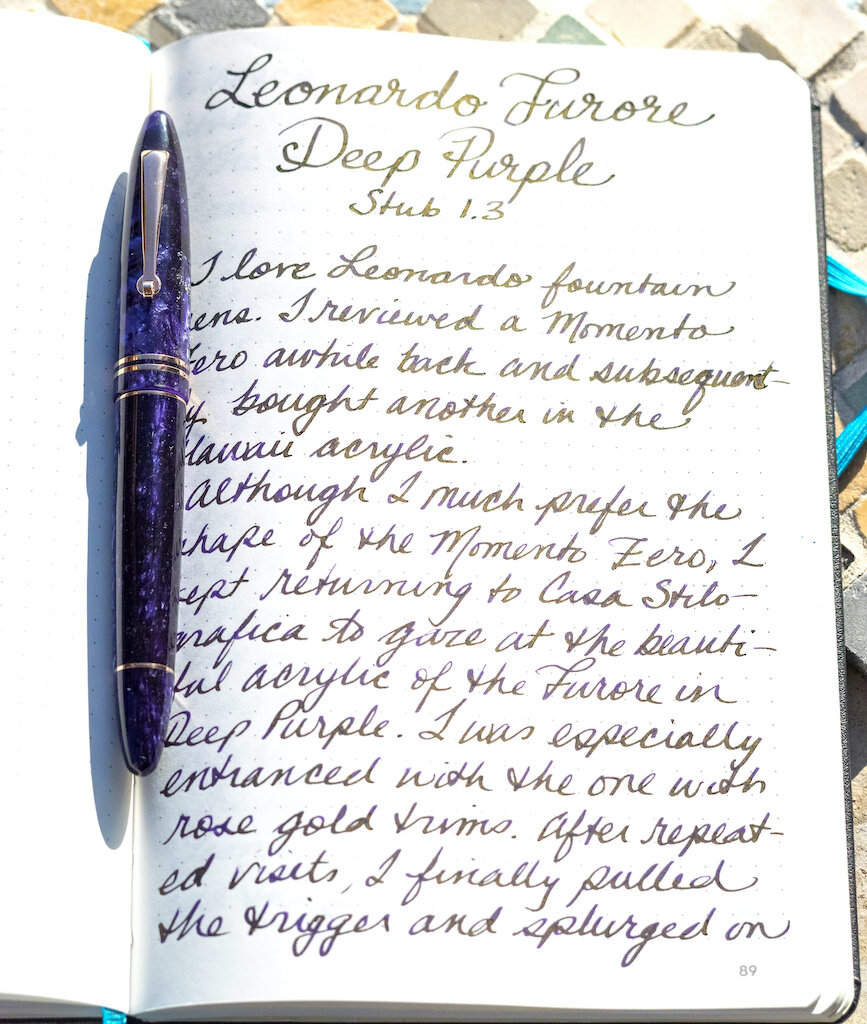
I love Leonardo fountain pens. I reviewed a Momento Zero awhile back, and subsequently I bought another Momento Zero in Hawaii resin. I suspect more Leonardo pens are in my future.

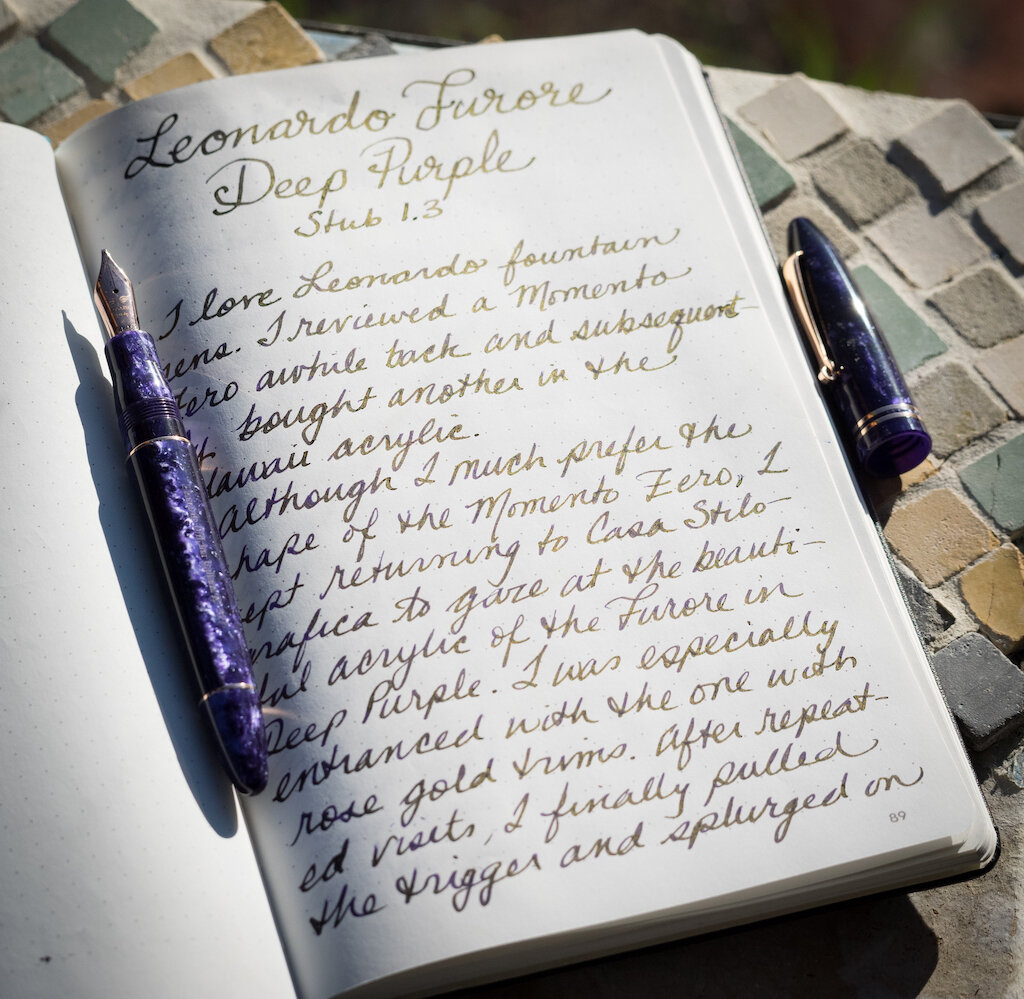
Although I much prefer the shape of the Momento Zero, I kept returning to Casa della Stilografica to gaze at the beautiful resin of the Furore in Deep Purple. I was especially entranced with the model with rose gold trims. After repeated visits, I finally pulled the trigger and splurged on the Furore with a 14k rose gold stub nib (1.3mm).

The pen arrived in record time from Casa della Stilografica. I couldn’t help from exclaiming, “Fra-jee-lay!” when I saw the package (you know, A Christmas Story). It was a box from Italy after all. And, apparently, “Furore” is pronounced “Foo-róh-ray,” so I was basking in Italian pronunciation anyway. The Furore box looks like an Italian countryside--floral and colorful.

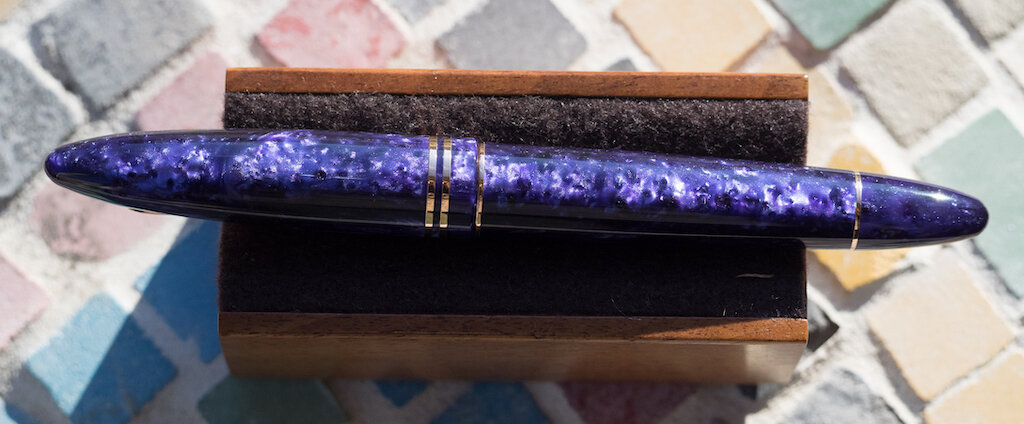
I love it when I open a new fountain pen and gasp. I gasped upon seeing the Furore’s purple resin. The purple is dark in some places and sparkles in others with lighter purple flecks. You can arrange the cap so the lighter purple flecks align.

Or you can cap the pen so there are alternate dark and light portions.

Usually I’m OCD about getting pen patterns aligned, but with the Furore, I like having alternating light and dark patterns.

The barrel is engraved with “Leonardo Officina Italiana” and the pen number, mine is No. 327.

The pen is cigar-shaped, though the ends are much narrower than, say, a Montblanc 149. In fact, I might call the Furore “torpedo-shaped.”

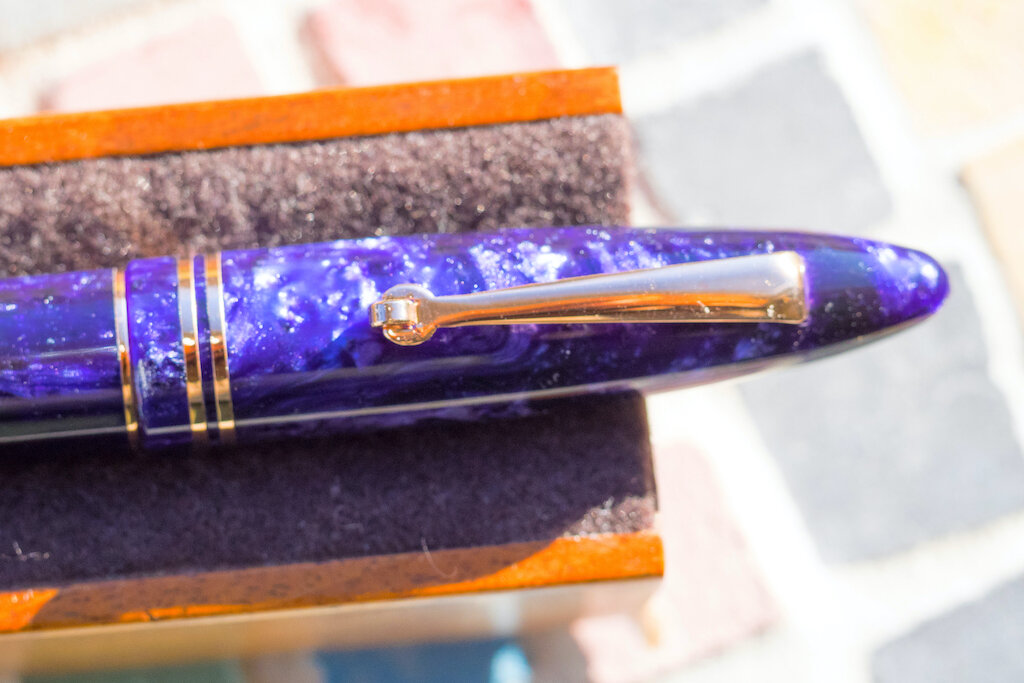
The rose-gold trims are lovely and complement the purple perfectly. The clip has a tiny roller on it, making it easy to clip the pen onto a notebook or shirt pocket. Two rings adorn the cap and two more adorn the top and bottom of the barrel.

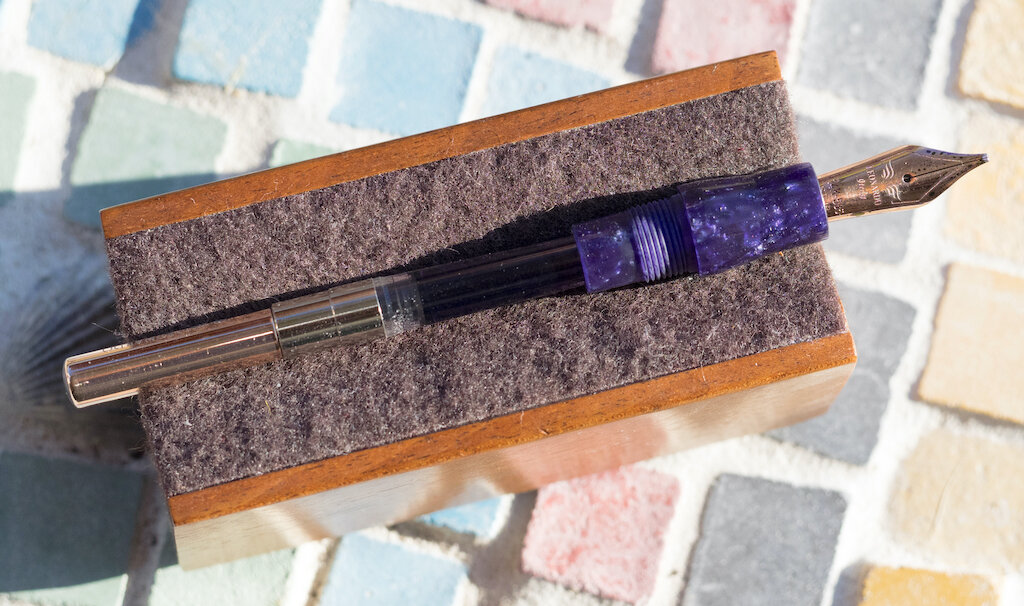
The pen is a cartridge/converter filler. Like other Leonardo pens, you can fill the converter by removing the blind cap on the bottom of the barrel so that it functions more like a piston.

Or, you can remove the barrel to expose the entire converter. I love Leonardo converters. They are well made and sturdy--far superior to the cheap plastic converters that come with so many other fountain pens.

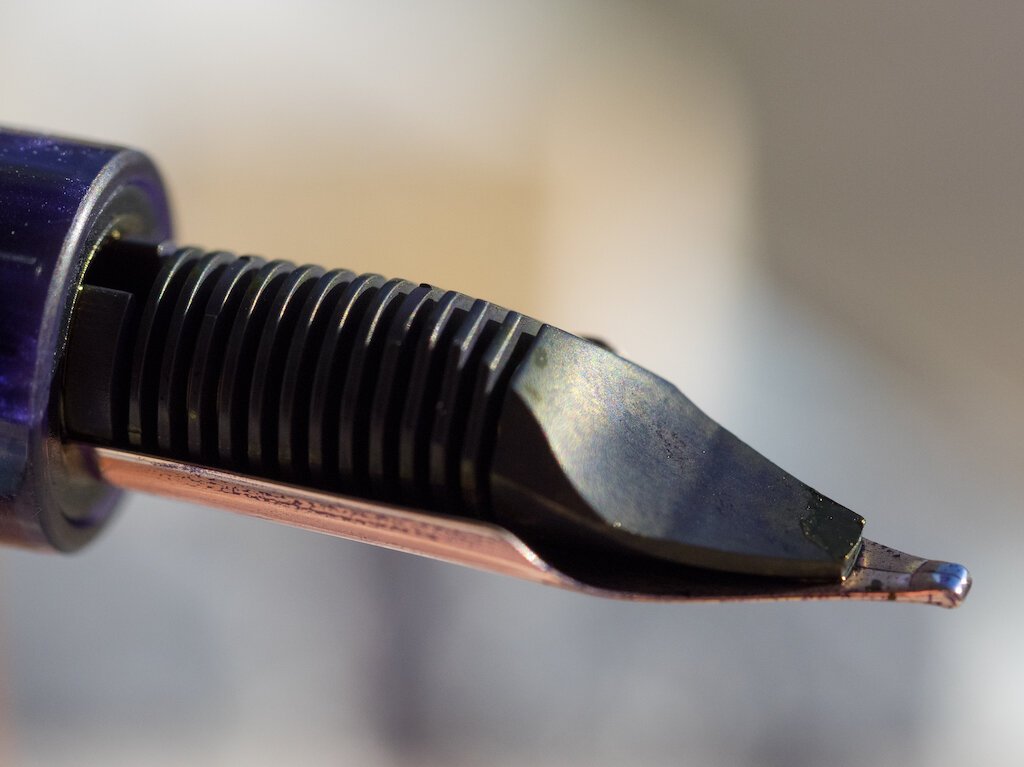
The 14k rose-gold nib is glorious with the simple Leonardo branding and a generous 1.3mm stub.

The feed offers excellent ink flow, and the stub has nice line variation.

It’s a satisfying, smooth, wet nib.

I honestly can’t tell a difference between the gold stub nib and the steel stub I have on my Leonardo Momento Zero Hawaii. That’s how good the steel nibs are. I suppose the gold nib might have a little more give to it, but, frankly, if you are torn between gold and steel, I think the steel nibs are just as good as the gold.

I purchased my Leonardo Furore from Casa della Stilografica. You can get this pen in various trims--gold, rose gold, and HT (rhodium), and you can choose steel or 14k nibs. A Furore with a steel nib costs €145.90 (= $161.29 at current conversion rates) and the gold nib costs €309.24 (= $341.96 at current conversion rates). I highly recommend Casa della Stilografica. They have all the varieties of Leonardo pens (unlike many American dealers who have more limited options), plus, their customer service is top notch.

My Leonardo Furore in Deep Purple is one of my happy pens. What I mean by that is this is a pen that makes me happy when I look at it and even happier when I use it. It’s a color that delights me, and the stub nib suits my writing style perfectly.

(I purchased the Leonardo Furore in Deep Purple with my own funds.)


Enjoy reading The Pen Addict? Then consider becoming a member to receive additional weekly content, giveaways, and discounts in The Pen Addict shop. Plus, you support me and the site directly, for which I am very grateful.

Membership starts at just $5/month, with a discounted annual option available. To find out more about membership click here and join us!

Posted on January 24, 2020 and filed under Leonardo, Fountain Pens, Pen Reviews.

Sailor Nagasawa Pro Color Fountain Pen Review

(Sarah Read is an author, editor, yarn artist, and pen/paper/ink addict. You can find more about her at her website and on Twitter. And check out her latest book, Out of Water, now available where books are sold!)

The Sailor Pro Color has a new special series from the Nagasawa Stationery Center in Kobe, Japan--this time in a lovely array of seven slightly shimmery pastel colors. I'm a big fan of the Pro Color model. To be fair, I'm a big fan of most Sailors that I've used. From their low-end, entry-level pens to their fancy-pants budget-breakers, there's an attention to detail and dedication to quality that makes all of them special.

The Pro Color isn't quite entry-level. With a price tag of $87, it's a stage past that, into the "generous gift" category, by my scale. It just crosses the impulse-buy threshold, though these pretty pens could easily blur that line with their charm.

Like the Shikiori Tsukuyo-no-Minamo that I reviewed last year, the primary difference between this pan and its fancier cousin, the 1911 Standard, is the nib material. The 1911 has a gold nib, while these models have a gold-colored steel nib. The resin of the body also feels, to me, a little bit less substantial. The edges are just slightly less finished. All of these differences have to be studied to be noticed at all. The steel nib is so smooth and perfectly tuned that I had to double-check that it wasn't gold.

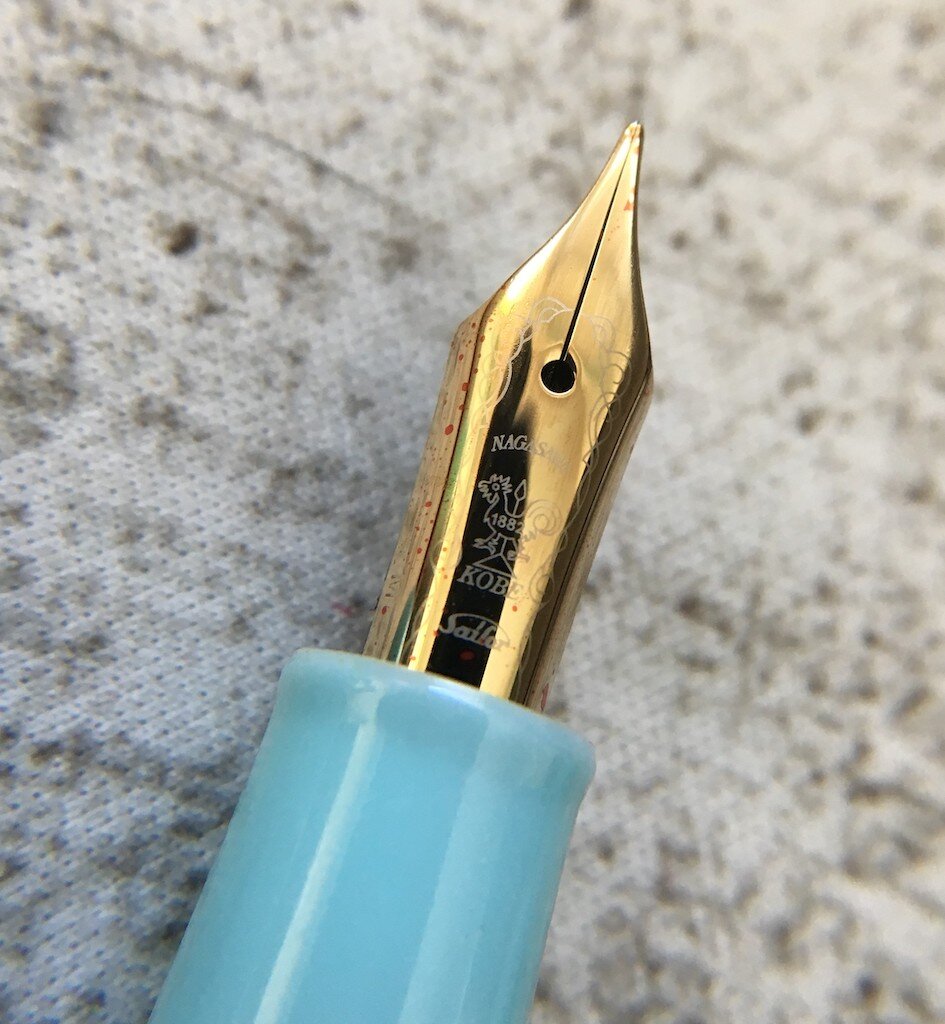
The nib on this Nagasawa edition has different stamping than the regular Pro Color series. Instead of the scroll work and anchor, there's a rooster weathervane with 1882 on it, with Nagasawa and Kobe written around it. Sailor is written below that. It's a really lovely nib, and it's fun to see something different and special on it. The looks would mean nothing, though, if it wasn't also a dreamy writer. It is perfectly smooth, even with this fine nib, and it has the perfect wetness to show off the characteristics of whatever ink you're using. I don't often see much ink shading with a Japanese fine nib, but I do with this pen.

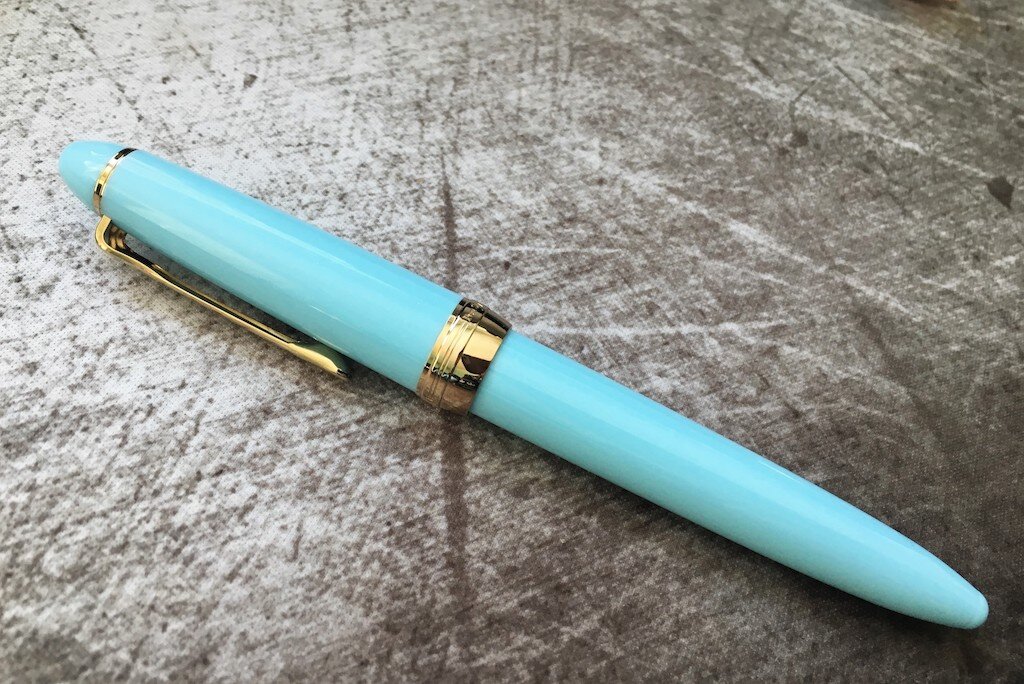
This model is the Kobe Water Blue color. It's a lovely, soft, robin's egg blue. It's also available in Ijinkan Mint (I need this color also), Nunobiki Lavender, Rikyu Moon Yellow, Hatoba Coral Pink (this one, too), Samura Sand Beige, and Oji Cherry. They're all gorgeous. The spring colors bring a nice pop of cheer to the deep winter.

All of the pens have gold-colored furniture. The cap band says "Nagasawa" and "pen style den". The clip is plain, but functions well. The grip section is comfortable, and made from the same plastic as the body. It can use Sailor cartridges or a Sailor converter. It comes with both, so you can choose your preference. I loaded mine with Sailor Ink Studios 773, which I'll be reviewing next week.

In my experience, you can't go wrong with a Sailor pen. It might be possible to spend too much on one, though. This Pro Color model gives you a wonderful writing experience for a fraction of the price of their middle- and high-end pens. If you haven't tried a Sailor yet, and are in the market for a step up from entry-level, this is a fantastic choice. Having a wonderful, inexpensive Sailor will not, however, make you immune to the allure of high-end Sailor pens. While this pen is perfectly good enough, there are never enough Sailors.

(JetPens provided this product at no charge to The Pen Addict for review purposes.)


Enjoy reading The Pen Addict? Then consider becoming a member to receive additional weekly content, giveaways, and discounts in The Pen Addict shop. Plus, you support me and the site directly, for which I am very grateful.

Membership starts at just $5/month, with a discounted annual option available. To find out more about membership click here and join us!

Posted on January 23, 2020 and filed under Sailor, Nagasawa, Fountain Pens, Pen Reviews.