Posts filed under Pen Reviews

RIIND Compact Pen Review

RIIND Compact Pen Review

(Jeff Abbott is a regular contributor at The Pen Addict. You can find more from Jeff online at Draft Evolution and Twitter.)

The world of custom machined pens is so fascinating to me, largely due to the constant innovation and release of new products. There's always something new around the corner to satiate any obscure pen refill or aesthetic needs you may have. At a higher level, they all perform a simple duty: they're all writing instruments in the same way a Bic is a writing instrument. But the individual design, craftsmanship, and vision is what sets these bespoke objects apart from anything you can find that's mass-produced.

The latest machined pen to cross my desk is from RIIND. After a successful Kickstarter run, the Compact and Slim ballpoint pens are being manufactured to fulfill the rewards. At some point, they'll also be available to purchase from RIIND in the event you missed out on the initial fundraiser. The RIIND Compact is what I'm using here, and it's their smaller body that uses a Parker refill. The pen comes with a Parker Quink 1.0mm black refill, and it writes beautifully for a ballpoint. The ink flow is smooth, and it starts writing immediately. While it isn't as crisp as gel ink, it's still a great writing experience and maintains a small package. Since it's a Parker style refill, you have a lot of options if you don't like the Quink refills.

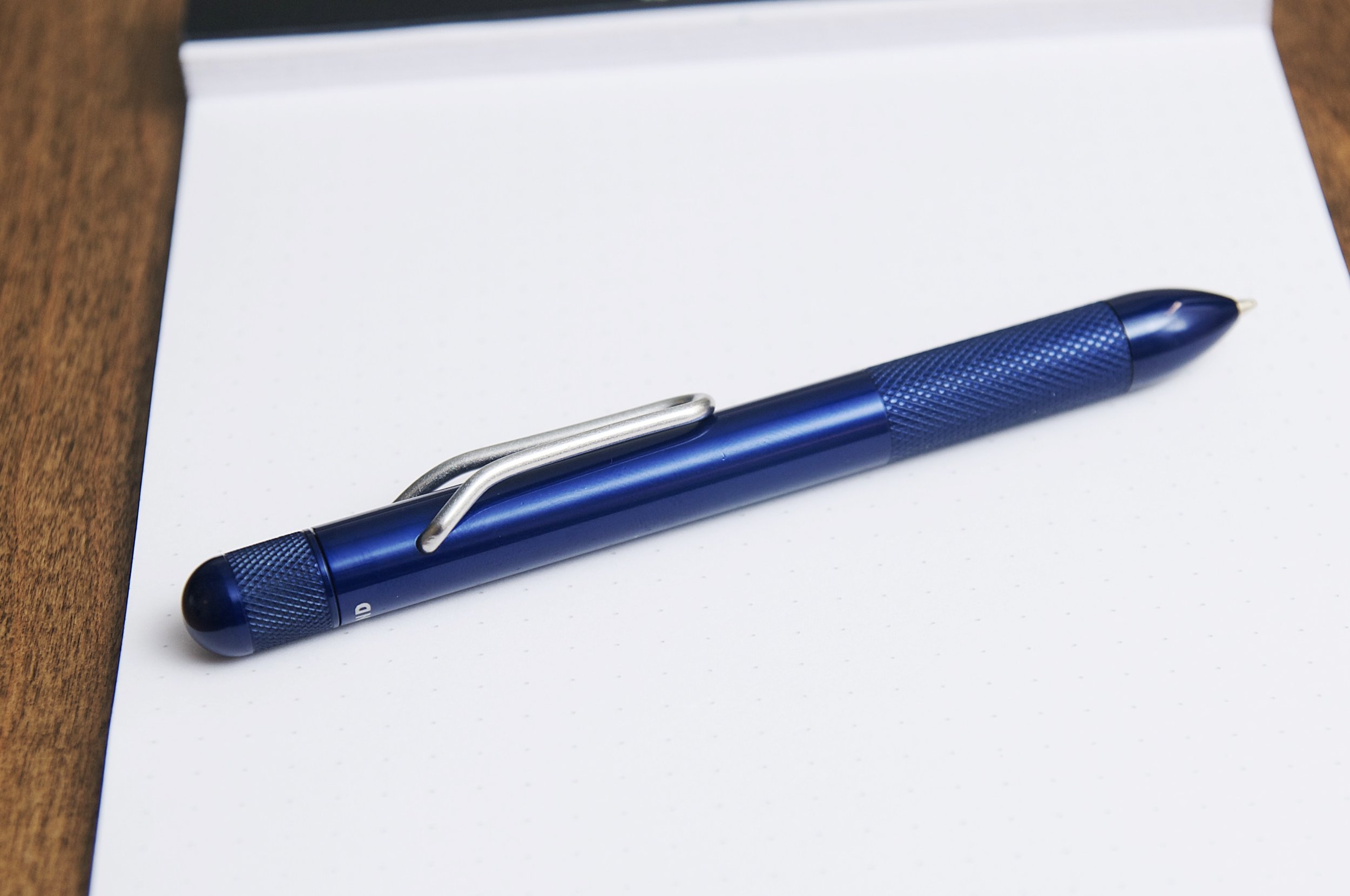
The RIIND is machined from aluminum, and my review unit is actually anodized in a lovely dark blue. This wasn't available in the original Kickstarter campaign, but I hope it's available as an option to purchase because it's a great color.
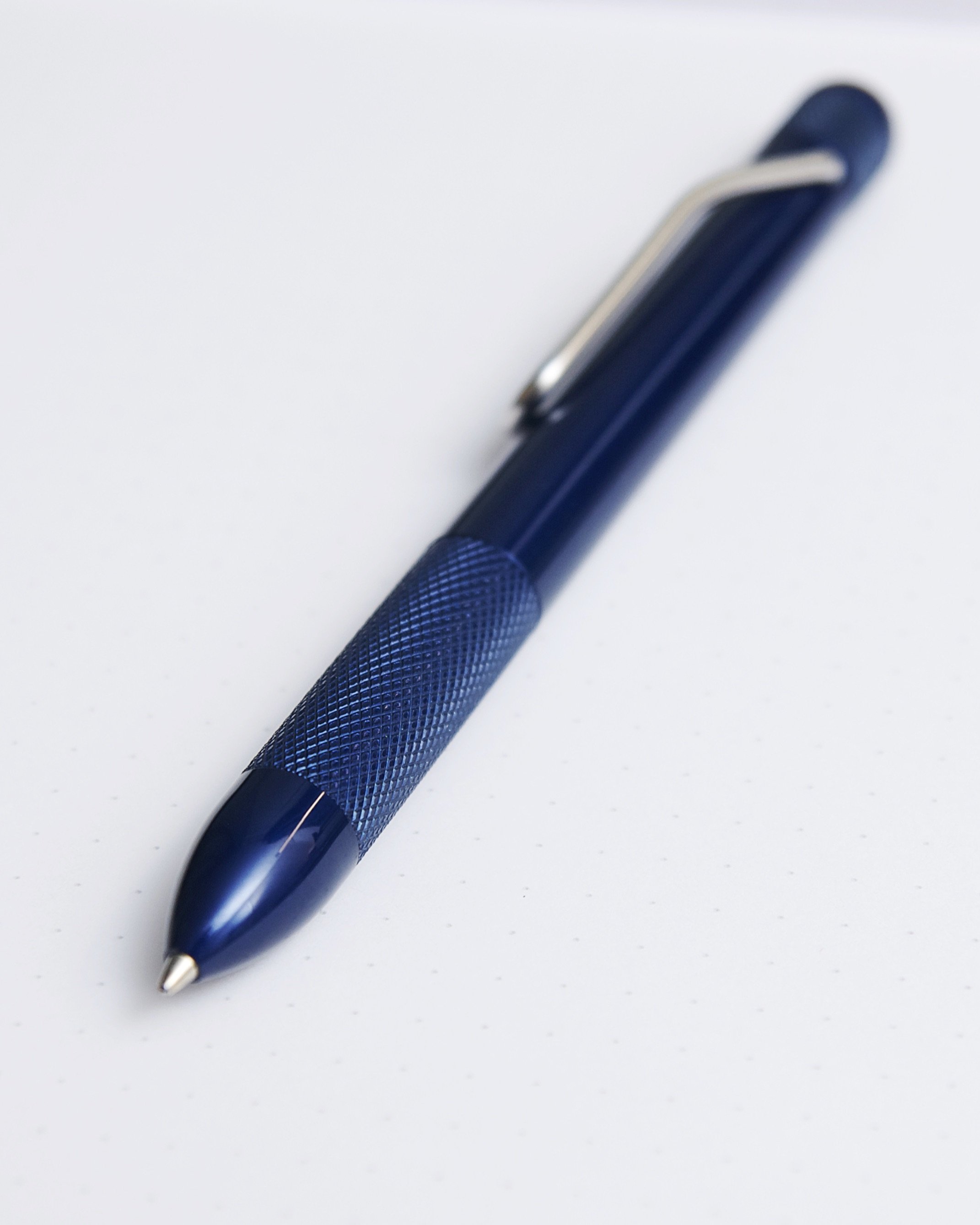
RIIND Compact Pen

The grip features an aggressive knurling texture that feels really good when writing. There's no feeling of slipping when using this pen due to the tactile grip. Even though the knurling feels intense, it's not overly sharp or unpleasant. It provides excellent grip while being pleasant to hold and use.

The twist cap uses the same knurling to great effect. You can twist the cap either way to open/close the pen. It takes a little bit of force to turn it, but once you get used to the effort needed to operate, it's a piece of cake to operate with one hand. Since the pen is fairly short, using it with one hand is pretty easy. Not sure if the same can be said for the longer G2 refill sibling.
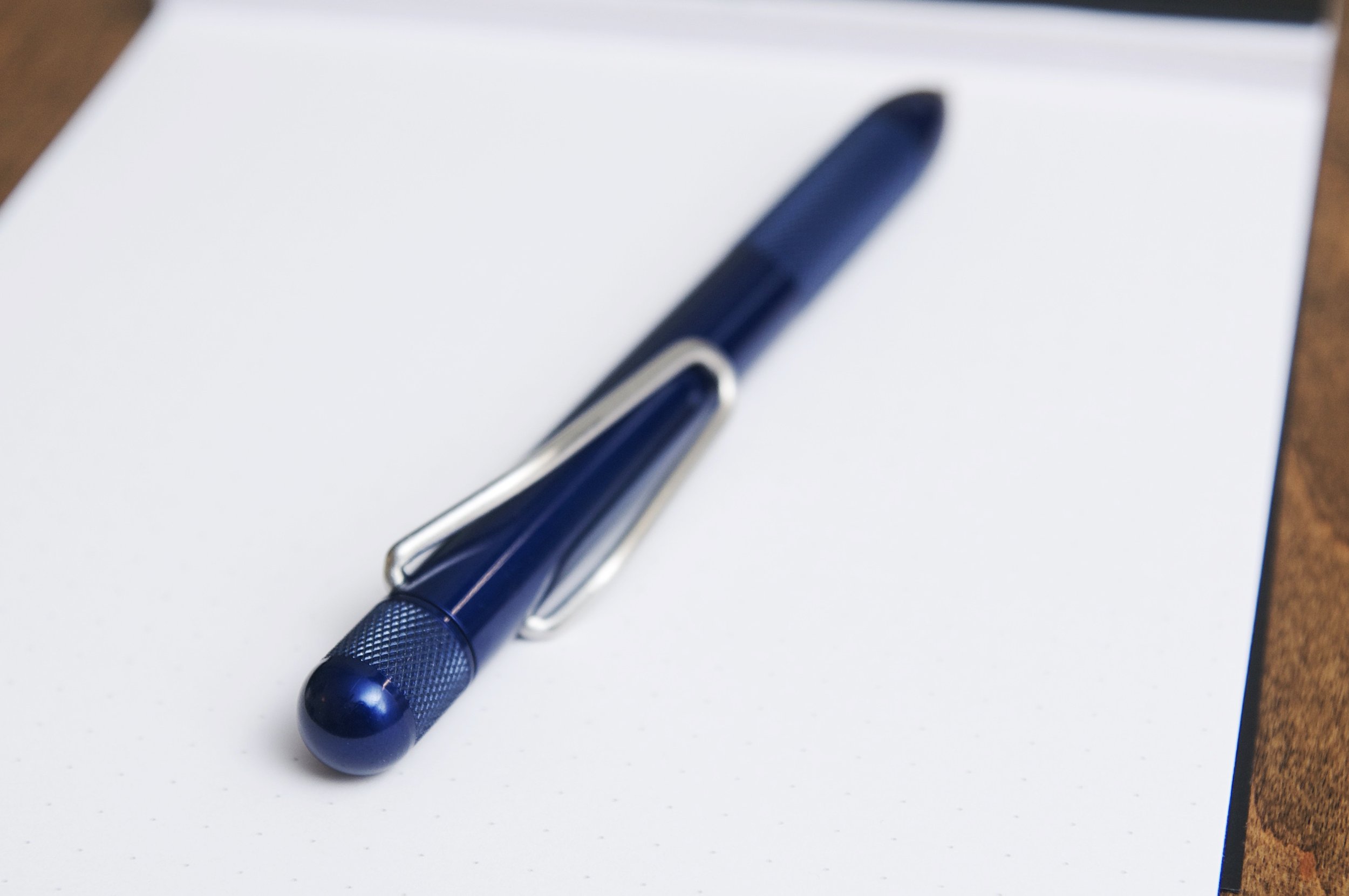
RIIND Compact Pen

The twist mechanism is really fun to use and very tactile. The resistance from the spring grows stronger right until the moment the nock clicks over to either extend or retract the refill. The click is crisp and clean, and there's a satisfying sound to go along with it. It's safe to say this can fill in for your favorite fidget toy.
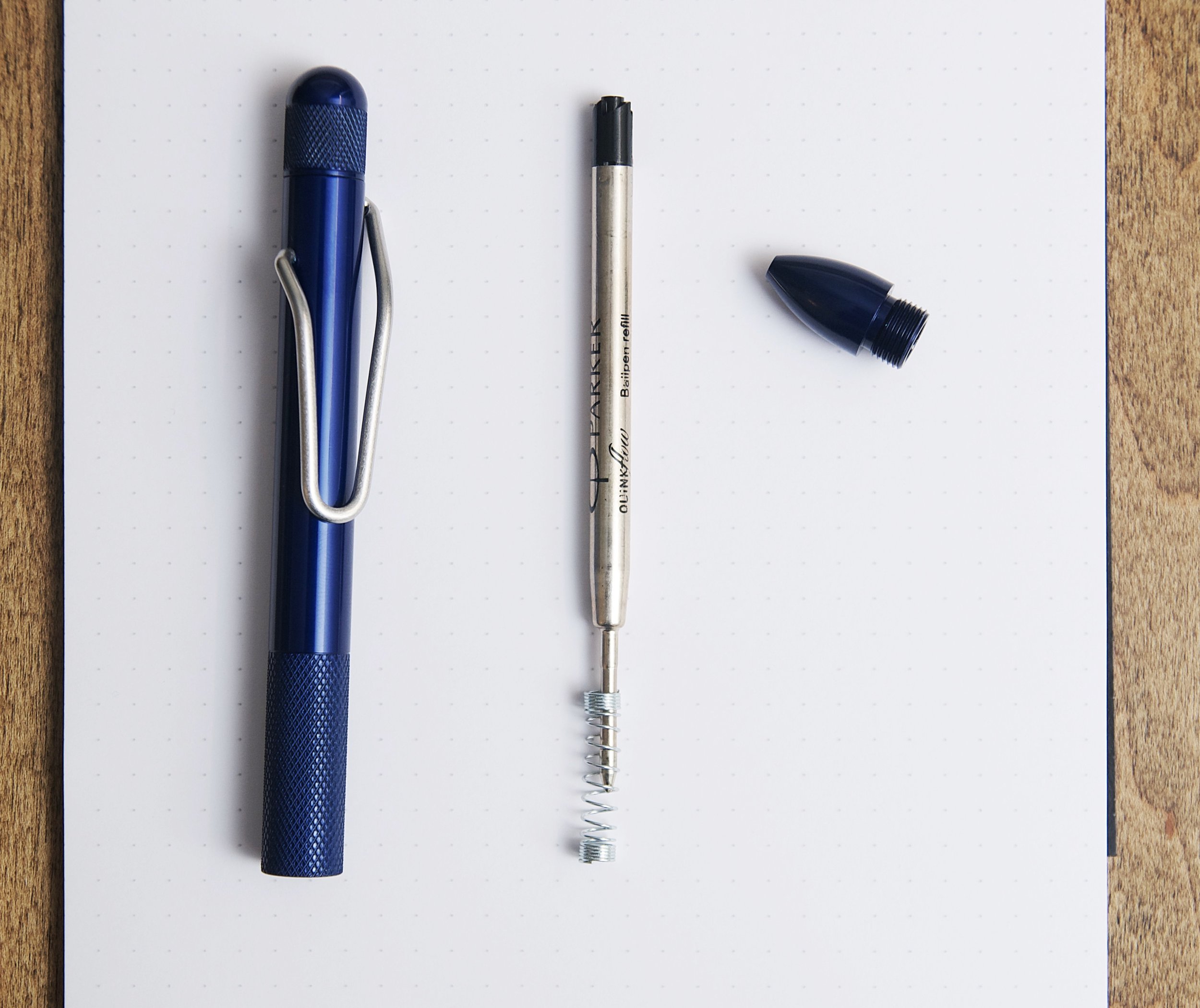
RIIND Compact Pen

The clip is unique and is one of my favorite aspects of the pen's aesthetics. How many different ways can you shape a tube that holds a refill? That's why the clip design is so important with these machined pens — that's where you can really set the pen apart from all the others. RIIND does that exceptionally well here with a robust clip that acts like a carabiner clip. The attachment points are staggered, giving the clip torsion when you pull it away from the pen body. It works really well! Despite being smooth and not using a clip shape at the end to grab onto things, it has no problem securing the pen to whatever you clip it to. The staggered attachment points add visual interest to the pen due to the lack of symmetry. I love looking at it, and it's also a joy to use.

Since this model is made of aluminum, it's not very heavy. It weighs more than other aluminum pens I own, but not by much. I think most of the additional weight is due to the unique retraction mechanism and possibly a thicker than normal pen body wall. This thing feels indestructible.
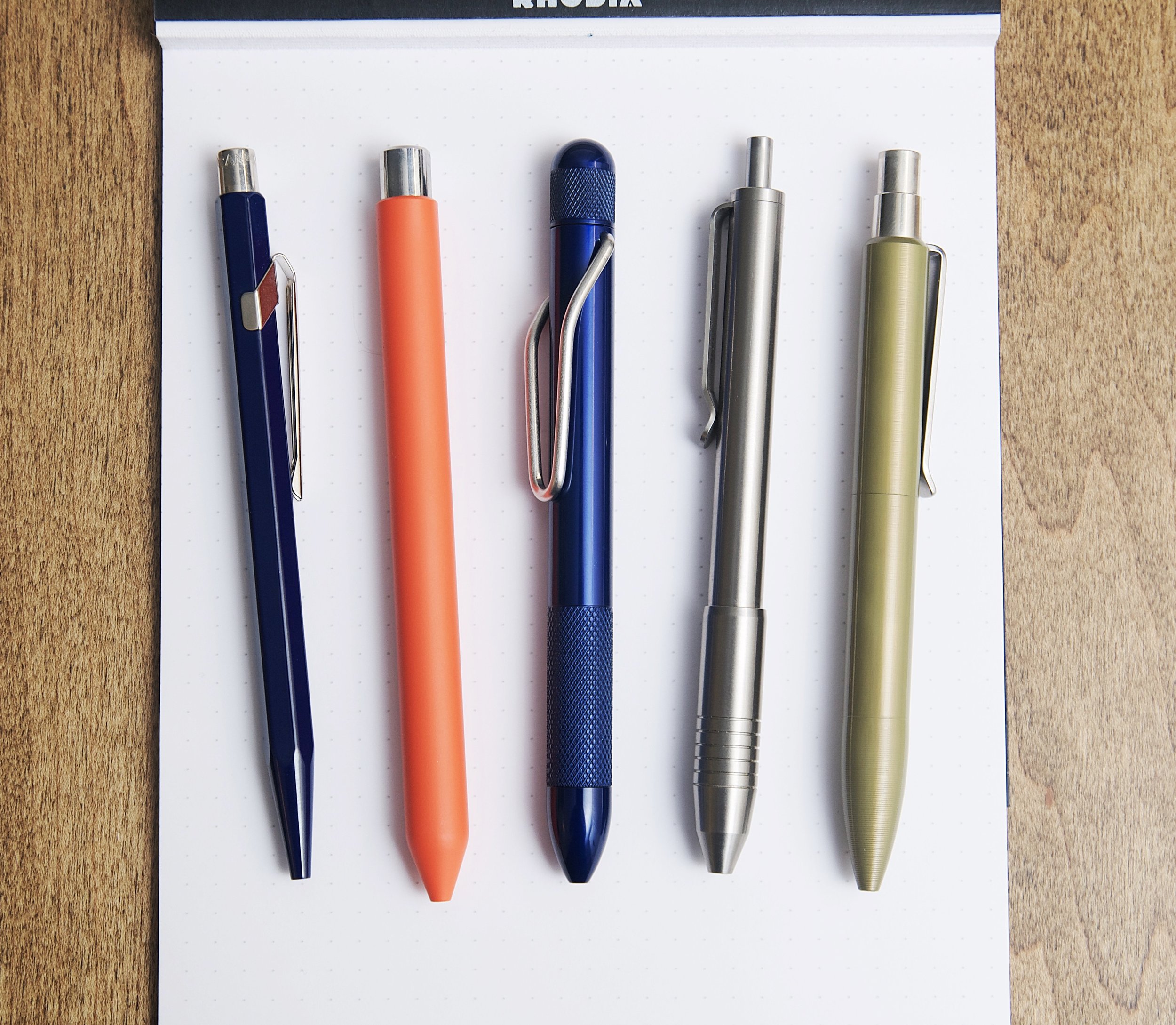
RIIND Compact Pen

Writing with this pen has been a fantastic experience. The Parker Quink refill has never been my favorite, but I've found myself picking this pen up more often than not despite the "sub-par" refill. I've enjoyed using it, and I think most of that comes down to how it feels in my hand and it handles when I'm writing. It's balanced perfectly and offers a fantastic level of control.

When it comes to machined pens, our options are plentiful. It's a fun space to explore, and when you find the right one for your style and taste, it's easy to pull the trigger. If the tubular and gnarly knurling juxtaposition of the RIIND meets your fancy, you'll love using it. At $99 (shipping included for US customers), it's also a fair deal. You can get aluminum machined pens for less (and more), but I think the quality, fit and finish, and writing experience are well-worth the cost of admission here.

Pre-orders are open now for both the Compact, as featured in this review, and Slim models.

(RIIND provided this product at no charge to The Pen Addict for review purposes.)


Enjoy reading The Pen Addict? Then consider becoming a member to receive additional weekly content, giveaways, and discounts in The Pen Addict shop. Plus, you support me and the site directly, for which I am very grateful.

Membership starts at just $5/month, with a discounted annual option available. To find out more about membership click here and join us!
Posted on July 20, 2022 and filed under RIIND, Pen Reviews.

Zebra G-450 and G-750 Gel Ink Pen Review

Zebra G-450 and G-750 Gel Ink Pen Review

Before I left my day job to focus on The Pen Addict full time, I was in the IT field. I was with the same company for around 15 years, 12 of that in the same facility. I knew a lot of people there, and a lot of them knew me as the pen guy.

For the few that were interested past the “oh, that’s nice,” phase, there were two pens that were their favorites: the Pilot G2, and the Zebra F-301.

I understood the love for the G2. Still do. It’s a rock solid gel ink pen that writes smooth and has dark ink. Wide availability on store shelves expanded its popularity. If you liked school supplies when you were a kid, you were prone to grab a pack of G2’s when you saw them, and sung their praises once compared to the general office supplies you were stuck with at work.

The F-301 was different. There is no doubt that it looked cool, and while not near as ubiquitous as the G2, it was reasonably available at office supply stores, if not grocery stores. And F-301 fans? The ones I met were passionate about this little pen. I’m never one to yuck someone’s yum, but let’s just say my feelings were not as strong about this pen as the G2 at the time.

The biggest failure with the design of the F-301 is the grip. It looks great on the shelf, but once you unpack the pen and hold it, it becomes evident how uncomfortable the plastic ridges are on your fingertips. For a quick note it is passable, but any longer writing is out of the question.

Still, the F-301 proved to be popular due to its construction. It is a durable pen, and the refill was good enough. And I’m happy that this pen has been a success for Zebra, because they took what worked well with the F-301 and improved on it. There is a softer grip model in the F-402, and they eventually added gel refill options in the various G-series models, including the two I’m going to talk about today.

Zebra G-450 and G-750 Gel Ink Pen

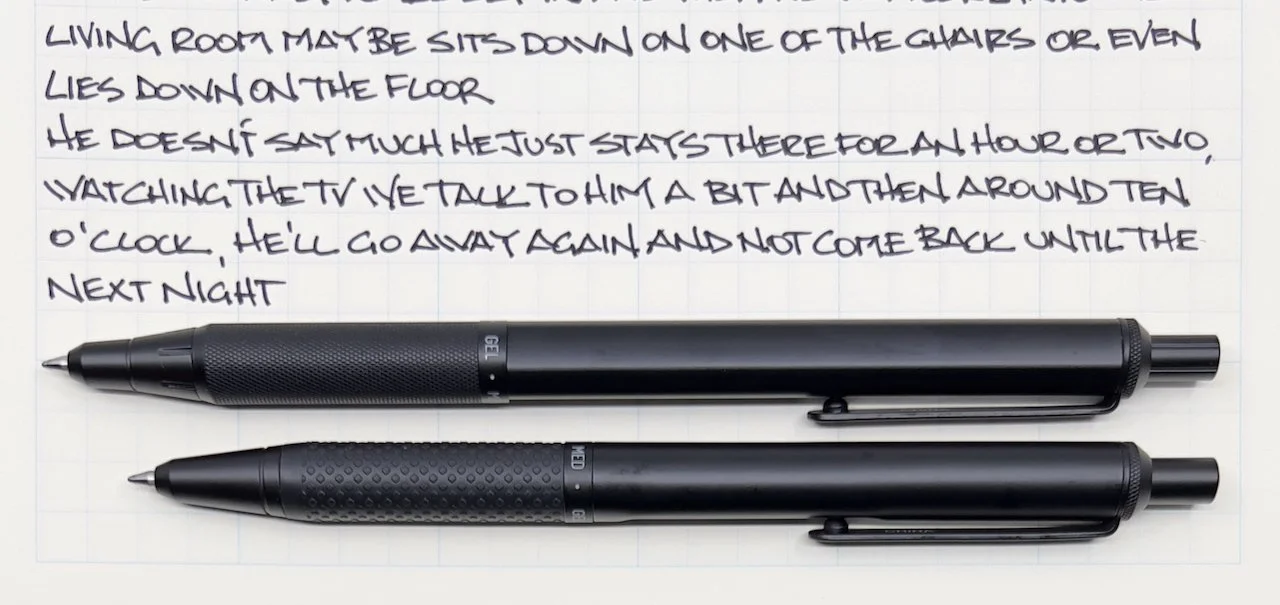
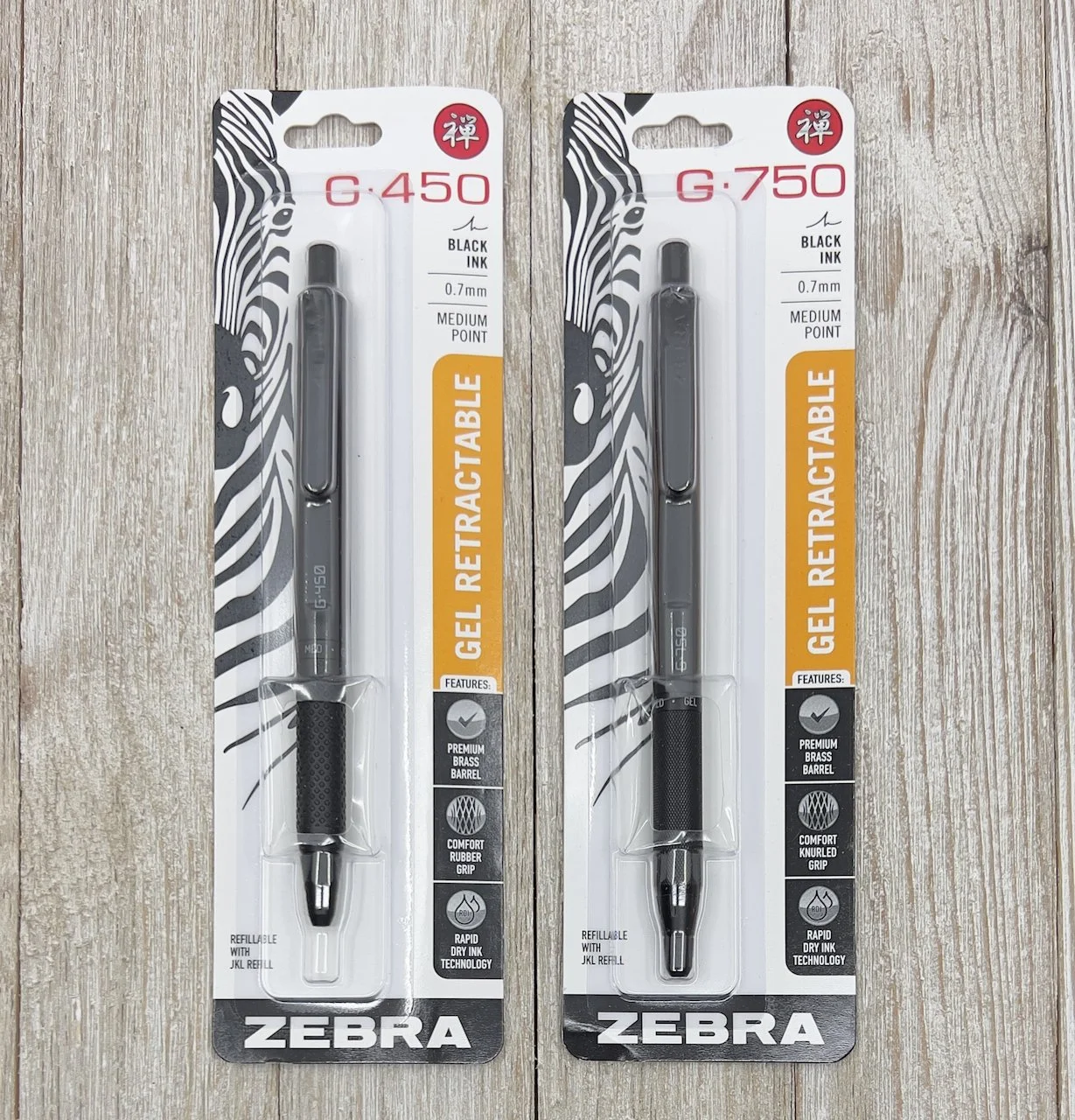
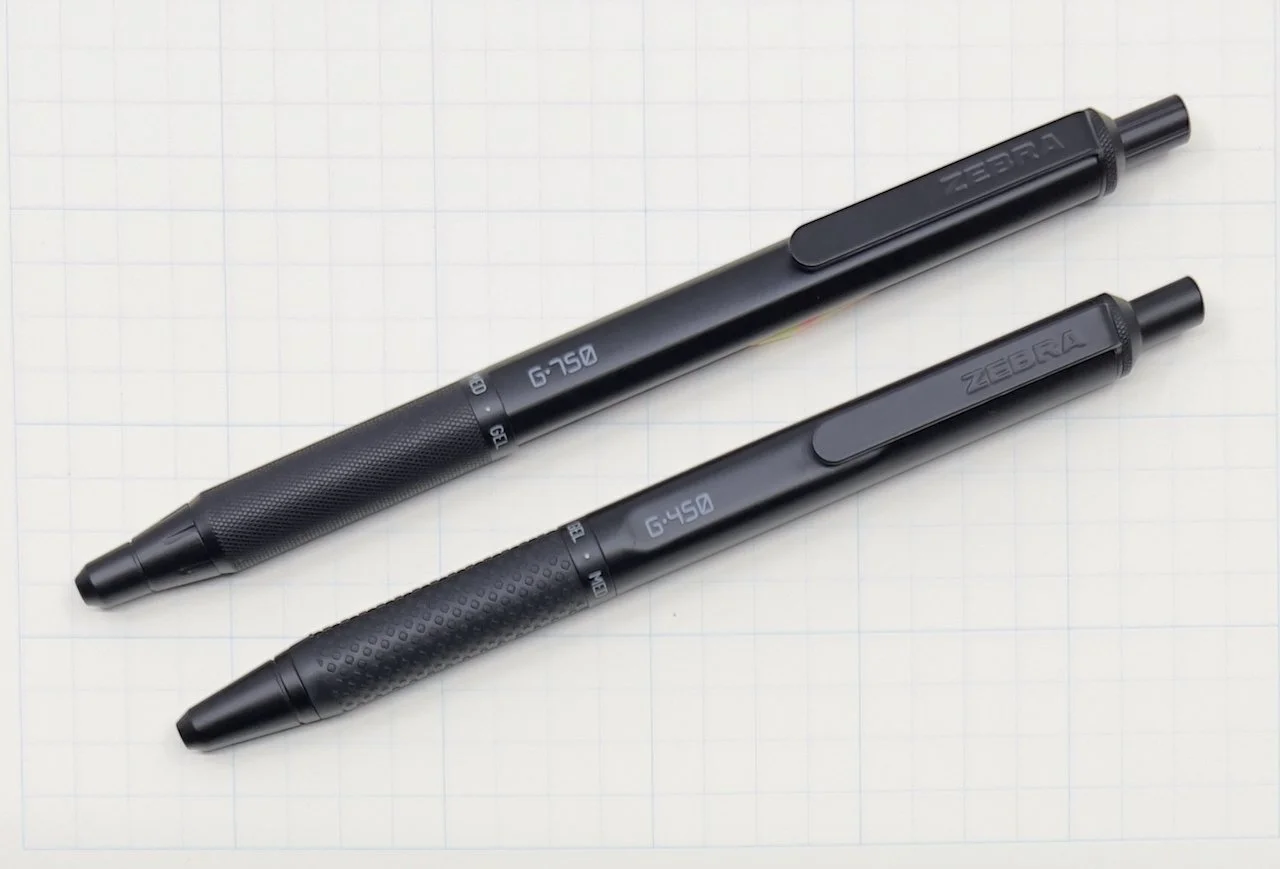
The G-450 and the G-750 are a continuation of the F-301 family tree, and pretty darn good ones at that. The G-450 is the shorter of the two pens by just under a half an inch, and features a rubber grip. The G-750 features a similar full-metal exterior, with the addition of a knurled metal grip. It also has a subtle triangle-shaped upper barrel, while the G-450 is essentially round. The G-designation on both pens mean they use gel ink, 0.7 mm black gel ink to be specific.

Zebra G-450 and G-750 Gel Ink Pen

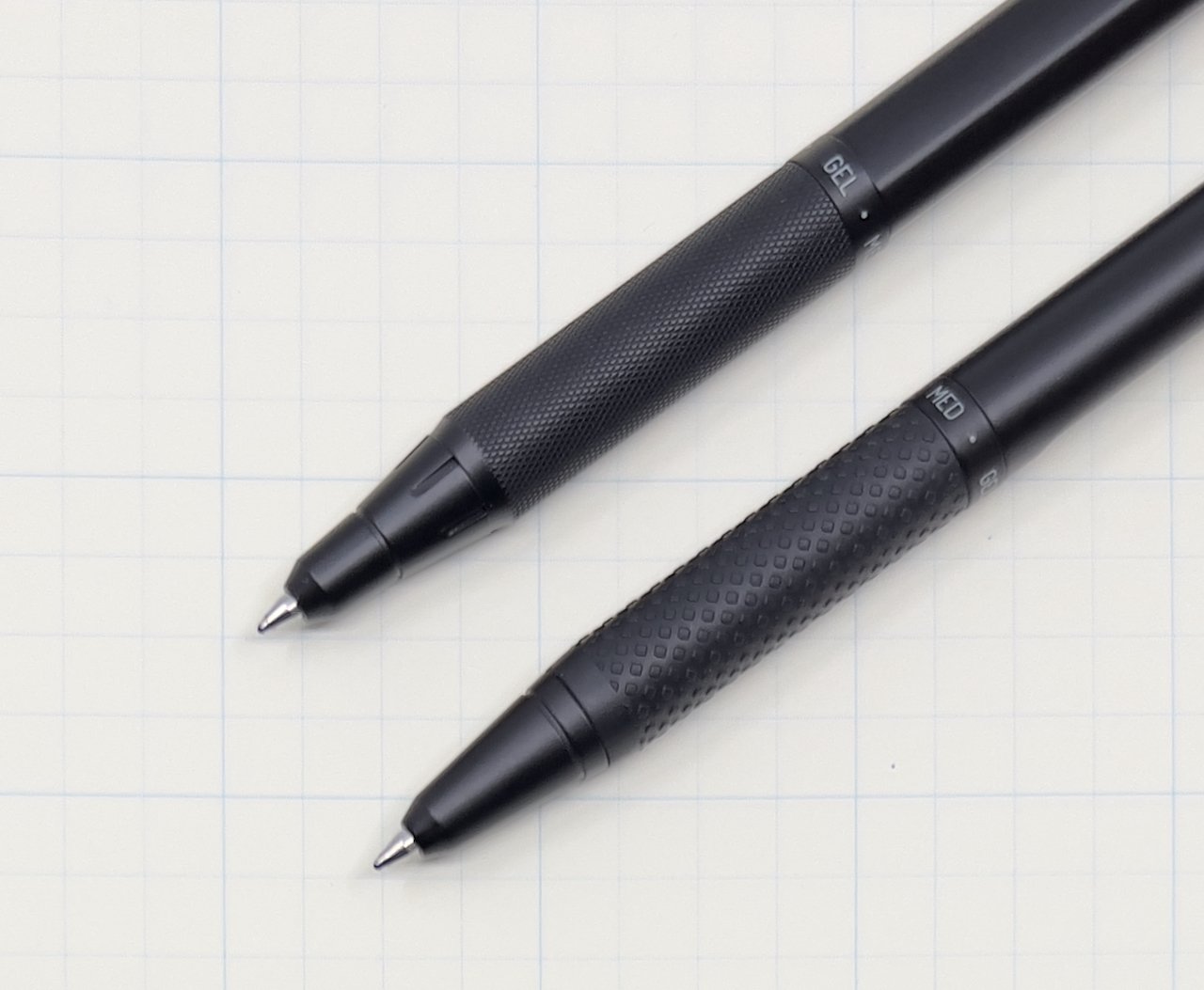
Comparing these two pens is difficult because there is not much that separates them from each other. The G-450 rubber grip is the superior of the two, which is hard for me to say as a knurled grip fan. The G-750 knurling is so fine and tight that the grip feels smooth. That’s not how I ever want to describe knurling. There has to be some grab in there, and there isn’t.

I will say that the nose cone design of the G-750 catches my eye. It has four angled steps down towards the tip of the pen, which allows for a great view of the tip and the page you are writing on. There’s nothing wrong with the front-end shape of the G-450, but the G-750 had me inspecting it, wondering why I liked it so much.

Zebra G-450

With matching 0.7 mm black gel ink refills, there is obviously no difference in writing performance between the two. The ink is dark, and the tip is smooth on the page. There are minimal swappable refill options for these pens, but JetPens does list a few, including 0.5 mm choices. I don’t think you will be successful hacking refills into either of these barrels, as the interior barrel opening for the refill is narrow. In fact, I had a hard time putting the refill back in one of the pens when I removed it for inspection.

Zebra G-450 and G-750

Between the two, the G-450 is the clear winner. The grip is more comfortable, and combined with the shorter length, it felt better in my hand while writing. Plus, it is $7.00, while the G-750 runs $9.50.

Zebra G-450 and G-750

If you like gel ink pens with upgraded metal barrels, I think you will be happy with either of these options from Zebra. Myself, I’m happy that they keep building and iterating on an interesting product lineup that differentiates them from the competition. I hope that continues.

(JetPens provided this product at no charge to The Pen Addict for review purposes.)


Enjoy reading The Pen Addict? Then consider becoming a member to receive additional weekly content, giveaways, and discounts in The Pen Addict shop. Plus, you support me and the site directly, for which I am very grateful.

Membership starts at just $5/month, with a discounted annual option available. To find out more about membership click here and join us!
Zebra G-450 and G-750
Posted on July 18, 2022 and filed under Zebra, Gel, Pen Reviews.

Gioia Alleria - A Review

(Kimberly (she/her) took the express train down the fountain pen/stationery rabbit hole and doesn't want to be rescued. She can be found on Instagram @allthehobbies because there really are many, many hobbies!.)

My first introduction to Gioia Pens was when I got a Gioia Partenope for my birthday last year at the SF Pen Show. It isn’t a pen that screams “Kimberly!!!” but it quickly became a favorite because it looked so different from my other pens and because it wrote so nicely. Not surprising, I was excited when the Bossman had Luxury Brands of America send me a Gioia Alleria for review.

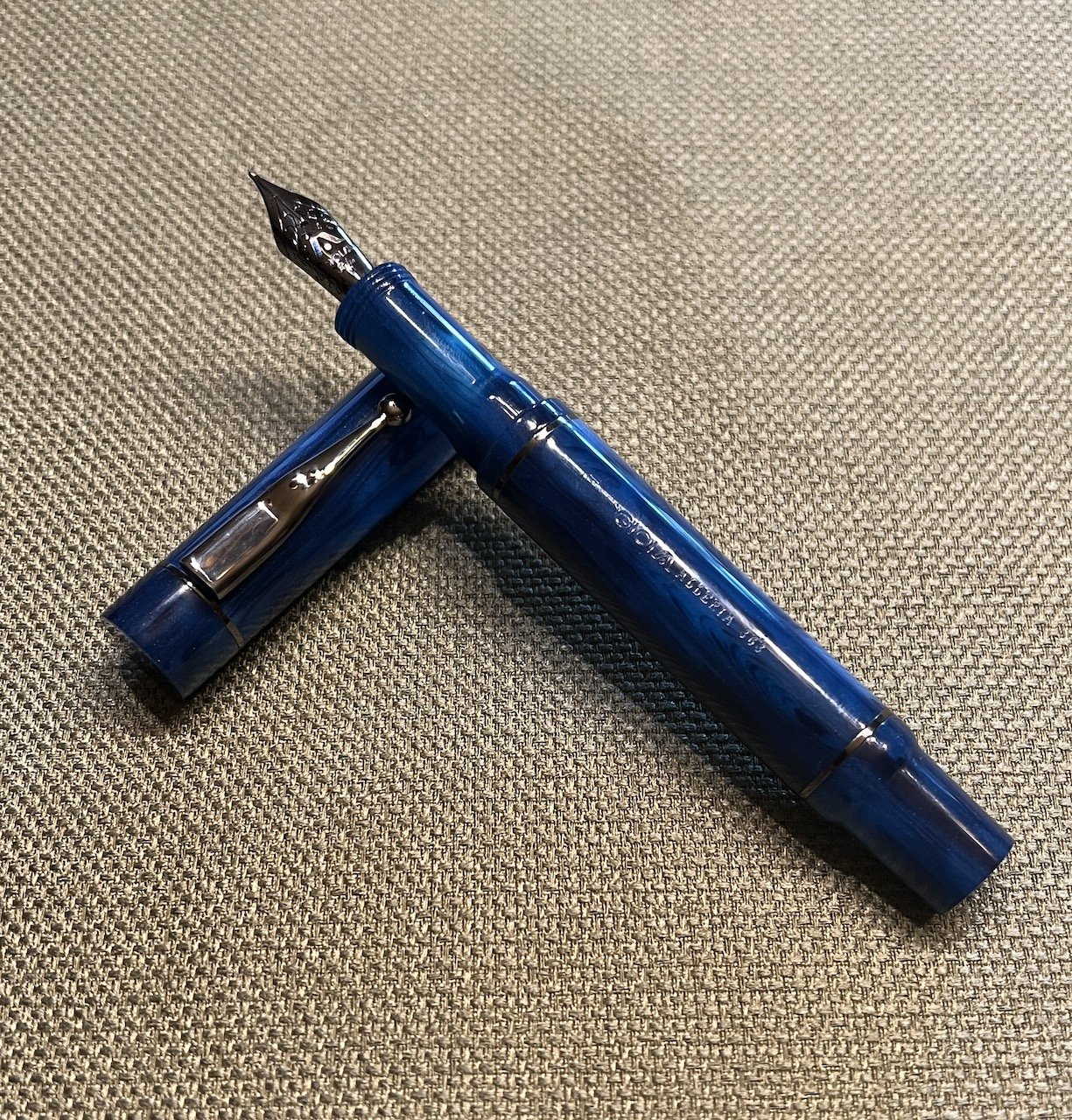
The review pen is the Gioia Alleria in the Grotta Azzurra color which comes in Ruthenium trim. The material is a darker teal blue with swirls of lighter and darker colors and with a bit of pearlescence. The name “Alleria” comes from the Neapolitan word for “happiness” and “Grotta Azzurra” means “Blue Grotto.

Gioia Alleria Fountain Pen

Gioia Alleria, Grotta Azzurra.

Gioia Alleria Fountain Pen

You can see the different shades of blue of the Grotta Azzurra.

The Alleria is similar to the Partenope but since I do not have the latter with me, you may wish to check out some of the comments/pictures from the Partenope review. The two pens are similar in size and weight but with a different filling mechanism. The Alleria uses a piston, while the Partenope uses a cartridge or converter. The Partenope’s converter adds a bit to the weight so if you prefer a lighter pen, the Alleria might be a better fit. The Alleria does not have an ink window, which I generally prefer with piston-fillers so that I can tell how much ink is left. It is not a dealbreaker for me but something to note if that’s important to you.

Like the Partenope, the Gioia Alleria uses Jowo 6 nibs engraved with their branding. Their nib units can be easily swapped as the nib units are screwed in. This makes cleaning a breeze as you can remove the nib, and syringe it clean (be sure to move the piston a few times during cleaning as ink can get on the edges of the piston valve. The Gioia Alleria is available in Extra Fine to 1.5mm stub (the “Stub” size is 1.1 mm). This pen has a medium nib and wrote beautifully out of the box (my usual lazy self did not clean the pen prior to inking). I inked it up with Colorverse #47 Ham, which is a great match color wise and I had no problems with the ink or the pen, despite a period of 2-3 weeks where I didn’t get a chance to use it.

Gioia Alleria Fountain Pen

Writing sample with Colorverse #47 Ham on Tomoe River 68 gsm paper.

The cap has an inner cap sleeve which minimizes evaporation. The pen also screws into the cap at the end of the grip; my understanding is that this also helps with evaporation as less of the writing end is exposed to air. This does mean that there are threads near the nib end, which might bother folks who write close to the nib. I am a “close to the nib” writer, but I didn’t even noticed the threads which are smooth and not sharp or bulky at all. In fact, some users might like that because it provides a bit of a “stop” to prevent your fingers from sliding downward.

As I said above, the Alleria feels very similar in girth and length to the Partenope. I like the slightly girthy grip and am glad that it is not heavy. Some folks expect girthier pens to be heavier, and this is not that pen. The Alleria cap is lighter because it doesn’t have the Partenope’s thick clip band, so it doesn’t feel as back-weighted for those who like to post their pens. For comparison, I have included a few similarly sized pens that are with me in my currently inked binder.

Gioia Comparison

Comparison with Lamy 2000, Leonardo Momento Zero, Narwhal Voyage, Gioia Alleria, TWSBI 580, Pilot Custom 74 and Platinum 3776.

Gioia Size Comparison
Gioia Posted

Note that the Narwhal does not post at all and that the Gioia and TWSBI pens do not post very well.

The Gioia Alleria has an MSRP of $240 USD and a street price around $190. Gioia is discontinuing some of the colors to make room for new resins that will be exclusive to them. As such, some of the colors of the Alleria are being discounted; the Mare Blue, Vittoria, Nuvola and Tramonto colorways will be discontinued and pretty heavily discounted (I’ve seen them ~$150-160). The Amaranto, Crepuscolo, Grotto Azzurra and Mare Chiaro colors are not being discontinued, so they will remain at their current pricing. I, for one, don’t love seeing different pen brands using the same acrylics, so I am looking forward to seeing Gioia’s new exclusive materials.

Pro:

  • Nice, lightweight piston filler
  • Good nib
  • Good value for a steel nib piston filler, but some models being discounted makes for an even better value.
  • Lifetime warranty

Neutral:

  • Piston filler does not have an ink window so you can’t see ink levels
  • Clip design may not suit everyone’s aesthetic

Con:

  • Pen may be too girthy if you prefer slimmer pens
  • Pen may be too light if you like girthy pens with more heft

In summary, I really enjoyed using the Gioia Alleria because it is a nice writer and is very comfortable for me. The cap seal means that I can pick up the pen after weeks of non-use and know that it will write right away. I am looking forward to seeing the new versions of the Alleria with their exclusive resins when they come out later this year.

(Thank you to Luxury Brands of America, who sent this pen at no charge for review.)


Enjoy reading The Pen Addict? Then consider becoming a member to receive additional weekly content, giveaways, and discounts in The Pen Addict shop. Plus, you support me and the site directly, for which I am very grateful.

Membership starts at just $5/month, with a discounted annual option available. To find out more about membership click here and join us!

Posted on July 15, 2022 and filed under Gioia, Fountain Pens, Pen Reviews.