
Posts filed under Pencil Reviews

Rotring 500 Drafting Pencil Review

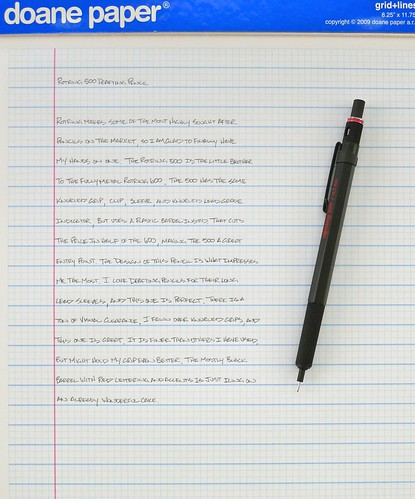
Rotring 500 Drafting Pencil


I am not completely up to speed on my Rotring history, but according to the Wikipedia page, the company was sold to the Newell Rubbermaid conglomerate in 1998, who also owns such popular brands as Sharpie, Uni-Ball, and many more office product names you know and love. Rotring brought a more technical product to their portfolio, but some of the all-time classics - like the Rotring 500, 600, and 800 - are not part of their US offering. These cult classic drafting pencils are still being manufactured, but are Japan only, and of course imported by JetPens.


The Rotring 500 is the entry level model in this line. It features a plastic body as opposed to the fully metal body of the Rotring 600, but otherwise all of the other features are the same. The knurled grip is the highlight for me - it feels just awesome to hold - and even the lead grade indicator has a knurled metal casing. The most visually appealing part of this pencil to me is tip/guide pipe section of the pencil. It is wonderfully designed and is the main reason why I like drafting style pencils more than traditional mechanical pencils.


The Rotring line can be expensive at first glance, with the prices (at the time of writing) at $16.50 for the 500, $33.00 for the 600, and $82.50 for the 800. But looking at the reviews online at JetPens and on other blogs like Dave’s Mechanical Pencils, these pencils are going to last you a very long time and are a great value.


I hope I get the opportunity to review the 600 and 800 soon. If anyone has either of these models and would like to write a guest review I would love to have you.
Posted on August 15, 2011 and filed under Drafting Pencil, Pencil Reviews, Rotring.

Platinum OLEeNu Lead Breakage Prevention Mechanical Pencil Review

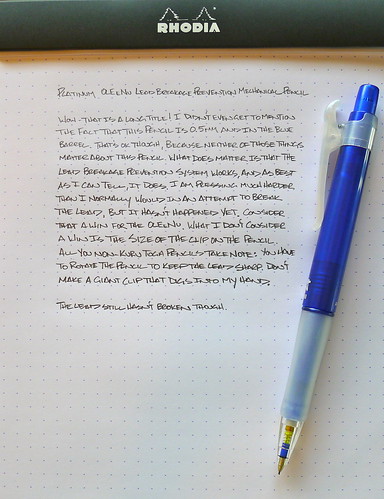
Platinum OLEeNu Mechanical Pencil Review


Aside from the Uni-Ball Kuru Toga, there haven’t been any great strides made in pencil technology over the past several years. That is not a bad thing. Pencils - mechanical included - are some of the most traditional writing instruments around, and it is difficult to change an almost perfect tool.


The Platinum OLEeNu attempts to bring something new to the table with its lead breakage prevention mechanism. This is not a world changing advancement in technology, but I will say it works as intended and is a nice feature.


When I started the written review, I was writing with standard pressure and at a standard pace. If you look closely at the page, you can see the gradient variation when I started pressing down really hard to see if I could get the lead to break, and I couldn’t. Now, I didn’t get violent with it, but you can see how hard I was pressing by how dark the lead is.


That is the major feature of the Platinum OLEeNu, and it works well. What I don’t like about this pencil is the barrel design, specifically the clip. Like most of you, I rotate all non-Kuru Toga pencils in my hand as I write to keep a sharp point on the lead, and the extra large clip gets in the way of my rotation. Not a deal breaker - more of an annoyance. The grip area wasn’t my favorite either - it is best described as funky. I can’t really put my finger on it, but I don’t love it.


In lieu of posting all of the technical details here, check out the specs and photos on the JetPens product page. There are some great photos and descriptions of how this pencil works.

Posted on August 12, 2011 and filed under OLEeNu, Pencil Reviews, Platinum, Mechanical Pencil.

Staedtler 925 Drafting Pencil 0.9 mm Review

Staedtler 925 0.9mm


What is the master of the micro tip doing reviewing an 0.9mm pencil? I thought the same thing when I ordered the Staedtler 925 Drafting Pencil, but sometimes you have to step out of your comfort zone a little bit to realize there are some really great products out there. This Staedtler is one of them.


I hedged a little bit by going with the plastic barrel 925 as opposed to the more expensive 925-25 and 925-35 aluminum body pencils. I wanted to get a feel for the 0.9mm lead more than anything, and as it turns out, I really like it.


The base 925 model has a black plastic barrel, rubber grip, and a different colored lead grade indicator for each lead width (orange for 0.9mm). The eraser is standard drafting pencil fare, which is why I always recommend a stand alone eraser for this type of pencil - something like the Uni-Ball Boxy.


I found out quickly that I like the 0.9mm lead width when taking notes. It feels weird to compare a pencil to a pen, but the output to me is similar to that of the Sharpie Pen. Wide, bold lines, but very sharp and controllable. I don't think I would want to design the next Guggenheim Bilbao with it, but the lead width is great for sketching and wireframes.


Does anyone have much experience with 0.9mm lead widths? I would love to hear what your uses are, so let me know in the comments section.

Posted on July 15, 2011 and filed under Drafting Pencil, Pencil Reviews, Staedtler.