Posts filed under Pencil Reviews

Uni Mitsubishi Vermilion and Prussian Blue Pencil Review

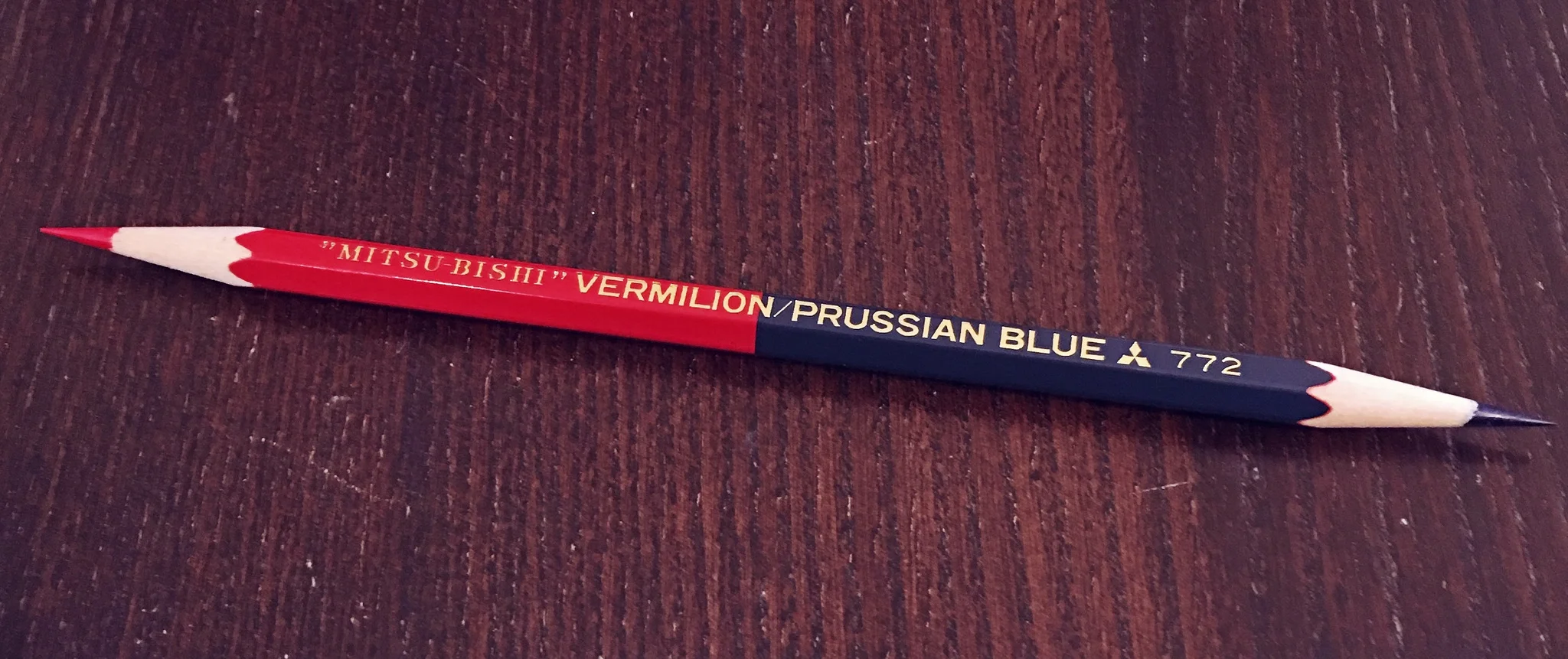
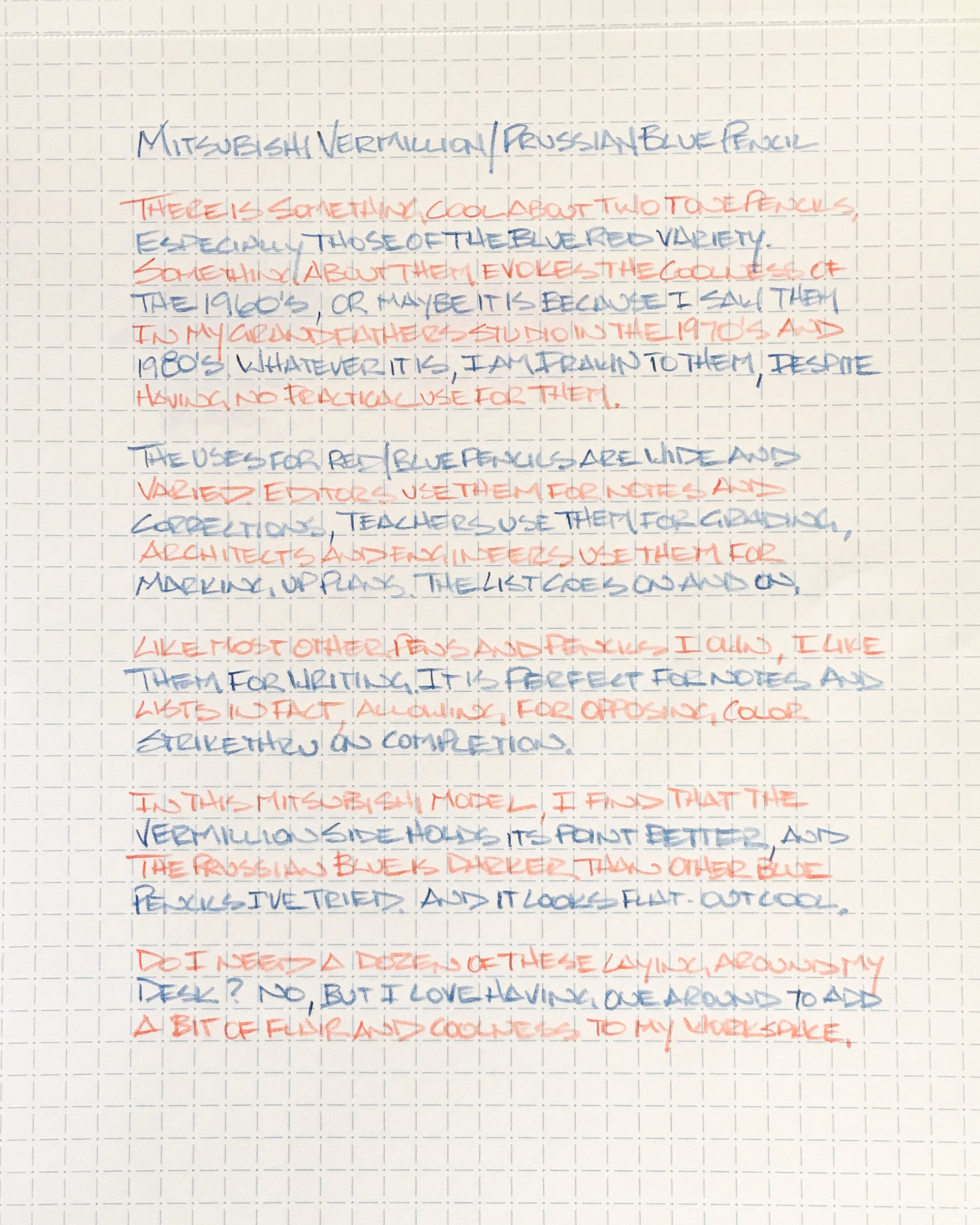
Seeing a two-tone pencil, especially one of the red and blue variety, takes me back. They seem like a cool relic of the 1960’s, although I assume they have been around much longer that that. If my memory serves me, I first ran across them in the 1970’s and 1980’s in my grandfathers art studio. It was one of those pencils that you only found on a table or in a desk there, giving them a bit of cachet in my young pen addict’s brain.

I liberated one or two over the years I’m sure, allowing me to double-blade long before Darth Maul made it popular. But they weren’t great pencils. The red was often too orange or too light, and the blue was similarly faint. Plus, I’m sure I would get in trouble turning in a school assignment in red colored pencil.

But red and blue two-tone pencils have an aura about them. If you see them in the wild, you know serious or interesting work goes on where they rest, more so than a desk full of yellow pencils or Bic Clics. Having one on my desk makes me feel like I am in Mad Men about to edit the new Coca-Cola ad copy.

The Uni Mitsubishi Vermilion and Prussian Blue Pencil is the first one I have tried in years, and I’m very happy with the results. Both pencil cores are dark enough, and the red isn’t too orange. The blue is softer than the red, so if you are using them in equal amounts the blue will need to be sharpened sooner. Also, don’t even bother with trying to erase them. That’s not happening.
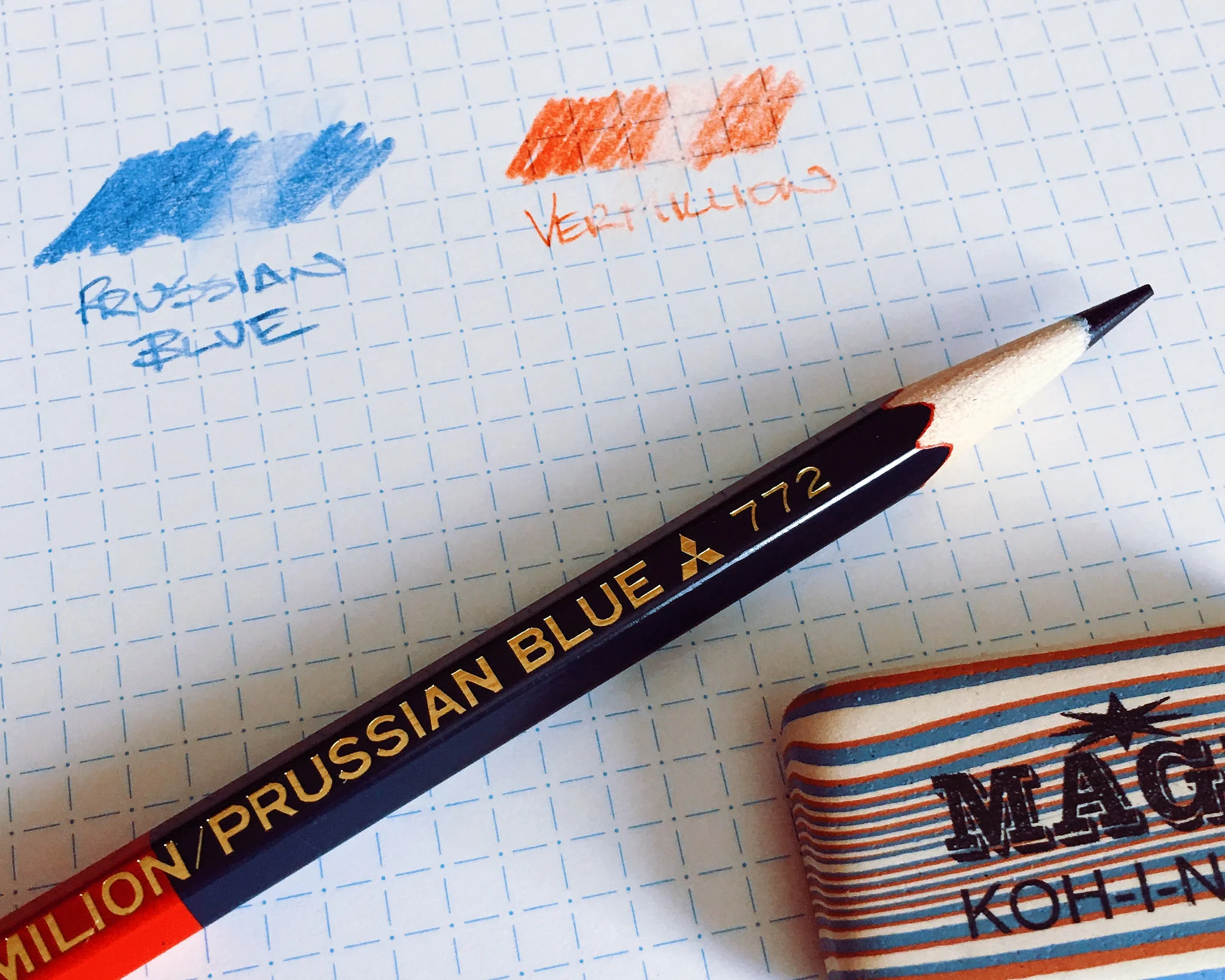
This leads to another interesting bit about two-tone pencils. As if they weren’t unique enough, they come in different color proportions. This one is a standard 5:5 model, meaning the ratio of red to blue is exactly even. There is a 7:3 model available, with red taking on the lions share of the core. That’s the one my editor would need to use if I actually had an editor. Red would be all over the page.

And that is where the use case for two-tone pencils lies today. If you aren’t using them as a markup tool for editing, engineering, or teaching, you may be using them as a colored pencil for artwork and sketching. Outside of that, they aren’t a great writing pencil. A traditional graphite pencil will outwork them every day of the week. But they are cool. And they are old school. And they add a little bit of brightness and inspiration to any desk they reside on.

(JetPens provided this product at no charge to The Pen Addict for review purposes.)
Posted on February 8, 2016 and filed under Uni, Pencil Reviews.

Uni Kuru Toga Disney Mechanical Pencil

Japanese stationery manufacturers are the best in the world at product tie-ins, and no one does it better than Uni-ball. Their latest collaboration features one of the best mechanical pencils in the world - the Uni Kuru Toga - and one of the world's favorite entertainment companies in Disney.

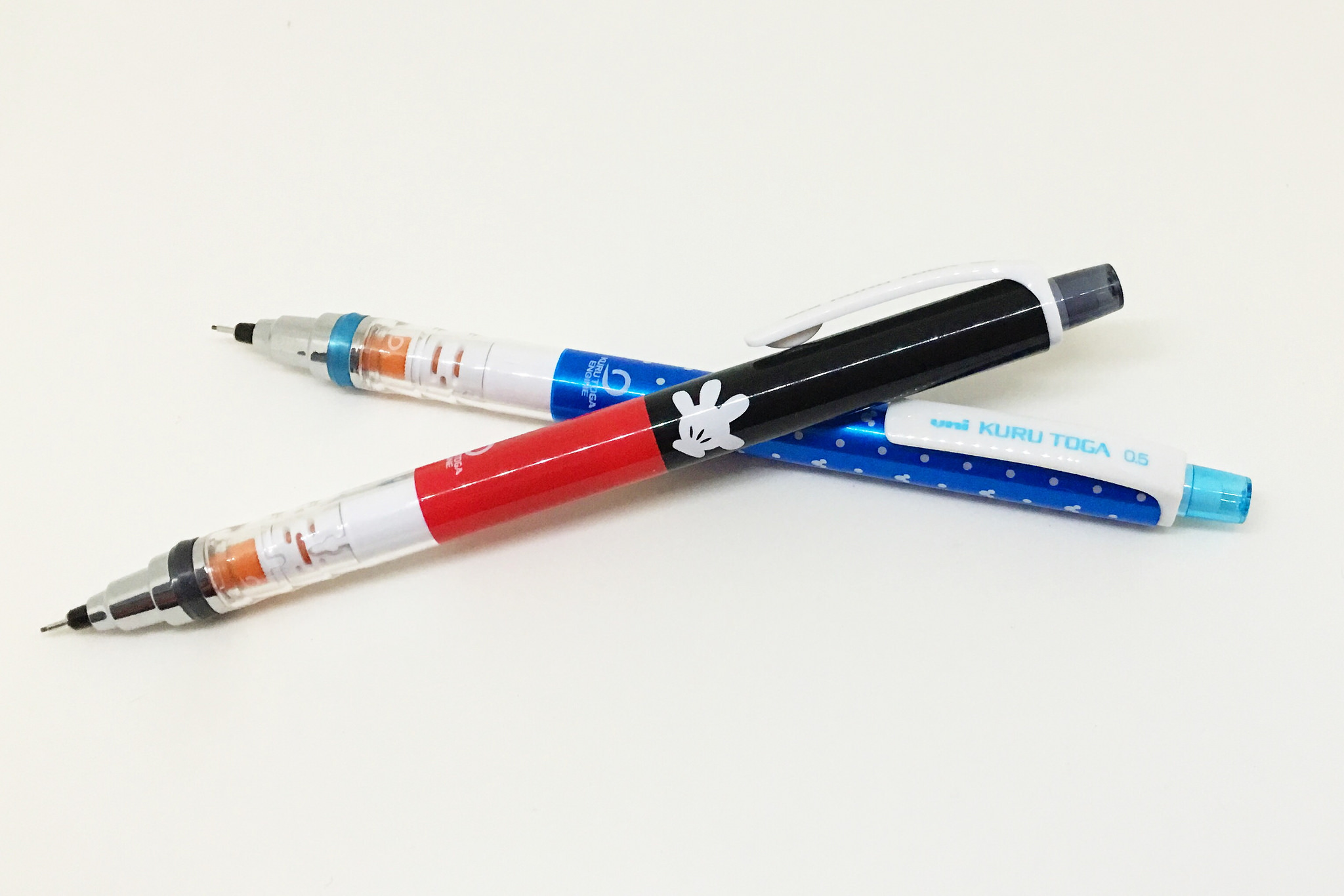
This latest Kuru Toga drop features three character pencils - Mickey, Minnie, and Donald - plus three mouse ear pattern barrels in black, blue, and pink. There are even matching spare lead holders in black, white, and pink.

I went with a one of each approach, grabbing the Mickey Glove pencil, Blue Mouse Ear pencil, and Disney White lead holder. While they are all wonderfully designed - I expect no less from Uni and Disney - the character pencils are the real standout.

For example, the Mickey Glove pencil features a two tone black and red barrel with white accents to match Mickeys famous look. The black section contains a single image of Mickey's white glove, and the red section a single yellow shoe. It is a simple, clean design that doesn't scream DISNEY PENCIL!!! But is classic and cool. The Minnie and Donald pencils are designed in the same fashion.

The Mouse Ear patterned pencils are excellent in their own right, with small ears and polka dots in a repeating pattern up and down the barrel. The pink and blue barrels have a little extra shine as well. The lead holders are done in a similar fashion with a couple of additional colors mixed in.

The one downside with this - and most - branded merchandise is that you are going to pay a premium. Two dollars more than the standard Kuru Toga (more if you can find basic black at an office supply store), and an equal amount for the lead holders. But Disney fans and stationery fans alike are happy to pay the price to see their favorite characters on one of their favorite writing instruments. I know I was excited to get my hands on these and my kids are excited as well, knowing they get them as soon as this review is done.

(JetPens provided this product at no charge to The Pen Addict for review purposes.)
Posted on February 5, 2016 and filed under Uni, Kuru Toga, Mechanical Pencil, Pencil Reviews.

Rotring Rapid Pro .7mm Drafting Pencil

(This is a guest post by Nick Folz. You can find more of Nick and his work on his blog, Smallberry Drive, Twitter, and Instagram.)

Rotring is a name with a lot of cache in the world of pens and pencils. Building a brand on quality products that last a lifetime will do that. The Rotring 600 is the gold standard for premium drafting pencils and most of their products have been lauded industry wide. The Rapid Pro keeps up the tradition of innovative excellence and makes some concessions for a friendlier price point.

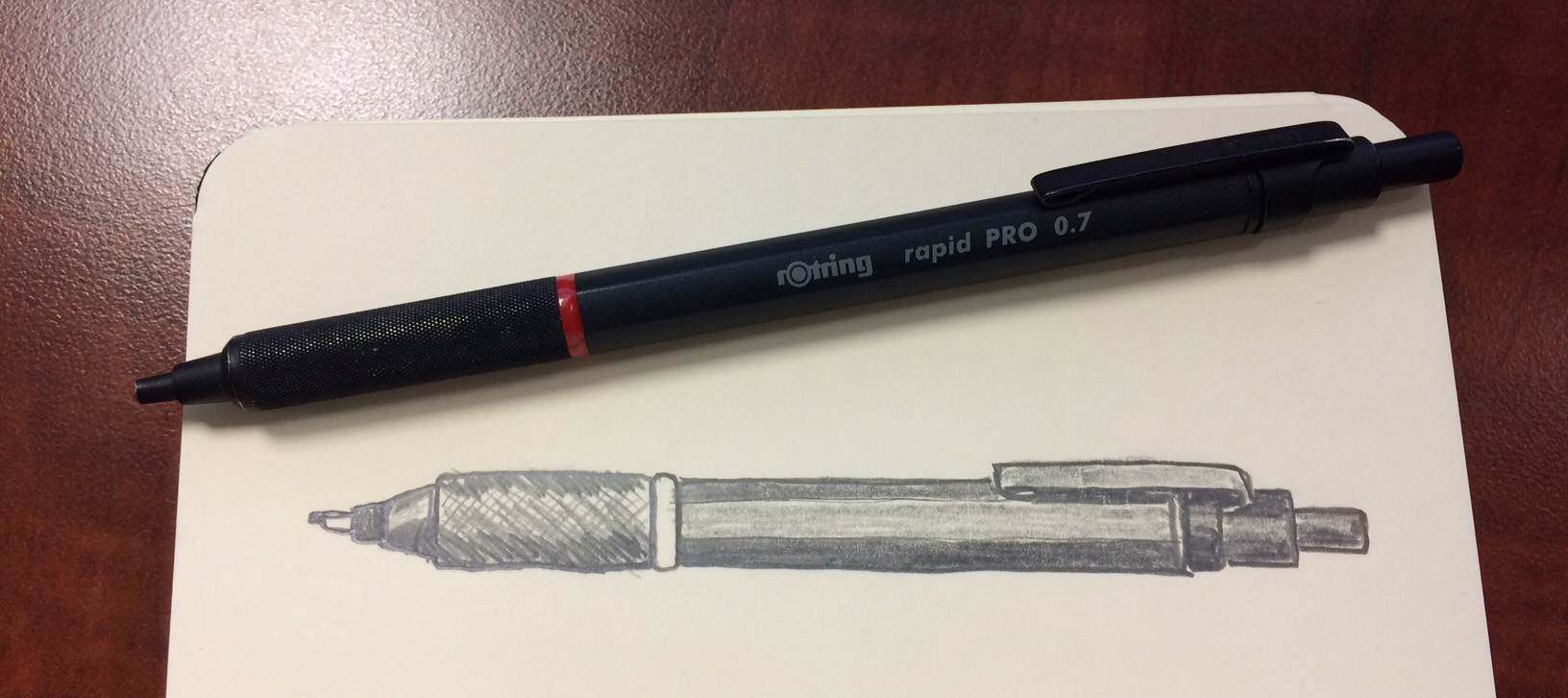
The Rapid Pro drafting pencil comes in three iterations: .5mm, .7mm and 2mm. Both the .5mm and .7mm feature a sliding sleeve that can be retracted to make it pocket safe.    The primary selling point is the cushion point lead mechanism, which not only extends the sliding sleeve but also protects the lead when writing. How it works is simple- one click deploys the sleeve and lead, all other clicks advance the lead. Pushing the lead back in also pushes the sleeve, making it pocket-safe.

The pocket-safe feature alone would be worth the price of admission, but it does double duty: If you press down too hard on the lead when writing, instead of snapping the lead, the cushion mechanism slides the lead back into the pencil. When you lift from the page, the lead springs back. This blew my mind the first time it happened. It takes a good amount of force, so it isn’t just sliding around when in normal use. If you press REALLY hard, the whole sleeve will slide back into the pencil. 

It's not always going to stop the lead from breaking, if you are holding it at a less than 30 degree angle with an inch of lead out, there ain't a pencil in the world that can help you. I use soft lead, 2B, and it has about an 80% success rate of sliding before breaking. It has saved me a ton of frustration.

If you use up all of the lead down to the tip of the sleeve, the sleeve will budge back down into the pencil body little by little so that you aren't just scratching the paper with the metal sleeve, also you will still be writing with the lead. While continuing to write like that is not ideal, it is better that running out of lead mid thought.

The metal body is a rounded edged version of the a hex style, a signature red ring separates a knurled grip. The tip narrows in two plateaus. The clip is very sturdy, and even after months of being abused by my pockets, its grip has not diminished. The weight is wonderful and the balance is great. Total length of the pencil is 5.75" and the balance point is roughly 2.75" from the writing end, making it ever so slightly front heavy. The black finish is a beautiful matte. After 3 months of use, mine does have some wear on it but I think it adds character. If that is something that bothers you then check out the silver model. It can hold about five spare pieces of lead, plus the one in use (I imagine the .5mm can hold more, just because of size).

There are a few sticking points, this pencil ain’t perfect.

  • The end cap that protects the eraser falls off. I nearly lost it a week into having it, and finding a tiny black cylinder is no easy task. My solution was to squish it a bit, bending the perfect cylinder into more of an oval shape, which grips the eraser part much better. I haven’t had trouble since.
  • The eraser sucks. I know, everyone waves this away as most drafting pencils don’t have great erasers, but come on. TWSBI’s Precision mechanical pencil had a decent eraser, and it would be nice to see that widely adopted. I know that tiny erasers have their defenders, especially in the drafting community, but this pencil feels very much like a writing/drawing tool and less like a drafting tool.

There are things about this pencil that some people have complained about that I think are non-issues. Some of the inner-workings are plastic, including the red ring (which is part of the cushion mechanism). This does not bother me one bit. I have seen drafting purists take issue with it being called a “drafting pencil” since it lacks a lead grade indicator. So, what’s in a name? As I said above, this does feel more like a well built mechanical pencil built with the best drafting pencil trappings, I never used those indicators anyways.

“Loose pencils, tight inking” is an adage I have. It was something we talked about in my comic art class. I like this idea, keep the planning loose, keep the execution tight. It is something I refer to in my head for all sorts of life stuff. Which is why I carry a pencil. The Rotring Rapid Pro makes "keeping it loose" a breeze thanks to their tight execution of a near perfect product. The total impression is that of a seriously fine tool. As an experiment, I have handed it over to several non-pen addict people when asking for a pencil and they always remark on it. It is impressive.

Just make sure you squish that end cap.

(JetPens provided this product at no charge to The Pen Addict for review purposes.)

Posted on December 31, 2015 and filed under Drafting Pencil, Pencil Reviews, Rotring.