Posts filed under Pilot

Pilot Down Force Pressurized Ballpoint Pen Review

(Jeff Abbott is a regular contributor at The Pen Addict. You can find more from Jeff online at Draft Evolution and Twitter.)

In the world of pressurized cartridges, I've come to expect a subpar writing experience. The old classic — the Fisher pressurized cartridge — isn't one of my favorite cartridges for general writing. I only use one if I know I'll need to write at an awkward angle or if there might be water involved. Why? Because I don't enjoy writing with a skippy pen, and that's exactly what I expect from the Fisher refills. That's not to say it's horrible, but it's not as good as something you'll get out of a gel pen. There are always trade-offs.

But maybe the Pilot Down Force is trying to change that. Maybe. The Down Force is a pressurized ballpoint pen from Pilot that writes very similarly to a Pilot Acroball or Uniball Jetstream, and that's a pretty big compliment for a ballpoint. So, how does it stack up as an all-around writing instrument?

Look and feel

First off, let's take a look at the outside of this pen. At arm's length, you might think this pen is made of metal sporting a matte black finish of some kind. Well, you'd be wrong. It's actually a well-done plastic that looks tactical, but doesn't deliver. The knurling on the grip is a great feature and I'm surprised it feels as good as it does, only because of the material.

It's a very lightweight pen, which is good and bad. It's good because it makes writing very comfortable, and it doesn't weigh down in your pockets. It's bad because it's not durable.

Pressurized special-use pens usually have a pretty sturdy body because they're meant to be used in environments not normally intended for writing instruments. Maybe we should call this category "off-desk writing instruments" (my pitiful attempt to draw an anology to off-road vehicles). Either way, you might be able to write in a harsh environment, but it wouldn't survive if it was run over by a lunar rover. And, let's face it, if you're writing on the moon, that's probably not an uncommon risk.

Kidding aside, I do wish the body was more sturdy. Really, if it was the same design but with a metal material, it would be several notches higher in my book.

The clip has a really satisfying "chunk" when you click it, and it also releases when you lift the clip. This will save any of us who unwittingly put open pens in our pockets.

The model I have is black, but you can also get other colors.

Writing

Where this pen really shines is in the cartridge. This is a smooth writer, and that's really surprising to me given the category. It feels similar to an Acroball or Jetstream, and the ink has a nice darkness to it (unlike most ballpoint inks). There is some noticeable skip every few words, but nothing that bothers me. I have to look pretty closely to see them.

Being a smooth writer makes it very comfortable for taking notes and jotting down ideas. This is the kind of pen that you could use for long-form writing if you're not sitting in a normal position, such as leaning back and propping a notebook on your legs so that it is perpendicular to the ground. This position always causes pens to stop writing after a couple of sentences due to the pesky effects of gravity on ink.

Apparently, a bit of pressure is applied to the open end of the cartridge when you click in the knock of the pen. The refill fits into a very tightly fit compartment, which would explain how they get an airtight seal on the open end. It's really pretty nifty.

Conclusion

Overall, the Pilot Down Force is a great writing pen. The fact that it has a pressurized cartridge is just a bonus. This is one of the first pressurized pens I've used that also offers a pleasant writing experience. I'd be really happy to see Pilot offer a more premium version of this pen body in some sort of metal, but for $7 it's hard to complain on this one.

Posted on July 23, 2015 and filed under Pilot, Pen Reviews.

Pilot Metropolitan White Tiger Fountain Pen Review

(Jeff Abbott is a regular contributor at The Pen Addict. You can find more from Jeff online at Draft Evolution and Twitter.)

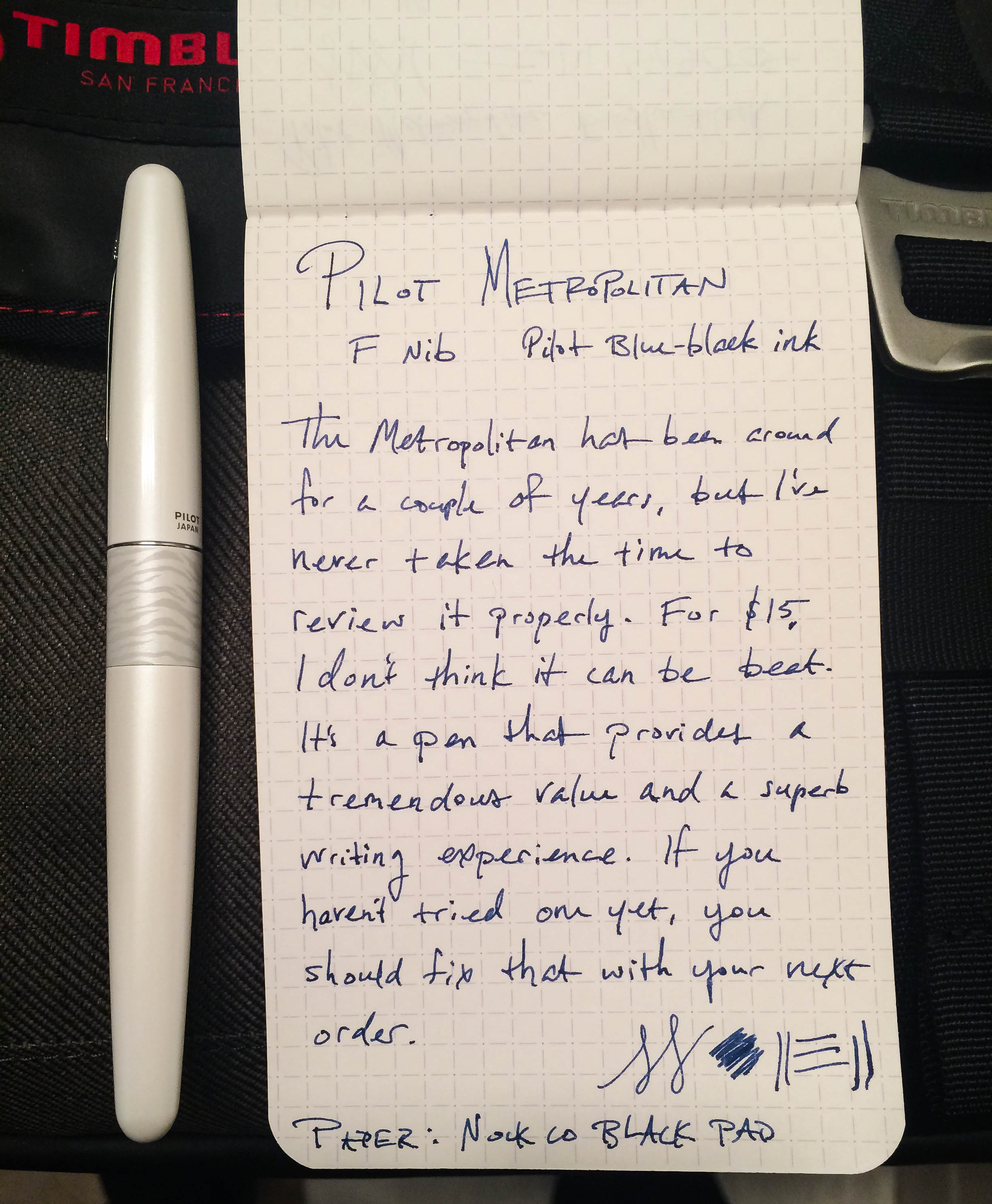
The Pilot Metropolitan is one of those pens that caused quite a stir when they first hit the U.S. market. Why? Well, for me it was the price, the quality, and the feel of the pen that made it seem like such an excellent value. It's a fantastic everyday pen, a vey good choice for a first fountain pen, and a pretty good choice for a gift pen. I guess I've overlooked it in my reviews because it's just so ubiquitous and standard nowadays. But, I recently ordered a new one due to my recent predicament of only having one fountain to use. The Metropolitan seemed like the only right choice when I was trying to pick an affordable pen to use as an everyday writer for the next few weeks.

I went over to JetPens and picked out the white Metro with a fine nib, and also got a pack of Pilot Blue-black cartridges for good measure because their blue-black is one of the best. In a couple days, I was back to using a regular size pen as my everyday writer. The Liliput is a great pen, but a little too small for my taste when it comes to longer writing sessions.

Now, I purchased my first Metropolitan back in 2013 and used it heavily for several months. This review is for a new pen, but one that I've used a lot in other forms.

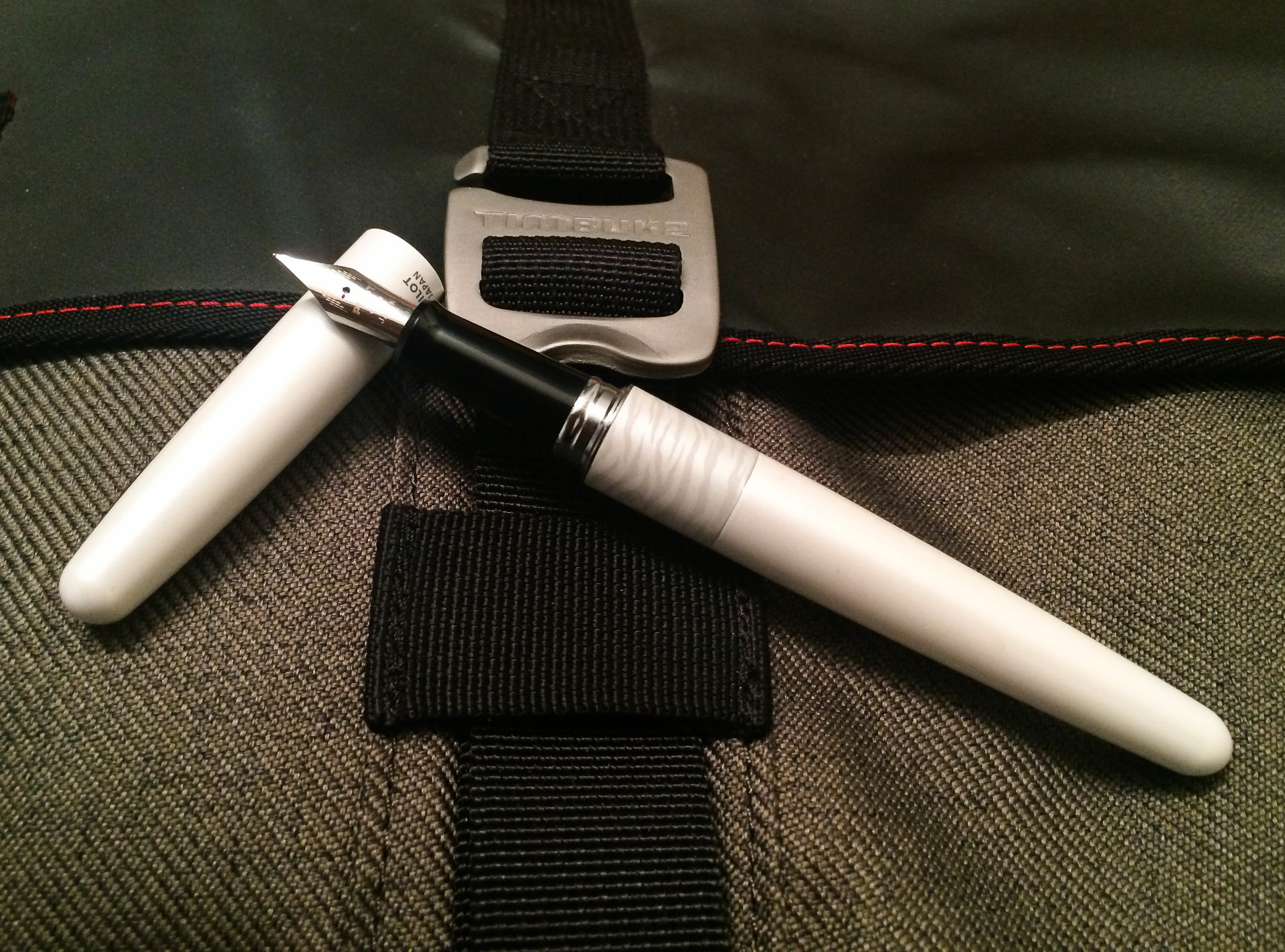
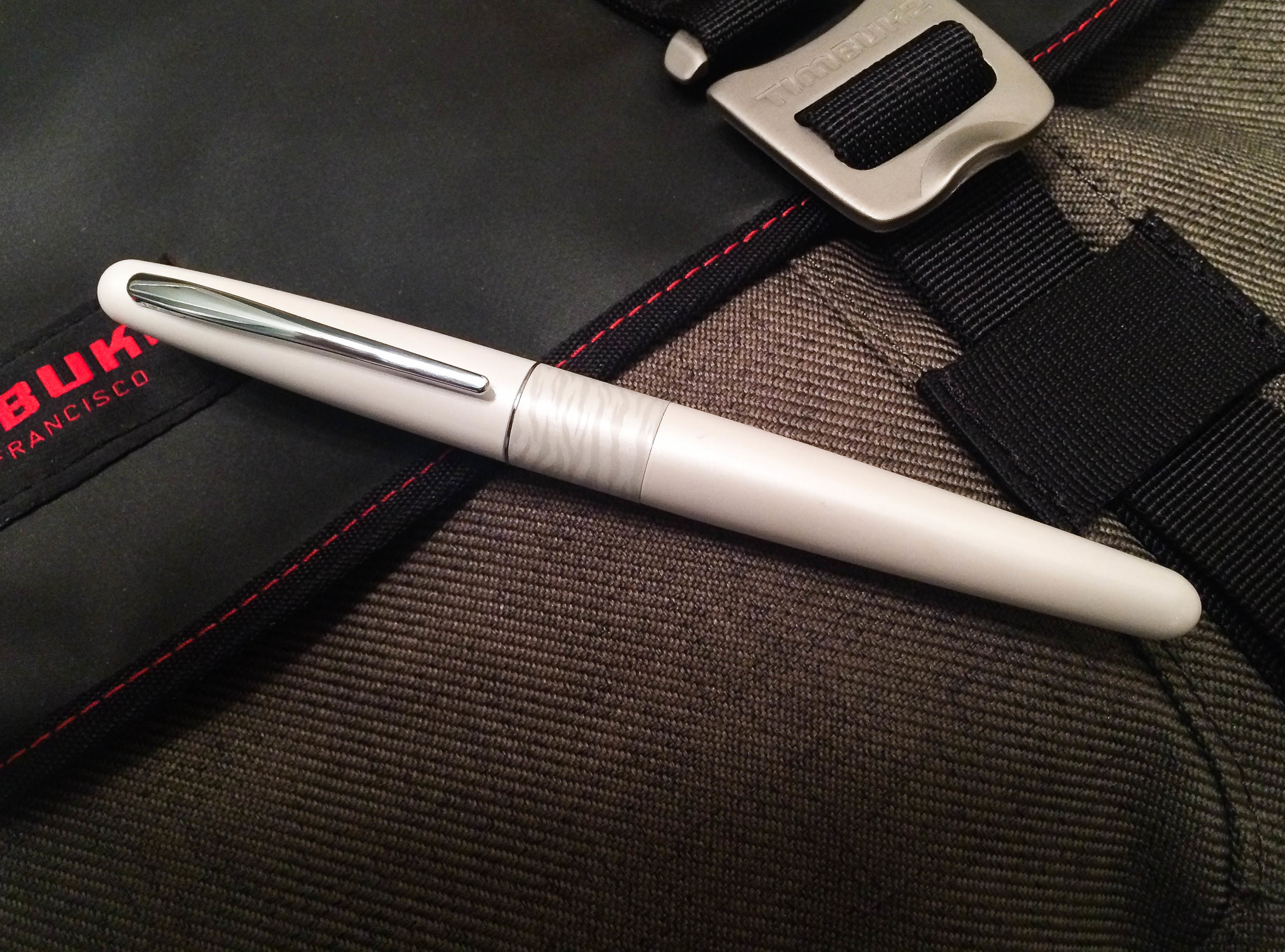
First off, there's the exterior of the pen, which is very simple and balanced. The original pens only came in three colors (black, silver, and gold) with three pattern options for the band (dot, zig-zag, and plain). Later on, Pilot released other designs that featured fake animal skin textures and more colors. I went with the white body and tiger print band. Personally, I love this design, but I know it's probably polarizing.

The pen has a fantastic weight since the insides of the barrel are supposedly brass. The outside is metal, probably aluminum, and I'm a huge sucker for metal bodied pens in general. In my opinion, Pilot hit a home run with this particular line of fountain pen. It's also very comfortable for me when I write — I've never had any complaints or aches when using the pen.

Apart from that, it's all about the nib. And, like I have come to expect from Pilot, it's smooth and error-free from the beginning.

My first Metropolitan has a medium nib because that's all Pilot offered in the first round. Later, they also introduced the fine nib, which is what I got this time. I've gotten to the point where I love both sizes and I pick them based on my mood. This one is no exception. Thin, crisp lines come out of this nib at a steady rate. The blue-black excels with this size nib, as you get a healthy dose of blue with just enough business feel.

For under $20, I don't think you can do better than the Metropolitan. It's a crowd-pleaser. It's about 4-times more than a Preppy, but it's leaps and bounds ahead of the Preppy in feel and performance. You can toss the Metro in the bag and not worry about it, while the Preppy will soon crack or break with minor wear.

It's also neutral compared to the Safari since it doesn't have a unique grip. And, now that they offer more color and band options, you can get one that offers a little more personality as well.

If you haven't tried out a Metro yet, you owe it to yourself to try out the fountain pen that offers the most value! It's an excellent beginner fountain pen, but it also hangs with the more expensive pens as well. It's a win-win.

Posted on June 24, 2015 and filed under Fountain Pens, Metropolitan, Pen Reviews, Pilot.

An Introduction To The Brush Pen Sampler

(Jeff Abbott is a regular contributor at The Pen Addict. You can find more from Jeff online at Draft Evolution and Twitter.)

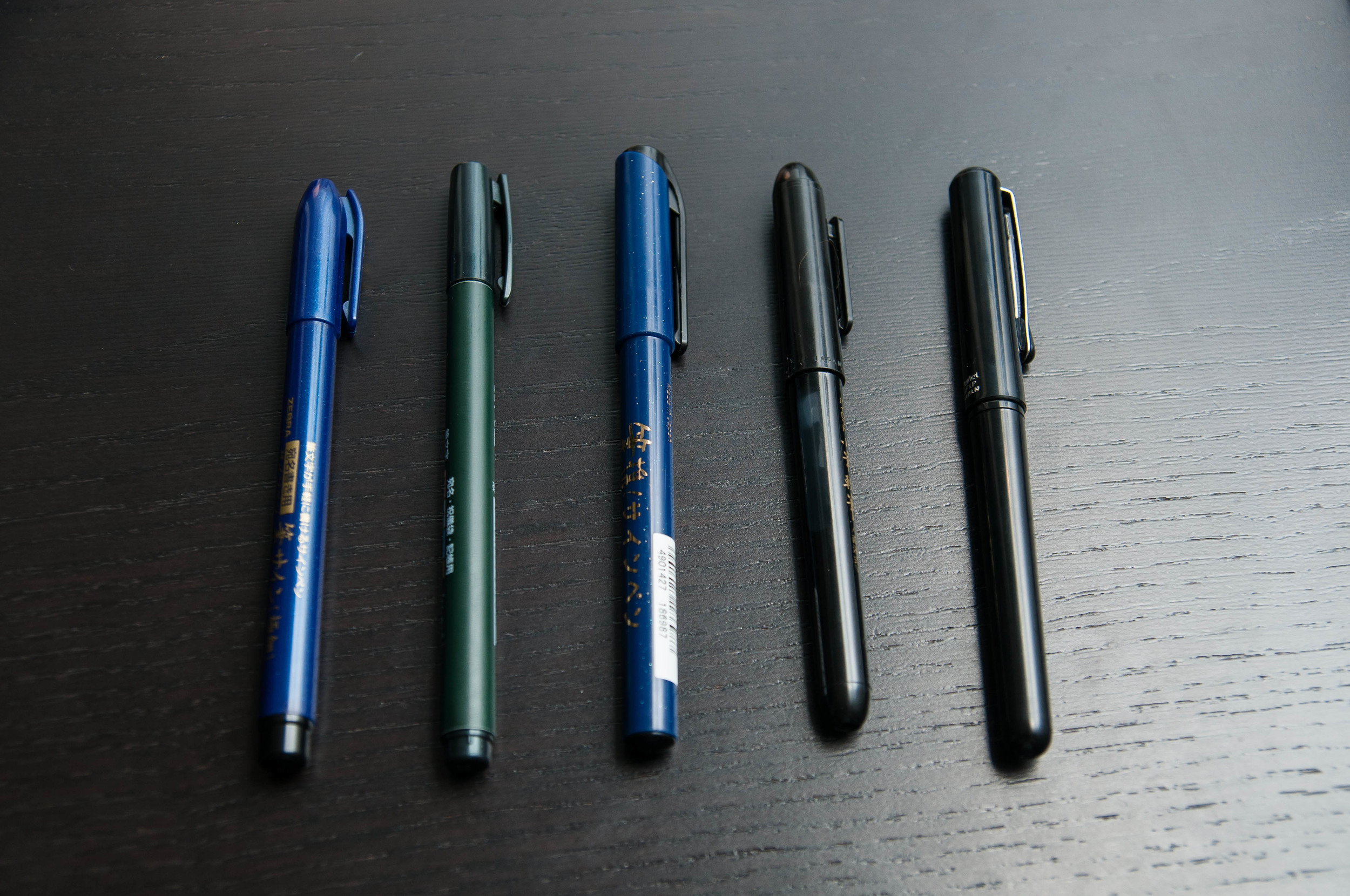
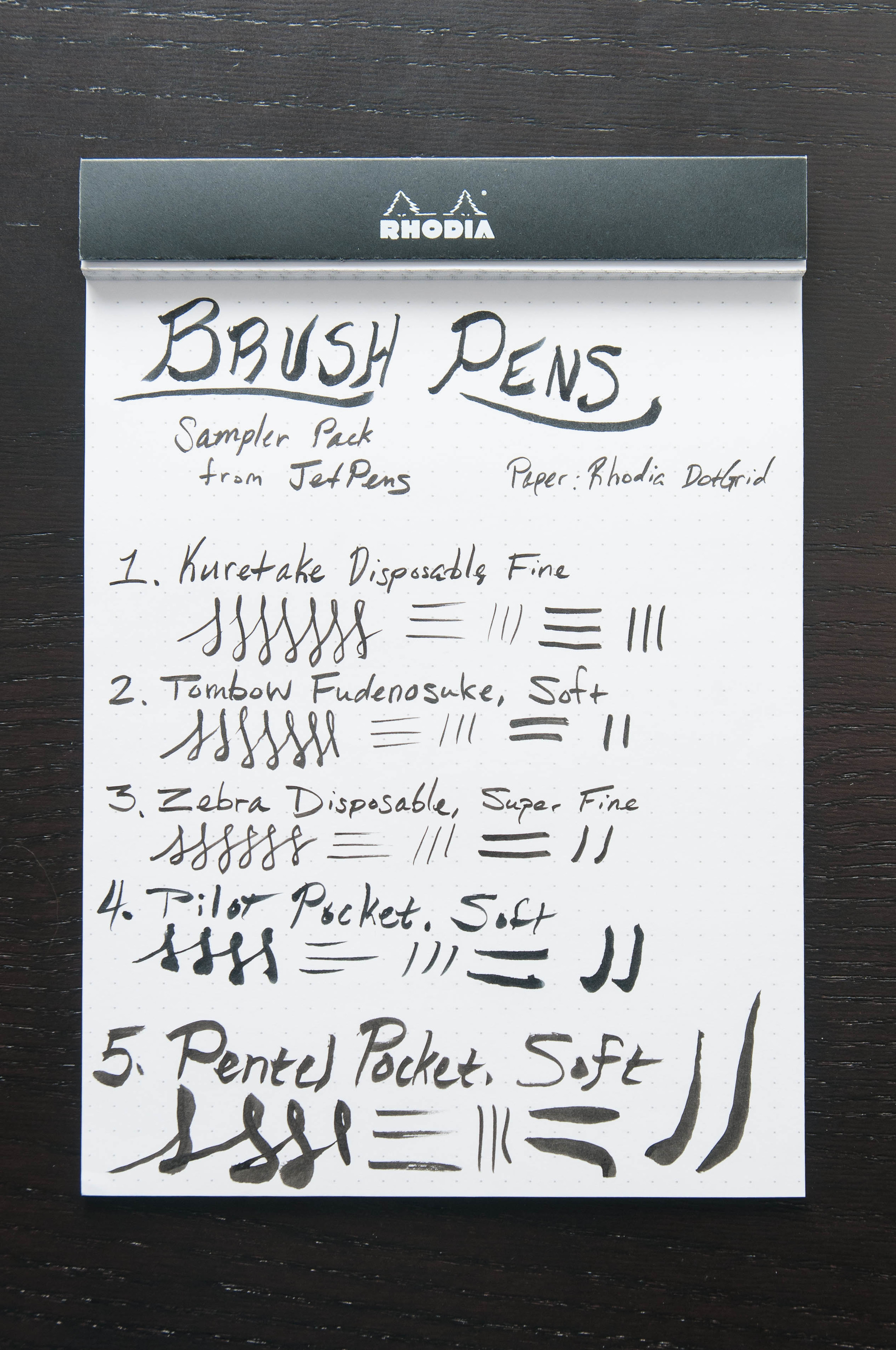
A few months ago, I wrote about my introduction to the brush pen genre with the Pilot Petit3. Shortly after that, JetPens began offering a sampler pack of 5 popular brush pens under the $30 mark. I ordered one right after seeing it, and I've been trying them out since. The main thing I've learned? Not all brush pens are created equal. Each one has a purpose, and as long as you understand that, you'll get along just fine.

The criteria

Recently, JetPens released a fantastic video that explains the different qualities of brush pens and how that affects the writing, drawing, lettering, etc. experience. I'm using the same qualities in my review, so let's have a quick look at what they are:

  • Tip type: This describes what the tip is made out of. This could be natural hair bristles, synthetic bristles, or felt. Depending on the type of material used in the tip, the rest of the characteristics of the pen will vary greatly.
  • Firmness: This can range from soft, medium, and firm. Soft tips will create wider line variation, but require more control and finesse. Firm tips are easier to use, but do not have great line variation.
  • Fineness: This can range from fine, medium, and broad. This refers to the line width the pen produces, similar to your fountain pen nib sizes. Brush pens with a soft firmness can hit all three line widths.
  • Elasticity: You guessed it, this refers to how well the brush tip can hold its original shape after being expanded with additional pressure. Basically, bristle tip pens will maintain the wide shape once you let off, and you'll have to fiddle with it a bit to make it fine again, whereas a felt tip pen will immediately return to its original width when the stroke is complete.
  • Ink flow: Again, if you're familiar with fountain pens, this one will make sense. This refers to how much ink comes out when making marks, similar to how we refer to a nib as "wet" or "dry."
  • Saturation: Another common term with fountain pens. This refers to the coloration of the ink. In the case of a black ink, a saturated ink will create a deep, dark black on the page, whereas a not-so-saturated ink will make a gray or brown shaded black mark.

Now, with that out of the way, let's take a look at these 5 pens.

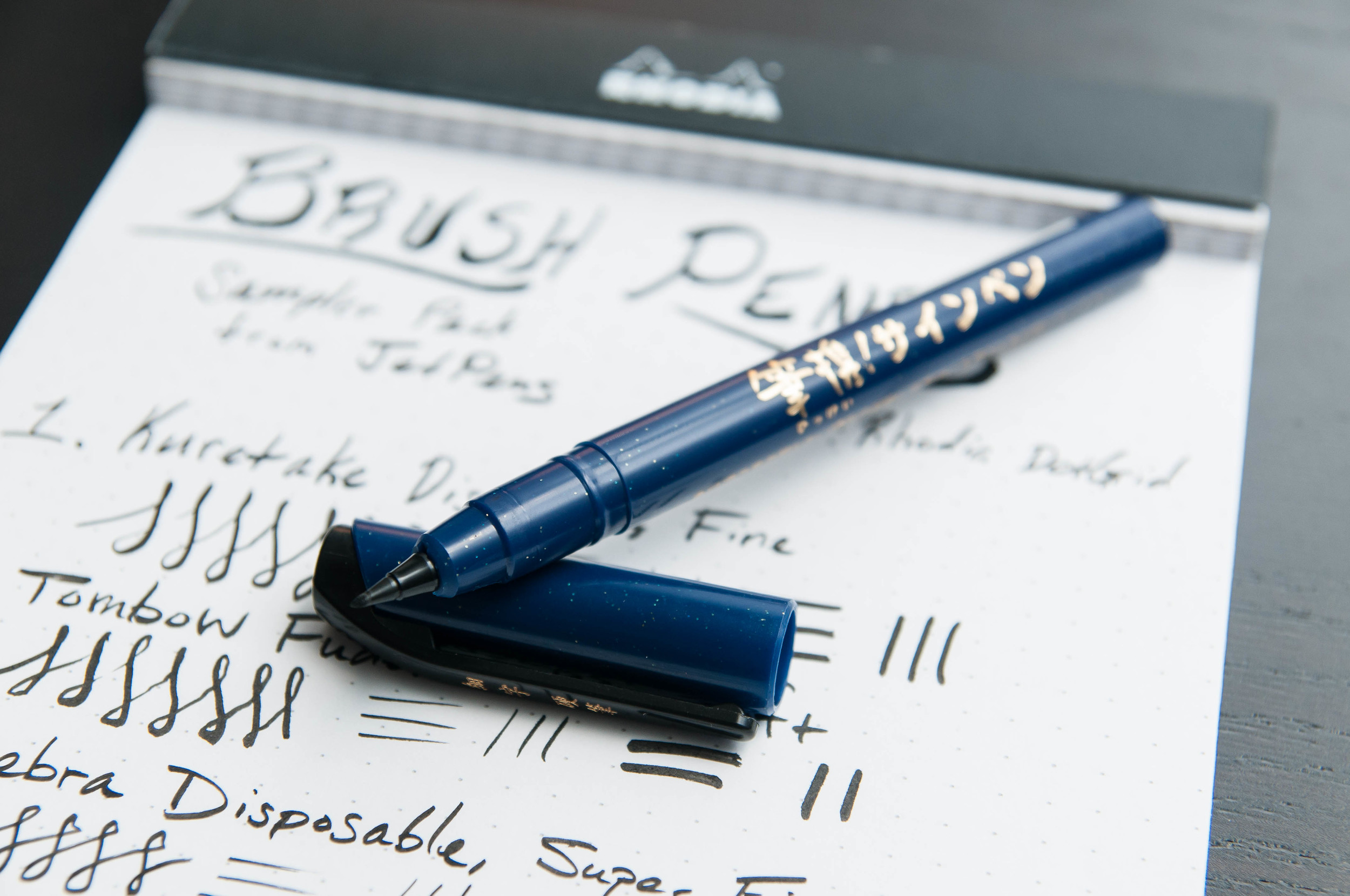
Kuretake Disposable Pocket Brush Pen, Fine

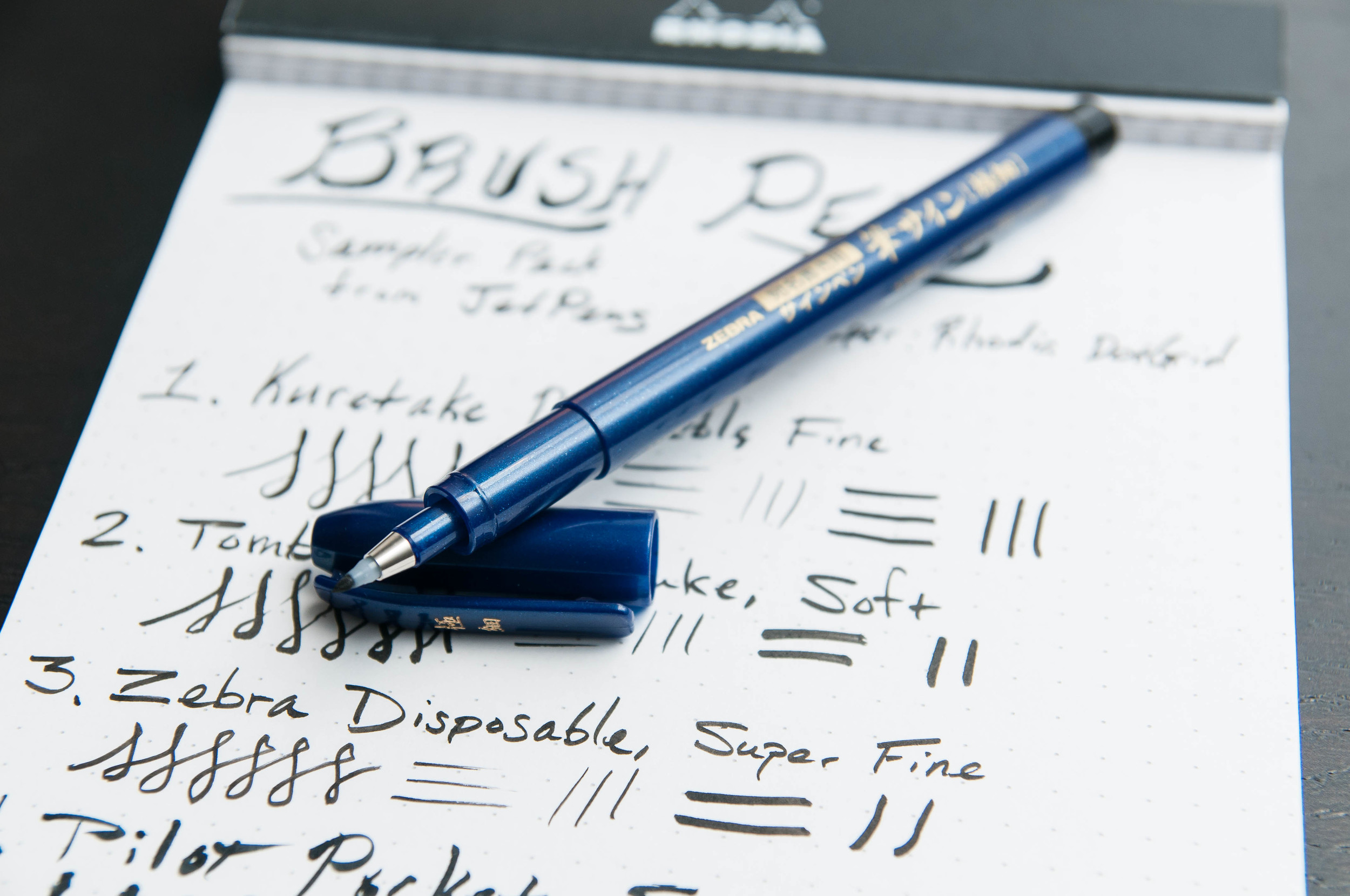
The Kuretake brush pen is a fine felt tip pen that is really easy to use. It's disposable, which means that once the ink dries up, you throw it away. The barrel is a sparkly dark blue color with gold text. The cap sits firmly on the pen when closed.

  • Tip type: Felt.
  • Firmness: I think this pen errs on the side of firm, but you can get some decent variation if you press hard enough.
  • Fineness: Fine
  • Elasticity: The tip returns to its original shape immediately.
  • Ink flow: Very good ink flow, as it requires the slightest pressure to put ink on the page.
  • Saturation: Very dark saturation.

Tombow Fudenosuke Brush Pen, Soft

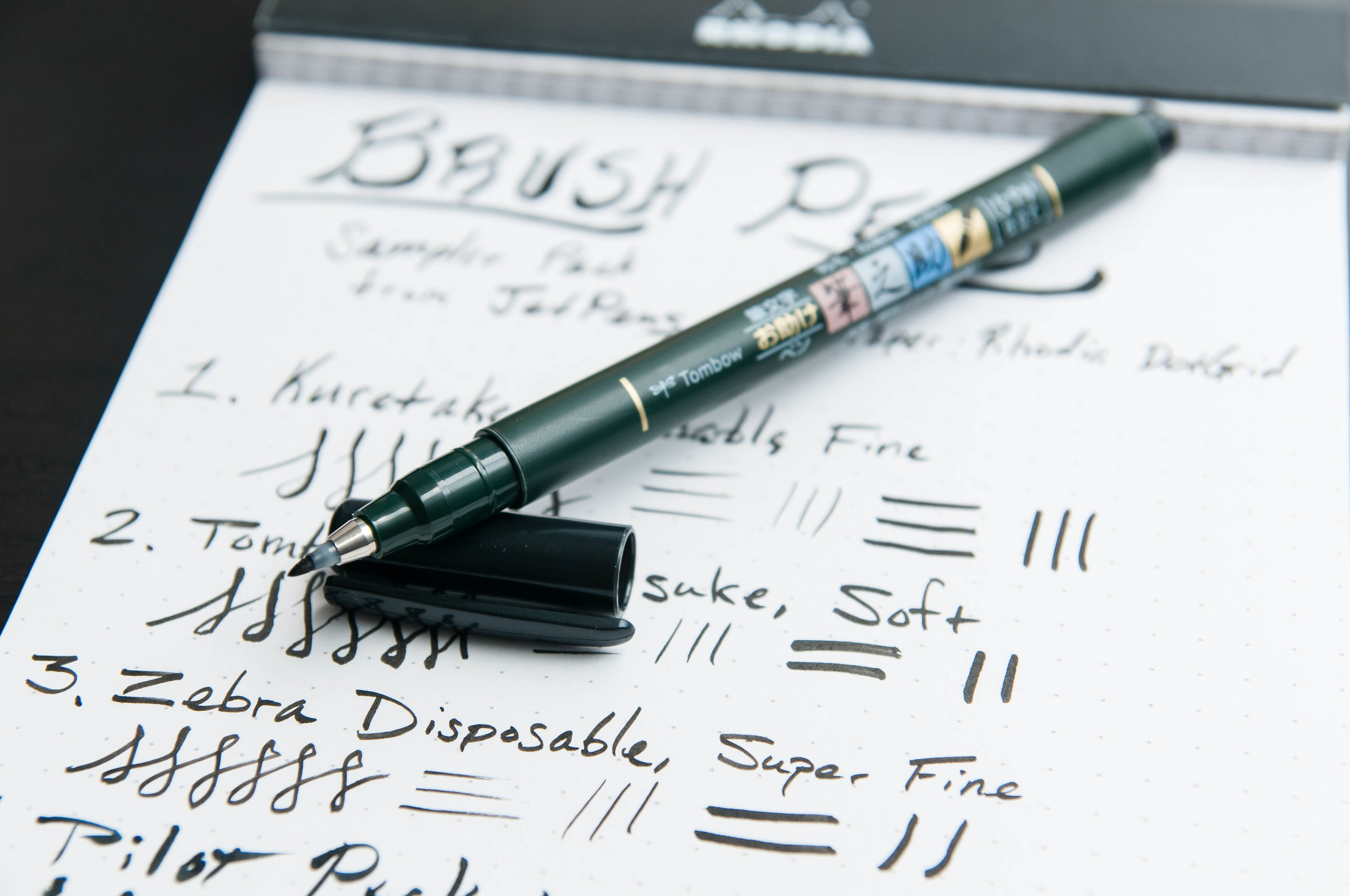
Of the felt tip brush pens in this pack, the Tombow is my favorite. I love how it writes, even if it isn't so pretty on the outside. This pen also comes with a handy little lettering guide, but I honestly haven't found much use for it. The body is a dark gray color with white text and lots of little graphics.

  • Tip type: Felt.
  • Firmness: I'd call this a medium because you can get a bit of line variation fairly easily.
  • Fineness: Fine to medium.
  • Elasticity: The tip returns to its original shape almost immediately.
  • Ink flow: Very good ink flow — requires almost no pressure to make a mark.
  • Saturation: Very dark saturation.

Zebra Disposable Brush Pen, Super Fine

The Zebra, even though its called "super fine," is very similar to the Tombow. You can get a decent amount of line variation, but it doesn't write as well as the Tombow. It's an excellent pen, but just a couple marks behind the Tombow. The body looks very similar to the Kuretake — dark sparkly blue with gold text, so it's very easy to confuse them.

  • Tip type: Felt tip.
  • Firmness: Firm to medium, but not as soft as the Tombow.
  • Fineness: Fine with the ability to reach medium.
  • Elasticity: Returns to original shape very quickly.
  • Ink flow: Very good ink flow, but a tad drier than the previous two.
  • Saturation: Very dark saturation.

Pilot Pocket Brush Pen, Soft

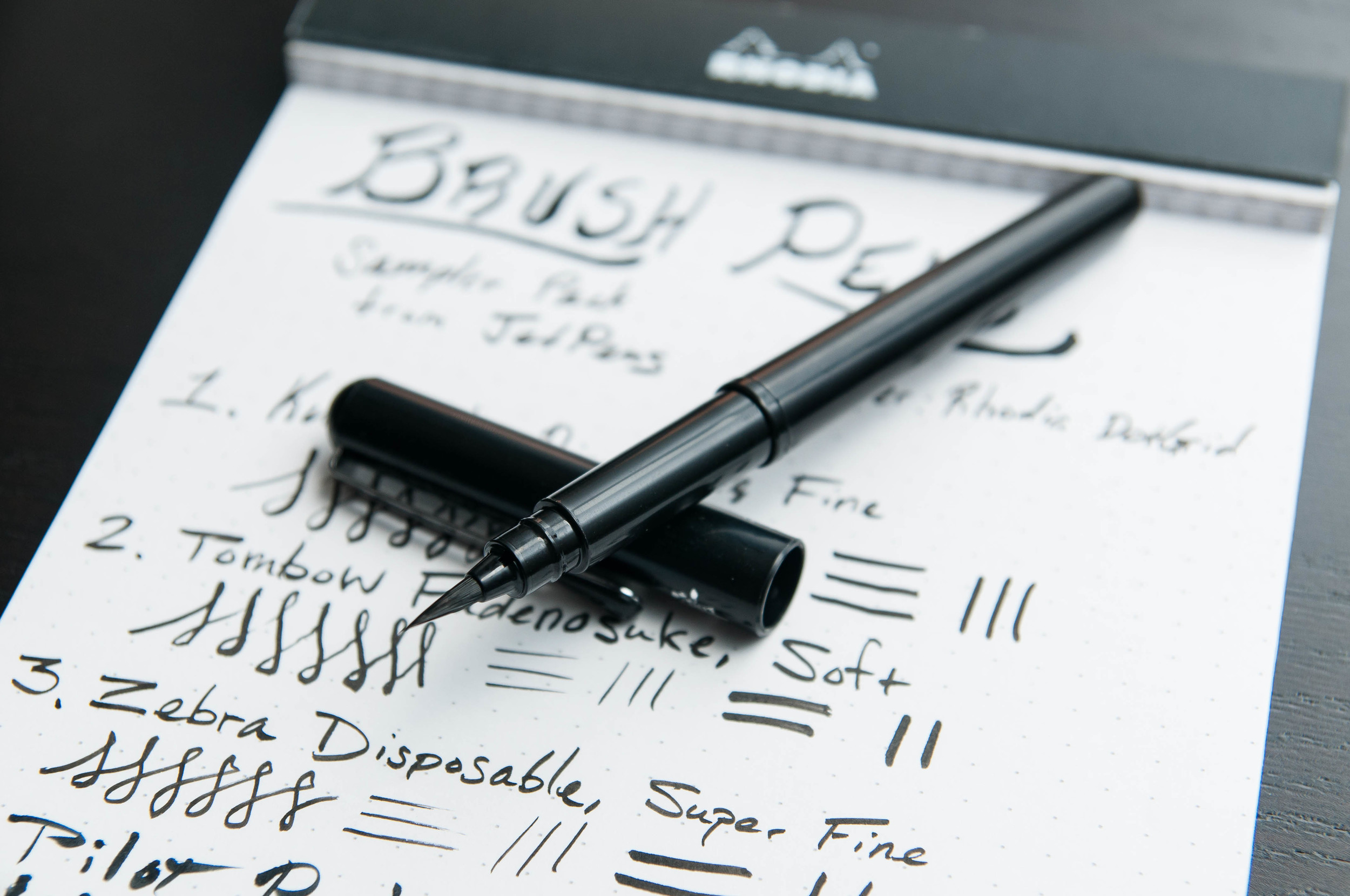
Ah, the Pilot brush pen. Of the broad, "lots of variation" group, this is my favorite. The pen is black with gold Japanese lettering on the body and red lettering on the cap. There isn't a word of English on this pen, so I only know it's the Pilot from a process of elimination.

  • Tip type: Felt.
  • Firmness: Very soft.
  • Fineness: Capable of making fine to broad lines easily.
  • Elasticity: Returns to original shape fairly easily, but might need some help after making broad lines.
  • Ink flow: Exceptional ink flow for such a wide tip.
  • Saturation: Very dark saturation.

Pentel Pocket Brush Pen for Calligraphy

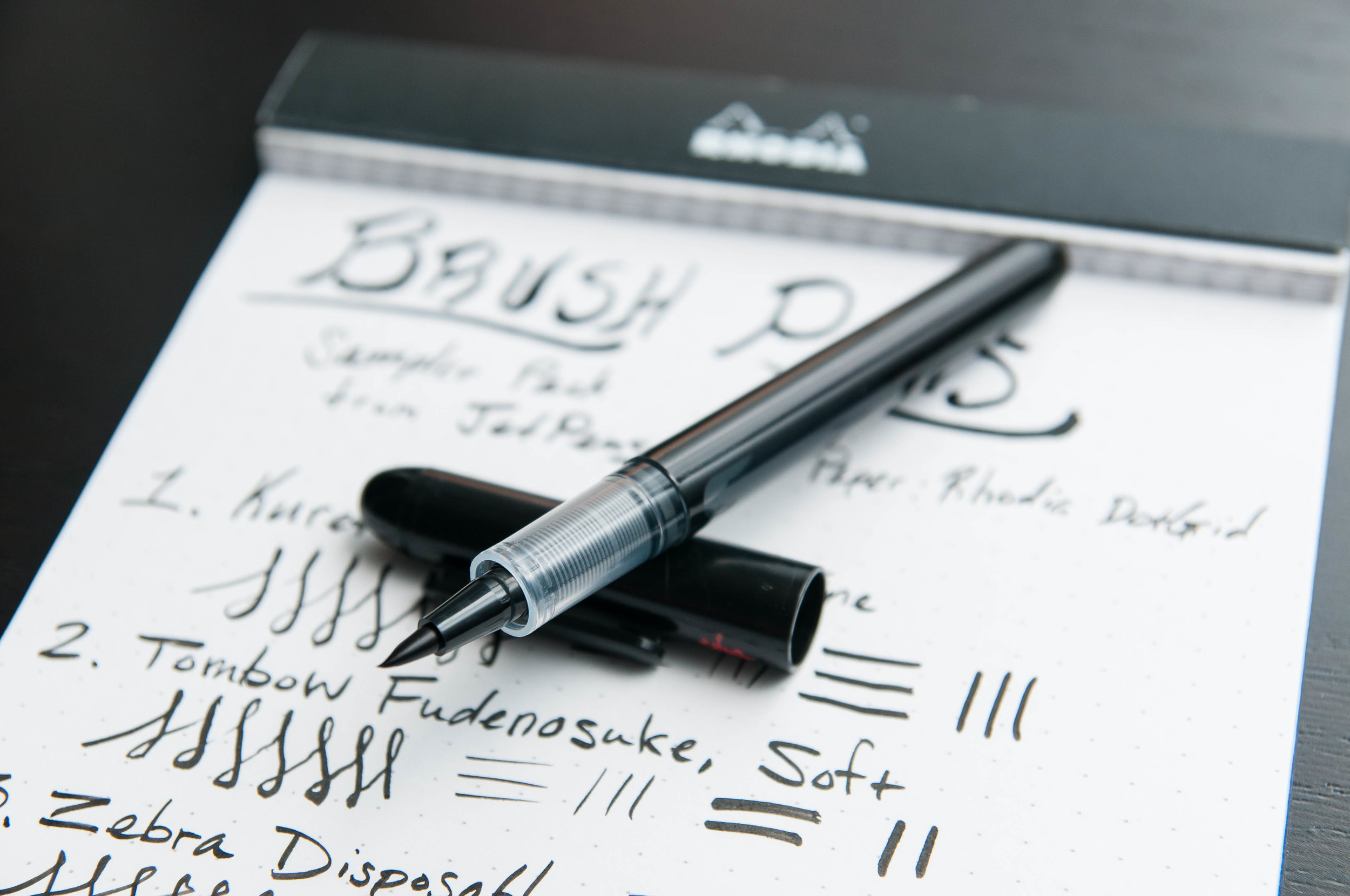
Of the bunch, this is the only bristle tip pen, and it's a hoot to use. This one takes the most practice and patience when using, and it's absolutely not suited for writing. The pen body is black some minimal silver text on the cap. Also, of the bunch, this pen uses an ink cartridge, so you can refill it after its empty.

  • Tip type: Synthetic bristles.
  • Firmness: Soft — very soft.
  • Fineness: Medium to broad. You can get an insane level of variation from this one.
  • Elasticity: Needs help returning to a medium point. It likes to stay pretty broad when making lines.
  • Ink flow: The ink flow is "good enough" for most things, but it's not nearly as good as the other 4.
  • Saturation: The saturation also leaves something to be desired, as the lines can look a bit brown on the page.

Conclusion

All in all, this sampler pack is a great way to break into the brush pen genre. For me, I still feel like I have no idea how to use these properly, but that doesn't mean I don't enjoy the heck out of them. I don't consider myself an artist, but these pens make me want to draw, and for that I'll eternally love them.

If you're curious about brush pens, I highly suggest you start here.

Posted on April 1, 2015 and filed under Tombow, Pentel, Kuretake, Pen Reviews, Pilot, Zebra, Brush Pen.