Posts filed under TWSBI

Who Wore It Better? Pilot Custom Heritage 92 Clear vs TWSBI 580 ALR Black

(Kimberly (she/her) took the express train down the fountain pen/stationery rabbit hole and doesn't want to be rescued. She can be found on Instagram @allthehobbies because there really are many, many hobbies!.)

The TWSBI 580 ALR Black arrived this week and I couldn’t help but notice the similarities with the Pilot Custom Heritage 92 Clear that was inked up in my pen binder. So, just for grins, I thought I’d do a little showdown to see “who wore it better!”

Aesthetics

Both the Pilot CH 92 and TWSBI 580 ALR Black are demonstrators with smoke or black accents, respectively. The Pilot has translucent black, aka smoke, finial and piston knob but the grip is clear, though the nib housing is black. The TWSBI has black aluminum accents on the finial, black trim ring around the piston knob, as well as a black ridged grip section. The TWSBI’s black matte aluminum cap band makes the white lettering of the branding very obvious, and not necessarily in a good way. Both have black plastic pistons which makes them look even more similar. I like the black furniture a bit more on the TWSBI but the white lettering is a bit of a turnoff for me. The Pilot is classic and understated, almost too much so.

Winner - Tie, but with a wee lean towards Pilot.

Pilot Custom Heritage 92 Clear (left) and TWSBI 580 ALR Black (right). At a casual glance, these two could be siblings but take a closer look and decide for yourself if they are similar enough to own both.

The white lettering seems harsh against the black cap band.

The lettering on the ALR Punch Pink and Navy Blue is also white, but it just looks more drastic to me on the black cap band. Maybe they should have done something more subtle like they did with the AL Smoke Rose Gold and White Rose Gold.

Nib

I got the TWSBI with a steel 1.1 stub while the PIlot has a 14kt gold, number 5 Medium nib. I do have many other 580s with other nibs and the writing experience is similar among the steel nibs. They are firm and generally feel fairly smooth, though I wouldn’t call them buttery. Their Fine is about as fine as I like, with Medium being my favorite nib size from TWSBI. They are similar in feel to steel Jowo nibs. The Pilot is lovely to write with, and the Medium is buttery smooth. It feels wee bit softer than the 580 without being bouncy or flexy. For me, it’s not even a contest nibwise.

Winner - Pilot.
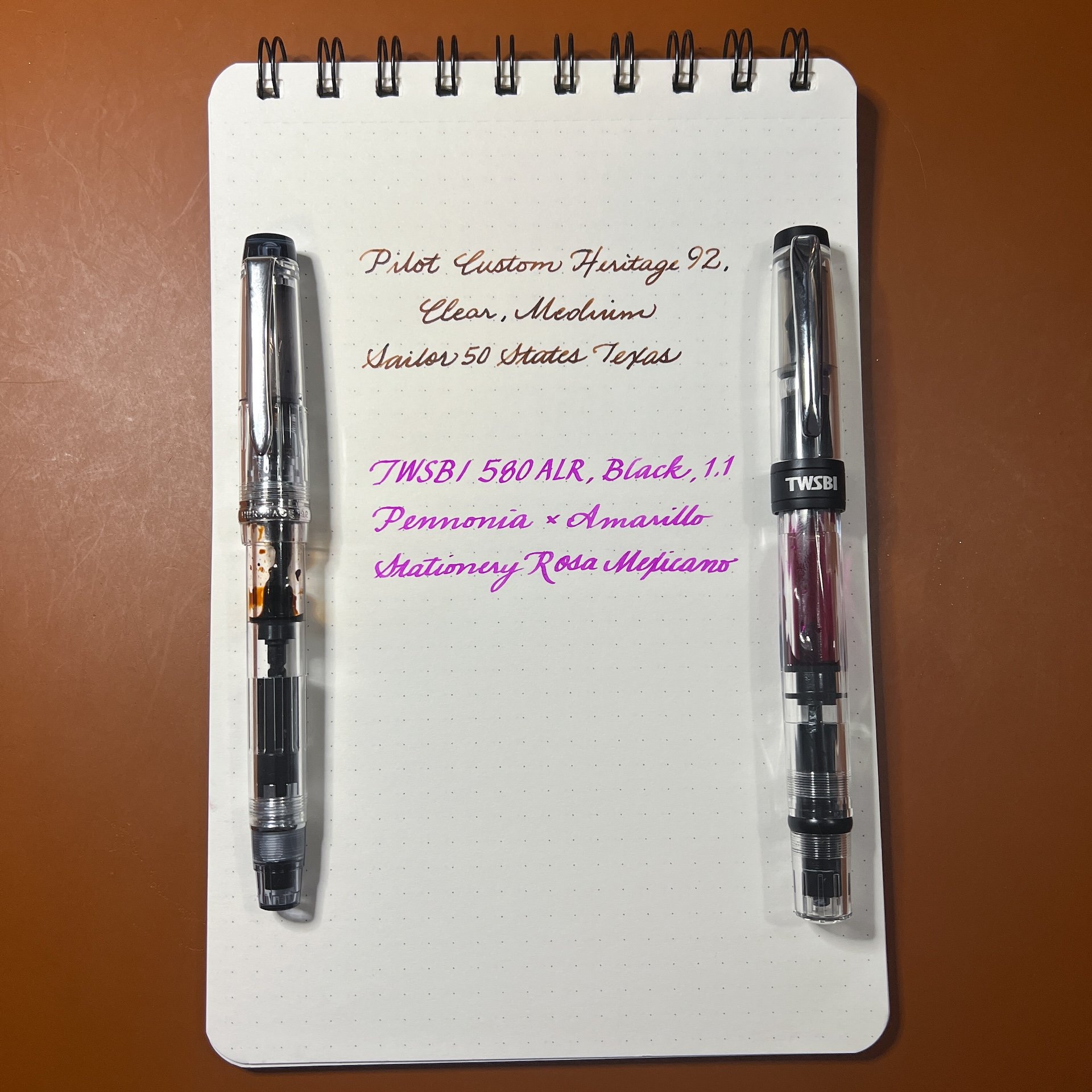
Pilot (left) inked with Sailor 50 States Texas, TWSBI (right) inked with Pennonia x Amarillo Stationery Rosa Mexicano - Can’t tell from a picture how they write but they are both solid writers, but the feel is different. Gotta try it for yourself, or just take my word for it. ;-)

Ink Capacity

The Pilot has an ink capacity of ~1.28ml while the TWSBI can hold almost 2ml of ink. Both of these hold way more ink than I ever want in a pen, so for me, ink capacity is fairly unimportant. But if you want more ink in your pen, gotta go with the TWSBI.

Winner - Tie, unless you care about ink capacity in which case, TWSBI

Feel in Hand - Grip

The Pilot is a bit slimmer than the TWSBI and has a very subtle shape to the grip which prevents your fingers from slipping on the smooth plastic grip section. The TWSBI has the textured grip section which gives it a more tactile sensation to the grip and the flare on the end is more pronounced than on the Pilot. This one was tough to choose but as I prefer slightly girthier pens, I went with the TWSBI, but both are comfortable for long writing sessions.

Winner - TWSBI

Pilot (left)’s grip is straighter and the smooth, unintrusive threads are relatively flush to the barrel. The TWSBI’s flared grip section is more noticeable next to the near-parallel Pilot grip and the texture of the ridges is subtle while providing a non-slippery grip.

Feel in Hand - Weight

Uncapped and empty, the Pilot weighs about 0.4 ounces (12 g) while the TWSBI weighs 0.60 oz (~17g). I can definitely tell the difference in weight but it isn’t something that made much of a difference to my hand when writing for a long time. Since I don’t have a preference weight-wise between these two pens, there is no winner. Winner - Tie

Length

Unposted (which is how I use pretty much all my pens), the Pilot CH 92 is a bit shorter than the TWSBI, 4.8” vs 5.2”. The length of both pens were fine in my hand. The Pilot can be posted while the TWSBI wasn’t designed to be; as such, the TWSBI is absurdly long and back-weighted if you attempt to post it and you may, over time, scuff and damage its piston knob.

Winner - Tie (unless you like longer or shorter pens)

The Pilot (left) is a bit shorter than the TWSBI.

Both pens were comfortable in hand and I didn’t notice the difference in length or weight.

The length difference when posted is pretty significant.

The TWSBI is ridiculously long when posted and imbalanced.

Price

The US price for the Pilot CH 92 is $240 vs $65 for the TWSBI ALR. Yes, there’s a gold nib on that Pilot, but for reasons unknown to me, the clear CH 92 has always had a premium compared to the other colors of the CH 92, which aren’t readily available in the US market. This pen can be found for 100-120 shipped from Japan and this is one of those times when the price difference is so big that it’s hard to justify the higher US price tag. If I had to pay $240 for the Pilot CH 92, the reality is, I probably wouldn’t own one. The TWSBI 580 ALR at 65 is a good price for a workhorse of a pen (just don’t do stuff like store it with your keys, bang it around in a backpack or crank on the cap or grip or piston knobs.) However, if you’re able to get the Pilot for $100 or even $150, it would be Pilot, hands down because I like the nib so much more, but if you can’t, then it’d have to be the TWSBI.

Winner - It’s complicated.

In the end, there were a lot of ties and some complicated answers with respect to pricing, as well as personal pen preferences. While they may look similar and share some similar qualities (piston fillers, demonstrators, not too heavy or girthy,) they don’t write similarly enough for me to hands-down pick just one of them. I love my TWSBIs for everyday writing and there is almost always one (or more) inked up in my binder but the Pilot really elevates the writing experience for me. So if you can, get them both, but if you already have a TWSBI, consider saving up for the Pilot Custom Heritage 92.

(Disclaimer: Both pens are my own. The Pilot was bought second hand, possibly on eBay, 4-5 years ago. The TWSBI was purchased from Lemur Ink.)


Enjoy reading The Pen Addict? Then consider becoming a member to receive additional weekly content, giveaways, and discounts in The Pen Addict shop. Plus, you support me and the site directly, for which I am very grateful.

Membership starts at just $5/month, with a discounted annual option available. To find out more about membership click here and join us!
Posted on February 2, 2024 and filed under Pilot, TWSBI, Fountain Pens, Pen Reviews.

TWSBI GO 1.1mm Stub Nib Fountain Pen Review

(Jeff Abbott is a regular contributor at The Pen Addict. You can find more from Jeff online at Draft Evolution and Twitter.)

The TWSBI GO isn't that new any more, but I've only just recently picked on up to play with. It always spoke to me as a great candidate for being an ink testing pen due to the simple filling system. After using this one for a while, there's definitely a lot more to like about this fun pen, and it will be more than just a testing pen.

I went with the fully transparent model with a 1.1mm stub nib as my intro to the GO. This is also my first time trying a TWSBI 1.1mm stub nib. Lots of firsts going into this pen experience!

There are plenty of TWSBIs in my collection already, so I knew what to expect in terms of the nib and build of the pen. With this being their lowest-cost entry point, I'm actually more impressed than I thought I'd be. For less than $20 USD, you get a lot of pen. I'm embarrassed that I waited so long to check out the GO and see what the fuss was about!

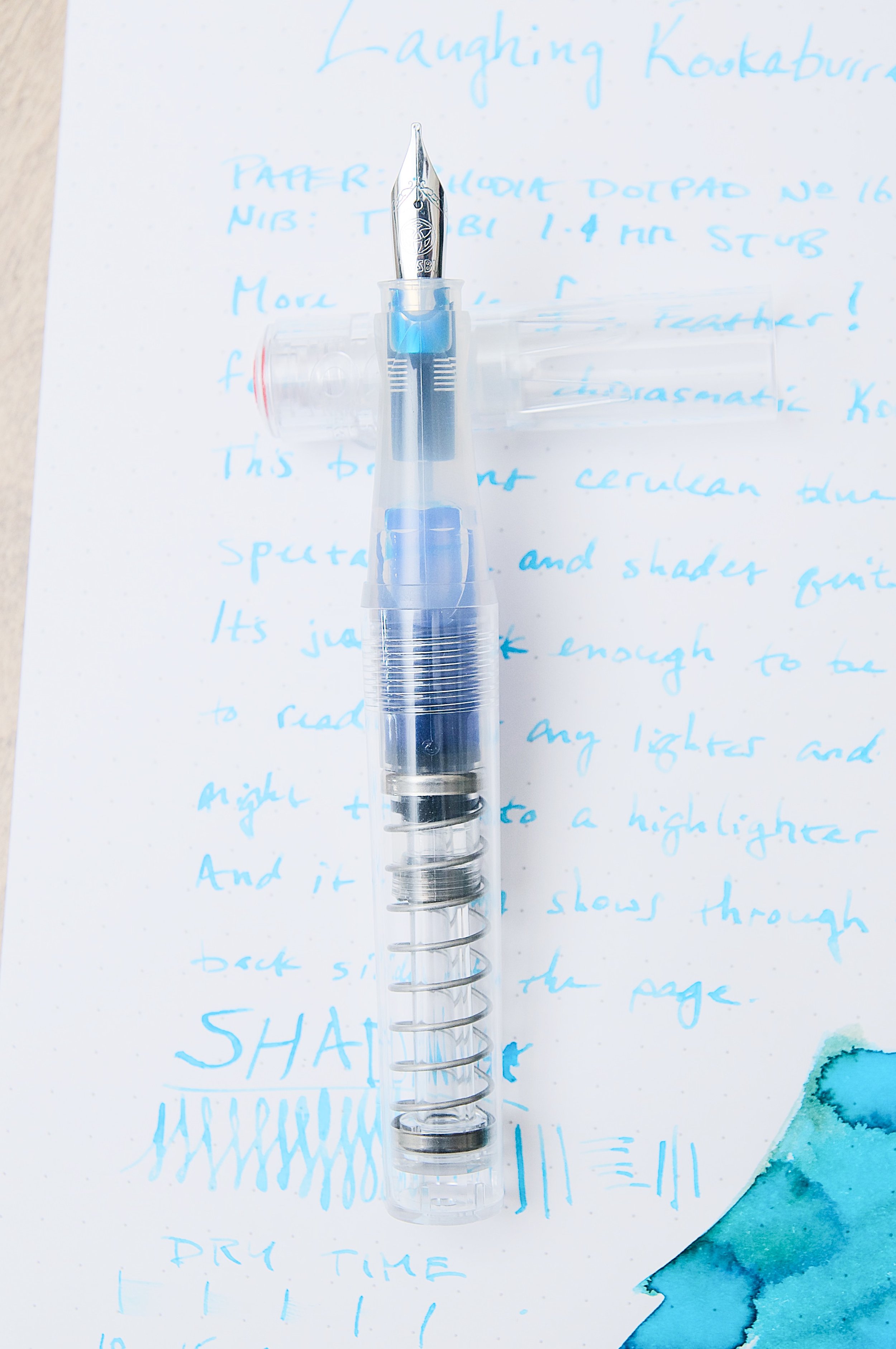
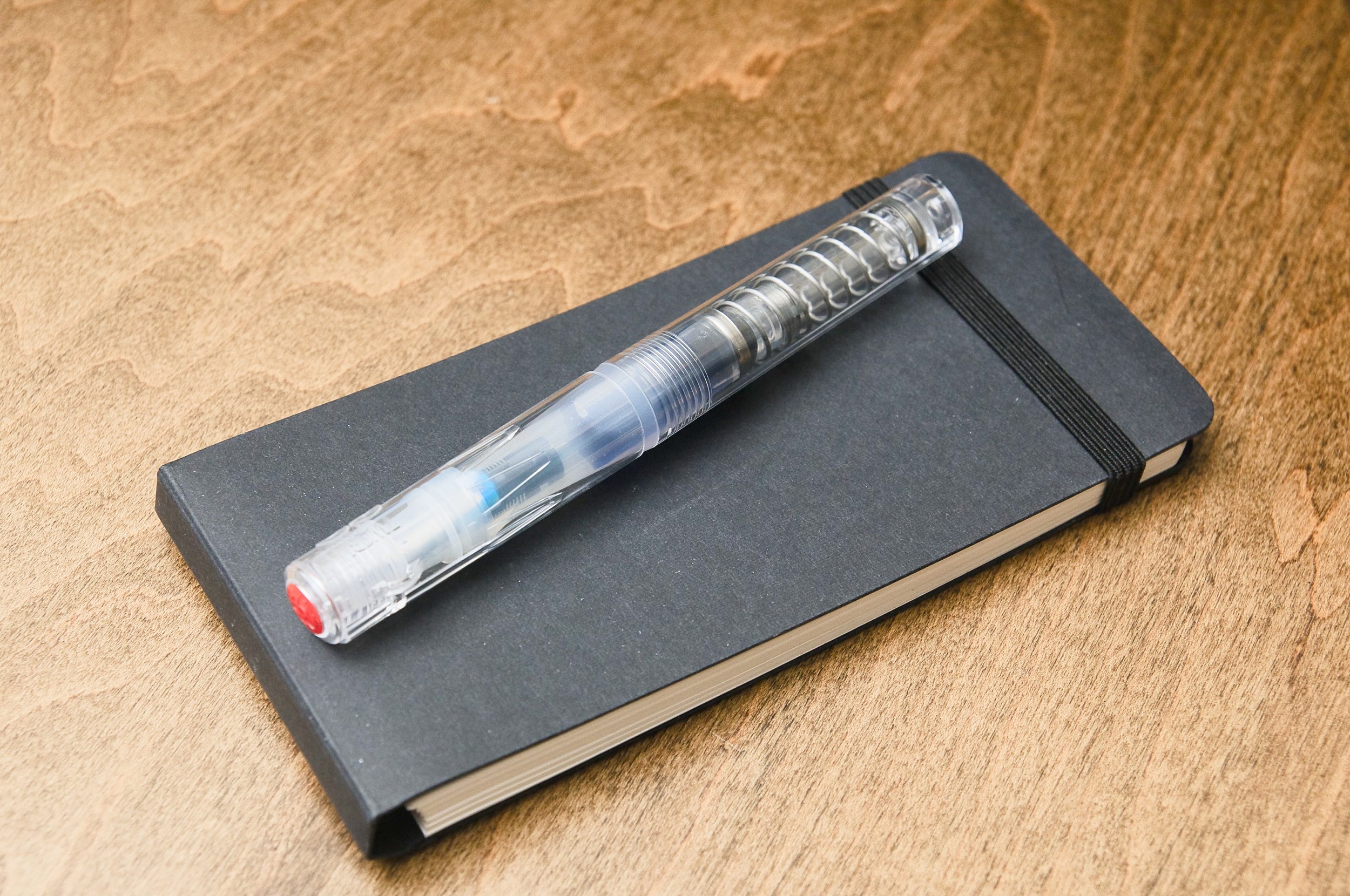
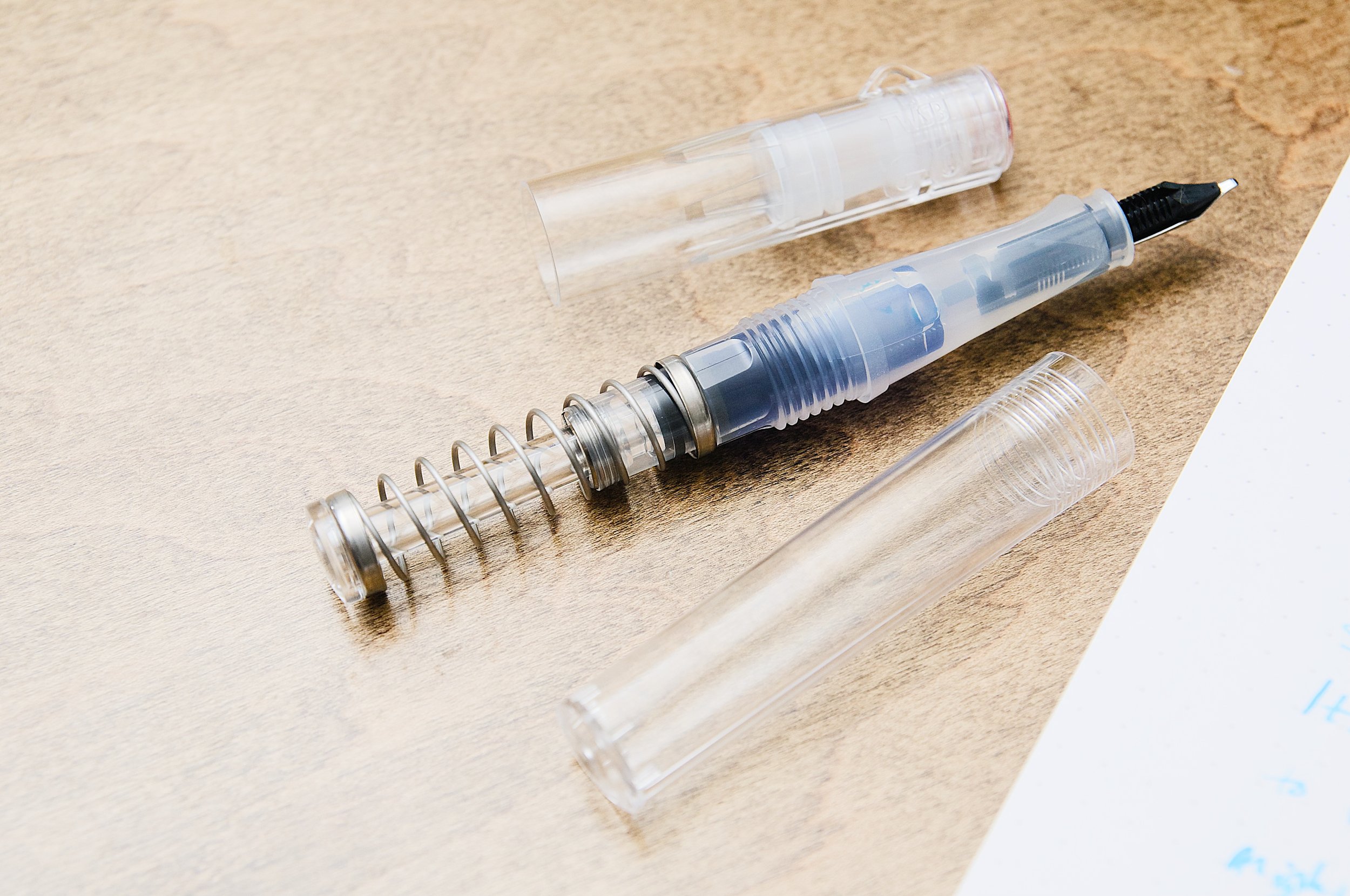
For the uninitiated, the GO is a plastic-barrel pen that features a spring-powered piston filling system. The large spring under the transparent body also adds a fun visual for the pen as well as being functional. It uses the standard TWSBI nib, but without the convenient threaded nib/feed module that you'll find on the more expensive models. You can still swap out the nib without much trouble, but it's not as quick and easy as with other TWSBIs.

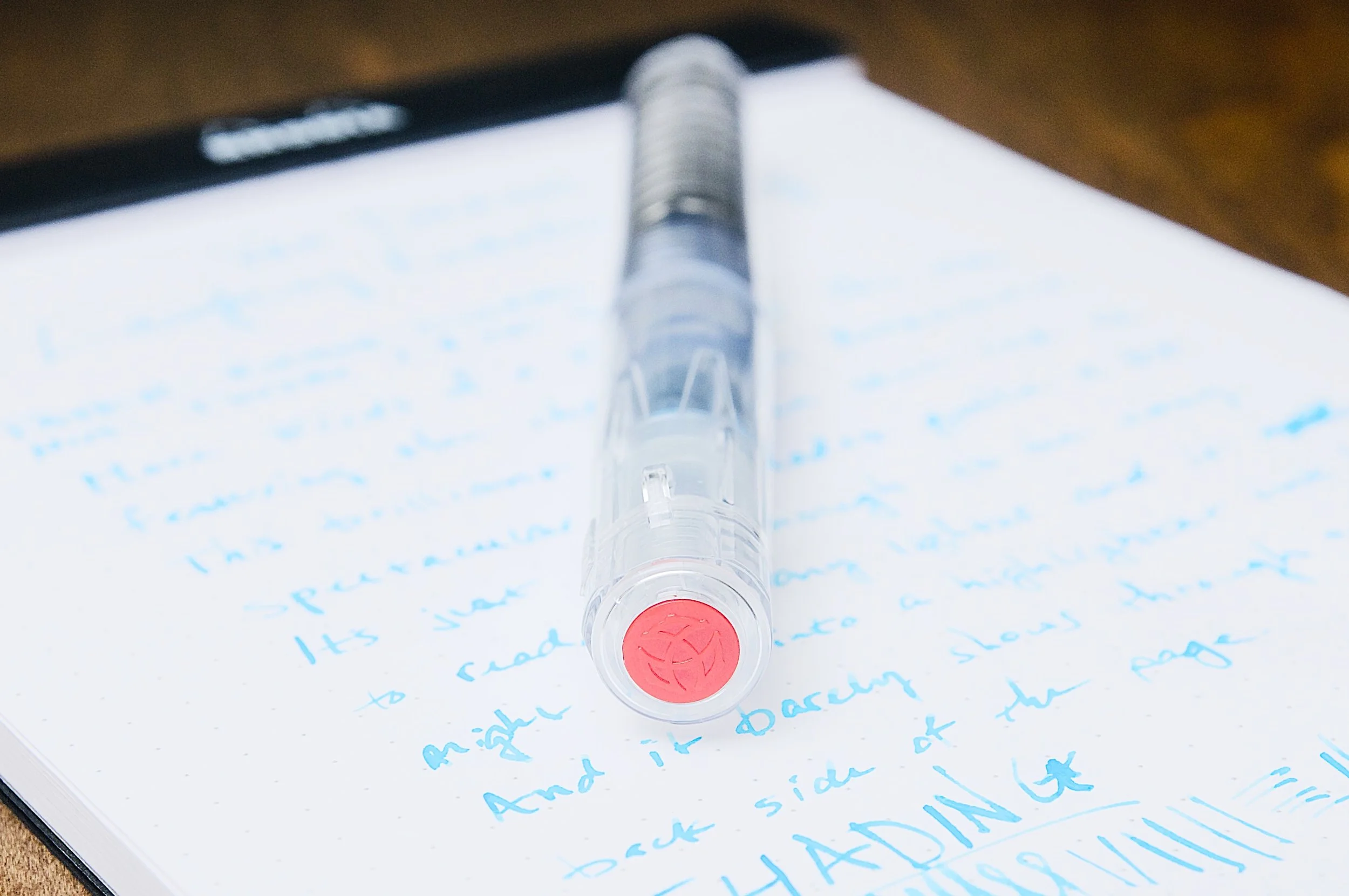
This is the only TWSBI I've used that has a friction-fit cap instead of a screw-on cap. I still make the mistake of trying to unscrew it! The cap works really well. Capping and uncapping the pen is really stable and makes a satisfying click. You can post the cap on the back of the pen, but this makes the pen too long for my preference. The uncapped pen is the perfect length for me when writing.

The grip section is a really nice shape. It has a nice taper down to the nib, and then there are three flattened edges that add a nice aesthetic to the grip but also a good spot for your fingers to hold steady.

To cut down on costs, there's no clip on this pen. It does have a small nub on the cap to keep the pen from rolling on your desk, but you can't clip this pen to anything. For the price, I'm not complaining. I'd rather have the cool spring filling system over a clip for this price.

Like every other TWSBI nib I've used, this is a great nib that worked great out of the box. It's my first time using the 1.1mm stub nib, and I've been really happy with it. The flow is smooth and the nib lays down a nice layer of ink with ease. I've tried several inks with it already, but I'm currently still loving the Laughing Kookaburra Wing with this pen/nib combo now.

The TWSBI GO is a fun pen, and I wish I'd tried one out sooner. The design is so much fun, and the large spring in the body catches everyone's attention. People can't help but pick up this pen, and that's exactly what I like to see with a pen that's marketed toward newcomers to the hobby. It's crazy what you get with this pen for less than $20 USD. Cool transparent body? Got it. Included converter that doesn't need cartridges? Even better — this pen has a built in piston filling system that can hold lots of ink. Good nib? Yup. I don't think there are any other options under $20 for getting a good 1.1mm stub nib. All considered, this pen is a phenomenal value that is perfect for newcomers who are interested in non-cartridge fountain pens and stub nibs. But, it's so much fun that it's great for those of us that already have too many pens!

The playful and unique design makes this a great pen for your collection that can also be a workhorse. It also makes for a great gift for those fountain-pen-curious folks in your life!

(Vanness Pens provided this product at a discount to The Pen Addict for review purposes.)


Enjoy reading The Pen Addict? Then consider becoming a member to receive additional weekly content, giveaways, and discounts in The Pen Addict shop. Plus, you support me and the site directly, for which I am very grateful.

Membership starts at just $5/month, with a discounted annual option available. To find out more about membership click here and join us!

Posted on December 13, 2023 and filed under TWSBI, Fountain Pens, Pen Reviews.

Reflections on Some Currently Inked Pens

(Kimberly (she/her) took the express train down the fountain pen/stationery rabbit hole and doesn't want to be rescued. She can be found on Instagram @allthehobbies because there really are many, many hobbies!.)

Despite being in this rabbit hole for 6.5 years, I continue to learn not just about pens, inks and all that, but about my preferences and habits. There isn’t a right or wrong way to be in this hobby and what works for someone may or may not work for you. For some reason during the past few weeks, a few of my currently inked pens were good reminders of lessons I’ve learned along the way.

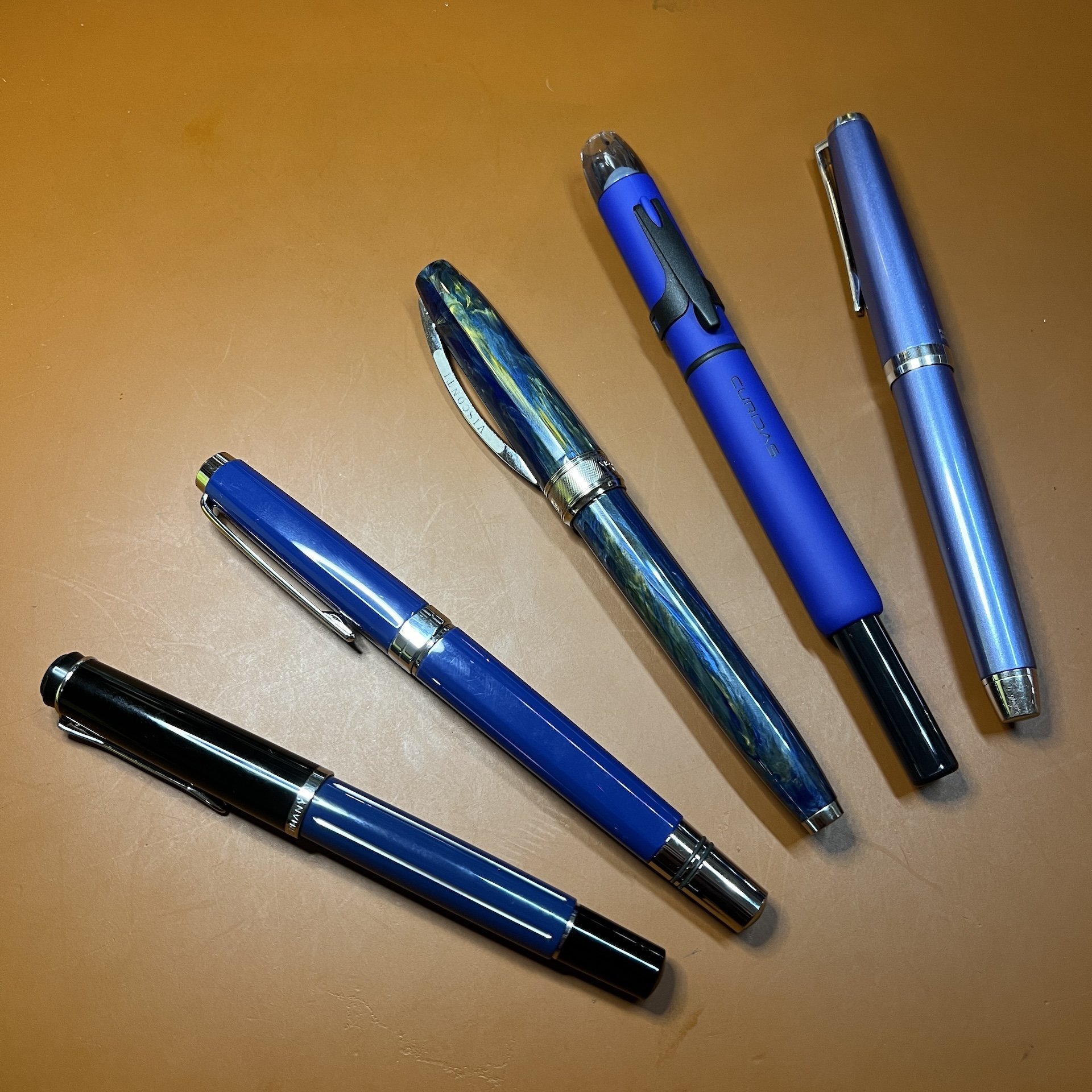
On the surface, there isn’t much that is similar among these pens, other than they all happen to be blue! (Bottom to top: Pelikan M215 Blue Stripe, TWSBI Classic Blue, Visconti Van Gogh, Platinum Curidas, Pilot Falcon/Elabo.)

Pelikan M215 Blue Stripe

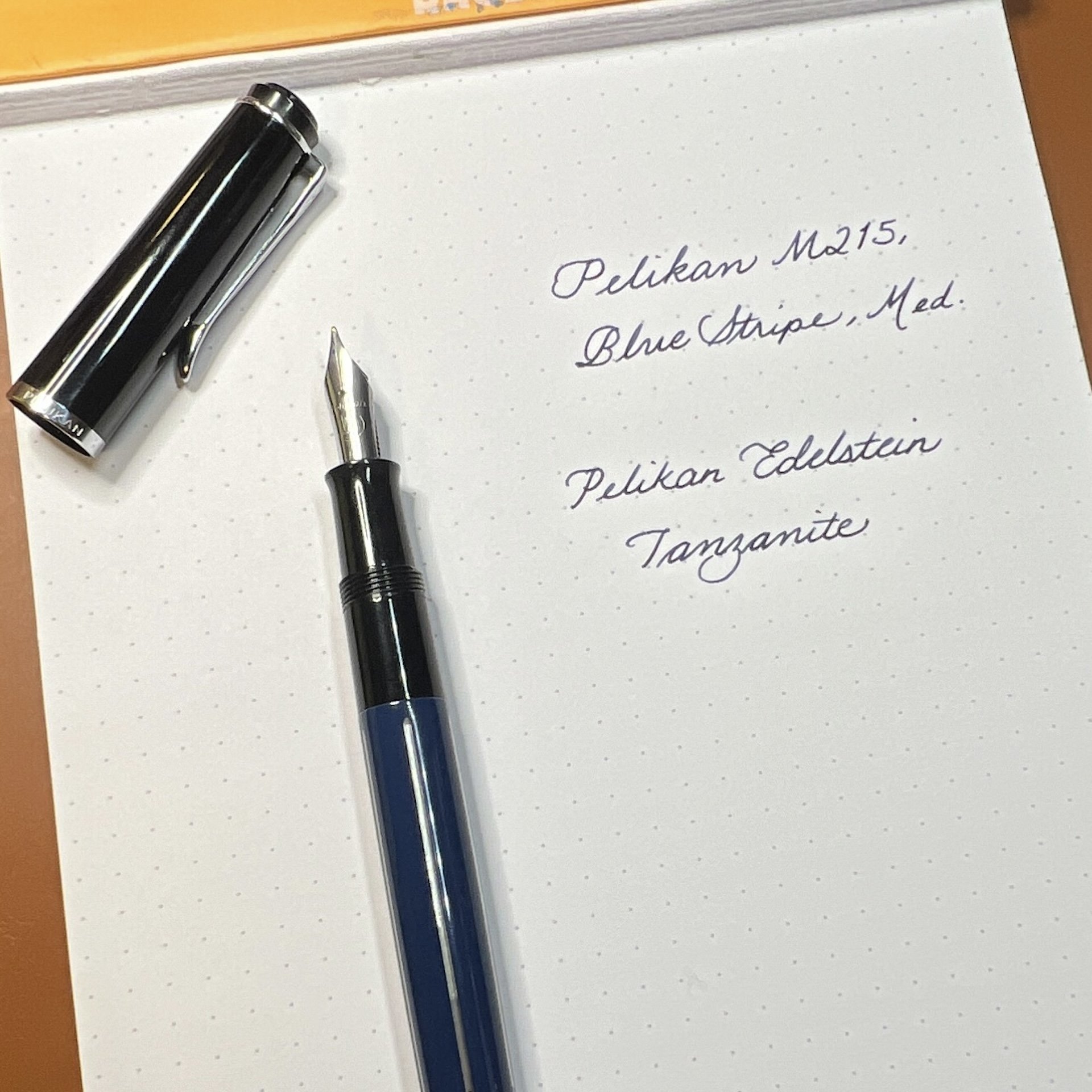
Hard to tell from this picture but there are silver colored stripes on the barrel of this pen.

  • Patience (and research), Grasshopper - I have wanted this pen for 3-4 years (maybe longer) and have seen it on eBay for very high/ambitious prices. And I am definitely not one for patience. But I also don’t want to overspend. Doing research ahead of time, including reaching out to folks who have better pulses on the Pelikan secondary market, made it easier for me to pounce on a listing that was finally in the right price range.
  • Inks & pen combinations matter - As I mentioned in recent ink reviews, inks behave differently in different pens (and also on different papers too). This M215 is currently inked up with Pelikan Edelstein Tanzanite, which is a lovely blue-black ink. Is it a shocker that this is a good matchup? No, not really, but I haven’t used this ink since I first tried it, gulp, way back in 2017, in a Lamy Safari. I absolutely hated the combination because it felt like writing with sand and I wondered if I should dump the ink out of the pen and get rid of the sample. What I didn’t know then, was that Lamy pens can be on the drier side and that Pelikan inks are also on the drier side (to compensate for their wetter nibs), so that combination was doomed from the start. What’s sad is that I was hesitant to try the ink again, even though I learned more about pens and inks since 2017. I’m glad I decided to try the ink in this pen, because it flows just perfectly from this pen, and it’s a great match colorwise, too. I’ve also since learned that it’s ok to empty out a pen if the ink just isn’t doing it for you. Life’s too short to write with a bad combination.

TWSBI Classic, Blue

  • Oldie but goodie - One of my first TWSBIs is the Classic, in Turquoise. I love the non-demonstrator look but I don’t really think about them as much because I usually want a demonstrator when I want to ink up a TWSBI. I needed to ink up a blue pen so I decided on the blue Classic. It had a Fine nib and even though Mediums are my usual jam, I just shrugged and inked it up anyway. Then I wrote with it and was shocked at how much I liked the Classic AND the fine nib. It is so easy to ink up the latest acquisitions and forget about the older pens (and inks). I try to balance that urge by having a mix of old and new pens in the “to-be-inked-next” tray. I do this with inks too. It’s like discovering a lost treasure.

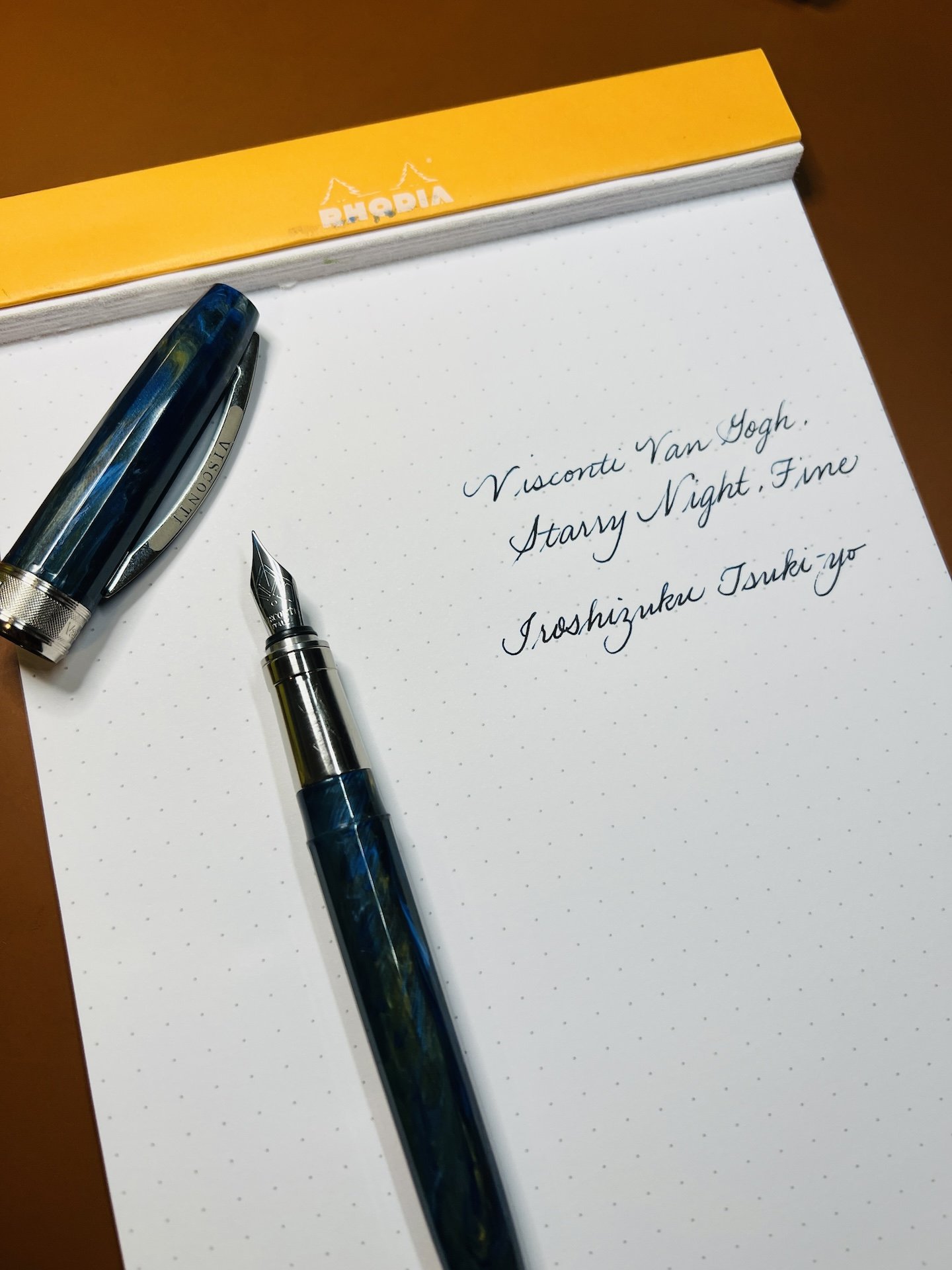
Visconti Van Gogh, Starry Night

  • It’s ok if looks are important - As a Van Gogh fan, and more specifically of Starry Night, I love this pen. Not because it is an amazing writer (I mean, it writes fine) but because looking at it makes me happy. It makes me think about my favorite piece of art and that makes me happy. People place different levels of importance on the nib vs the appearance and that’s one of the many wonderful things about this rabbit hole. My personal pen preference emphasizes looks over writing (probably 65:35 as long as the nib doesn’t write poorly). In the end, as long as you’re happy, whether it’s with the looks, the nib (or both), it’s a win in my book.
  • Oldie but goodie, this time with ink - I inked this up with an ink that I once loved but sorta put by the wayside (shame on me) - Iroshizuku Tsuki-yo. When everyone was raving about Shin-kai (cough cough, Bossman), I instead fell in love with Tsuki-yo. With all the deluge of inks that currently exist and continue to be released, it’s easy to get caught up in the latest “must-have ink”. I had forgotten how much I liked that ink and I’m glad I decided to use it again.

Platinum Curidas, Matte Blue

  • It is not a popularity contest - Not gonna lie, the Platinum Curidas is probably one of the more polarizing pens when it comes to looks, nock length, design, etc. And yet, I still love it. I have the original demonstrator finishes but I love this Matte Blue with black trim. The Medium steel nib gives me the perfect line width. Do I love it more than the Vanishing Points or Decimos? Probably not, but I still love it, even if it’s not for everyone, and that’s what matters.
  • Don’t judge an ink before using it - I bought a sample of Taccia Ukiyo-e Hiroshige-Ruri and after swatching it, I thought “yet another dark blue ink” and was glad that I hadn’t bought a bottle. After pairing it up with the Curidas though, I’m loving the richness of this blue ink, along with its subtle sheen that can even been seen on Rhodia, and am now adding it to my “bottles to buy” list. It’s another reminder that I shouldn’t judge an ink too quickly!

Pilot Falcon/Elabo, Metal Blue

  • They can’t all be winners - The Pilot Falcon (or Elabo in other markets) is a pen that has a fun, bouncy nib that can give some line variation, which I generally love, but there’s something about this one that isn’t doing it for me. I really like the plastic version of this pen with a Soft Fine nib, but I don’t think it’s the minimally- added weight. The Akkerman Delfts Blauw ink is flowing just fine so it’s not that. Maybe it’s the Soft Medium nib which feels blobby and almost squeaky. I really want to love it, but I don’t, so I think it’s better to part ways, than to have it stay in the collection untouched and unloved.
  • It’s hard saying goodbye - Despite everything I just wrote about the pen not being a good fit, it’s still really hard for me to decide to sell a pen. I just have to remember that someone else will enjoy it more than I do and that I can use the proceeds to get something else, like that bottle of Taccia Hiroshige-ruri :-)

None of these things are earth-shattering or new in any way, but I don’t usually have these revelations when I’m writing with my pens. So when they do pop up, it’s worth taking a moment to pay attention to what they’re trying to teach me.

Posted on November 17, 2023 and filed under Fountain Pens, Pilot, Pelikan, TWSBI, Visconti, Platinum.