Posts filed under Tombow

Tombow Mono Graph Shaker Neon Green Mechanical Pencil Review

(Jeff Abbott is a regular contributor at The Pen Addict. You can find more from Jeff online at Draft Evolution and Twitter.)

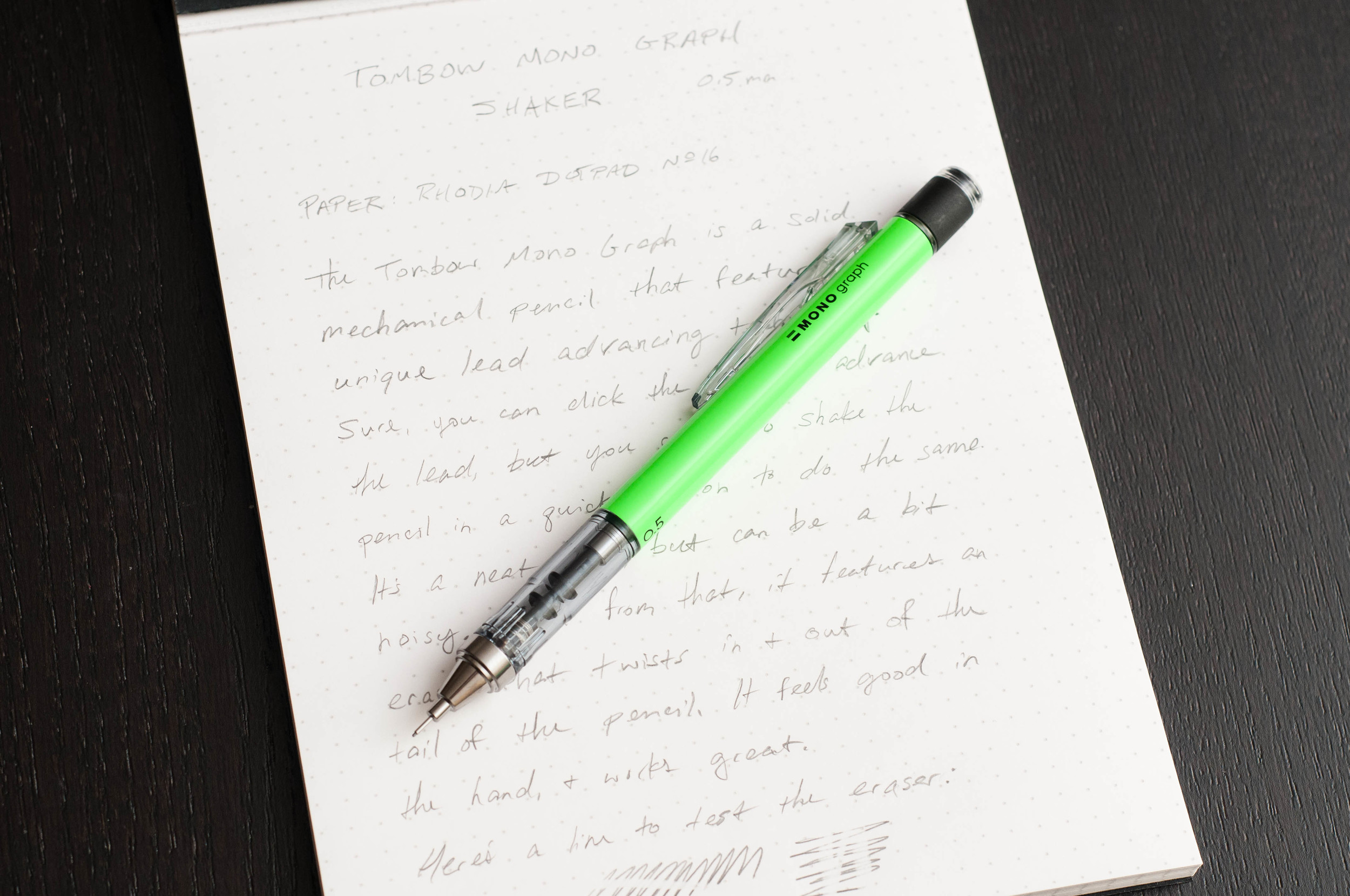
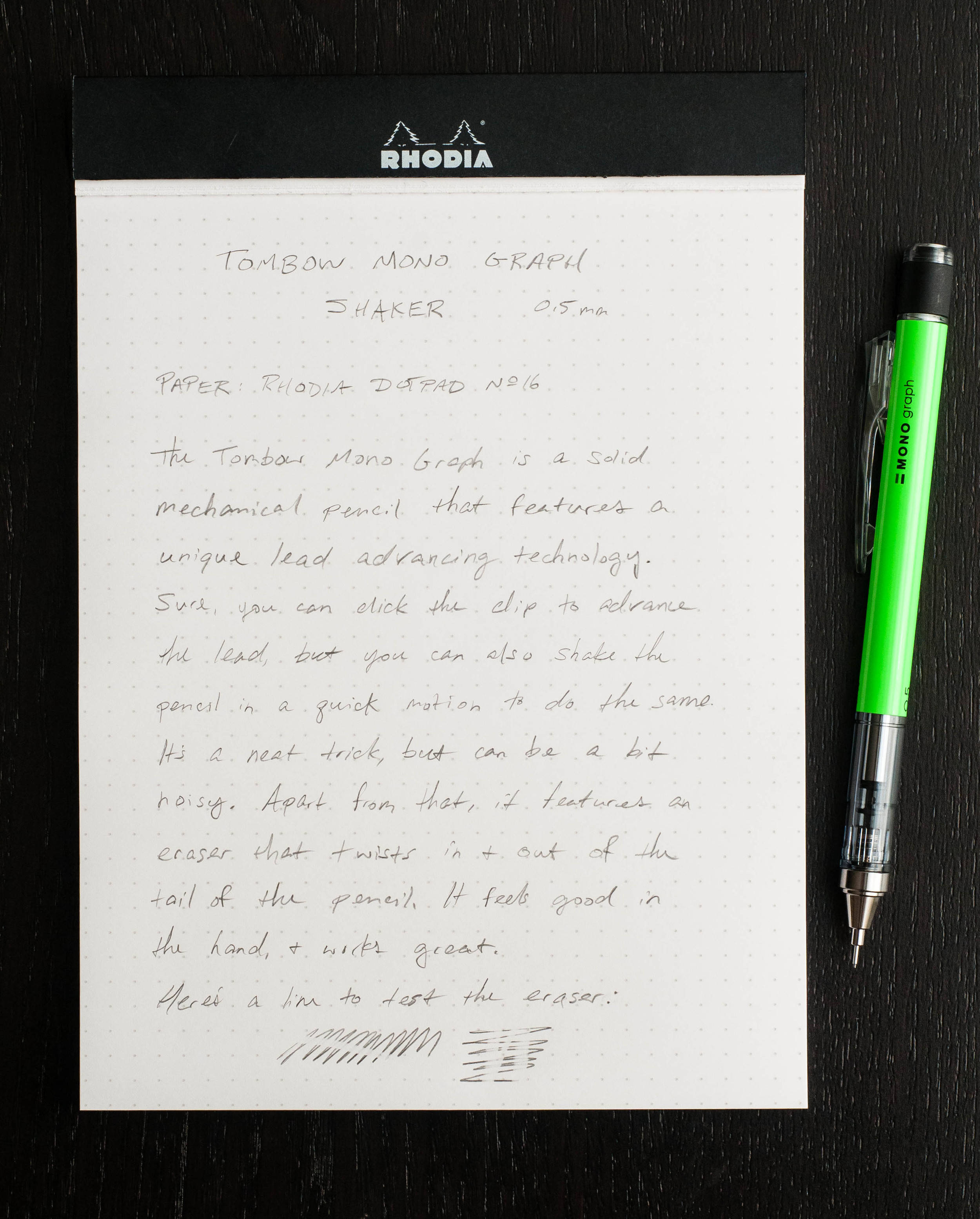
The Tombow Mono Graph Shaker isn't a new player to the mechanical pencil lineup, but the new neon colors certainly are. The colors that you could buy from JetPens before this week were more standard and "non-exciting," but these new colors are far from normal or boring.

The particular color I have, the Neon Green, is especially bright on my desk. I have several orange bags and pens, and this Tombow has no problem standing out.

For those that are new to the Tombow Shaker series, what exactly makes these unique? Well, it has something to do with the name. The Shaker denotes the unique lead advancement method that this pencil employees. Sure, you can still click to advance lead using the pocket clip, but you can also give the pencil a shake or two to bring out more lead. Once you try it, it makes perfect sense, and it works pretty well.
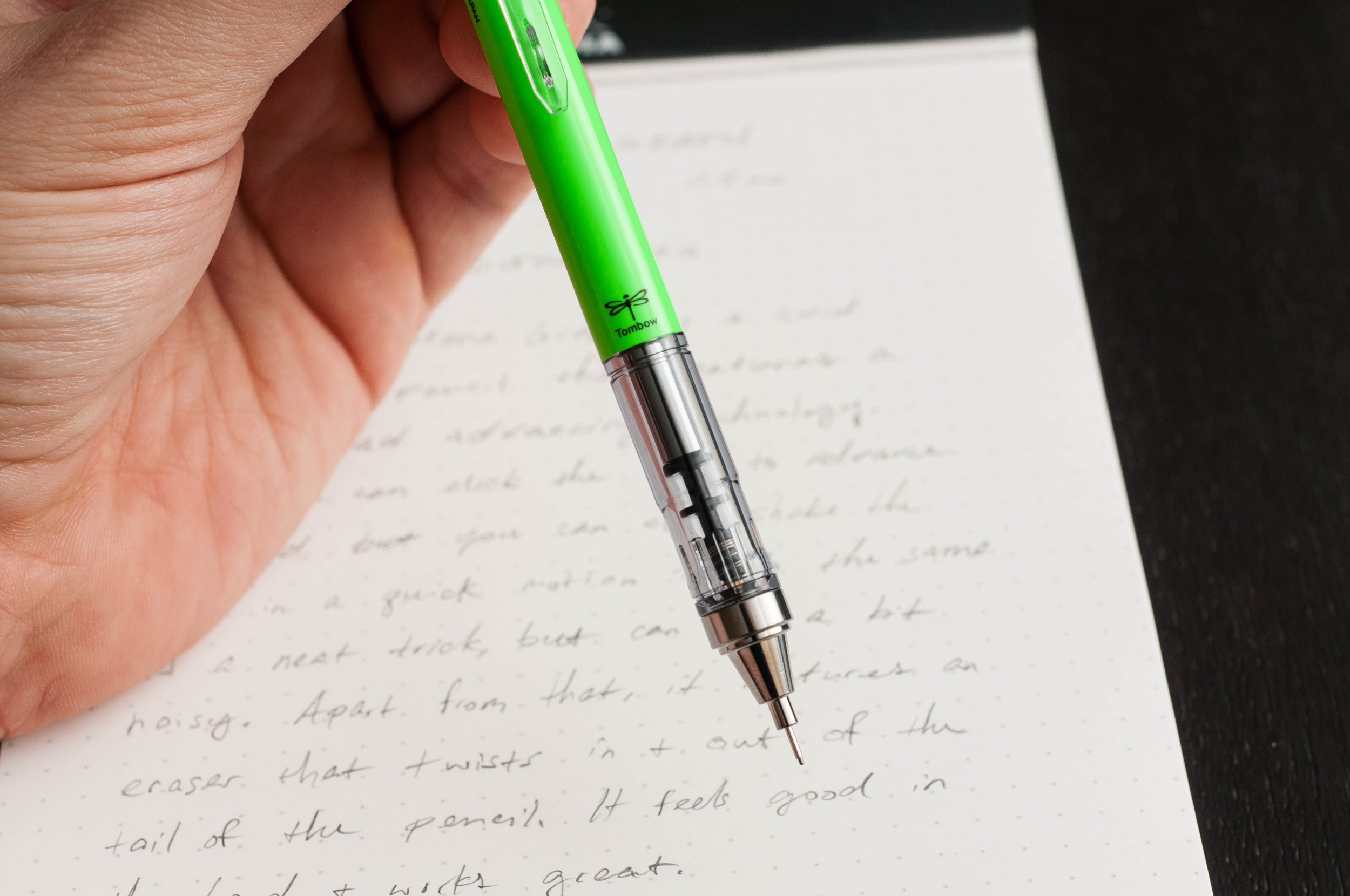
There's a small weight inside the body of the pencil (you can see it through the translucent grip section) that puts enough force on the lead mechanism to generate a "click" when it comes in contact. It's a pretty cool idea, and fun to use in practice. It does't require a violent shake, but just a simple flick of the wrist. Once you’ve done it a couple times, it's pretty easy to casually advance the lead when needed.

As far as unique click mechanisms go, I'be always been a fan of the index finger click button on the pencil grip because it allows you to keep the pencil on the page as you advance the lead. Still, this shaker method allows you to keep your grip on the pencil instead of repositioning so your thumb can click the back end of the pencil. The shaker mechanism adds a bit of fun to the process of keeping your lead going while writing.

Like I mentioned earlier, the pocket clip also acts as a clicker to advance the lead, but if you push the clip up toward the back of the pencil, it locks the shaker mechanism so that it doesn't accidentally advance lead while not in use. It's a very firm position on the clip that isn't likely to come undone accidentally. It takes deliberate action to open the pencil for use again.
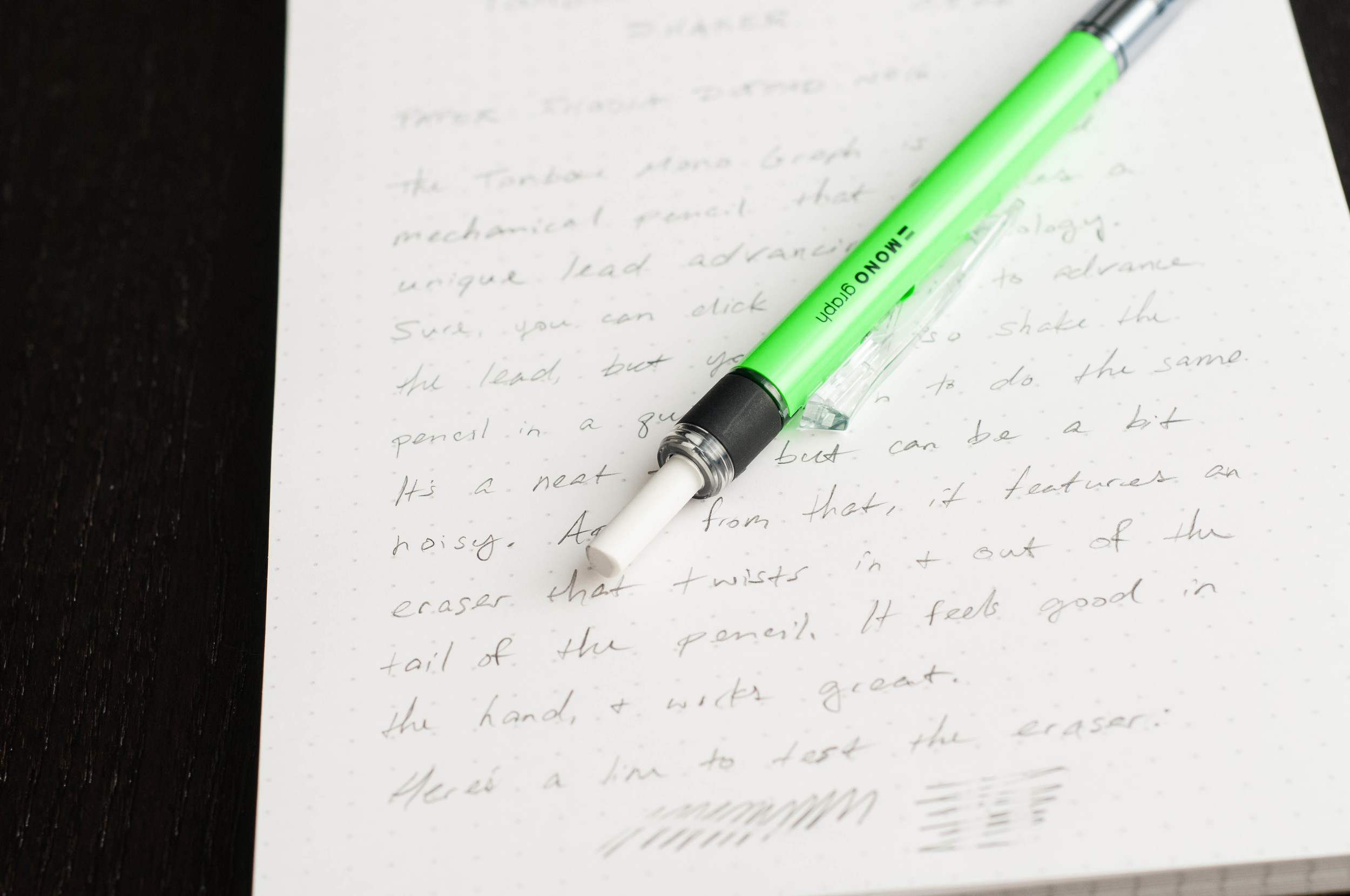
On the end of the pencil, you have a standard twist eraser that does a pretty good job of erasing marks. If you pull the eraser component, it pops off to reveal the lead reservoir. The Shaker I have is the 0.5 mm version that came with standard HB lead.

The grip of the pencil is actually very comfortable. I've enjoyed writing with it so far. Even though it's completely plastic, it doesn't have any issues with slipping or being uncomfortable. Plus, the fact that it's translucent and exposes the pencil workings inside is an added bonus.

The tip of the pencil is a 5 mm long shaft that makes it easy to always see where your lead is on the page or to use a straight-edge without damaging the lead.

All in all, it's a great pencil. There's nothing earth-shatteringly new with this version, but the additional colors are a nice bonus for those of you that want a more exciting array of colors in your pencil collection.

The price is also very agreeable, at just $6.00. As far as "gimmicky" pencils go, this one doesn't break the bank, and it does a great job to boot.
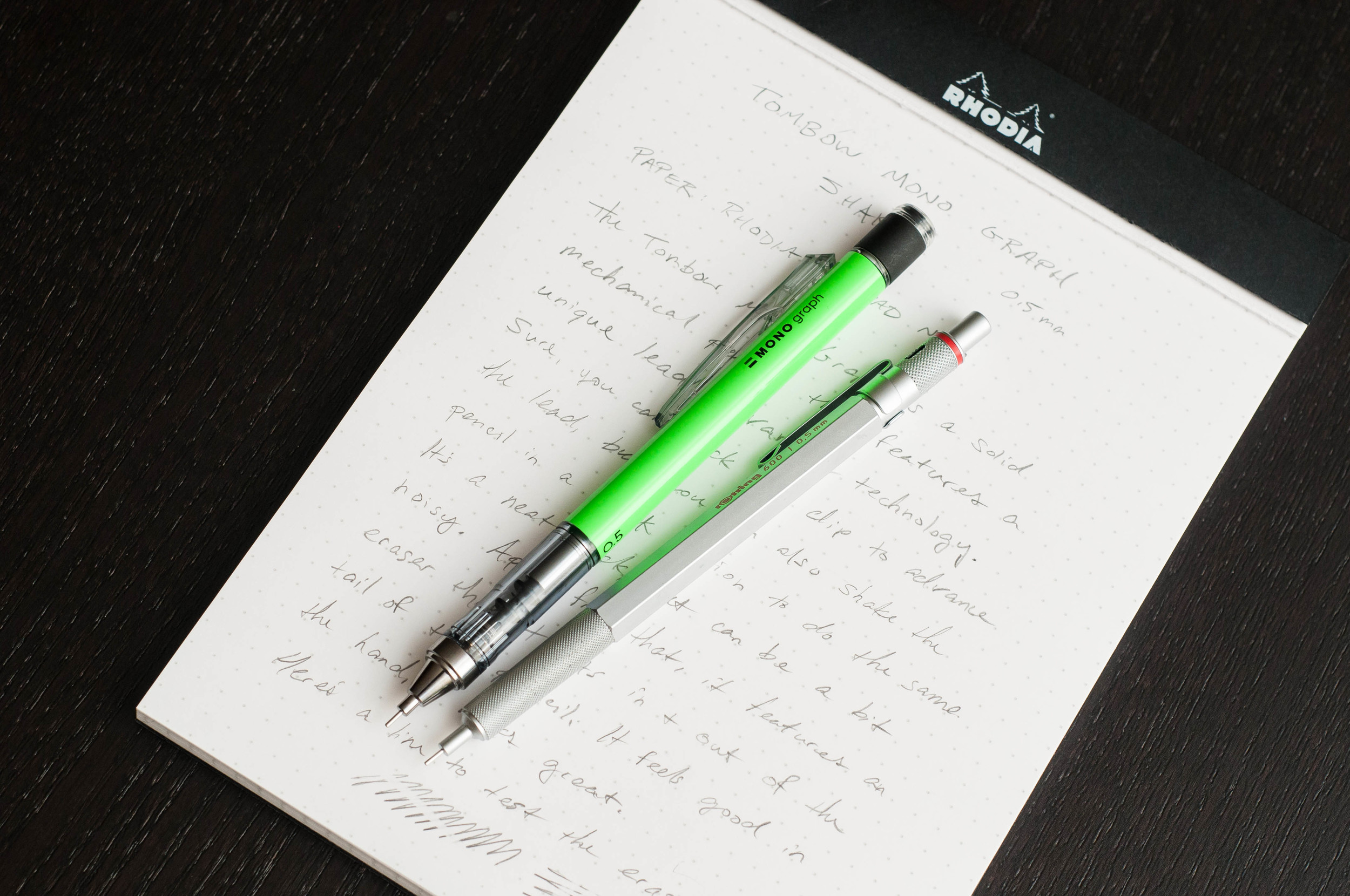
The barrel is a bit on the thick side, but it's still very comfortable for me. I compared the size to a Rotring 600, which I feel is a skinny pencil. There's a nice weight to the Mono Graph, and the balance works well since the shaker weight always sits toward the writing end of the pencil while you're writing (assuming you're not writing upside down).

Overall, the Tombow Mono Graph Shaker is a great pencil with or without the shaker mechanism. It writes well, feels great in the hand, and has a decent eraser. Now, with the additional neon colors, you have more choices in front of you.

(JetPens provided this product at no charge to The Pen Addict for review purposes.)


Enjoy reading The Pen Addict? Then consider becoming a member to receive additional weekly content, giveaways, and discounts in The Pen Addict shop. Plus, you support me and the site directly, which I am very grateful for.

Membership starts at just $5/month, with a discounted annual option available. To find out more about membership click here and join us!
Posted on July 6, 2016 and filed under Tombow, Pencil Reviews, Mechanical Pencil.

Tombow 2558 Pencil Review

I rarely find myself without a wooden pencil within reach these days.

That's quite a change, isn't it? I used to say this about fountain pens too, something along the lines of "I don't get it." Well, I'm starting to get it more and more, and I don't like being without a pencil. I may not use one every day - if fact I don't - but the comfort knowing the sweet smell of cedar is just an arms reach away is comforting.

I'm still in the discovery phase in my pencil addiction. What I have found so far is that I like good point retention and a medium/dark line. I also like nice paint jobs and dipped ends (no erasers) but those things are far down the list compared to the first two items.

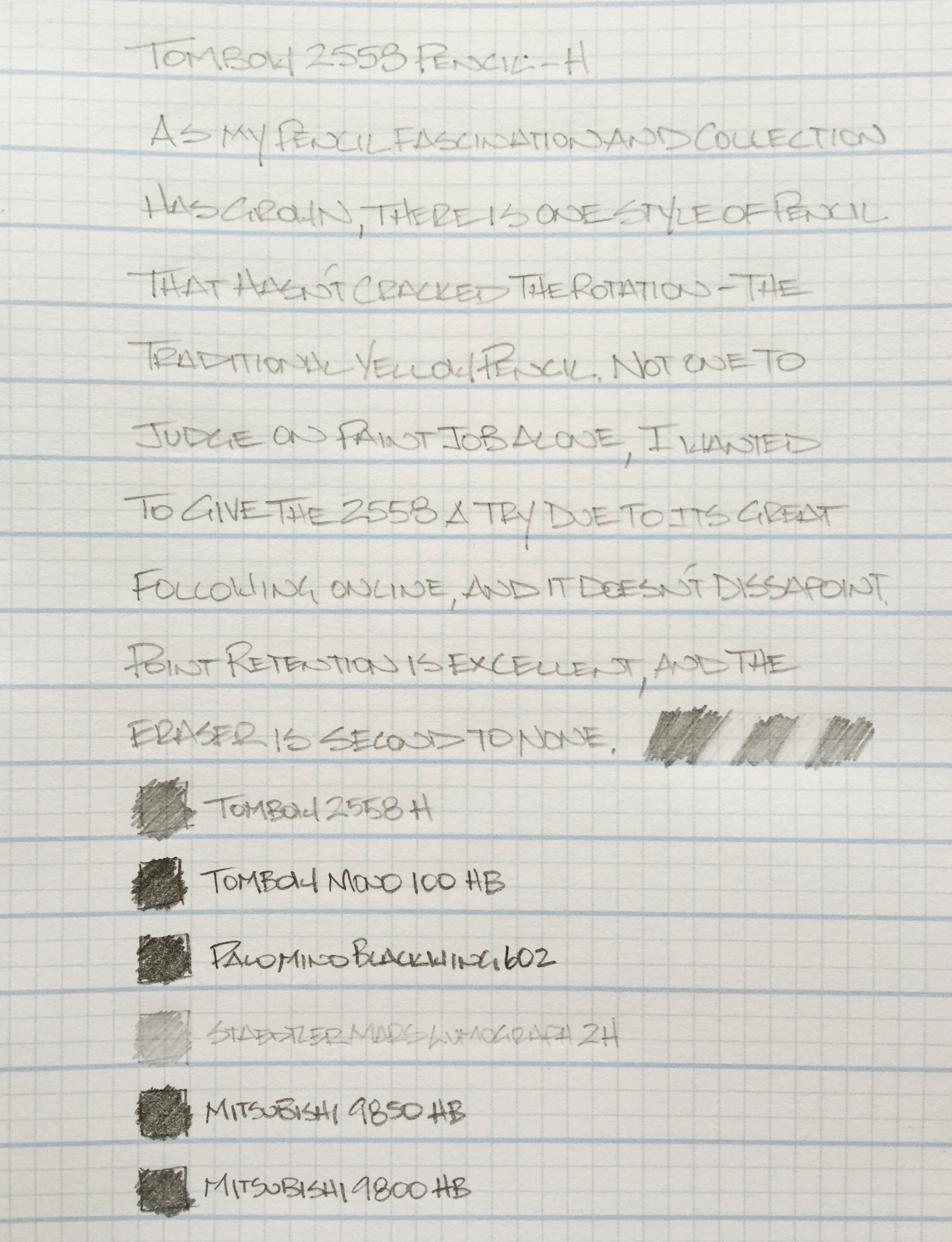
For example, my two favorite pencils right now are the Tombow Mono 100 HB and the Palomino Blackwing 602. The Mono taught me that 1. Pencils can be beautiful, and 2. Point retention is a thing. I could write and write and see only moderate wear in the graphite. Certainly much less than some random #2 pencil from my school days. The Blackwing 602 taught me about smoothness and depth of color. It really leaves an amazing line on the page and is a pleasure to write with.

Taking what I like about those two pencils, I wanted to start climbing up the H side of the hardness scale to find the best point retention in combination with the darkest graphite. The Tombow 2558 H seemed like a nice place to start considering how much I like the Mono 100.

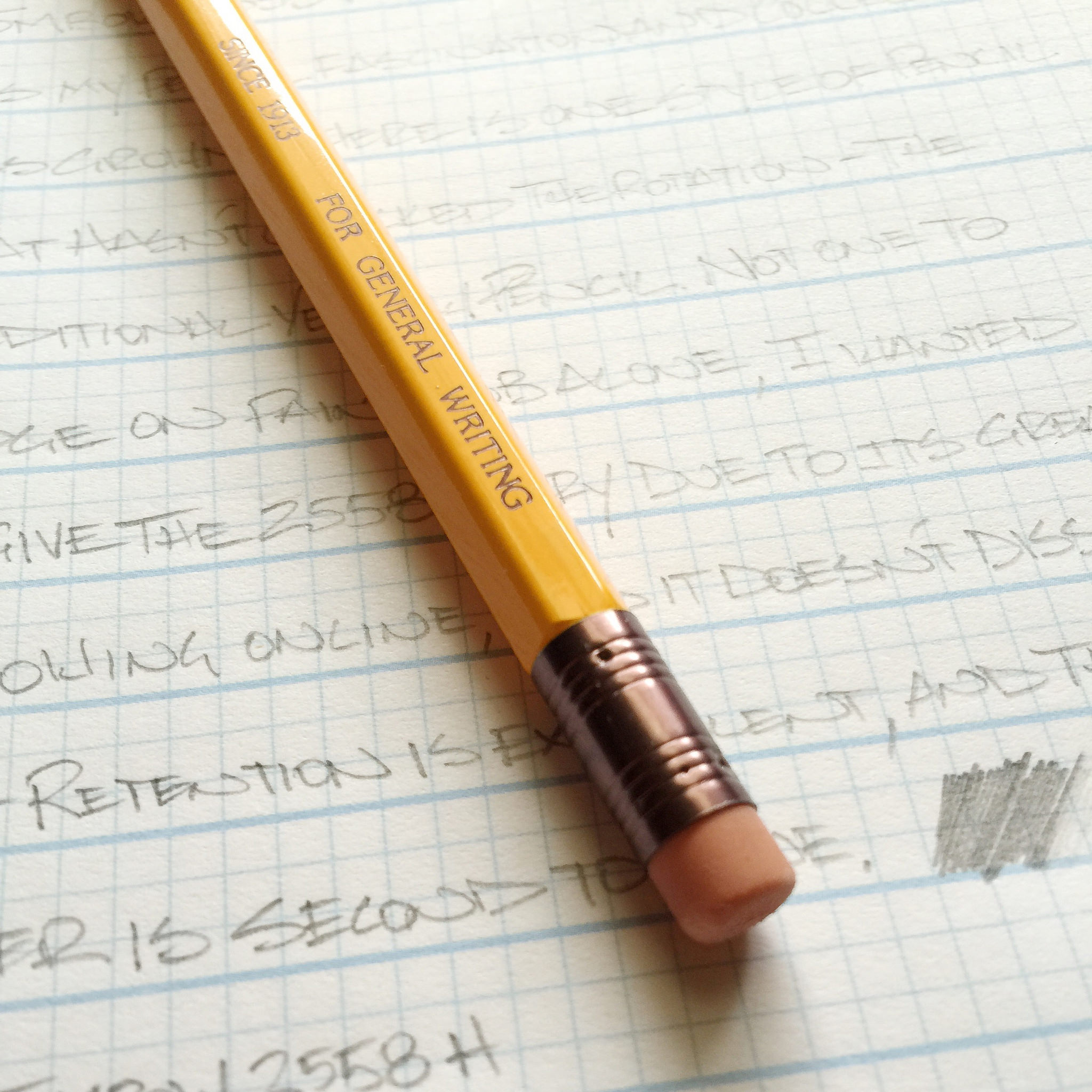
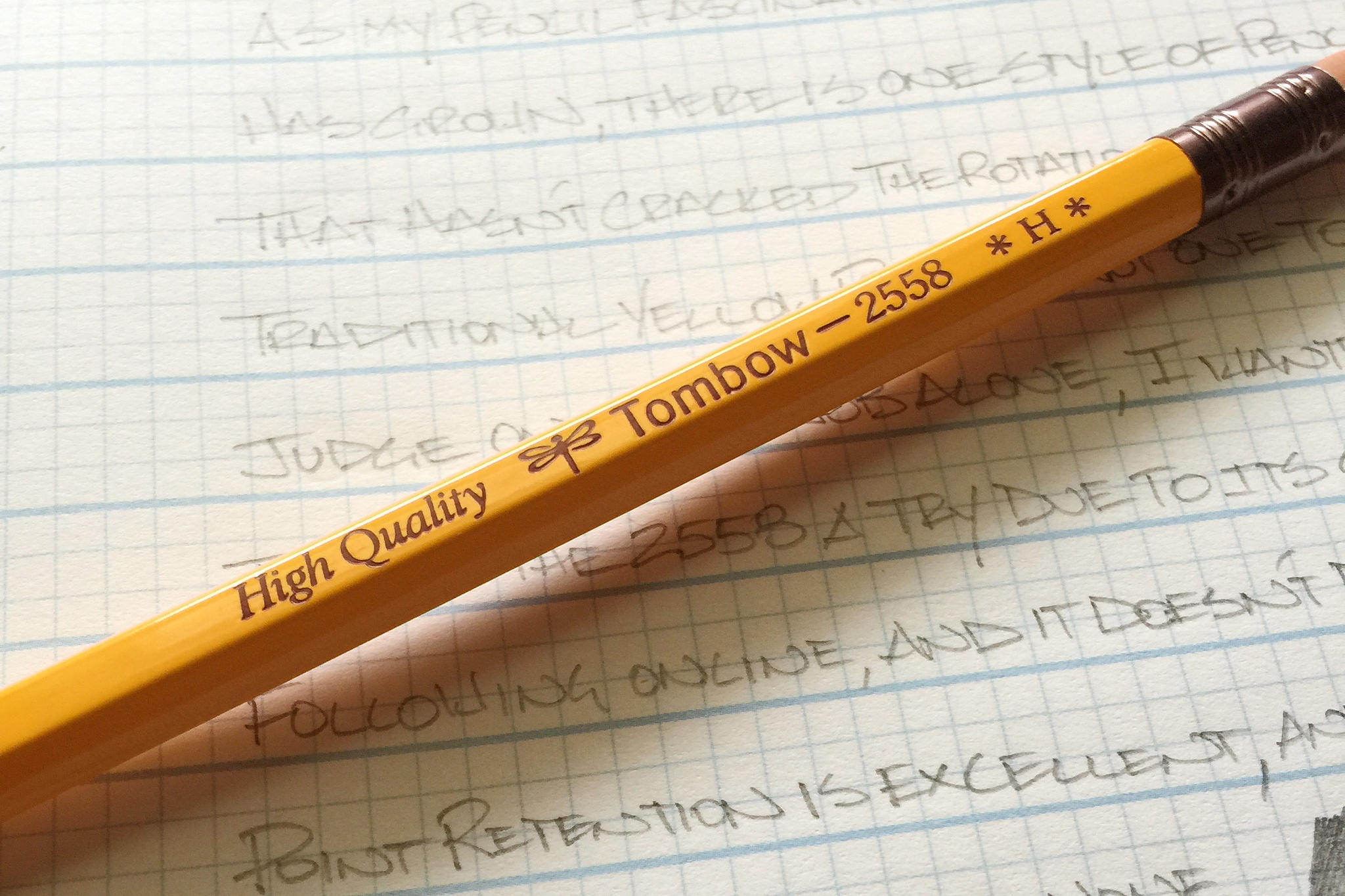
The 2558 is likely the most normal Tombow pencil going. It has that traditional yellow pencil paint job, standard size and shape ferrule, and a pink eraser. Put it in a pile with a bunch of first graders pencils and you may not be able to pick it out easily (although the ferrule has a sweet purple tint.) The looks of the pencil were a bit of a turnoff at first. Why buy something normal looking when their are so many better (for me) choices?

Fortunately, the graphite delivered what I was looking for in performance. It sharpened up well and the point held nicely through several writing sessions. Once you cross the HB middle line, the harder graphite cores are naturally lighter, and although this H is light, it is dark enough for me and how I like to write. I think I could go one to two grades harder in fact, although they are not available in this model.

While I'm not normally an eraser guy, the 2558 eraser is very nice. Probably the best I have used, although my sample size is admittedly small. It doesn't take much action to remove the graphite from the page, and the eraser bits roll up nicely for easy sweeping away.

The Tombow 2558 isn't going to knock off my favorite pencils any time soon, but every time I try something new (like this pencil), I learn more and more what my preferences are. Luckily for me, there are many more pencils to be tried.

(JetPens provided this product at no charge to The Pen Addict for review purposes.)

Tombow 2558 Review.jpg
Posted on September 28, 2015 and filed under Pencil Reviews, Tombow.

An Introduction To The Brush Pen Sampler

(Jeff Abbott is a regular contributor at The Pen Addict. You can find more from Jeff online at Draft Evolution and Twitter.)

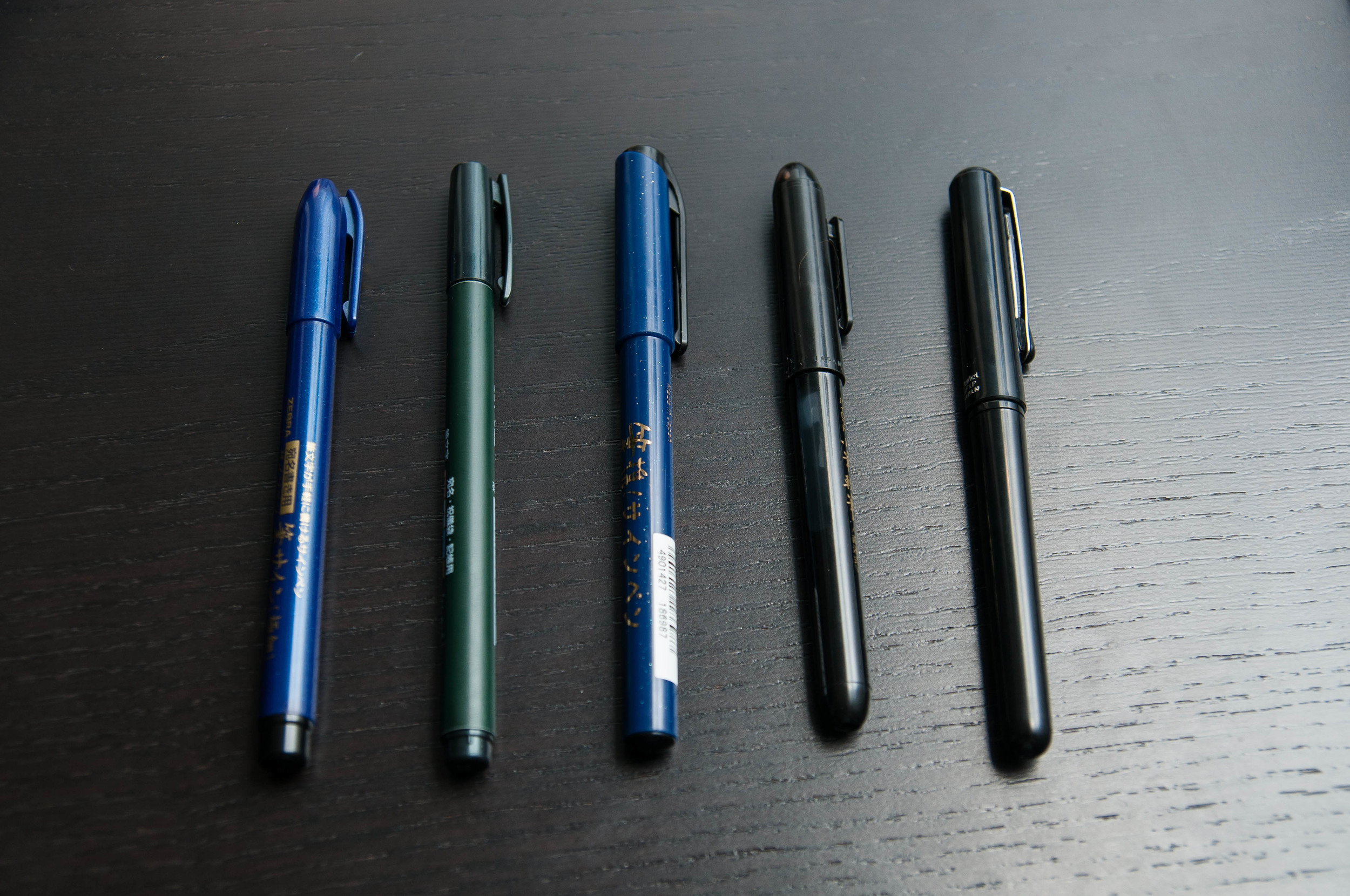
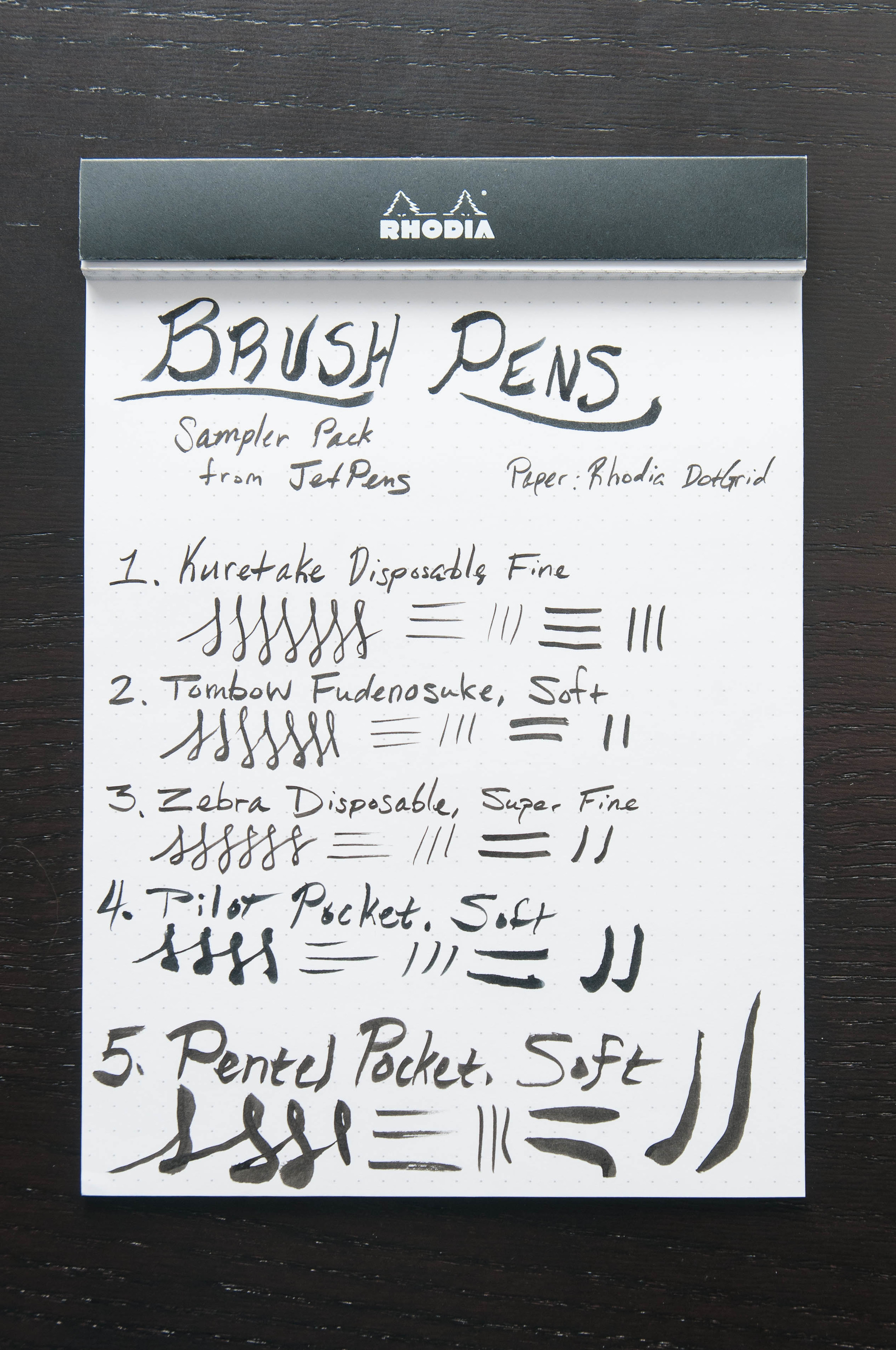
A few months ago, I wrote about my introduction to the brush pen genre with the Pilot Petit3. Shortly after that, JetPens began offering a sampler pack of 5 popular brush pens under the $30 mark. I ordered one right after seeing it, and I've been trying them out since. The main thing I've learned? Not all brush pens are created equal. Each one has a purpose, and as long as you understand that, you'll get along just fine.

The criteria

Recently, JetPens released a fantastic video that explains the different qualities of brush pens and how that affects the writing, drawing, lettering, etc. experience. I'm using the same qualities in my review, so let's have a quick look at what they are:

  • Tip type: This describes what the tip is made out of. This could be natural hair bristles, synthetic bristles, or felt. Depending on the type of material used in the tip, the rest of the characteristics of the pen will vary greatly.
  • Firmness: This can range from soft, medium, and firm. Soft tips will create wider line variation, but require more control and finesse. Firm tips are easier to use, but do not have great line variation.
  • Fineness: This can range from fine, medium, and broad. This refers to the line width the pen produces, similar to your fountain pen nib sizes. Brush pens with a soft firmness can hit all three line widths.
  • Elasticity: You guessed it, this refers to how well the brush tip can hold its original shape after being expanded with additional pressure. Basically, bristle tip pens will maintain the wide shape once you let off, and you'll have to fiddle with it a bit to make it fine again, whereas a felt tip pen will immediately return to its original width when the stroke is complete.
  • Ink flow: Again, if you're familiar with fountain pens, this one will make sense. This refers to how much ink comes out when making marks, similar to how we refer to a nib as "wet" or "dry."
  • Saturation: Another common term with fountain pens. This refers to the coloration of the ink. In the case of a black ink, a saturated ink will create a deep, dark black on the page, whereas a not-so-saturated ink will make a gray or brown shaded black mark.

Now, with that out of the way, let's take a look at these 5 pens.

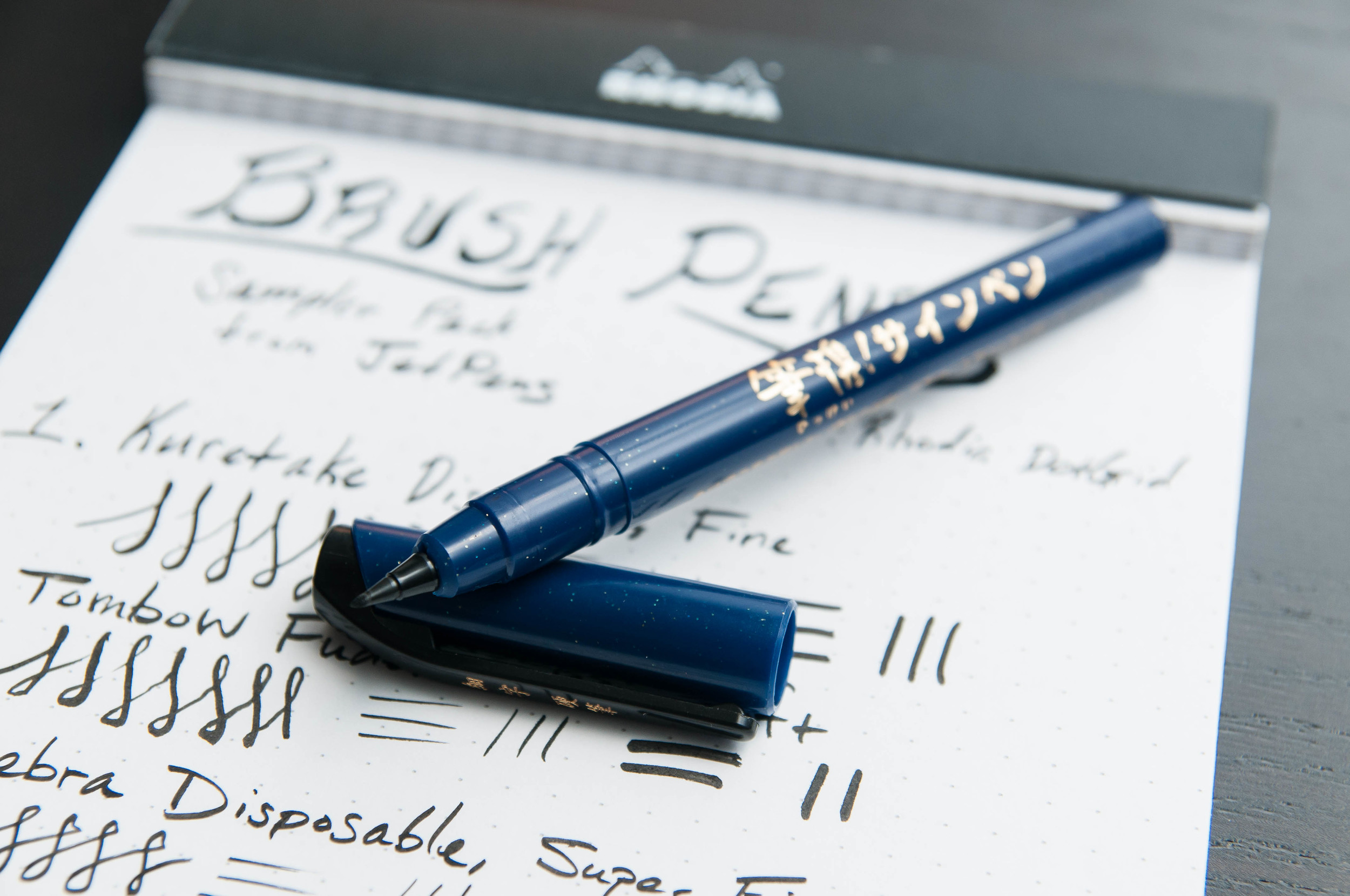
Kuretake Disposable Pocket Brush Pen, Fine

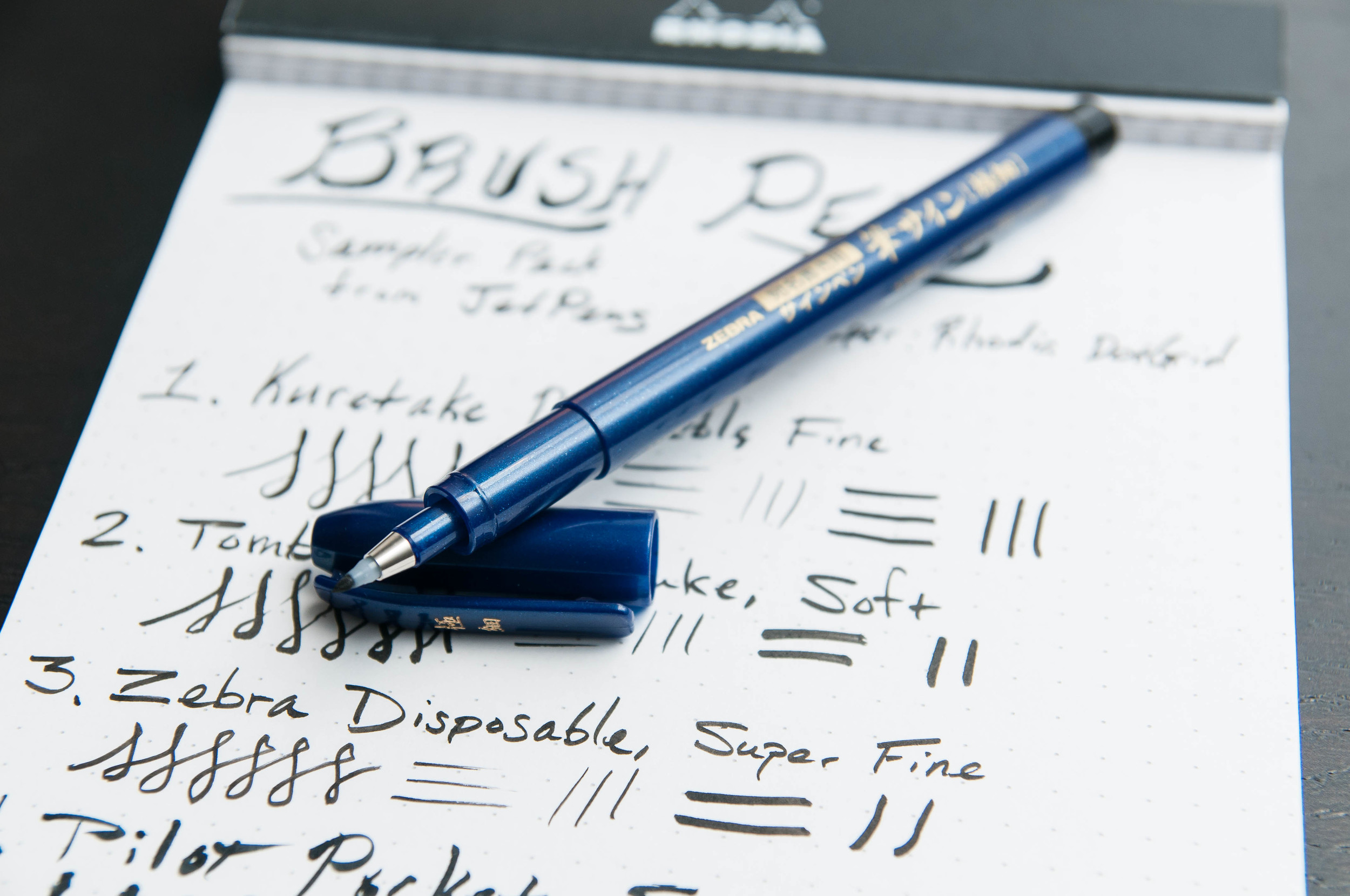
The Kuretake brush pen is a fine felt tip pen that is really easy to use. It's disposable, which means that once the ink dries up, you throw it away. The barrel is a sparkly dark blue color with gold text. The cap sits firmly on the pen when closed.

  • Tip type: Felt.
  • Firmness: I think this pen errs on the side of firm, but you can get some decent variation if you press hard enough.
  • Fineness: Fine
  • Elasticity: The tip returns to its original shape immediately.
  • Ink flow: Very good ink flow, as it requires the slightest pressure to put ink on the page.
  • Saturation: Very dark saturation.

Tombow Fudenosuke Brush Pen, Soft

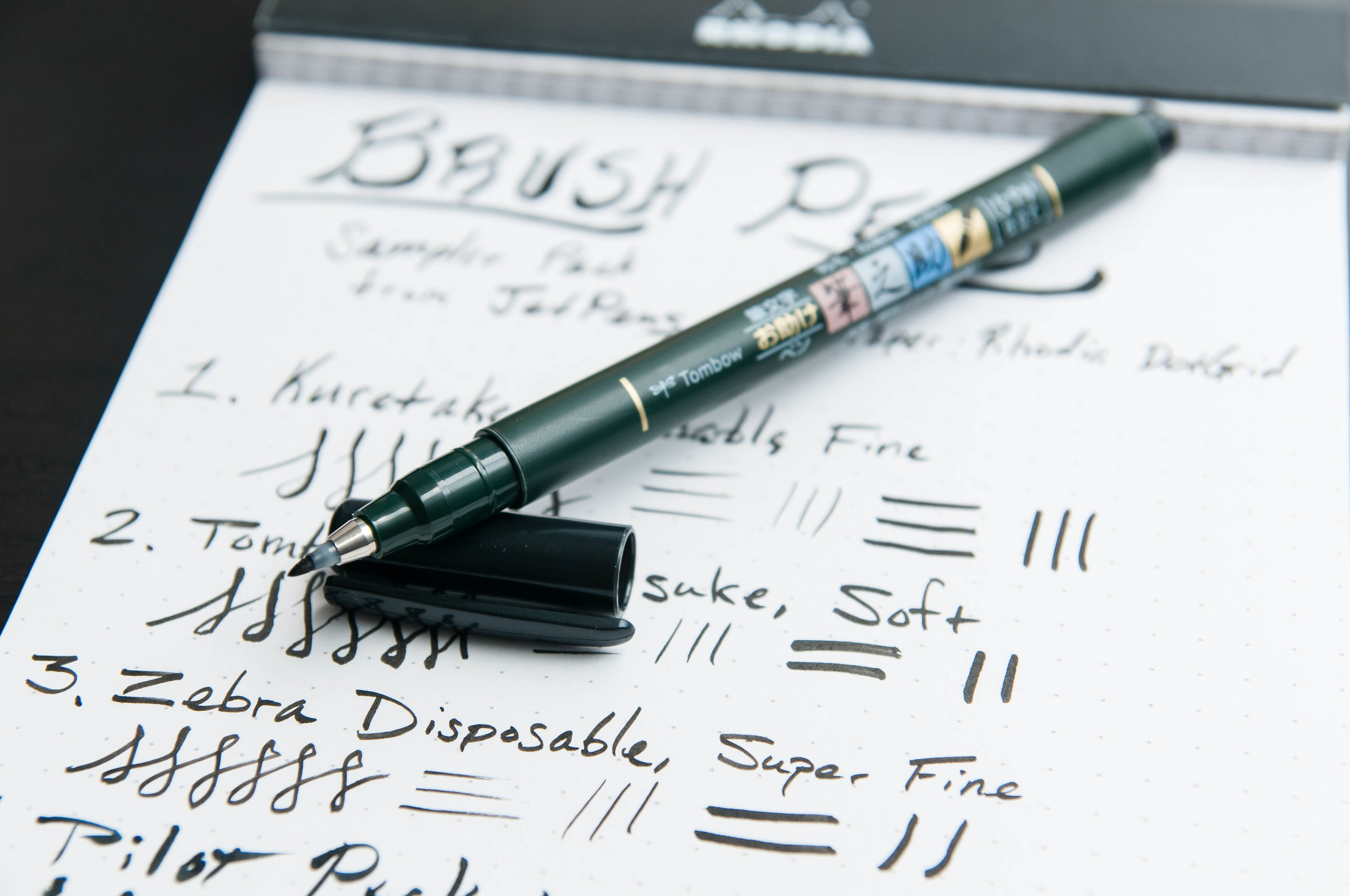
Of the felt tip brush pens in this pack, the Tombow is my favorite. I love how it writes, even if it isn't so pretty on the outside. This pen also comes with a handy little lettering guide, but I honestly haven't found much use for it. The body is a dark gray color with white text and lots of little graphics.

  • Tip type: Felt.
  • Firmness: I'd call this a medium because you can get a bit of line variation fairly easily.
  • Fineness: Fine to medium.
  • Elasticity: The tip returns to its original shape almost immediately.
  • Ink flow: Very good ink flow — requires almost no pressure to make a mark.
  • Saturation: Very dark saturation.

Zebra Disposable Brush Pen, Super Fine

The Zebra, even though its called "super fine," is very similar to the Tombow. You can get a decent amount of line variation, but it doesn't write as well as the Tombow. It's an excellent pen, but just a couple marks behind the Tombow. The body looks very similar to the Kuretake — dark sparkly blue with gold text, so it's very easy to confuse them.

  • Tip type: Felt tip.
  • Firmness: Firm to medium, but not as soft as the Tombow.
  • Fineness: Fine with the ability to reach medium.
  • Elasticity: Returns to original shape very quickly.
  • Ink flow: Very good ink flow, but a tad drier than the previous two.
  • Saturation: Very dark saturation.

Pilot Pocket Brush Pen, Soft

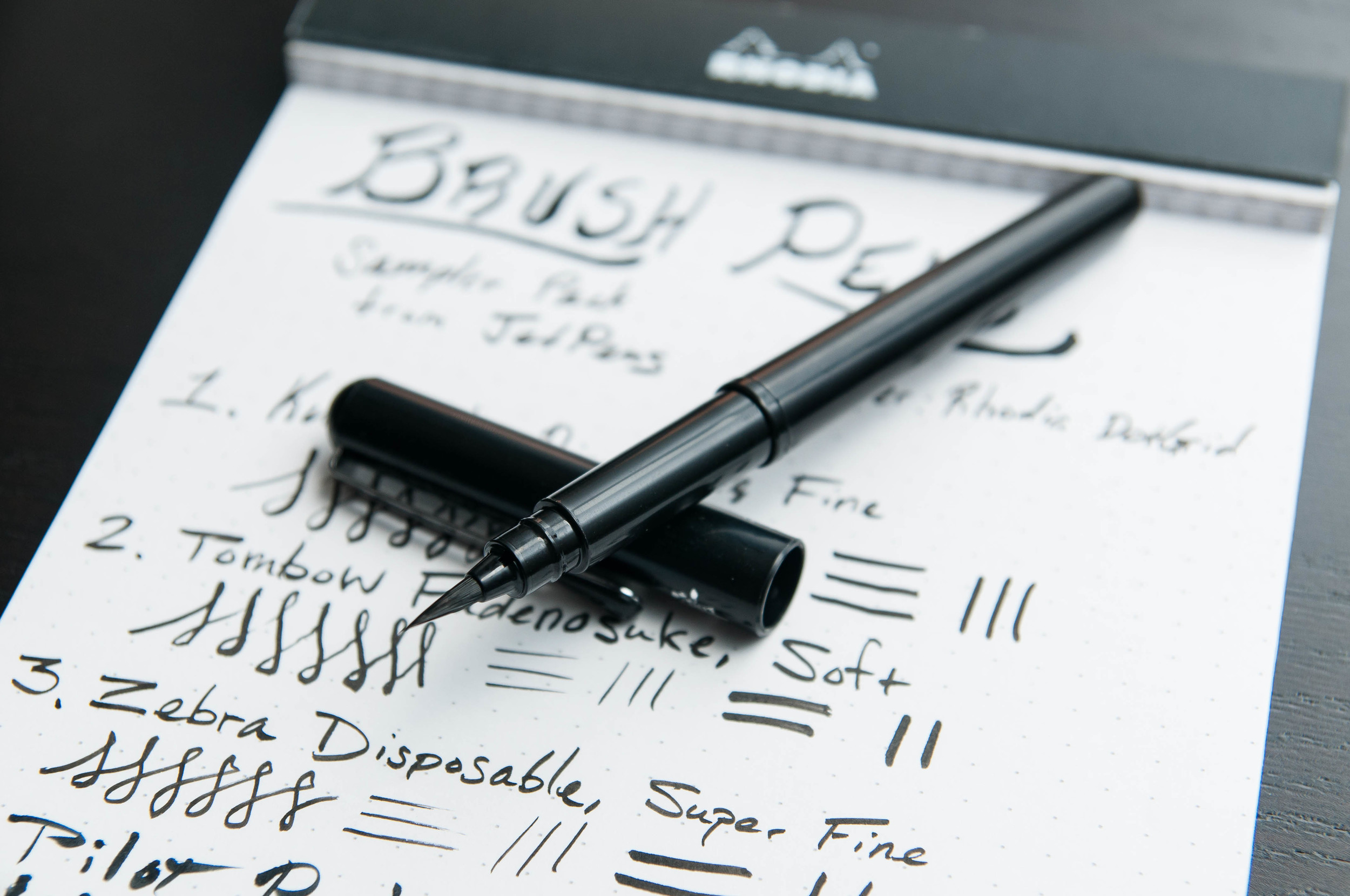
Ah, the Pilot brush pen. Of the broad, "lots of variation" group, this is my favorite. The pen is black with gold Japanese lettering on the body and red lettering on the cap. There isn't a word of English on this pen, so I only know it's the Pilot from a process of elimination.

  • Tip type: Felt.
  • Firmness: Very soft.
  • Fineness: Capable of making fine to broad lines easily.
  • Elasticity: Returns to original shape fairly easily, but might need some help after making broad lines.
  • Ink flow: Exceptional ink flow for such a wide tip.
  • Saturation: Very dark saturation.

Pentel Pocket Brush Pen for Calligraphy

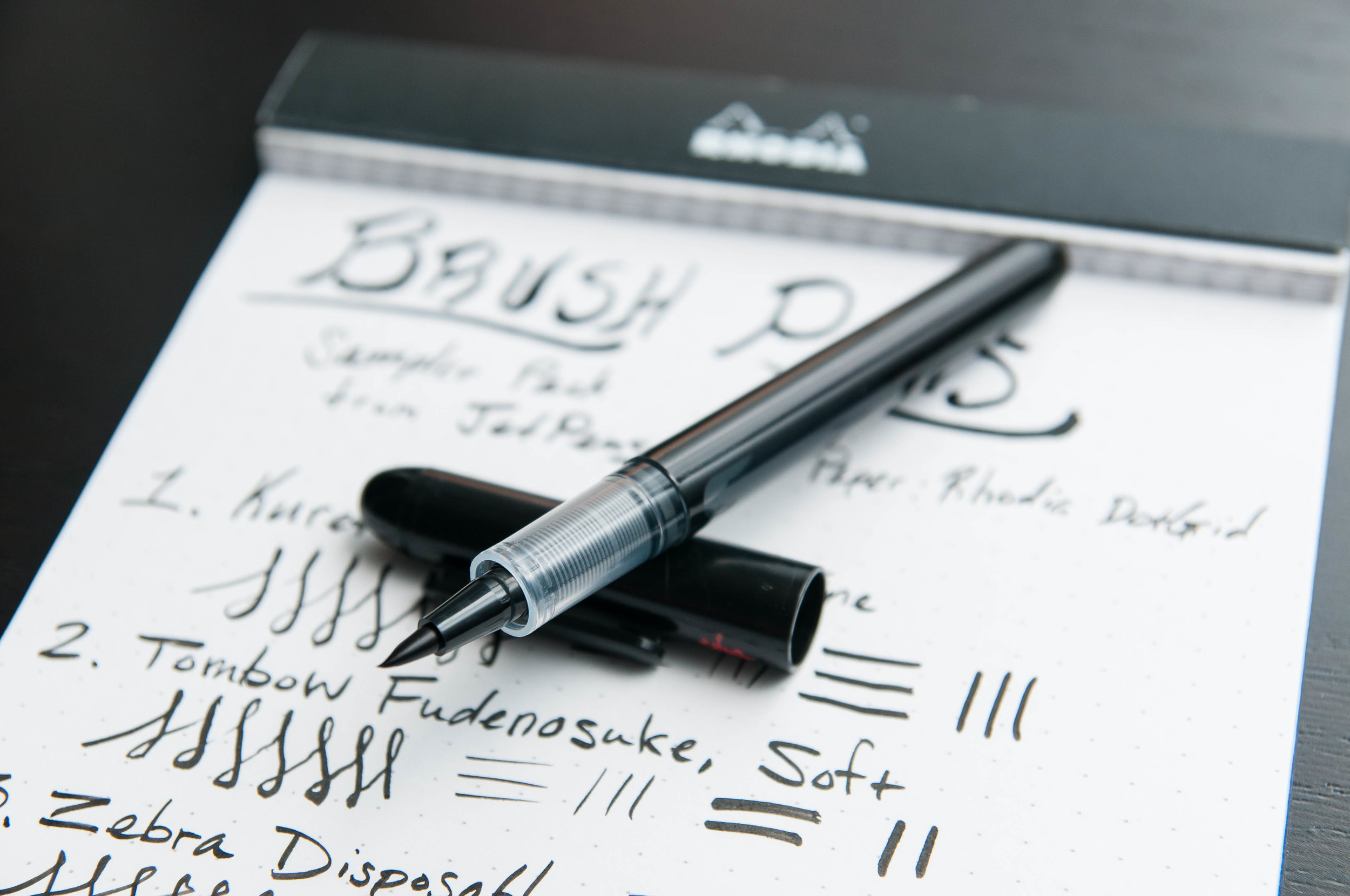
Of the bunch, this is the only bristle tip pen, and it's a hoot to use. This one takes the most practice and patience when using, and it's absolutely not suited for writing. The pen body is black some minimal silver text on the cap. Also, of the bunch, this pen uses an ink cartridge, so you can refill it after its empty.

  • Tip type: Synthetic bristles.
  • Firmness: Soft — very soft.
  • Fineness: Medium to broad. You can get an insane level of variation from this one.
  • Elasticity: Needs help returning to a medium point. It likes to stay pretty broad when making lines.
  • Ink flow: The ink flow is "good enough" for most things, but it's not nearly as good as the other 4.
  • Saturation: The saturation also leaves something to be desired, as the lines can look a bit brown on the page.

Conclusion

All in all, this sampler pack is a great way to break into the brush pen genre. For me, I still feel like I have no idea how to use these properly, but that doesn't mean I don't enjoy the heck out of them. I don't consider myself an artist, but these pens make me want to draw, and for that I'll eternally love them.

If you're curious about brush pens, I highly suggest you start here.

Posted on April 1, 2015 and filed under Tombow, Pentel, Kuretake, Pen Reviews, Pilot, Zebra, Brush Pen.