Sailor Young Profit: A Tale of Quality Control

(Jeff Abbott is a regular contributor at The Pen Addict. You can find more from Jeff online at Draft Evolution and Twitter.)

In a perfect world, every fountain pen would be created equally and would write with flawless beauty from the very beginning. Alas, the world is far from perfect, and not every pen is perfectly tuned out of the box. It's a shame, really. Besides, the problems that new pens have out of the box are normally due to the nib and feed system that's so fascinating in the first place. It's an imperfect system, and errors occur. Luckily, they're usually not very difficult to fix.

But, on the other side of the coin, it's a hassle to ink up a new pen and have it act like a spoiled toddler on the page when first writing with it. Maybe it's just me, but I've had really sour luck with the $50-$100 range lately. The past three pens I've bought from a particular brand have been scratchy, dry, and skippy. Not only until after I did some basic tuning were they really usable. I'm glad that I could tune the pens, and I even enjoy it sometimes, but not when it's a brand new pen.

If Lamy and Kaweco (and many others) can make sub-$50 pens that write beautifully out of the box, I don't understand why others can't do the same with more expensive pens. (Lamy and Kaweco can certainly be guilty of this.) It's the age of mass production that causes the issues, I'm sure. If you buy an Edison pen, it will definitely write flawlessly from day 1, but that's because it's been hand-tuned before it's shipped out. It's unique and hand-made with care. Same goes for a Nakaya and other premium brands. Once you start mass producing something, the law of diminishing returns steps in and dictates that "good enough" quality control is a fair trade-off for selling in bulk. So it goes.

Why the rant? Well, because Sailor.

I really want to love the brand. They make some beautiful pens. My first fountain pen was a Sailor High Ace Neo, and luckily it wrote like a champ from the beginning.

Since then, I've purchased three other Sailors: the Lecoule, a Fasciner, and now a Young Profit.

Each of these pens have been imperfect writers from the beginning. In each case, the tines are too close together and/or angled poorly. Some tine adjustments and nib smoothing is all that's needed, but I think that shouldn't be a requirement for a new pen. Imagine if someone new to fountain pens purchased their first pen and had that experience! The Bic Crystal would look pretty good after that, thanks to modern engineering, etc.

They all write great now, but they still carry that bad first impression around.

The point in all this is simple. I'm just not sure that it's worth spending more than $50 or $60 on a fountain pen. In my experience, the pens that cost double that still have the same quality control issues. Only when you jump up to the next notch can you expect (mostly) to avoid the QC issues in the intro level. But $150+ purchases are more rare because of the cost barrier. With hard-hitting players like the Pilot Metropolitan, Lamy Safari, and Kaweco Sport lines, it's hard to recommend something more expensive (apart from TWSBI because they're awesome).

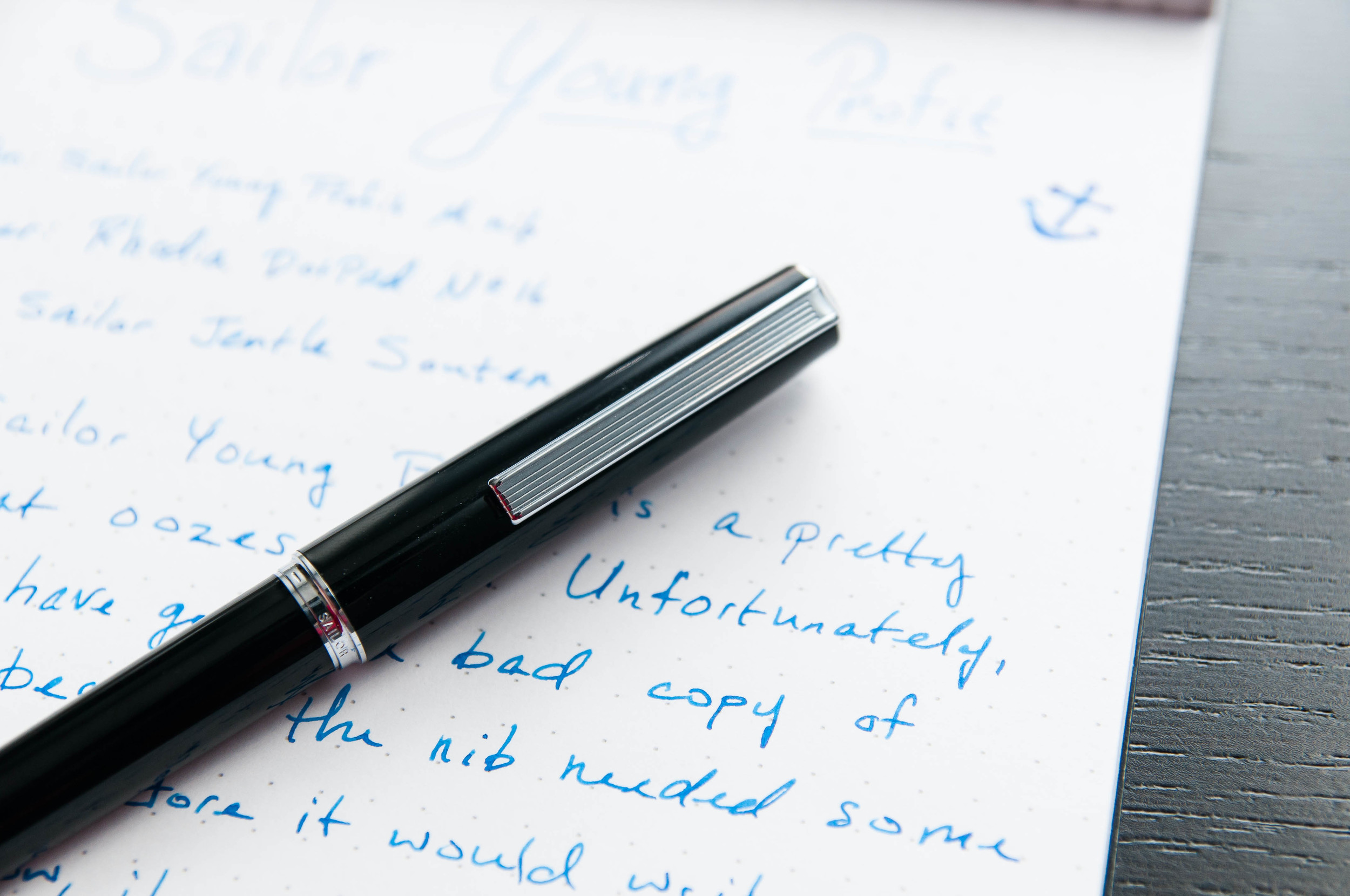
Back to the Sailor Young Profit. It's actually a pretty nice pen once you get past the flaky nib! Let's take a closer look at the outside.

I grabbed a black/silver version when they first appeared at JetPens because I wasn't a fan of the gold furniture. I went with a medium nib this time — based on past experience, Sailor runs small and I wanted to try something with more line width. The medium is a great size for me. It's comparable to a German fine nib (even on the small side of fine).

The body is plastic, which is something I don't like. I have other plastic body pens that cost about the same, but the Young Profit feels a bit cheaper than those. It doesn't feel brittle, but just doesn't have a quality feel, and let's face it: how expensive a pen feels in your hand is an important aspect that speaks to the quality.

The body is fairly slim and can actually get a tad uncomfortable for me when writing for long stretches. The grip section is plastic as well and there's a small ridge at the very end of the grip where it meets the feed. None of the grip features get in the way of my grip, but we're all unique.

The nib looks very classy and has some beautiful etching that's in line with the Sailor brand. The internal parts of the pen are solid and make me feel better about the overall quality of the parts that went into the pen.

It's a pretty pen that oozes class.
As for writing, I'll describe how it writes after the tuning. Before the tuning, it was dry, skippy, and scratchy.

The nib is extremely smooth and glides across the paper. Like I said earlier, the line width is similar to a small German fine nib. The ink flow is a tad dry for my tastes, but it works just fine and can keep up with swift strokes.

There's not much feedback in the nib, even on rough paper like the Baron Fig notebook. Paper like Mnemosyne or Tomoe River feels like velvet on glass. It's really nice.

The nib behaves very well and is a pleasure to write with. The only problem I've had so far is the slim width of the grip — makes it uncomfortable after 10 minutes of use.

Not exactly your average review, but I doubt my experiences with these nibs are isolated. I'm also not sure what to do about the situation except to vote with your money. For me, fountain pens are part hobby and part utility. Sometimes you try things you don't like, but you always have your faithful tools that always get the job done and manage to bring delight to menial tasks like writing lists and thank you notes.

As for the Young Profit, I can't recommend it purely because of the lack of value it offers compared to cheaper pens on the market. The High Ace Neo is a fantastic pen that packs a ton of value. In the Young Profit's case, the price doesn't justify the means.

(JetPens provided this product at no charge to The Pen Addict for review purposes.)

Posted on February 11, 2015 and filed under Fountain Pens, Sailor, Pen Reviews.

The Pen Addict Podcast: Episode 141 - Shiny Happy People

I broke out the feels in this one, as I grappled with handling the negativity around two recent, and vastly different, pen launches. These things need to be discussed, but I can't let them take up too many brain cycles, lest I go insane. We then jumped into the fun stuff, including a Bigfoot sighting and Myke's pen buying rut.

Show Notes & Download Links

This episode of The Pen Addict is sponsored by:

Hoban Cards: Affordable, beautiful custom letterpress printed calling cards. Use code 'WASHBURNE' for free worldwide shipping.

Hover: Simplified Domain Management. Use code 'ATLANTA' for 10% off your first purchase.

© 2005 WMG Shiny Happy People (Video)

The amazingly awful "Shiny Happy People" by the otherwise awesome R.E.M. Featuring Mykeal Hurley-Stipe on vocals, me as the lovely Kate Pierson, and a special appearance by Jeff Bruckwicki on mandolin.

Posted on February 10, 2015 and filed under Podcast.

United P2 Pocket Pen Review

United P2.jpg

Dylan Polseno reached out to me a month or so ago wanting some feedback on a new pen design he was working on. I liked what I heard from Dylan, and the pictures he provided were interesting, so I agreed to take a look at what now has turned into the United P2 Pocket Pen on Kickstarter.

I used the P2 on and off for a couple of weeks, then went back to Dylan with my thoughts. Since I was using a prototype and the final product saw some changes from what I was using, I thought it would be interesting to see the actual email discussion Dylan and I had around the design. I asked Dylan for his permission to share this behind the scenes conversation and he agreed. Here is my original feedback:

Finally getting to this Dylan! I need to carry it more, which I will start doing tonight. My initial thoughts:

  1. The size is good, but it is borderline too small to write with comfortably. Adding the bulge in the barrel to help with the grip is fine, but that pushes my grip higher up the pen and with the cap posted it barely reaches the cusp of my hand to rest on. I have average hands, so those with bigger hands may find it uncomfortable.

  2. The friction fit on the posting is much more solid that on the cap. The cap feels a little loose. I know the tolerances are tight here, I just wonder if it will slip off.

  3. The post in the rear of the pen sticks out farther than the end of the barrel. The first thing I did when I got the pen was uncap it and stand it up on the end of the pen and it fell right over. The appearances of it visually tell me I should be able to do that if needed so I can set the pen down without it rolling away.

  4. I love the D1 refill option - it's just plug and play.

  5. I think you are going to get some pricing friction at $65. I personally understand why it costs what it does and I'm fine with that, but I wonder what other potential customers will think. You are going to have to answer the "why shouldn't I buy a Fisher Space Pen for $20 instead of this" a lot, because people will use this pen in the same way and won't understand the differences.

Let me know what questions or comments you have for me and I'll get back to you again after I pocket it for a while.

Thanks, Brad

(If you want the non copy/pasted version you can find it here. This post is image heavy enough as-is.)

To summarize my thoughts: I love the barrel construction. The aluminum stock with black hard-coating looks and feels great. The stainless steel cap provides wonderful contrast, and the tolerances are very tight. I felt there was a difference in fit between the front and back of the pen, with the cap on the front feeling a hair looser. I'm concerned with the posted writing length of the pen, as it falls just short of what I feel is comfortable for a portable pocket pen. The post on the rear of the pen sticks out too far, but that is easily corrected. Love the choice of D1 refill.

Dylan responded the same day:

Hi Brad,

In regards to your comments:

  1. I kept going back and forth upon which side to have the refill come out, as in I could have had the bulge as the grip or the inverted bulge as the grip. I chose the inverted bulge due to the small size of the pen, ideally your pointer finger rests within the inverted bulge aiding in grip. I most likely will enlarge the pen overall by about 25%.

  2. I haven’t seen any loose issues between the body and cap. My test for that was to hold onto the body and whip the pen, if it doesn’t fall off then, it shouldn’t during normal use. The choice to design it this way was for one reason: I wanted to remove any steps that most pens have accounting for a cap/ any outer threads. I wanted to make this the cleanest pen possible and this was the only way to accomplish that in my opinion.

  3. This will also be addressed on the production version, the little stainless cap on the back was a late addition. I’ll end up making that cap even with the body so it will stand on end.

  4. It’s critically important for the pen to be expandable to a person’s likes so the D1 was a no brainer.

  5. The price for me has been a tough decision. I’m definitely going after a higher end, lower volume market. I’ve seen incredibly basic pens do well selling on Kickstarter for $40, so it was only logical for me to go above that. Also these will be offered below $65 on the Kickstarter campaign (I haven’t decided exactly what the price levels will be yet). After that the price will float between $55-65.

In the end, this pens intention is for those that want something new, truly new. It breaks free of old pen designs and will be manufactured with extensive detail. The form has to match the function for me to be pleased with it. I honestly don’t think many people will realize/ appreciate the machining feat that is this pen but I hope that some do.

Regards,

Dylan Polseno

(Original image here)

This is awesome feedback from Dylan. Open and transparent, answering all the points I brought up and discussing what changes he might make in the upcoming launch. He got feedback from others too, including Elizabeth at No Pen Intended. From the time of our discussion to the Kickstarter launch, here is what changed:

Improvements for the Production Run:

After living with our pen for a couple of months and hearing outside opinions we will be making the following improvements to the pen:

The length of the body will be increased 1/4" and the overall diameter will increase .060" (Updated 2/8/14) Smaller hole in the cap. A smaller hole will be drilled in the cap making it more difficult for something to physically get into the cap. Making the press fit cap in the rear of the pen even with the pen body so it can stand on end. The current prototype version features a cap that protrudes past the pen body, this will be addressed. Better body contour machining for a perfect blend of the radii.

Making your own product is hard. Finalizing design decisions is tough. Making everyone happy is impossible. Showing an openness to change while staying true to your design ideals all while being transparent is impressive. I hope you enjoyed this look inside my inbox.

My thanks to Dylan for sending this prototype at no charge for me to review. Be sure to check out the United P2 Pocket Pen on Kickstarter, which I have happily backed.

Posted on February 9, 2015 and filed under Kickstarter, United P2.