
(Ron Gilmour is a fountain pen enthusiast, would-be calligrapher, and librarian. You can find him online at Twitter @gilmour70 and Instagram.)
If there is a Lamy Safari of the vintage fountain pen world, it would probably be the Esterbrook J. Like the Safari, it's inexpensive, comes in a variety of attractive colors, and has easily swappable nibs.
The pen's name comes from the shape of the internal piece that depresses the ink sac when the lever is moved. There are three size variants of the J: the classic J (the largest), the LJ (a bit thinner), and the SJ (both thinner and shorter). You'll also sometimes see models referred to as "transitional," which are basically like the J, but with a slightly different shape and no jewel at the back end of the pen barrel.
(Vocabulary note: "Jewel" refers to ornamental bits at the top of caps or the back end of the pen barrel. They are often strikingly un-jewel-like, as in the Esterbrook J, where they are discs of black plastic.)
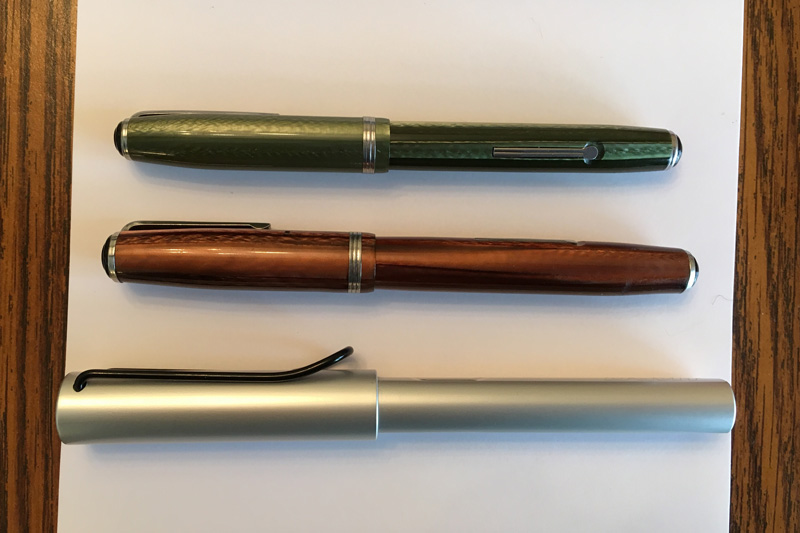
This may be a good opportunity to mention something about sizes in vintage pens: they may be smaller than what you're used to. While there were oversize pens produced in Days of Yore, these were less common and so will be more expensive now. Many vintage pens fall in the size range of the Pelikan M2xx/4xx models, which is about the size of the Esterbrook J. If you're used to the larger end of the modern pen spectrum, you may be surprised by the small size and light weight of Esterbrooks and many other vintage pens.
The design of the pen is basic, maybe a little bland, but the celluloid of which they are made is beautiful. The black model looks like most black pens, but the colored ones are amazingly complex, exhibiting depth, vibrancy, texture to rival many far more expensive modern pens. The colors vary a lot. Saying that you have a green Esty isn't saying much: depending on factors either intrinsic to the original manufacture or the storage conditions in which the pen was kept, the greens can vary from sage to pale mint to olive. And the patterning of the material can vary, even on the same pen, from a smooth streakiness to a pronounced rippled appearance sometimes called "snakeskin."

Buying an Esterbrook
These may be the most plentiful vintage pens out there, so you shouldn't have any trouble finding one. Keep an eye on the classified sections of fountain pen websites. If you get impatient, you might even try your luck on an online auction site--just remember to buy from actual pen dealers.
The main thing you'll want to be clear about with a purchase is the condition of the sac. Assuming you're not looking to get into pen repair as a hobby, you'll want a pen in which the sac has been recently replaced, ideally by the person who is selling you the pen. Ink sacs break down and you don't want to find that your new-to-you Esty is full of crunchy bits of ossified sac material and dried ink.

Filling Your Esterbrook
The Esterbrook J and its relatives are lever fillers. There's a little lever on the outside of the pen body. When you open the lever, the "J bar" inside the pen squeezes the sac and air is forced out through the nib. When you return the lever to its flush position, the ink sac is released and re-inflates, drawing in ink.
All you need to do is stick the nib in a bottle of ink, making sure that the entire nib is submerged. Open the lever (you should see or hear bubbling as air is forced out). Now close the lever, leaving the pen in place for a few seconds to allow time for the ink to be drawn up. Repeat this process to get a more complete fill. Wipe off the nib and grip section with a paper towel and you're ready to write.

Cleaning your Esterbrook
Thanks to the removable nib units, Esterbrooks are easier to clean than many other sac-filling pens. If you're a patient person, you can submerge the nib in water and pump the lever gently until the water comes out clean. If you're more thorough or less patient, you can remove the nib unit and rinse out the inside of the sac directly. You might try using a blunt syringe to shoot water into the sac, but, of course, don't poke the sac.
About Those Nibs
You know how you might go into a coffee shop and order something like a full-fat, half-caf, hazelnut latte with an extra shot of vanilla? (Not my thing, but I've seen people do this.) Customization is fun! You're not just ordering a generic cup of Joe--you're ordering this highly specialized drink that you experience as uniquely yours.
Esterbrook figured out this customization thing long before Starbucks. Their interchangeable "Re-New Point" nibs come in dozens of varieties, tailored to specific purposes. They even offered nibs specifically for use with the Gregg shorthand system of writing. The nibs are all steel, but for the most part are of high quality. I've heard of duds, but since new ones are so readily available, even if you have the bad luck of getting an Esty with a bum nib, you can replace it fairly cheaply.

The nib types are designated by four digit numbers. There are patterns to these codes, but I've never bothered to learn them. Just look them up on a chart like this one. The common nib types, like the 2556 "firm fine" on my copper J, are often available for under $10 US, while more exotic nib types like flex and stub nibs can be more expensive.
The nibs work a lot like those on modern Pelikan pens. The nibs and feeds are assembled into units, so you can just screw out the whole nib/feed assembly and screw in a new one. As you do this, grip the nib firmly near the base to avoid twisting the tines.
Further Reading
- Richard Binder's profile page on the Esterbrook Model J Family
- Brian Anderson's Esterbrook.net