The Wink Pen: A Review

(Susan M. Pigott is a fountain pen collector, pen and paperholic, photographer, and professor. You can find more from Susan on her blog Scribalishess.)

The Wink Pen is a unique concept, combining a glass nib with a converter and a demonstrator body.

The idea came about when the creator, Jessica Chan, decided to combine a writing instrument with sustainable, alternative liquids. Chan collaborated with Matthew Malone, an engineer, to create a prototype pen that could be used with wine, juice, and other liquids. They launched a successful Kickstarter campaign in 2015 (Source: booklet included with the Wink Pen).

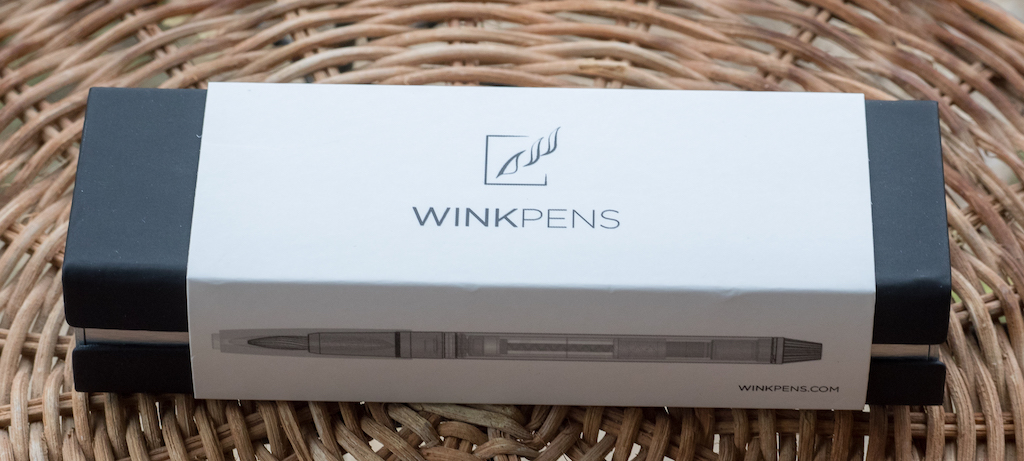
The Wink Pen arrives in beautiful packaging. A sophisticated looking black cardboard and metal box opens to reveal the pen wrapped in a soft, satin-like cloth.

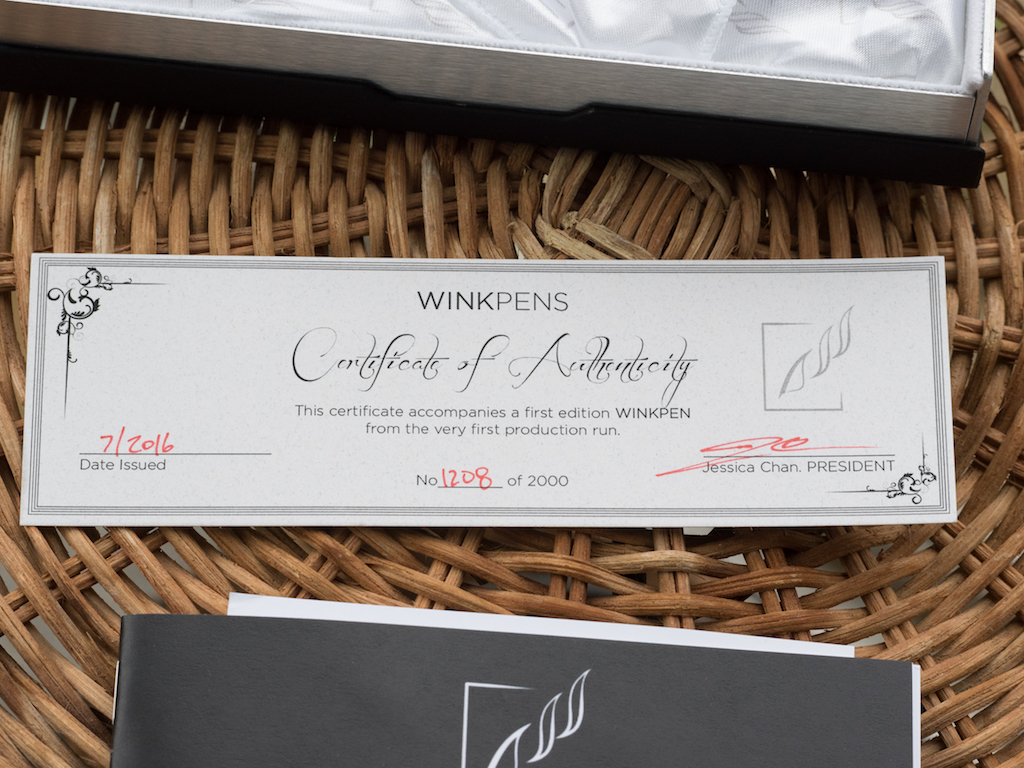
Included are the booklet that describes the history of Winkpens, a certificate of authenticity, and a cardboard sleeve that provides usage instructions.
The pen can be completely dissassembled, which is good since it is meant to be used with a variety of liquids. The pen is comprised of a glass nib, a coupler, a converter, a barrel cap, the pen cap, and the glass barrel.

The cap has a clip with the initials of the creator (J.C.) engraved near the top. The Winkpen logo is on the finial.

To use the pen, fill the converter with your desired liquid, insert it into the coupler, push the glass barrel and barrel cap on, and twist the barrel cap until liquid starts dripping from the nib.
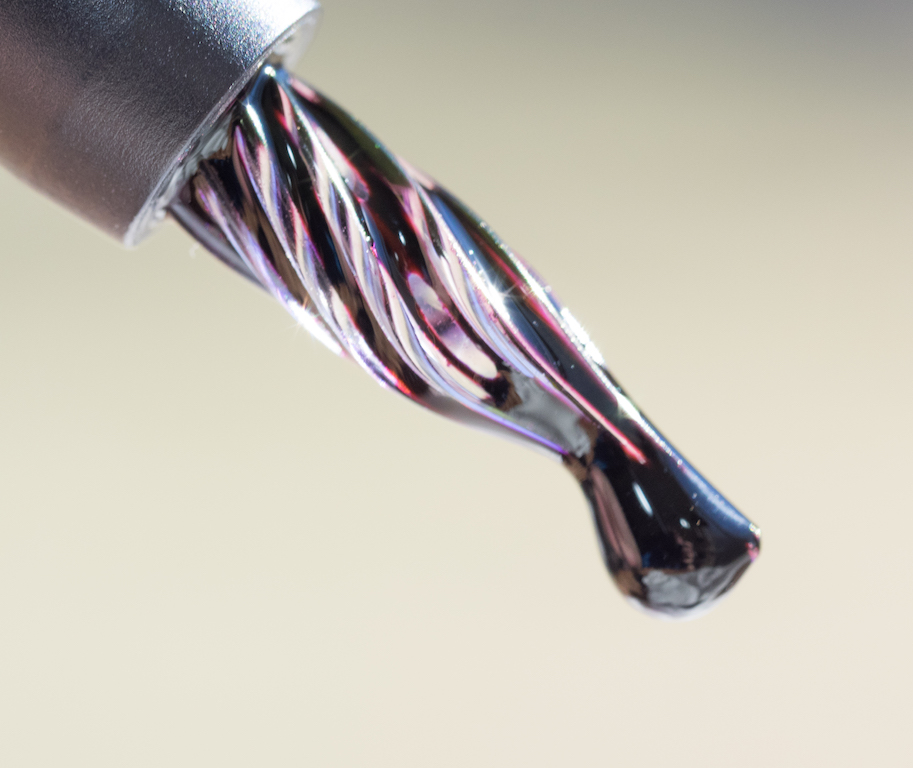
The pen is designed to work with low viscosity liquids. I tried it first with coffee:
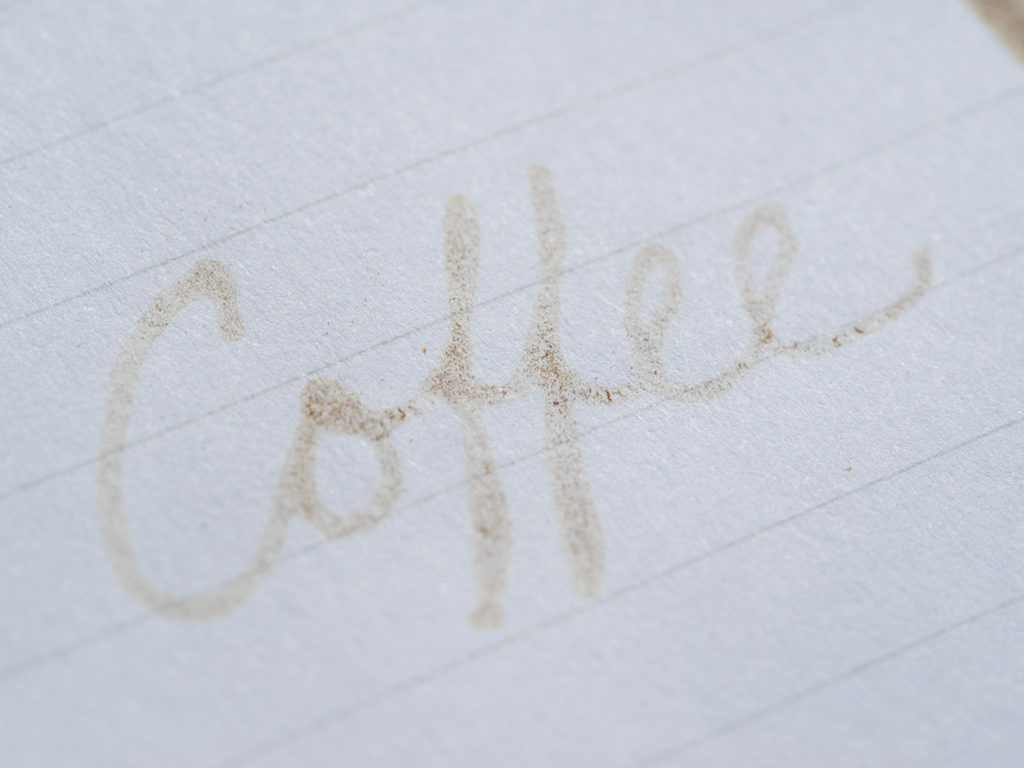
Then Cabernet Sauvignon wine:

Unfortunately, as excited as I was to try unusual liquids in the pen, it didn’t work very well. In order to write even a couple of letters with the coffee or wine, I had to twist the barrel knob to get a blob of liquid to come out. The converter couldn’t deliver enough liquid to the glass nib to write continuously. My conclusion: the pen doesn’t work well with low viscosity liquids. It would be easier just to use a dip pen.

I will say the paper you write on makes a difference. My first tests were on Maruman Septcouleur paper which is pretty slick and Moo Notebook paper (very high quality with little texture). When I wrote with wine on Maruman sketch paper I had much better results with color saturation. But I still had to wet the nib constantly.

The pen works just fine with fountain pen ink. I tested it with Callifolio Aurora and Bung Box Sweet Potato Purple. The Callifolio worked fairly well, though I had to turn the pen to keep the ink flowing.

The Bung Box Sweet Potato ink worked perfectly.
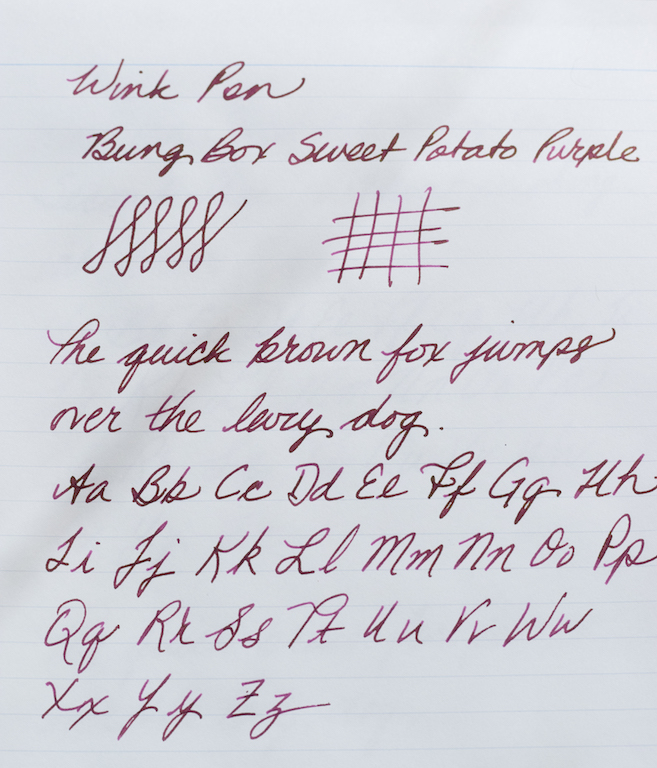
Although I love the original idea of using the Wink Pen with any liquid, my experiments were frustrating. The liquids I tried simply would not keep flowing from the converter. I found using the pen with coffee and wine to be messy and inconsistent. Therefore, I’m not sure what advantage the Wink Pen offers when compared with a regular glass dip pen.

However, the Wink Pen works quite well with regular ink. Those who enjoy the feel of a glass nib but prefer the convenience of a converter (less mess), will like the Wink Pen.

You can purchase a first edition Wink Pen from Winkpens for $65 (originally $129). I did not find any information on the website about forthcoming editions of the pen.

Pros

  • The Wink Pen is an unusual combination of a glass nib with a converter-filled pen.
  • The pen writes well with regular fountain pen ink.
  • The pen is simple to assemble and dissassemble which makes it easy to clean—important if you choose to use wine or coffee as ink.
  • The glass nib writes smoothly and is beautiful when inked with saturated colors.

Cons

  • Unfortunately, writing with alternative liquids, which is the main intent of the Wink Pen, was frustrating. Coffee and wine were too wet and the flow too inconsistent to write more than a few letters.
  • I found that I had to twist the barrel cap to force liquid out every few letters, which sort of defeats the purpose of having a converter-based glass-nibbed pen. This was not a problem with regular fountain pen ink.

(Wink Pens provided this product at no charge to The Pen Addict for review purposes.)

Posted on February 3, 2017 and filed under Wink, Fountain Pens, Pen Reviews.

Pilot Ridge Four-Color Ballpoint Multipen Review

(Sarah Read is an author, editor, yarn artist, and pen/paper/ink addict. You can find more about her at her website and on Twitter.)

I haven't ever cared much for multipens. I often find them to be bulky, rattle-y, and the refills can be fiddly and don't hold enough ink. Many times I run out of one color before the rest, and I find myself playing refill roulette. As a child, I thought they were magical, but eventually my inner curmudgeon took over. So when someone says they have a great multipen, my initial thought is "you mean you have a convenient cluster of mediocre pens". I'm just admitting my bias up front, here, because this review should be read through that lens.

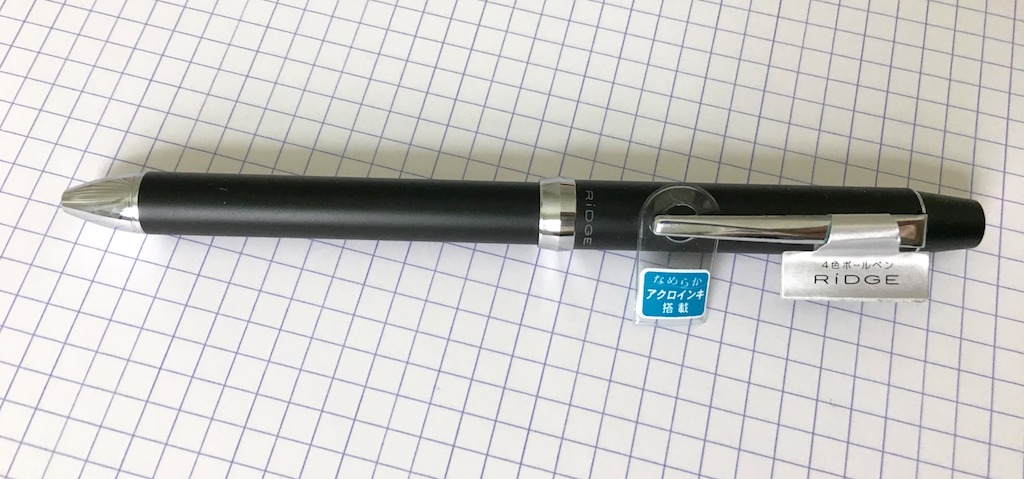
The Pilot Ridge is a pretty great multipen. I'm using it more than I thought I would--and it somehow seems to have claimed a permanent residence in a pocket of my carrying case. What has ultimately won me over is that it's a multipen that doesn't look or act anything like a multipen.

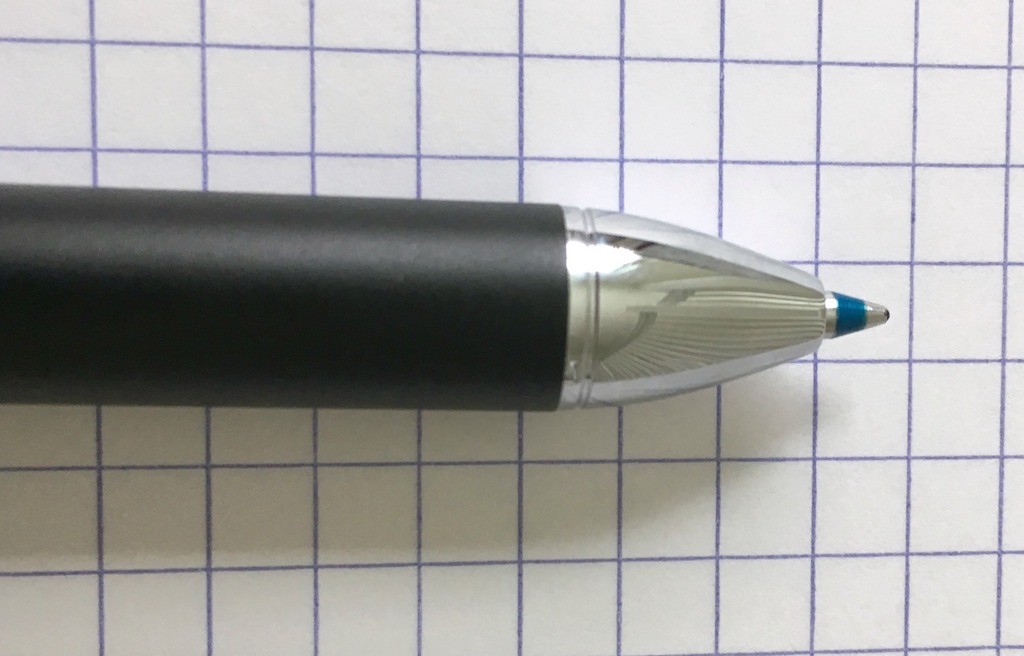
For one thing, it's very slender. The main part of the barrel is even slimmer than a Retro 51, and the black model has a sleek matte finish that is smooth and comfortable to hold. The texture provides just the right amount of grip friction. Overall, the pen is very minimalistic and elegant in its simplicity. Despite it's slimness, though, the pen is quite heavy. It packs a lot of pen into its small frame, and I found myself getting some hand fatigue after about thirty minutes of writing. But a multipen isn't likely what one would use for a long writing session, anyway.

Part of its sleekness is the lack of those wing-like slide-clicks that you see on so many multipens. The Ridge uses, instead, a smooth twist mechanism that deploys the different tips in a rotation. It's completely silent, and quickly springs each color forward till you get to the one you want. Admittedly, sometimes it goes too quick, so you have to backtrack--but the twist works in both directions, so once you get the sequence down, you can find your desired color quite efficiently.

One small issue I have with it is that the only way to tell what color you have is to look at the tiny band on the end of each cartridge tip as it pops out. There's very little difference between the blue and green, and in low light, it can even be difficult to tell between the blue and black. I've found myself squinting at it often, and wishing for a better way to indicate the ink color. Another problem with the mechanism is that there is very little pause space between colors, so positioning it in such a way as to keep the tip retracted takes a little fiddling. It would also only take a small agitation for it to move past that between-spot and deploy the tip in a pocket or bag. So I don't recommend this pen for pocket carry.

The thin cartridges are securely housed in the two parts of the barrel. The two sections pull apart to reveal the four D1 cartridges. The cartridges are friction-fit into the revolving mechanism--just pull one out to replace it. They are quite tiny. I haven't run out of any ink yet, but I don't imagine each cartridge has a very long lifespan.

The ink was another pleasant surprise. It's ballpoint ink, but upon first use, it could be mistaken for gel ink. It is very smooth and vibrant with excellent flow. It's Pilot's special Arco ink, formulated with low viscosity, and it just glides. The green still has a little of that washed-out ballpoint ink look, but the red, black, and blue all have more intensity than I've seen in other ballpoint inks. And if you want to add more wild colors to the lineup, it appears to take any D1 refill, so there are lots of other brands and colors to choose from.

I was a little surprised by the price--at $54.50, it seems a bit high. It is definitely well-constructed of quality materials, so it may be my general aversion to multipens clouding my view here, but if someone had handed it to me and asked me to guess the cost, I'd have been way off.

While it isn't something I would have picked out for myself, I think this pen would make an excellent gift--especially for a graduate or a young professional getting their first job or promotion. It would be great to give to a visiting business partner, or a valued assistant or teacher. It's very elegant and professional looking, and super practical. The multi-function is inarguably great for editing, grading, or coding notes. Personally, I have a feeling I'll be ordering some refills at some point, and this may very well be the first multipen that stays in my collection. It brings back some of that old multipen magic, much to my inner curmudgeon's dismay.

(JetPens provided this product at no charge to The Pen Addict for review purposes.)
Posted on February 2, 2017 and filed under Pilot, Multi Pen, Pen Reviews.

The Pen Addict Podcast: Episode 242 - The Hype Man

We launched a Kickstarter project, funded it, and announced a stretch goal all since the last episode, so needless to say Myke and I had a lot to discuss today. We also talk about the Pen Show World Tour I am about to embark on, starting with Los Angeles in February and Little Rock in March.

Show Notes & Download Links

This episode of The Pen Addict is sponsored by:

Pen Chalet: Click the ‘podcast’ link at the top of the website and enter the password ‘penaddict’ for this week’s special offer, and to get your code for 10% off.

Blue Apron: A better way to cook. Get three free meals with free shipping.

Harry’s: Use code PENADDICT at checkout to claim your free trial set and bonus post-shave balm.

Posted on February 1, 2017 and filed under Podcast.