Monteverde Giant Sequoia Fountain Pen: A Review

(Susan M. Pigott is a fountain pen collector, pen and paperholic, photographer, and professor. You can find more from Susan on her blog Scribalishess.)

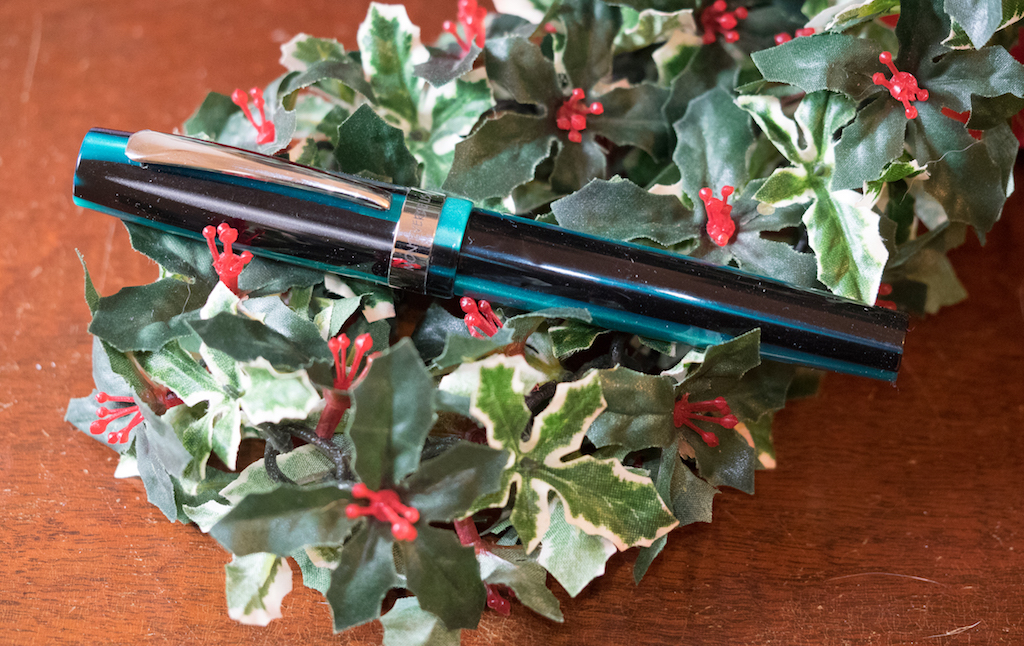
The Monteverde Giant Sequoia fountain pen is a large resin pen with a stainless steel nib. It comes packaged in a substantial clamshell box with two cartridges as well as a converter.

The green Sequoia has sheeny turquoise, black, and silver stripes. It’s a really beautiful resin.
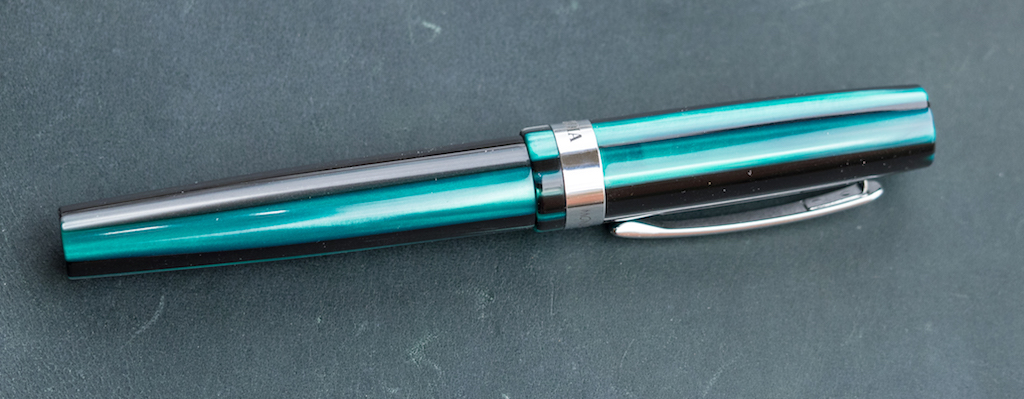
The pen itself is cylindrical in shape with a flat top and barrel bottom. The cap has an unadorned silver clip and a band engraved with “Monteverde USA Sequoia.” The cap screws on, and although it is postable, doing so throws the balance off considerably.

The Sequoia is a large pen both in length and girth. It is 5.7 inches (145mm) capped, 5 inches (127mm) uncapped, and 6.7 inches (170mm) posted. The grip is 10.8mm in diameter and the barrel is 15.4mm. In spite of its size, the pen itself is not heavy, weighing 33 grams capped and 19 grams uncapped.

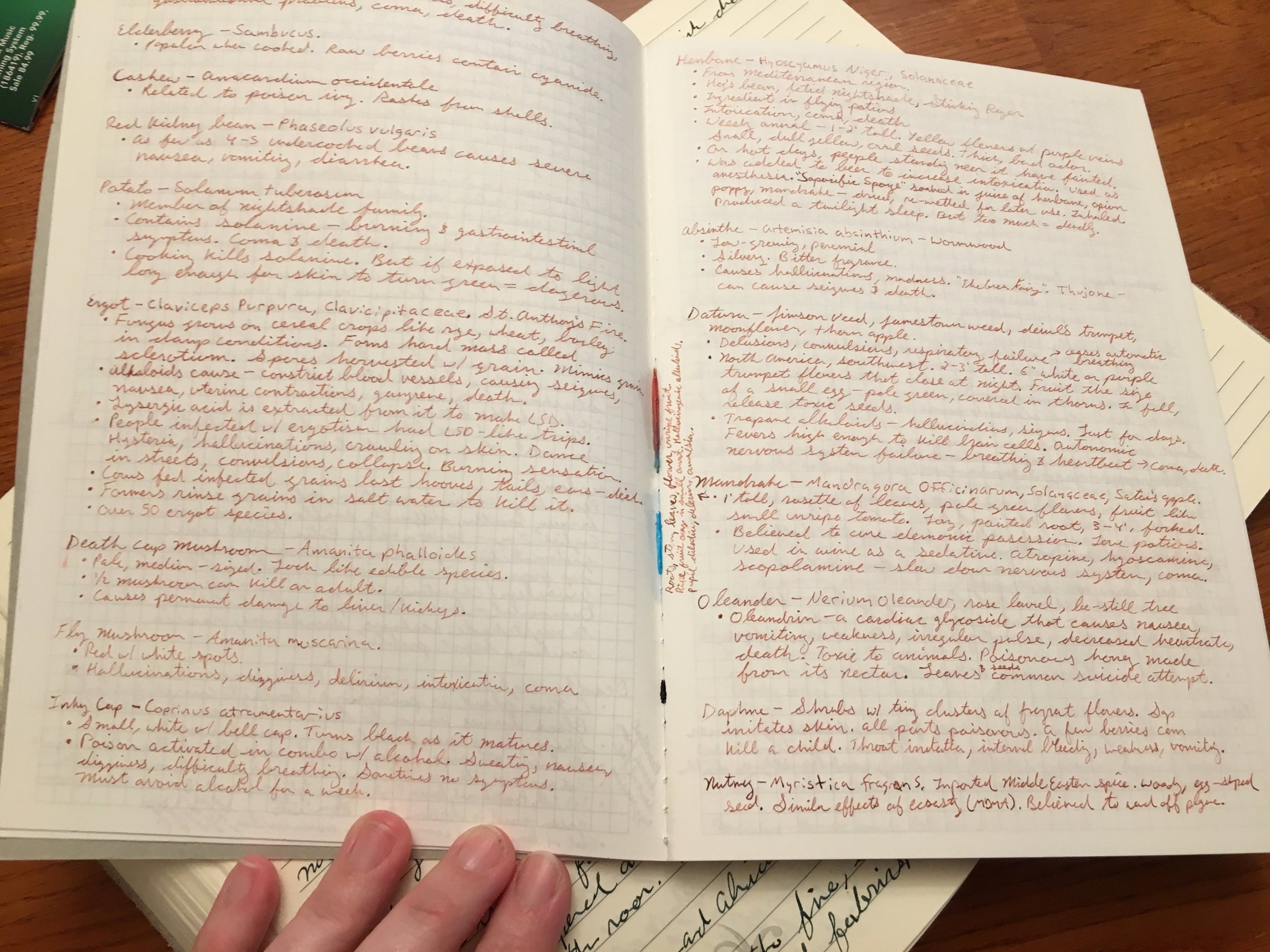
William Hannah Notebook

The pen fills by cartridge or converter. Since it is made of resin and there are no metal parts on the barrel, you could probably eyedropper the pen if you wished.

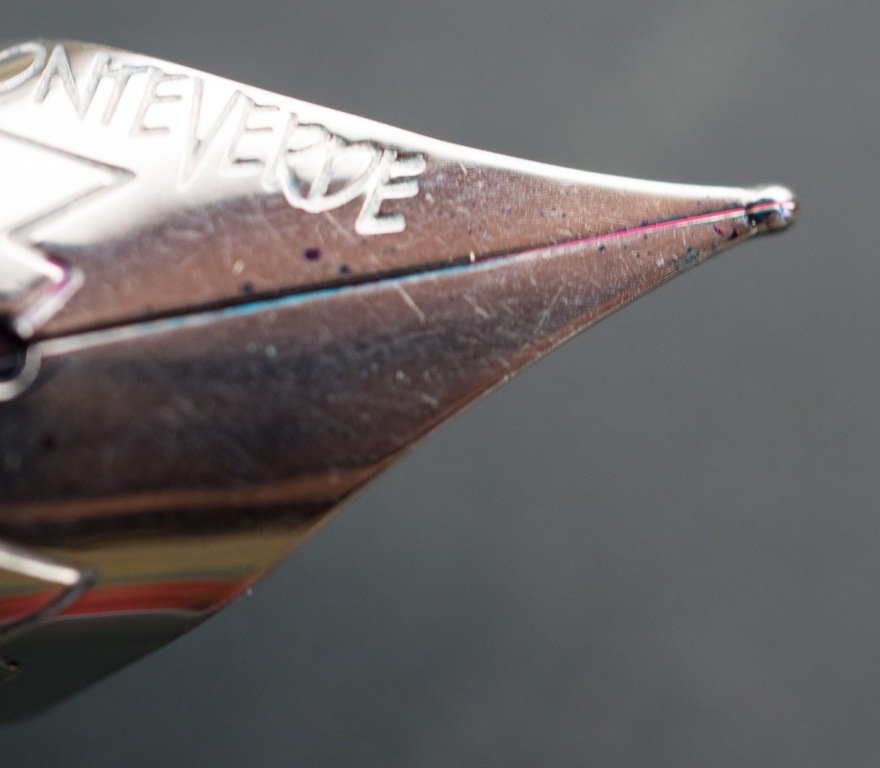
The Sequoia comes with a #6 stainless steel nib. My review pen has a fine nib width. The nib is engraved with the Monteverde logo, and the Monteverde name appears twice, once near the base of the nib and once along the perimeter near the tip.

Unfortunately, this nib is scratchy, hard, and dry. Writing with it is not a pleasurable experience. It skips occasionally on downstrokes, and if you stop writing for any length of time, you have to re-wet the nib to continue.

You can see where the nib skipped on the downstroke

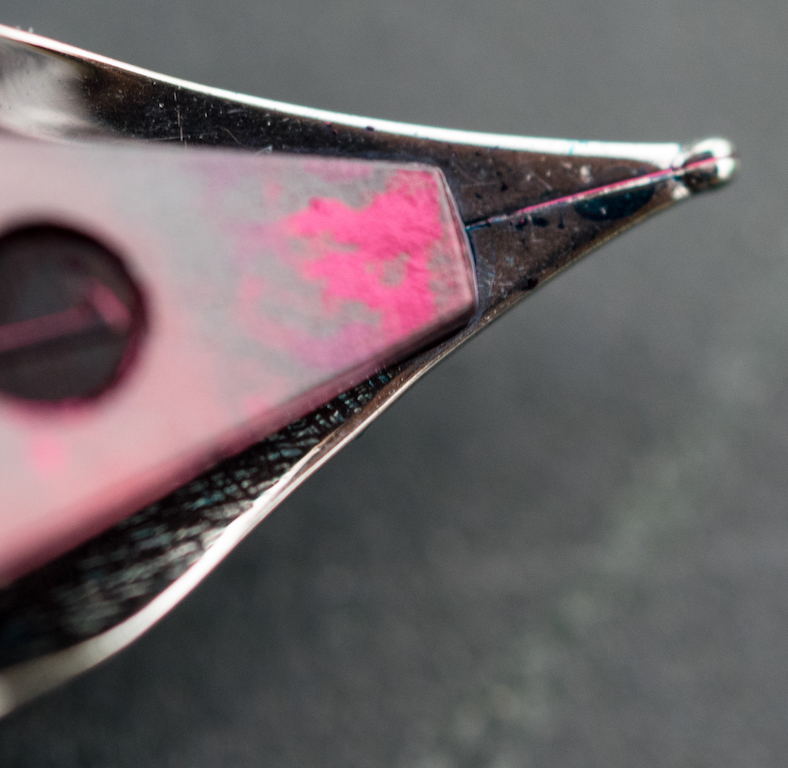
My macro photos of the nib don’t reveal any obvious problems, such as misaligned tines or tipping issues. I think the nib is just scratchy and ink-stingy. A nibmeister could probably get it writing better, but that’s an added expense.
The Sequoia is a beautiful pen, and I really like its size. My middle-aged hands prefer pens with a larger girth, especially for long writing sessions. But, the nib is a deal-breaker for me. If a pen doesn’t write well, no amount of beauty will make up for it.

You can purchase the Monteverde Giant Sequoia in green, blue, or brown from Vanness Pens. It costs $90.00 and comes in fine, medium, broad, and stub nib sizes.

Pros

  • The Monteverde Sequoia is a beautiful, large-sized pen that is light and comfortable in the hand.
  • The pen offers at least two filling methods (cartridge and converter), and it probably can be eyedroppered as well.
  • I really like the resin on this pen. It reminds me of the ao-tamenuri color Nakaya used to offer.

Cons

  • Unfortunately, the nib on this pen is scratchy and unyielding. It is also stingy with ink.

(Vanness Pens loaned this product to The Pen Addict for review purposes.)

Posted on December 8, 2017 and filed under Monteverde, Fountain Pens, Pen Reviews.

The Pen Addict Podcast: Episode 286 - A More Aggressive Swirl Pattern

I know I just received, but dang if I don’t love the new TWSBI ECO-T. The color and design are right up my alley, and it feels great. I love the new Blackwing Volumes 16.2 edition as well, and the new Pelikan M805 Ocean Swirl. It’s a love fest up in here this week!

Show Notes & Download Links

This episode of The Pen Addict is sponsored by:

Pen Chalet: Click the ‘podcast’ link at the top of the website and enter the password ‘penaddict’ for this week’s special offer, and to get your code for 10% off.

Blue Apron: A better way to cook. Get $30 off your first delivery and FREE SHIPPING.

Away: Travel smarter with the suitcase that charges your phone. Get $20 off with the code ‘penaddict’.

Posted on December 7, 2017 and filed under Podcast.

NaNoWriMo, the Pen Addict Way

(Sarah Read is an author, editor, yarn artist, and pen/paper/ink addict. You can find more about her at her website and on Twitter.)

If you noticed, during the month of November, your writer friends looking a little wild-eyed or sleep deprived, or perhaps couldn't find them at all, they may have been participating in NaNoWriMo--National Novel Writing Month.

For NaNoWriMo, writers commit to producing 50,000 words in 30 days, usually on a novel manuscript. The goal is to shut off the inner editor voice that tells us that what we are writing is terrible. Because of course it is terrible--all first drafts are. But you can't edit thin air, so get the draft down and fix it later. Plus, it's a fun way to connect with writer friends and band together in what can be a grueling sort of writerly boot camp.

It's not necessarily the pace of NaNoWriMo that's difficult. Writing 1600 to 2000 words a day only takes a few hours. It's sustaining that pace that gets to you--because you have to give up the things you'd normally do in those few hours, like visit with friends, watch your favorite movies, sleep.

This is where pen addicts have a huge advantage. HUGE.

How would you like to play with your pens and ink for two hours every day for a month? Best month ever--right? Yer darn right, it is.

I've participated in NaNoWriMo a few times, and always using analog tools. At the write-ins I've attended, most people pop open laptops. Precious writing time is devoted to fighting over outlets and backing up hard drives. It really doesn't matter what you use, as long as you're writing, but using a nice pen, fun ink, and good paper just makes everything easier.

This year, my setup was focused on portability and durability. I have a day job and two young kids, so my "few hours a day" is taken in increments of five minutes whenever I can get them.

For my planning and outlining, I used a Graphilo grid notebook. It's been perfect and wonderful. I wish I had indexed it from the beginning, because it got a little disorganized in the fray, but the small-scale grid and excellent paper facilitated outlining and making very tiny notes in margins. All of my historical research, character profiles, and plot ideas are stowed happily within. I guard it well.

For my main notebook, I used one of the Barnes & Noble brand Italian leather notebooks. I don't see these notebooks raved about much in the stationery community--perhaps because they can only be purchased at Barnes & Noble, which makes them inaccessible for many. If you have access to one of their stores, these notebooks are worth checking out. The leather covers are beautiful, the paper is great, and they have enough pages to hold a hastily-written first draft. I strapped a Quiver pen holder on mine. It did warp the leather cover a little (the leather is soft and only reinforced with thin cardstock), but it wasn't too excessive and I needed to be able to grab my tools in one unit. I always kept two pens in the Quiver, just in case.

For pens and ink, I used...a lot. I started with a Conklin Word Gauge, because I've always wanted to know how many words I could really write with it. It boasts that you can write 5k words on one fill, and the ink window has the level measured in thousand-word increments. Well, my wet medium nib gave me about 12.5k words on one fill. It lasted so long, I was getting anxious to use something new. When it finally ran dry, I decided to work though my case of inked pens and empty and clean as many of them as possible. I wanted to see if I could empty every pen I had inked. Turns out I couldn't. That's how you know you have too many pens inked--write a whole book and still not run out. But I enjoyed the rotation immensely, and got to use some of my favorite pens in the process. I cleaned out the empties every weekend--sometimes as many as six at a time. Not all were full to begin with, so it's difficult to estimate how much ink I actually used, but I'd guess close to 20ml. Which gives me hope that I might actually, someday, use most of the ink I already own, as long as I stop buying new ink and write a novel every month for the rest of my days.

The most common question I get when doing analog NaNoWriMo is how I know I've written 50k words. There's certainly no time to count them out every day, and my notebooks don't have an auto word counter (though I bet that's a thing, somewhere). I estimate--I count my words for the first few days, and calculate an average word count per page, then mark my page numbers with important milestones. I needed to write about 300 pages to reach 50k this year. I wrote to 313 to be safe. There are plenty of word-generating tools on the internet to create a document you can use to verify your word count in the NaNoWriMo website--I use a Lorem Ipsum creator.

While I did hit the 50k mark this year, my book still isn't done. So I'm still going! I'm doing NaNoWriEternity. When I'm finally done with the draft, the real work will start--editing. Because first drafts are terrible.

(Watch Sarah flip through her entire notebook on Instagram.)

One of the best things about NaNoWriMo is that there's no way to lose. Even if you only go for one day, that's a few thousand words you didn't have before--winner! And if you're a pen addict, with your favorite pen and a fresh notebook and a lovely ink at hand, you win double. Because no one enjoys writing, as an act in and of itself, as much as we do.


Enjoy reading The Pen Addict? Then consider becoming a member to receive additional weekly content, giveaways, and discounts in The Pen Addict shop. Plus, you support me and the site directly, for which I am very grateful.

Membership starts at just $5/month, with a discounted annual option available. To find out more about membership click here and join us!

Posted on December 7, 2017 and filed under NaNoWriMo.