(Jeff Abbott is a regular contributor at The Pen Addict. You can find more from Jeff online at Draft Evolution and Twitter.)
No matter what your preferences may be in terms of gel pens, you can probably find a multi-pen variant from that manufacturer or that will fit your favorite refills. Today, we're looking at the Sakura Ballsign 4*1 multi-pen.
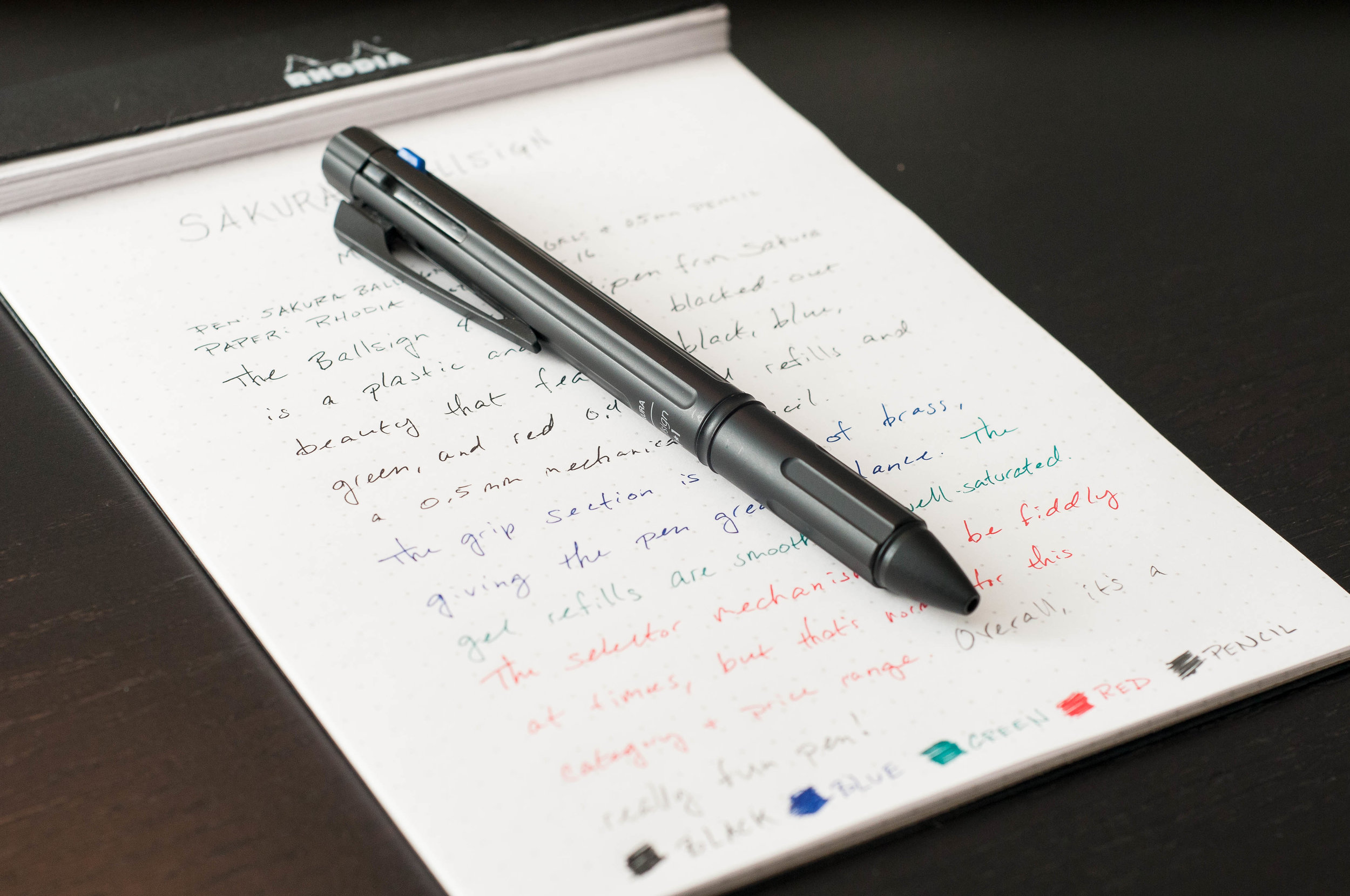
The Ballsign 4*1 is available in several color options, but I have the all-black version, which looks fantastic. There isn't a single piece of bling on the matte black beauty apart from the colored refill selectors. It gives this pen a tactical feel, though I don't think the same is true in the other colors.
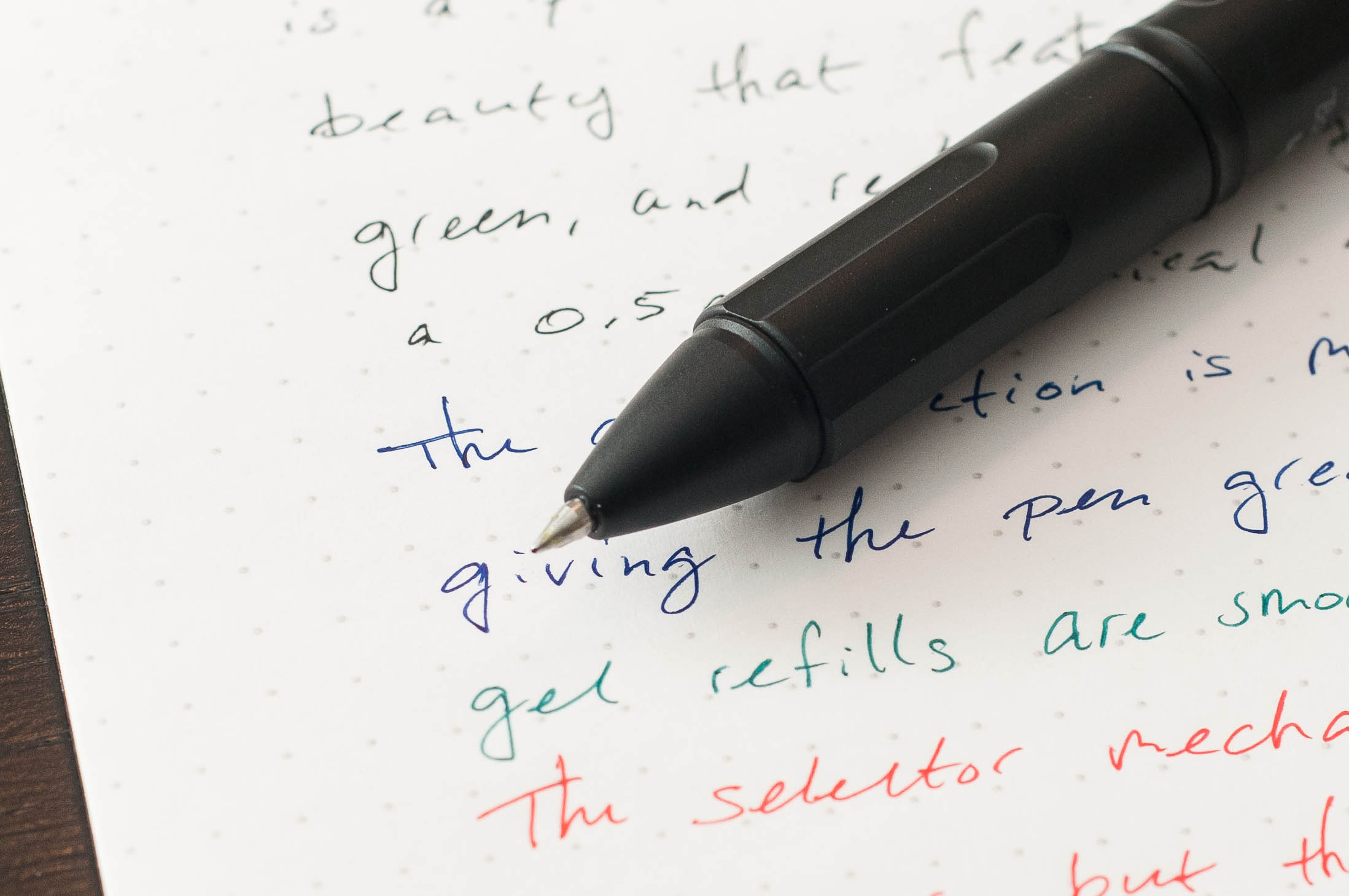
Most of the pen is plastic, but the grip section is a coated brass that adds a nice balance when writing. With the center of gravity so low, it's easy to control the pen when writing. This is especially important when using such fine-tipped refills like those that come with the pen. At 0.4mm, they strike a good balance between ultra-fine and still wide enough to show off the colors.
Like most multi-pens, you select a refill by depressing a tab at the top of the pen. When you want to retract it or select another refill, just depress another one. While there are four different gel ink refills to choose from (black, blue, green, and red), it also features a 0.5mm mechanical pencil component. To use this, depress the clip! The integrated clip, pencil selector, and lead advancer is a great implementation for this pen. I've really enjoyed using it and haven't had any trouble with the pencil.
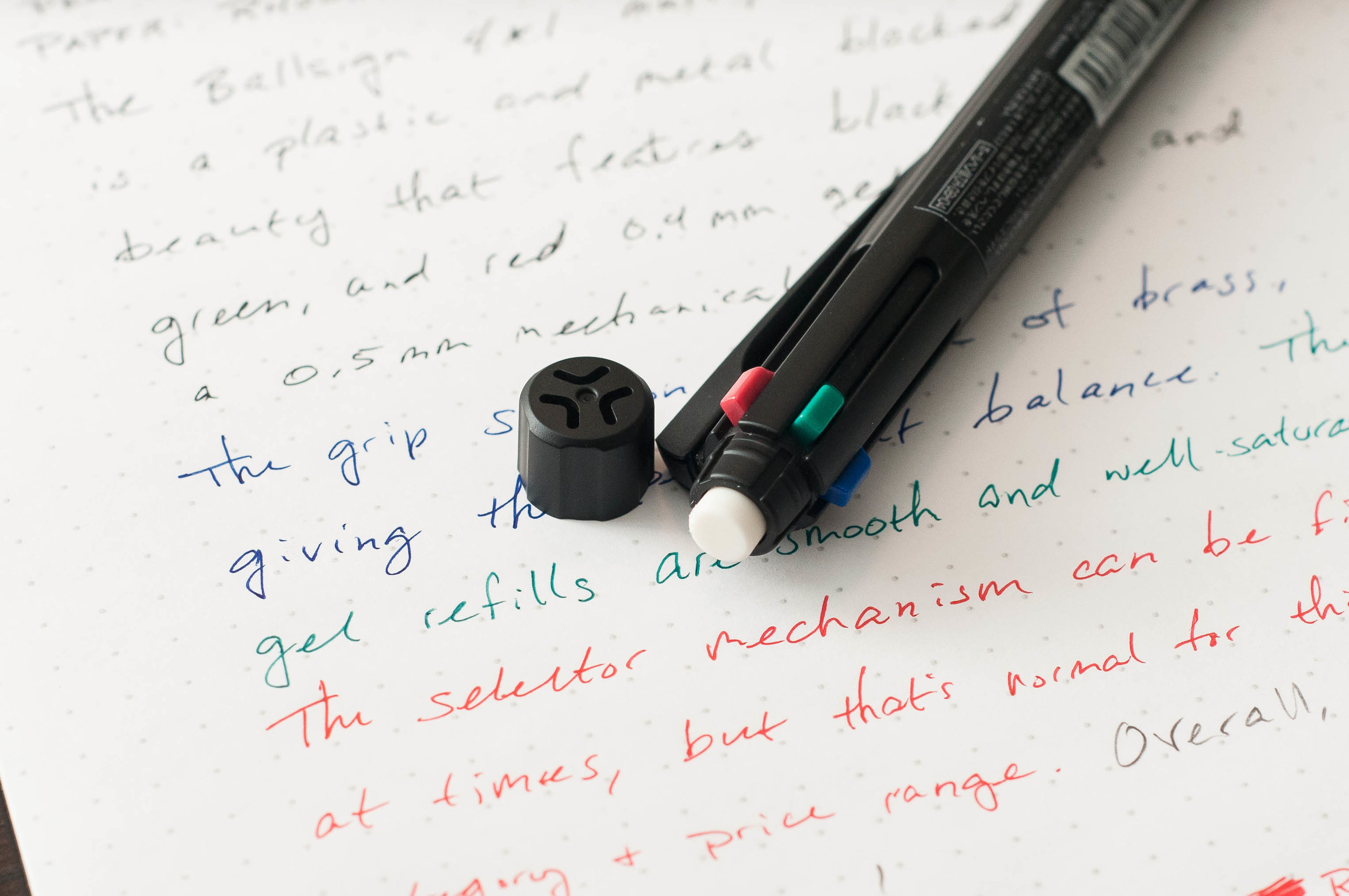
At the top of the pen, there's a small eraser hidden under a black cap that snaps on and off. Like most pencils with hidden erasers, I worry about losing the eraser cap at some point, even if I'm not routinely using the eraser.
Unlike other mechanical pencils, you don't refill the lead by dropping in more lead in the barrel that also holds the eraser. In this case, you unscrew the pen and remove the mechanical pencil component. The lead drops into the small component, and you can reassemble the pen. All in all, it's only one additional step compared to normal mechanical pencils.
The 0.4mm gel refills that come with this pen are very nice — they are smooth, bold, and have great color. The green is a little dark and a tad blue for my tastes, but it's still an interesting color. It's not a typical hunter green that normally comes with a standard multi-pen. The line edges are crisp and clean, and I haven't had any issues with skipping on most paper. Oddly, the black refill doesn't play nicely with Rhodia, but has no issues on other papers. I assume this has something to do with the coating on the paper, so keep that in mind if you intend to use this pen on any paper that features a smooth coating (like Rhodia).

As far as refill options go, you're pretty limited in the Sakura lineup. They only offer the same four colors that come with the pen: black, blue, green, and red. Unfortunately, I can't find anything else that fits. Pilot Acroball, Zebra Sarasa, Uni Style Fit, Uniball Jetstream, and D1 refills are either too short or too wide for the Sakura. This is a shame because an important part of any multi-pen is the ability to fill it with whatever colors fit your fancy. It's not uncommon for a manufacture to limit the color options in their multi-pen, but I wish it wasn't true. Either way, also bear that in mind if you're interested in this pen. The refill options are very limited!
Another aspect that somewhat soured my experience with this pen was upon initially opening it and trying to use it. Like most gel pens, each refill had a protective seal on the tip of the point. I've never had any problems removing these, as they simply slide off with a small amount of pressure. The Sakura Ballsign refills (all four of them) were a much different story. Using friction from your fingertips won't cut it; you have to use fingernails in order to accomplish anything, but it's slow work. Only small strips of the protective gel/wax covering came off with each attempt. Even after removing it (I spent 15 minutes doing this), the refills had trouble writing due to small amounts of sticky residue left behind on the gel ball. In time, everything started working perfectly, but it was a frustrating initial experience. Maybe it was a fluke, but consider yourself warned!

Apart from the lack of color options for the refills and a frustrating unboxing experience, the Sakura Ballsign 4*1 is a solid multi-pen. The refills are all smooth and bold, and the pencil is reliable and well made. The weighted grip section gives the pen a premium and stable feel when writing, and the matte black color scheme gives it an intriguing aesthetic.
The Ballsign 4*1 is available in 2 varieties: standard and Premium. In the standard vein, you have an option of Navy, Red, Black, and Dark Brown. In the Premium vein, you have Black and Silver. The difference between the two is that the Premium pens have the weighted brass section, whereas the standard pens have a plastic, textured grip section. The prices range from about $15 to $25 for both lines, which are affordable and fair for the quality. Overall, these are great multi-pens!
(JetPens provided this product at no charge to The Pen Addict for review purposes.)
Enjoy reading The Pen Addict? Then consider becoming a member to receive additional weekly content, giveaways, and discounts in The Pen Addict shop. Plus, you support me and the site directly, for which I am very grateful.
Membership starts at just $5/month, with a discounted annual option available. To find out more about membership click here and join us!