Karas Kustoms Decograph Fountain Pen Review

(Sarah Read is an author, editor, yarn artist, and pen/paper/ink addict. You can find more about her at her website and on Twitter.)

Karas Kustoms, renowned machinist of metal pens that can withstand nearly apocalyptic conditions, has decided to explore their softer side with a line of thermoplastic and acrylic pens called the Decograph. The design fuses the ultramodern aesthetic of Karas with the sleek Art Deco look of vintage pens. It's a perfect blend, a very attractive pen, and the super light thermoplastic makes it a tool I can write with for hours.

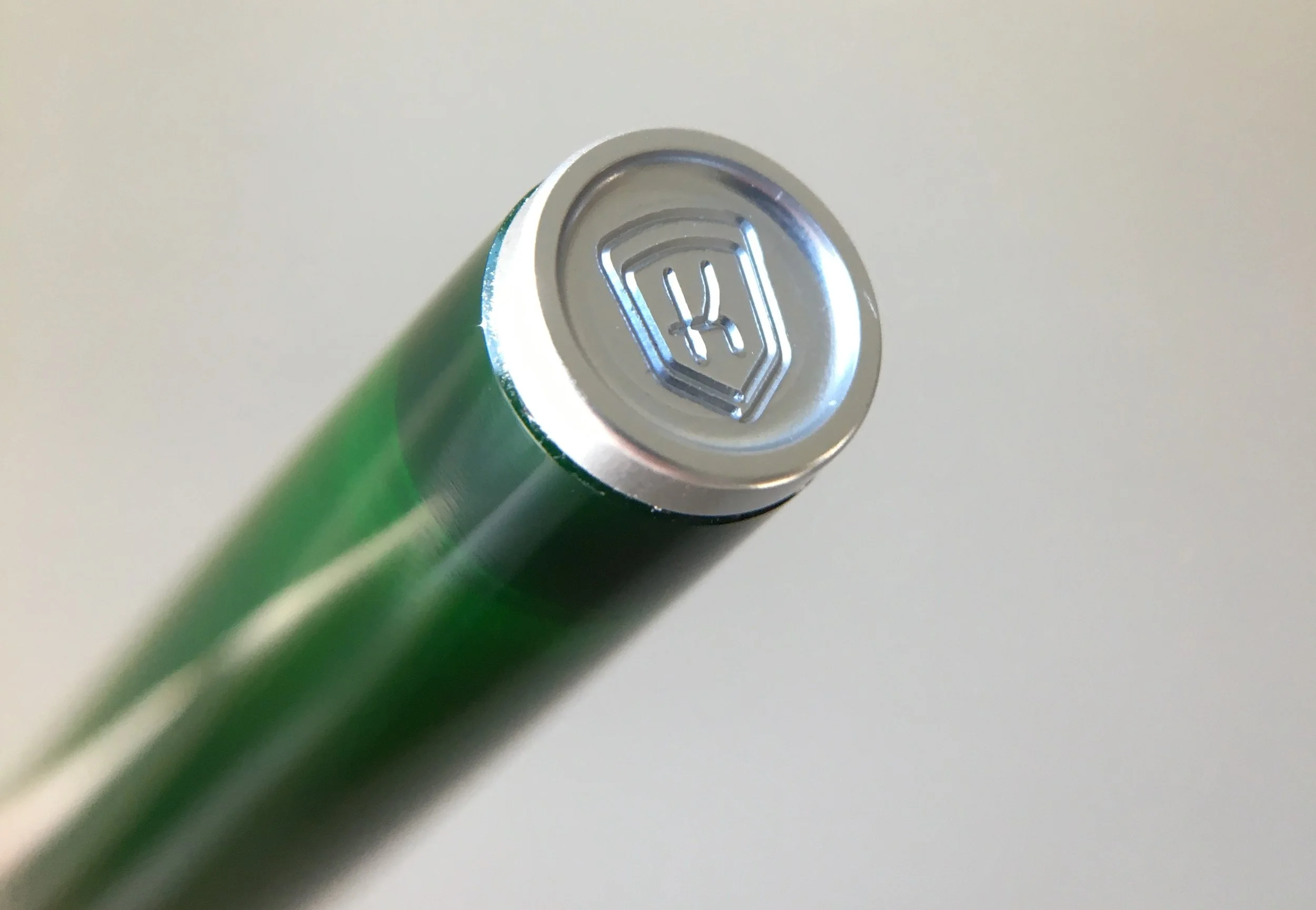
Right now, the pen comes in two standard colors: black and almost-black-but-actually-wait-it's-green. The green pen is shown here. In low light and at first glance, it appears to be shiny black, but once the light hits it, it's a dazzling beetle green. The effect is downright magical. If Voldemort had need of a pen, he couldn't choose better than this one. There are also regular special editions of this model, so keep your eyes peeled for a color that speaks to you.

The pen arrives in a swanky aluminum tube. It feels like a time capsule from outer space. There is no doubt, from the first moment, that there's something special inside. The pen is cushioned securely in the tube with a foam insert, and the whole setup makes for an attractive pen stand.

The pen is equipped with a standard #6 Bock nib and a Schmidt K5 piston converter. Gold, black, and Titanium nibs are available at additional cost. The nib performed well--standard and as expected for a Bock nib, though with a little more feedback than I personally prefer. It writes with a good flow and starts right up even after sitting for a day. The nib unit screws out and can be switched and swapped as you fancy.

The pen body is beautifully designed, with an elegant taper and well-fitted machined aluminum finials. The top finial is slightly pointed at the center and the bottom shows the Karas logo--all very understated and elegant. The clip is a machined aluminum piece with classic Art Deco chiseled shaping, secured with a piece of spring steel under the top finial. It feels sturdy but flexes enough to perform well.

The cap screws on with all plastic threads that are tucked high enough inside the cap that they should prevent the thin lip of plastic at the cap edge from cracking. The threads are smooth and secure and don't interfere with the pen's grip. The grip section is hourglass shaped and tapers quite narrowly. It fits perfectly in my hand, which means some may find it to be too narrow.

It's one of the more comfortable pens I've held. The shaped grip, light weight and balance, and the way the plastic warms in my hand all make for a really pleasant writing experience. It's a pen that makes me want to pick it up and write for hours.
At a start price of $165, it's considerably more expensive than Karas's other models, but is priced in line with similar pens from other companies and seems more than fair. I'll be watching the limited edition releases and hoping for more color choices from this line in the future.

(Karas Kustoms provided this product at no charge to The Pen Addict for review purposes.)


Enjoy reading The Pen Addict? Then consider becoming a member to receive additional weekly content, giveaways, and discounts in The Pen Addict shop. Plus, you support me and the site directly, for which I am very grateful.

Membership starts at just $5/month, with a discounted annual option available. To find out more about membership click here and join us!

Posted on December 28, 2017 and filed under Karas Kustoms, Fountain Pens, Pen Reviews.

Pilot Cocoon 0.5mm Mechanical Pencil Review

(Jeff Abbott is a regular contributor at The Pen Addict. You can find more from Jeff online at Draft Evolution and Twitter.)

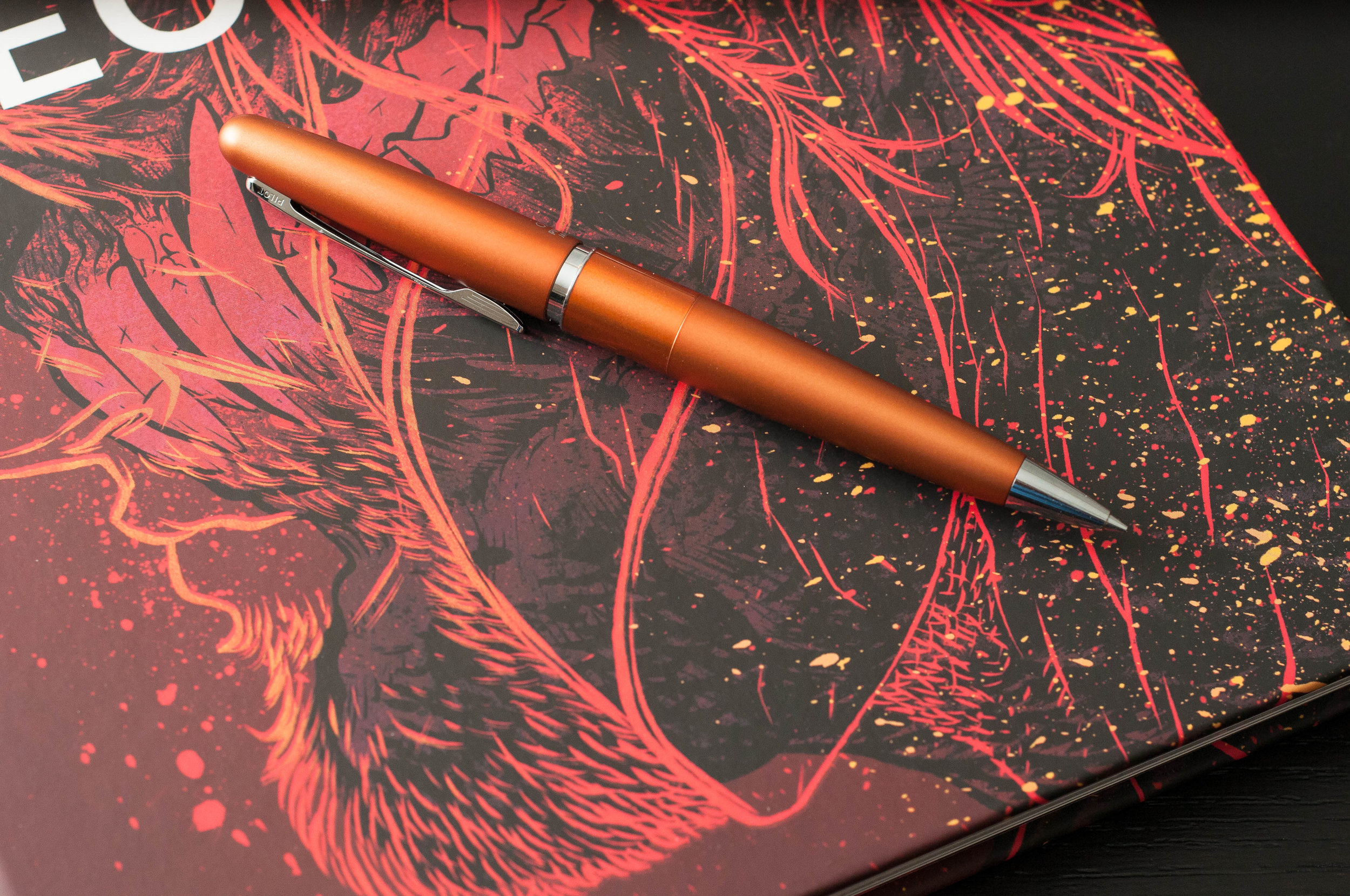
The Pilot Cocoon mechanical pencil is a familiar design that was born from the popular Pilot Metropolitan fountain pen. I've long been a fan of the Metropolitan, and the Cocoon hits a similar price point and comfort level that makes it easy to love.

Apart from sharing the general shape and feel of the Metropolitan, that's where the similarities stop. This is a pencil after all! Pilot also makes gel pen and other versions of the Metropolitan and Cocoon line, but those all feature a cap system. For the pencil, there is no cap; instead, it looks like a posted Metropolitan or Cocoon all the time.

To advance the lead, just click the cap down a couple of times. The build quality of the pencil is good, which is to be expected for the name. There's a shirt protector built into the tip of the pencil, which prevents the lead from snagging anything when retracted. For my taste, I wish the tip retracted fully into the pencil body, but that's a bit much to ask for the price range. As it works today, I have no real complaints.

0.5mm is the only lead size available in this line of pencils. Pilot could probably sell a few more units if they offered a couple other sizes, but 0.5mm is a good middle ground.

If you remove the cap from the pencil, there's a tiny eraser that closes the lead tube. To refill the lead, just remove the eraser to drop the lead into the tube. Of course, Pilot sell replacement erasers in a set of 5, but I'd recommend picking up a dedicated eraser to use with your pencils.

There's a nice range of colors available for this pencil, from silver, black, white, and several in between. In all, there are eight colors available.

When using the pencil, the Cocoon feels great in the hand. It's not too heavy, but it also offers a great deal of control and stability. I've used it quite a bit and haven't had any complaints on the way the pencil feels. It isn't fair to say that it feels just like the Metropolitan or Cocoon since the overall design and construction is much different. It looks very similar, but feels entirely unique.

All in all, the Cocoon mechanical pencil is a fantastic iteration of a beloved pen lineup from Pilot. It's a solid pencil with a great aesthetic, and also available in a wide variety of fun colors. Students and professionals alike can enjoy this pen, and the price is low enough to make it an easy decision.

(JetPens provided this product at no charge to The Pen Addict for review purposes.)


Enjoy reading The Pen Addict? Then consider becoming a member to receive additional weekly content, giveaways, and discounts in The Pen Addict shop. Plus, you support me and the site directly, for which I am very grateful.

Membership starts at just $5/month, with a discounted annual option available. To find out more about membership click here and join us!

Posted on December 27, 2017 and filed under Pilot, Mechanical Pencil, Pencil Reviews.

Lamy Aion Fountain Pen Review

(This is a guest post by Y. Amit. He is a freelance writer, living and working in Tel Aviv, Israel.)

There is something strange about Lamy. In fact, it seems like there are two different Lamys: One is the groundbreaking-design-firm, that designs pens that are both minimalist and sophisticated (Lamy 2000), That is not afraid of bold and crazy colors (The Safari and Al Star lineup); The other Lamy is a company that seems a bit, how should I put it… non-evolving: sure, one can definitely recognize a Lamy pen when one sees it, but is that a good thing? Do pen lovers really not want to be surprised by pen companies?

Case in Point: the new Lamy Aion, the latest addition to the Lamy lineup. The pen is made of Aluminum, and comes in either Olivesilver or Black, and with a stainless steel nib, that while interchangeable with regular Lamy nibs (such as the Safari ones), is different in design. As always with Lamy pens, the designer was named, so let's give him the credit: Jasper Morrison, a renowned industrial designer, is the person behind the design. Lamy marked it "Simply Modern", and they claim it to be in direct linkage to the famous Lamy 2000, maybe that's why over 50% of their marketing material regarding the Aion refer to the 2000 instead.

I bought my Aion from Cult Pens, which charges about GBP 40 (USD 54) without the tax, and GBP 47.50 including tax. On American websites the Aion sells for about USD 70, give or take. The first drawback for me was the fact that the pen did not ship with a converter. Now, I use cartridges sometimes, mostly with my Kaweco Sports; I don't like to use cartridges on pens I use for work, as I find the ink flow to be much better with a converter. I think that a pen at this price, should come with a converter. Now, I understand that in the US market, a converter is included, which is fine.

The pen itself is well built: there is nothing new or exciting in the design, and if you're looking for a gimmiky-type pen, that's not it. However, it is a good, solid pen, suited for the office and for the boardroom alike. Compared to the Studio, which is approximately in the same price range, the Aion is a heftier pen: its diameter is slightly larger, and it is a bit higher, so for people with larger hands, this may be better and more comfortable to write with.

The pen is not very heavy, but does have some gravitas to it, and it is well balanced. The cap posts comfortably, without throwing off the balance.

The main novelty of this pen is the nib. Lamy are famous for their uniform nibs, using for most of their pens (except for the 2000 line). The nib on the Aion is somewhat different: it is more round on the tines, and while you can replace it with any other standard Lamy nib (if you want to upgrade to gold nibs, or if you prefer calligraphy nibs), the use of this new design is a statement. Is it a good statement? I have to admit, I'm not sure. One of Lamy's strong suits has always been in my mind the fantastic stainless steel nibs they make. The nibs on the Al Star or the Safari are, generally, so good, they give you a smooth, silent writing experience. In fact, trying the Lamy gold nibs have proven almost no different to me than use of the stainless steel ones.

The new, rounded nib is different. While not scratchy per-se, it does make a distinctive sound on the paper. Some may like it: the tactile sense of a nib running on paper is one of the positive effects of writing with a fountain pen, so for some of you, this may not be an issue, but this is by no means a smooth writing experience. I have tried the pen on many types of paper: from Rhodia pads to the horrible laser-printer pages, and while the sound was more distinctive on some papers than on others, it was present on all papers, smooth or toothy.

The ink flow, as expected from Lamy, is very good: the nib is neither too wet nor too dry, and using a Visconti Blue ink on it gave great results. So, is the Lamy Aion a good buy? I've been writing with it for about a week now as my main writing instrument. It is, like most Lamy pens, a workhorse. Lamy was right to place it in the medium price range. At this range, it is a decent pen, worth having in your pen case.

(DISCLAIMER: The writer purchased the pen with his hard-earned money.)

Posted on December 26, 2017 and filed under Aion, Lamy, Fountain Pens, Pen Reviews.