Nakaya Dorsal Fin 2 in Heki-Tamenuri: A Review

(Susan M. Pigott is a fountain pen collector, pen and paperholic, photographer, and professor. You can find more from Susan on her blog Scribalishess.)

Nakaya pens are all grail pens in my opinion, but there’s one model, in particular, that has always captured my imagination: the Dorsal Fin 2. To me, the pen mimics the soft curve of a Samurai sword more than it does a dorsal fin. But I’ve never much liked the Dorsal Fin 1 model, even though it more obviously evokes a dorsal fin. Dorsal Fin models (especially the Dorsal Fin 2) are in high demand and are constantly on backorder. When nibs.com announced last summer that they were expecting a shipment to arrive in the fall, I preordered one immediately and received it in October.

Nakaya pens come packaged in a softwood box with a red velvet-like interior. Included with the pen are a box of cartridges and a kimono. The pen is also supplied with a converter.

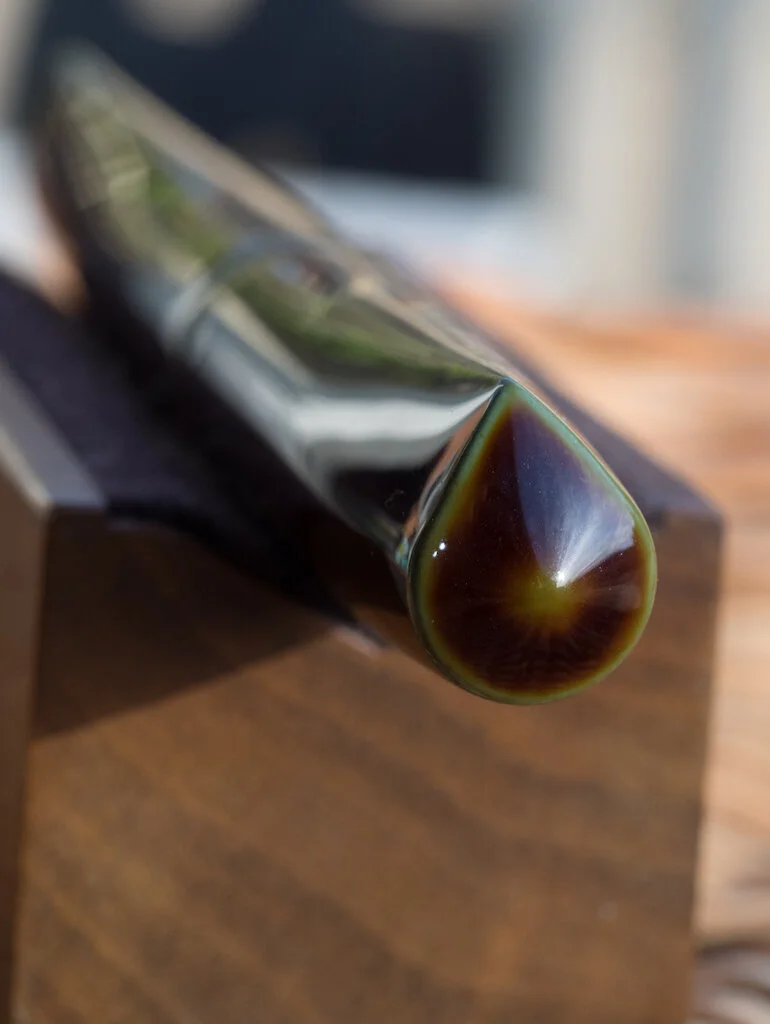
Heki-Tamenuri is a lovely urushi with organic, earthy tones of brown and green.

One of the reasons I chose the Dorsal Fin is because the model’s unique lines show off the underlying green urushi so well.

When you uncap the pen, you see even more of the green in the threads and grip section.

This pen is pure zen. It is perfectly balanced capped and uncapped, and it feels absolutely luscious in the hand. Urushi warms to your body temperature, so the pen becomes an extension of you. Writing with it is a simple pleasure.

For this Nakaya, I chose a medium-soft nib with added flex, ground to a stub by John Mottishaw. The Nakaya branding on the nib is gorgeous and the nib performs exactly as I hoped it would.

You can see the flex of the tines in this photo.

I inked the pen with Iroshizuku Tsukushi. I’ve found that Nakaya pens work especially well with Iroshizuku inks. This nib is wet and smooth. It is bouncy when writing without flex and it offers good line variation when you flex the nib.

The Nakaya Dorsal Fin 2 retails at $1,500 plus additional charges if you want nib modifications like mine. It’s obviously one of those pens you think about long and hard before purchasing. I’m absolutely pleased with my purchase. Not only is this pen a piece of beautiful art, it is one of my best writers as well.

You can purchase the Nakaya Dorsal Fin 2 from nibs.com. The Dorsal Fin 2 comes in various colors, including Heki-Tamenuri, Kuro-Tamenuri, Aka-Tamenuri, Midori-Tamenuri, Toki-Tamenuri, and various Ishime colors.

(I purchased this pen with my own funds after selling several beloved pens so I could afford this one!)


Enjoy reading The Pen Addict? Then consider becoming a member to receive additional weekly content, giveaways, and discounts in The Pen Addict shop. Plus, you support me and the site directly, for which I am very grateful.

Membership starts at just $5/month, with a discounted annual option available. To find out more about membership click here and join us!

Posted on March 13, 2020 and filed under Nakaya, Fountain Pens, Pen Reviews.

The Five Best Tools for Outlining Your Next Novel

(Sarah Read is an author, editor, yarn artist, and pen/paper/ink addict. You can find more about her at her website and on Twitter. And check out her latest book, Out of Water, now available where books are sold!)

Not every writer outlines, but many do--especially if there's a deadline involved. Outlining is very much a discovery process and employs just as much creativity as the writing itself. Sometimes the brainstorms involved can be messy. So what's the best way to keep those ideas roped into a useable order? Some proper stationery tools can help. Everyone's process is a bit different, so ymmv.

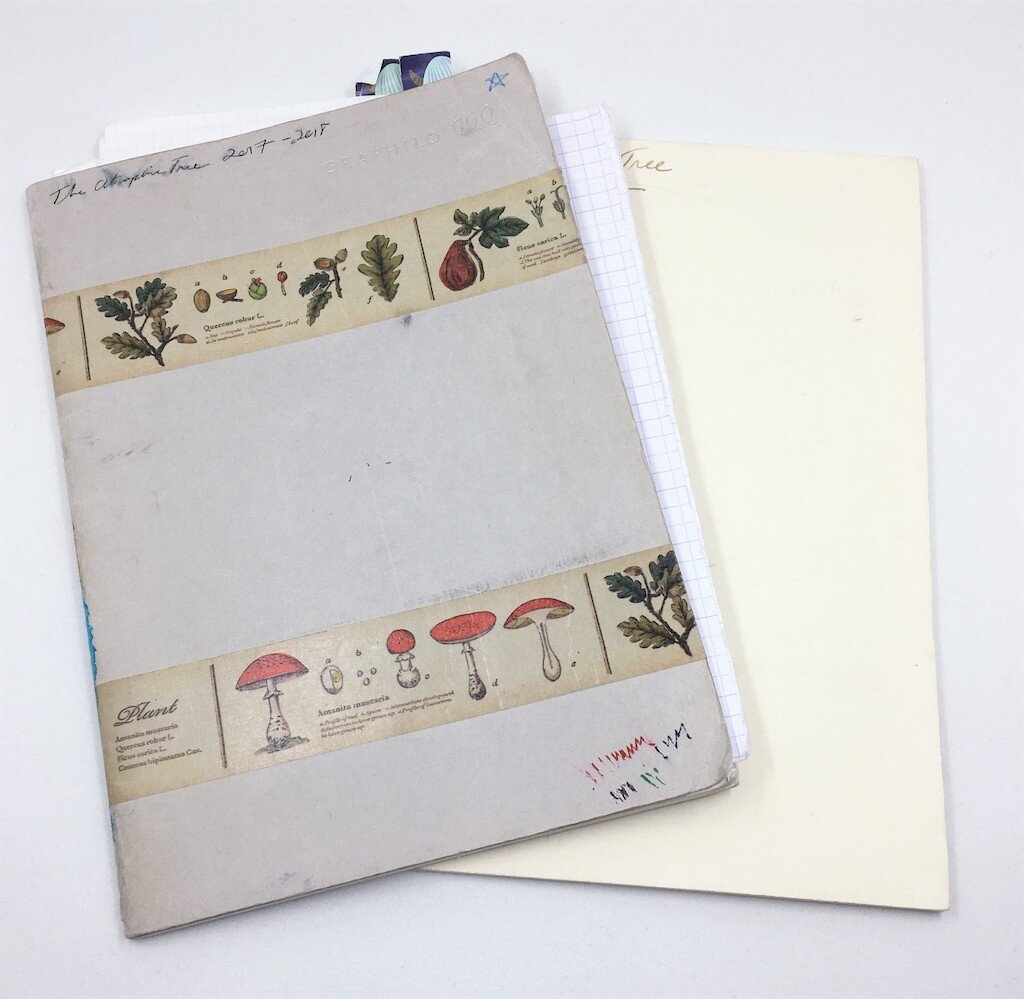
A good notebook. For my outlining, I usually use a slim book that becomes my planning, research, outlining, and editing guide for the whole project. That's a tall order, so it must be durable. It needs to last for years! My current one has been in use for two years and five months. Grid rule is ideal, if not essential. It allows you to easily level your indents for different sub headers. I prefer fountain pen friendly books, even though not every page will have fountain pen ink. My favorites so far have been the Graphilo and the Midori MD. Both have just enough pages for their purpose, while still being easily portable. I can slip the notebook in behind the back cover of the journal I'm writing the book in and carry them as a set.

A set of color-coding pens. It's very handy, when outlining, to be able to color code your notes. Whether it's by setting, character, timeline--all of these in conjunction... You may need only a few colors or a LOT of them, depending on the scope of your project. I would suggest a basic set of black, blue, red, and green at the very minimum. You can find those colors within many brands. But if you're penning an epic legend that spans generations of warring houses, you're probably going to need a set with more variety. I prefer gel pens, as it's easier to find large and varied sets with that ink type. My favorite ones to use are the Pilot Maica because of their bright colors, excellent flow, and fine tips that allow me to add notes to margins easily without cluttering the pages too much. Pilot Juice, Uni-Ball Signo, and Zebra Sarasa Clip are also excellent choices. You could use an array of fountain pens all inked with different colors of ink, also, but I found that the difference in line width between pens added some confusion to my notes. For example, pens that wrote more boldly seemed to be emphasized in the text when that information didn't necessarily need to be emphasized. Consistency of line width can be an important factor in keeping outlines tidy. Which brings me to my next point.

A bold pen for headers. When you're scanning your outline for important information, it can be very handy to have important key words and headers written boldly, so they're easy to find at a glance. Character names, places, themes, or scene headers might be good candidates for this. I use either a thick-tipped fineliner in black, like the Sakura Pigma Micron, or a fountain pen with a stub nib to add a bold emphasis to those notes. Either works, but try to stick to the same tool and color throughout, for ease of scanning.

Notecards. Writers love to follow outlines, but characters rarely do. Sometimes seeing the structure of your book on paper isn't enough. Sometimes whole scenes need to move or the plot structure needs to be adjusted. To do that, I recommend making a brief additional outline on notecards (sticky notes work, too) and spreading them out where you can rearrange and shuffle them as needed. Any scrap of paper will work, but my favorite tool for the job are the Nock DotDash note cards. They're fountain pen friendly and have a grid pattern on them, so they work great for mini scene outlines.

Highlighters. Even with color coding and bolding, you're likely going to need another level of emphasis. Maybe to highlight (literally) plot twists or foreshadowing, themes or critical character development. Highlighters are the classic best tool for the job. I don't care much for the typical marker-style chisel-tip highlighters. They do work, but too often I dislike the way they bleed through paper or smear ink. Neon colored pencils are good, but aren't as quick, since it takes some scribbling to cover an area, instead of one swoop. My favorite tool for the job are the Staedtler Textsurfer Gel highlighters, which are basically super-soft gel crayons. You can highlight in a smooth swoop, and the soft wax doesn't bleed through paper or smear ink. One downside, though, as the wax makes it impossible to write over that area again at all.

And of course, the non-stationery ingredient to this list is flexibility. Outlines are the best example of the "guidelines not rules" adage. You're in charge of your story and you can change your mind anytime. Make your story work for you. And if your outline isn't fitting, change the outline! I have three outlines for my current novel, where the story trajectory changed and I needed to re-route things. Maybe add some scissors and scotch tape to this list, too. And a glass of wine.

Tell me your favorite tools for planning your writing projects! Everyone's method is a little different, and I find them all fascinating.

(JetPens provided these products at no charge to The Pen Addict for review purposes.)
Posted on March 12, 2020 and filed under Gel, Highlighter, Index Card, Notebooks.