Yamamoto Paper Tasting Washi Vol. 1: A Review

Yamamoto Paper Tasting Washi Vol. 1 Review

(Susan M. Pigott is a fountain pen collector, pen and paperholic, photographer, and professor. You can find more from Susan on her blog Scribalishess.)

Back in May of 2020, I did a two-part review of the Yamamoto Fountain Pen Friendly Paper Collection (part 1 and part 2). I had a blast testing each type of paper and discovering that there's more to life than Tomoe River Paper (although there's that too)!

This week I'm reviewing a smaller collection of paper that Yamamoto calls "Paper Tasting." I love this expression, because, like wine, paper is a sensory experience that varies depending on the pens and inks you pair with the paper.

Although stationery addicts are familiar with washi tape, they may not know what washi paper is. I honestly didn't know what the difference between washi paper and other paper was. The term "washi" comes from "wa" (="Japanese") and "shi" (="paper"), thus "washi" means "Japanese paper." However, washi paper is typically made with natural fibers like kozo (mulberry) and gampi to give it texture and strength. (Source: https://japanobjects.com/features/washi-paper).

Yamamoto Paper Tasting

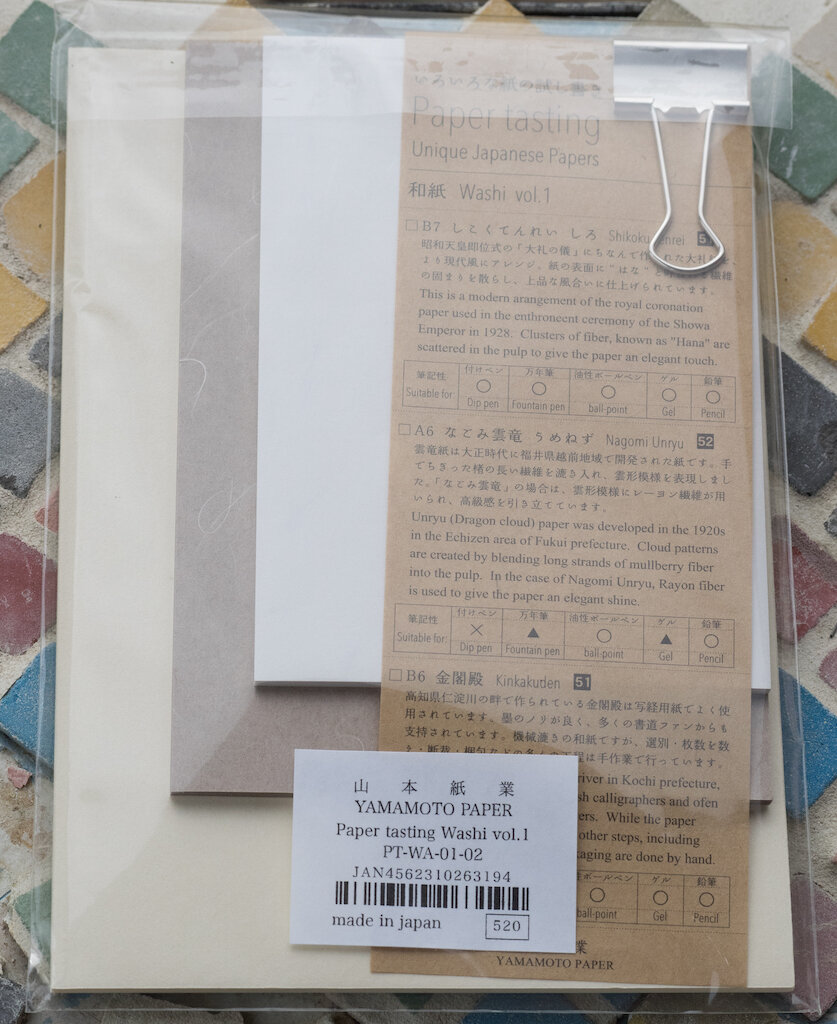
Washi Vol. 1 contains three papers: Shikoku Tenrei (slightly larger than B7 size: 90mm x 127mm/ 3.5 x 5 inches); Nagomi Unryu (slightly larger than A6 size: 110mm x 148mm/ 4.3 x 5.8 inches), and Kinkakuden (slightly larger than B6 size: 127mm x 181mm/ 5 x 7.1 inches). Each pad of paper is 25 sheets. In addition, the packet includes a pamphlet discussing the importance of paper grain, a binder clip, and a sheet describing each type of washi paper.

Shikoku Tenrei

Yamamoto Paper Tasting Washi Shikoku Tenrei

Shikoku Tenrei is the smallest of the three paper samples. It is ivory with bits of Hana fiber scattered throughout. Hana fiber has a shiny white/silver appearance difficult to capture in photos.

Yamamoto Paper Tasting Washi Shikoku
Yamamoto Paper Tasting Washi Shikoku Tenrei Hana Fiber

The paper is smooth to the touch--you cannot feel the Hana fibers nor will they catch on your nibs. I tested nine pens and inks on Shikoku Tenrei. The paper handled all of them flawlessly. I noted no bleeding of the ink into the paper and, although there is show-through, none of the inks bled through the paper.

Yamamoto Paper Tasting Washi Shikoku Pen Test
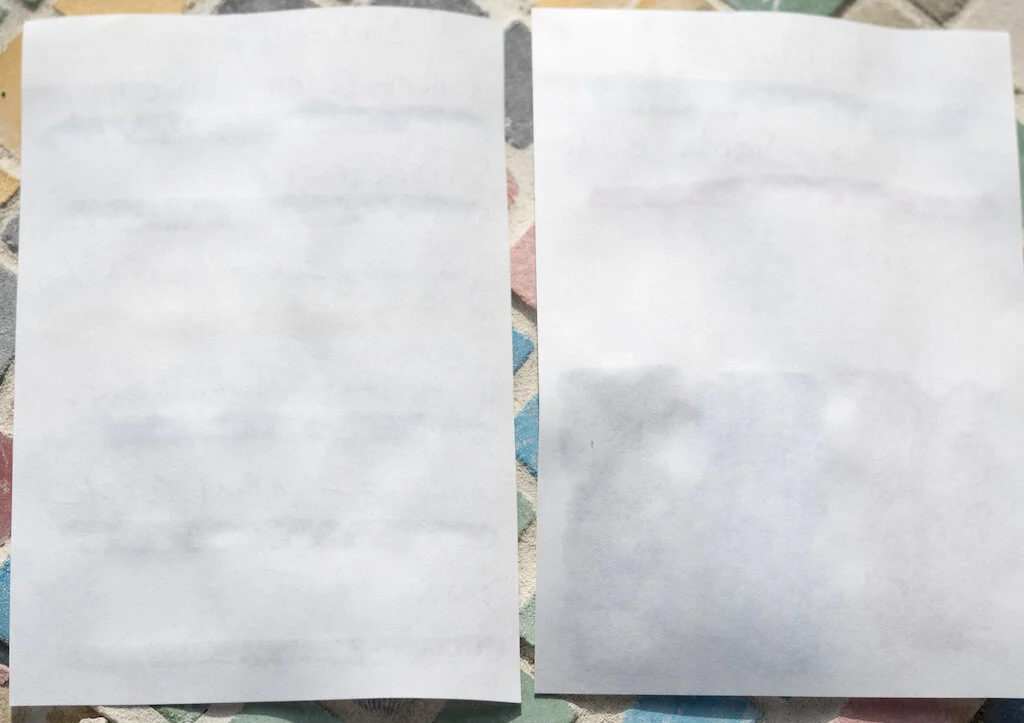
Yamamoto Paper Tasting Washi Shikoku Pen Test Back

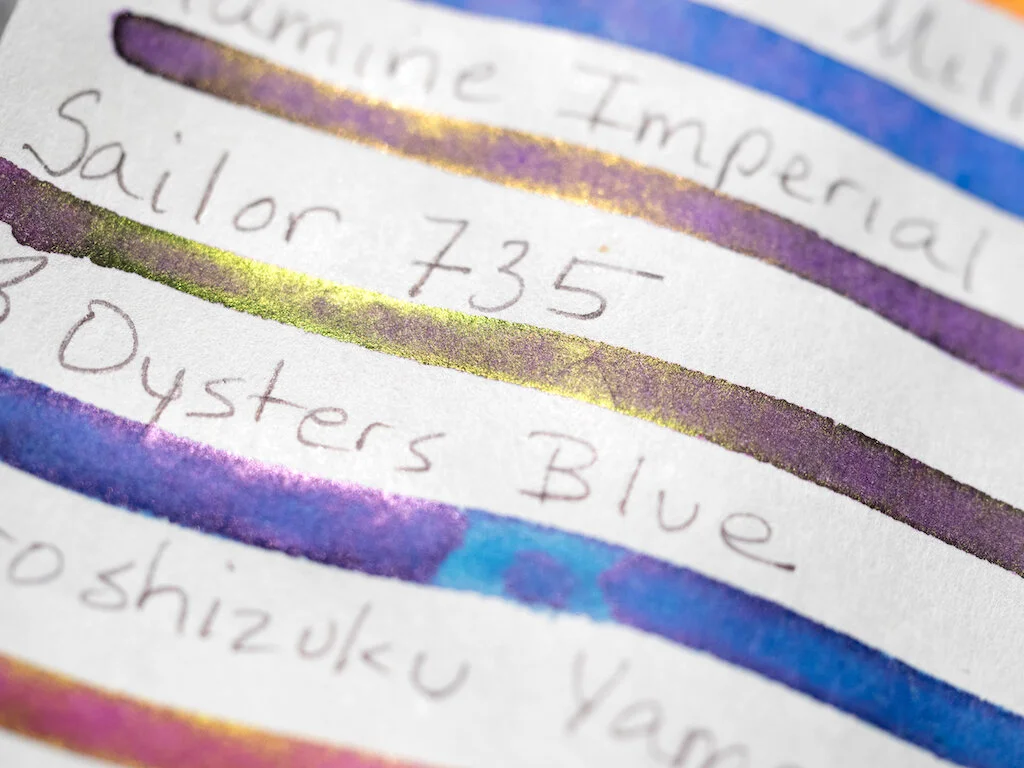
I also swatched eight inks with cotton swabs. Once again, the paper accepted the inks without any problems (no bleed through). This paper displayed sheen when it was present in the inks. One of the coolest effects was the Hana fibers shining through the inks.

Yamamoto Paper Tasting Washi Shikoku Ink Swatch
Yamamoto Paper Tasting Washi Shikoku Ink Swab Back
Yamamoto Paper Tasting Washi Shikoku Hana Fibers Shining

I really like Shikoku Tenrei washi paper. It deserves its role as royal paper, because it is elegant and beautiful. I'd love to have larger sheets of this for bookbinding, and it would make excellent stationery (though the B7 size is a bit small for letter writing).

Nagomi Unryu
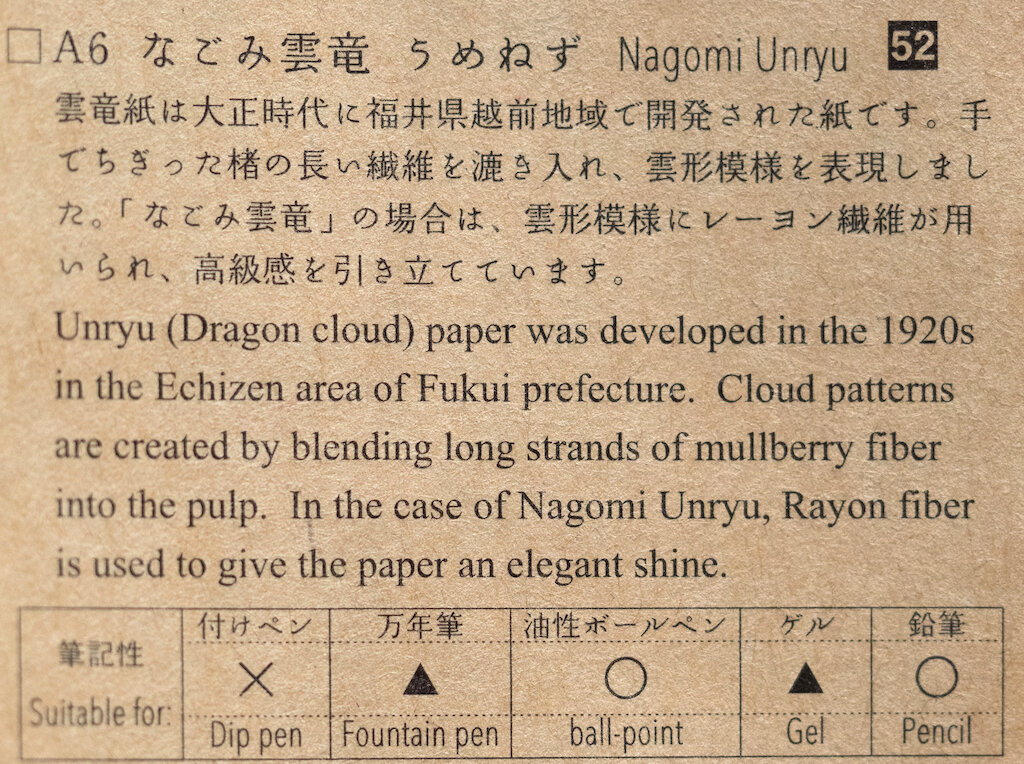
Yamamoto Paper Tasting Washi Nagomi

Who wouldn't love paper that is called Dragon Cloud? This brown, textured paper is embedded with rayon fibers that look like wisps of dragon breath. When you rub the paper between your fingers, you discover that the front side is smoother and the reverse side is more textured. The rayon fibers can be felt on both sides.

Yamamoto Paper Tasting Washi Nagomi Paper
Yamamoto Paper Tasting Washi Nagomi Rayon

Because this washi paper has so much texture, it does not work well with fountain pens, especially fine-nibbed fountain pens. When writing, the nib catches on the textured paper and can even pull out the rayon fibers. I noticed that the ink bled into the paper and whenever it touched the rayon fibers, it spread along them. However, the paper is thick enough that the ink doesn't show through at all. The paper does have a tendency to curl up after you write on it.
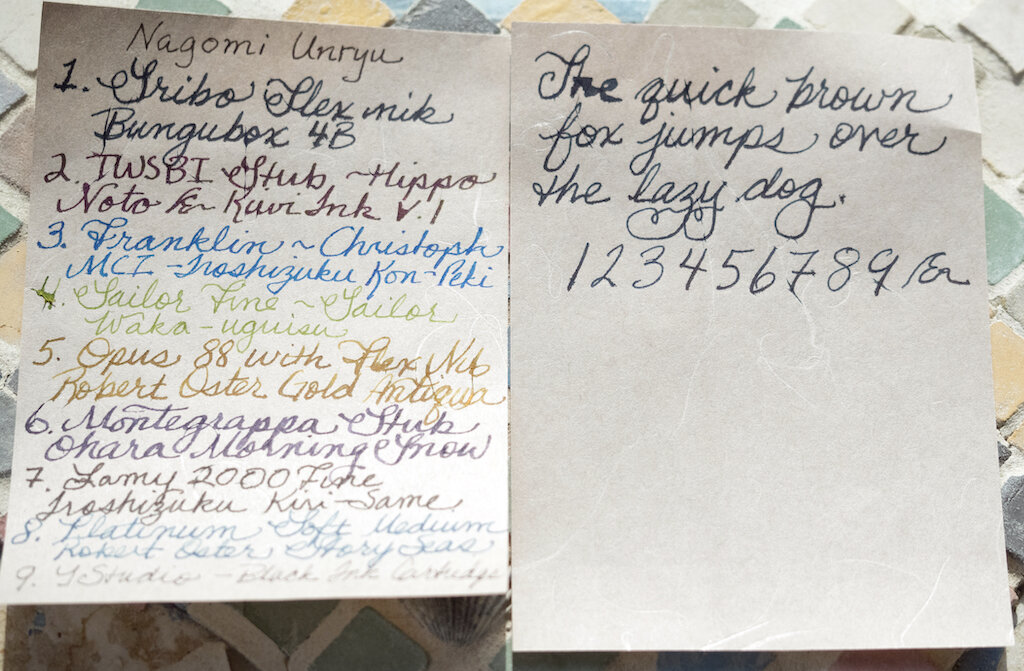
Yamamoto Paper Tasting Washi Nagomi Pen Test
Yamamoto Paper Tasting Washi Nagomi Pen Test Back
Yamamoto Paper Tasting Washi Nagomi Bleed
Yamamoto Paper Tasting Washi Nagomi Rayon Bleed

The paper handled most of the ink swabs well, except for Yama-Budo, which bled. Ink also spread along the rayon fibers. I thought the larger swab of Scribo Grigio was fascinating with the rayon fibers dancing through it.

Yamamoto Paper Tasting Washi Nagomi Ink Swab
Yamamoto Paper Tasting Washi Nagomi Ink Swab Back
Yamamoto Paper Tasting Washi Nagomi Rayon Spread
Yamamoto Paper Tasting Washi Nagomi Grigio

Nagomi Unryu is not a fountain-pen friendly washi paper, although it would be fine for regular pens and pencils. I think it is the most interesting paper in the set. With its dual texture and rayon fibers, it would work well as an art paper. I plan to try it with watercolors and ink/bleach splashes.

Kinkakuden

Yamamoto Paper Tasting Washi Kinkakuden

Kinkakuden was one of the papers included in the Yamamoto Fountain Pen Friendly Collection. It's a cream-colored paper with texture (but no obvious fibers like the other two papers in the set). If you hold the paper up to the light, you can see laid lattice marks (though this paper is made by machines, not by hand).

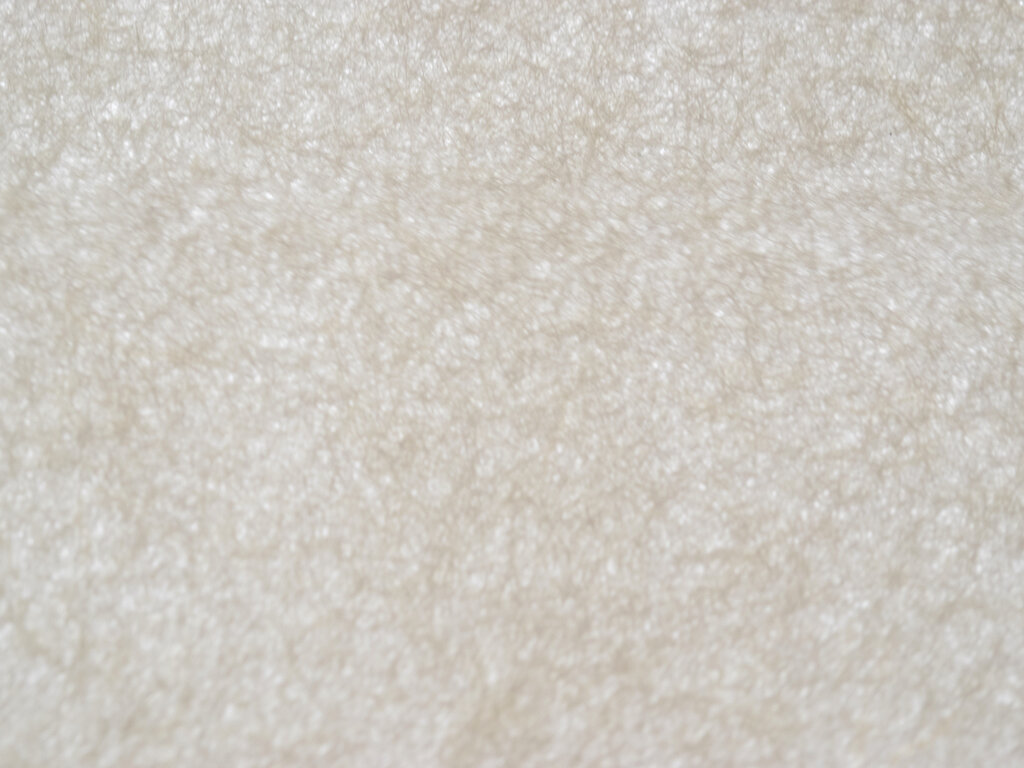
Yamamoto Paper Tasting Washi Kinkakuden Paper
Yamamoto Paper Tasting Washi Kinkakuden Texture

The paper has a smooth side and a more textured side. And, although there is texture in the paper, my nibs didn't catch like they did when I tested this paper back in May. It's possible I was writing on the side with more texture when I did my tests then. Ink does not bleed when you write and, although there's show through, none of the inks bled through the paper.

Yamamoto Paper Tasting Washi Kinkakuden Test
Yamamoto Paper Tasting Washi Kinkakuden Back
Yamamoto Paper Tasting Washi Kinkakuden Close

The paper is excellent for ink swabs. Unlike my previous test where the paper seemed to absorb sheen, it was quite obvious in this test on the smooth side of the paper. The paper does pucker beneath the wet swabs, but none of the ink bled through.

Yamamoto Paper Tasting Washi Kinkakuden Swab
Yamamoto Paper Tasting Washi Kinkakuden Swab Back
Yamamoto Paper Tasting Washi Kinkakuden Swab Close

Kinkakuden is a lovely paper that can be used as stationery or for journaling and calligraphy.

I am such a paper nerd that I want to get all the Yamamoto Paper Tasting sets. You can find the Washi Vol. 1 set at JetPens for $10.80. Other sets available are Eggshell Vol. 1, Onionskin Vol. 1, Translucent Vol. 1, and Silky Vol. 1. Since these are all labeled "Vol. 1," I'm sure we can expect more volumes in the future.

(JetPens provided this product at no charge to The Pen Addict for review purposes.)


Enjoy reading The Pen Addict? Then consider becoming a member to receive additional weekly content, giveaways, and discounts in The Pen Addict shop. Plus, you support me and the site directly, for which I am very grateful.

Membership starts at just $5/month, with a discounted annual option available. To find out more about membership click here and join us!

Yamamoto Paper Tasting Washi Review
Posted on January 29, 2021 and filed under Yamamoto, Papaer Reviews.

The Pen Addict Podcast: Episode 446 - We Are Now Under New Ownership

Feels good.

Feels good.

A new Retro 51 ownership announcement. A huge Sailor price increase. Presidential pens. Brad’s righty writing returns. It’s a jam-packed episode!

Show Notes & Download Links

This episode of The Pen Addict is sponsored by:

Pen Chalet: Click the ‘podcast’ link at the top of the website and enter the password ‘penaddict’ for this week’s special offer, and to get your code for 10% off.

Posted on January 28, 2021 and filed under Podcast.

Spring Semester Stationery Setup

School Stationery Setup

A new semester started for me this week, which means my life is once again ruled by school supplies! Last semester taught me a lot (I mean, school-wise, obviously, but also stationery-wise) about what works for me and what doesn't. I've made some adjustments from what I used before, kept a few things that worked well, and of course, got some new supplies. I'm only taking one class this semester (two was too much for a working mom with two kids home virtual learning, and I'm already glad I scaled back) but the format of this class is very different from the ones I took last semester, so some of my adjustments are based on predictions of what I think will work.

Roterfaden Taschenbegleiter

First of all, the Roterfaden Taschenbegleiter Bestseller is back for an encore performance. It worked great last semester, and I have once again put a Clairefontaine Art Deco A5 notebook in it for my class lecture notes, along with the same Nock Co A5 slim notebook to be my school admin notebook. Right now the third clip is empty. It may stay that way. This class is a literature survey, where we'll be reading, taking notes on, and discussing 22 novels. I was going to put my reading notes log in the third clip, but I realized a few things. One, I'm going to need a lot of pages for taking notes on 22 books. Two, I'm going to need something that I'll take with me everywhere. Three, I don't need to take my lecture notes with me everywhere--those typically stay on my desk. So I opted for a separate notebook.

Leuchtturm1917

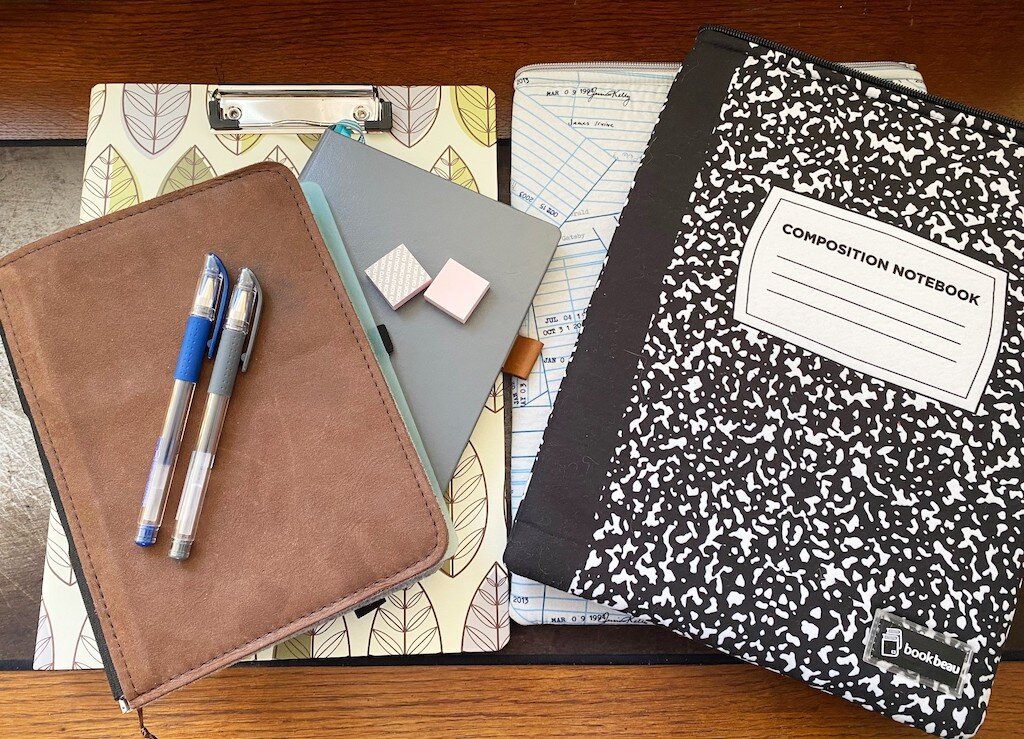
My reading notes book is a Leuchtturm 1917 hardcover. The index and double ribbon make it perfect for this purpose. We're reading 2 books a week, so they can each have their own ribbon. I started reading the books over break, but not in the order we're going to discuss them, so having an index is very helpful for quick reference. I can carry this notebook with me, along with whatever book I'm reading. I also added a Traveler's Company clip-on pen loop, so I can keep my pen handy.

I'll carry them in these great padded book sleeves by Book Beau. I've used them for a while now, and found that they work even better for school than they did for my personal reading. They're designed to keep your books safe and protected in your bag, but I find them useful for also carrying reading supplies. With this larger size, I can fit a thick hardback novel, my reading notebook, and a few pens or highlighters, and sticky notes. That way I have a self-contained reading kit that I can grab and go.

Greenroom Clipfolio

Last semester I used a clipboard for reading my academic article print-outs, but often found that I had more reading than would fit on the clipboard, leading to a complicated folder system that didn't quite work. I dug out this Greenroom Clipfolio to try and address that problem this time. The generous interior pocket should hold some hefty textbook chapters, and I can clip whatever piece I'm actively reading to the front.

Midori Sticky Notes

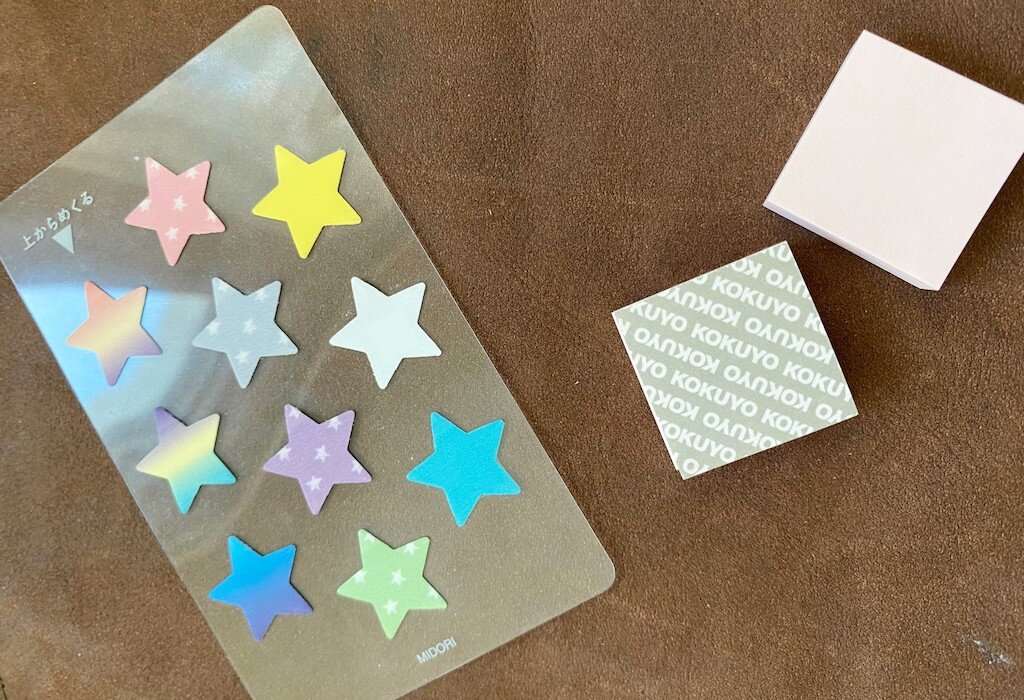
Last semester I read about 1500 pages of textbook and academic articles per week, and I went through two to four highlighters every week, for fourteen weeks. I can already tell that this semester my staple school supply will be sticky notes/page flags. I've been using the Midori film star sticky notes for my reading so far, and I'm using about 50 flags per book. I'm almost out already and class just started. I have a JetPens cart full of sticky notes--five different brands, so I can compare them.

Uni-ball Signo DX

Highlighters don't work great in novels. I'll be using them on the printouts, but for underlining and making notes in the books themselves (yes, I'm doing this, don't hate) I'm using Uni-Ball Signo DX pens in the .38 mm tips. They're fine enough for writing notes in small book margins, but the ink is saturated enough that the underlines are easily visible. They're also tiny enough to use in my planner.

Hobonichi Weeks

I decided to downsize from an A5 planner to the Hobonichi Weeks this year. I've found that, like goldfish, my to-do list will expand to fill the space allowed. I'm hoping that by keeping my planner space minimal, I'll learn to see that the day is full when the space is full and stop trying to add more tasks. That's really not working so far. Instead I'm just running out of space for all the stuff I have to do. But I'm going to keep at it--training brains can take time.

Bookmark Washi

As a side tip, if you use a Weeks and have a zipper case like mine, you're probably also mad about the ribbon bookmarks. Ribbon bookmarks and zipper cases are not compatible! The stationery world has not learned this, yet, somehow. What I do is take a strip of washi tape, and tape the ribbons to the outside of the back cover, so they're tucked inside the cover sleeve. Then I use something else as a bookmark, like the Weeks pencil board, or the Midori clip bookmarks. It works much better than trying to extract shredded ribbon from zipper teeth ten times a day.

That is my setup for this semester! As always, it's subject to changes on-the-go. Sometimes I'm tempted to stick with something that isn't working, just for consistency's sake, but if there's anything I learned in 2020, it's how to change plans.


Enjoy reading The Pen Addict? Then consider becoming a member to receive additional weekly content, giveaways, and discounts in The Pen Addict shop. Plus, you support me and the site directly, for which I am very grateful.

Membership starts at just $5/month, with a discounted annual option available. To find out more about membership click here and join us!
Leuchtturm Pen Loop
Posted on January 28, 2021 and filed under School Supplies, Stationery Carry.