(Kimberly (she/her) took the express train down the fountain pen/stationery rabbit hole and doesn't want to be rescued. She can be found on Instagram @allthehobbies because there really are many, many hobbies!.)
Sometimes I look down at the pile o’ goodness that the Bossman sends me and try to figure out what to play with that is both interesting to me and to you. Most of the time, it is difficult because I’m paralyzed with so many choices! Should I review an ink? Maybe a notebook? Or a new pen? Well, this time, it was a pretty easy choice because I found TWO things that I wanted to play with, so lucky you, you’re gonna get a 2-for-1 quick look today!
I have a bottle of Kakimori 08 Zabun, which is a pigmented ink, and Kakimori Letter Paper. Thank you to Vanness Pens for sending these for review.
Zabun is one of 10 pigmented inks in their classic line from Kakimori and comes in an adorable 35ml bottle. These ink bottles were designed by Makoto Koizumi, who wanted them to look like falling drops. It’s easier to show you than describe but imagine a big round drop of glass with a flat base, but rather than an opening right at the top, it’s off to the side, making it look a little tipsy or lopsided, but in a cute way. The nice wide opening is at an 8-degree angle from the top, making it perfect for dipping as well as inking up pens/converters.


Unlike dye-based inks, pigmented inks are meant to be water, fade and smudge- resistant. It is not an iron gall ink, so it can be used safely in pens with steel as well as gold nibs. Also, because it is pigmented, you should always shake up the bottle prior to inking up a pen to evenly disperse the pigment. Lastly, pigmented inks are mixable, so if your inner alchemist/artist/colorist wants to try making other colors of pigmented ink, have at it - just be sure to use a separate clean vial/bottle for the mixing so you don’t contaminate the original colors.
Because it is meant to be water resistant, pigmented inks may be more difficult to clean out your pen if you leave it unused for a long time, or if it has dried out. Since I don’t always get a chance to rotate my pen usage as much as I’d like, I decided to ink this up in a converter (in case it permanently stains it).

I wrote a few lines on HP 28lb laser jet paper and let the ink dry before running water over it for 15 seconds.

This is what it looked like after I put the wet paper on the counter. Definitely water-resistant!
On Col-o-ring cards, you can see that it is a nice dark teal. I used a Woodshed Pen Company teal demonstrator with a Franklin-Christoph Medium nib for the writing sample. You can see that it is a nice dark teal - neither too green nor too blue. It has average flow, maybe even a teensy bit on the dry side, resulting in a little bit of shading on both the Col-o-ring cards and the Kakimori letter paper.

I put the Col-o-ring cards on the Kakimori letter paper to show that the latter has a slight cream tinge to it.
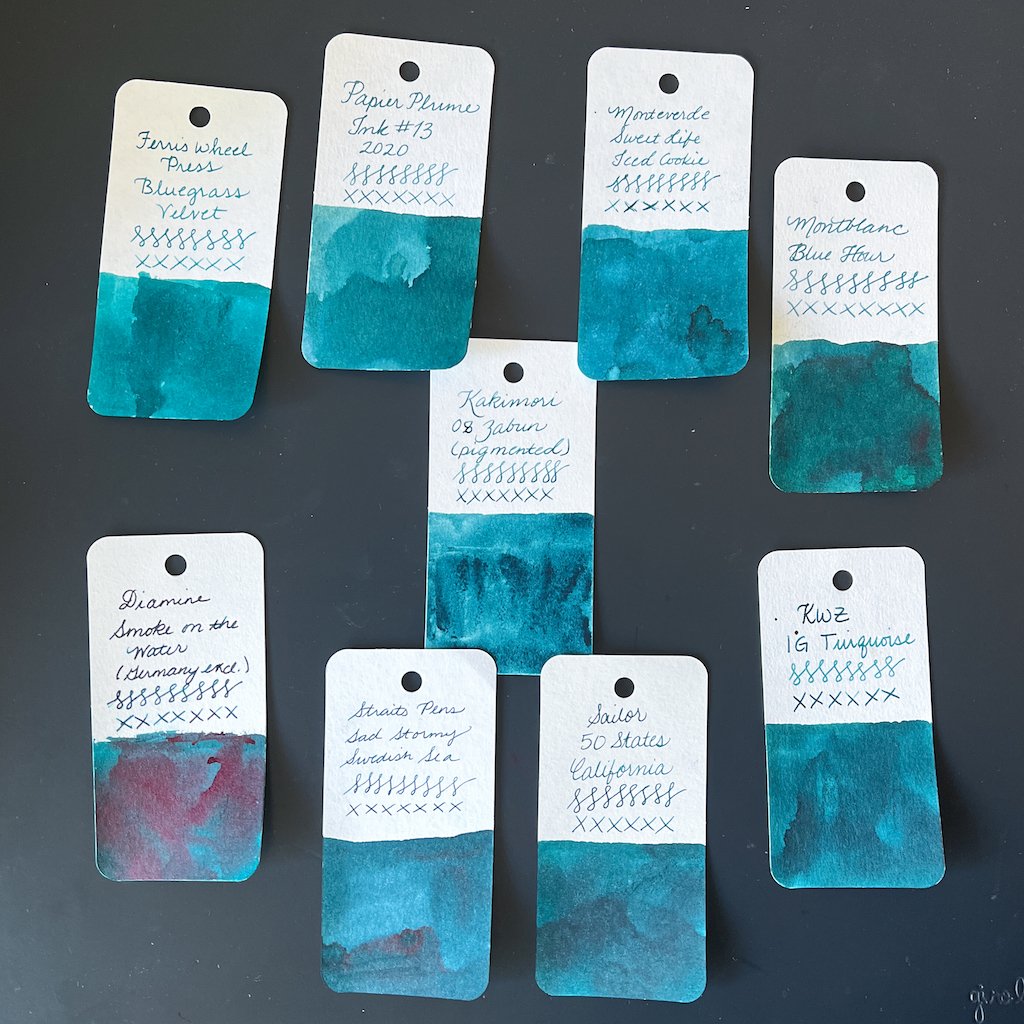
Similar inks include Ferris Wheel Press Bluegrass Velvet, Papier Plume Ink 13, Monteverde Iced Cookie, Montblanc Blue Hour, Diamine Smoke on the Water (minus the sheen), Straits Pens Sad Stormy Swedish Sea, Sailor 50 States California and KWZ IG Turquoise.
Zabun dries fairly quickly on the Exacompta index card as well as the Kakimori letter paper. It might take a touch longer on more slick papers like Tomoe River, but I didn’t really notice much of a difference for dry time.

Dry time was about 30 seconds on this yellow index card (it’s not my bad lighting this time, lol)
On to the Kakimori letter paper! The paper is blank with teal colored lines and swirls on the top and a single line at the bottom with a small Kakimori logo in the lower right hand corner. The paper is B5-sized and has a laid texture, where there are fine “lines” running across the page both horizontally and vertically. These lines feel like little bumps and can help you write straight without a guide sheet, but it can also be distracting when writing with fine or extra fine nibs as you may feel each bump with up/down strokes. The “front” side of laid paper is the side with the texture. In addition, there is a watermark which will indicate which is the writing side - if you hold it up to the light, you can see the watermark of the word “conqueror” (its placement is random on each sheet). The reverse side is smooth by comparison, but not like Tomoe River or Cosmo Air Light.
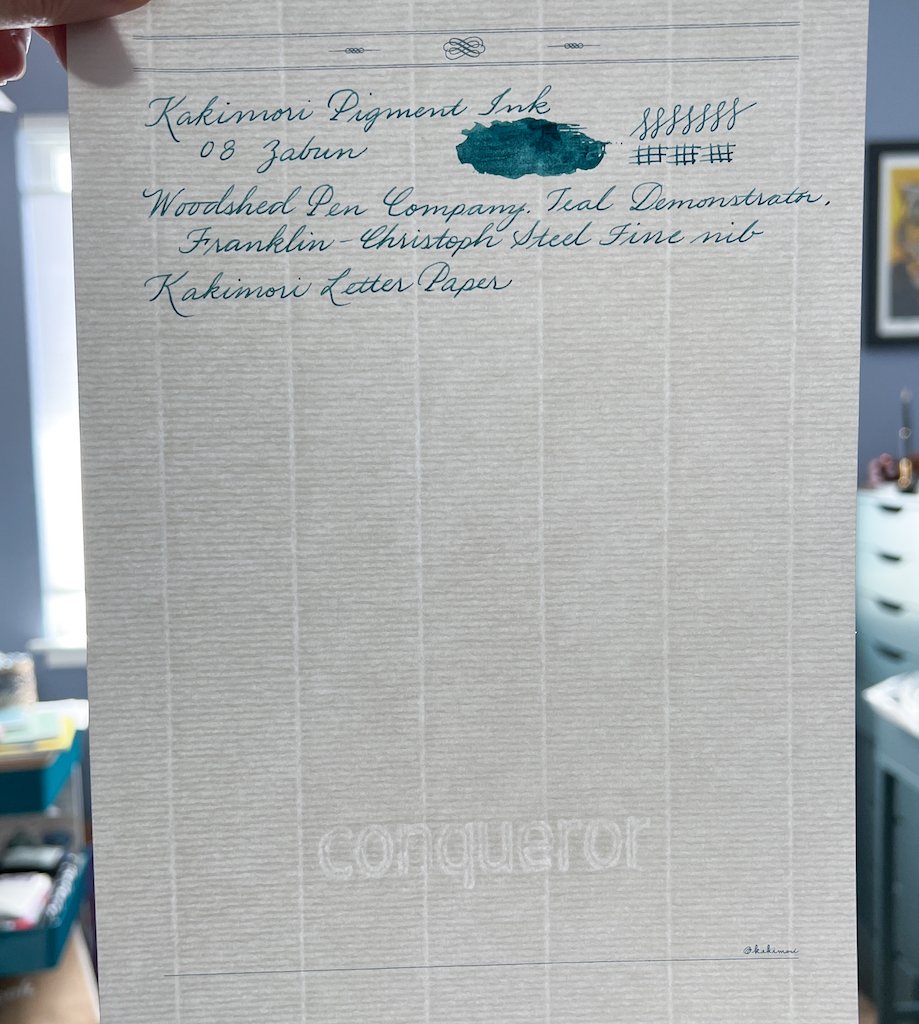
It’s a lot easier to see the laid texture as well as the watermark if you hold it up against the light.
It took me a bit to get used to the texture but it was nice not having to use a guide sheet or rely on preprinted lines/dots. The paper held up nicely to a variety of pens, nibs and inks. It handled dye-based inks (what we’d all just call “ink”), this Zabun pigmented ink, shimmer ink as well as a sheening ink, though the paper seems to have soaked up most of the sheen. Other than the bottom swatch where I released a drop of ink from the converter onto the page and smeared it onto the paper, there was really no bleed through, which is impressive. Even then, it barely bled through to the other side.

I didn’t see any feathering with any of the writing samples.


All of the inks looked fine on the page, too.

Barely any ghosting on the back even with the ink swatches.
The Kakimori letter paper comes either as 6 sheets to a pack for $5, or 3 sheets and an envelope in the letter set for $6. This can add up very quickly, especially if you have a lot of penpals or are long-winded like me. But if you wanted something a little more special, this would be a great option. And if you wanted a nice pigmented ink to address your envelopes for rainy season or perhaps use for art or just because you like the color, the Kakimori pigmented ink, at $30 for a 35ml bottle, is also an excellent but somewhat pricey option.
(Brad purchased this product at a discount from Vanness Pens for review purposes.)