(Kimberly (she/her) took the express train down the fountain pen/stationery rabbit hole and doesn't want to be rescued. She can be found on Instagram @allthehobbies because there really are many, many hobbies!.)
The question “should I get a Vanishing Point?” is asked often enough that I think it merits its own little article. Not because it’s particularly difficult to answer but because it’s not a one-size-fits-all kind of answer. Still, this is meant to be a “quick” comparison, so let’s get to it!
The Pilot Vanishing Point was first introduced in the early 1960s as the Pilot Capless. It is still called the Capless in the Japanese market and a few others as well. As the name implies, it is a pen that does not have a cap. Carmen Rivera has written a short history of the Pilot Capless with links to the many variations of the pen up until 2010. I will be using the term “Capless” for this group of pens that don’t have caps, and “Vanishing Point” for the specific model of that name. There are a lot more models of the pen that I don’t have, so I will be focusing on the most commonly discussed models - (1) Vanishing Point (AKA “VP”), (2) the Decimo, (3) faceted VPs and (4) the Fermo.
The VP in its current form, as well as the faceted ones (which were released in the 80s) and the Decimo, use a knock, push button or “clicker” atop the pen, which extends and retracts the nib. This allows the user to quickly make notes without dealing with capping and uncapping a pen, and by extension, or dealing with what to do with said cap. You can imagine how handy this is if you’re not at a desk, like a doctor who needs to take notes while standing, or if you just need to write a few words or check off a todo list. The Fermo requires you to twist the back end of the pen to extend and retract the nib.
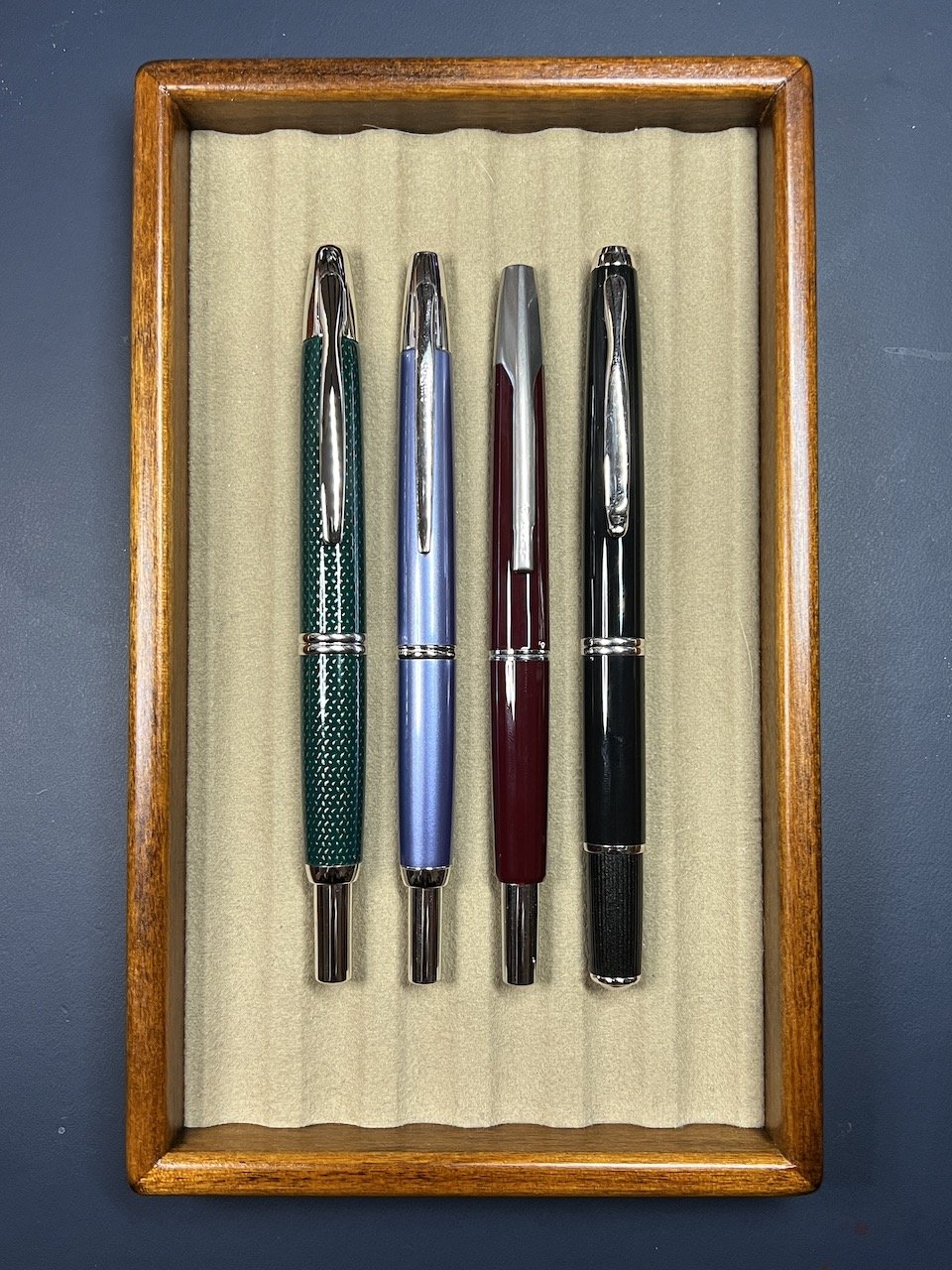
L to R: Vanishing Point, Decimo, Faceted VP, and Fermo.
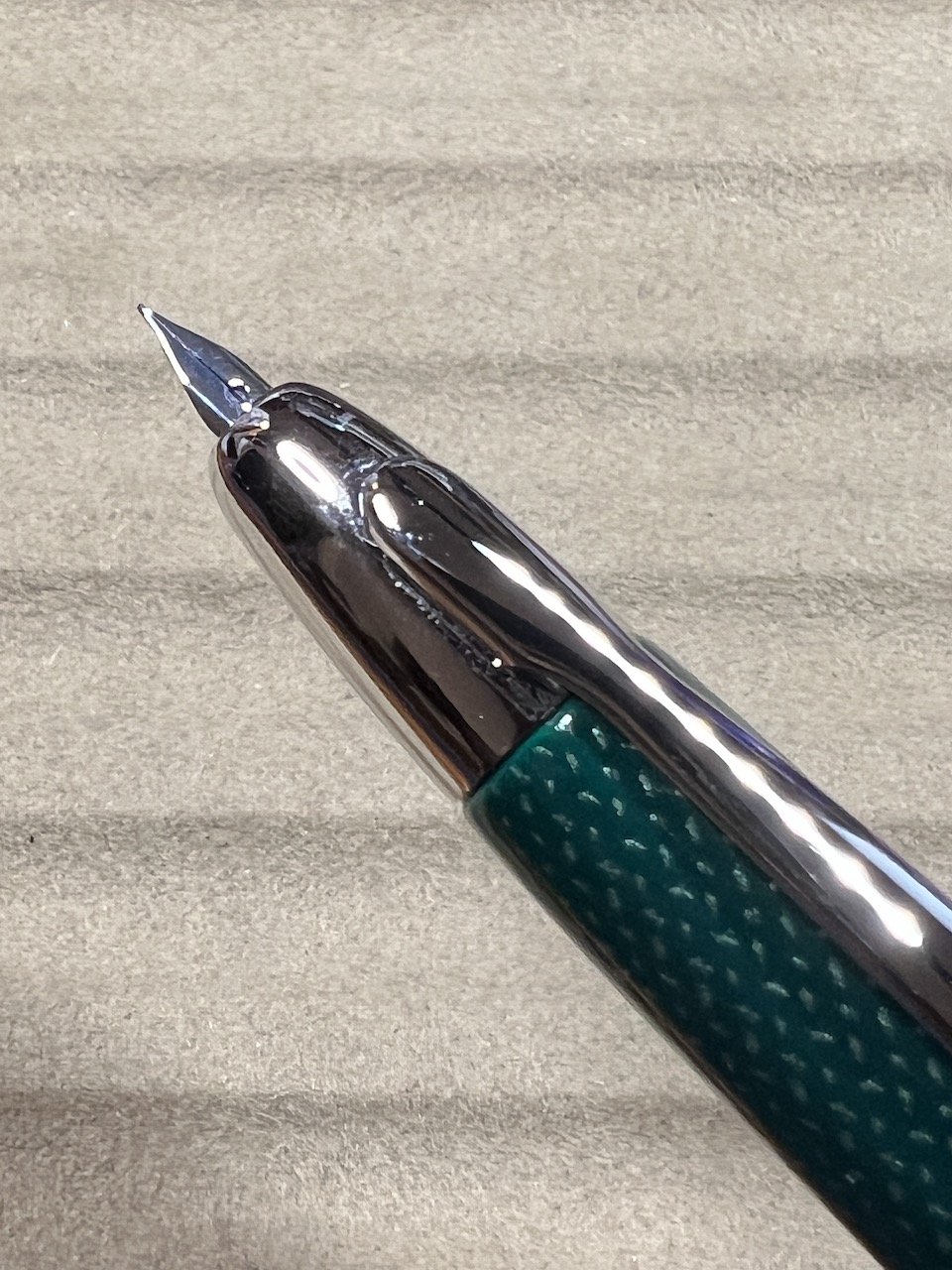
The Capless nib extends a short distance from the tip of the pen.
As you can see, once the nib has been extended, the user holds the pen down by the clip. This may or may not be comfortable depending on how you grip your pens.
All 4 of the Capless pens have clips on the nib end of the pen, but they are all slightly different in shape as well as profile, so one model may be more comfortable for you than another. The Fermo also feels slightly more back-weighted than the others because the twist mechanism is in the back of the pen. I don’t find it uncomfortably back-weighted but it’s something to consider if you tend to dislike that in a pen. The twist mechanism of the Fermo makes it quite unwieldy to operate single-handedly (I was unable to smoothly extend the nib one-handed, but retracting it was easier).
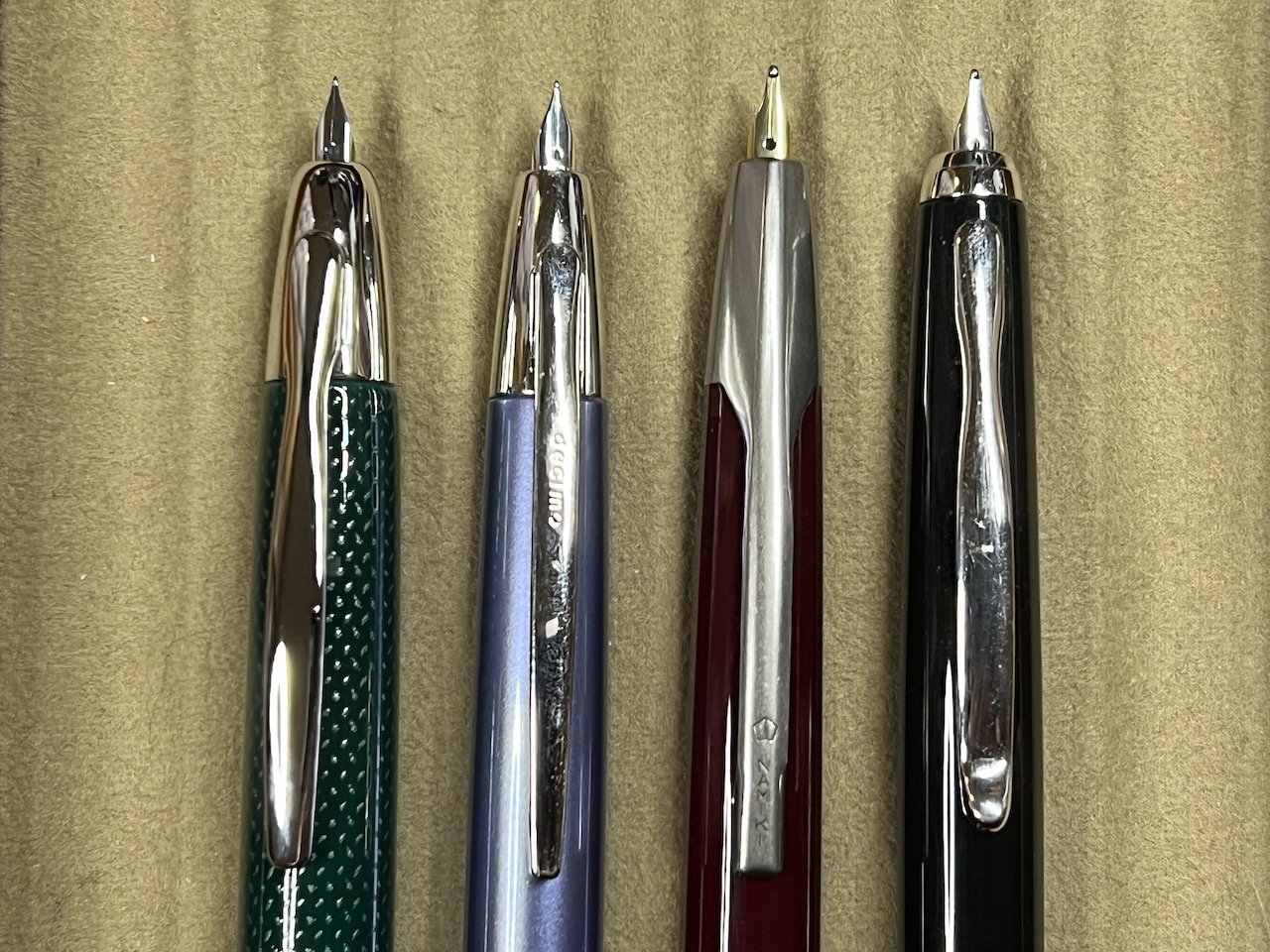
Closeup of the grips/cliips of the VP, Decimo, Faceted VP, and Fermo.
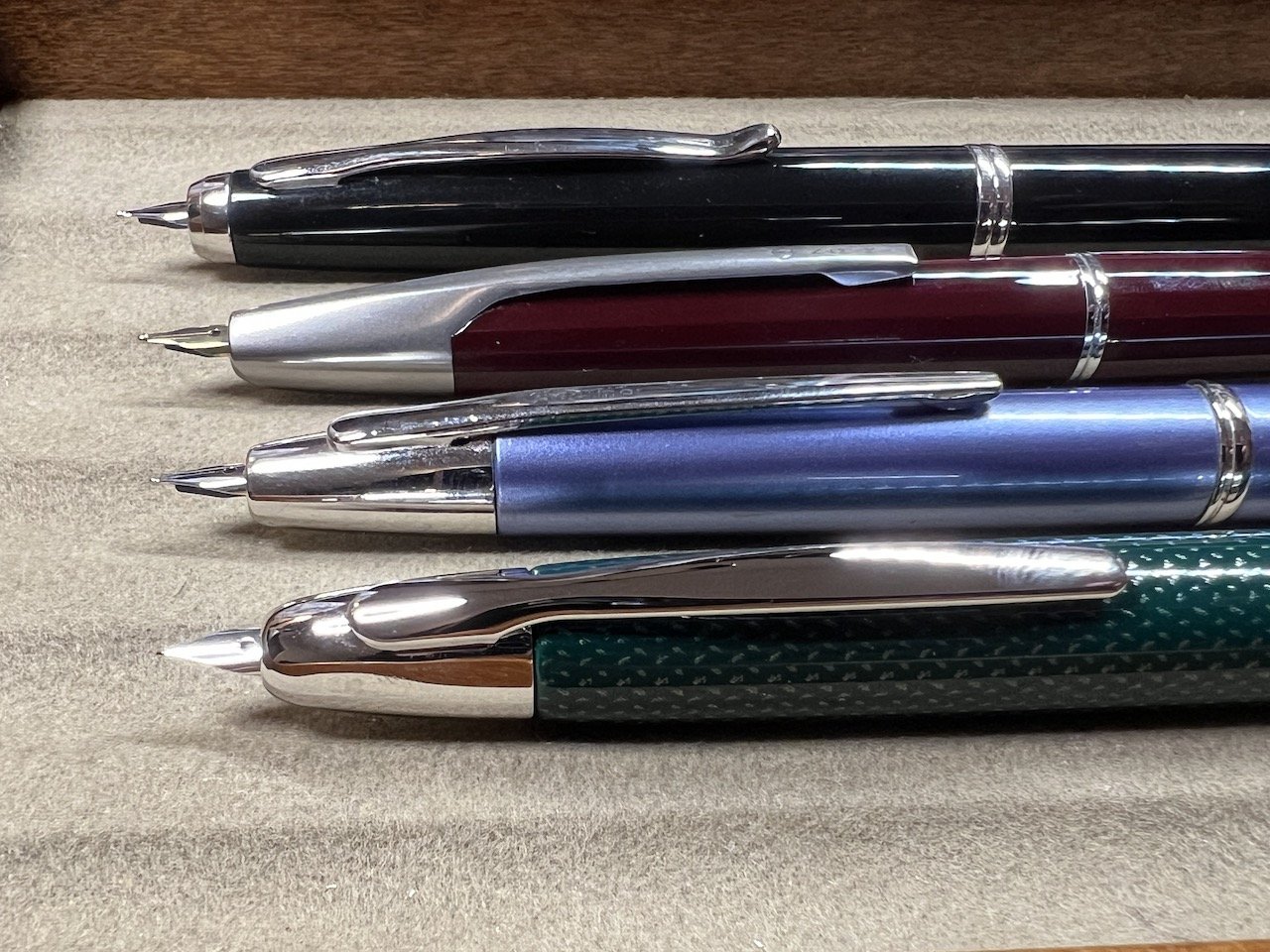
Profiles of the VP, Decimo, Faceted VP and Fermo.
I have included some similarly sized pens but am showing them uncapped since that’s the best way to compare them with the Capless.
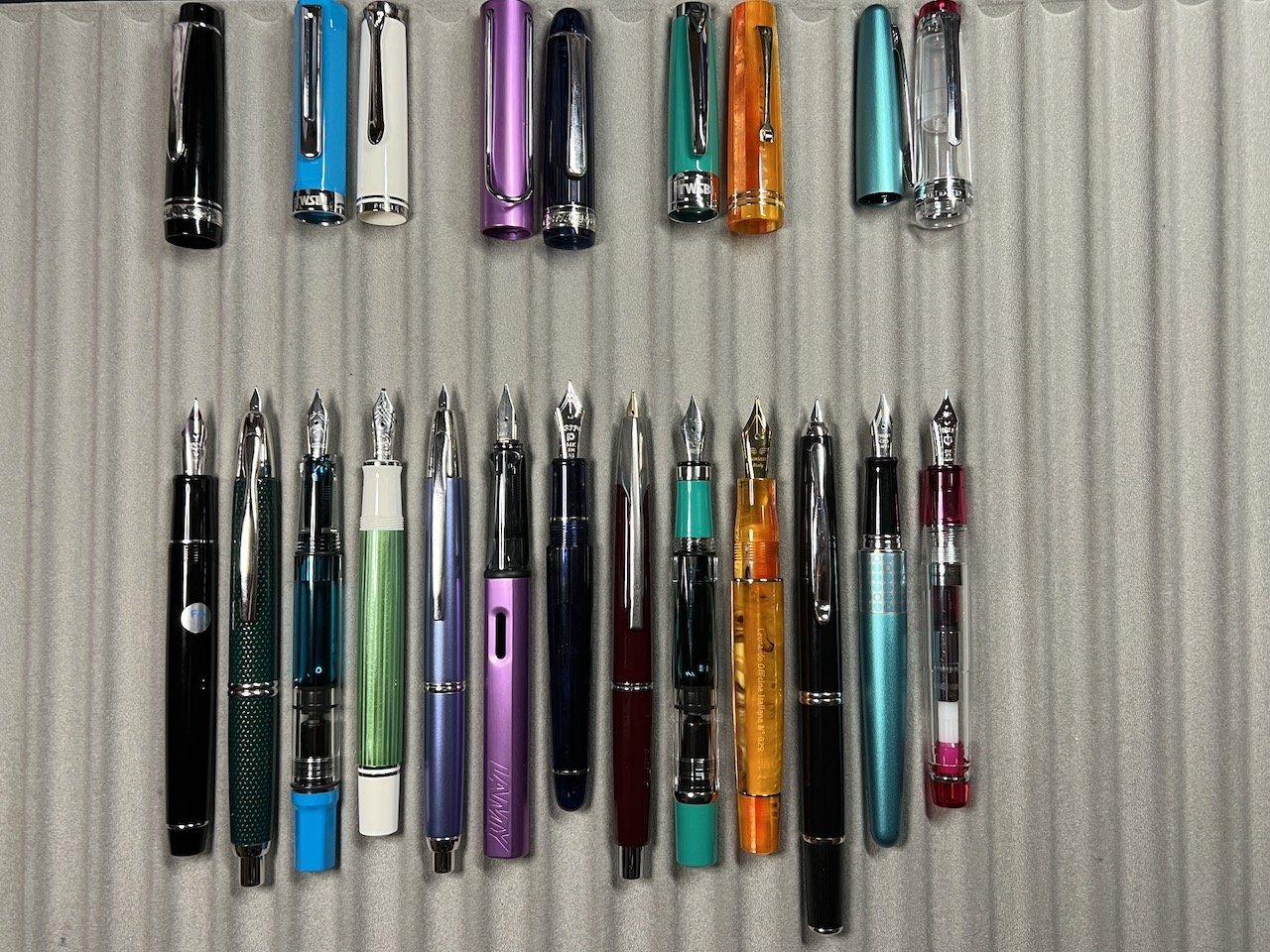
L to R: Pilot 912, VP, TWSBI Eco, Pelikan M605, Decimo, Lamy AL-Star, Platinum 3776, Faceted VP, TWSBI 580, Leonardo Momento Zero, Fermo, Pilot Metropolitan, Sailor Pro Gear.
“But Kimberly”, you say, “how will I know if the Capless will work for me and if so, which one would work the best?” If you own or have access to a Pilot Metropolitan (or MR), I have a hack for you! Flip the Metro around such that you are gripping it at the cap/clip end and see if it works with your grip! The VP is slightly girthier than the Metro, and the Faceted VP, Fermo, and Decimo are slightly slimmer.
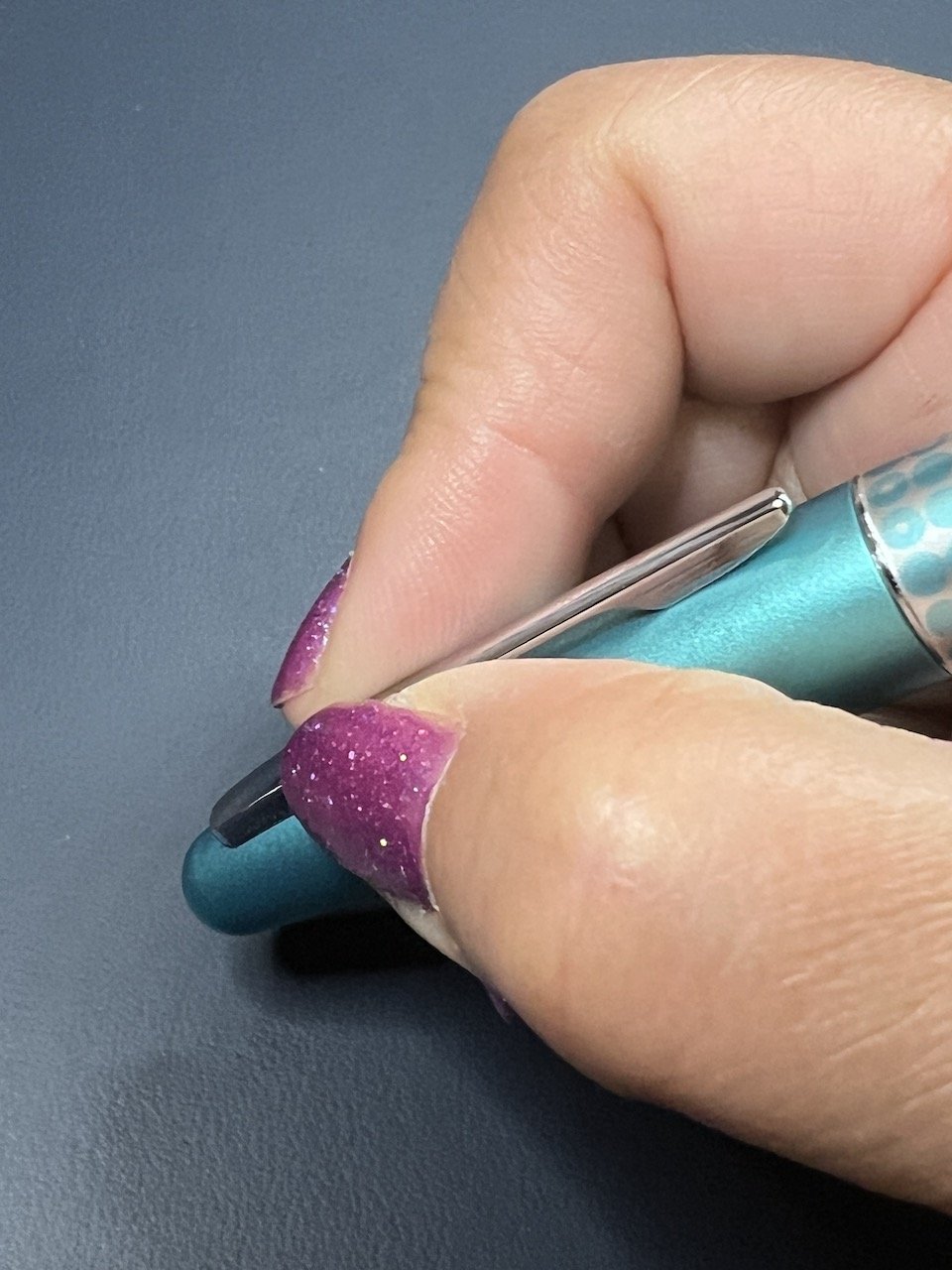
”Turn it on its head” and pretend you can click it!

A few different grip positions in relation to the clip (I grip my pens like the top left, my husband more like the top right and my son bottom left.)
The recent LS Capless also uses a knock to extend the nib, but a twist to retract it. I don’t have this one because (1) it is quite a bit more expensive than a regular Capless and (2) I don’t like the thought of two different mechanisms for extending and retracting the nib. And if you think that one is expensive, don’t even bother looking up the one that was a collaboration with Hermès (yes, that one), called the Nautilus which employs a twist mechanism that is extremely smooth and satisfying to watch. And no, I don’t have that one either, and if you Google the price tag, you’ll know why!
Compared to pens with an actual cap, the Capless’ trap door doesn't have as tight a seal, so you may experience a little bit of drying if you don’t use the pen regularly. It is also more noticeable if you use dryer inks. For this reason, I try to use my Capless pens a little more frequently than my capped pens and I use wetter inks like Iroshizuku.
Other random tidbits:
- Faceted VPs are long discontinued - These pens have been discontinued for quite some time (more than 20 years) but I included them in this review because they pop on the secondary market and are sought after because people often find their clips to be less intrusive. They came in 5 colors (black, blue, green, burgundy – all with silver trim, and black matte with black trim).
- Fermo discontinued? - I have heard that the Fermo has been discontinued but I don’t know that definitively. You can still find them new from both the Asian markets as well as here in the states.
- Alloy nib VP - Though not officially sold outside of Japan, Pilot has made VPs available with a steel alloy nib, instead of gold. This is most often found on eBay or Amazon and is a $100 way to find out if the pen is for you.
- Swappable VP units - For the most part, the nib units on the various capless models are swappable. However, some of the vintage models may not take the current VP units as they are a bit too girthy, so keep that in mind.
- Metal Cartridge cap - The “clicky” Capless pens (aka, not Fermo) come with a metal cartridge cap, which you should use over your cartridge. Otherwise, the repeated clicking may result in a damaged cartridge and an inky mess.
- Special Editions - Pilot releases a special edition VP every year like the 2019 Tropical Turquoise or the 2016 Guilloche. Pilot often makes special Japan-only or store-exclusive releases that are unavailable elsewhere. Those often command a premium because many of those stores do not ship outside Japan or require you to purchase them in store.
- Other retractable pens - I know that Majohn has recently released their A1 and A2 versions of the Pilot Vanishing Point and faceted VPs. I have heard good things about them but I don’t have either one to compare them to. There’s also the Platinum Curidas and the upcoming Endless Creator, but I decided to keep this article focused on the Pilot retractables.
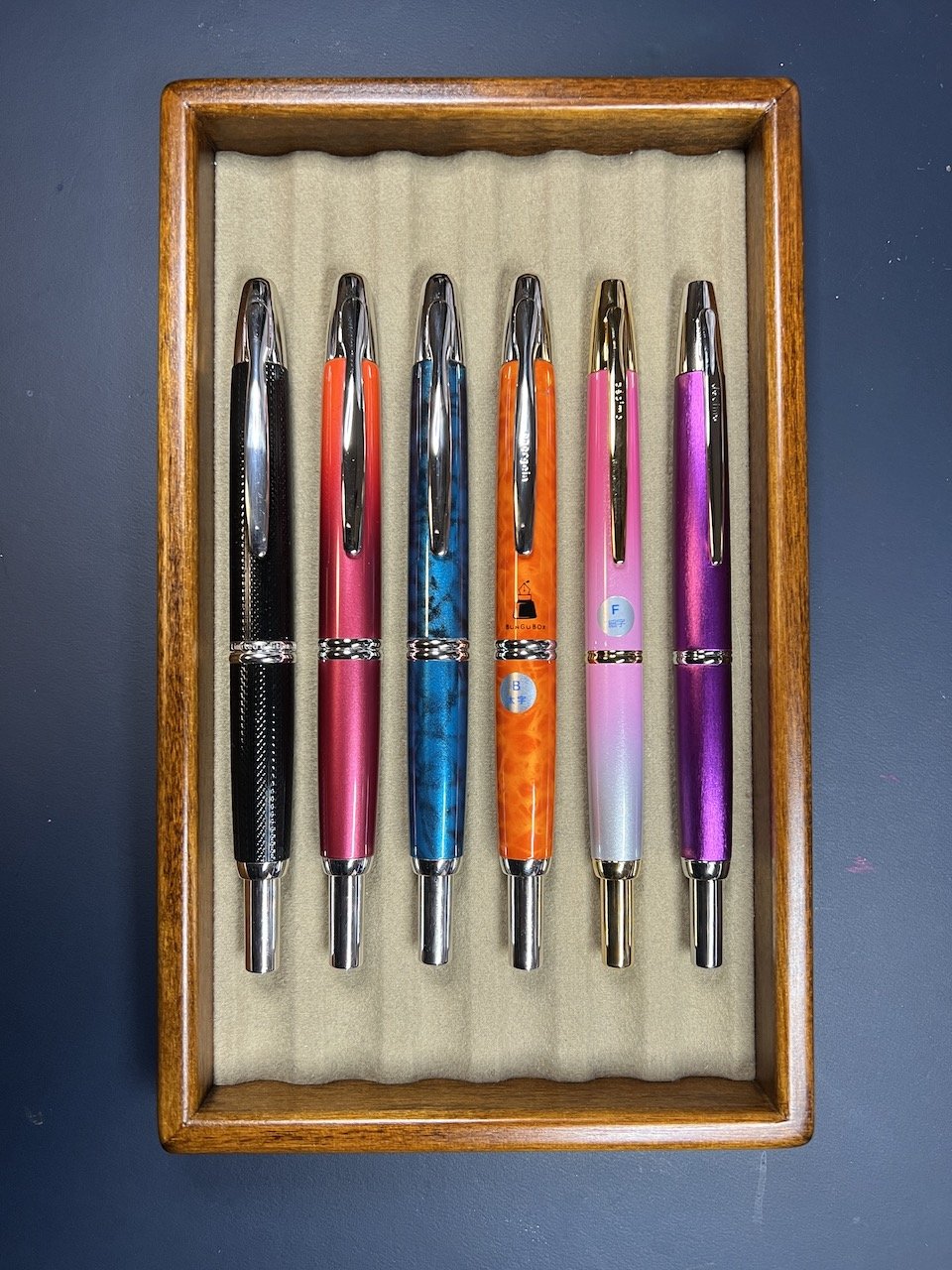
Some special editions including the 2016 Guilloche, 2017 Crimson Sunrise, 2019 Tropical Turquoise, Bungubox Energia VP, Nagasawa Kobe Gradation Decimo, Brushed Aluminum Decimo 20 colors in Purple.
The Pilot Vanishing Point has a retail/street of $210 USD & $168 respectively, while the Decimos are $200/$160. VP nib units are $134/$107. The Fermo can still be found for $190. And the aforementioned LS model is $600/$480. Limited Editions range wildly in price, especially on the secondary market, depending on its popularity.
The Pilot Capless pens were quite revolutionary when they came out and they continue to be the standard by which other retractable fountain pens are measured. The clip placement makes it quite a polarizing option for consumers, but for folks like me who aren’t bothered by it, they can be quite a fun and useful pen to have in your collection.
(Disclaimer: All pens pictured, including non-Capless pens, were purchased by me.)