Sailor Yurameku Zare Gokoro Ink Review

(Jeff Abbott is a regular contributor at The Pen Addict. You can find more from Jeff online at Draft Evolution and Twitter.)

The latest ink that I've been using in a couple of my pens is a dark brown ink from Sailor's Yurameku line called Zare Gokoro. This particular ink looks almost black when wet, but dries to a lighter shade that has some brown-black to dark brown hues that show through.

There are several Sailor inks in my collection, so I'm always excited to try something new from this Japanese brand. Zare Gokoro looks exciting due to the marketing copy that claims this "mysterious" ink changes color as it dries. How can you pass that up? I already have some inks in my collection that do this, but they're most iron gall inks. In this case, Zare Gokoro is a water-based dye ink. How does it stack up against the iron gall alternatives?
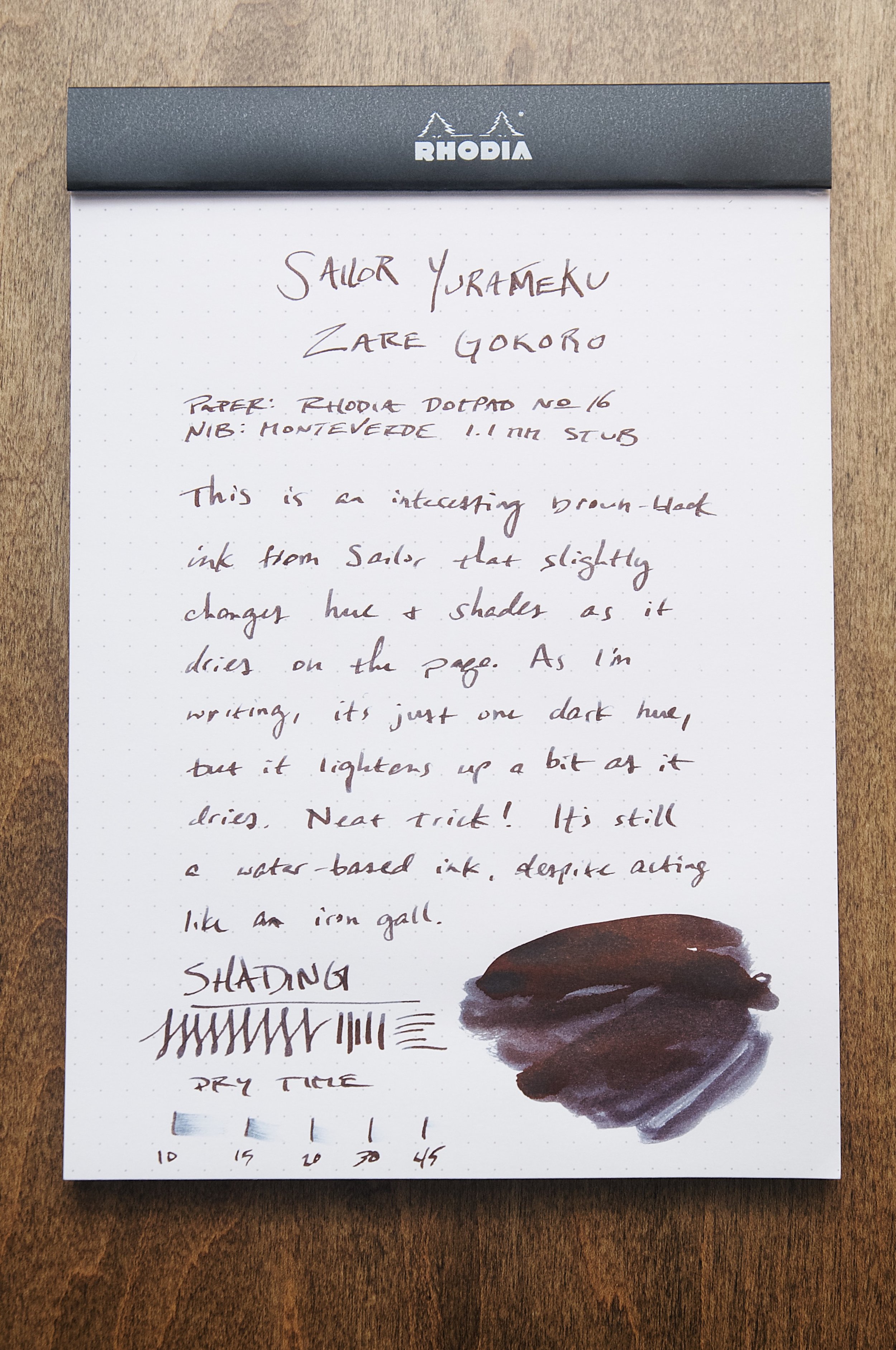
Like all Sailor inks I've used, this ink flows well, doesn't feather or bleed, and is incredibly consistent and easy to use. It's an incredibly slow ink to dry, though. In my tests, it takes at least 30 seconds to dry to the point where it doesn't easily smudge. For areas where more ink has pulled up in the valley of a direction change from the nib, it can take up to a minute to dry. This is a really slow drying ink.

I was really curious to see how the ink color changed as it dried, so that was the first thing I was focused on after inking up the pen. Sure enough, writing with the ink lays down a dark line that looks black to my eyes. I wouldn't even call it black-brown because I can't discern any brown while this ink is wet. Magically, the ink color lightens as the ink dries, revealing a dark brown with mild shading. In some areas, you can even detect some dark red or rust color. It's really fun to watch this transition happen as the ink slowly dries.
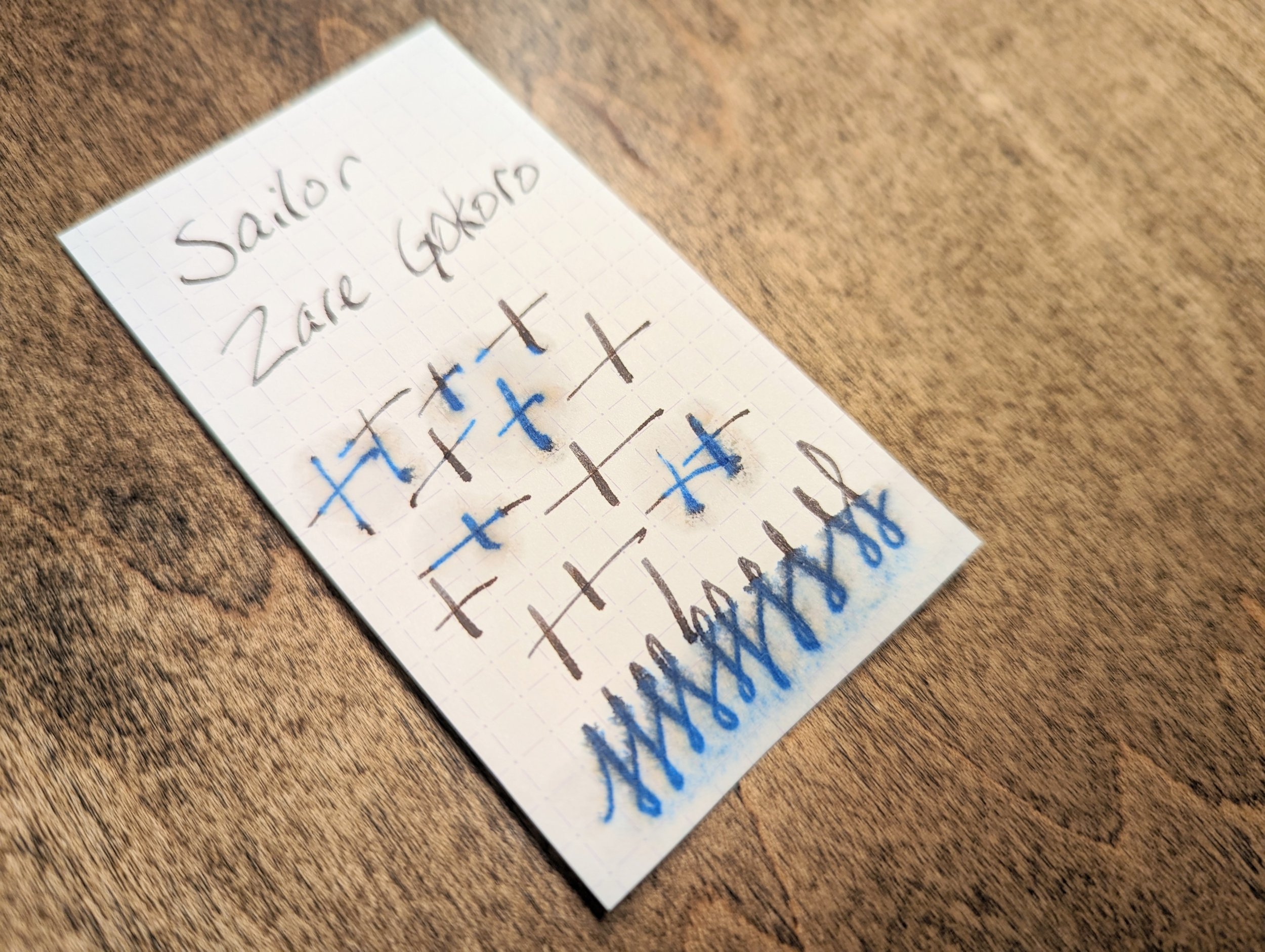
Since this is an ordinary water-based ink, it doesn't fare well when introduced to water. It doesn't wash away, but just a little bit of water rinses away the darkness of the ink and leaves behind a de-saturated blue color instead. You would be able to read what was on the page as long as the paper survived, but it might be difficult in some areas.
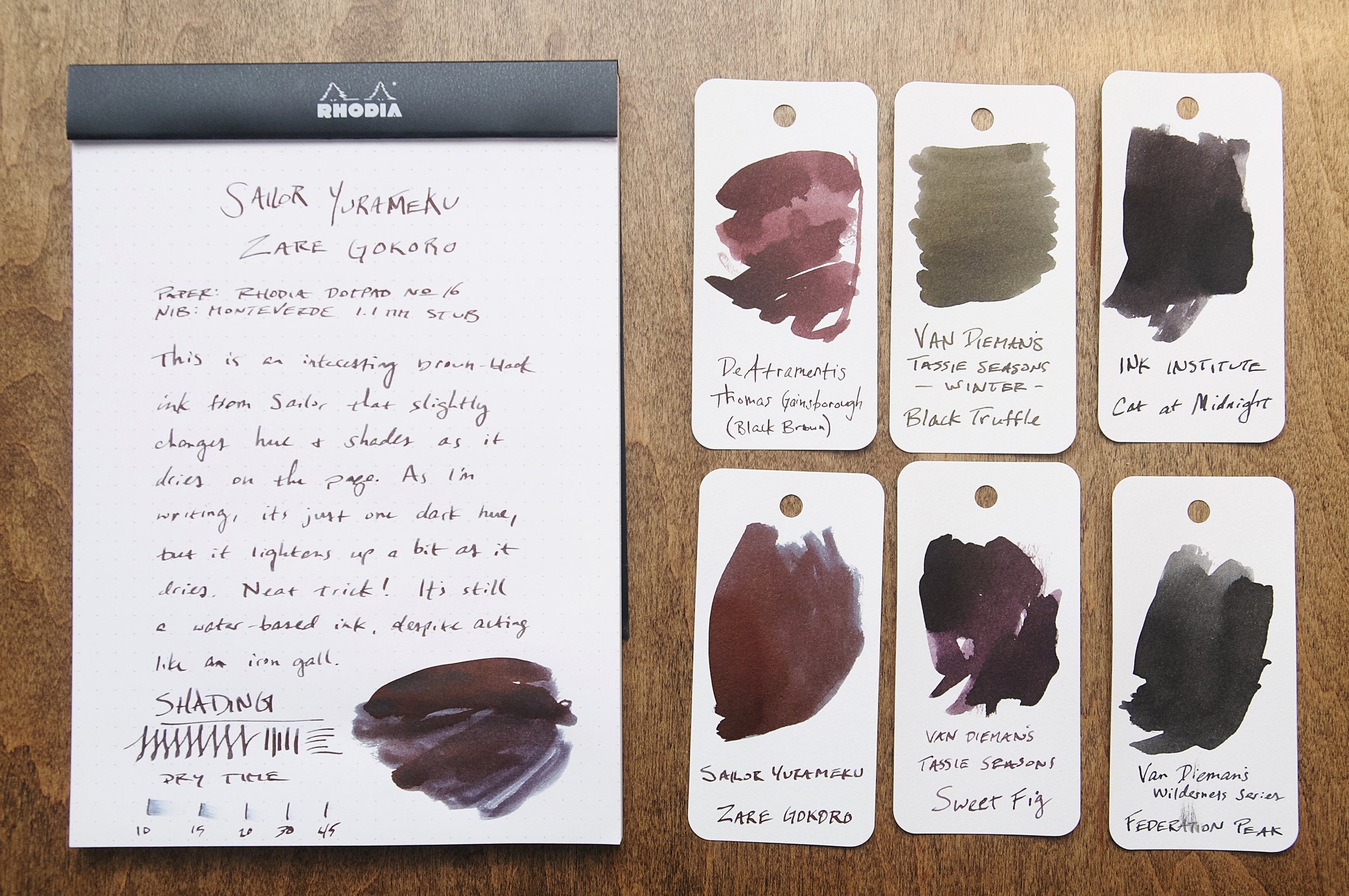
Overall, I was expecting more out of this ink. The color changing behavior was interesting since most inks get a little darker as the dry, not lighter. Iron gall inks also get a bit lighter as they dry, which is something I've always liked about them. It was one of their unique qualities aside from their water resistance. The super long dry time, lack of much shading, and the price all put me off this ink.

At $20 for a 20ml bottle, you're paying a premium for the Sailor name, and I don't think the price justifies the ink performance in this case. There are so many other interesting and well-performing inks on the market, so it's easy to point in almost any other direction here.

(JetPens provided this product at no charge to The Pen Addict for review purposes.)


Enjoy reading The Pen Addict? Then consider becoming a member to receive additional weekly content, giveaways, and discounts in The Pen Addict shop. Plus, you support me and the site directly, for which I am very grateful.

Membership starts at just $5/month, with a discounted annual option available. To find out more about membership click here and join us!

Posted on July 19, 2023 and filed under Sailor, Ink Reviews.

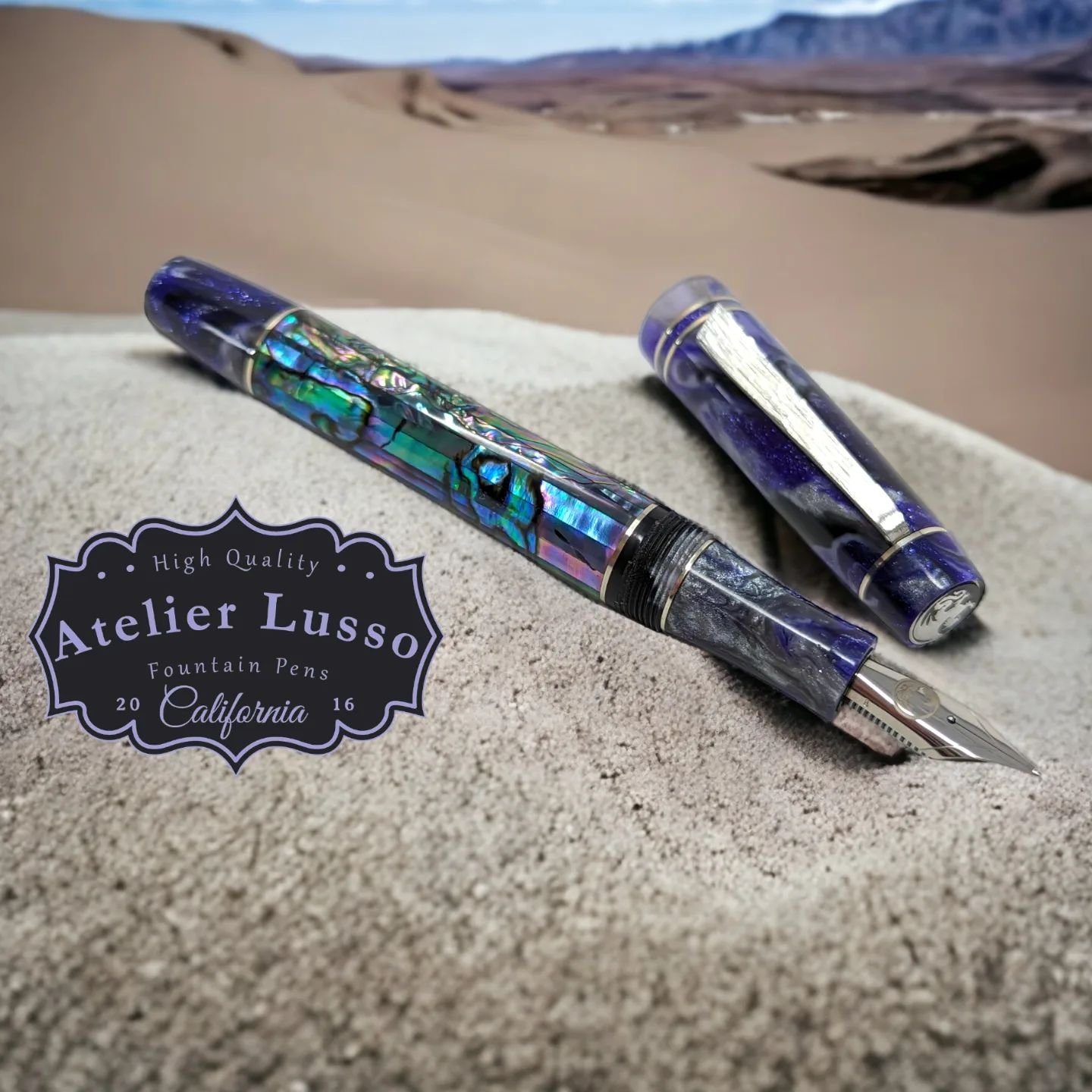
Meet Your Maker: Eric Sands, Atelier Lusso

(Caroline Foty's first fountain pen was a 1970s Sheaffer No Nonsense that still writes perfectly. Since she discovered pens by independent makers, she wants "one of each, please" and wants to meet all the makers. Maybe you do, too. She lives in Baltimore with pens, cats, and all kinds of fiber arts supplies.)

There was a moment when Eric Sands chose between playing the drums and making pens.

“I’ve always done something other than work, I worked to live, I didn’t live to work.” During a long career managing a furniture store, running a hobby shop, organizing international RC car tournaments, and working in IT, he pursued many interests: taking classes in interior design and art history, restoring, racing, and showing cars, and trying many different musical instruments. “I’ve been a frustrated musician my whole life – I just wasn’t very good at it.”

He had gotten out of involvement in showing cars, was trying to learn to play the drums, and was searching around for a new avocation that “maybe could pay for itself.” In 2016, when shopping for a nice razor, he found someone who made them from kits and also made kit pens, and his interest was piqued. After looking up lots of information and videos about making pens, he decided to sell his drum set to invest in a lathe and the other required tools. Sales of kit pens yielded money that he plowed into more equipment.

Sands quickly felt the constraints of making kit pens, and after about two years he had accumulated money for a metal lathe and the tools to make kitless pens. “I was never a fountain pen enthusiast, but I loved the idea of them. When I started making them and using them, I loved them.” He isn’t a collector, however – “When I see interesting pens I try to make them.” He is intrigued by the idea of casting his own materials, but “that would mean less pen making time!”

When naming his company, Sands chose words that reflect his intent about what he does. “Atelier” is a French word meaning an individual artist’s home studio or workshop, and “lusso” is an Italian word that means luxury. An Italian luxury car he saw at age sixteen, the Ferrari 250 Lusso Coupe, made such an impression that the word stayed with him forever after.

The pen style that is most distinctively his own combines abalone shell barrels with resins in coordinating colors. “We lived near the beach, and the incorporation of southern California beach culture into my work has become a nice niche for me.” Sheets of abalone veneer are cut and glued onto brass tubes then cast into clear resin, and lined with material that allows cutting of threads. Underneath the stunning appearance, this provides a little heft to the finished pen. He works closely with his supplier and the maker of the cast abalone tubes to source new colors and patterns of shell. There is a new one coming soon that is still in development to get the sheets thin enough.

Almost from the beginning, metal work has been part of his craft. At first, he bought brass washers and tried to make them work as trim. Then he ran across the work of John Albert Lawrence (formerly Romulus Pens) and got some pointers as well as direction to good sources of rod and sheet metal stock for making clips and trim. “He has a jewelry background. I learned a lot from him when I started making custom pens, he gave me a lot of advice. I don’t think I would have done as well without his help.”

This kind of support from the penmaker community at large is an ongoing source of friendship and assistance that Sands values highly. Through the Pen Maker’s Anonymous monthly Zoom meeting, makers discuss their process and share information and sources. “It’s a great family of people who like doing the same thing in different ways.”

Despite the beauty of the pens he makes, he hasn’t kept many of them. He still has the prototype of his Draco model, a large pen with a #8 nib. His favorite pen that he didn’t make is an Ironfeather Creative pen in a very simple ivory resin with a tooled clip. A customer sent him a Montblanc 149, and he was impressed with it, but “it’s a black pen. If I want that I should just make it!” If he were to buy a pen, he singles out Jacob Pawloski of Mad Science Pen Company as a maker whose work he would want to acquire. “He’s figured out new ways to do things and brought a unique style to his work.”

Sands sees the evolution of his craft as a process of focusing. “When I first started, I was all about trying all the things and learning how to do them. Now I’m concentrating on the styles people buy the most, trying to make them better – how do I make the threads smoother, refine the weight and size, make a better pen.” This process is not necessarily a straight line, however. “Almost every day I learn something to make a pen better; sometimes you have to learn it more than once…” He was struggling with the process of making good threads, and realized he was rushing the process. “I take more time now to cut them centered and make them smooth, it’s very satisfying that I can make that happen.” This focus on details earned him a 2022 Readers Choice Award for Best Artisan Pen from Pen World magazine.

His favorite moment in the pen making process is the very end, when all the pieces have been made and he puts them together. “Being able to make a pen and have people be excited about it filled a need for me – creativity, a mechanical process, a tangible result, and a pleasant experience.”

Eric Sands’ work can be seen at his website, Atelier Lusso, and on Instagram.


Enjoy reading The Pen Addict? Then consider becoming a member to receive additional weekly content, giveaways, and discounts in The Pen Addict shop. Plus, you support me and the site directly, for which I am very grateful.

Membership starts at just $5/month, with a discounted annual option available. To find out more about membership click here and join us!

Posted on July 18, 2023 and filed under Meet Your Maker.