Posts filed under Sailor

Sailor Que Será Erasable Gel Ink Pen Review

Sailor Que Será Erasable Gel Ink Pen

They are trying.

And you know what? I give Sailor credit for that. As Pilot has proven with the FriXion, there is an enormous market for erasable gel ink pens. Pilot has been perfecting theirs for 20 years, which is important context to keep in mind as I go through the rest of this review, because the Sailor Que Será is not a good pen. Yet.

The Que Será was launched by Sailor earlier this year, with an ink formulation designed to differentiate itself from the FriXion. Where the FriXion uses thermo-sensitive ink and erases via heat generated by friction, the Que Será designed their ink to essentially sit on top of the page, and allow the eraser to “peel” off the ink, similar to a traditional pencil erasing experience.
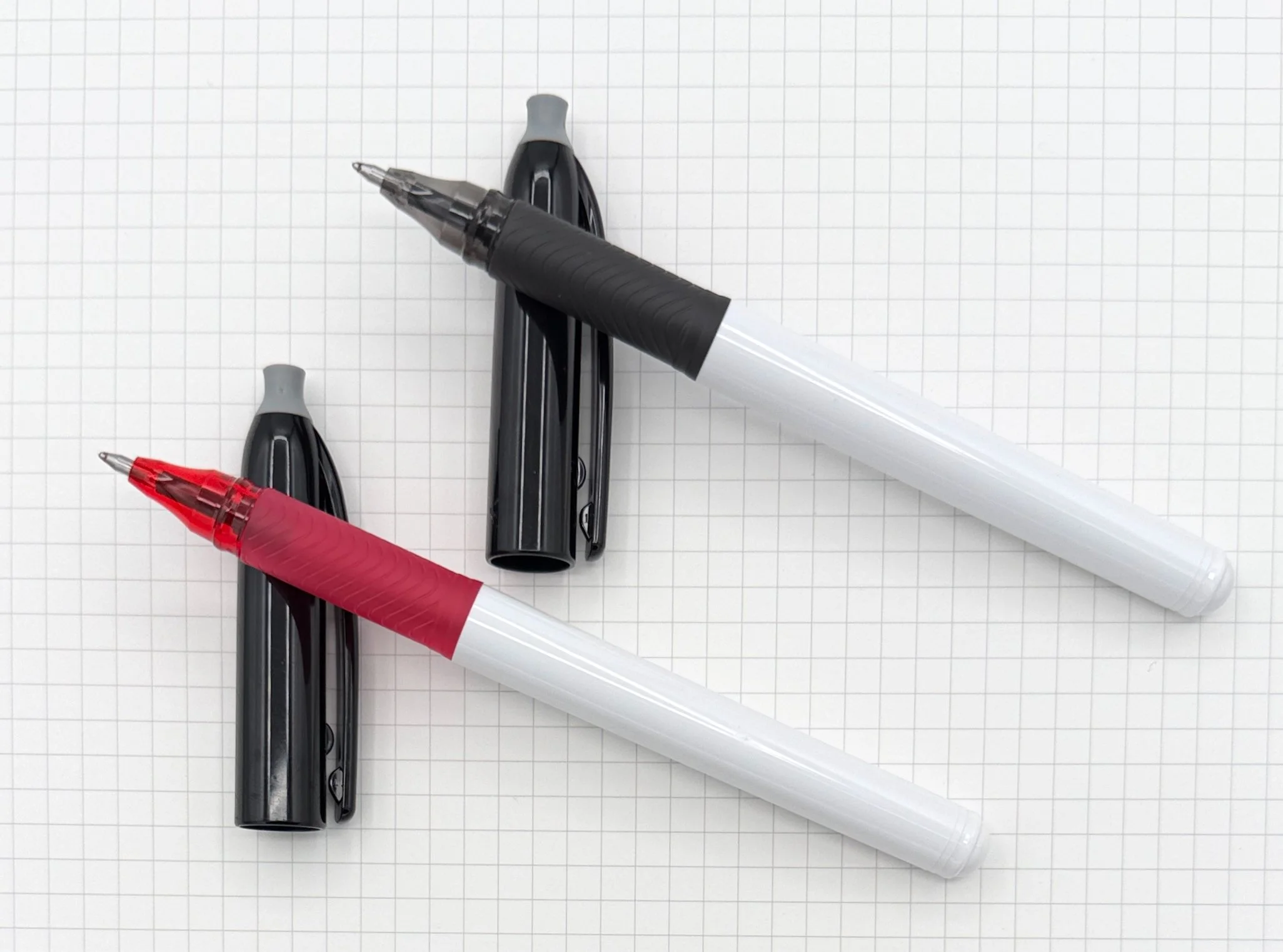
Sailor Que Será Erasable Gel Ink Pen Barrel

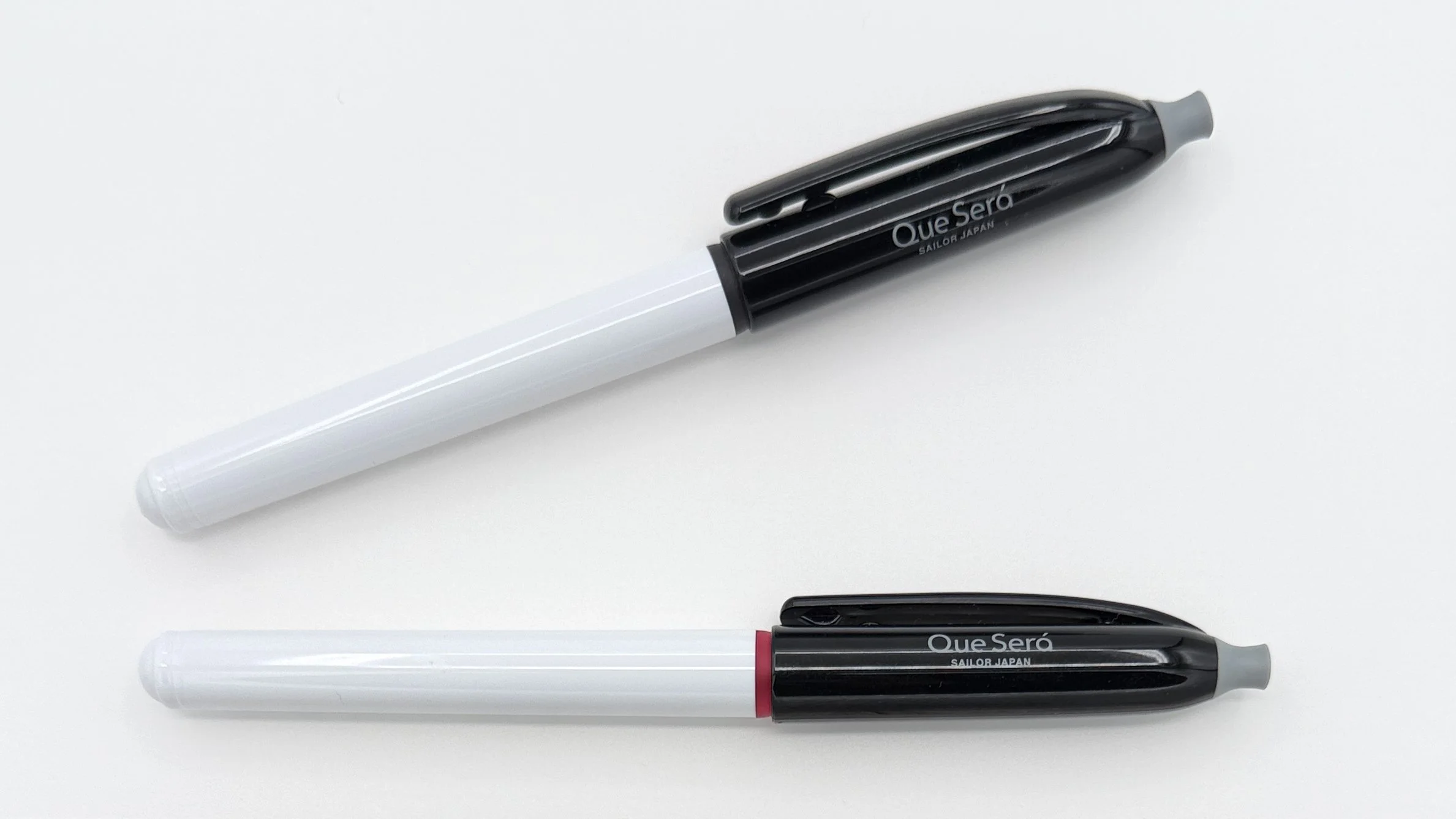
Shades of a Sharpie marker, but with Pentel parts on the front end.

That may sound weird, but it works. The eraser marks are mostly clean, although there is some mess left behind, again, like a standard pencil. This time, it’s ink bits, not eraser bits, left on the page that need to be brushed off. This ink formulation does mean your words are actually erased, unlike with the FriXion, where the words can be “restored,” by placing the page in a cool area, like a freezer.
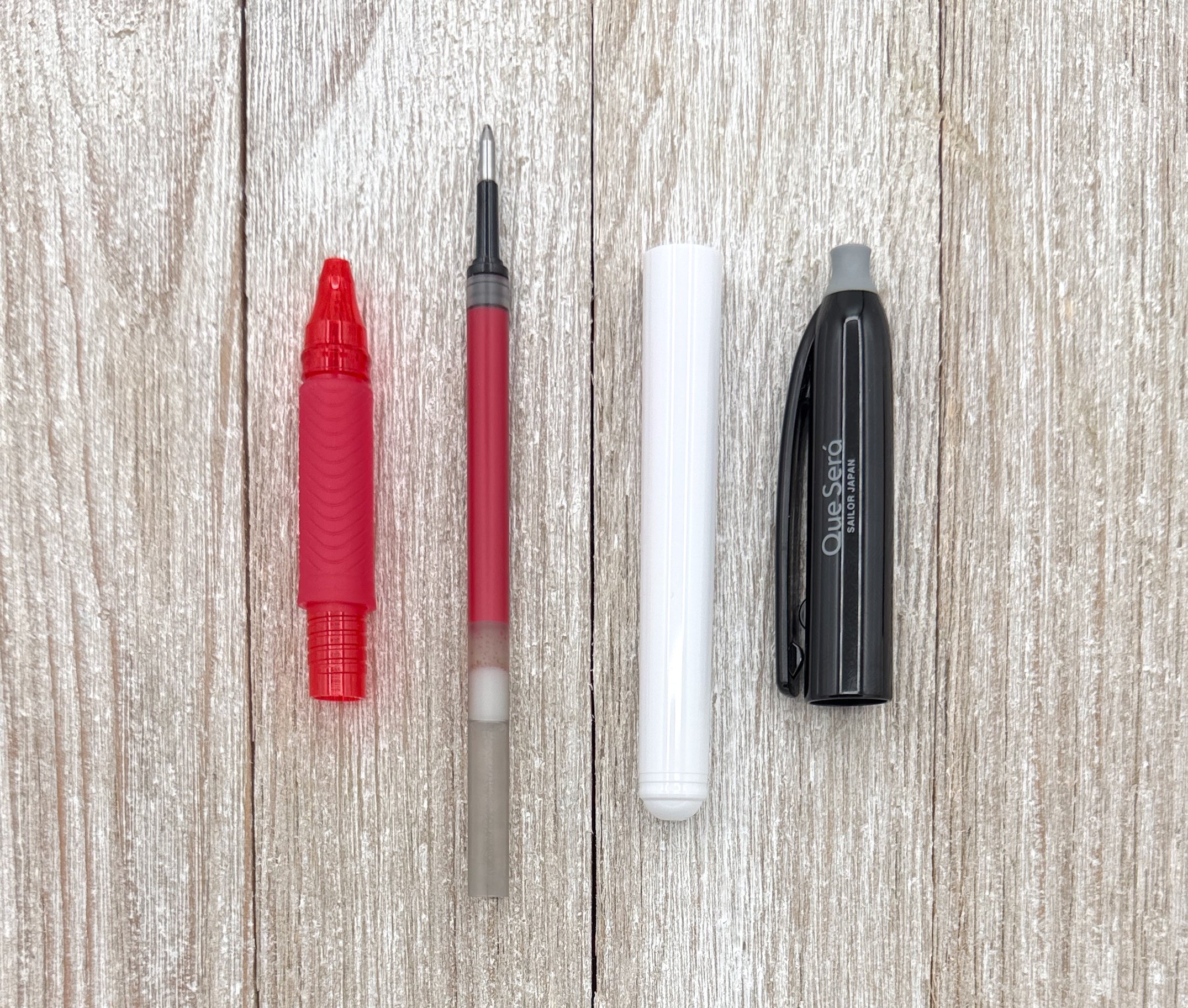
Sailor Que Será

EnerGel refill shape and grip section.

While it’s main feature, gel ink that erases, works well, the general writing experience is one of the worst I’ve had with any standard pen, erasable or not. That’s a problem for the Que Será, because I’ll never get to the main benefit if I don’t enjoy writing with the pen in the first place.
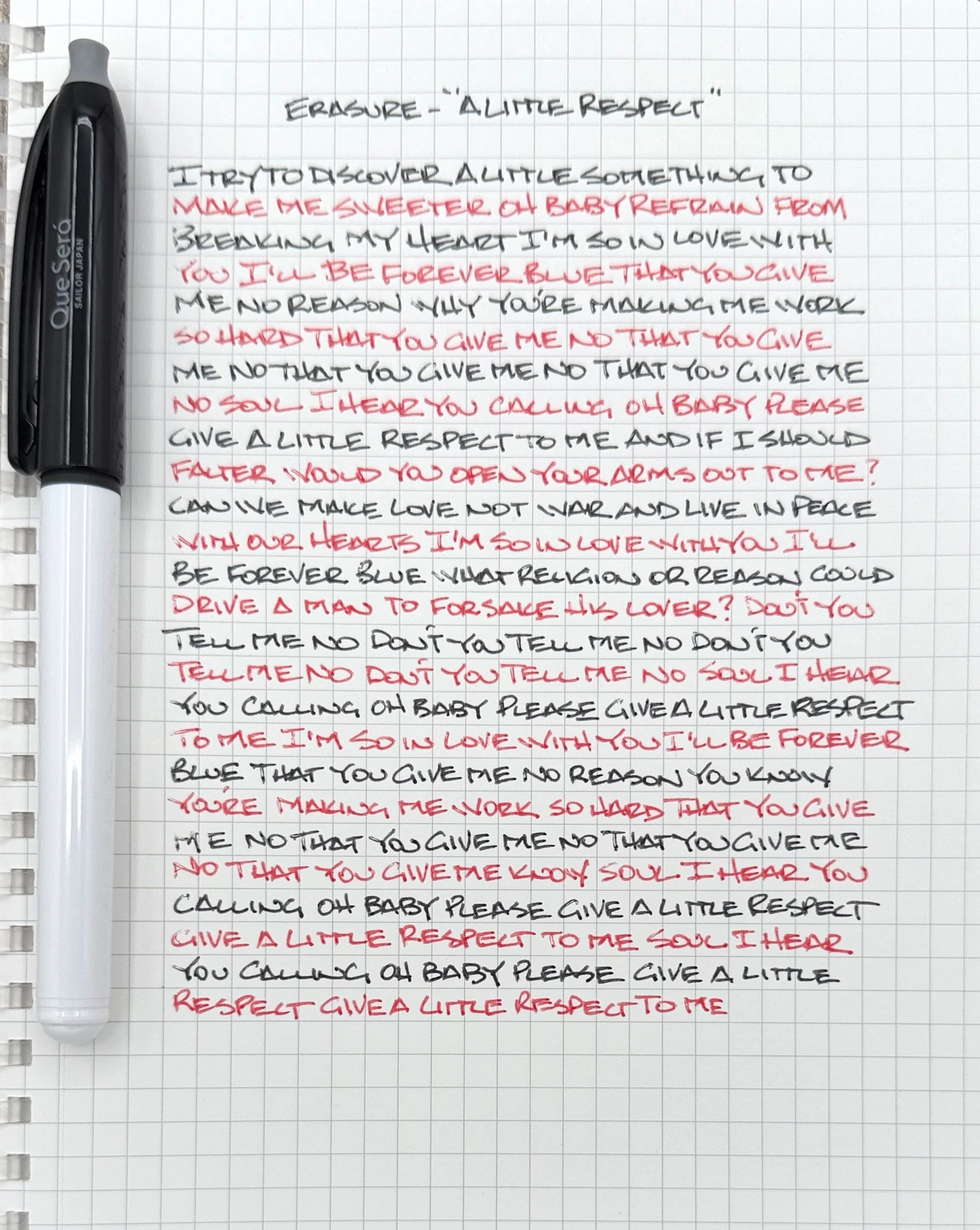
Sailor Que Será Writing

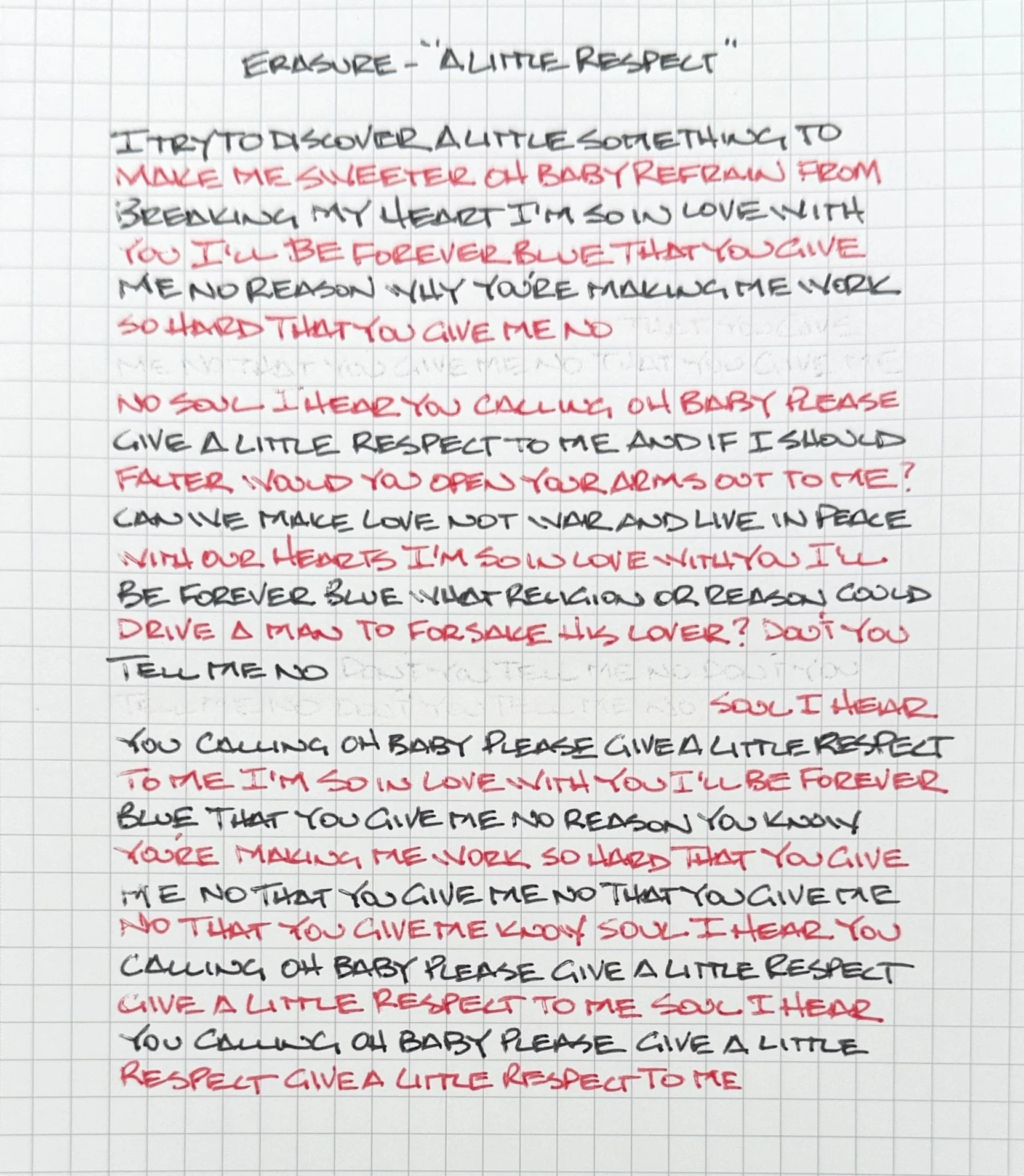
I was sent two Que Será pens by a friend - one Black, one Red - each with an 0.8 mm tip size. From my first lines the writing experience was underwhelming, and with more use it escalated to downright bad. I think the good part of the ink formulation - the erasability - plays directly into the poor writing performance. The ink sometimes builds up on the tip, making my lines messy, but more annoying was the constant railroading of the lines on the page.
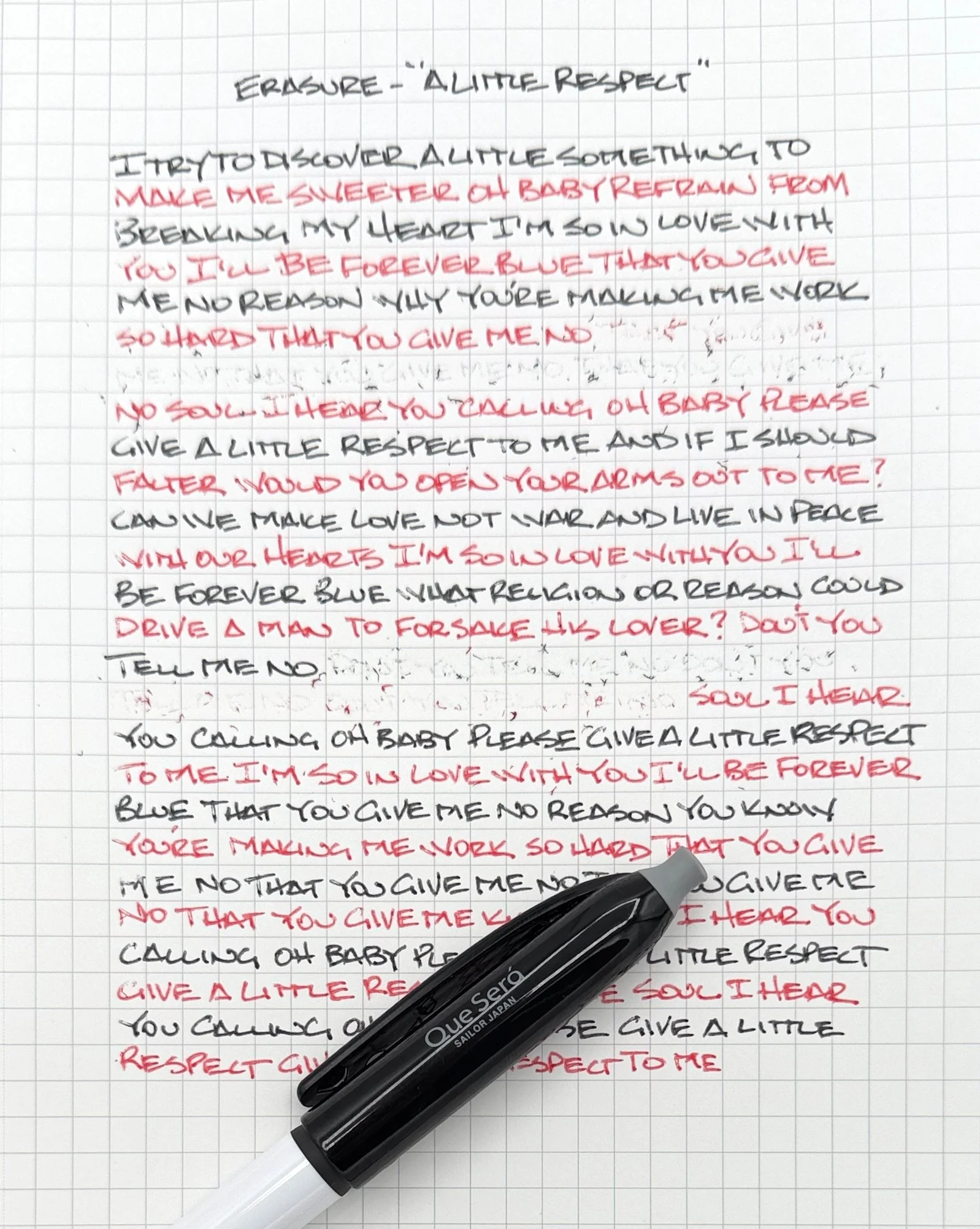
Sailor Que Será Erasing

Initial erasing.

Sailor Que Será Brushed

Brushed off. You can still see the underlying writing like with almost any erasable product, and I could take another pass to erase more fully.

Railroading is an effect where you see white space in the lines on the page, usually in the middle of a mark. It was constant with both Que Será pens, but more noticeable with the Black. I did try to wipe off the tips on occasion, but that was a fool’s errand. They started bad, and stayed that way. On top of that, their pigmentation was light compared to standard gel ink options.
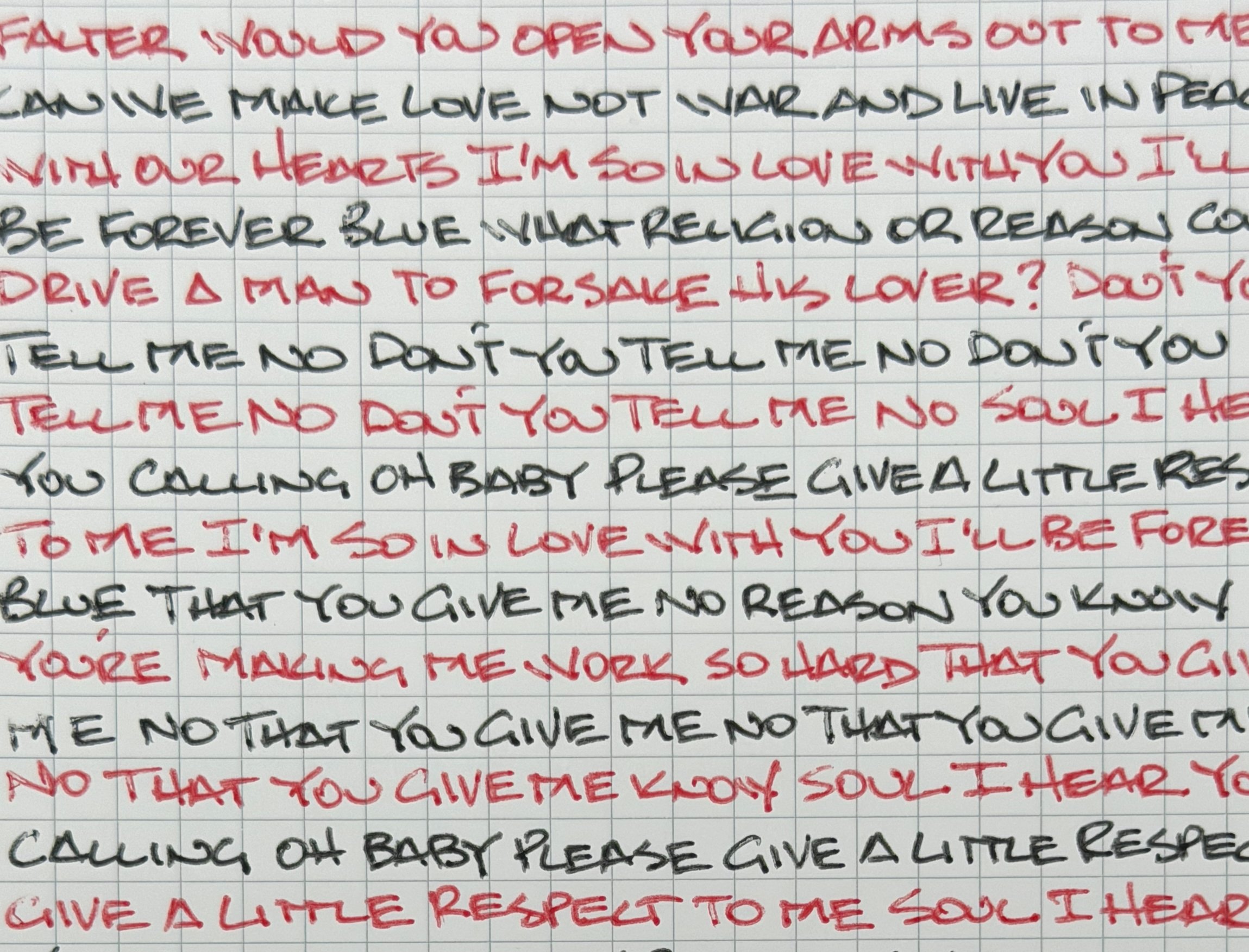
Sailor Que Será Close-up

A close-up of the writing. Look at the vertical lines - especially every “T” in both colors - not good.

While all of this is bad for the current iteration of the Que Será, I wonder if they can find their footing like Pilot did with the FriXion? When it launched, the ink was very light - the Black much lighter than the current Que Será - and the erasability was only average. It didn’t work well enough to be an every day pen, but Pilot stuck with it, and turned it into a high-quality gel ink pen that, almost as a bonus, has great erasability if that’s a feature you need.

What path will Sailor take with the Que Será? We can only wait and see. Now that Pentel is also under the same corporate umbrella as Sailor, can they continue to iterate and improve on it together? I hope so, because competition is good, and right now, the FriXion continues to have none.


Enjoy reading The Pen Addict? Then consider becoming a member to receive additional weekly content, giveaways, and discounts in The Pen Addict shop. Plus, you support me and the site directly, for which I am very grateful.

Membership starts at just $5/month, with a discounted annual option available. To find out more about membership click here and join us!
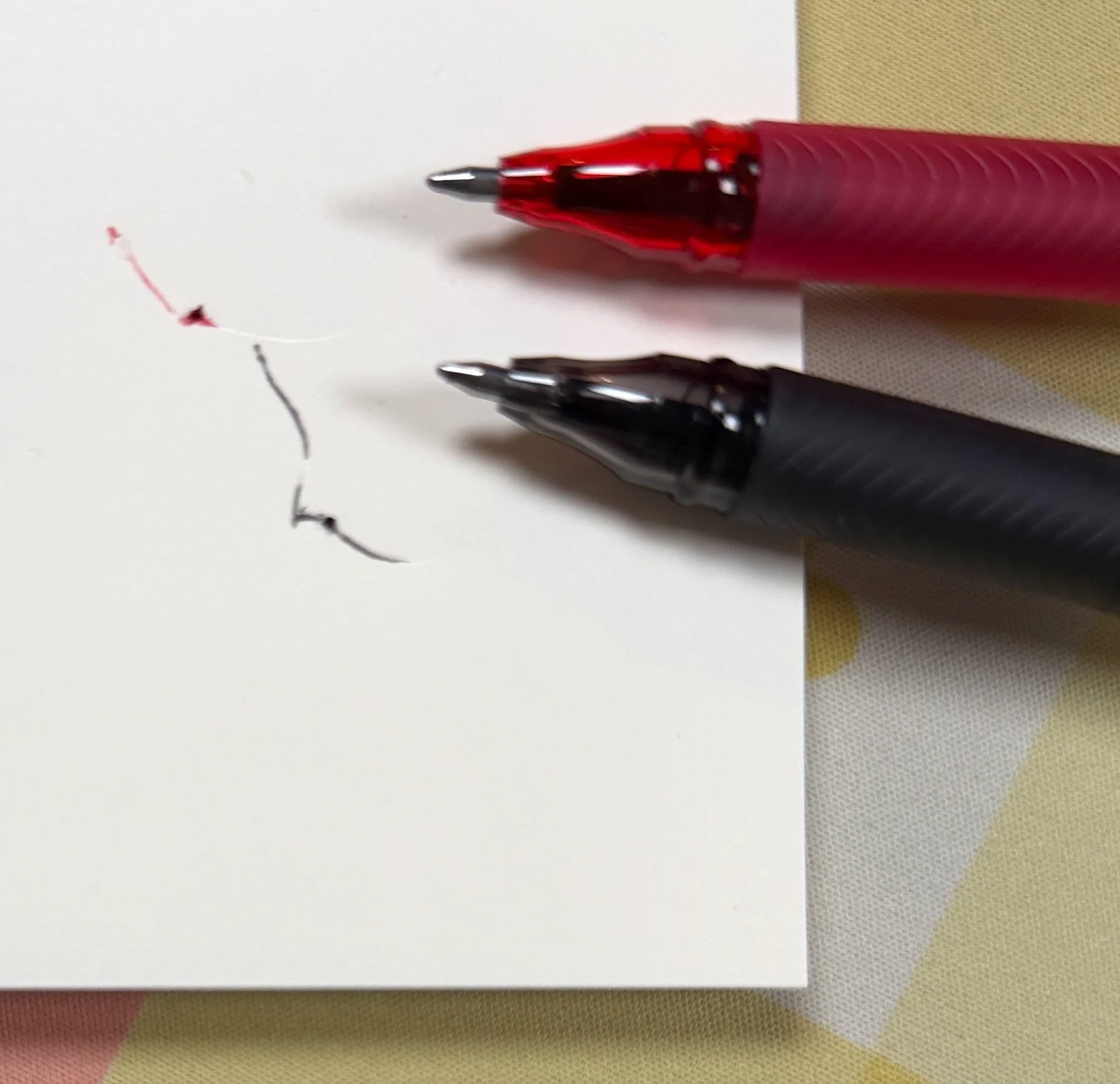
Sailor Que Será Nib Crud

Maybe keep a “nib crud” page handy.

Posted on July 6, 2026 and filed under Sailor, Que Será, Erasable, Gel, Pen Reviews.

Sailor TUZU Adjust Fountain Pen Review

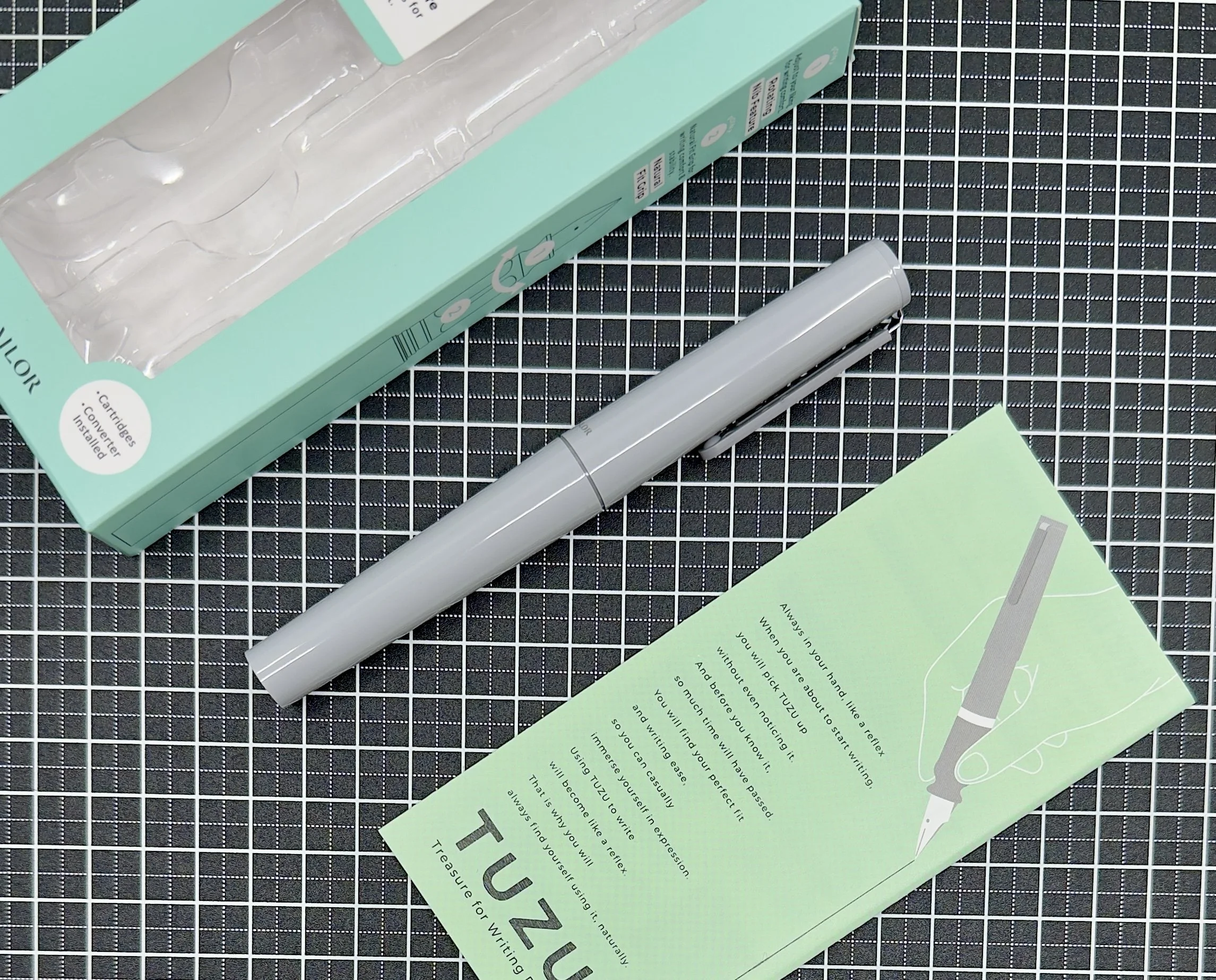
Sailor TUZU Fountain Pen

For a $44 fountain pen, I sure have a lot of thoughts on the Sailor TUZU. Some thoughts are straightforward (Does the TUZU provide good value?) while others are more complicated, such as if there is any benefit to its main feature.

Sailor TUZU Fountain Pen Converter

Ships with converter!

Let’s start here: what is the Sailor TUZU? It’s a fountain pen, with a twist. Literally. In short, the nib is designed to rotate around the barrel to better match your preferred writing angle. For a fountain pen, writing angle is everything. If not held at a certain angle, the nib on the page could feel terrible, or possibly not write at all. Sailor created a fantastic product page for the TUZU, which you can find here.

Sailor TUZU Fountain Pen Barrel

To assist with non-traditional writing grips and angles, the TUZU allows the user to rotate the nib in 10 degree increments. How? You unscrew the barrel, loosen the section ring, slide back the grip section, and rotate the nib to a new position. It’s quite simple, with guidelines to assist you in slotting the nib correctly in its new position.

Sailor TUZU Fountain Pen Band

How it works: Unscrew the barrel, and loosen the Silver section band.

Sailor TUZU Fountain Pen Slide and rotate

Slide the section back, rotate the nib as needed. In this case, I went one station (10 degrees - you can see the guide lines,) to the left.

Sailor TUZU Fountain Pen Rotated

Tighten it all back up and Profit!

All of this can happen with the pen inked, so feel free to twist and adjust accordingly. The grip is molded in a triangular-style and you can rotate it, too, to give you a more personalized writing experience.

Sailor TUZU Fountain Pen Grip

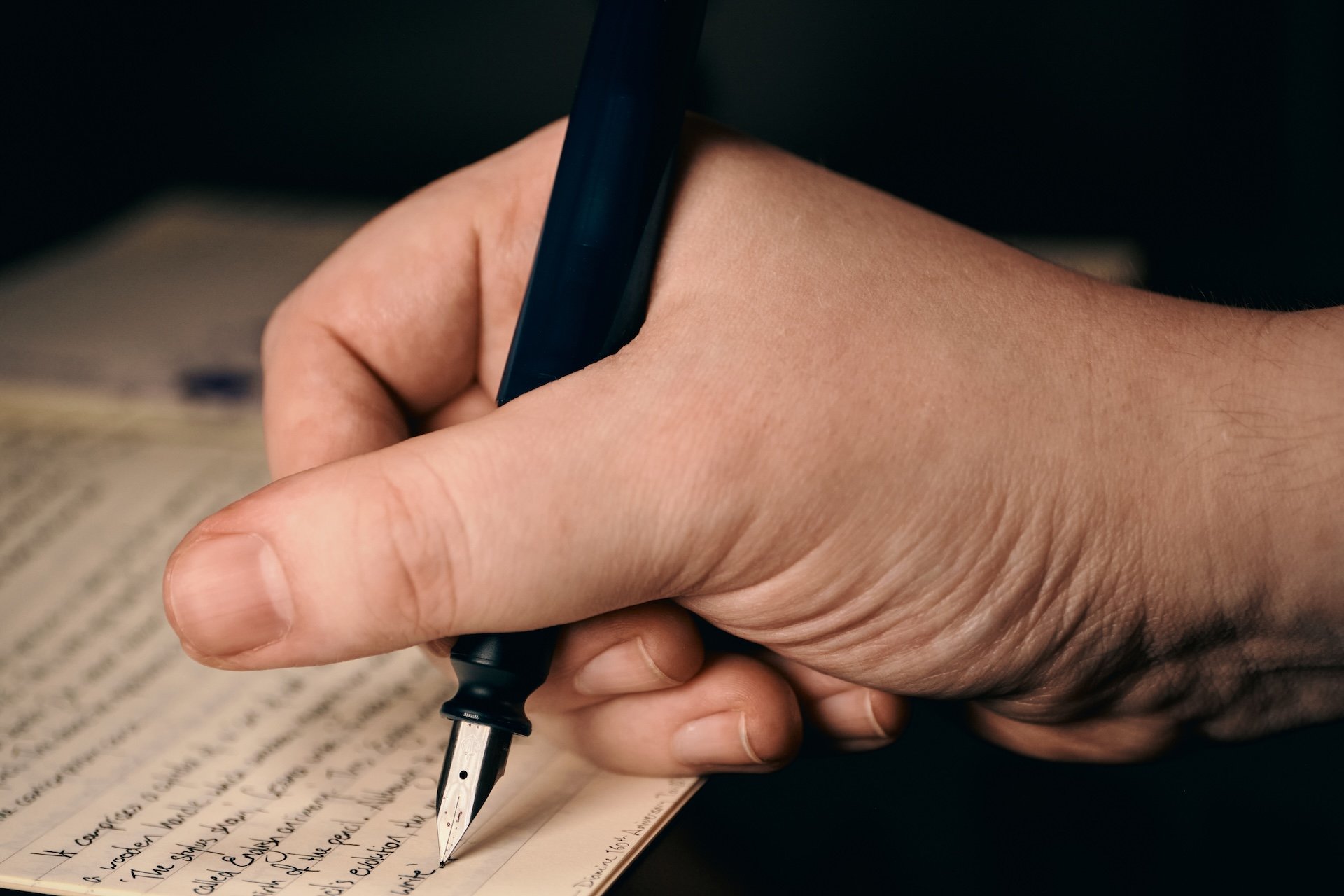
My grip and writing angle.

From a technical perspective, it works perfectly. From a writing perspective? I can’t say. Well, I can say if you have a traditional writing grip and angle like I do. But that’s not the purpose of this pen, so I enlisted a friend who could provide some insight if the TUZU offers any benefits to non-traditional grips and writing angles.

Say hello to Toga, from Toga’s Stationery Vagaries:

Hi, I'm Toga, and I have a wonky grip. I'm not too sure when exactly I developed this way of holding a pen. I'm fairly certain I would have been taught the standard tripod grip at school, but at some point it morphed into whatever the heck you'd call what it is now. I only realised it had changed when a customer asked me: "Why on earth do you hold your pen like that?" I couldn't give them an answer. My index finger rests pretty much where it should, the underside of the pen rests on the first knuckle of my middle finger, and my thumb hooks over the pen, resting on my index finger.

Toga's TUZU

Because of this rather "innovative" way of holding a pen, I don't tend to go for ones with triangular grips if I can at all help it. That being said, I do have a few with these grips, with varying degrees of aggressiveness. The more aggressive the grip, the more uncomfortable it is for me to hold.

That's where the TUZU comes in with its moulded grip that can be rotated in 10 degree increments. The moulding is less aggressive than a Lamy Safari, and even in its default position the TUZU is more comfortable for me to hold than said Safari.

I wasn't sure if the rotation gimmick was actually going to be useful for someone like me or not, so when Brad mentioned that he was looking for people with non-standard grips to help him with the review, I was happy to volunteer. After some trial and error finding the position that worked best for me (140° clockwise) I can confidently say that it absolutely is useful for people like me. In fact, it has surprisingly become one of the most comfortable pens I have. My index and middle fingers sit comfortably in the moulded sides while my thumb rests nicely over the rounded end that would usually be the underside of the grip. It's a fairly chonky pen, too, but manages to remain lightweight without feeling cheap, all of which add to the comfort levels for me.

However, a comfortable pen isn't much good if the rest of the writing experience is poor. I initially had some issues with the nib as the tines were too tight, making it extremely dry to the point of barely writing. Opening tines is something that I'm comfortable with doing, but it can be daunting for new users—the kind of users who Sailor have marketed this pen towards. That said, provided you've bought it from a reputable seller you'll be able to return the pen for a new one should you be unlucky enough to run into this problem.

Knowing Sailor, I imagine this will be a fairly uncommon occurrence. It didn't take much to get the pen writing as it should, just a little gentle spreading of the tines with brass shims was enough to get the ink flowing as it should, with the Fine nib giving a line slightly wider than a western Extra Fine. Despite being a steel nib, it has the "textured" feel that their gold nibs are famous for. Not quite to the same level, but it's definitely there. That's not something I've noticed on their other steel nibs before, but I've only used the Fude models so it may be different for them. I do enjoy the almost pencil-like feedback of Sailor's gold nibs, so I'm happy to find it present on this new steel nib Sailor developed for this pen.

So, the gimmick certainly works, but is it worth the money? I'd say the major competition for this pen is the Lamy Safari, as it's a similar size and also has the moulded grip section. The TUZU is $12-$15 more expensive than the Safari, which at this price point is not an insignificant premium to pay. Despite this, I would go for the TUZU every time. For one, I prefer the way it looks, but more importantly the TUZU is so much more comfortable for me to use. If you have a non-standard or rotated grip I believe you will have a far nicer writing experience with the TUZU. Thank you Brad for sending me the pen and letting me help with the review!

How cool is that? Thank you Toga!

Since everyone’s writing experiences differ, I thought it was important for this review to bring in someone who could actually use the main feature this pen was designed for. This type of insight is invaluable, and has me giving Sailor their due for helping fountain pen users have an experience that I might take for granted.

One bit from Toga’s talk that I wanted to elaborate on were his comments on the nib. My experience has been similar, but better in the fact that the nib has always written, but the tines are tight! That makes for an especially fine line from this Fine steel nib. It should come as no surprise to many long-time readers that I love it. This nib is a nail, and the only Sailor Steel nib I’ve ever enjoyed. If I was recommending the TUZU to a new user, I would recommend choosing either a Medium or Broad nib.

Sailor TUZU nib

Nails.

I’ll be interested to see if they take this redesigned LAMY-eqsue nib and feed into other entry-level products. I think it would do well, but is it Sailor enough for their more traditional pens, like the Compass?

What about the price point? $44 is more than fair for what Sailor has built, but at the same time, is the technology enough of a selling point to entice a new user to spend this much on a fountain pen? I think so, if they can get buying assistance, or have enough information available wherever they purchase to pen to take a chance on it.

TUZU Safari

Sailor TUZU vs. LAMY Safari.

For me personally, I love it, but am I choosing it over the Pilot Kakuno, Explorer, or Prera? How about the TWSBI ECO? The LAMY Safari or AL-Star? No to all of those, but maybe over some of Platinum’s entry level pens (Preppy, Prefounte, Plaisir,) purely because of barrel feel. As Toga alluded to, the TUZU is mostly comparable to the LAMY Safari. That’s one of my favorite pens of all-time, and also a pen that many people dislike due to the grip and/or design. In fact, I could see the TUZU becoming a pen favored by artists - like the LAMY Safari - because of how it is built, and the options and opportunities the nib angles could provide.

Will the Sailor TUZU be a long-term success? Only time will tell, but I think it is off to a good start. They are even launching a new barrel color, Translucent Violet, to the lineup this year, so it must be doing reasonably well. If nothing else, Sailor now has an entry-level fountain pen for people to consider, and one I think many users will be happy with.

(JetPens provided this product at no charge to The Pen Addict for review purposes.)


Enjoy reading The Pen Addict? Then consider becoming a member to receive additional weekly content, giveaways, and discounts in The Pen Addict shop. Plus, you support me and the site directly, for which I am very grateful.

Membership starts at just $5/month, with a discounted annual option available. To find out more about membership click here and join us!

Sailor TUZU Writing
Posted on March 3, 2025 and filed under Sailor, TUZU, Fountain Pens, Pen Reviews.

Sailor Manyo Uri Fountain Pen Ink Review

Sailor Manyo Uri Fountain Pen Ink Review

I think the most important thing to tackle right from the start is “what color is Sailor Manyo Uri?”

Is it Brown? Is it Green? Is it Gold? Is it Grey? I think Uri is a “yes to all” situation, especially when that situation calls for this fascinating ink to be used on several different paper types.

According to the description of the Sailor Manyo Ink Collection, these inks were inspired by the “Man'yōshū,” Japan’s oldest poetry collection. Specifically, the foods and culinary traditions of the Heian period. Uri represents a Melon-Cucumber shade … does that help narrow down what color it is on the page?

Sailor Manyo Uri Swatch

I’ll go on record that I see it as Brown-Green. On most of my pages, Brown is at the forefront, with Green appearing in undertones. There are a mixture of other shades contained within, such as Gold, and even a hint of Reddish-Purple where the edge of the ink pools. It’s legit wild, and your mileage may vary.

Sailor Manyo Uri

Bungubox Mikkabi Mandarin Orange Mini Fountain Pen, Sailor Manyo Uri ink lines, Pennonia Niagara Peach dots. So fruity!

On non-absorbent papers, Green takes the visual lead. The lines above were drawn in a Yoseka notebook, and I would bet this is the shade you would see on papers like Cosmo Air Light and Iroful, especially with inky applications.

Sailor Manyo Uri Paper Comparison

Yoseka Notebook, top, Midori Cotton, bottom.

When writing with a traditional nib - in this case a Japanese Fine - on papers like Life and Midori Cotton, the Brown comes out. I think it looks fantastic, even though I wouldn’t consider myself a Light Brown ink fan. That this ink has so many other things going for it color-wise has me wanting to use it for everything.

Sailor Manyo Uri Swab

If you are not familiar with Sailor inks as a whole, I consider them one of the top brands on the market. They are consistent performers, even across product lines. And wow, are there product lines. This specific Manyo series is a Limited Edition, and they join a range of existing Manyo inks that make up a regular edition. Yes, it’s confusing, but even a Limited series like this set of five inks can be found in stock at most retailers.

Sailor Manyo Uri Writing

At $24 for a 50 ml bottle, Uri, and the rest of the Manyo ink lineup, is priced well, comparatively speaking. A quick glance at all of Sailor’s different pricing will make your head spin, but these bottles are in the sweet spot, I think.

Uri is in that sweet spot for me as well. I love traditional fountain pen ink colors like Blue Black, but odd colors like this one are seeing more and more use from me over the past year, and I’m here for it. Strange inks here we come.

(This bottle of ink was sent to me by a friend. Thanks Lisa!)


Enjoy reading The Pen Addict? Then consider becoming a member to receive additional weekly content, giveaways, and discounts in The Pen Addict shop. Plus, you support me and the site directly, for which I am very grateful.

Membership starts at just $5/month, with a discounted annual option available. To find out more about membership click here and join us!

Sailor Manyo Uri Nib
Posted on February 3, 2025 and filed under Sailor, Ink Reviews.