Posts filed under Ink Reviews

Five J. Herbin Inks: An Overview

(Susan M. Pigott is a fountain pen collector, pen and paperholic, photographer, and professor. You can find more from Susan on her blog Scribalishess.)

This week I’m doing an overview of five J. Herbin inks. I won’t review each ink in as much detail as I usually do, but I wanted to introduce each ink with a few comments about color, saturation, and wetness.

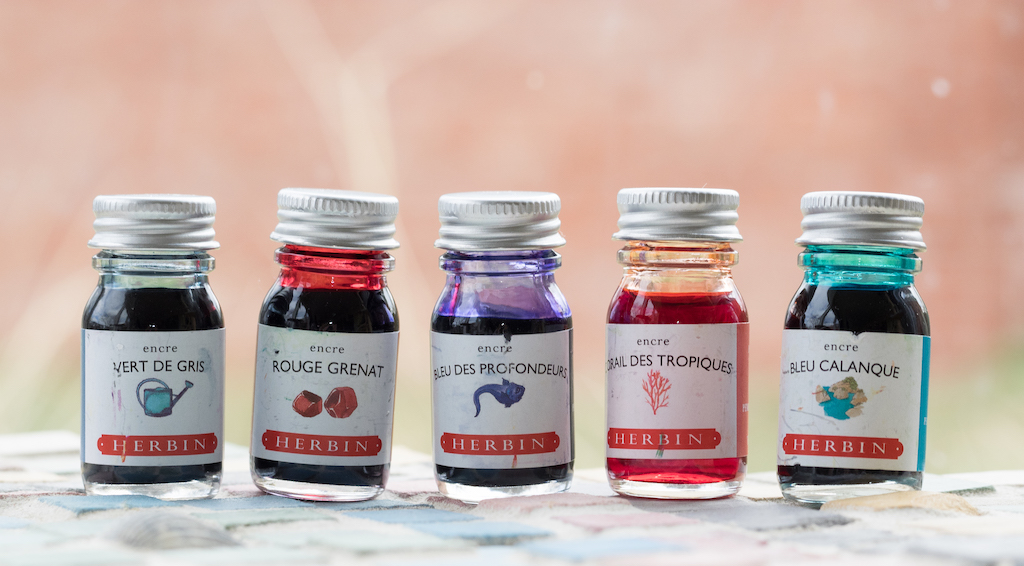
These five inks come in adorable 10ml bottles (though you can purchase larger 30ml bottles). The 10ml bottles aren’t very practical, however. Since they are so small, the opening won’t accommodate bigger nibs, such as the MB 149. Still, they are a nice size for travel or for an office stash of ink.

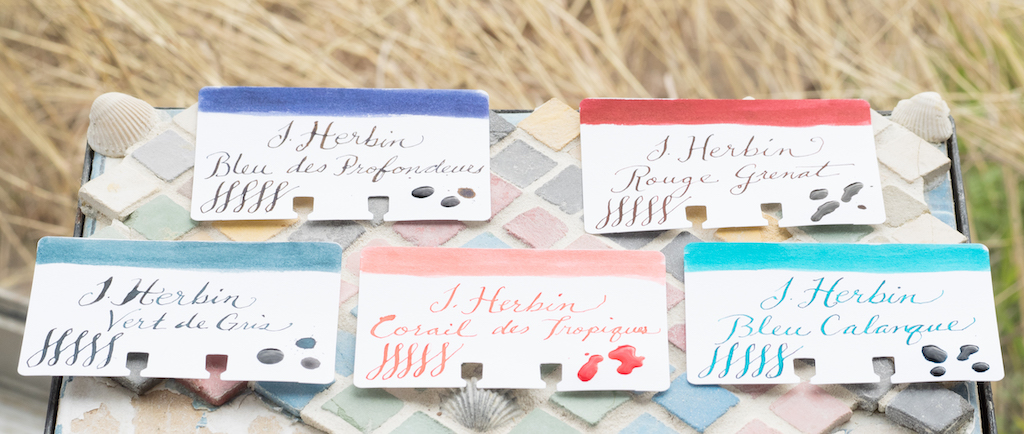
The colors range from a very light coral to a deep purple blue.
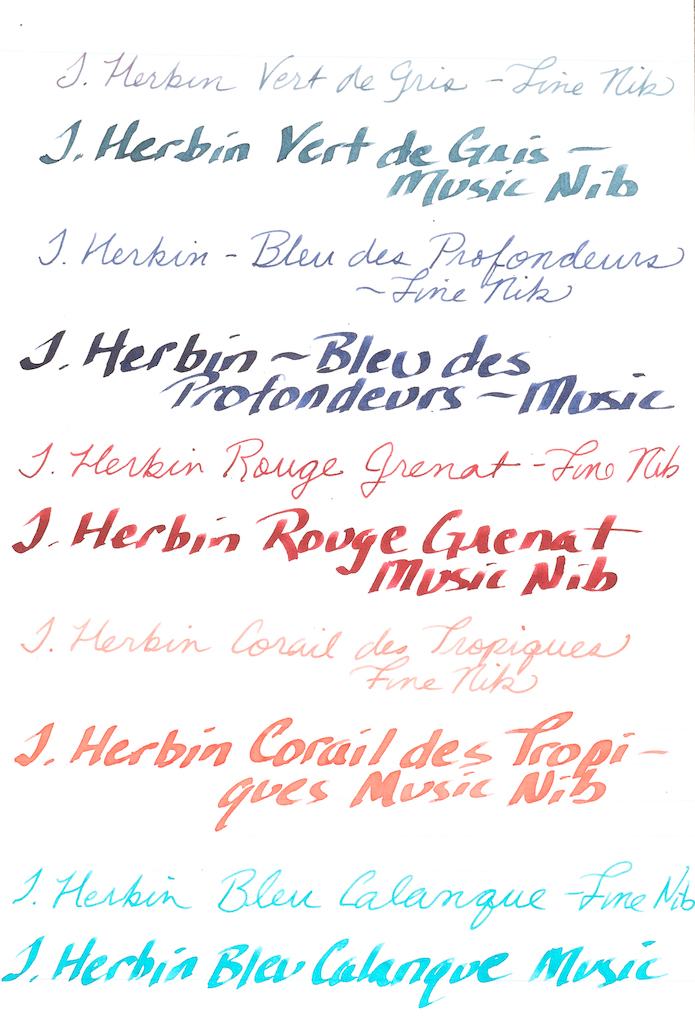
The first ink is Vert de Gris.

This, in my opinion, is the most unique color of the five inks. “Vert de Gris” means “Green-Gray” and this color has both deep turquoise and gray hues. It is gorgeous in fine and broad nibs, and it exhibits good shading but no sheen.

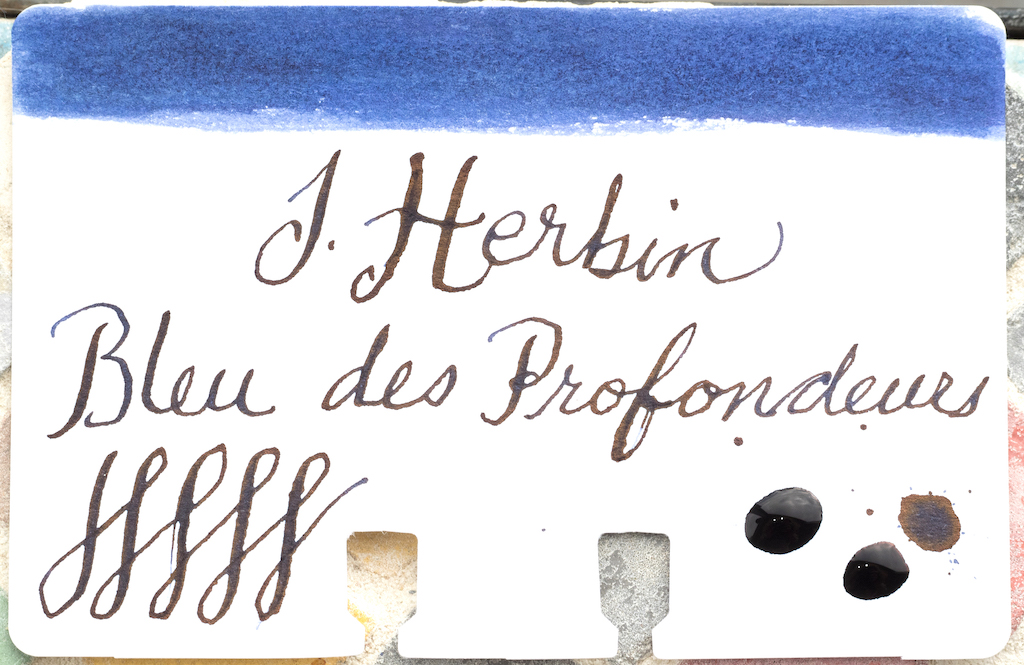
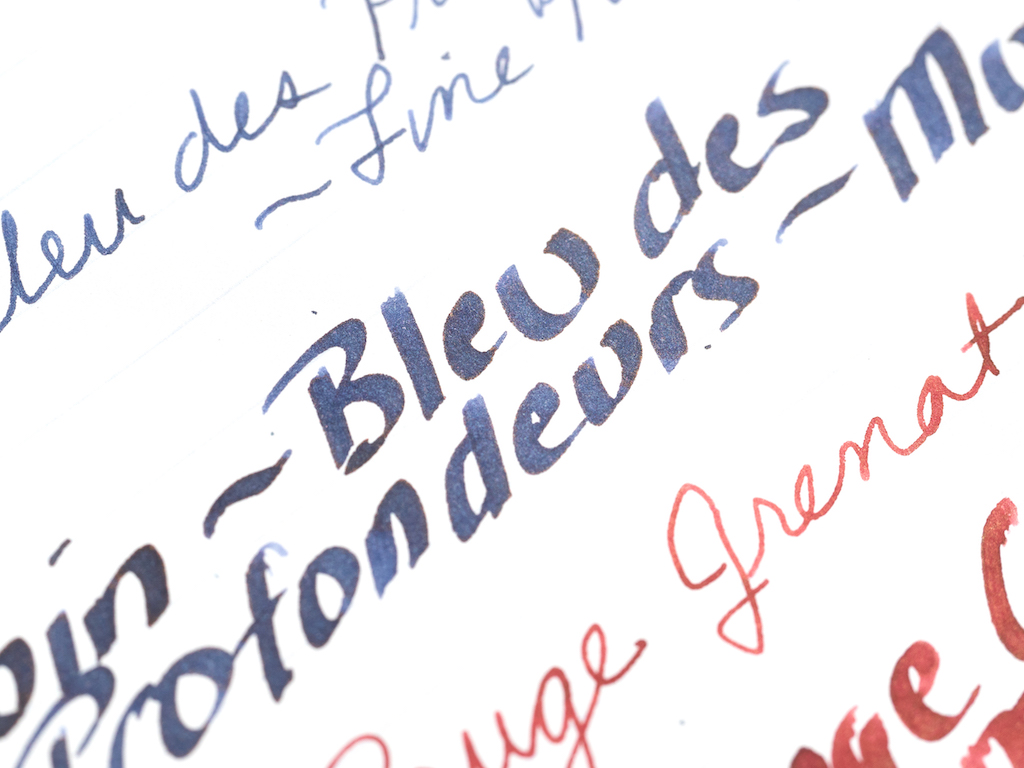
The second ink is Bleu de Profondeurs, which means “deep blue.” This ink is a purple blue. It’s nicely saturated and looks good in both fine and broad nibs. In broad nibs it offers a little bit of shading, but no sheen.
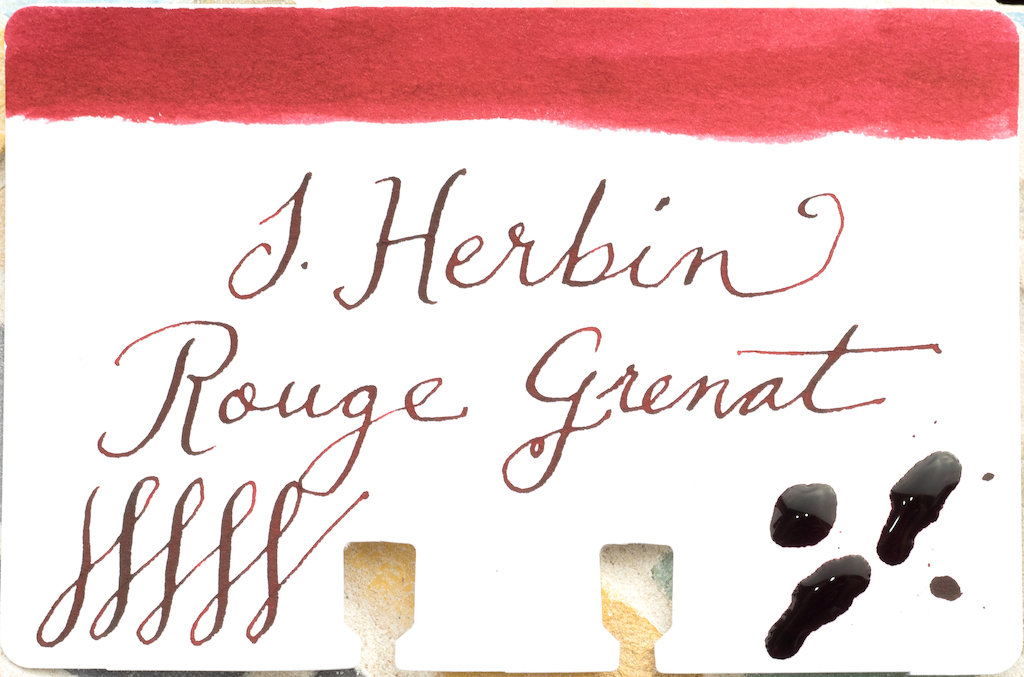
The third ink is Rouge Grenat, which is a lush garnet red.

The ink works well in both fine and broad nibs, and is highly saturated. Although it doesn’t have any observable sheen, it does exhibit a little bit of shading in broad nibs.
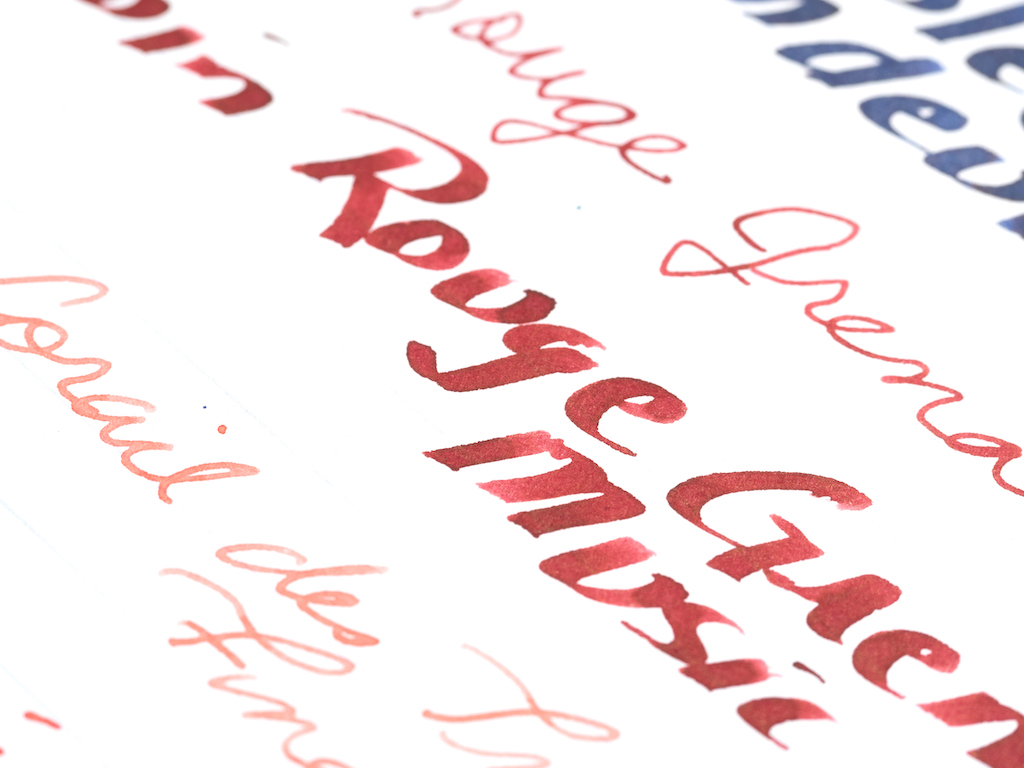
The fourth ink is Corail des Tropiques.

Of the five inks, this one is my least favorite, mainly because it’s watery and too light for use in finer nibs. It might work well as a wash. In broad nibs it has enough saturation to be usable and even has a tiny bit of shading. In my testing it exhibited no sheen.

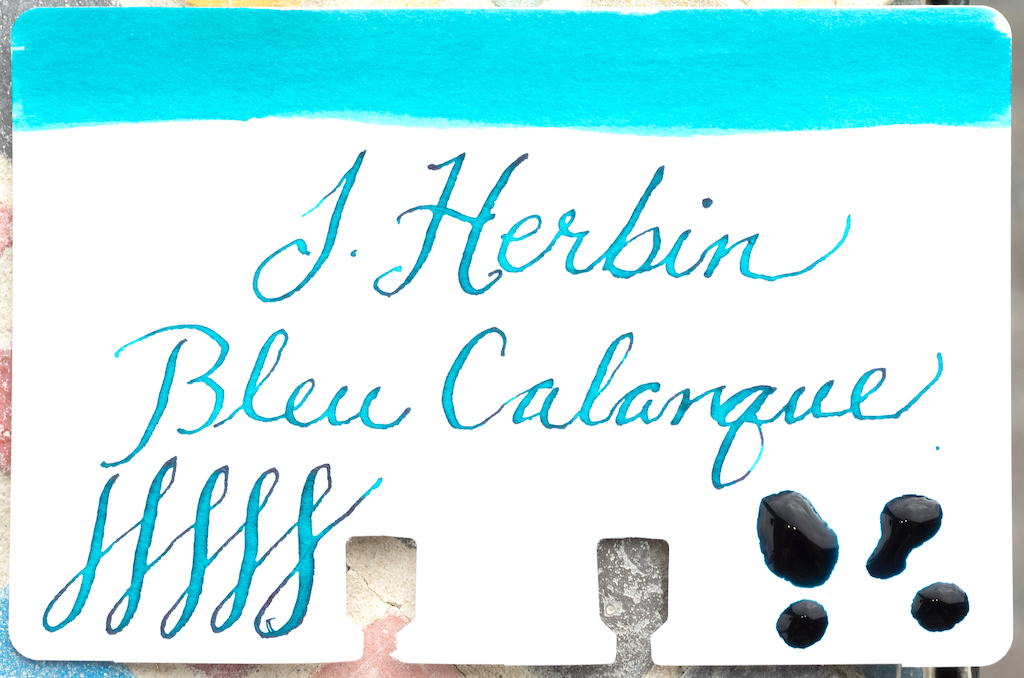
Last is Bleu Calanque or “Blue Cove.”

This is a bright turquoise color that is saturated enough to work well in fine nibs. It also exhibits a bit of shading in broad nibs.
I like all of these J. Herbin inks--in fact, they surprised me. They are far more saturated than I expected. I’ve found J. Herbin inks can be too light and very dry (I’m thinking of you, Rouille d’Ancre). These five inks flow quite well, though Corail des Tropiques was too watery for my taste.

The 10ml bottles are a good size for sampling an ink. Unlike typical 4 or 5ml ink samples, you have enough ink for several fills so you can decide if you want to buy a regular sized bottle. You can purchase J. Herbin 10ml inks from Vanness Pens for $6.00 a piece (30ml bottles are $12.95).

(Vanness Pens provided this product at no charge to The Pen Addict for review purposes.)


Enjoy reading The Pen Addict? Then consider becoming a member to receive additional weekly content, giveaways, and discounts in The Pen Addict shop. Plus, you support me and the site directly, for which I am very grateful.

Membership starts at just $5/month, with a discounted annual option available. To find out more about membership click here and join us!
Posted on March 8, 2019 and filed under J. Herbin, Ink Reviews.

Robert Oster Thunderstorm Ink Review

(Sarah Read is an author, editor, yarn artist, and pen/paper/ink addict. You can find more about her at her website and on Twitter. And check out her first novel, The Bone Weaver’s Orchard, now available where books are sold!)

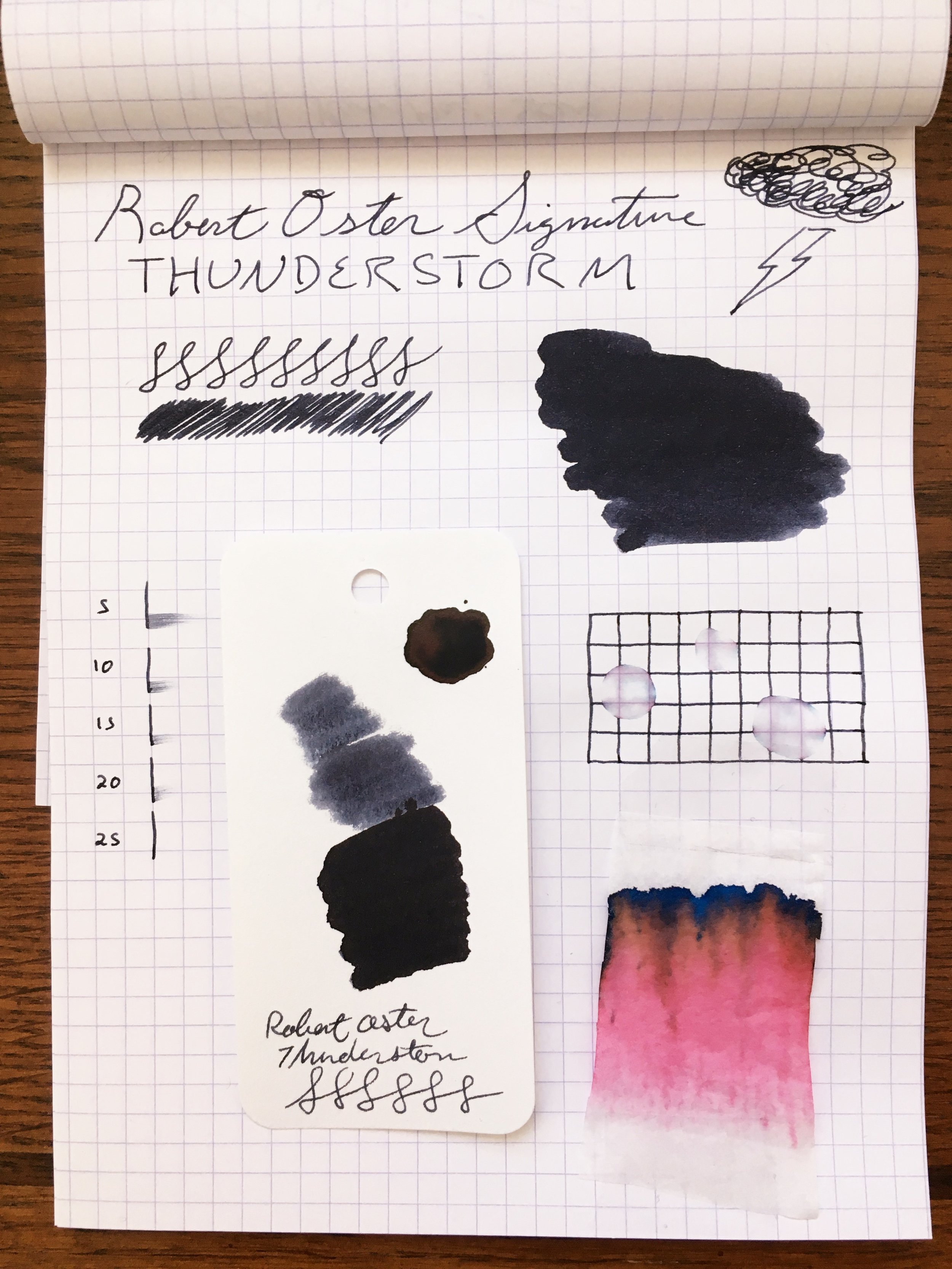
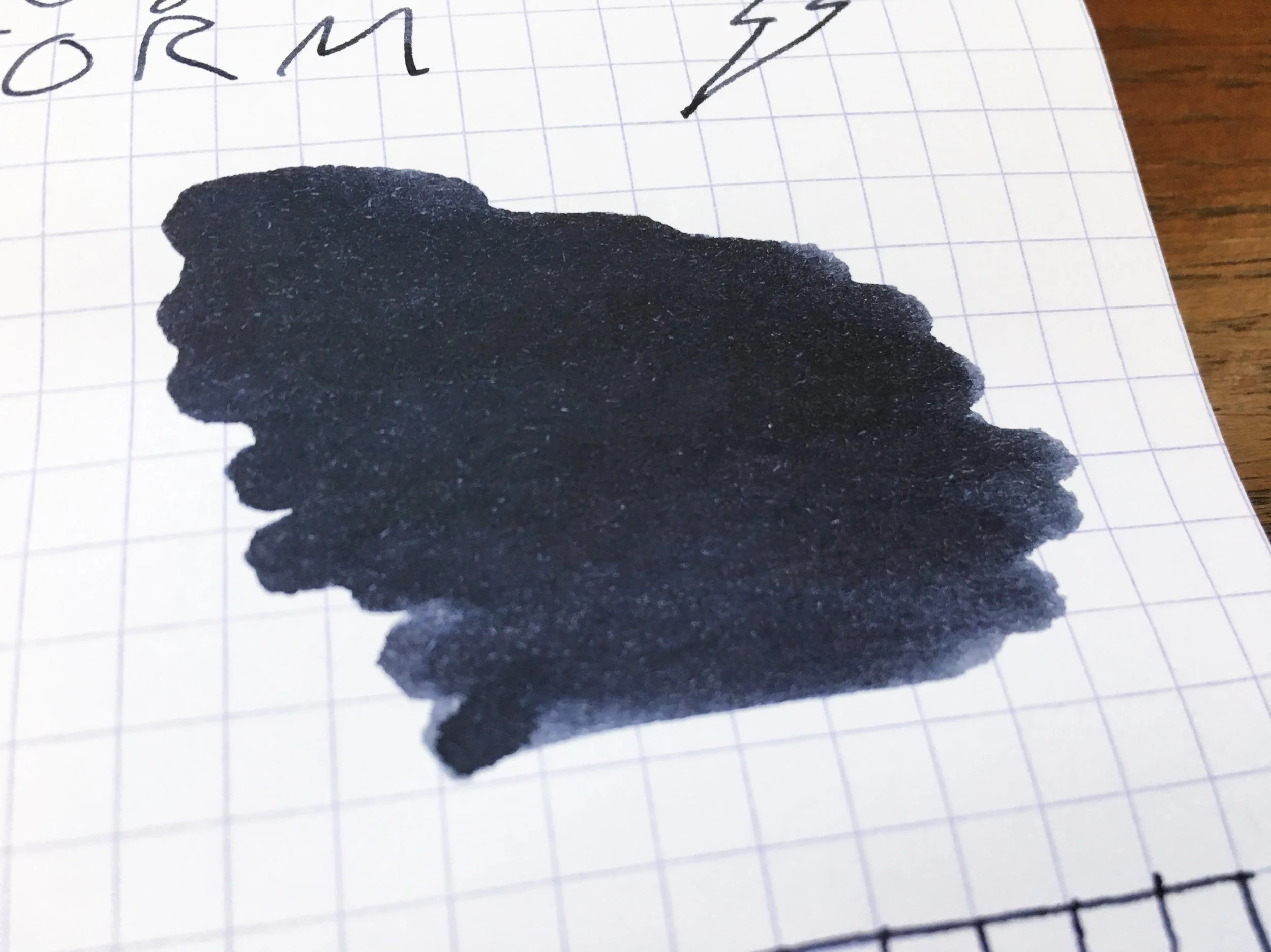
Robert Oster is an ink wizard. Thunderstom is a newer offering in his lineup of enchanted and enchanting inks. At first glance, it looks black. Just plain old black. But when the light hits it, Ah! Maybe it's navy! Then, do I see teal? Purple? What is happening???

If I had to classify the color, I'd call it a blue-black. It's subtle enough to be a good work ink, but has the complexity to bring some fun to your desk. Fine layers of it show up as a smoky grey-blue and concentrated areas look anywhere from navy blue to black. The color is almost impossible to photograph. Its closest color relatives that I've encountered are Aurora Blue-Black and Kobe 7, though both of those have crazy sheen and Thunderstom has none. Even where it pools it looks like it has a matte finish, which adds to its deep color complexity.

It's very well lubricated and flows out of the pen nicely, but also dries quickly. It has no water resistance--the drip test pretty much erased it all. It doesn't bleed or feather on Rhodia paper or on the ink sample card. It does on regular printer paper, but that's expected.

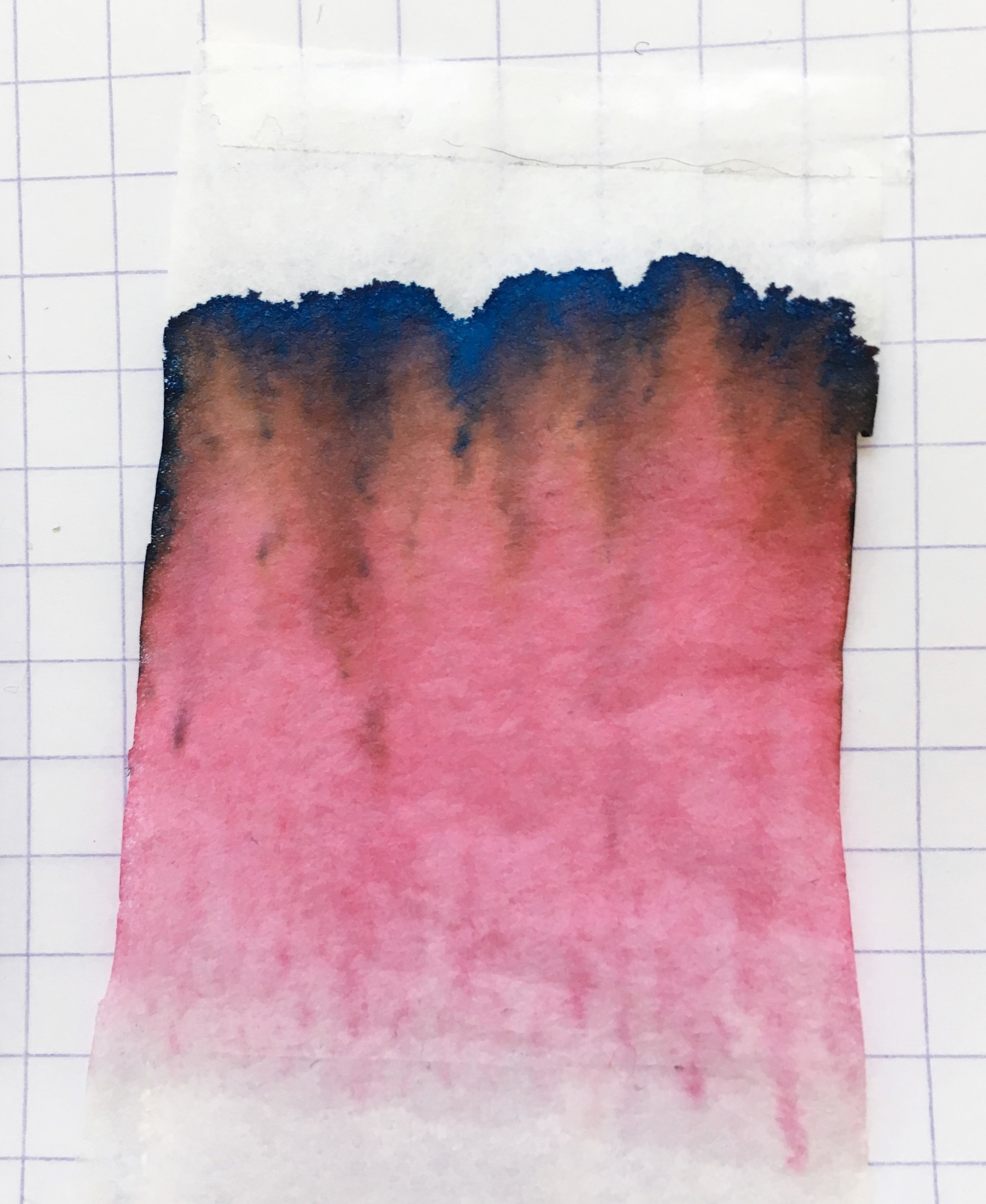
The most surprising thing about this ink was the chromatography test. I mean... Pink? I did not see that coming! How does blue and grey come from pink? With magic, I guess. But the colors that split were cobalt blue and pink, and somehow they make this awesome, subtle color.

This isn't one of those colors that leaps out at you from first sight, but it gradually makes its character known the more you see it. If you're looking for an ink that can subtly liven up some boring paperwork that still has to appear businesslike, this is a great choice. It's $17 for 50 ml at JetPens, which is fantastic value for ink these days. It's one color I'll always have a use for.

(JetPens provided this product at no charge to The Pen Addict for review purposes.)


Enjoy reading The Pen Addict? Then consider becoming a member to receive additional weekly content, giveaways, and discounts in The Pen Addict shop. Plus, you support me and the site directly, for which I am very grateful.

Membership starts at just $5/month, with a discounted annual option available. To find out more about membership click here and join us!
Posted on February 21, 2019 and filed under Robert Oster, Ink Reviews.

Kyo-no-oto No. 6 Adzuki-iro Ink: A Review

(Susan M. Pigott is a fountain pen collector, pen and paperholic, photographer, and professor. You can find more from Susan on her blog Scribalishess.)

Several weeks ago, Vanness sent the Pen Addict ink samples for review. One of the inks I received was Kyo-no-oto No. 6 Adzuki-iro, a burgundy ink that I loaded into my TWSBI Eco T to test the pen. I loved the ink so much that I purchased a bottle.

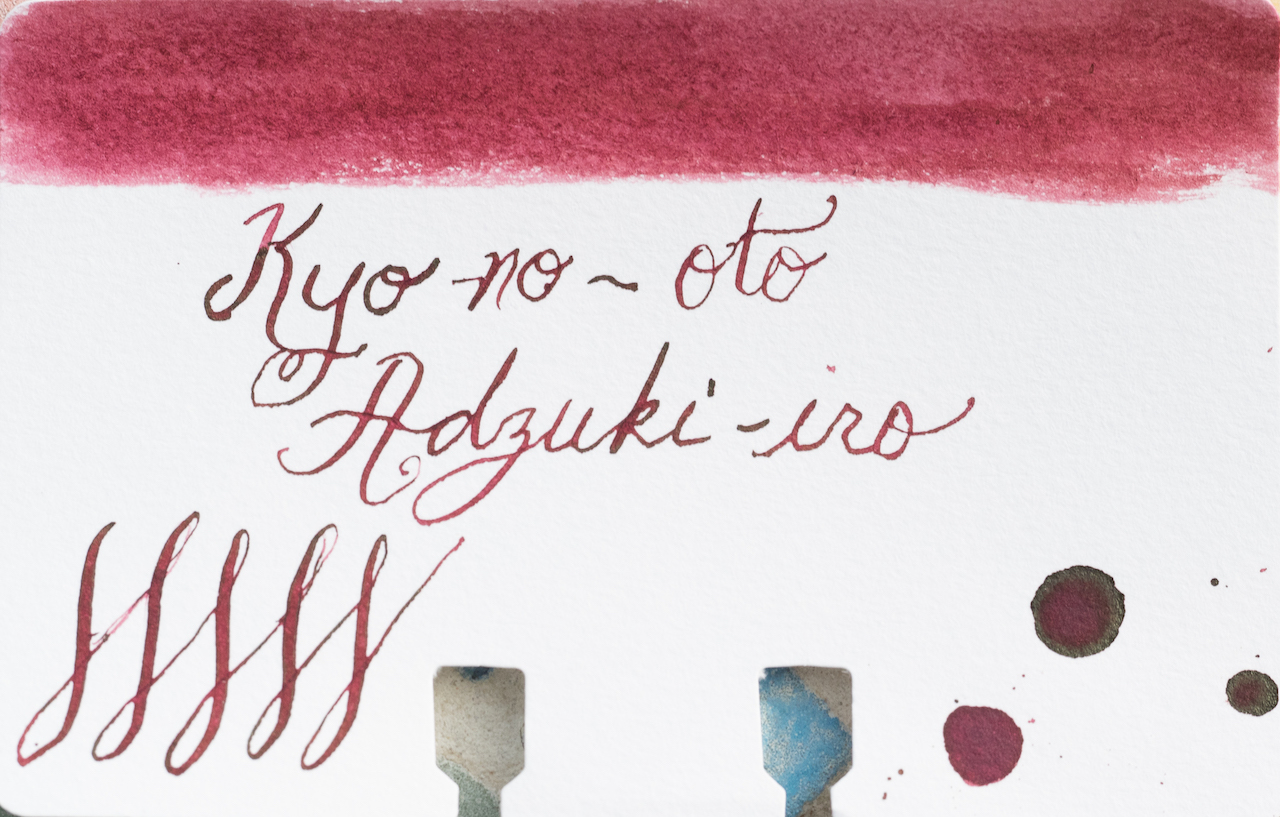
Adzuki-iro means “red beans.” It is a limited edition ink from the TAG Stationery Store in Kyoto, Japan. “Adzuki-iro” sounds more beautiful to my ear than “red beans,” and this color certainly lacks any brown tones that I would associate with red beans. The color is a gorgeous cabernet that reminds me of the deeper hues of cherry blossoms.

In my ink test, you can see how Adzuki-iro performs on Maruman Septcouleur paper. It has lots of saturation, especially when you layer it, and it dries fairly quickly. It is not water resistant.

I was fascinated by the chromatography test. The ink contains a wide array of colors: light blue, lavender, pink, red, and orange.

This complexity gives the ink much more depth and character than two similar inks, Kyo-Iro No. 5 Keage-Sakura and Robert Oster Cherry Blossom.

Although Adzuki-iro isn’t a super sheeny ink, it does exhibit a bit of green sheen when it pools.

The ink performs quite well in my TWSBI stub (I’ve been using it for several weeks), though the shading characteristics are much more noticeable in wider nibs.

I really love this ink. It is not as flashy as Iroshizuku Yama-Budo, which makes it much more versatile--it is dark enough in finer nibs that you could definitely use it at work and for correspondence. In wider nibs, its lovely burgundy-pink tones and shading make it a great choice for cards, art, and calligraphy.

You can purchase a 40ml bottle of Adzuki-iro from Vanness Pens for $28.00. You might want to hurry, though. Since this is a limited edition color that I am crazy about, I may wind up purchasing whatever Vanness has left in stock!

(Vanness Pens provided this product at no charge to The Pen Addict for review purposes.)


Enjoy reading The Pen Addict? Then consider becoming a member to receive additional weekly content, giveaways, and discounts in The Pen Addict shop. Plus, you support me and the site directly, for which I am very grateful.

Membership starts at just $5/month, with a discounted annual option available. To find out more about membership click here and join us!

Posted on February 15, 2019 and filed under Kyo-no-oto, Ink Reviews.