Posts filed under Pen Reviews

The Sheaffer Snorkel

(Ron Gilmour is a fountain pen enthusiast, would-be calligrapher, and librarian. You can find him online at Twitter @gilmour70 and Instagram.)

In the early 1950s, Sheaffer faced significant challenges on at least two fronts. First, there was the tremendous popularity of the Parker 51, with its sleek, modern design. Second, the ballpoint pen was making inroads, boasting ease of use with no messy dipping or filling.

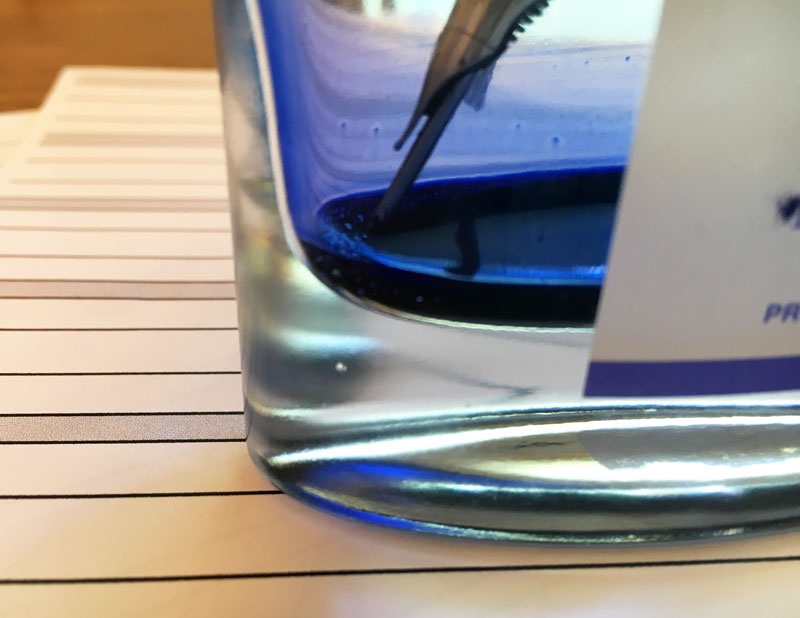
Sheaffer responded with the Snorkel. Its look was clearly influenced by the 51, but with some uniquely Sheaffer elements. Best of all, it could be filled without any mess thanks to a tube that extended from the feed to suck up ink. This meant that the nib need not be submerged to fill the pen.

Most modern fountain pen users are unlikely to be put off by the alleged messiness of filling a pen, but the Snorkel's eponymous tube is unbeatable for getting those last precious drops out of an ink bottle.
Buying a Snorkel

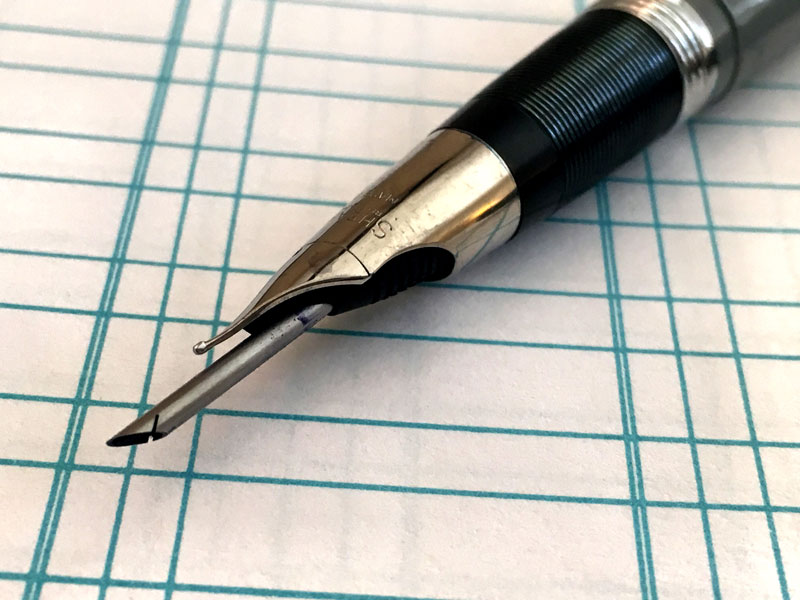
The Snorkel is such a uniformly great pen that your choices in selecting one will be largely aesthetic. Personally, I'm a fan of the tubular "Triumph"-style nib, but Snorkels are also available with conventional nibs.

The original color range was fairly subdued, but starting in the mid-1950s the palette expanded to include colors of Fiestaware-like vibrancy. There were all-metal models (these were rarer), and very attractive "Crest" and "Clipper" models with plastic bodies and metal caps. (See David Isaacson's article for explanations of the 13(!) model names used for the Snorkel.)

For a functional, but "nothing special," Snorkel, you can expect to pay roughly $70-150 US.

Filling

For a pen that boasts the most complex filling system in the history of fountain pens, the Snorkel is surprisingly easy to fill.

Unscrew the blind cap and pull back. This will expose the metal "Touchdown" tube that surrounds the ink sac, and will also cause the snorkel tube to extend. Put the end of the snorkel tube in the ink and push the blind cap back into position. As you tighten the blind cap, the snorkel tube will retract into the feed. You're ready to write.
Cleaning

In principle, cleaning a Snorkel isn't much different from any other sac-filling pen. Just draw water up into the sac and expel it. Repeat until the water comes out clean. In practice, this is easier than cleaning a lever-filling pen, since the Snorkel's filling mechanism can be operated more quickly.

In Closing

The Snorkel is a solid pen that will not disappoint. As with all vintage Sheaffers, the nibs are excellent, though generally very firm. The relatively low cost on the secondary market and the large number of models and colors makes the pen a nice option for a collection as well as a great user.

If you like the idea of the snorkel tube, but don't like the slim body of the Snorkel, you might look at the Sheaffer PFM, a later model that uses the same filling mechanism, but has a chunkier build and a beautiful inlaid nib.

Further Reading

Brian Gray's explanation of his pneumatic filling mechanism discusses how a similar filling mechanism works and includes a helpful video.

David Isaacson's Sheaffer Snorkel Collector's Guide helps to decipher the profusion of model names for the Snorkel.

Richard Binder's extensive profile page on the Snorkel is helpful for determining the age of your Snorkel and lists many of the colors.

Richard Binder's Anatomy of a Fountain Pen III: Sheaffer's Snorkel explains the complex internal workings of the filling mechanism, with detailed diagrams.
Posted on September 28, 2016 and filed under Sheaffer, Fountain Pens, Pen Reviews.

Derwent Graphik Paint Liner Review

(Sarah Read is an author, editor, yarn artist, and pen/paper/ink addict. You can find more about her at her website and on Twitter.)

When it comes to art supplies, Derwent is my personal favorite brand. I love their colored pencils, so I was super excited to test drive these Graphik Paint Liners. Past experiences with the brand set my expectations high, and I was overall pleased with this product.

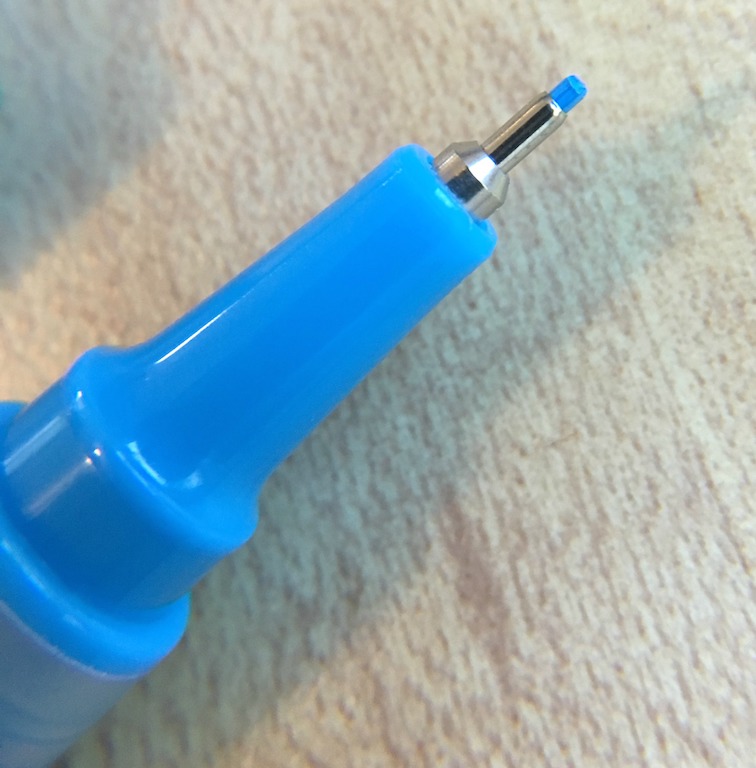
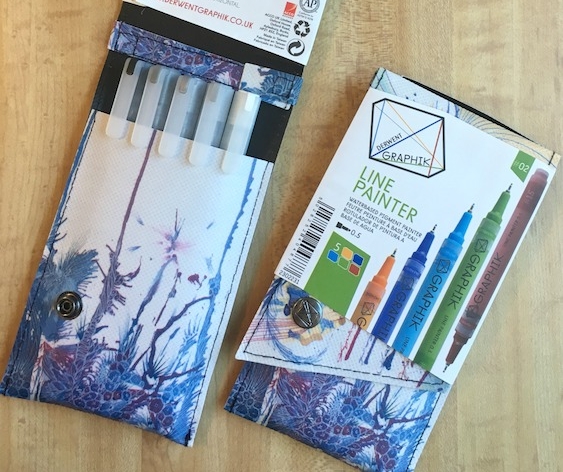
The pens have a nice aesthetic to them. They come in a handy reusable pouch that is printed with a color guide and instructions. The body design is attractive and practical--they are sturdy but lightweight, and the see-through plastic allows you to see what color you're reaching for and how much pigment is left. It's also super fun to watch the paint slosh around inside. The grip sections are a little short and narrow, which may make them uncomfortable to hold after a while. And holding the pens farther back on the body didn't work very well, as the tips have a very specific sweet spot that requires a more upright angle.

The tips are .5 mm--fine for a paint pen. But they lay down a very wet line, so the end result is closer to a Japanese broad nib, in fountain pen terms. There is no paint in the tips to begin with (probably to keep them from drying out and clogging while stored), and this is where the instructions come in. Those of you familiar with paint pens probably already know this, but I'm a novice, so I referred to the illustrations printed on the package. To prime the tip, you must compress it for two seconds, then release it and wait for the pigment to flow into the tip, which takes about five to six seconds. Don't--hypothetically speaking, for example--wonder why the paint doesn't come right away and maybe hold the tip down for a bit longer and then OMG that's a lot of paint all at once.

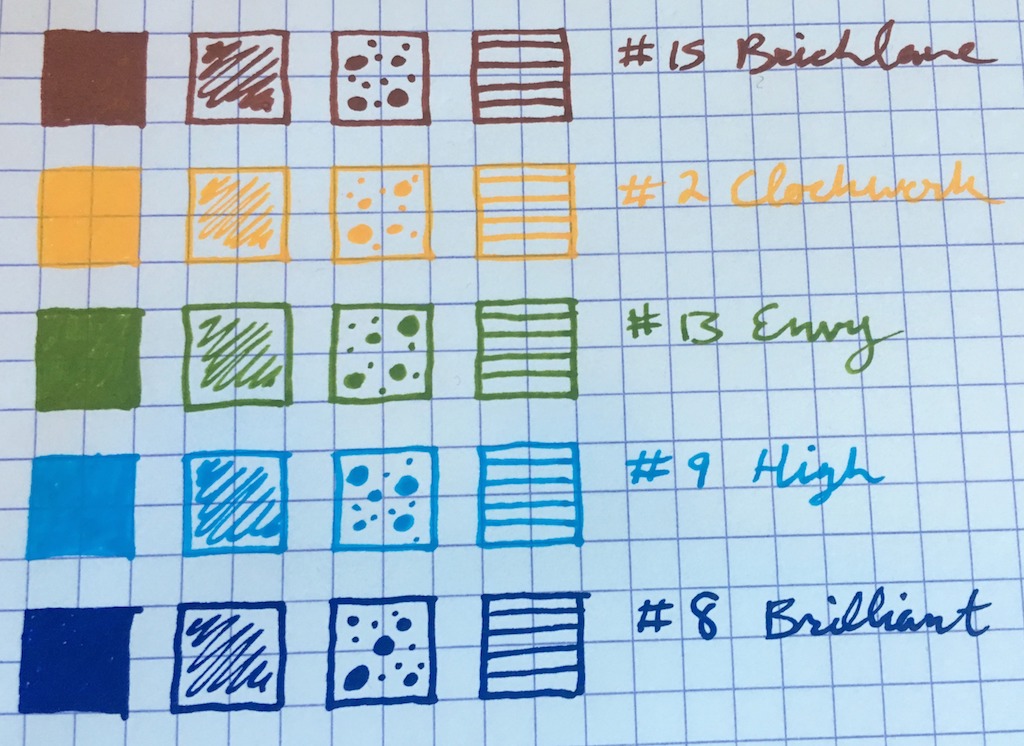
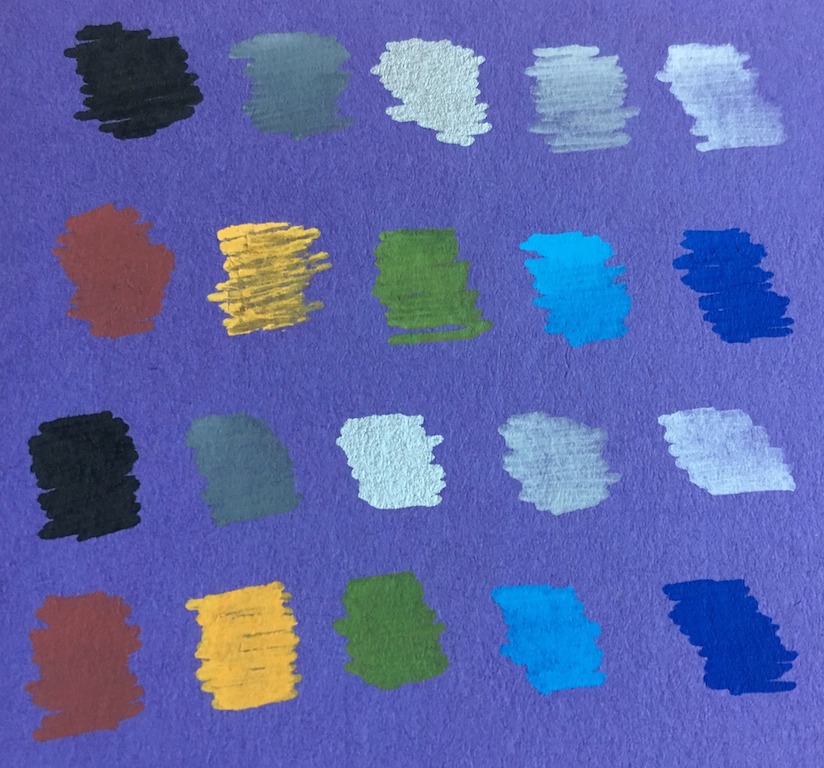
The pigment itself is very well-behaved. It doesn't run or drip or bleed. I was astonished to see that not even the puddle I put down for my review doodle showed through the Rhodia paper. As I filled in the solid square, I thought I'd regret not using a page protector and assumed I'd have to scrap the page behind my work. But I almost have to hold the paper up to the light to see a shadow of the Graphik pigment. I also tested them on a colorful piece of cardstock. Most (but not all) did well there. The "snow" color, for example, doesn't show at all on white paper and was weak and milky on colored paper. I suspect it may work best as a highlight on top of other layers of pigment. The metallic silver (#20, fox) creates an almost mirror-like effect on either paper.

After setting the pens aside for a few days, only the yellow (#2, clockwork) became problematically dried out and clogged. You can see in the colored paper swatches that it struggled a bit at first. I expect that, after longer naps, the pens may need a strong cup of tea before they can party. Or just to be cleaned up a bit and re-primed.

I can see these paint liners being used to make some awesome art. The bold colors and tonal greys make me think instantly of contemporary comics and modern graffiti-like portraits. If you dive in, be sure to share what you make--I'd love to see it!

(JetPens provided this product at no charge to The Pen Addict for review purposes.)


Enjoy reading The Pen Addict? Then consider becoming a member to receive additional weekly content, giveaways, and discounts in The Pen Addict shop. Plus, you support me and the site directly, which I am very grateful for.

Membership starts at just $5/month, with a discounted annual option available. To find out more about membership click here and join us!

Posted on September 22, 2016 and filed under Derwent, Paint Pen, Pen Reviews.

First Look: BN Works BNdot

BN Works is a new player on the pen manufacturing scene, and they recently sent me a prototype of their first design, the slick-looking BNdot.

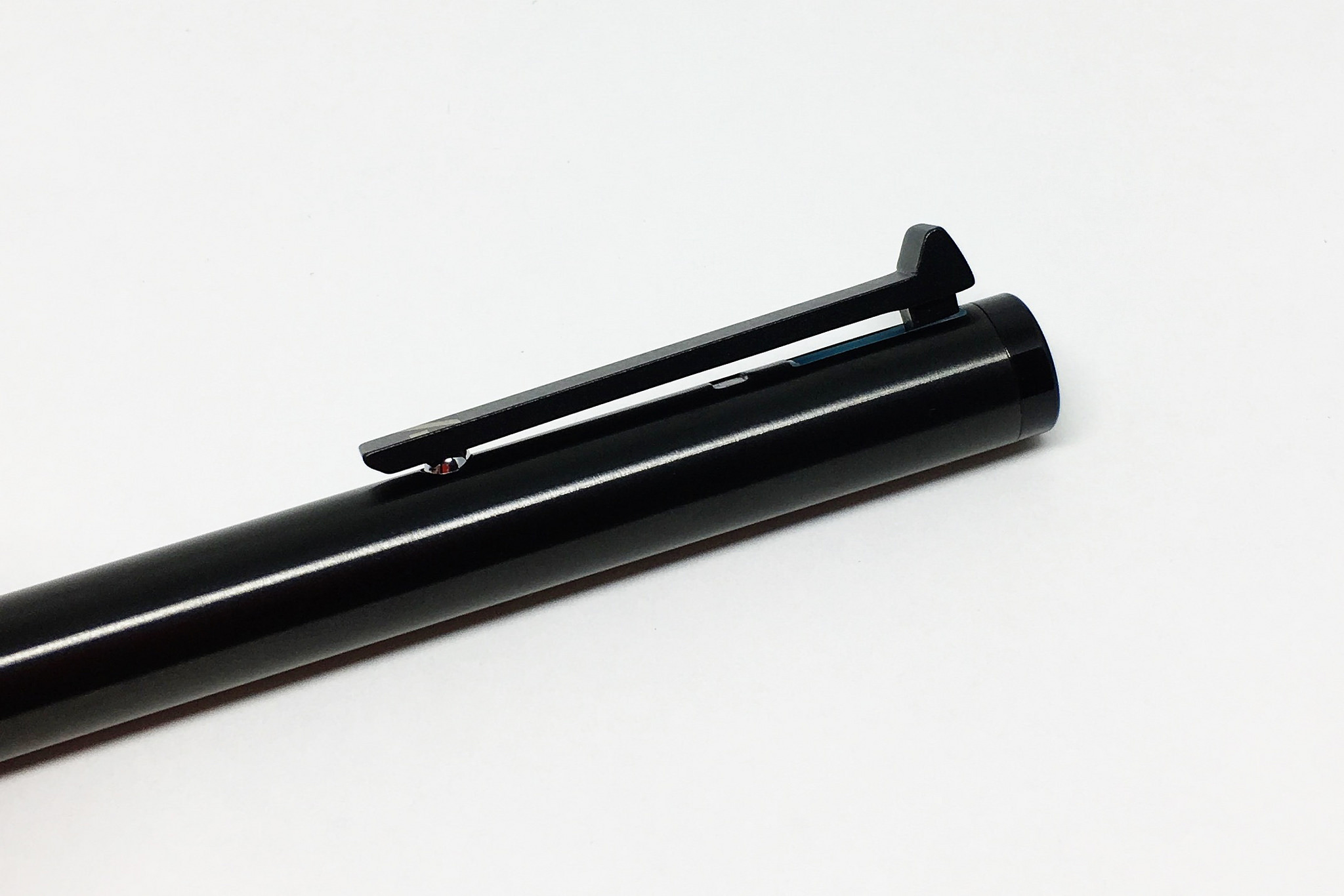
The industrial design and clean lines remind me a lot of Lamy, as does the refined feel of the pen. The 304 stainless steel barrel is smooth, and comes in three PVD coating options in Champagne, Gold, and Black, along with the standard Chrome.

What sets the BNdot apart is the clip design. It is rock-solid and works flawlessly as the refill deployment method. One press down to extend the tip, another press to snap it right back up into the barrel.

While using this prototype I noticed a bit of tip rattle from the Schmidt Easy Flow 900 ballpoint (this is a Parker compatible refill pen). I emailed Tony, the designer behind BN Works, and that tolerance has already been tightened for production to eliminate the rattle. Tony has been wonderful to work with since I have had this pen in fact.

For just $65 with free worldwide shipping, and even free custom engraving, the BNdot provides great value for those looking for a sleek, sturdy, well-designed Parker refill compatible pen. Look for the launch on Indiegogo tomorrow morning at 10:30 eastern.

My thanks to BN Works for sending me this pen at no charge for purposes of this review.


Enjoy reading The Pen Addict? Then consider becoming a member to receive additional weekly content, giveaways, and discounts in The Pen Addict shop. Plus, you support me and the site directly, which I am very grateful for.

Membership starts at just $5/month, with a discounted annual option available. To find out more about membership click here and join us!

Posted on September 19, 2016 and filed under BN Works, Pen Reviews.